
 100% FREE ACCESS
12th Standard Syllabus & Materials
12th Standard
TN 12th Computer Applications மின்னணு தரவு பரிமாற்றம் Sample Question Papers Study Material - QB365 Set A
NEW12th Standard
TN 12th Computer Applications மின் - வணிக பாதுகாப்பு அமைப்புகள் Sample Question Papers Study Material - QB365 Set A
NEW12th Standard
TN 12th Computer Applications மின்னணு செலுத்தல் முறைகள் Sample Question Papers Study Material - QB365 Set A
NEW12th Standard
TN 12th Computer Applications மின் - வணிகம் Sample Question Papers Study Material - QB365 Set A
NEW12th Standard
TN 12th Computer Applications திறந்த மூல கருத்துருக்கள் Sample Question Papers Study Material - QB365 Set A
NEW12th Standard
TN 12th Computer Applications வலையமைப்பு வடமிடல் Sample Question Papers Study Material - QB365 Set A

Published on: 03/09/2020
12th Standard Maths English Medium Important 3 Mark Book Back Questions (New Syllabus) 2020
Download Tamil Nadu 12th Standard Maths question papers, model tests, one-mark questions, important questions, and public exam papers in PDF format. Free study materials and answer keys for TN State Board students.
Questions + Answers key
Take MCQ Maths Test1.
Consider p→q : If today is Monday, then 4 + 4 = 8.
2.
A firm produces two types of calculators each week, x number of type A and y number of type B. The weekly revenue and cost functions (in rupees) are R(x, y) = 80x + 90y + 0.04xy − 0.05x2 − 0.05y2 and C(x, y) = 8x + 6y + 2000 respectively
(i) Find the profit function P(x, y)
(ii) Find \(\frac { { \partial P } }{ \partial { x } } \) (1200, 1800) and \(\frac { \partial v }{ \partial y} \) (1200, 1800)
3.
Show that \(\int ^\frac{2\pi}{0}_{0}\) g(cos x)dx = 2 \(\int ^{\pi}_{0}\) g(cosx)dx where g(cos x) is a function of cos x
4.
If α and β are the roots of the quadratic equation 2x2−7x+13 = 0 , construct a quadratic equation whose roots are α2 and β2.
5.
Prove that q ➝ p ≡ ¬p ➝ ¬q
6.
If X is the random variable with distribution function F(x) given by,
\(F(x)=\begin{cases} \begin{matrix} 0 & x<0 \end{matrix} \\ \begin{matrix} x & 0\le x<1 \end{matrix} \\ \begin{matrix} 1 & 1\le x \end{matrix} \end{cases}\)
then find
(i) the probability density function f(x)
(ii) P(0.2 ≤ X ≤ 0.7)
7.
8.
Evaluate: \(\int _{ 0 }^{ 2\pi }{ { x }^{ 2 }sin\ nx\ dx } \) where n is a positive integer.
9.
A coat of paint of thickness 0.2 cm is applied to the faces of a cube whose edge is 10 cm. Use the differentials to find approximately how many cubic centimeters of paint is used to paint this cube. Also calculate the exact amount of paint used to paint this cube.
10.
The radius of a circular plate is measured as 12.65 cm instead of the actual length 12.5 cm. find the following in calculating the area of the circular plate:
Absolute error
11.
Evaluate the following limit, if necessary use l ’Hôpital Rule
\(\underset { x\rightarrow { 1 }^{ + } }{ lim } \left( \frac { 2 }{ { x }^{ 2 }-1 } -\frac { x }{ x-1 } \right) \)
12.
A race car driver is racing at 20th km. If his speed never exceeds 150 km/hr, what is the maximum kilometer he can reach in the next two hours.
13.
Find the absolute extrema of the following functions on the given closed interval.
\(f(x)=6x^{ \frac { 3 }{ 4 } }-3x^{ \frac { 1 }{ 3 } };\left[ -1,1 \right] \)
14.
Solve \({ y }^{ 2 }+{ x }^{ 2 }\frac { dy }{ dx } =xy\frac { dy }{ dx } \)
15.
Show that y = a cos(log x) + bsin (log x), x > 0 is a solution of the differential equation x2 y" + xy'+y = 0.
16.
If the mass m(x) (in kilograms) of a thin rod of length x (in metres) is given by, m(x) = \(\sqrt { 3 } x\) then what is the rate of change of mass with respect to the length when it is x = 3 and x = 27 metres.
17.
Find the value of
\(cos\left( { sin }^{ -1 }\left( \frac { 4 }{ 5 } \right) -{ tan }^{ -1 }\left( \frac { 3 }{ 4 } \right) \right) \)
18.
If z1 = 3, z2 = -7i, and z3 = 5 + 4i, show that (z1 + z2)z3 = z1z3 + z2 + z3
19.
Find the equation of the plane which passes through the point (3, 4, -1) and is parallel to the plane 2x - 3y + 5z = 0. Also, find the distance between the two planes.
20.
If the straight lines \(\frac { x-5 }{ 5m+2 } =\frac { 2-y }{ 5 } =\frac { 1-z }{ -1 } \) and \(x=\frac { 2y+1 }{ 4m } =\frac { 1-z }{ -3 } \) are perpendicular to each other, find the value of m.
21.
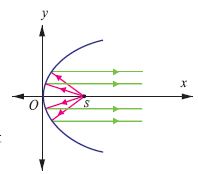
A search light has a parabolic reflector (has a cross-section that forms a ‘bowl’). The parabolic bowl is 40 cm wide from rim to rim and 30 cm deep. The bulb is located at the focus.
(1) What is the equation of the parabola used for reflector?
(2) How far from the vertex is the bulb to be placed so that the maximum distance covered?
22.
Find the equation of the hyperbola in each of the cases given below:
passing through (5, −2) and length of the transverse axis along x axis and of length 8 units.
23.
If \(\frac { 1+z }{ 1-z } =cos2\theta +isin2\theta \), show that z = i tan\(\theta\)
24.
Prove by vector method that the diagonals of a rhombus bisect each other at right angles.
25.
Find the rank of the matrix \(\left[ \begin{matrix} 2 \\ \begin{matrix} -3 \\ 6 \end{matrix} \end{matrix}\begin{matrix} -2 \\ \begin{matrix} 4 \\ 2 \end{matrix} \end{matrix}\begin{matrix} 4 \\ \begin{matrix} -2 \\ -1 \end{matrix} \end{matrix}\begin{matrix} 3 \\ \begin{matrix} -1 \\ 7 \end{matrix} \end{matrix} \right] \) by reducing it to an echelon form.
26.
Find the value of tan−1(−1 ) + cos-1\((\frac{1}{2})+sin^-1(-\frac{1}{2})\)
27.
If A = \(\left[ \begin{matrix} 8 & -4 \\ -5 & 3 \end{matrix} \right] \), verify that A(adj A) = (adj A)A = |A|I2.
28.
With usual notations, in any triangle ABC, prove the following by vector method.
(i) a = b cos C + c cos B
(ii) b = c cos A + a cos C
(iii) c = a cos B + b cos A
29.
Find the values of the real numbers x and y, if the complex numbers (3−i)x−(2−i)y+2i +5 and 2x+(−1+2i)y+3+ 2i are equal.
30.
Find the equation of the circle described on the chord 3x + y + 5 = 0 of the circle x2 + y2 = 16 as diameter.
31.
Find the volume of the solid formed by revolving the region bounded by the ellipse \(\frac { { x }^{ 2 } }{ { a }^{ 2 } } +\frac { { y }^{ 2 } }{ { b }^{ 2 } } =1\), a>b about the major axis.
32.
Suppose a discrete random variable can only take the values 0, 1, and 2. The probability mass function is defined by
\(\\ \\ \\ \\ \\ f(x)=\begin{cases} \begin{matrix} \frac { { x }^{ 2 }+1 }{ k } & forx=0,1,2 \end{matrix} \\ \begin{matrix} 0 & otherwise \end{matrix} \end{cases}\\ \\ \\ \\ \\ \\ \)
Find
(i) the value of k
(ii) cumulative distribution function
(iii) P(X ≥ 1).
33.
For any four vectors \(\vec { a } ,\vec { b } ,\vec { c } ,\vec { d } \) we have \((\vec { a } \times \vec { b } )\times (\vec { c } \times \vec { d } )=[\vec { a } ,\vec { b } ,\vec { d } ]\vec { c } -[\vec { a } ,\vec { b } ,\vec { c } ]\vec { d } =[\vec { a } ,\vec { c } ,\vec { d } ]\vec { b } -[\vec { b } ,\vec { c } ,\vec { d } ]\vec { a } \)
34.
Solve the following system of linear equations, by Gaussian elimination method : 4x + 3y + 6z = 25, x + 5y + 7z = 13, 2x + 9y + z = 1.
35.
Find the roots of 2x3 + 3x2 + 2x + 3 = 0
1.
Here the component statements p and q are given by,
p: Today is Monday; q: 4 + 4 = 8.
The truth value of p→q is T because the conclusion q is T.
An important point is that p→q should not be treated by actually considering the meanings of p and q in English. Also it is not necessary that p should be related to q at all.
2.
Given R (x, y) = 80 x + 90 y + 0.04xy - 0.05 x2 + 0.05 y2 and
(x,y) = 8x + 6y + 2000
Profit function P (x,y) = Revenue - cost
P (x,y) = R (x,y) - C (x,y)
= -80 x + 90 y + 0.04xy - 0.05 x2 - 0.05y2 - 8x - 6y - 2000
P (x, y) = 72x + 84y + 0.04 xy - 0.05 x2 - 0.05y2 - 2000
(ii) \(\frac { { \partial P } }{ \partial { x } } \) = 72 + 0 + 0.04y - 0.05(2x) - 0 - 0
= 72 + 0.04y- 0.1x
∴ \(\frac { { \partial P } }{ \partial { x } } \) (1200, (1800)
= 72+ 0.04 (1800) - 0.1(1200)
= 72 + 72 - 120 = 24 .......(1)
\(\frac { \partial v }{ \partial y} \) = 0 + 84+ 0.4x-0-0.5(2y) - 0
= 84 + 0.04x - 0.1y
= 84 + 0.04 (1200) - 0.1(1800)
∴ \(\frac { \partial v }{ \partial y} \)(1200,1800) = 84 + 48 - 180 = - 48 .......(2)
From (1) and (2), keeping y constant and 4 increasing x then increases profit.
3.
Take 2a = 2\(\pi\) and f(x) = g(cosx)
Then, f (2a−x) = f(2\(\pi\)-x) = g(cos(2\(\pi\)-x)) = g(cos x) = f(x)
\(\therefore \int _{ 0 }^{ 2a }{ f(x)dx=2 } \int _{ 0 }^{ a }{ f(x)dx } \)
\(\therefore \int _{ 0 }^{ 2\pi }{ g(cosx)dx=2\int _{ 0 }^{ \pi }{ g(cosx)dx } } \)
4.
Since α and β are the roots of the quadratic equation, we have α + β =\(\frac { 7 }{ 2 } \) and αβ = \(\frac { 13 }{ 2 } \).
Thus, to construct a new quadratic equation,
Sum of the roots = α2+β2 = (α+β)2-2αβ =\(\frac { -3 }{ 4 } \)
Product of the roots = α2β2 = (αβ)2 = \(\frac { 169 }{ 4 }\)
Thus a required quadratic equation is x2+\(\frac { 3 }{ 4 } x+\frac { 169 }{ 4 } \)= 0.
From this we see that 4x2+3x+169 = 0 is a quadratic equation with roots α2 and β2.
5.
| p | q | q ➝ p | ~p | ~q | ~q ➝ ~p |
| T | T | T | F | F | T |
| T | F | T | F | T | T |
| F | T | F | T | F | F |
| F | F | T | T | T | T |
The entries in the columns corresponding q ➝ p and ~p ➝ ~q are identical and hence they are equivalent.
q ➝ p ≡ ~p ➝ ~q
Hence proved
6.
(i) Differentiating F(x) with respect to x at continuity points of f(x), we get
\(f(x)={ F }^{ 1 }(x)=\begin{cases} \begin{matrix} 0 & x<0 \end{matrix} \\ \begin{matrix} 1 & 0\le x<1 \end{matrix} \\ \begin{matrix} 0 & x\ge 1 \end{matrix} \end{cases}\)
The pdf f(x) is not continuous at x = 0, or at x = 1. We can define f(0) and f(1) in any manner. Choosing f(0) = 1, and f(1) = 0 .
Therefore the probability density function f(x) is
\(f(x)=\begin{cases} \begin{matrix} 1 & 0\le x<1 \end{matrix} \\ \begin{matrix} 0 & otherwise \end{matrix} \end{cases}\)
(ii) P(0.2 ≤ X ≤ 0.7) = F(0.7) − F(0.2)
= 0.7-0.2 = 0.5
\(P(0.2\le X\le 0.7)=\int _{ 0.2 }^{ 0.7 }{ f(x) } dx=\int _{ 0.2 }^{ 0.7 }{ 1dx } =0.5\)
7.
8.
Taking u = x2 and v = sin nx, and applying the Bernoulli’s formula, we get
\(I=\int _{ 0 }^{ 2\pi }{ { x }^{ 2 } } sin\quad nx\quad dx={ \left[ \left( { x }^{ 2 } \right) \left( -\frac { cos\quad nx }{ n } \right) -(2x)\left( -\frac { sin\quad nx }{ { n }^{ 2 } } \right) +(2)\left( \frac { cos\quad nx }{ { n }^{ 3 } } \right) \right] }_{ 0 }^{ 2x }\)
\(=\left[ (4{ \pi }^{ 2 })\left( -\frac { 1 }{ n } \right) -0+(2)\left( \frac { 1 }{ { n }^{ 3 } } \right) \right] -\left[ 0-0+(2)\left( \frac { 1 }{ { n }^{ 3 } } \right) \right] \) since cos 2n\(\pi\) = 1 and sin 2n \(\pi\) = 0
\(=-\frac { 4{ \pi }^{ 2 } }{ n } +\frac { 2 }{ { n }^{ 3 } } -\frac { 2 }{ { n }^{ 3 } } =\frac { { 4\pi }^{ 2 } }{ n } \)
9.
Given a = edge of the circle
= 10 cm and da
= 0.2 cm
Volume of cube = a3
Approximate amount of cubic centimeters of paint is used to paint this cube = 3a2 da
= 3(102)(0.2)
= 300 \(\left( \frac { 2 }{ 10 } \right) \) = 60 cm3
Exact amount of paint used = f(x + ∆x) - f(x)
= f(10.2) - f(10)
= 10.23 -103
= 1061.208 - 1000
= 61.208 cm2
10.
Actual radius of the circular plate = 12.5 cm
Measured radius of the circular plate = 12.65
dr = 12.65-12.5
= 0.15
\( \mathrm{A} =\pi \mathrm{r}^{2} \\ \mathrm{dA} =2 \pi \mathrm{rdv} \)
Change in Area
A(12.65)-A(12.5) = dA
\( =2 \pi \times 12.5 \times 0.15 \)
\(=3.75 \pi \)
Absolute error = 3.7725\(\pi\) - 3.75\(\pi\)
:0.0225\(\pi\) cm2
11.
\(\underset { x\rightarrow { 1 }^{ + } }{ lim } \left( \frac { 2 }{ { x }^{ 2 }-1 } -\frac { x }{ x-1 } \right) =\underset { x\rightarrow { 1 }^{ + } }{ lim } \left( \frac { 2-x(x+1) }{ { x }^{ 2 }-1 } \right) \)
\(\underset { x\rightarrow { 1 }^{ + } }{ lim } \left( \frac { 2-{ x }^{ 2 }-x }{ { x }^{ 2 }-1 } \right) =\frac { 0 }{ 0 } \)
Form which is indeterminate,
Applying L' Hopital rule we get,
\(\underset { x\rightarrow { 1 }^{ + } }{ lim } \left( \frac { 2-{ x }^{ 2 }-x }{ { x }^{ 2 }-1 } \right) =\frac { 0 }{ 0 } =\frac { -2-1 }{ 2(1) } =\frac { -3 }{ 2 } \)
12.
Let f (t) represents the distance covered at 't' hour.
Given f(0) = 20 and f(2) = ?
Also speed = f' (t) ≥ 150
The distance function is continuous as well as differentiable.
By Lagrange's mean value theorem, there exists c such that
⇒ f'(c) = \(\frac { f(b)-f(a) }{ b-a } \)
⇒ f'(c) = \(\frac{f(2)-20}{2-0}\) ≥ 150 [Man speed is 150 km/hr and f' (c) represents speed]
⇒ \(\frac{f(2)-20}{2-0}\) ≥ 150
⇒ f(2) - 20 ≥ 300
⇒ f(2) ≥ 320
Hence, in the next two hours he can cover 320km.
13.
\(f'\left( x \right) =6\times \frac { 4 }{ 3 } { x }^{ \frac { 4 }{ 3 } -1 }-3\times \frac { 1 }{ 3 } { x }^{ \frac { 1 }{ 3 } -1 }\)
= \({ 8x }^{ \frac { 1 }{ 3 } }-x^{ \frac { -2 }{ 3 } }\)
f'(x) = 0
\(\Rightarrow{ 8 }x^{ \frac { 1 }{ 3 } }-\frac { 1 }{ { x }^{ \frac { 2 }{ 3 } } } =0\)
\(\Rightarrow \frac { 8x-1 }{ { x }^{ \frac { 2 }{ 3 } } } =0\)
\(\Rightarrow x=\frac { 1 }{ 8 } \)
Thus, the critical number is \(x=\frac { 1 }{ 8 } \)
Evaluating f(x) at the end points = -1
x = 1 and at the critical number x = \(\frac { 1 }{ 8 } \)
we get
\(f(-1)=6(-1)^{ \frac { 4 }{ 3 } }-3\left( -1 \right) ^{ \frac { 1 }{ 3 } }\)
= 6( 1) - 3 (-1) = 6 + 3 = 9
\(f(1)=6(1)^{ \frac { 4 }{ 3 } }-3(1)^{ \frac { 1 }{ 3 } }=6-3=3\)
\(f\left( \frac { 1 }{ 8 } \right) =6\left( \frac { 1 }{ 8 } \right) ^{ \frac { 4 }{ 3 } }-3\left( \frac { 1 }{ 8 } \right) ^{ \frac { 1 }{ 3 } }\)
=\(6\left( { 2 }^{ -3 } \right) ^{ \frac { 4 }{ 3 } }-3\left( 2^{ -3 } \right) ^{ \frac { 1 }{ 3 } }\)
= \(\frac { 6 }{ 16 } -\frac { 3 }{ 2 } =\frac { 3 }{ 8 } -\frac { 3 }{ 2 } \)
= \(\frac { 3-12 }{ 8 } =\frac { -9 }{ 8 } \)
From these values, the absolute maximum is 9 which occurs at x = -1 and the absolute minimum is \(-\frac { 9 }{ 8 } \) which occurs at x = \(\frac { 1 }{ 8 } \)
14.
The given equation is rewritten as \(\frac { dy }{ dx } =\frac { { y }^{ 2 } }{ xy-{ x }^{ 2 } } \)
This is a homogeneous differential equation
Put y = vx . Then, we have \(x\frac { dv }{ dx } =\frac { v }{ v-1 } \)
By separating the variables, \(\frac { v-1 }{ v } dv=\frac { dx }{ x } .\)
Integrating, we obtain v − log |v| = log |x| + log |C| or v = log |vxC|.
Replacing v by \(\frac{y}{x}\), we get, \(\frac{y}{x}\) = log |Cy| = ey/x or y = key/x (how!) which is the required solution.
15.
The given function is y = a cos(log x) + bsin (log x) ...(1)
where a, b are two arbitrary constants. In order to eliminate the two arbitrary constants, we have to differentiate the given function two times successively
Differentiating equation (1) with respect to x , we get
y' = -a sin (log x).\(\frac{1}{x}\)+ b cos (log x).\(\frac{1}{x}\Rightarrow\)xy' = -a sin(log x)+b cos (log x).
Again differentiating this with respect to x, we get
xy" + y' = -a cos(log x).\(\frac{1}{x}-b\) sin (log x).\(\frac{1}{x}\Rightarrow\)x2y" + xy'+ y = 0
Therefore, y = a cos(log x) + bsin (log x) is a solution of the given differential equation.
16.
Given m (x) = \(\sqrt { 3 } x\) = \(\sqrt { 3 } .{ x }^{ \frac { 1 }{ 2 } }\)
Differentiating with respect to 'x' we get,
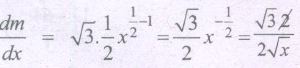
when x = 3, \(\frac { dm }{ dx } =\frac { \sqrt { 3 } }{ 2\sqrt { 3 } } =\frac { 1 }{ 2 } \) Kg/m
when x = 27, \(\frac { dm }{ dx } =\frac { \sqrt { 3 } }{ 2\sqrt { 27 } } \)
\(=\frac{\sqrt{\not 3}}{2(3) \sqrt{\not 3}}=\frac{1}{6} \mathrm{Kg} / \mathrm{m}\)
17.
\(cos\left( { sin }^{ -1 }\left( \frac { 4 }{ 5 } \right) -{ tan }^{ -1 }\left( \frac { 3 }{ 4 } \right) \right) \)
\(\Rightarrow \frac { 4 }{ 5 } =sinx\)
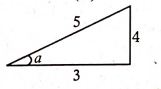
\(\therefore cosx=\frac { adj }{ hyp } =\frac { 3 }{ 5 } \)
Let \({ tan }^{ -1 }\left( \frac { 3 }{ 4 } \right) =y\)
\(\Rightarrow tany=\frac { 3 }{ 4 } \)
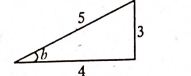
\(\Rightarrow siny=\frac { opp }{ hyp } =\frac { 3 }{ 5 } \ cosy=\frac { adj }{ hup } =\frac { 4 }{ 5 } \)
\(\therefore cos\left( { sin }^{ -1 }\left( \frac { 4 }{ 5 } \right) \right) -{ tan }^{ -1 }\left( \frac { 3 }{ 4 } \right) \)
= cos (x - y) = cos x cos y + sin x sin y
= \(\frac { 3 }{ 5 } .\frac { 4 }{ 5 } +\frac { 4 }{ 5 } .\frac { 3 }{ 5 } \)
= \(\frac { 12 }{ 25 } +\frac { 12 }{ 25 } =\frac { 24 }{ 25 } \)
= \(\frac { 24 }{ 25 } \)
18.
(z1 + z2)z3 = z1z3 + z2 + z3
LHS = (z1 + z2)z3
= (3-7i)(5 + 4i)
15+12i-35i-28i2
= 15-23i + 28
= 43 - 23i
RHS = z1z3 + z2z3
3(5+4i)+(-7i)(5+4i)
= 15+12i -35i -28i2
= 15-23i + 28
= 43 - 23i
LHS = RHS
∴ (z1+z2)z3 = z1z3 + z2z3
19.
Equation of the given plane is 2x - 3y + 5z +7 = 0
Equation of the plane parallel to the given plane
is 2x - 3y + 5z + k = 0 ..(1)
Since this plane passes through the point (3, 4, -1). we get
2(3) - 3(4) + 5(-1) + k = 0
\(\Rightarrow\) 6 - 12 - 5 + k = 0
\(\Rightarrow\) 11 +k = 0
k = 11
\(\therefore\) (1) becomes, 2x - 3y + 5z + 11 = 0 which is the equation of the required plane. Distance between two parallel planes.
= \(\frac { \left| { d }_{ 1 }-{ d }_{ 2 } \right| }{ \sqrt { { a }^{ 2 }+{ b }^{ 2 }+{ c }^{ 2 } } } \)
\(d=\frac { \left| 7-11 \right| }{ \sqrt { { 2 }^{ 2 }+\left( -3 \right) ^{ 2 }+{ 5 }^{ 2 } } } \)
= \(\cfrac { \left| -4 \right| }{ \sqrt { 4+9+25 } } \)
= \(\cfrac { 4 }{ \sqrt { 38 } } \) units.
20.
Given lines are \(\frac { x-5 }{ 5m+2 } =\frac { 2-y }{ 5 } =\frac { 1-z }{ -1 } \)
⇒ \(\frac { x-5 }{ 5m+2 } =\frac { y-2 }{ -5 } =\frac { z-1 }{ 1 } \)
∴ \(\vec { b } =(5m+2)\hat { i } -5\hat { j } +\hat { k } \) ...(1)
and x = \(\frac { 2y+1 }{ 4m } =\frac { 1-z }{ -3 } \)
⇒ \(\frac { x }{ 1 } =\frac { y+\frac { 1 }{ z } }{ 2m } =\frac { z-1 }{ 3 } \)
∴ \(\vec { d } =\hat { i } +2m\hat { j } +3\hat { k } \) ...(2)
since \(\vec { b } \bot \vec { d } \Rightarrow \vec { b } .\vec { d } \)= 0
⇒ \((\hat { i } +2m\hat { j } +3\hat { k } ).((5m+2)\hat { i } -5\hat { j } +\hat { k } )=0\)
⇒ (5m+2)1+2m(-5)+3(1) = 0
⇒ 5m+2-10m+3 = 0
⇒ 5-5m = 0
⇒ 5 = 5m
∴ m = 1
21.
Let the vertex be (0, 0) .
The equation of the parabola is
y2 = 4ax
(1) Since the diameter is 40cm and the depth is 30 cm , the point (30, 20) lies on the parabola.
202 = 4a × 30
4a = \(\frac { 400 }{ 30 } \) = \(\frac { 40 }{ 3 } \)
Equation is y2 = \(\frac { 40 }{ 3 } \)x.
(2) The bulb is at focus (0, a).
Hence the bulb is at a distance of \(\frac { 10 }{ 3 } \)cm from the vertex.
22.
Passing through (5, -2) length of the transverse axis is a long x-axis and of length 8 units.
2a = 8 ⇒ a = 4
Since the transverse axis is along x-axis, centre is (0, 0)
Equation of the hyperbola is
\(\frac { { x }^{ 2 } }{ 16 } -\frac { { y }^{ 2 } }{ b^{ 2 } } =1\)
Since (5, -2)passes through the parabola,
\(\frac { 25 }{ 16 } -\frac { 4 }{ { b }^{ 2 } } \Rightarrow \frac { 4 }{ { b }^{ 2 } } =\frac { 25 }{ 16 } -1=\frac { 25-16 }{ 16 } =\frac { 9 }{ 16 } \)
∴ \({ b }^{ 2 }=\frac { 16\times 4 }{ 9 } =\frac { 64 }{ 9 } \)
∴ Equation of the hyperbola is
\(\frac { { x }^{ 2 } }{ 16 } -\frac { { y }^{ 2 } }{ \frac { 64 }{ 9 } } =1\Rightarrow \frac { { x }^{ 2 } }{ 16 } -\frac { 9{ y }^{ 2 } }{ 64 } =1\)
23.
Let z = x + iy
Then \(\frac { 1+z }{ 1-z } \) = cos2θ + i sin 2θ
⇒ \(\frac { 1+x+iy }{ 1-x-iy } \) = cos 2θ + i sin 2θ ....(1)
Taking modulus,
\(\left| \frac { 1+x+iy }{ 1-x-iy } \right| \) = |cos 2θ+i sin 2θ| ⇒ \(\frac { |1+x+iy| }{ |1-x-iy| } \)
=\(\sqrt { cos^{ 2 }2\theta +sin^{ 2 }2\theta } \) = 1
⇒ |1 + x + iy| = |1 - x - iy|
⇒ \(\sqrt { (1+x)^{ 2 }+{ y }^{ 2 } } =\sqrt { (1+x)^{ 2 }+{ y }^{ 2 } } \)
⇒ (1 + x)2+ y2 = (1-x)2+ y2

⇒ 4x = 0 ⇒ x = 0
From (1) \(\frac { (1+x)+iy }{ (1-x)-iy } \times \frac { (1-x)+iy }{ (1-x)+iy } \)
= cos2θ + isin 2θ
Choosing the imaginary part alone we get,
\(\frac { y(1+x)+y(1-x) }{ (1-x)^{ 2 }+{ y }^{ 2 } } \)= sin 2θ
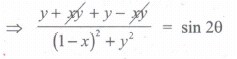
\(\frac { 2y }{ 1+y^{ 2 } } \) = sin 2θ
⇒ \(\frac { 2tan\theta }{ 1+tan^{ 2 }\theta } \) = sin 2θ
∴ y must be equal to tan θ
⇒ y = tan θ
z = x+ iy
∴ z = 0 + i tan θ
⇒ z = tan θ
24.
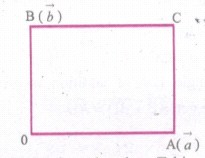
Let OACB be a rhombus. Taking O as the origin, let the position vectors of A and B be \(\vec { a } \) and \(\vec { b } \) respectively.
Then \(\vec { OA } =\vec { a } \) and \(\vec { OB } =\vec { b } \) [∵ \(\vec { AC } =\vec { OB } \)]
So, the p.v. of C is \(\vec { a } +\vec { b } \)
∴ Position vector O f the miid-point of OC is \(\frac { \vec { a } +\vec { b } }{ 2 } \)
Similarly, the position vector of mid-point of AB is \(\frac { \vec { a } +\vec { b } }{ 2 } \).
Hence, the mid-point of OC coincides with the mid-point of AB.
Now, \(\vec { OC } .\vec { AB } =(\vec { a } +\vec { b } ).(\vec { b } -\vec { a } )=|\vec { b } |^{ 2 }-|\vec { a } |^{ 2 }\)
= OB2- OA2 = 0 [∵ OB = OA]
⇒ \(\vec { OC } \bot \vec { AB } \).
Hence, the diagonals of a rhombus bisect each other at right angles.
25.
Let A be the matrix. Performing elementary row operations, we get
A = \(\left[ \begin{matrix} 2 \\ \begin{matrix} -3 \\ 6 \end{matrix} \end{matrix}\begin{matrix} -2 \\ \begin{matrix} 4 \\ 2 \end{matrix} \end{matrix}\begin{matrix} 4 \\ \begin{matrix} -2 \\ -1 \end{matrix} \end{matrix}\begin{matrix} 3 \\ \begin{matrix} -1 \\ 7 \end{matrix} \end{matrix} \right] \)\(\overset { { R }_{ 2 }\longrightarrow 2{ R }_{ 2 } }{ \longrightarrow } \left[ \begin{matrix} 2 \\ \begin{matrix} -6 \\ 6 \end{matrix} \end{matrix}\begin{matrix} -2 \\ \begin{matrix} 8 \\ 2 \end{matrix} \end{matrix}\begin{matrix} 4 \\ \begin{matrix} -4 \\ -1 \end{matrix} \end{matrix}\begin{matrix} 3 \\ \begin{matrix} -2 \\ 7 \end{matrix} \end{matrix} \right] \overset { \begin{matrix} { R }_{ 2 }\longrightarrow { R }_{ 2 }+3{ R }_{ 1 } \\ { R }_{ 3 }\longrightarrow { R }_{ 3 }-3{ R }_{ 1 } \end{matrix} }{ \longrightarrow } \left[ \begin{matrix} 2 \\ \begin{matrix} 0 \\ 0 \end{matrix} \end{matrix}\begin{matrix} -2 \\ \begin{matrix} 2 \\ 8 \end{matrix} \end{matrix}\begin{matrix} 4 \\ \begin{matrix} 8 \\ -13 \end{matrix} \end{matrix}\begin{matrix} 3 \\ \begin{matrix} 7 \\ -2 \end{matrix} \end{matrix} \right] \).
\(\overset { { R }_{ 3 }\longrightarrow { R }_{ 3 }-4{ R }_{ 2 } }{ \longrightarrow } \left[ \begin{matrix} 2 \\ \begin{matrix} 0 \\ 0 \end{matrix} \end{matrix}\begin{matrix} -2 \\ \begin{matrix} 2 \\ 0 \end{matrix} \end{matrix}\begin{matrix} 4 \\ \begin{matrix} 8 \\ -45 \end{matrix} \end{matrix}\begin{matrix} 3 \\ \begin{matrix} 7 \\ -30 \end{matrix} \end{matrix} \right] \overset { { R }_{ 3 }\longrightarrow { R }_{ 3 }\div \left( -15 \right) }{ \longrightarrow } \left[ \begin{matrix} 2 \\ \begin{matrix} 0 \\ 0 \end{matrix} \end{matrix}\begin{matrix} -2 \\ \begin{matrix} 2 \\ 0 \end{matrix} \end{matrix}\begin{matrix} 4 \\ \begin{matrix} 8 \\ 3 \end{matrix} \end{matrix}\begin{matrix} 3 \\ \begin{matrix} 7 \\ 2 \end{matrix} \end{matrix} \right] \).
The last equivalent matrix is in row-echelon form. It has three non-zero rows. So, ρ(A) = 3.
26.
Let tan−1(−1) = y. Then, tan y = -1 = -tan\(\frac{\pi}{4}=tan(-\frac{\pi}{4})\)
As -\(\frac{\pi}{4}\in (-\frac{\pi}{2},\frac{\pi}{2}), tan^-1(-1)=-\frac{\pi}{ 3}\)
Now, cos-1\((\frac{1}{2})\) = y implies cos y = \(\frac{1}{2}\) = cos\(\frac{\pi}{3}\)
As \(\frac{\pi}{3}\)\(\in\)[0, \(\pi\)], cos-1 \((\frac{1}{2})=\frac{\pi}{3}\)
Now, sin-1\((-\frac{1}{2})\) = y implies sin y = -\(\frac{1}{2}\) = sin(-\(\frac{\pi}{3}\)).
As -\(\frac{\pi}{6}\in[-\frac{\pi}{2},\frac{\pi}{2}], sin^-1(-\frac{1}{2})=-\frac{\pi}{6}\)
Therefore, tan−1(−1)+cos-1\((\frac{1}{2})+sin^-1(-\frac{1}{2})=-\frac{\pi}{4}+\frac{\pi}{3}-\frac{\pi}{6}=-\frac{\pi}{12}\)
27.
Given A =\(\left[ \begin{matrix} 8 & -4 \\ -5 & 3 \end{matrix} \right] \)
adj A =\(\left[ \begin{matrix} 3 & 4 \\ 5 & 8 \end{matrix} \right] \)
[Interchange the elements in the leading diagonal and change the sign of the elements in the off diagonal]
|A| = 24 - 20 = 4
∴ A(adj A) =\(\\ \left[ \begin{matrix} 8 & -4 \\ -5 & 3 \end{matrix} \right] \left[ \begin{matrix} 3 & 4 \\ 5 & 8 \end{matrix} \right] \)
=\(\left[ \begin{matrix} 24-20 & 32-32 \\ -15+15 & -20+24 \end{matrix} \right] =\left[ \begin{matrix} 4 & 0 \\ 0 & 4 \end{matrix} \right] \) ....(1)
(adj A)(A) =\(\left[ \begin{matrix} 3 & 4 \\ 5 & 8 \end{matrix} \right] =\left[ \begin{matrix} 8 & -4 \\ -5 & 3 \end{matrix} \right] \)
=\(\left[ \begin{matrix} 24-20 & -12+12 \\ 40-40 & -20+24 \end{matrix} \right] =\left[ \begin{matrix} 4 & 0 \\ 0 & 4 \end{matrix} \right] \)...(2)
|A|I2 = 4\(\left[ \begin{matrix} 1 & 0 \\ 0 & 1 \end{matrix} \right] =\left[ \begin{matrix} 4 & 0 \\ 0 & 4 \end{matrix} \right] \) .....(3)
From (1), (2) and (3), it is proved that
A (adj A) = (adj A) A = |A|I2
28.
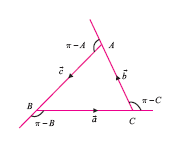
With usual notations in triangle ABC, let \(\vec { BC } =\vec { a } ,\vec { CA } =\vec { b } \) and \(\vec { AB } =\vec { c } \).
Then \(\left| \vec { BC } \right| =a\) , \(\left| \vec { CA } \right| =b\), \(\left| \vec { AB} \right| =c\), and \(\vec { BC } +\vec { CA } +\vec { AB } =\vec { 0 } \)
So, \(\vec { BC } =-\vec { CA } -\vec { AB } \)
Applying dot product, we get
\(\vec { BC } .\vec { BC } =-\vec { BC } .\vec { CA }-\vec { BC }. \vec { AB } \)
⇒ \({ \left| \vec { BC } \right| }^{ 2 }=-\left| \vec { BC } \right| \left| \vec { CA } \right| \) cos(兀-c)-\(\left| \vec { BC } \right| \left| \vec { AB} \right| \)cos(兀-B)
⇒ a2 = ab cos C + ac cos B
Therefore a = b cos C + c cos B
The results (ii) and (iii) are proved in a similar way
29.
Given (3 -i) x - (2 - i) y + 2i + 5
= 2x + (-1 + 2i) y + 3 + 2i
⇒ 3x - ix - 2y + iy + 2i + 5 = 2x - y + 2iy + 3 + 2i
choosing the real and imaginary parts
(3x-2y + 5) + i (-x + y + 2) = 2x - y + 3 + i (2y+ 2)
Equating the real and imaginary parts both sides, we get
3x- 2y+ 5 = 2x-y+3
⇒ 3x - 2y + 5 - 2x +y - 3 = 0
⇒ x-y = -2... (1)
-x+y+2 = 2y+2
⇒ -x+y+2-2y-2 = 0
⇒ -x-y = 0 ⇒ x+y = 0.. (2)
(1)-(2) we get,
| x - y | = -2 |
| x + y | = 0 |
| 2y | = -2 |
y = 1
Substituting y = 1 in (2) we get.
x+1 = 0 ⇒ x = -1
∴ x = -1 and y = 1
30.
Equation of the circle passing through the points of intersection of the chord and circle by
Theorem is x2 + y2−16+\(\lambda \)(3x + y + 5) = 0 .
The chord 3x + y + 5 = 0 is a diameter of this circle if the centre\(\left( \frac { -3\lambda }{ 2 } \frac { -\lambda }{ 2 } \right) \) lies on the chord.
So we have 3\(\left( \frac { -3\lambda }{ 2 } \right) \)-\(\frac { -\lambda }{ 2 } \)+5 = 0,
\(\frac { -9\lambda }{ 2 } \)-\(\frac { \lambda }{ 2 } \)+5 = 0,
−5λ + 5 = 0 ,
λ = 1.
Therefore, the equation of the required circle is x2 + y2+3x + y −11 = 0.
31.
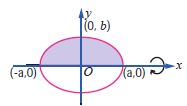
The ellipse is symmetric about both the axes. The major axis lies along x-axis. The region to be revolved is sketched
Hence, the required volume is given by
\(V=\pi \int _{ -a }^{ a }{ { y }^{ 2 }dx } =\pi \int _{ -a }^{ a }{ \frac { { b }^{ 2 } }{ { a }^{ 2 } } \left( { a }^{ 2 }-{ x }^{ 2 } \right) dx } \)
\(=\frac { 2\pi { b }^{ 2 } }{ { a }^{ 2 } } \int _{ 0 }^{ a }{ ({ a }^{ 2 }-{ x }^{ 2 })dx } \) since the integrand is an even function
\(=\frac { { 2\pi b }^{ 2 } }{ { a }^{ 2 } } { \left( { a }^{ 2 }x-\frac { { x }^{ 3 } }{ 3 } \right) }_{ 0 }^{ a }=\frac { 2\pi { b }^{ 2 } }{ 3 } ={ \left( { a }^{ 2 }-\frac { { a }^{ 3 } }{ 3 } \right) }_{ 0 }^{ a }=\frac { 2\pi { b }^{ 2 } }{ 3 } \left( \frac { { 2a }^{ 3 } }{ 3 } \right) =\frac { 4\pi { ab }^{ 2 } }{ 3 } \)
32.
Given
\(\\ \\ \\ \\ \\ f(x)=\begin{cases} \begin{matrix} \frac { { x }^{ 2 }+1 }{ k } & forx=0,1,2 \end{matrix} \\ \begin{matrix} 0 & otherwise \end{matrix} \end{cases}\\ \\ \\ \\ \\ \\ \)
The random variable X take the values 0, 1, 2.
Probability mass function.
| x | 0 | 1 | 2 |
| f(x) | \(\cfrac { 1 }{ k } \) | \(\cfrac { 2 }{ k } \) | \(\cfrac {5 }{ k } \) |
\(\sum _{ i=0 }^{ 2 }{ f(x_{ i })=1\Rightarrow f(0)+f(1)+f(2)=1 } \)
\(\Rightarrow \frac { 0+1 }{ k } +\frac { 1+1 }{ k } +\frac { 4+1 }{ k } \)
\(\Rightarrow \frac { 1 }{ k } +\frac { 2 }{ k } +\frac { 5 }{ k } =1\)
\(\Rightarrow \frac { 8 }{ k } =1\)
\(\Rightarrow k=8\)
(ii) Cumulative distribution function
| x | 0 | 1 | 2 |
| f(x) | \(\cfrac { 1 }{ 8 } \) | \(\cfrac { 2 }{ 8 } \) | 1 |
\(F(0)=P(X<0)\\P(x=0)\\ =\frac { 1 }{ 8 } \)
\(F(1)=P(X = 0)+ P(X = 1)\\
\frac { 1 }{ 8 } +\frac { 2 }{ 8 } =\frac { 3 }{ 8 } \)
\(F(2)=P(X= 0) + P(X = 1) + P(X = 2) = \frac { 1 }{ 8 } +\frac { 2 }{ 8 } +\frac { 5 }{ 8 } =1\)
Cumulative distribution function is
\(f(x)=\begin{cases} \begin{matrix} \frac { 1 }{ 8 } & for & x\le 0 \end{matrix} \\ \begin{matrix} \frac { 2 }{ 8 } +\frac { 1 }{ 8 } & for & \frac { 3 }{ 8 } forx\le 1 \end{matrix} \\ \begin{matrix} \frac { 3 }{ 8 } +\frac { 5 }{ 8 } =1 & for & x\le 2 \end{matrix} \end{cases}\)
(iii) p(x ≥ 1) = p(x = 1) + p(x = 2)
= \(\frac { 2 }{ 8 } +\frac { 5 }{ 8 } \)
\(p(x\ge 1)=\frac { 7 }{ 8 } \)
33.
Taking \(\vec { p } =(\vec { a } \times \vec { b } )\) as a single vector and using the vector triple product expansion, we get
\((\vec { a } \times \vec { b } )\times(\vec{c}\times\vec{d})=\vec{p}\times(\vec{c}\times\vec{d})\)
= \((\vec { p } .\vec { d } )\vec { c } -(\vec { p } .\vec { c } )\vec { d } \)
= \(((\vec { a } \times \vec { b } ).\vec { d } )\vec { c } -((\vec { a } \times \vec { b } ).\vec { c } )\vec { d } =[\vec { a } ,\vec { b } ,\vec { d } ]\vec { c } -[\vec { a } \vec { b } \vec { c } ]\vec { d } \)
Similarly, taking \(\vec { q } \) = \(\vec { c } \times \vec { d } \)
\((\vec { a } \times \vec { b } )\times (\vec { c } \times \vec { d } )=(\vec { a } \times \vec { b } )\times \vec { q } \)
= \((\vec { a } .\vec { q } )\vec { b } -(\vec { b } .\vec { q } )\vec { a } \)
\(= [\vec { a } ,\vec { c }, \vec d ]\vec { b } -[\vec { b } ,\vec { c },\vec d ]\vec { a } \)
34.
Transforming the augmented matrix to echelon form, we get
\(\left[ \begin{matrix} 4 & 3 & 6 \\ 1 & 5 & 7 \\ 2 & 9 & 1 \end{matrix}|\begin{matrix} 25 \\ 13 \\ 1 \end{matrix} \right] \overset { { R }_{ 1 }\leftrightarrow { R }_{ 2 } }{ \longrightarrow } \left[ \begin{matrix} 1 & 5 & 7 \\ 4 & 3 & 6 \\ 2 & 9 & 1 \end{matrix}|\begin{matrix} 13 \\ 25 \\ 1 \end{matrix} \right] \overset { \begin{matrix} { R }_{ 2 }\longrightarrow { R }_{ 2 }-4{ R }_{ 1 } \\ { R }_{ 3 }\longrightarrow { R }_{ 3 }-2{ R }_{ 1 } \end{matrix} }{ \longrightarrow } \left[ \begin{matrix} 1 & 5 & 7 \\ 0 & -17 & -22 \\ 0 & -1 & -13 \end{matrix}|\begin{matrix} 13 \\ -27 \\ -25 \end{matrix} \right] \)\(\overset { \begin{matrix} { R }_{ 2 }\longrightarrow { R }_{ 2 }\div \left( -1 \right) \\ { R }_{ 3 }\longrightarrow { R }_{ 3 }\div \left( -1 \right) \end{matrix} }{ \longrightarrow } \left[ \begin{matrix} 1 & 5 & 7 \\ 0 & 17 & 22 \\ 0 & 1 & 13 \end{matrix}|\begin{matrix} 13 \\ 27 \\ 25 \end{matrix} \right] \overset { { R }_{ 3 }\longrightarrow 17{ R }_{ 3 }-{ R }_{ 2 } }{ \longrightarrow } \left[ \begin{matrix} 1 & 5 & 7 \\ 0 & 17 & 22 \\ 0 & 0 & 199 \end{matrix}|\begin{matrix} 13 \\ 27 \\ 398 \end{matrix} \right] \).
The equivalent system is written by using the echelon form:
x + 5y + 7 = 13, … (1)
17y + 22z = 27, … (2)
199z = 398..... (3)
From (3), we get z = \(\frac { 398 }{ 199 } \) = 2.
Substituting z = 2 in (2), we get y = \(\frac { 27-22\times 2 }{ 17 } =\frac { -17 }{ 17 } \) = -1
Substituting z = 2, y = -1, in (1), we get x = 13 - 5 x (-1) - 7 \(\times\) 2 = 4.
So, the solution is (x = 4, y = -1, z = 2).
35.
According to our notations, an= 2 and a0 = 3.
If \(\frac{p}{q}\) is a zero of the polynomial, then as (p, q) = 1, p must divide 3 and q must divide 2.
Clearly, the possible values of p are 1, −1, 3, −3 and the possible values of q are 1, −1, 2, −2.
Using these p and q we can form only the fractions \(\pm \frac { 1 }{ 1 } ,\pm \frac { 1 }{ 2 } ,\pm \frac { 3 }{ 2 } ,\pm \frac { 3 }{ 1 } \).
Among these eight possibilities, after verifying by substitution, we get \(\frac { -3 }{ 2 } \) is the only rational zero.
To find other roots, we divide the given polynomial 2x3+ 3x2+ 2x + 3 by 2x + 3 and get x2+1 as the quotient with zero remainder. Solving x2+1 = 0, we get i and −i as roots. Thus \(\frac { -3 }{ 2 } \), -i, i are the roots of the given polynomial equation.

12th Standard Syllabus & Materials
12th Standard
TN 12th Computer Applications களப்பெயர் முறைமை (DNS) Sample Question Papers Study Material - QB365 Set A
NEW12th Standard
TN 12th Computer Applications வலையமைப்பு எடுத்துக்காட்டுகள் மற்றும் நெறிமுறைகள் Sample Question Papers Study Material - QB365 Set A
NEW12th Standard
TN 12th Computer Applications கணினி வலையமைப்பு ஓர் அறிமுகம் Sample Question Papers Study Material - QB365 Set A
NEW12th Standard
TN 12th Computer Applications PHP-உடன் MySQL-ஐ இணைத்தல் Sample Question Papers Study Material - QB365 Set A



Tamilnadu Stateboard 12th Standard Subjects
Maths

Chemistry

Physics

Biology

Computer Science

Business Maths and Statistics

Economics

Commerce

Accountancy

History

Computer Applications
Biology
Computer Technology
Computer Applications
Computer Science
Business Maths and Statistics
Commerce
Economics
Maths
Chemistry
Physics
Computer Technology
History
Accountancy

Tamil

English

French
Tamilnadu Stateboard Standards

