
 100% FREE ACCESS
12th Standard Syllabus & Materials
12th Standard
TN 12th Computer Applications மின்னணு தரவு பரிமாற்றம் Sample Question Papers Study Material - QB365 Set A
NEW12th Standard
TN 12th Computer Applications மின் - வணிக பாதுகாப்பு அமைப்புகள் Sample Question Papers Study Material - QB365 Set A
NEW12th Standard
TN 12th Computer Applications மின்னணு செலுத்தல் முறைகள் Sample Question Papers Study Material - QB365 Set A
NEW12th Standard
TN 12th Computer Applications மின் - வணிகம் Sample Question Papers Study Material - QB365 Set A
NEW12th Standard
TN 12th Computer Applications திறந்த மூல கருத்துருக்கள் Sample Question Papers Study Material - QB365 Set A
NEW12th Standard
TN 12th Computer Applications வலையமைப்பு வடமிடல் Sample Question Papers Study Material - QB365 Set A

Published on: 03/09/2020
12th Standard Maths English Medium Sample 3 Mark Book Back Questions (New Syllabus) 2020
Download Tamil Nadu 12th Standard Maths question papers, model tests, one-mark questions, important questions, and public exam papers in PDF format. Free study materials and answer keys for TN State Board students.
Questions + Answers key
Take MCQ Maths Test1.
Prove that q ➝ p ≡ ¬p ➝ ¬q
2.
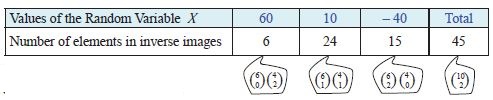
Two balls are chosen randomly from an urn containing 6 white and 4 black balls. Suppose that we win Rs. 30 for each black ball selected and we lose Rs. 20 for each white ball selected. If X denotes the winning amount, then find the values of X and number of points in its inverse images.
3.
Let U(x, y, z) = x2 − xy + 3 sin z, x, y, z ∈ R Find the linear approximation for U at (2,−1,0).
4.
Evaluate \(\int _{ 0 }^{ 1 }{ { x }^{ 3 }{ (1-x) }^{ 4 }dx } \)
5.
Evaluate the following definite integrals:
\(\int _{ 0 }^{ \frac { \pi }{ 2 } }{ \sqrt { cos\theta } } { sin }^{ 3 }\theta d\theta \)
6.
Let \(f(x)=\sqrt [ 3 ]{ x } \). Find the linear approximation at x = 27. Use the linear approximation to approximate \(\sqrt [ 3 ]{ 27.2 } \)
7.
Evaluate the following limit, if necessary use l ’Hôpital Rule
\(\underset { x\rightarrow { 1 }^{ + } }{ lim } \left( \frac { 2 }{ { x }^{ 2 }-1 } -\frac { x }{ x-1 } \right) \)
8.
Find the absolute extrema of the following functions on the given closed interval.
\(f(x)=2cosx+sin2x;\left[ 0,\frac { \pi }{ 2 } \right] \)
9.
Find the equations of tangent and normal to the curve y = x2 + 3x − 2 at the point (1, 2)
10.
Find the differential equation corresponding to the family of curves represented by the equation y = Ae8x + Be-8x, where A and B are arbitrary constants.
11.
Obtain the Cartesian equation for the locus of z = x + iy in each of the following cases:
|z - 4|2- |z -1 |2 = 16
12.
Find the domain of
g(x) = sin−1x + cos−1x
13.
Solve the following system of linear equations by matrix inversion method :
2x − y = 8 , 3x + 2y = −2.
14.
Find the coordinates of the point where the straight line \(\vec { r } =(2\hat { i } -\hat { j } +2\hat { k } )+t(3\hat { i } +4\hat { j } +2\hat { k } )\) intersects the plane x−y+z−5 = 0.
15.
Find the shortest distance between the two given straight lines \(\vec { r } =(2\hat { i } +3\hat { j } +4\hat { k } )+t(-2\hat { i } +\hat { j } -2\hat { k } )\) and \(\frac { x-3 }{ 2 } =\frac { y }{ -1 } =\frac { z+2 }{ 2 } \)
16.
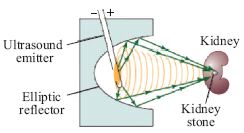
The equation of the ellipse is \(\frac { { \left( x-11 \right) }^{ 2 } }{ 484 } +\frac { { y }^{ 2 } }{ 64 } =1\). ( x and y are measured in centimeters) where to the nearest centimeter, should the patient’s kidney stone be placed so that the reflected sound hits the kidney stone?
17.
Prove that \([\vec { a } \times \vec { b } ,\vec { b } \times \vec { c } ,\vec { c } \times \vec { a } ]\) = \([{ \vec { a } ,\vec { b } ,\vec { c } }]^{ 2 }\)
18.
Obtain the Cartesian form of the locus of z in each of the following cases.
|z| = |z - i|
19.
If z = x + iy is a complex number such that \(\left| \frac { z-4i }{ z+4i } \right| =1\) show that the locus of z is real axis.
20.
A particle acted upon by constant forces \(\hat { 2j } +\hat { 5j } +\hat { 6k } \) and \(-\hat { i } -\hat { 2j } -\hat { k } \) is displaced from the point (4, −3, −2) to the point (6, 1, −3). Find the total work done by the forces.
21.
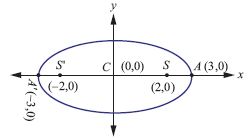
Find the equation of the ellipse with foci (±2, 0), vertices (±3, 0)
22.
Find the value of tan−1(−1 ) + cos-1\((\frac{1}{2})+sin^-1(-\frac{1}{2})\)
23.
The complex numbers u, v, and w are related by \(\frac { 1 }{ u } =\frac { 1 }{ v } +\frac { 1 }{ w } \) If v = 3−4i and w = 4+3i, find u in rectangular form.
24.
Verify (AB)-1 = B-1A-1 with A = \(\left[ \begin{matrix} 0 & -3 \\ 1 & 4 \end{matrix} \right] \), B = \(\left[ \begin{matrix} -2 & -3 \\ 0 & -1 \end{matrix} \right] \).
25.
If the sides of a cubic box are increased by 1, 2, 3 units respectively to form a cuboid, then the volume is increased by 52 cubic units. Find the volume of the cuboid.
26.
Construct the truth table for \((p\overset { \_ \_ }{ \vee } q)\wedge (p\overset { \_ \_ }{ \vee } \neg q)\)
27.
Verify the
(i) closure property,
(ii) commutative property,
(iii) associative property
(iv) existence of identity and
(v) existence of inverse for the arithmetic operation - on Z.
28.
Find the area of the region bounded by x−axis, the curve y = |cos x|, the lines x = 0 and x = \(\pi\).
29.
Evaluate \(\int _{ 0 }^{ 1 }{ xdx } \), as the limit of a sum.
30.
Solve the Linear differential equation:
\(x\frac { dy }{ dx } +2y-x^2logx=0\)
31.
Write the Taylor series expansion of \(\frac{1}{x}\) about x = 2 by finding the first three non-zero terms.
32.
Solve the following differential equations:
ydx + (1 +x2) tan-1 xdy = 0
33.
Solve the following equations,
12x3+ 8x = 29x2- 4
34.
Solve \({ cot }^{ -1 }x-{ cot }^{ -1 }\left( x+2 \right) =\frac { \pi }{ 12 } ,x>0\)
35.
Test for consistency of the following system of linear equations and if possible solve:
x - y + z = -9, 2x - 2y + 2z = -18, 3x - 3y + 3z + 27 = 0.
36.
Find the inverse of the non-singular matrix A = \(\left[ \begin{matrix} 0 & 5 \\ -1 & 6 \end{matrix} \right] \), by Gauss-Jordan method.
37.
If the roots of x3+ px2+ qx + r = 0 are in H.P. prove that 9pqr = 27r2+2q3.
38.
The probability that a certain kind of component will survive a electrical test is \(\frac { 3 }{ 4 } \). Find the probability that exactly 3 of the 5 components tested survive.
39.
Evaluate \(\begin{matrix} lim \\ (x,y)\rightarrow (0,0) \end{matrix}cos=\left( \frac { { e }^{ x }siny }{ y } \right) \), if the limit exists.
40.
For the random variable X with the given probability mass function as below, find the mean and variance
\(f(x)= \begin{cases}2(x-1) & 1<x<2 \\ 0 & \text { otherwise }\end{cases}\)\(\)
41.
An egg of a particular bird is very nearly spherical. If the radius to the inside of the shell is 5 mm and radius to the outside of the shell is 5.3 mm, find the volume of the shell approximately.
42.
Identify the type of the conic for the following equations:
(1) 16y2 = −4x2+64
(2) x2+y2 = −4x−y+4
(3) x2−2y = x+3
(4) 4x2−9y2−16x+18y−29 = 0
1.
| p | q | q ➝ p | ~p | ~q | ~q ➝ ~p |
| T | T | T | F | F | T |
| T | F | T | F | T | T |
| F | T | F | T | F | F |
| F | F | T | T | T | T |
The entries in the columns corresponding q ➝ p and ~p ➝ ~q are identical and hence they are equivalent.
q ➝ p ≡ ~p ➝ ~q
Hence proved
2.
The possible events of selection are
(i) both balls may be black, or
(ii) one white and one black or
(iii) both are white.
Therefore X is a random variable that take the values,
X (both are black balls) = Rs. 2(30) = Rs. 60
X (one black and one white ball) = Rs. 30 − Rs. 20 = Rs. 10
X (both are white balls) = Rs. 2( − 20) = - Rs. 40
Therefore X takes on the values 60,10, and − 40.
3.
By (14), Linear approximation is given by
L (x, y, z) = U(x0, y0, z0) + \({ \frac { { \partial }U }{ { \partial x } } | }_{ { x }_{ 0 },{ y }_{ 0 },{ z }_{ 0 } }\) (x-x0)+\({ \frac { { \partial }U }{ { \partial y } } | }_{ { x }_{ 0 },{ y }_{ 0 },{ z }_{ 0 } }\) (y-y0)+\({ \frac { { \partial }U }{ { \partial z } } | }_{ { x }_{ 0 },{ y }_{ 0 },{ z }_{ 0 } }\) (z-z0)
Now Ux = 2x -y, Uy = -xand Uz = 3cos z.
Here (x0, y0, z0) = (2,−1,0 )
hence Ux (2, −1,0) = 5, Uy (2, −1,0) = −2 and Uz (2,-1,0) = 3.
Thus L(x, y, z) = 6 + 5(x − 2) − 2( y +1) + 3(z − 0) = 5x − 2y + 3z − 6 is the required linear approximation for U at (2,−1,0).
4.
\(\int _{ 0 }^{ 1 }{ { x }^{ m } } { (1-x) }^{ n }dx=\frac { m!\times n! }{ (m+n+1)! } \)
\(\therefore \int _{ 0 }^{ 1 }{ { x }^{ 3 }{ (1-x) }^{ 4 }dx } =\frac { 3!\times 4! }{ (3+4+1)! } =\frac { 3!\times 4! }{ 8! } =\frac { 3\times 2\times 1\times 4\times 3\times 2\times 1 }{ 8\times 7\times 6\times 5\times 4\times 3\times 2\times 1 } =\frac { 1 }{ 280 } \)
5.
\(=\int _{ 0 }^{ \frac { \pi }{ 2 } }{ { cos }^{ \frac { 1 }{ 2 } }\theta (1-{ cos }^{ 2 }) } sin\ \theta\ d\theta \)
\(=\int _{ 0 }^{ \frac { \pi }{ 2 } }{ \left( { cos }^{ \frac { 1 }{ 2 } }\theta -{ cos }^{ \frac { 5 }{ 2 } }\theta \right) } sin\theta\ d\theta \)
\(Put\ cos\theta =t\)
\(\\ \Rightarrow -sin\theta\ d\theta =dt\)
\(\Rightarrow sin\theta\ d\theta =-dt\)
| \(\theta\) | 0 | \(\frac{\pi}{2}\) |
| t | 1 | 0 |
\(=-\int _{ 1 }^{ 0 }{ ({ t }^{ \frac { 1 }{ 2 } }-{ t }^{ \frac { 5 }{ 2 } }) } dt=\int _{ 0 }^{ 1 }{ ({ t }^{ \frac { 1 }{ 2 } }-{ t }^{ \frac { 5 }{ 2 } }) } dt\)
\(={ \left[ \frac { { t }^{ \frac { 3 }{ 2 } } }{ \frac { 3 }{ 2 } } -\frac { { t }^{ \frac { 7 }{ 2 } } }{ \frac { 7 }{ 2 } } \right] }_{ 0 }^{ 1 }=\left[ \frac { 2 }{ 3 } (1)-\frac { 2 }{ 7 } (1)-0 \right] \)
\(=\frac { 2 }{ 3 } -\frac { 2 }{ 7 } =\frac { 14-6 }{ 21 } =\frac { 8 }{ 21 } \)
6.
Given \(f(x)=\sqrt [ 3 ]{ x } \)
Let x0 = 27 and \(\triangle x=0.2\)
We know L(x) = \(f({ x }_{ 0 })+{ f }^{ ' }({ x }_{ o })\) (x - x0) ∀ x ∈ (a, b)
∴ \(\sqrt [ 3 ]{ 27.2 } =f(27)+{ f }^{ ' }(27)(0.2)\) .. (1)
Now f(27) = \(\sqrt [ 3 ]{ 27 } =3\)
\({ f }^{ ' }(27)=\frac { 1 }{ 3 } x^{ \frac { 1 }{ 3 } -1 }=\frac { 1 }{ 3 } { x }^{ \frac { 2 }{ 3 } }=\frac { 1 }{ { 3x }^{ \frac { 2 }{ 3 } } } \)
\(\therefore \) becomes,
\(\sqrt [ 3 ]{ 27.2 } =3+\frac { 1 }{ 27 } (0.2)\)
= 3 + .0074 = 3.0074
\(\therefore \) \(\sqrt [ 3 ]{ 27.2 } =3.0074\)
7.
\(\underset { x\rightarrow { 1 }^{ + } }{ lim } \left( \frac { 2 }{ { x }^{ 2 }-1 } -\frac { x }{ x-1 } \right) =\underset { x\rightarrow { 1 }^{ + } }{ lim } \left( \frac { 2-x(x+1) }{ { x }^{ 2 }-1 } \right) \)
\(\underset { x\rightarrow { 1 }^{ + } }{ lim } \left( \frac { 2-{ x }^{ 2 }-x }{ { x }^{ 2 }-1 } \right) =\frac { 0 }{ 0 } \)
Form which is indeterminate,
Applying L' Hopital rule we get,
\(\underset { x\rightarrow { 1 }^{ + } }{ lim } \left( \frac { 2-{ x }^{ 2 }-x }{ { x }^{ 2 }-1 } \right) =\frac { 0 }{ 0 } =\frac { -2-1 }{ 2(1) } =\frac { -3 }{ 2 } \)
8.
f'(x) = -2 sin x + 2 cos 2x
f'(x) = 0
\(\Rightarrow\) 2 sin x + 2 cos 2x = 0
\(\Rightarrow\) 2 sin x + 2(1 - 2 sin2x) = 0
\(\Rightarrow\) 4 sin2x + 2 sin x - 2 = 0
\(\Rightarrow\) 4 sin2 x + 2 sin x - 2 = 0
\(\Rightarrow\) 2 sin2 x + sin x-1 = 0
\(\Rightarrow\) (sin x+1) (2sin x-1) = 0
\(\Rightarrow\) \(sinx=-1\ or\ sinx=\frac { 1 }{ 2 } \)
\(\Rightarrow\) \(sinx=-sin\frac { \pi }{ 2 } \) or
\(sinx=sin\frac { \pi }{ 6 } \)
\(\Rightarrow sinx=sin\left( -\frac { \pi }{ 2 } \right) \)
\(sinx=sin\frac { \pi }{ 6 } \)
\(\Rightarrow x=-\frac { \pi }{ 2 } or \ x=\frac { \pi }{ 6 } \)
\(\Rightarrow x=\frac { \pi }{ 6 } \)
\(\\ \\ \\ \\ \\ \\ \left[ \because x=-\frac { \pi }{ 2 }∉ \left[ 0.\frac { \pi }{ 2 } \right] \right] \)
\(\therefore\) The critical number is \(x=\frac { \pi }{ 6 } \)
Evaluating f(x) at the end points x = 0, \(x=\frac { \pi }{ 2 } \) and at the critical number \(x=\frac { \pi }{ 6 } \) we get.
f(0) = 2 cos0 + sin0 = 2
\(f(\frac { \pi }{ 2 } )=2cos\frac { \pi }{ 2 } +sin\pi =0\)
\(f\left( \frac { \pi }{ 6 } \right) =2cos\frac { \pi }{ 2 } +sin\frac { \pi }{ 3 } \)
\(2\left( \frac { \sqrt { 3 } }{ 2 } \right) +\frac { \sqrt { 3 } }{ 2 } =\frac { 3\sqrt { 3 } }{ 2 } \)
From these values, the absolute maximum is \(\frac { 3\sqrt { 3 } }{ 2 } \) which occurs at \(x=\frac { \pi }{ 6 } \) and the absolute minimum is 0 which occurs at \(x=\frac { \pi }{ 2 } \)
9.
We have, \(\frac{dy}{dx}=2x+3\). Hence at (1, 2), \((\frac{dy}{dx})=5\)
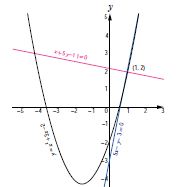
Therefore, the required equation of tangent is.
\((y-2)=5(x-1)\Rightarrow 5x-y-3=0\)
The slope of the normal at the point (1, 2) is -\(\frac{1}{5}\).
therefore, the required equation of normal is
\((y-2)=-\frac{1}{5}(x-1)\Rightarrow x+5y-11=0\)
10.
given equation of family of curves is
y = Ae8x + Be-8x ..(1)
where A & B are arbitrary constants. Differentiating cquation (1) twice successively (because we have two arbitrary constant), we get
Differentiating with respect to 'x' we get,
\(\frac { dy }{ dx } \\ \\ \) = 8Ae8x + 8Be-8x
Differentiating again with respect to 'x' we get,
\(\frac { d^{ 2 }y }{ dx^{ 2 } } \) = 64Ae8x + 64Be-8x
= 64(Ae8x + Be-8x)
\(\frac { d^{ 2 }y }{ dx^{ 2 } } \) = 64 y [using (1)]
\(\frac { d^{ 2 }y }{ dx^{ 2 } } \) - 64 y = 0
Which is the required differential equation.
11.
|z-4|2-|z-1|2 = 16
|x+iy-4|2 - |x+iy-1|2 = 16
⇒ |(x-4)+iy|2 - |(x-1)+iy2|2 = 16
⇒ [(x-4)2+y2] - [(x-1)2+y2] = 16
⇒ x2-8x+16+y2-[x2-2x+1+y2] = 16
\(\Rightarrow \not x^{2}-8 x+16+\not y^{2}-\not x^{2}+2 x-1-\not y^{2}=16\)
⇒ -6x+15-16 = 0
⇒ -6x-1 = 0
⇒ 6x+1 = 0 Which is the required Cartesian equation.
The locus of the point is a straight line.
12.
Given g(x) = sin-1 x + cos-1x
From the definition of sin-1x.
\(-1\le x\le 1\) ...(1)
Also from the definition of cos-1x
\(-1\le x\le 1\) .........(2)
\(\therefore \) From (1) & (2),
Domain ofg(x) = [-1, 1] U [-1, 1]
= [-1, 1]
Hence the domain of g(x) is [-1, 1].
13.
2x-y = 8, 3x+2y+2 = -2
The matrix form of the system is
\(\left[ \begin{matrix} 2 & -1 \\ 3 & 2 \end{matrix} \right] \left[ \begin{matrix} x \\ y \end{matrix} \right] =\left[ \begin{matrix} 8 \\ -2 \end{matrix} \right] \)
⇒ AX = B where A =\(\\ \left[ \begin{matrix} 2 & -1 \\ 3 & 2 \end{matrix} \right] \)
B =\(\left[ \begin{matrix} 8 \\ -2 \end{matrix} \right] \)
⇒ X = A-1N
Now, |A| =\(\left[ \begin{matrix} 2 & -1 \\ 3 & 2 \end{matrix} \right] \)= 4 + 3 = 7
∴ A-1= \(\frac { 1 }{ |A| } \)adj A
= \(\frac { 1 }{ 7 } \left[ \begin{matrix} 2 & 1 \\ -3 & 2 \end{matrix} \right] \)
∴ X = A-1B = \(\frac { 1 }{ 7 } \left[ \begin{matrix} 2 & 1 \\ -3 & 2 \end{matrix} \right] \left[ \begin{matrix} 8 \\ -2 \end{matrix} \right] \)
= \(\frac { 1 }{ 7 } \left[ \begin{matrix} 16-2 \\ -24-4 \end{matrix} \right] \)
= \(\frac { 1 }{ 7 } \left[ \begin{matrix} 14 \\ -28 \end{matrix} \right] =\left[ \begin{matrix} \frac { 14 }{ 7 } \\ \frac { -28 }{ 7 } \end{matrix} \right] =\left[ \begin{matrix} 2 \\ -4 \end{matrix} \right] \)
∴ x = 2, y = -4
Hence, the solution set is {2, -4}
14.
Here, \(\vec { a } =(2\hat { i } -\hat { j } +2\hat { k } ),\vec { b } =(3\hat { i } +4\hat { j } +2\hat { k } )\).
The vector form of the given plane is \(\vec { r } .(\hat { i } -\hat { j } +\hat { k } )=5\). Then \(\vec { r } .(\hat { i } -\hat { j } +\hat { k } )=5\) and p = 5
We know that the position vector of the point of intersection of the line \(\vec { r } =\vec { a } +t\vec { b } \) and the plane
\(\vec { r } .\vec { d } =p\vec { u } =\vec { a } +\left( \frac { p-(\vec { a } .\vec { n } ) }{ \vec { b } .\vec { n } } \right) \vec { b } \), where \(\vec { b } .\vec { n } \neq \vec { 0 } \)
Clearly, we observe that \(\vec { b } .\vec { n } \neq \vec { 0 } \)
Now, \(\frac { p-(\vec { a } .\vec { n } ) }{ \vec { b } .\vec { n } } =\frac { 5-(2\hat { i } -\hat { j } +2\hat { k } ).(\hat { i } -\hat { j } +\hat { k } ) }{ (3\hat { i } +4\hat { j } +2\hat { k } ).(\hat { i } -\hat { j } +\hat { k } ) } =0\). Therefore, the position vector of the point of intersection of the given line and the given plane is
\(\hat { r } =(2\hat { i } -\hat { j } +2\hat { k } )+(0)(3\hat { i } +4\hat { j } +2\hat { k } )=2\hat { i } -\hat { j } +2\hat { k } \)
That is, the given straight line intersects the plane at the point (2, −1, 2)
Aliter:
The Cartesian equation of the given straight line is \(\frac { x-2 }{ 3 } =\frac { y+1 }{ 4 } =\frac { z-2 }{ 2 } =t\)(say)
We know that any point on the given straight line is of the form (3t+2, 4 t−1, 2 t+2). If the given line and the plane intersects, then this point lies on the given pane x−y+z−5 = 0.
So, (3t + 2)−(4t − 1) + (2t + 2) − 5 = 0 ⇒ t = 0.
Therefore, the given line intersects the given plane at the point (2, -1, 2)
15.
The parametric form of vector equations of the given straight lines are
\(\vec { r } =(2\hat { i } +3\hat { j } +4\hat { k } )+t(-2\hat { i } +\hat { j } -2\hat { k } )\)
and \(\vec { r } =(3\hat { i } -2\hat { k } )+t(2\hat { i } -\hat { j } +2\hat { k } )\)
Comparing the given two equations with \(\vec { r } =\vec { a } +t\vec { b } ,\vec { r } =\vec { c } +s\vec { d } \)
we have \(\vec { a } =2\hat { i } +3\hat { j } +4\hat { k } ,\vec { b } =-2\hat { i } +\hat { j } -2\hat { k } ,\vec { c } =3\hat { i } -2\hat { k } ,\vec { d } =2\hat { i } -\hat { j } +2\hat { k } \)
Clearly, \(\vec { b } \) is a scalar multiple of \(\vec { d } \), and hence the two straight lines are parallel. We know that the shortest distance between two parallel straight lines is given by \(d=\frac { \left| (\vec { c } -\vec { a } )\times \vec { b } \right| }{ \left| \vec { b } \right| } \)
\((\vec { c } -\vec { a } )\times \vec { b } =\left| \begin{matrix} \hat { i } & \hat { j } & \hat { k } \\ 1 & -3 & -6 \\ -2 & 1 & -2 \end{matrix} \right| =12\vec { i } +14\vec { j } -5\vec { k } \)
\(d=\frac { \left| 12\hat { i } +14\hat { j } -5\hat { k } \right| }{ \left| -2\hat { i } +\hat { j } -2\hat { k } \right| } =\frac { \sqrt { 365 } }{ 3 } \)
16.
The equation of the ellipse is \(\frac { { \left( x-11 \right) }^{ 2 } }{ 484 } +\frac { { y }^{ 2 } }{ 64 } =1\). The origin of the sound wave and the kidney stone of patient should be at the foci in order to crush the stones.
a2 = 484 and b2 = 64
c2 = a2 -b2
= 484-64
= 420
c \(\simeq \) 20.5
Therefore the patient’s kidney stone should be placed 20.5 cm from the centre of the ellipse.
17.
Using the definition of the scalar triple product, we get
\([\vec { a } \times \vec { b } ,\vec { b } \times \vec { c } ,\vec { c } \times \vec { a } ]\) = \((\vec { a } \times \vec { b } ).[(\vec { b } \times \vec { c } )\times (\vec { c } \times \vec { a } )]\) ....(1)
By treating \((\vec { b } \times \vec { c } )\) as the first vector in the vector triple product, we find
\((\vec { b } \times \vec { c } )\times (\vec { c } \times \vec { a } )\) = \(((\vec { b } \times \vec { c } ).\vec { a } )\vec { c } \) - \(((\vec { b } \times \vec { c } ).\vec { c } )\vec { a } )\) = \([{ \vec { a } ,\vec { b } ,\vec { c } }]\vec { c } \)
Using this value in (1), we get
\([\vec { a } \times \vec { b } ,\vec { b } \times \vec { c } ,\vec { c } \times \vec { a } ]\) = \((\vec { a } \times \vec { b } ).([\vec { a } ,\vec { b } ,\vec { c } ]\vec { c } )=[\vec { a } ,\vec { b } ,\vec { c } ](\vec { a } \times \vec { b } ).\vec { c } ={ [\vec { a } ,\vec { b } ,\vec { c } ] }^{ 2 }\)
18.
We have |z| - |z - i|
\(\Rightarrow\)|x + iy| = |x + iy - i|
\(\Rightarrow\) \(\sqrt { { x }^{ 2 }+{ y }^{ 2 } } =\sqrt { { x }^{ 2 }+\left( y-1 \right) ^{ 2 } } \)
\(\Rightarrow x^{2}+y^{2}=x^{2}+y^{2}-2 y+1\)
\(\Rightarrow\) 2y -1 = 0
19.
Given z = x + iy
Consider \(\left| \frac { z-4i }{ z+4i } \right| =1\Rightarrow \left| \frac { x+iy-4i }{ x+iy+4i } \right| \)=1
⇒ \(\left| \frac { x+i(y-4) }{ x+i(y+4) } \right| \)
⇒ \(\frac { \sqrt { { x }^{ 2 }+(y-4)^{ 2 } } }{ \sqrt { { x }^{ 2 }+((y+4)^{ 2 } } } \) = 1
⇒ \(\sqrt { { x }^{ 2 }+(y-4)^{ 2 } } =\sqrt { { x }^{ 2 }+(y+4)^{ 2 } } \)
Squaring both sides we get,
x2+(y-4)2 = x2+(y+4)2
\(\Rightarrow \not x^{2}+\not y^{2}-8 y+\not 16=\not x^{2}+\not y^{2}+8 y+\not 16\)
⇒ 8y+8y = 0
⇒ 16y = 0
⇒ y = 0 [∵ 16 ≠ 0]
y = 0 is the equation of real axis Locus of z is the real axis.
20.
Resultant of the given forces is \(\hat{F}\) = ( \(\hat { 2j } +\hat { 5j } +\hat { 6k } \) )+ (\(-\hat { i } -\hat { 2j } -\hat { k } \) ) = \(\hat { i } +\hat { 3j } +\hat {5 k } \)
Let A and B be the points (4, −3, −2) and (6, 1, −3) respectively.
Then the displacement vector of the particle is
\(\vec { d } =\vec { AB } =\vec { OB } -\vec { OA } =(\hat { 6i } +\hat { j } -\hat { 3k } )-(\hat { 4i } -\hat { 3j } -\hat { 2k } )=\hat { 2i } +\hat { 4j } -\hat { k } \)
Therefore the work done
w = \(\vec { f } .\vec { d } =(\hat { i } +\hat { 3j } +\hat { 5k } ).(\hat { 2j } +\hat { 4j } -\hat { k } )\) = 9 units.
21.
SS′ = 2c and 2c = 4; A'A = 2a = 6
c = 2 and a = 3,
b2 = a2−c2 = 9−4 = 5.
Major axis is along x-axis, since a > b.
Centre (0, 0) and Foci are (±2, 0)
Therefore, equation of the ellipse is \(\frac { { x }^{ 2 } }{ 9 } \frac { { y }^{ 2 } }{ 5 } =1\)
22.
Let tan−1(−1) = y. Then, tan y = -1 = -tan\(\frac{\pi}{4}=tan(-\frac{\pi}{4})\)
As -\(\frac{\pi}{4}\in (-\frac{\pi}{2},\frac{\pi}{2}), tan^-1(-1)=-\frac{\pi}{ 3}\)
Now, cos-1\((\frac{1}{2})\) = y implies cos y = \(\frac{1}{2}\) = cos\(\frac{\pi}{3}\)
As \(\frac{\pi}{3}\)\(\in\)[0, \(\pi\)], cos-1 \((\frac{1}{2})=\frac{\pi}{3}\)
Now, sin-1\((-\frac{1}{2})\) = y implies sin y = -\(\frac{1}{2}\) = sin(-\(\frac{\pi}{3}\)).
As -\(\frac{\pi}{6}\in[-\frac{\pi}{2},\frac{\pi}{2}], sin^-1(-\frac{1}{2})=-\frac{\pi}{6}\)
Therefore, tan−1(−1)+cos-1\((\frac{1}{2})+sin^-1(-\frac{1}{2})=-\frac{\pi}{4}+\frac{\pi}{3}-\frac{\pi}{6}=-\frac{\pi}{12}\)
23.
Given v = 3-4i, w = 4+3i and \(\frac { 1 }{ u } =\frac { 1 }{ v } +\frac { 1 }{ w } \)
∴ \(\frac { 1 }{ u } =\frac { 1 }{ 3-4i } +\frac { 1 }{ 4+3i } \)
= \(\frac { 3+4i }{ (3-4i)(3+4i) } +\frac { 4-3i }{ (4+3i)(4-3i) } \)
= \(\\ \frac { 3+4i }{ 9-(4i)^{ 2 } } +\frac { 4-3i }{ 16-(3i)^{ 2 } } =\frac { 3+4i }{ 9+16 } +\frac { 4-3i }{ 16+9 } \)
= \(\frac { 3+4i }{ 25 } +\frac { 4-3i }{ 25 } =\frac { 3+4i+4-3i }{ 25 } \)
\(\frac { 1 }{ u } =\frac { 7+i }{ 25 } \)
∴ u = \(\frac { 25 }{ 7+i } \times \frac { 7-i }{ 7-i } =\frac { 25(7-i }{ 7^{ 2 }-({ i }^{ 2 }) } \)
= \(\frac { 25(7-i) }{ 49+1 } =\frac { 25(7-i) }{ 50 } =\frac { 1 }{ 2 } \)(7-i)
∴ u = \(\frac { 1 }{ 2 } \)(7-i) or \(\frac { 7 }{ 2 } \) - \(\frac { i }{ 2 } \)
24.
We get AB = \(\left[ \begin{matrix} 0 & -3 \\ 1 & 4 \end{matrix} \right] \left[ \begin{matrix} -2 & -3 \\ 0 & -1 \end{matrix} \right] =\left[ \begin{matrix} 0+0 & 0+3 \\ -2+0 & -3-4 \end{matrix} \right] =\left[ \begin{matrix} 0 & 3 \\ -2 & -7 \end{matrix} \right] \)
(AB)-1 = \(\frac { 1 }{ \left( 0+6 \right) } \left[ \begin{matrix} -7 & -3 \\ 2 & 0 \end{matrix} \right] =\frac { 1 }{ 6 } \left[ \begin{matrix} -7 & -3 \\ 2 & 0 \end{matrix} \right] \)...(1)
A-1 = \(\frac { 1 }{ \left( 0+3 \right) } \left[ \begin{matrix} 4 & 3 \\ -1 & 0 \end{matrix} \right] =\frac { 1 }{ 3 } \left[ \begin{matrix} 4 & 3 \\ -1 & 0 \end{matrix} \right] \)
B-1 = \(\frac { 1 }{ \left( 2-0 \right) } \left[ \begin{matrix} -1 & 3 \\ 0 & -2 \end{matrix} \right] =\frac { 1 }{ 2 } \left[ \begin{matrix} -1 & 3 \\ 0 & -2 \end{matrix} \right] \)
B-1A-1 = \(\frac { 1 }{ 2 } \left[ \begin{matrix} -1 & 3 \\ 0 & -2 \end{matrix} \right] \frac { 1 }{ 3 } \left[ \begin{matrix} 4 & 3 \\ -1 & 0 \end{matrix} \right] =\frac { 1 }{ 6 } \left[ \begin{matrix} -7 & -3 \\ 2 & 0 \end{matrix} \right] \) ...(2).
As the matrices in (1) and (2) are same, (AB)−1 = B−1A−1 is verified.
25.
The length and breadth of the cuboid are x + 1.
x + 2 and x + 3
[∵ they are increased by 1, 2, 3 units]
Also volume = V + 52 .
[since V is increased by 52]
∴ V + 52 = (x +1)(x + 2)(x + 3) .........(1)
⇒ V = (x + 1) (x + 2) (x + 3) - 52
Here a = -1, β = -2, ૪ = -3
⇒ V = x3-x2(α+β+૪)+x(αβ+β૪+૪α)-αβ૪ = 52
⇒ V = x3-x2(-1-2-3)+x(2+6+3)-(-1)(-2)(-3) = 52
⇒ V = x3-x2(-6)+x(11)+6-52
⇒ x3 = x2+6x2+11x+6-52
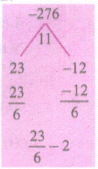
⇒ 6x2+11x-46 = 0
⇒ (6x+23)(x-2) = 0
⇒ (6x+23)(x-2) = 0
⇒ x = 2
∴ Volume of the cube = x3 = 23 = 8.
Volume of a cuboid = 52 + 8 = 60
[∵ x = \(\frac{-23}{6}\) is not possible as x represents the side of the cube]
26.
| p | q | ¬ q | \(r:(p\overset { \_ \_ }{ \vee } q)\) | s:\((p\overset { \_ \_ }{ \vee } \neg q)\) | r ∧ s |
| T | T | F | F | T | F |
| T | F | T | T | F | F |
| F | T | F | T | F | F |
| F | F | T | F | T | F |
Also the above result can be proved without using truth tables. This proof will be provided after studying the logical equivalence
27.
i) Though - is not binary on N; it is binary on Z. To check the validity of any more properties satisfied by – on Z, it is better to check them for some particular simple values.
ii) Take m = 4 , n = 5 and (m− n) = (4 − 5) = −1and (n −m) = (5 − 4) = 1.
Hence (m− n) ≠ (n −m). So the operation - is not commutative on Z.
iii) In order to check the associative property, let us put m = 4, n = 5 and p = 7 in both (m- n) - p and m- (n - p).
(m−n)− p = (4−5)−7 = (−1−7) = −8 …(1)
m−(n− p) = 4−(5−7) = (4+2) = 6 …(2)
From (1) and (2), it follows that (m - n) - p m - (n - p).
Hence – is not associative on Z.
iv) Identity does not exist (why?).
v) Inverse does not exist (why?).
28.
The given curve is \(y=\begin{cases} cosx,0\le x\le \frac { \pi }{ 2 } \\ -cosx,\frac { \pi }{ 2 } \le x\le \pi \end{cases}\)
It lies above the x − axis. The required area is sketched. So, the required area is given by
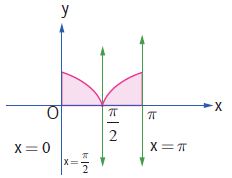
\(A=\int _{ 0 }^{ \pi }{ ydx=\int _{ 0 }^{ \frac { \pi }{ 2 } }{ cosxdx } +\int _{ \frac { \pi }{ 2 } }^{ \pi }{ (-cosx)dx } ={ [sin\quad x] }_{ 0 }^{ \frac { \pi }{ 2 } }-{ [sin\quad x] }_{ \frac { \pi }{ 2 } }^{ \pi } } \)
= [1-0]-[0-1] = 2
29.
Here f (x) = x, a = 0 and b = 1. Hence, we get
\(\int _{ a }^{ b }{ f(x)dx } =\underset { n\rightarrow \infty }{ lim } \frac { 1 }{ n } \sum _{ r=1 }^{ n }{ f } \left( \frac { r }{ n } \right) \Rightarrow \int _{ 0 }^{ 1 }{ xdx } =\underset { n\rightarrow \infty }{ lim } \frac { 1 }{ n } \sum _{ r=1 }^{ n }{ \frac { r }{ n } } \)
\(=\underset { n\rightarrow \infty }{ lim } \frac { 1 }{ { n }^{ 2 } } [1+2+...+n]\)
\(=\underset { n\rightarrow \infty }{ lim } \frac { 1 }{ { n }^{ 2 } } \frac { n(n+1) }{ 2 } =\underset { n\rightarrow \infty }{ lim } \frac { 1 }{ 2 } \left( 1+\frac { 1 }{ n } \right) =\frac { 1 }{ 2 } \)
30.
\(x\frac { dy }{ dx } +2y=x^2logx\)
Dividing by x we get,
\(\frac { dy }{ dx } +\frac { 2 }{ x } y=xlogx\)
This is a linear differential equation
\(\therefore P=\frac { 2 }{ x } ;Q=logx\)
\(\int { pdx } =\int { \frac { 2 }{ x } } dx=2logx=logx^2\)
\(\therefore I.F={ e }^{ \int { pdx } }={ e }^{ log\ x ^2}=x ^2\)
\(\therefore\) The solution is \({ e }^{ \int { u\ dv} }=uv-\int { vdu}\)
\(u=log\ x;dv=x^3\)
\(du=\frac { 1 }{ x }dx;v=\frac { { x }^{ 4} }{ 4} \)
\({ ye }^{ \int { pdx } }=\int { Q{ e }^{ \int { pdx } }dx+c } \)
\(\Rightarrow { yx }^{ 2 }=\int { xlogx.({ x }^{ 2 })dx } \)
\(\Rightarrow { x }^{ 2 }y=\int { { x }^{ 3 } } log\quad xdx\)
\(\Rightarrow { x }^{ 2 }y=\frac { { x }^{ 4 } }{ 4 } logx-\int { \frac { { x }^{ 4 } }{ 4 } .\frac { 1 }{ x } } dx\)
\(\Rightarrow { x }^{ 2 }y=\frac { { x }^{ 4 } }{ 4 } logx-\frac { 1 }{ 4 } \int { { x }^{ 3 }dx } \)
\(\Rightarrow { x }^{ 2 }y=\frac { { x }^{ 4 } }{ 4 } logx-\frac { { x }^{ 4 } }{ 16 } +c\)
31.
Let \(f(x)=\frac{1}{x}\). then the Taylor series of f (x) is
\(f(x)=\sum^{n=\infty}_{n=0}a_{n}(x-2)^{n},\) where \(a_{n}=\frac{f^{(n)}(2)}{n!}\)
Various derivatives of the function f (x) evaluated at x = 2 are given below.
| Functions and its derivatives |
\(\frac{1}{x}\)and its derivatives |
value at x = 2 |
| f(x) | \(\frac{1}{x}\) | \(\frac{1}{2}\) |
| f'(x) | \(-\frac{1}{x^{2}}\) | \(-\frac{1}{4}\) |
| f''(x) | \(\frac{2}{x^{3}}\) | \(\frac{1}{4}\) |
| f'''(x) | \(-\frac{6}{x^{4}}\) | \(-\frac{3}{8}\) |
Substituting these values, we get the required expansion of the function as:
\(\frac{1}{x}=\frac{1}{2}-\frac{1}{4}\frac{(x-2)}{1!}+\frac{1}{4}\frac{(x-2)^{2}}{2!}-\frac{3}{8}\frac{3(x-2)^{3}}{3!}+...\)
which is, \(\frac{1}{x}=\frac{1}{2}-\frac{(x-2)}{4}+\frac{(x-2)^{2}}{8}-\frac{(x-2)^{3}}{16}+...\)
32.
ydx + (1 + x2) tan-1 xdy = 0
\(\mathrm{yd} x=-\left(1+x^2\right) \tan ^{-1} x \mathrm{dy}
\)
\(\frac{d x}{\left(1+x^2\right) \tan ^{-1} x}=-\frac{d y}{y}
\)
Take \(\mathrm{t}=\tan ^{-1} x
\)
\(\mathrm{dt}=\frac{1}{1+x^2} d x\)
The equation can be written as
\(\frac{d t}{t}=-\frac{d y}{y}\)
Taking Integration on both sides, we get
\(\int \frac{d t}{t}=-\int \frac{d y}{y}\)
log t = - log y + log C
log (tan-1 x) = -log y+ log C
log (tan-1 x) + log y = log C
log y(tan-1 x) = log c
y tan-1 x = c
33.
12x + 8x = 29x2- 4
This equation can be re-written as
12x3 - 29x2 + 8x + 4 = 0

∴ x = 2 is a root and the remaining factor is
12x2- 5x - 2
⇒ (3x-2)(4x+1) = 0
⇒ 3x-2 = 0 or 4x+1 = 0

⇒ x = \(\frac{2}{3}\)
x = \(\frac{-1}{4}\)
∴ The roots are 2, \(\frac{2}{3}\), \(\frac{-1}{4}\)
34.
\({ cot }^{ -1 }x-{ xot }^{ -1 }\left( x+2 \right) =\frac { \pi }{ 12 } ,x>0\)
\({ tan }^{ -1 }\left( \frac { 1 }{ x } \right) -{ tan }^{ -1 }\left( \frac { 1 }{ x+2 } \right) =\frac { \pi }{ 2 } \)
\(\left[ \because { cot }^{ 1 }\left( x \right) ={ tan }^{ -1 }\left( \frac { 1 }{ x } \right) ifx>0 \right] \)
\(\Rightarrow { tan }^{ -1 }\left( \frac { \frac { 1 }{ x } +\frac { 1 }{ x+2 } }{ 1+\frac { 1 }{ x } .\frac { 1 }{ x+2 } } \right) =\frac { \pi }{ 2 } \)
\(\Rightarrow \left( \frac { \frac { x+2-x }{ x(x+2) } }{ \frac { x(x+2)+1 }{ x(x+2) } } \right) ={ tan15 }^{ 0 }\)
\(\left[ \because { tan15 }^{ 0 }=tan\left( { 45 }^{ 0 }-30^{ 0 } \right) \right] \)
\(\frac { { tan45 }^{ 0 }-{ tan30 }^{ 0 } }{ 1+tan{ 45 }^{ 0 }tan{ 30 }^{ 0 } } \)
\(\frac { 1-\frac { 1 }{ \sqrt { 3 } } }{ 1+\frac { 1 }{ \sqrt { 3 } } } =\frac { \sqrt { 3 } -1 }{ \sqrt { 3 } +1 } \times \frac { \sqrt { 3 } -1 }{ \sqrt { 3 } -1 } \)
\(\frac { \left( \sqrt { 3 } -1 \right) ^{ 2 } }{ 3-1 } =\frac { \left( \sqrt { 3 } -1 \right) ^{ 2 } }{ 2 } \)
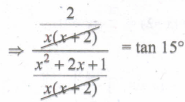
\(\Rightarrow \frac { 2 }{ { x }^{ 2 }+2x+1 } =\frac { \left( \sqrt { 3 } -1 \right) ^{ 2 } }{ 2 } \)
\(\Rightarrow \frac { 7 }{ (x+1)^{ 2 } } =\frac { \left( \sqrt { 3 } -1 \right) ^{ 2 } }{ 2 } \)
\(\Rightarrow 4=(x+1)^{ 2 }\left( \sqrt { 3 } -1 \right) ^{ 2 }\)
Taking square root both sides
\(2=(x+1)(\sqrt { 3 } -1)\)
\(\Rightarrow x+1=\frac { 2 }{ \sqrt { 3- } 1 } \times \frac { \sqrt { 3 } +1 }{ \sqrt { 3 } +1 } =\frac { 2\left( \sqrt { 3 } +1 \right) }{ 3-1 } =\sqrt { 3 } +1\)
\(x+1=\sqrt { 3 }+ 1\)
\(x=\sqrt { 3 } \)
35.
Here the number of unknowns is 3.
The matrix form of the system is AX = B, where
A = \(\left[ \begin{matrix} 1 & -1 & 1 \\ 2 & -2 & 2 \\ 3 & -3 & 3 \end{matrix} \right] \), X = \(\left[ \begin{matrix} x \\ y \\ z \end{matrix} \right] \), B = \(\left[ \begin{matrix} -9 \\ -18 \\ -27 \end{matrix} \right] \).
Applying elementary row operations on the augmented matrix[A | B], we get
[A | B] = \(\left[ \begin{matrix} 1 & -1 & 1 \\ 2 & -2 & 2 \\ 3 & -3 & 3 \end{matrix}|\begin{matrix} -9 \\ -18 \\ -27 \end{matrix} \right] \overset { \begin{matrix} { R }_{ 2 }\longrightarrow { R }_{ 2 }-2{ R }_{ 1 }, \\ { R }_{ 3 }\longrightarrow { R }_{ 3 }-3{ R }_{ 1 } \end{matrix} }{ \longrightarrow } \left[ \begin{matrix} 1 & -1 & 1 \\ 0 & 0 & 0 \\ 0 & 0 & 0 \end{matrix}|\begin{matrix} -9 \\ 0 \\ 0 \end{matrix} \right] \).
So, ρ(A) = ρ ([A | B]) = 1 < 3.
From the echelon form, we get the equivalent equations x - y + z = -9, 0 = 0, 0 = 0.
The equivalent system has one non-trivial equation and three unknowns.
Taking y = s, z = t arbitrarily, we get x - s + t = -9; x = -9 + s - t.
So, the solution is (x = -9 + s - t, y = s, z = t), where s and t are parameters.
The above solution set is a two-parameter family of solutions.
Here, the given system of equations is consistent and has infinitely many solutions which form a two parameter family of solutions.
36.
Applying Gauss-Jordan method, we get
[A | I2] = \(\left[ \begin{matrix} 0 & 5 \\ -1 & 6 \end{matrix}|\begin{matrix} 1 & 0 \\ 0 & 1 \end{matrix} \right] \overset { { R }_{ 1 }\leftrightarrow { R }_{ 2 } }{ \longrightarrow } \left[ \begin{matrix} -1 & 6 \\ 0 & 5 \end{matrix}|\begin{matrix} 0 & 1 \\ 1 & 0 \end{matrix} \right] \overset { { R }_{ 1 }\longrightarrow \left( -1 \right) { R }_{ 1 } }{ \longrightarrow } \left[ \begin{matrix} 1 & -6 \\ 0 & 5 \end{matrix}|\begin{matrix} 0 & -1 \\ 1 & 0 \end{matrix} \right] \)\(\overset { { R }_{ 1 }\longrightarrow \left( -1 \right) { R }_{ 1 } }{ \longrightarrow } \left[ \begin{matrix} 1 & -6 \\ 0 & 5 \end{matrix}|\begin{matrix} 0 & -1 \\ 1 & 0 \end{matrix} \right] \overset { { R }_{ 2 }\longrightarrow \frac { 1 }{ 5 } { R }_{ 2 } }{ \longrightarrow } \left[ \begin{matrix} 1 & -6 \\ 0 & 1 \end{matrix}|\begin{matrix} 0 & -1 \\ \left( 1/5 \right) & 0 \end{matrix} \right] \)\(\overset { { R }_{ 1 }\longrightarrow { R }_{ 1 }+6{ R }_{ 2 } }{ \longrightarrow } \left[ \begin{matrix} 1 & 0 \\ 0 & 1 \end{matrix}|\begin{matrix} \left( 6/5 \right) & -1 \\ \left( 1/5 \right) & 0 \end{matrix} \right] \).
So, we get A-1 = \(\left[ \begin{matrix} \left( 6/5 \right) & -1 \\ \left( 1/5 \right) & 0 \end{matrix} \right] =\frac { 1 }{ 5 } \left[ \begin{matrix} 6 & -5 \\ 1 & 0 \end{matrix} \right] \).
37.
Let the roots be in H.P. Then, their reciprocals are in A.P. and roots of the equation
\(\left( \frac { 1 }{ x } \right) ^{ 3 }+p\left( \frac { 1 }{ x } \right) ^{ 2 }+q\left( \frac { 1 }{ x } \right) \)+ r = 0 ⇔ rx3 + qx2 + px + 1 = 0.....(1)
Since the roots of (1) are in A.P., we can assume them as α-d, α, α+d
Applying the Vieta’s formula, we get
Σ1 = (α-d)+α+(α+d) = -\(\frac { q }{ r } \) ⇒ 3α = -\(\frac { q }{ r } \) ⇒ α = -\(\frac { q }{ 3r } \)
But, we note that α is a root of (1). Therefore, we get
\(r\left( -\frac { q }{ 3r } \right) ^{ 2 }+q\left( -\frac { q }{ 3r } \right) ^{ 2 }+p\left( -\frac { q }{ 3r } \right) \) + 1 = 0 ⇒ q3 + 3q3 - 9pqr + 27r2 = 0 ⇒ 2q3 + 27r2.
38.
Given \(p=\frac { 3 }{ 4 }\)
n = 5
P(X = x) = nCxpx (1-p)n-x
\(P(X=3)={ 5C }_{ 3 }\left( \frac { 3 }{ 4 } \right) ^{ 3 }\left( 1-\frac { 3 }{ 4 } \right) ^{ 2 }\)
\(P(X=3)={ 5C }_{ 2 }\left( \frac { 3 }{ 4 } \right) ^{ 3 }\left( \frac { 1 }{ 4 } \right) ^{ 2 }\) [∵nCr = nCn-r]
\(P(X=3)=\frac{5 \times 4}{2 \times 1} \times \frac{3 \times 3 \times 3}{4 \times 4 \times 4 \times 4 \times 4}\)
= \(\frac { 135 }{ 512 }\)
39.
\(\begin{matrix} lim \\ (x,y)\rightarrow (0,0) \end{matrix}cos=\left( \frac { { e }^{ x }siny }{ y } \right) \) = \(cos\left( { e }^{ 0 }\frac { siny }{ y } \right) \)
= cos[(1)(1)] = cos (1) \(\left[ \because \begin{matrix} lim \\ y\rightarrow 0 \end{matrix}\frac { siny }{ y } =1 \right] \)
40.
\(\)\(Mean=E(X)=\int _{ 1 }^{ 2 }{ f(x)dx=\int _{ 1 }^{ 2 }{ 2((x-1)dx } }\)
\(=2\left[\frac{8}{3}-\frac{4}{2}-\frac{1}{3}+\frac{1}{2}\right]\)
\(=2\left(\frac{7}{3}-\frac{3}{2}\right)\)
\(=2 \times \frac{5}{6}\)
\(=\frac{5}{3}\)
\(E({ x }^{ 2 })=\int _{ 1 }^{ 2 }{ { x }^{ 2 }f(x)dx }\)
= \(\int _{ 1 }^{ 2 }{ { x }^{ 2 }.2\left( x-1 \right) } dx\)
= \(2\int _{ 1 }^{ 2 }{ ({ x }^{ 3 }-{ x }^{ 2 })dx }\)
= \(2\left[ \frac { { x }^{ 4 } }{ 4 } -\frac { { x }^{ 3 } }{ 3 } \right] _{ 1 }^{ 2 }\)
= \(2\left[ \left( 4-\frac { 8 }{ 3 } \right) -\left( \frac { 1 }{ 4 } -\frac { 1 }{ 3 } \right) \right]\)
= \(2\left[ \frac { 4 }{ 3 } +\frac { 1 }{ 12 } \right] =2\left[ \frac { 16+1 }{ 12 } \right]\)
= \(\frac { 17 }{ 6 }\)
ஃ Var(X) = E(X2) - [E(X)]2
= \(\frac { 17 }{ 6 } -(\frac{5}{ 3 }^{ 2 })=\frac { 17 }{ 6 } -\frac { 25 }{ 9 }\)
= \(\frac{51-50}{18}\)
= \(\frac{1}{18}\)
41.
Volume of sphere = \(\frac43\) πr3
Given r = 5 mm
⇒ dr = (5.3 - 5) = 0.3 mm
\(\text { Approximate volume }=\frac{4}{\not 3} \pi \cdot \not 3 r^{2} d r\)
= 4π (52) (0.3)
= 100 π (0.3)
= 30π mm3
42.
| Q.no | Equation | condition | Type of the conic |
| 1 | 16y2 = −4x2+64 | 3 | Ellipse |
| 2 | x2+y2 = −4x−y+4 | 1 | Circle |
| 3 | x2−2y = x+3 | 2 | parabola |
| 4 | 4x2−9y2−16x+18y−29 = 0 | 4 | Hyperbola |

12th Standard Syllabus & Materials
12th Standard
TN 12th Computer Applications களப்பெயர் முறைமை (DNS) Sample Question Papers Study Material - QB365 Set A
NEW12th Standard
TN 12th Computer Applications வலையமைப்பு எடுத்துக்காட்டுகள் மற்றும் நெறிமுறைகள் Sample Question Papers Study Material - QB365 Set A
NEW12th Standard
TN 12th Computer Applications கணினி வலையமைப்பு ஓர் அறிமுகம் Sample Question Papers Study Material - QB365 Set A
NEW12th Standard
TN 12th Computer Applications PHP-உடன் MySQL-ஐ இணைத்தல் Sample Question Papers Study Material - QB365 Set A



Tamilnadu Stateboard 12th Standard Subjects
Maths

Chemistry

Physics

Biology

Computer Science

Business Maths and Statistics

Economics

Commerce

Accountancy

History

Computer Applications
Biology
Computer Technology
Computer Applications
Computer Science
Business Maths and Statistics
Commerce
Economics
Maths
Chemistry
Physics
Computer Technology
History
Accountancy

Tamil

English

French
Tamilnadu Stateboard Standards

