
 100% FREE ACCESS
12th Standard Syllabus & Materials
12th Standard
TN 12th Computer Applications மின்னணு தரவு பரிமாற்றம் Sample Question Papers Study Material - QB365 Set A
NEW12th Standard
TN 12th Computer Applications மின் - வணிக பாதுகாப்பு அமைப்புகள் Sample Question Papers Study Material - QB365 Set A
NEW12th Standard
TN 12th Computer Applications மின்னணு செலுத்தல் முறைகள் Sample Question Papers Study Material - QB365 Set A
NEW12th Standard
TN 12th Computer Applications மின் - வணிகம் Sample Question Papers Study Material - QB365 Set A
NEW12th Standard
TN 12th Computer Applications திறந்த மூல கருத்துருக்கள் Sample Question Papers Study Material - QB365 Set A
NEW12th Standard
TN 12th Computer Applications வலையமைப்பு வடமிடல் Sample Question Papers Study Material - QB365 Set A

Published on: 01/10/2019
QUARTERLY EXAM - 2019
Download Tamil Nadu 12th Standard Chemistry question papers, model tests, one-mark questions, important questions, and public exam papers in PDF format. Free study materials and answer keys for TN State Board students.
Questions + Answers key
Take MCQ Chemistry Test
1.
Which of the following statement is not correct?
Molecularity of a reaction cannot be fractional
Molecularity of a reaction cannot be more than three
Molecularity of a reaction can be zero
Molecularity is assigned for each elementary step of mechanism.
2.
Which one of the following compounds has similar structure to that of graphite?
Boron nitride
Boron Carbide
Aluminium Carbide
Aluminium Oxide
3.
The lanthanide contraction is responsible for the fact that _______.
Zr and Zn have the same oxidation state
Zr and Hf have almost the same radius
Zr and Nb have similar oxidation state
Zr and Y have similar radius
4.
Primary valency corresponds to the _______.
oxidation state of the metal
co-ordination number
number of ligands
charge on the complex
5.
Consider the following statements:
(i) increase in concentration of the reactant increases the rate of a zero order reaction.
(ii) rate constant k is equal to collision frequency A if Ea = 0
(iii) rate constant k is equal to collision frequency A if Ea = ∞
(iv) a plot of ln (k) vs T is a straight line.
(v) a plot of ln (k) vs \(\left( \frac { 1 }{ T } \right) \) is a straight line with a positive slope.
Correct statements are
(ii) only
(ii) and (iv)
(ii) and (v)
(i), (ii) and (v)
6.
CsCl has bcc arrangement, its unit cell edge length is 400pm, its inter atomic distance is ________.
400pm
800pm
\(\sqrt { 3 } \times 100pm\)
\(\left( \frac { \sqrt { 3 } }{ 2 } \right) \times 400pm\)
7.
Choose the correct statement.
Square planar complexes are more stable than octahedral complexes
The spin only magnetic moment of [Cu(Cl)4]2- is BM and it has square planar structure.
Crystal field splitting energy \(\left( { \Delta }_{ 0 } \right) \) [FeF6]4- is higher than the \((\Delta _{ 0 })\) of [Fe(CN)6]4-
crystal field stabilization energy of [V(H2O)6]2+ is higher than the crystal field stabilization of [Ti(H2O)6]2+
8.
Which one of the following will give a pair of enantiomorphs?
[Cr(NH3)6][Co(CN)6]
[Co(en)2Cl2]Cl
[Pt(NH3)4][PtCl4]
[Co(NH3)4Cl2]NO2
9.
Which one of the following statements related to lanthanons is incorrect?
Europium shows +2 oxidation state
The basicity decreases as the ionic radius decreases from Pr to Lu.
All the lanthanons are much more reactive than aluminium
Ce4+ solutions are widely used as oxidising agents in volumetric analysis.
10.
The catalytic behaviour of transition metals and their compounds is ascribed mainly due to _______.
their magnetic behaviour
their unfilled d orbitals
their ability to adopt variable oxidation states
their chemical reactivity
11.
Which of the following is not sp2 hybridised?
Graphite
graphene
Fullerene
dry ice
12.
Solid (A) reacts with strong aqueous NaOH liberating a foul smelling gas(B) which spontaneously burn in air giving smoky rings. A and B are respectively_________.
P4(red) & PH3
P4(white) & PH3
S8 & H2S
P4(white) & H2S
13.
Which of the following is not true with respect to Ellingham diagram?
Free energy changes follow a straight line. Deviation occurs when there is a phase change.
The graph for the formation of CO2 is a straight line almost parallel to free energy axis.
Negative slope of CO shows that it becomes more stable with increase in temperature.
Positive slope of metal oxides shows that their stabilities decrease with increase in temperature.
14.
Match items in column - I with the items of column – II and assign the correct code.
| Column-I | Column-II | ||
| A. | Cyanide process | (i) | Ultrapure Ge |
| B | Froth floatation process | (ii) | Dressing of ZnS |
| C | Electrolytic reduction | (iii) | Extraction of Al |
| D | Zone refining | (iv) | Extraction of Au |
| (v) | Purification of Ni | ||
| A | B | C | D |
| (i) | (ii) | (iii) | (iv) |
| A | B | C | D |
| (iii) | (iv) | (v) | (i) |
| A | B | C | D |
| (iv) | (ii) | (iii) | (i) |
| A | B | C | D |
| (ii) | (iii) | (i) | (v) |
15.
If the rate of a reaction gets doubled as the temperature is increased from 27oC to 37oC. Find the activation energy of reaction?
16.
Name the building block of zeolites. Why zeolites have high porosity?
17.
Deduce the oxidation number of oxygen in hypofluorous acid – HOF.
18.
Give a reaction between nitric acid and a basic oxide.
19.
20.
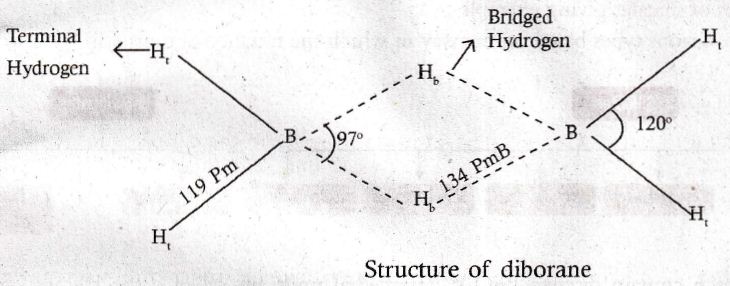
Describe the structure of diborane.
21.
Chalcogens belongs to p-block. Give reason.
22.
What is catenation ? describe briefly the catenation property of carbon.
23.
24.
Explain the electrometallurgy of aluminium.
25.
26.
Explain briefly the collision theory of bimolecular reactions.
27.
What are the limitations of VB theory?
28.
Discuss briefly the nature of bonding in metal carbonyls.
29.
Calculate the percentage efficiency of packing in case of body centered cubic crystal.
30.
Differentiate crystalline solids and amorphous solids.
31.
Explain the principle of electrolytic refining with an example.
32.
33.
Silver crystallizes in fcc lattice. If edge length of the cell is 4.07 x 10⁻⁸ em and density is 10.5 g cm-3. Calculate the atomic mass of silver
34.
Find out the oxidation state of carbon in each of the following:
(i) CaC2
(ii) H2CO3
(iii) HCN
(iv) CO
35.
A first order reaction is 40% complete in 50 minutes. Calculate the value of the rate constant. In what time will the reaction be 80% complete?
36.
How do nature of the reactant influence rate of reaction.
37.
Define half life of a reaction. Show that for a first order reaction half life is independent of initial concentration.
38.
39.
Compare lanthanoids and actinoids.
40.
Justify the position of lanthanoids and actinoids in the periodic table.
41.
Write briefly about the applications of coordination compounds in volumetric analysis
42.
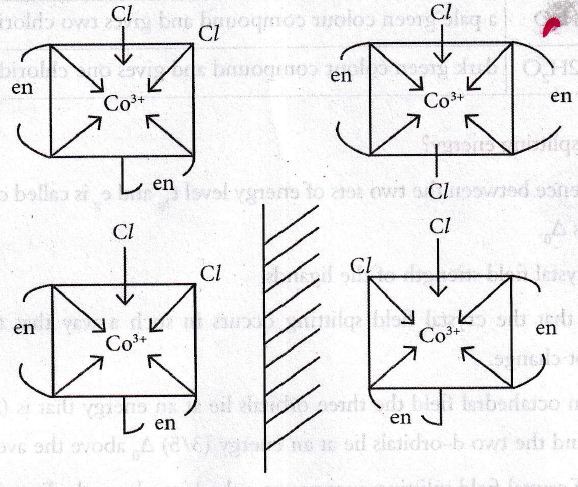
Draw all possible geometrical isomers of the complex [Co(en)2Cl2]+ and identify the optically active isomer.
43.
What is meant by the term “coordination number”? What is the coordination number of atoms in a bcc structure?
44.
How will you convert boric acid to boron nitride?
1.
(c)
Molecularity of a reaction can be zero
2.
(a)
Boron nitride
3.
(b)
Zr and Hf have almost the same radius
4.
(a)
oxidation state of the metal
5.
(rate constant K is equal to collision frequency A if Ea = 0)
In zero order reactions, increase in the concentration of reactant does not alter the rate.
So statement (i) is wrong.
\(k=A{ e }^{ -\left( \frac { { E }_{ a } }{ RT } \right) }\)
if Ea = 0 so, statement (ii) is correct, and statement (iii) is wrong
k = Ae0
k = A
In k = In A - \({ \left( \frac { { E }_{ a } }{ R } \right) }\) \(\left( \frac { 1 }{ T } \right) \)
This equation is of the form of a straight line y = mx+c
A plot of In k Vs \(\left( \frac { 1 }{ T } \right) \) gives a straight line with a negative slope
So statement (iv) and (v) are wrong.
6.
\(3 \sqrt{a} = r_{C_{s+}} + 2r_{C_{f-}} + r_{C_{s+}} \)
\(\left( \frac { \sqrt { 3 } }{ 2 } \right) a = r_{C_{s+}} + r_{C_{f-}} \)
\(\left( \frac { \sqrt { 3 } }{ 2 } \right) \times 400\)= inter ionic distance
7.
(d)
crystal field stabilization energy of [V(H2O)6]2+ is higher than the crystal field stabilization of [Ti(H2O)6]2+
8.
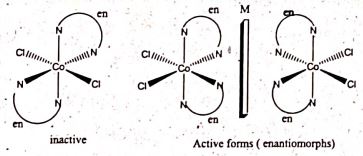
Complexes given in other options (a), (c) and (d) have symmetry elements and hence they are optically inactive.
9.
As we move from La to Lu, their metallic behaviour because almost similar to that of aluminium.
10.
(c)
their ability to adopt variable oxidation states
11.
(d)
dry ice
12.
(b)
P4(white) & PH3
13.
(b)
The graph for the formation of CO2 is a straight line almost parallel to free energy axis.
14.
(c)
| A | B | C | D |
| (iv) | (ii) | (iii) | (i) |
15.
In \(\frac { { k }_{ 2 } }{ { k }_{ 1 } } =\frac { { E }_{ a } }{ R } \left[ \frac { { T }_{ 2 }-{ T }_{ 1 } }{ { T }_{ 1 }{ T }_{ 2 } } \right] \)
In 2 = \(\frac { { E }_{ a } }{ R } \) \(\left[ \frac { 10 }{ 300\times 310 } \right] \)
Ea = 9300 R In 2
= 53.4 kJ mol-1
16.
(i) Zeolites have a three dimensional crystalline structure looks like a honeycomb consisting of a network of interconnected tunnels and cages.
(ii) Water molecules moves freely in and out of these pores hence they are highly porous.
17.
Oxidation number of F = -1
Oxidation number of H = +1
Oxidation number of O in HOF =x
(+1) + x + (-1) = 0
x = 0
Oxidation number of O in HOF = 0
18.
HNO3 reacts with basic oxides to form salts and water
ZnO + 2HNO3\(\longrightarrow \) Zn(NO3)2 + H2O
3FeO + 10HNO3 \(\longrightarrow \) 3Fe(NO3)3 + NO + 5H2O
19.
20.
(i) In diborane two BH2 units are linked by two bridged hydrogens.
(ii) It has eight B-H bonds.
(iii) Diborane has only 12 valance electrons.
(iv) The four terminal B-H- bonds is "2c - 2e" bond (two centre - two electron bond.)
(v) Two three centred B - H - B bonds two electrons each. "(3c - 2e)"
(vi) In diborane, the boron is "sp3" hybridised
(vii) Three of the four "sp3" hydridised orbitals contains single electron and the fourth orbital is empty.
21.
(i) The Chalcogens belong to group (16).
(ii) The group consists of elements: Oxygen, Sulphur, Selenium, Tellurium and Polonium.
(iii) These are ore forming elements as most of the ores are oxides and sulphides.
(iv) Chalcos meaning 'ore formers'.
22.
Catenation is an ability of an element to form chain of atoms.
The conditions for catenation.
(a) The valency of element is greater than or equal to two.
(b) Element should have an ability to bond with itself
(c) The self bond must be as strong as Its bond with other elements
(d) Kinetic inertness of catenated compound towards other molecules.
(e) Carbon possesses all the above properties and forms a wide range of compounds with itself and with other elements such as H, O, N, S and halogens.
23.
24.
1. This process is called as Hall-Heroult process.
Cathode: In this method, electrolysis is carried out in an iron tank lined with carbon which acts as the cathode.
Anode: The carbon blocks immersed in the electrolyte acts as a anode.
Eletrolyte: A 20% solution of alumina, obtained from the bauxite ore is mixed with molten Cryolite and is taken in the electrolysis chamber.
2. About 10% calcium chloride is also added to the solution.
3. Here Calcium chloride helps to lower the melting point of the mixture.
Temperature: The fused mixture is maintained at a temperature of above 1270 K.
4. The chemical reactions involved in this process as follows
(a) Ionisaiton of alumina: \({ A }l_{ 2 }{ O }_{ 3 }\longrightarrow { 2Al }^{ 3+ }+{ 3O }^{ 2- }\)
(b) Reaction at cathode: \(2{ Al }^{ 3+ }_{(melt)}+{ 6e }^{ - }\longrightarrow { Al }_{ (l) }\)
(c) Reaction at anode: \(6{ O }^{2-}_{(melt)}\longrightarrow { 3O }_{ 2 }+{ 12e }^{ - }\)
5. Since carbon acts as anode the following reaction also takes place
(a) \({ C }_{ (s) }+{ O }^{ 2- }_{(melt)}\longrightarrow CO+{ 2e }^{ - }\)
(b) \({ C }_{ (s) }+{ 2O }^{ 2- }_{(melt)}\longrightarrow { CO }_{ 2 }+{ 4e }^{ - }\)
6. Due to the above two reactions, anodes are slowly consumed during the electrolysis.
7. The pure aluminium is formed at the cathode. The net electrolysis reaction can be written as
\({ 4Al }^{ 3+ }_{(melt)}+{ 6O }^{ 2- }_{(melt)}+{ 3C }_{ (s) }\longrightarrow { 4Al }_{ (l) }+{ 3CO }_{ 2(g) }\)
25.
26.
(i) Collision theory is based on the kinetic theory of gases. According to this theory, a chemical reaction occurs as a result of collisions between the reacting molecules.
(ii) Let us understand this theory by considering the following reaction.
A2(g) + B2(g) ⟶ 2AB(g)
(iii) If we consider that, the reaction between A2 and B2 molecules proceeds through collisions between them, then the rate would be proportional to the number of collisions per second.
(iv) Rate ∝ number of molecules colliding per litre per second (collision rate).
(v) The number of collisions is directly proportional to the concentration of both A2 and B2.
Collison rate ∝ [A2][B2]
Collision rate = Z [A2][B2]
(vi) Where, Z is a constant
(vii) A fraction of effective collisions (f) is given by the following expression
\(f={ e }^{ \frac { { -E }_{ a } }{ RT } }\)
(xiv) This fraction of collisions is further reduced due to orientation factor i.e., even if the reactant collides with sufficient energy, they will not react unless the orientation of the reactant molecules is suitable for the formation of the transition state.
(viii) The diagram illustrates the importance of proper alignment of molecules which leads to reaction.
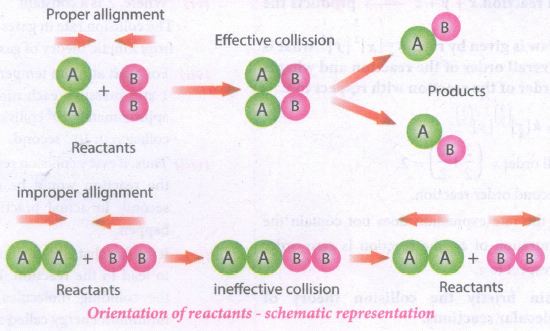
(ix) The fraction of effective collisions (f) having proper orientation is given by the steric factor p.
⇒ Rate = p x f x collision rate
\(\Rightarrow Rate=p\times { e }^{ \frac { -Ea }{ RT } }\times Z\left[ { A }_{ 2 } \right] \left[ { B }_{ 2 } \right] \quad ...(1)\)
As per the rate law,
Rate = \(k=\left[ { A }_{ 2 } \right] \left[ { B }_{ 2 } \right] \quad ...(2)\)
Where k is the rate constant
On comparing equation (1) and (2), the rate constant k is
\(k=pZ{ e }^{ \frac { -Ea }{ RT } }\)
27.
(i) It does not explain the colour of the complex.
(ii) It considers only the spin only magnetic moments and does not consider the other components of magnetic moments.
(iii) It does not provide a quantitative explanation as to why certain complexes are inner orbital complexes and the others are outer orbital complexes for the same metal. For example, [Fe(CN)6]4- is diamagnetic (low spin) whereas [FeF6]4- is paramagnetic (high spin).
28.
Bonding in metal carbonyls:
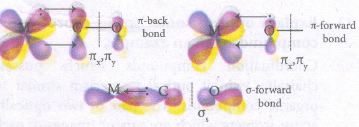
(i) In metal carbonyls, the bond between metal atom and the carbonyl ligand consists of two components.
(ii) The first component is an electron pair donation from the carbon atom of carbonyl ligand into a vacant d-orbital of central metal atom.
(iii) This electron pair donation forms \(M\overset { \sigma \ bond }{ \longleftarrow } \text {CO sigma bond}\)
(iv) This sigma bond formation increases the electron density in metal d orbitals and makes the metal electron rich.
(v) In order to compensate for this increased electron density, a filled metal d-orbital interacts with the empty \({ \pi }^{ \bigstar }\) orbital on the carbonyl ligand and transfers the added electron density back to the ligand.
(vi) This second component is called \(\pi\)-back bonding.
(vii) Thus in metal carbonyls, electron density moves from ligand to metal through sigma bonding and from metal to ligand through pi bonding, this synergic effect accounts for strong M⇽CO bond in metal carbonyls.
(viii) This phenomenon is shown diagrammatically as follows.
29.
In bcc unit cell, ΔABC
AC2 = AB2 + BC2
\(AC=\sqrt { { AB }^{ 2 }+{ BC }^{ 2 } } \)
\(\\ AC=\sqrt { { a }^{ 2 }+{ a }^{ 2 } } =\sqrt { { 2a }^{ 2 } } =\sqrt { 2 } a\)

In ΔACG
AG2 = AC2 + CG2
\(AG=\sqrt { { AC }^{ 2 }+{ CG }^{ 2 } } \)
\(AG=\sqrt { { \left( \sqrt { 2a } \right) }^{ 2 }+{ a }^{ 2 } } \)
\(AG=\sqrt { { 2a }^{ 2 }+{ a }^{ 2 } } =\sqrt { { 3a }^{ 2 } } \)
\(AG=\sqrt { 3a } \)
\(\sqrt { 3 } a=4r\)
\(r=\frac { \sqrt { 3 } }{ 4 } a\)
∴ Volume of the sphere with radius 'r' \(=\frac { 4 }{ 3 } { \pi r }^{ 3 }\)
\(=\frac{4}{3}\pi { \left( \frac { \sqrt { 3 } }{ 4 } a \right) }^{ 3 }\)\(=\frac { \sqrt { 3 } }{ 16 } \pi { a }^{ 3 }\)
Number of spheres belong to a unit cell in BCC arrangement is equal to two and hence the total volume of all spheres.
(i) Packing fraction = \(=\frac{Total \quad volume \quad occupied \quad by \quad spheres \quad in \quad a \quad unit \quad cell}{volume \quad of \quad the \quad unit \quad cell}\times100\)
\(\therefore\)Volume of all spheres \(=2\times \left( \frac { \sqrt { 3 } \pi { a }^{ 3 } }{ 16 } \right) =\frac { \sqrt { 3 } \pi { a }^{ 3 } }{ 8 } \)
Packing fraction \(=\frac { \left( \frac { \sqrt { 3 } \pi { a }^{ 3 } }{ 8 } \right) }{ ({ a }^{ 3 }) } \times 100\)
\(=\frac { \sqrt { 3 } \pi }{ 8 } \times 100\)
\(\\ =\sqrt { 3 } \pi \times 12.5\)
= 1.732 x 3.14 x 12.5
= 68%
30.
| S. No | Crystalline Solids | Amorphous Solids |
| 1. | Long range orderly arrangement of constituents. | Short range, random arrangement of constituents. |
| 2. | Definite shape | Irregular shape |
| 3. | Anisotropic in nature | They are "isotropic" like liquids |
| 4. | They are true solids | They are considered as pseudo solids (or) super cooled liquids |
| 5. | Definite Heat of fusion | Heat of fusion is not definite |
| 6. | They have sharp melting points. | Gradually soften over a range of temperature and so can be moulded. |
| 7. | Eg: NaCl, diamond etc. | Eg: Rubber, plastics, glass etc. |
31.
1. The crude metal is refined by electrolysis. It is carried out in an electrolytic cell
Anode : Impure metal to be refined with dilute acid.
Cathode : Thin strips of pure metal
Electrolyte : Aqueous solution of the salts of the metal with dilute acid.
2. The metal dissolves from the anode, pass into the solution.
3. At the same amount of metal ions from the solution will be deposited at the cathode.
4. During electrolysis, the less electropositive impurities in the anode, settle down at the bottom and are removed as anode mud.
Example: Electrolytic refining of silver.
Cathode: Pure silver
Anode: lmpure silver rods
Electrolyte: Acidified aqueous solution of silver nitrate
5. When a current is passed through the electrodes the following reactions will take place
(a) Reaction at anode: \({ Ag }_{ (s) }\longrightarrow { Ag }^{ + }_{ (aq) }+{ 1e }^{ - }\)
(b) Reaction at cathode: \({ Ag }^{ + }_{ (aq) }+{ 1e }^{ - }\longrightarrow { Ag }_{ (s) }\)
6. During electrolysis, at anode silver loses electrons and form silver ions and the silver ions migrate towards the cathode and get discharged and deposited on the cathode.
7. Copper, Zinc etc can also be refined by this process.
32.
(d)
33.
\(M=\frac { d\times { a }^{ 3 }\times NA }{ g } \)
d = Density of the material
a = Length of the edge of the cell.
NA = Avogadro number
Z = No. of atoms
\(M=\frac { 10.5{ gcm }^{ -3 }{ (4.07\times { 10 }^{ -6 }cm) }^{ 3 }\times \left( 6.023\times { 10 }^{ 23 }{ mol }^{ -1 } \right) }{ 4 } \)
Atomic mass of silver M = 107.08 g mol-1.
34.
(i) CaC2
2 + 2x = 0
2x = -2
x = -1
(ii) H2CO3
2 + x + (-6) = 0
x = +4
(iii) HCN
1 + x + (-3) = 0
x = +3 - 1 = +2
(iv) CO
x + (-2) = 0
x= +2
35.
Let \(\left[A_{0}\right]=100 \%\), t = 50 minutes
Then [A]=100 - 40 = 60 %
(1) \(\mathrm{k}=\frac{2.303}{\mathrm{t}} \log \frac{\left[\mathrm{A}_{\mathrm{o}}\right]}{[\mathrm{A}]}\)
\(=\frac{2.303}{50} \log \left(\frac{100}{60}\right) \)
\(=\frac{2.303}{50} \log 1.667 \)
\(=\frac{2.303}{50} \times 0.2219 \)
\(\mathrm{k}=0.010216 \mathrm{~min}^{-1} \)
\(\mathrm{k}=1 \times 10^{-2} \mathrm{~min}^{-1}\)
(2) \( t =\frac{2.303}{0.010216} \log \left(\frac{100}{20}\right) \)
\(t =\frac{2.303}{{0.010216}}\times 0.6990\)
= 225.43 \(\times \) 0.6990
t = 157.58 min.
The time at which the reaction will be 80% complete is 157.58 min.
36.
(i) The chemical reaction involves breaking of certain existing bonds of the reactant and forming new bonds which lead to the product.
(ii) The net energy involved in this process is dependent on the nature of the reactant and hence the rates are different for different reactants.
Example:
Let us compare the following two reactions that you carried out in volumetric analysis.
1) Redox reaction between ferrous Ammonium Sulphate (FAS) and KMnO4.
2) Redox reaction between oxalic acid and KMnO4.
(i) The oxidation of oxalate ion by KMnO4 is relatively slow compared to the reaction between KMnO4 and Fe2+. In fact heating is required for the reaction between KMnO4 and Oxalate ion and is carried out at around 60oC.
(ii) The physical state of the reactant also plays an important role to influence the rate of reactions.
(iii) Gas phase reactions are faster as compared to the reactions involving solid or liquid reactants.
Ex : Na(s) + I2(vap) [Faster]
Na(s) + I2(s) [Slower]
KI(aq) + Pb(NO3)2(aq) → PbI2 (yellow) [Faster]
KI(s) + Pb(NO3)2(s) → PbI2 (yellow) [Slower]
37.
(i) The half life of a reaction is defined as the time required for the reactant concentration to reach one half its initial value.
\(k=\frac { 2.303 }{ t } log\frac { \left[ { A }_{ 0 } \right] }{ \left[ A \right] } \)
\(at\quad t={ t }_{ \frac { 1 }{ 2 } };\left[ A \right] =\frac { \left[ { A }_{ 0 } \right] }{ 2 } \)
\(k=\frac { 2.303 }{ t_{ 1/2 } } log\frac { \left[ { A }_{ 0 } \right] }{ \frac { \left[ { A }_{ 0 } \right] }{ 2 } } \)
\(k=\frac { 2.303 }{ { t }_{ 1/2 } } log2\)
\(k=\frac { 2.303\times 0.3010 }{ { t }_{ 1/2 } } =\frac { 0.6932 }{ { t }_{ 1/2 } } \)
\({ t }_{ 1/2 }=\frac { 0.6932 }{ k } \)
This equation has no concentration term So, the half life of a first order reaction is independent of initial concentration.
38.
39.
| S.No | Lanthanoids | Actinoids |
|---|---|---|
| 1. | Differentiating electron enters in 4f orbital | Differentiating electron enters in 5f orbital |
| 2. | Binding energy of 4f orbitals are higher | Binding energy of 5f orbitals are lower |
| 3. | They show less tendency to form complexes | They show greater tendency to form complexes |
| 4. | Most of the lanthanoids are colourless | Most of the actinoids are coloured For Example: U3+ (red) U4+ (green). |
| 5. | They do not form oxo cations | They do form oxo cations such as UO22+, NpO22++ etc. |
| 6. | Besides +3 oxidation states lanthanoids show +2 and +4 oxidation states in few cases | Besides +3 oxidation states actinoids show higher oxidation states such as +4, +5, +6 and +7 |
40.
(i) The actual position of Lanthanides in the periodic table is at group number 3 and period number 6. However, in the sixth period after lanthanum, the electrons are preferentially filled in inner 4f sub shell and these fourteen elements following lanthanum show similar chemical properties.
(ii) Similarly the fourteen elements following actinium resemble in their physical and chemical properties. Hence they are placed separately bottom of the modern periodic table.
41.
(i) EDTA is used in the volumetric determination of a wide variety of metal ions in solution.
Eg. Zn2+, Pb2+, Ca2+, CO2+, Ni2+,Cu2+, etc.
(ii) By careful adjustment of the pH and using suitable indication, mixtures of metals can v be analyzed.
Eg. Bi3+in the presence of Pb2+
(iii) Hardness of water due to the presence of Ca2+ and Mg2+ ions is estimated by complexometric titrations using EDTA.
42.
[Co (en)2 Cl2]+ This is an octahedral complex
43.
1. The number of nearest neighbours that surrounding a particle in a crystal is called the coordination number of that particle.
2. The coordination number of atoms in a bcc structure is '8'.
44.
Fusion of urea with B(OH)3' in an atmosphere of ammonia at 800 - 1200 K gives boron nitride.
B(OH)3 + NH3 \(\overset { \Delta }{ \longrightarrow } \) BN+ 3H2O

12th Standard Syllabus & Materials
12th Standard
TN 12th Computer Applications களப்பெயர் முறைமை (DNS) Sample Question Papers Study Material - QB365 Set A
NEW12th Standard
TN 12th Computer Applications வலையமைப்பு எடுத்துக்காட்டுகள் மற்றும் நெறிமுறைகள் Sample Question Papers Study Material - QB365 Set A
NEW12th Standard
TN 12th Computer Applications கணினி வலையமைப்பு ஓர் அறிமுகம் Sample Question Papers Study Material - QB365 Set A
NEW12th Standard
TN 12th Computer Applications PHP-உடன் MySQL-ஐ இணைத்தல் Sample Question Papers Study Material - QB365 Set A



Tamilnadu Stateboard 12th Standard Subjects

Maths
Chemistry

Physics

Biology

Computer Science

Business Maths and Statistics

Economics

Commerce

Accountancy

History

Computer Applications
Biology
Computer Technology
Computer Applications
Computer Science
Business Maths and Statistics
Commerce
Economics
Maths
Chemistry
Physics
Computer Technology
History
Accountancy

Tamil

English

French
Tamilnadu Stateboard Standards
