
 100% FREE ACCESS
12th Standard Syllabus & Materials
12th Standard
TN 12th Computer Applications மின்னணு தரவு பரிமாற்றம் Sample Question Papers Study Material - QB365 Set A
NEW12th Standard
TN 12th Computer Applications மின் - வணிக பாதுகாப்பு அமைப்புகள் Sample Question Papers Study Material - QB365 Set A
NEW12th Standard
TN 12th Computer Applications மின்னணு செலுத்தல் முறைகள் Sample Question Papers Study Material - QB365 Set A
NEW12th Standard
TN 12th Computer Applications மின் - வணிகம் Sample Question Papers Study Material - QB365 Set A
NEW12th Standard
TN 12th Computer Applications திறந்த மூல கருத்துருக்கள் Sample Question Papers Study Material - QB365 Set A
NEW12th Standard
TN 12th Computer Applications வலையமைப்பு வடமிடல் Sample Question Papers Study Material - QB365 Set A

Published on: 01/09/2019
Download Tamil Nadu 12th Standard Business Maths and Statistics question papers, model tests, one-mark questions, important questions, and public exam papers in PDF format. Free study materials and answer keys for TN State Board students.
Questions + Answers key
Take MCQ Business Maths and Statistics Test1.
The demand and supply curves are given by \({ P }_{ d }=\frac { 16 }{ x+4 } \) and \(P_s=\frac { x }{ 2 } \) . Find the Consumer's surplus and producer's surplus at the market equilibrium price.
2.
The demand and supply functions under pure competition are Pd = 16 - x2 and ps = 2x2 + 4. Find the consumer's surplus and producer's surplus at the market equilibrium price.
3.
In an examination the number of candidates who secured marks between certain interval were as follows
| Marks | 0-19 | 20-39 | 40-59 | 60-79 | 80-99 |
| No.of.candidates | 41 | 62 | 65 | 50 | 17 |
Estimate the number of candidates whose marks are lessthan 70.
4.
Estimate the production for 1964 and 1966 from the following data
| Year | 1961 | 1962 | 1963 | 1964 | 1965 | 1966 | 1967 |
| Production | 200 | 220 | 260 | - | 350 | - | 430 |
5.
From the following table of half- yearly premium for policies maturing at different ages. Estimate the premium for policies maturing at the age of 63.
| Age | 45 | 50 | 55 | 60 | 65 |
| Premium | 114.84 | 96.16 | 83.32 | 74.48 | 68.48 |
6.
The population of a certain town is as follows
| Year : x | 1941 | 1951 | 1961 | 1971 | 1981 | 1991 |
| Population in lakhs:y | 20 | 24 | 29 | 36 | 46 | 51 |
Using appropriate interpolation formula, estimate the population during the period 1946.
7.
From the following table find the number of students who obtained marks less than 45.
| Marks | 30-40 | 40-50 | 50-60 | 60-70 | 70-80 |
| No. of Students | 31 | 42 | 51 | 35 | 31 |
8.
Solve \(\frac { dy }{ dx } \) −3ycot x = sin 2x given that y = 2 when x = \(\frac { \pi }{ 2 } \)
9.
The demand and supply function of a commodity are pd = 18− 2x − x2 and ps = 2x − 3 . Find the consumer’s surplus and producer’s surplus at equilibrium price.
10.
The elasticity of demand with respect to price p for a commodity is \(\eta _{ d }=\frac { p+2{ p }^{ 2 } }{ 100-p-{ p }^{ 2 } } \).Find demand function where price is Rs. 5 and the demand is 70.
11.
The marginal cost and marginal revenue with respect to commodity of a firm are given by C'(x) = 8 + 6x and R'(x)= 24. Find the total Profit given that the total cost at zero output is zero.
12.
13.
Evaluate \(\int { \frac { { 3x }^{ 2 }+6x+1 }{ \left( x+3 \right) \left( { x }^{ 2 }+1 \right) } } dx\)
14.
Evaluate \(\int { \frac { 3x+2 }{ { \left( x-2 \right) }^{ 2 }\left( x-3 \right) } dx } \)
15.
A salesman has the following record of sales during three months for three items A, B and C, which have different rates of commission.
| Months | Sales of units | Total commission drawn (in Rs) | ||
| A | B | C | ||
| January | 90 | 100 | 20 | 800 |
| February | 130 | 50 | 40 | 900 |
| March | 60 | 100 | 30 | 850 |
Find out the rate of commission on the items A, B and C by using Cramer’s rule
16.
A new transit system has just gone into operation in Chennai. Of those who use the transit system this year, 30% will switch over to using metro train next year and 70% will continue to use the transit system. Of those who use metro train this year, 70% will continue to use metro train next year and 30% will switch over to the transit system. Suppose the population of Chennai city remains constant and that 60% of the commuters use the transit system and 40% of the commuters use metro train this year.
(i) What percent of commuters will be using the transit system after one year?
(ii) What percent of commuters will be using the transit system in the long run?
17.
80% of students who do maths work during one study period, will do the maths work at the next study period. 30% of students who do english work during one study period, will do the english work at the next study period. Initially there were 60 students do maths work and 40 students do english work.
Calculate,
(i) The transition probability matrix
(ii) The number of students who do maths work, english work for the next subsequent 2 study periods.
18.
The price of three commodities X, Y and Z are x, y and z respectively Mr. Anand purchases 6 units of Z and sells 2 units of X and 3 units of Y. Mr. Amar purchases a unit of Y and sells 3 units of X and 2units of Z. Mr. Amit purchases a unit of X and sells 3 units of Y and a unit of Z. In the process they earn Rs. 5,000/-, Rs. 2,000/- and Rs. 5,500/- respectively. Find the prices per unit of three commodities by rank method.
19.
The total number of units produced (P) is a linear function of amount of over times in labour (in hours) (l), amount of additional machine time (m) and fixed finishing time (a)
i.e, P = a + bl + cm
From the data given below, find the values of constants a, b and c
| Day | Production (in Units P) |
Labour (in Hrs l) |
Additional Machine Time (in Hrs m) |
| Monday Tuesday Wednesday |
6,950 6,725 7,100 |
40 35 40 |
10 9 12 |
Estimate the production when overtime in labour is 50 hrs and additional machine time is 15 hrs.
20.
Investigate for what values of ‘a’ and ‘b’ the following system of equations x + y + z = 6,x + 2y + 3z = 10, x + 2y + az = b have
(i) no solution
(ii) a unique solution
(iii) an infinite number of solutions.
21.
Show that the equations x + y + z = 6, x + 2y + 3z = 14, x + 4y + 7z = 30 are consistent and solve them.
22.
Show that the equations 2x + y + z = 5, x + y + z = 4, x − y + 2z = 1 are consistent and hence solve them.
23.
If f(x) = \(\begin{cases} { x }^{ 2 }, \\ x, \\ x-4, \end{cases}\begin{matrix} -2 & \le & x \\ 1 & \le & x \\ 2 & \le & x \end{matrix}\begin{matrix} < & 1 \\ < & 2 \\ \le & 4 \end{matrix}\), then find the following
(i) \(\int_{-2}^{1} f(x) d x\)
(ii) \(\int_{1}^{2} f(x) d x\)
(iii) \(\int_{2}^{3} f(x) d x\)
(iv) \(\int_{-2}^{1.5} f(x) d x\)
(v) \(\int_{1}^{3} f(x) d x\)
24.
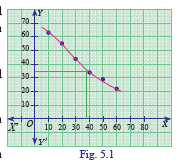
Using graphic method, find the value of y when x = 38 from the following data:
| x | 10 | 20 | 30 | 40 | 50 | 60 |
| y | 63 | 55 | 44 | 34 | 29 | 22 |
25.
Solve \(y d x-x d y-3 x^{2} y^{2} e^{x^{3}} d x=0\)
1.
For market equilibrium, Pd = Ps
\({ P }_{ d }=\frac { 16 }{ x+4 } =\frac { x }{ 2 } \Rightarrow 32=x(x+4)\)
⇒ 32-x2+4x
⇒ x2+4x-32 = 0
⇒ (x+8)(x-4) = 0
⇒ x = -8, x = 4
Since x = - 8 is not possible, Xo = 4
\(\therefore { p }_{ 0 }=\frac { 16 }{ 4+4 } =\frac { 16 }{ 8 } =2\)
\(\therefore { p }_{ 0 }{ x }_{ 0 }=2(4)=8\)
Consumer's Surplus \(CS=\int _{ 0 }^{ x0 }{ f(x)dx-{ p }_{ 0 }{ x }_{ 0 } } \)
\(Cs=\int _{ 0 }^{ 4 }{ \frac { 16 }{ x+4 } dx-8 } \)
\(={ \left[ 16log(x+4) \right] }_{ 0 }^{ 4 }-8\)
\(=16\left[ log(4+4)-log(0+4) \right] -8\)
\(=16[log\quad 8-log4]-8\)
\(=16log\left( \frac { 8 }{ 4 } \right) -8\)
CS=(16 log 2-8)units.
Producer's Surplus \(PS={ p }_{ 0 }{ x }_{ 0 }-\int _{ 0 }^{ x0 }{ g(x)dx } \)
\(=8-\int _{ 0 }^{ 4 }{ \frac { x }{ 2 } dx } =8-{ \left[ \frac { { x }^{ 2 } }{ 4 } \right] }_{ 0 }^{ 4 }\)
\(=8-\left[ \frac { { 4 }^{ 2 } }{ 4 } \right] =8-\frac { 16 }{ 4 } =8-4\)
PS = 4units
2.
For market equilibrium, Pd = ps
⇒ 16-x2 = 2x2+4
⇒ 16-4 = 2x2+x2
⇒ 3x2 = 12
⇒ x2 = 4
⇒ x = 土2
Since x = 2 is not possible x0 = 2
p0 = 16 - 22 = 16 - 4 = 12
∴ p0x0 = 2 x 12 = 24
Consumer's Surplus CS \(\int _{ 0 }^{ x0 }{ f(x)dx-{ p }_{ 0 }{ x }_{ 0 } } \)
\(=\int _{ 0 }^{ 2 }{ (16-{ x }^{ 2 }) } dx-24\)
\(={ \left[ 16x-\frac { { x }^{ 3 } }{ 3 } \right] }_{ 0 }^{ 2 }-24\)
\(=16(2)-\frac { { 2 }^{ 3 } }{ 3 } -24\)
\(=32-\frac { 8 }{ 3 } -24\)
\(=8-\frac { 8 }{ 3 } -24\)
\(=\frac { 16 }{ 3 } \) units
Producer's Surplus \(PS={ p }_{ 0 }{ x }_{ 0 }-\int _{ 0 }^{ x0 }{ g(x)dx } \)
\(=24-\int _{ 0 }^{ 2 }{ (2{ x }^{ 2 }+4)dx } \)
\(=24-{ \left[ \frac { { 2x }^{ 3 } }{ 3 } +4x \right] }_{ 0 }^{ 2 }\)
\(=24-\left[ \frac { 16 }{ 3 } +8 \right] \)
\(=24-\frac { 16 }{ 3 } -8=16-\frac { 16 }{ 3 } \)
\(=\frac { 48-16 }{ 3 } =\frac { 32 }{ 3 } \)units
3.
Given
| Marks | 0-19 | 20-39 | 40-59 | 60-79 | 80-99 |
| No.of.candidates | 41 | 62 | 65 | 50 | 17 |
This can be rewritten as
| Marks: | Below 19 |
Below 39 |
Below 59 |
Below 79 |
Below 99 |
|---|---|---|---|---|---|
| No. of. candidates: |
41 | (41 + 62) =103 |
(41 + 62 + 65) = 168 |
(41 + 62 + 65 + 50) =218 |
(41 + 62 + 65 + 50 + 17) = 235 |
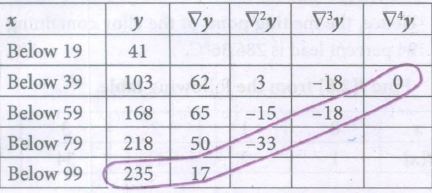
Since we have to find below 70, use Newton's backward interpolation formula
∴ xn + nh = 70 ⇒ 99 + n(20) = 70
⇒ 20n = 70 - 99 = -29
⇒ n = \(\frac{-29}{20}\) = -1.45
∴ y70 = yn + \(\frac { n }{ 1! } { \triangledown y }_{ n }+\frac { n(n+1) }{ 2! } { \triangledown }^{ 2 }{ y }_{ n }+\frac { n(n+1)(n+2) }{ 3! } { \triangledown }^{ 3 }{ y }_{ n }\)
\(=235-1.45(17)+\frac { (-1.45)(-1.45+1) }{ 2 } (-33)+\frac { (-1.45)(-1.45+2)(-18) }{ 6 } \)
\(=235-24.65+\frac { (-1.45)(-.45) }{ 2 } (-33)+\) (-1.45)(-0.45)(0.55)(-3)
= 235 - 24.65 - 12.375 - 1.125
= 196
Hence, the number of students who have scored below 70 are 196 (app).
4.
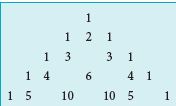
Since five values are given, the polynomial which fits the data is of degree four.
Hence Δ5yk = 0 (i.e) (E−1)5yk = 0
i.e., (E5 - 5E4 + 10E3 - 10E2 + 5E - 1)yk = 0
E5yk - 5E4yk+ 10E3yk- 10E2yk+ 5Eyk - yk = 0 (1)
Put k = 0 in (1)
E5y0 - 5E4y0+ 10E3y0- 10E2y0+ 5Ey0 - y0 = 0
y5 − 5y4 + 10y3 − 10y2 +5 y1 - y0 = 0
y5 − 5(350) +10y3−10(260)+5(220)− 200 = 0
y5 + 10y3 = 3450 (2)
Put k = 1 in (1)
E5y1 - 5E4y1+ 10E3y1- 10E2y1+ 5Ey1- y0 = 0
y6 − 5y5 + 10y4 −1 0y3 − y1 = 0
430 −5y5 +10(350) −10y3 + 5(260)− 220 = 0
5y5+10y3 = 5010 (3)
(3) – (2) ⇒ 4y5 = 1560
y5 = 390
From (1) 390 +10y3 = 3450
10y3 = 3450 – 390
y3 ≅ 306
5.
Let age = x and premium = y
To find y at x = 63
So apply Newton’s backward interpolation formula
\({ y }_{ \left( x={ x }_{ 0 }+nh \right) }={ y }_{ 0 }+\frac { n }{ n! } \Delta { y }_{ 0 }+\frac { n(n-1) }{ 2! } { \Delta }^{ 2 }{ y }_{ 0 }+\frac { n(n-)(n-2) }{ 3! } { \Delta }^{ 3 }{ y }_{ 0 }+..\)
| x | y | \(\Delta y\) | \(\Delta ^{ 2 }y\) | \(\Delta ^{ 2 }y\) | \(\Delta ^{ 4 }y\) |
| 45 | 114.84 | ||||
| -18.68 | |||||
| 50 | 96.16 | 5.84 | |||
| -12.84 | -1.84 | ||||
| 55 | 83.32 | 4 | 0.68 | ||
| -8.84 | -1.16 | ||||
| 60 | 74.48 | 2.84 | |||
| -6 | |||||
| 65 | 68.48 |
\({ y }_{ (x=6.5) }=68.48+\frac { \frac { -2 }{ 5 } }{ 1! } \left( -6 \right) +\frac { \frac { -2 }{ 5 } \left( \frac { -2 }{ 5 } +1 \right) }{ 2! } 2.84+\frac { \frac { -2 }{ 5 } \left( \frac { -2 }{ 5 } +1 \right) \left( \frac { -2 }{ 5 } +2 \right) }{ 3! } \left( -1.16 \right) +\frac { \frac { -2 }{ 5 } \left( \frac { -2 }{ 5 } +1 \right) \left( \frac { -2 }{ 5 } +2 \right) \left( \frac { -2 }{ 5 } +3 \right) }{ 3! } (0.68)\)
= 68.48 + 2.4 – 0.3408 + 0.07424 – 0 – 0.028288
y(63) = 70.437
6.
| x | 1941 | 1951 | 1961 | 1971 | 1981 | 1991 |
| y | 20 | 24 | 29 | 36 | 46 | 51 |
Here we find the population for year 1946. (i.e) the value of y at x = 1946. Since the value of y is required near the beginning of the table, we use the Newton’s forward interpolation formula.
\({ y }_{ \left( x={ x }_{ 0 }+nh \right) }={ y }_{ 0 }+\frac { n }{ n! } \Delta { y }_{ 0 }+\frac { n(n-1) }{ 2! } { \Delta }^{ 2 }{ y }_{ 0 }+\frac { n(n-)(n-2) }{ 3! } { \Delta }^{ 3 }{ y }_{ 0 }+..\)
To find y at x = 1946
\(\therefore\) x0 + nh = 1946, x0 = 1941, h = 10
1941 + n(10) = 1946 \(\Rightarrow\) n = 0.5
| x | y | \(\Delta y\) | \(\Delta ^{ 2 }y\) | \(\Delta ^{ 3 }y\) | \(\Delta ^{ 4 }y\) | \(\Delta ^{ 5 }y\) |
| 1941 | 20 | |||||
| 4 | ||||||
| 1951 | 24 | 1 | ||||
| 5 | 1 | |||||
| 1961 | 29 | 2 | 0 | |||
| 7 | 1 | -9 | ||||
| 1971 | 36 | 3 | -9 | |||
| 10 | -8 | |||||
| 1981 | 46 | -5 | ||||
| 5 | ||||||
| 1991 | 51 |
Here we find the population for year 1946. (i.e) the value of y at x = 1946. Since the value of y is required near the beginning of the table, we use the Newton’s forward interpolation formula.
\({ y }_{ \left( x=1946 \right) }=20+\frac { 0.5 }{ 1! } (4)+\frac { 0.5(0.5-1) }{ 2! } (1)+\frac { 0.5(0.5-1)(0.5-2) }{ 3! } (1)+\frac { 0.5(0.5-1)(0.5-2)(0.5-3) }{ 4! } (0)+\frac { 0.5(0.5-1)(0.5-2)(0.5-3)(0.5-4) }{ 5! } (-9)\)
= 20+2-0.125+0.0625-0.24609
= 21.69 lakhs
7.
Let x be the marks and y be the number of students
By converting the given series into cumulative frequency distribution, the difference table is as follows.
| x | y | \(\Delta y\) | \(\Delta ^{ 2 }y\) | \(\Delta ^{ 2 }y\) | \(\Delta ^{ 4 }y\) |
| Less than 40 | 31 | ||||
| 42 | |||||
| 50 | 73 | 9 | |||
| 51 | –25 | ||||
| 60 | 124 | -16 | |||
| 35 | 12 | ||||
| 70 | 159 | -4 | |||
| 31 | |||||
| 80 | 190 |
\({ y }_{ \left( x={ x }_{ 0 }+nh \right) }={ y }_{ 0 }+\frac { n }{ n! } \Delta { y }_{ 0 }+\frac { n(n-1) }{ 2! } { \Delta }^{ 2 }{ y }_{ 0 }+\frac { n(n-)(n-2) }{ 3! } { \Delta }^{ 3 }{ y }_{ 0 }+...\)
To find y at x = 45
\(\therefore\) x0+nh = 45 , x0 = 40, h = 10 \(\Rightarrow n=\frac { 1 }{ 2 } \)
y(x = 45) = \(31+\frac { 1 }{ 2 } \times 42+\frac { \frac { 1 }{ 2 } \left( \frac { -1 }{ 2 } \right) }{ 2 } (9)+\cfrac { \frac { 1 }{ 2 } \left( \frac { -1 }{ 2 } \right) \left( \frac { -3 }{ 2 } \right) }{ 6 } \times \left( -25 \right) +\frac { \frac { 1 }{ 2 } \left( \frac { -1 }{ 2 } \right) \left( \frac { -3 }{ 2 } \right) \left( \frac { -5 }{ 2 } \right) }{ 24 } \times \left( -37 \right) \)
= \(31+21-\frac { 9 }{ 8 } -\frac { 25 }{ 16 } -\frac { 37\times 15 }{ 384 } \)
= 47.867 ≅ 48
8.
Given \(\frac { dy }{ dx } \) − (3 cot x) y = sin 2x
It is of the form \(\frac { dy }{ dx } \) + Py = Q
Here P= − 3 cot x,Q = sin 2x
ഽPdx = ഽ-3 cot xdx = -3 log sin x = - log sin3x = log \(\frac { 1 }{ { sin }^{ 3 }x } \)
I.F. = \({ e }^{ log\frac { 1 }{ { sin }^{ 3 }x } }=\frac { 1 }{ { sin }^{ 3 }x } \)
The required solution is y (I.F) = ഽQ(I.F)dx+c
\(y\frac { 1 }{ { sin }^{ 3 }x } =\int { sin2x } \frac { 1 }{ { sin }^{ 3 }x } dx+c\)
\(\int { \frac { 1 }{ { sin }^{ 3 }x } } =\int { 2sinxcosx\times \frac { 1 }{ { sin }^{ 3 }x } } dx+c\)
= \(2\int { \frac { 1 }{ sinx } \times \frac { cosx }{ sinx } } dx+c\)
= ഽcos ecx cot xdx + c
\(y\frac { 1 }{ { sin }^{ 3 }x } =-2cosecx+c\)
Now y = 2 when x = \(\frac { \pi }{ 2 } \)
(1) ⇒ 2\(\frac {1 }{ 1 } \) = −2×1+c ⇒ c= 4
∴ (1) ⇒ \(y\frac { 1 }{ { sin }^{ 3 }x } \) = −2cosecx + 4
9.
Given Pd = 18− 2x − x2 ; Ps = 2x − 3
We know that at equilibrium prices pd = ps
18− 2x − x2 = 2x – 3
x2 + 4x −21 = 0
(x − 3) (x + 7) = 0
x = –7 or 3
The value of x cannot be negative, x = 3
When x0 = 3
ஃ p0 = 18 − 2(3) − (3)2 = 3
CS = \(\int _{ 0 }^{ { x }_{ o } }{ f(x) } \) dx - x0p0
= \(\int _{ 0 }^{ 3 }{ (18-2x-{ x }^{ 2 }) } \)dx - 3 x 3
= \({ \left[ 18x-{ x }^{ 2 }-\frac { { x }^{ 3 } }{ 3 } \right] }_{ 0 }^{ 3 }\)- 9
= 18(3) - (3)2 - \(\left( \frac { { 3 }^{ 3 } }{ 3 } \right) \) - 9
CS = 27 units
PS = x0P0 - \(\int _{ 0 }^{ { x }_{ o } }{ g(x) } \)
= (3 \(\times\) 3) - \(\int _{ 0 }^{ 3 }{ (2x-3) } \)
= 9 - \(({ { { x }^{ 2 }-3x) } }_{ 0 }^{ 3 }\)
= 9 units
Hence at equilibrium price,
(i) the consumer’s surplus is 27 units
(ii) the producer’s surplus is 9 units.
10.
\(\eta _{ d }=\frac { p+2{ p }^{ 2 } }{ 100-p-{ p }^{ 2 } } \)
\(\frac { -p }{ x } \frac { dx }{ dp } =\frac { p(2p+1) }{ 100-p-{ p }^{ 2 } } \)
\(\frac { -dx }{ x } =\frac { -(2p+1) }{ { p }^{ 2 }+p-100 } dp\)
\(\int { \frac { dx }{ x } } =\int { \frac { 2p+1 }{ { p }^{ 2 }+p-100 } } dp\)
log x = log(p2 + p = 100) + log k
ஃ x = k(p2 + p −100)
When x = 70, p = 5,
70 = k(25 + 5 − 100)
⇒ k = –1
Hence x = 100 − p − p2
R = px
Revenue = p(100 – p – p2)
11.
Given MC = 8 + 6x
\(C(x)=\int { (8+6x)dx } \) + k1
= 8x + 3x2 + k1 ...(1)
But given when x = 0, C = 0 ⇒ k1 = 0
ஃ C(x) = 8x + 3x2 ....(2)
Given that MR = 24
R(x) = \(\int { MR } \) dx + k2
= \(\int { 24 } \) dx + k2
= \(\int { 24 } \) + k2
Revenue = 0, when x = 0 ⇒ k2 = 0
R(x) = 24x ...(3)
Total Profit functions P(x) = R(x) – C(x)
P(x) = 24x − 8x − 3x2
= 16x − 3x2
12.
13.
\(\int { \frac { { 3x }^{ 2 }+6x+1 }{ \left( x+3 \right) \left( { x }^{ 2 }+1 \right) } } dx =\int { \left[ \frac { 1 }{ \left( x+3 \right) } \frac { 2x }{ \left( { x }^{ 2 }+1 \right) } \right] } dx\)
\(\int { \frac { dx }{ \left( x+3 \right) } +\int { \frac { 2x }{ \left( { x }^{ 2 }+1 \right) } } } dx\)
\(=\log\left| x+3 \right| +\log\left| { x }^{ 2 }+1 \right| +c\)
\(=\log\left| \left( x+3 \right) \left( { x }^{ 2 }+1 \right) \right| +c\)
\(=\log\left| { x }^{ 3 }+{ 3x }^{ 2 }+x+3 \right| +c\)
[ By partial fractions,
\(\frac { { 3x }^{ 2 }+6x+1 }{ \left( x+3 \right) \left( { x }^{ 2 }+1 \right) } =\frac { A }{ \left( x+3 \right) } +\frac { Bx+C }{ \left( { x }^{ 2 }+1 \right) } \Rightarrow \frac { { 3x }^{ 2 }+6x+1 }{ \left( x+3 \right) \left( { x }^{ 2 }+1 \right) } =\frac { 1 }{ \left( x+3 \right) } +\frac { 2x }{ \left( { x }^{ 2 }+1 \right) } \)
14.
\(\int { \frac { 3x+2 }{ { \left( x-2 \right) }^{ 2 }\left( x-3 \right) } dx } =\int { \left[ \frac { 11 }{ \left( x-2 \right) } -\frac { 8 }{ { \left( x-2 \right) }^{ 2 } } +\frac { 11 }{ \left( x-3 \right) } \right] } dx\)
\(=11\int { \frac { dx }{ \left( x-2 \right) } -8 } \int { \frac { dx }{ { \left( x-2 \right) }^{ 2 } } +11 } \int { \frac { dx }{ \left( x-3 \right) } } \)
\(=11\log\left| x-2 \right| +\frac { 8 }{ x-2 } +11\log\left| x-3 \right| +c\)
\(=11\log\left| \frac { x-3 }{ x-2 } \right| +\frac { 8 }{ x-2 } +c\)
[ By partial fractions,
\(\frac { 3x+2 }{ { (x-2) }^{ 2 }(x-3) } =\frac { A }{ (x-2) } +\frac { B }{ (x-2)^{ 2 } } +\frac { C }{ (x-3) } \Rightarrow \frac { 3x+2 }{ { (x-2) }^{ 2 }(x-3) } =- \frac { 11 }{ (x-2) } - \frac { 8 }{ (x-2)^{ 2 } } +\frac { 11 }{ (x-3) } \)]
15.
Let the rate of commission on the items A, B and C be x, y and z respectively.
By the given data, the non-homogeneous equations are
90x + 100y + 20z = 800
\(\Rightarrow\)9x + 10y + 2z = 80
130x + 50y + 40z = 900
\(\Rightarrow\) 13x + 5y + 4z = 90
60x + 100y + 30z = 850
\(\Rightarrow\) 6x + 10y + 3z = 85
\(\Delta =\left| \begin{matrix} 9 & 10 & 2 \\ 13 & 5 & 4 \\ 6 & 10 & 3 \end{matrix} \right| \)
\(9\left| \begin{matrix} 5 & 4 \\ 10 & 3 \end{matrix} \right| -10\left| \begin{matrix} 13 & 4 \\ 6 & 3 \end{matrix} \right| +2\left| \begin{matrix} 13 & 5 \\ 6 & 10 \end{matrix} \right| \)
= 9 (15 - 40) - 10 (39 - 24) + 2(130 - 30)
= 9 (- 25) - 10(15) + 2(100)
= - 225 - 150 + 200
= -175
Since \(\Delta \neq 0\) Cramer's rule can be applied and the system is consistent with unique solution.
\(\Delta x=\left| \begin{matrix} 80 & 10 & 2 \\ 90 & 5 & 4 \\ 85 & 10 & 3 \end{matrix} \right| \)
= \(80\left| \begin{matrix} 5 & 4 \\ 10 & 3 \end{matrix} \right| -10\left| \begin{matrix} 90 & 4 \\ 85 & 3 \end{matrix} \right| +2\left| \begin{matrix} 90 & 5 \\ 85 & 10 \end{matrix} \right| \)
= 80(15 - 40) - 10(270 - 340) + 2(900 - 425)
= 80 (- 25) - 10 (- 70) + 2 (475)
= - 2000 + 700 + 950
= -350
\(\Delta y=\left| \begin{matrix} 9 & 80 & 2 \\ 13 & 90 & 4 \\ 6 & 85 & 3 \end{matrix} \right| \)
= \(9\left| \begin{matrix} 90 & 4 \\ 85 & 3 \end{matrix} \right| -80\left| \begin{matrix} 13 & 4 \\ 6 & 3 \end{matrix} \right| +2\left| \begin{matrix} 13 & 90 \\ 6 & 85 \end{matrix} \right| \)
= 9(270 - 340) - 80(39 - 24) +2(1105 - 540)
= 9(- 70) - 80(15) + 2(565)
= - 630 - 1200 + 1130
= -700
\(\Delta z=\left| \begin{matrix} 9 & 10 & 80 \\ 13 & 5 & 90 \\ 6 & 10 & 85 \end{matrix} \right| \)
= \(9\left| \begin{matrix} 5 & 90 \\ 10 & 85 \end{matrix} \right| -10\left| \begin{matrix} 13 & 90 \\ 6 & 85 \end{matrix} \right| +80\left| \begin{matrix} 13 & 5 \\ 6 & 10 \end{matrix} \right| \)
= 9(425 - 900) - 10(1105 - 540) + 80(130 - 30)
= 9(- 475) - 10(565) + 80 (100)
= - 4275 - 5650 + 8000
= - 1925
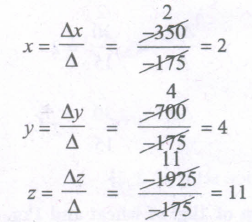
\(\therefore\) The rate of commission on the items A, Band Care 2%, 4% and 11%
16.
Transition probability matrix
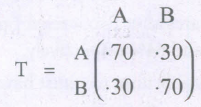
Where A represents the percentage of people using transit system and B represents the percentage of people using metro train.
By the given data
A 60% = .60
and B 40% = ·4
= ((-6)(-7)+(-4)(-3) (-6)(-3)+(-4)(-7))
= (-42+·12 ·18+·28)
= (-54 -46)
\(\therefore\) A = 54%and B = 46%
(i) The percent of Commuters using the transit system after one year is 54% and the percent of commuters using the metro train after one year is 46%
(ii) Equilibrium will be reached in the long run. At equilibrium we must have
(A B) T = (A B)
where A+B = 1
\(\Rightarrow \left( A\quad B \right) \left( \begin{matrix} \cdot 7 & \cdot 3 \\ \cdot 3 & \cdot 7 \end{matrix} \right) =(A\quad B)\)
(-7A +·3B ·3A +.7B) = (A B)
Equaling the entries on both sides, we get
·7A+ ·3B = A
\(\Rightarrow \cdot 7A+\cdot 3(1-A)=A\)
\(\left[ \because A+B=1\Rightarrow B=1-A \right] \)
\(\Rightarrow \cdot 7A+\cdot 3(1-A)=A\)
\(\Rightarrow \cdot 3=A-\cdot 7A+\cdot 3A\)
\(\Rightarrow \cdot 3=A(\cdot 3+\cdot 3)\)
\(\Rightarrow 3=A(\cdot 6)\)
\(\Rightarrow A=\cfrac { \cdot 3 }{ \cdot 6 } =\cfrac { 1 }{ 2 } =\cdot 50\)
\(\therefore\) The percent of commuters using the transit system in the long run is 50%
17.
(i) Transition probability matrix T = \(_{ E }^{ M }\left( \begin{matrix} \overset { M }{ 0.8 } & \overset { E }{ 0.2 } \\ 0.7 & 0.3 \end{matrix} \right) \)
After one study period, \(\left( \overset { M }{ 60\quad } \overset { E }{ 40 } \right) \) \(_{ E }^{ M }\left( \begin{matrix} \overset { M }{ 0.8 } & \overset { E }{ 0.2 } \\ 0.7 & 0.3 \end{matrix} \right) \) =\(\left( \overset { M }{ 76\quad } \overset { E }{ 24 } \right) \)
So in the very next study period, there will be 76 students do maths work and 24 students do the English work.
After two study periods,
\(\left( \overset { M }{ 76\quad } \overset { E }{ 24 } \right) \) \(_{ E }^{ M }\left( \begin{matrix} \overset { M }{ 0.8 } & \overset { E }{ 0.2 } \\ 0.7 & 0.3 \end{matrix} \right) \)
= (60.8+16.8 15.2+7.2)
= (77.6 22.4)
After two study periods there will be 78 (approx) students do maths work and 22 (approx) students do English work.
18.
Given that the price of commodities X, Y and Z are x, y and z respectively
By the given data
| Transaction | x | y | z | Earning |
|---|---|---|---|---|
| Mr. Anand | +2 | +3 | -6 | Rs.5000 |
| Mr. Amar | +3 | -1 | +2 | Rs.2000 |
| Mr. Amit | -1 | +3 | +1 | Rs.5500 |
Here, purchasing is taken as negative symbol and selling is taken as positive symbol
Thus, the non-homogeneous equations are
2x + 3y - 6z = 5000
3x - y + 2z = 2000
-x + 3y + z = 550
The matrix equation corresponding to the given system is
\(\left( \begin{matrix} 2 & 3 & -6 \\ 3 & -1 & 2 \\ -1 & 3 & 1 \end{matrix} \right) \left( \begin{matrix} x \\ y \\ z \end{matrix} \right) =\left( \begin{matrix} 5000 \\ 2000 \\ 5500 \end{matrix} \right) \)
| Augmented matrix | Elementary Transformation |
|---|---|
| \(\left( \begin{matrix} 2 & 3 & -6 \\ 3 & -1 & 2 \\ -1 & 3 & 1 \end{matrix}\begin{matrix} 5000 \\ 2000 \\ 5500 \end{matrix} \right) \) | |
| \(\left( \begin{matrix} -1 & 3 & 1 \\ 3 & -1 & 2 \\ 2 & 3 & -6 \end{matrix}\begin{matrix} 5500 \\ 2000 \\ 5000 \end{matrix} \right) \) |  |
| \(\left( \begin{matrix} 1 & -3 & -1 \\ 3 & -1 & 2000 \\ 2 & 3 & -6 \end{matrix}\begin{matrix} -5000 \\ 2000 \\ 5500 \end{matrix} \right) \) | \({ R }_{ 1 }\rightarrow { R }_{ 1 }\left( -1 \right) \) |
| \(\left( \begin{matrix} 1 & -3 & -1 \\ 0 & 8 & 5 \\ 0 & 9 & -4 \end{matrix}\begin{matrix} -5500 \\ 18500 \\ 16000 \end{matrix} \right) \) | \({ R }_{ 2 }\rightarrow { R }_{ 2 }-3{ R }_{ 1 }\) \({ R }_{ 3 }\rightarrow { R }_{ 3 }-2{ R }_{ 1 }\) |
| \(\left( \begin{matrix} 1 & -3 & -1 \\ 0 & 1 & \frac { 65 }{ 8 } \\ 0 & 1 & \frac { -4 }{ 9 } \end{matrix}\begin{matrix} -5500 \\ \frac { 18500 }{ 8 } \\ \frac { 16000 }{ 9 } \end{matrix} \right) \) | \({ R }_{ 2 }\rightarrow { R }_{ 2 }\div 8\) \({ R }_{ 3 }\rightarrow { R }_{ 3 }\div 9\) |
| \(\left( \begin{matrix} 1 & -3 & -1 \\ 0 & 1 & \frac { 5 }{ 8 } \\ 0 & 0 & \frac { -4 }{ 9 } -\frac { 5 }{ 8 } \end{matrix}\begin{matrix} -5500 \\ \frac { 18500 }{ 8 } \\ \frac { 16000 }{ 9 } -\cfrac { 18500 }{ 8 } \end{matrix} \right) \) | \({ R }_{ 3 }\rightarrow R_{ 3 }-{ R }_{ 2 }\) |
| \(\left( \begin{matrix} 1 & -3 & -1 \\ 0 & 1 & \frac { 5 }{ 8 } \\ 0 & 0 & \frac { -77 }{ 72 } \end{matrix}\begin{matrix} -5500 \\ \frac { 18500 }{ 8 } \\ \frac { -38500 }{ 72 } \end{matrix} \right) \) |
.Clearly the last equivalent matrix is in echelon form and it has three non-zero rows
\(\therefore \rho (A)=\rho \left( \left[ A,B \right] \right) =3\) Number of unknowns.
\(\therefore\) The given system is consistent and has unique solution. To find the solution, let us rewrite the above : echelon form into the matrix form.
\(\left( \begin{matrix} 1 & -3 & -1 \\ 0 & 1 & \frac { 5 }{ 8 } \\ 0 & 0 & \frac { -77 }{ 72 } \end{matrix} \right) \left( \begin{matrix} x \\ y \\ z \end{matrix} \right) \left( \begin{matrix} -5000 \\ \frac { 18500 }{ 8 } \\ \frac { -38500 }{ 72 } \end{matrix} \right) \)
\(\Rightarrow x-3y-z=-5500\)
\(y+\cfrac { 5 }{ 8 } z=\cfrac { 18500 }{ 8 } \)
\(\cfrac { -77 }{ 72 } z=\cfrac { 38500 }{ 72 } \)
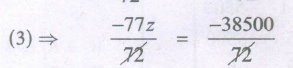
\(\Rightarrow z=\cfrac { -38500 }{ -77 } \)
\(\Rightarrow z=500\)
\((2)\Rightarrow y+\cfrac { 5 }{ 8 } \left( 500 \right) =\cfrac { 18500 }{ 8 } \)
\(y=\cfrac { 18500 }{ 8 } -\cfrac { 2500 }{ 8 } \)
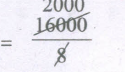
\(\Rightarrow y=2000\)
\((1)\Rightarrow x-3\left( 2000 \right) -500=-5500\)
\(\Rightarrow x-6000-500=-5500\)
\(\Rightarrow x-6000-500=-5500\)
\(\Rightarrow x=-5500+6500\)
\(\Rightarrow x=1000\)
Hence, the prices per unit of three commodities are Rs.1000, Rs. 2000 and Rs. 500 respectively
19.
We have, P = a + bl + cm
Putting above values we have
6,950 = a + 40b + 10c
6,725 = a + 35b + 9c
7,100 = a + 40b + 12c
The Matrix equation corresponding to the given system is
\(\left( \begin{matrix} 1 & 40 & 10 \\ 1 & 35 & 9 \\ 1 & 40 & 12 \end{matrix} \right) \left( \begin{matrix} a \\ b \\ c \end{matrix} \right) =\left( \begin{matrix} 6950 \\ 6725 \\ 7100 \end{matrix} \right) \)
| Augmented matrix [A,B] | Elementary Transformation |
| \(\left( \begin{matrix} 1 & 40 & 10 \\ 1 & 35 & 9 \\ 1 & 40 & 12 \end{matrix}\begin{matrix} 6950 \\ 6725 \\ 7100 \end{matrix} \right) \) \(\left( \begin{matrix} 1 & 40 & 10 \\ 0 & -5 & -1 \\ 0 & 0 & 2 \end{matrix}\begin{matrix} 6950 \\ -225 \\ 150 \end{matrix} \right) \) |
\({ R }_{ 2 }\rightarrow { R }_{ 2 }-{ R }_{ 1 }\) \({ R }_{ 3 }\rightarrow { R }_{ 3 }-{ R }_{ 1 }\) |
| \(\rho (A)=3,\rho ([A,B])=3\) |
\(\therefore \) The given system is equivalent to the matrix equation
\(\left( \begin{matrix} 1 & 40 & 10 \\ 0 & -5 & -1 \\ 0 & 0 & 2 \end{matrix} \right) \left( \begin{matrix} a \\ b \\ c \end{matrix} \right) =\left( \begin{matrix} 6950 \\ -225 \\ 150 \end{matrix} \right) \)
a + 40b + 10c = 6950 (1)
-5b - c = -225 (2)
2c = 150 (3)
c- = 75
Now, (2) \(\Rightarrow \) -5b - 75 = -225
b = 30
and (1) \(\Rightarrow \) a + 1200 + 750 = 6950
a = 5000
a = 5000, b = 30, c = 75
\(\therefore \) The production equation is P = 5000 + 301 + 75m
\(\therefore \) Pat l = 50, m = 15 = 5000 + 30(50) + 75(15)
= 7625 units.
\(\therefore \) The production = 7,625 units.
20.
The matrix equation corresponding to the given system is
\(\left( \begin{matrix} 1 & 1 & 1 \\ 1 & 2 & 3 \\ 1 & 2 & a \end{matrix} \right) \left( \begin{matrix} X \\ Y \\ Z \end{matrix} \right) =\left( \begin{matrix} 6 \\ 10 \\ b \end{matrix} \right) \)
AX = B
| Augmented matrix [A,B] | Elementary Transformation |
| \(\left( \begin{matrix} 1 & 1 & 1 \\ 1 & 2 & 3 \\ 1 & 2 & a \end{matrix}\begin{matrix} 6 \\ 10 \\ b \end{matrix} \right) \) \(\sim \left( \begin{matrix} 1 & 1 & 1 \\ 0 & 1 & 2 \\ 0 & 1 & a-1 \end{matrix}\begin{matrix} 6 \\ 4 \\ b-6 \end{matrix} \right) \) \(\sim \left( \begin{matrix} 1 & 1 & 1 \\ 0 & 1 & 2 \\ 0 & 0 & a-3 \end{matrix}\begin{matrix} 6 \\ 4 \\ b-10 \end{matrix} \right) \) |
\({ R }_{ 2 }\rightarrow { R }_{ 2 }-{ R }_{ 1 }\) \({ R }_{ 3 }\rightarrow { R }_{ 3 }-{ R }_{ 1 }\) |
Case (i) For no solution:
The system possesses no solution only when \(\rho (A)\neq ([A,B])\) which is possible only when a−3 = 0 and b −10 \(\neq \) 0.
Hence for a = 3, b \(\neq \) 10, the system possesses no solution.
Case (ii) For a unique solution:
The system possesses a unique solution only when \(\rho (A)= ([A,B])\)=number of unknowns.
i.e when \(\rho (A)=\rho ([A,B])\) = 3
Which is possible only when a−3 \(\neq \) 0 and b may be any real number as we can observe .
Hence for a \(\neq \) and b \(\in \) R, the system possesses a unique solution.
Case (iii) For an infinite number of solutions:
The system possesses an infinite number of solutions only when
\(\rho (A)=\rho ([A,B])\)
Hence for a = 3, b = 10, the system possesses infinite number of solutions.
21.
The matrix equation corresponding to the given system is
\(\left( \begin{matrix} 1 & 1 & 1 \\ 1 & 2 & 3 \\ 1 & 4 & 7 \end{matrix} \right) \left( \begin{matrix} X \\ Y \\ Z \end{matrix} \right) =\left( \begin{matrix} 6 \\ 14 \\ 30 \end{matrix} \right) \)
A X = B
| Augmented matrix [A,B] | Elementary Transformation |
| \(\left( \begin{matrix} 1 & 1 & 1 \\ 1 & 2 & 3 \\ 1 & 4 & 7 \end{matrix}\begin{matrix} 6 \\ 14 \\ 30 \end{matrix} \right) \) \(\sim \left( \begin{matrix} 1 & 1 & 1 \\ 0 & 1 & 2 \\ 0 & 2 & 4 \end{matrix}\begin{matrix} 6 \\ 8 \\ 16 \end{matrix} \right) \) \(\sim \left( \begin{matrix} 1 & 1 & 1 \\ 0 & 1 & 2 \\ 0 & 0 & 0 \end{matrix}\begin{matrix} 6 \\ 8 \\ 0 \end{matrix} \right) \) |
\({ R }_{ 2 }\rightarrow { R }_{ 2 }-{ R }_{ 1 }\) \({ R }_{ 3 }\rightarrow { R }_{ 3 }-{ R }_{ 2 }\) \({ R }_{ 3 }\rightarrow { R }_{ 3 }-{ 2R }_{ 2 }\) |
| \(\rho (A)=2,\rho ([A,B])=2\) |
Obviously the last equivalent matrix is in the echelon form. It has two non-zero rows.
\(\rho (A)=2,\rho ([A,B])=2\)
\(\rho (A)=2,\rho ([A,B])=2\)
The given system is equivalent to the matrix equation,
\(\left( \begin{matrix} 1 & 1 & 1 \\ 0 & 1 & 2 \\ 0 & 0 & 0 \end{matrix} \right) \left( \begin{matrix} X \\ Y \\ Z \end{matrix} \right) =\left( \begin{matrix} 6 \\ 8 \\ 0 \end{matrix} \right) \)
x + y + z = 6 (1)
y + 2z = 8 (2)
\((2)\Rightarrow \)Y = 8 - 2Z,
\((2)\Rightarrow \) X = 6 - Y - Z = 6 - (8 - 2z) - Z = z - 2
Let us take z = k,k \(\in \) R, we get x = k − 2, y = 8 − 2k, Thus by giving different values for k we get different solutions.
Hence the given system has infinitely many solutions.
22.
The matrix equation corresponding to the given system is
\(\left( \begin{matrix} 2 & 1 & 1 \\ 1 & 1 & 1 \\ 1 & -1 & 2 \end{matrix} \right) \left( \begin{matrix} X \\ Y \\ Z \end{matrix} \right) =\left( \begin{matrix} 5 \\ 4 \\ 1 \end{matrix} \right) \)
A X = B
| Augmented matrix [A,B] | Elementary Transformation |
| \(\left( \begin{matrix} 2 & 1 & 1 \\ 1 & 1 & 1 \\ 1 & -1 & 2 \end{matrix}\begin{matrix} 5 \\ 4 \\ 1 \end{matrix} \right) \) \(\sim \left( \begin{matrix} 1 & 1 & 1 \\ 2 & 1 & 1 \\ 1 & -1 & 2 \end{matrix}\begin{matrix} 4 \\ 5 \\ 1 \end{matrix} \right) \) \( \left( \begin{matrix} 1 & 1 & 1 \\ 0 & -1 & -1 \\ 1 & -2 & 1 \end{matrix}\begin{matrix} 4 \\ -3 \\ -3 \end{matrix} \right) \) \(\sim \left( \begin{matrix} 1 & 1 & 1 \\ 2 & -1 & -1 \\ 0 & 0 & 3 \end{matrix}\begin{matrix} 4 \\ -3 \\ 3 \end{matrix} \right) \) |
\({ R }_{ 1 }\leftrightarrow { R }_{ 2 }\) \({ R }_{ 2 }\rightarrow { R }_{ 2 }-{ 2R }_{ 1 }\) \({ R }_{ 3 }\rightarrow { R }_{ 3 }-{ R }_{ 1 }\) \({ R }_{ 3 }\rightarrow { R }_{ 3 }-{ 2R }_{ 2 }\) |
| \(\rho (A)=3,\) \(\rho ([A,B])=3\) |
Obviously the last equivalent matrix is in the echelon form. It has three non-zero rows.
\(\rho (A)=3,\) \(\rho ([A,B])=3\) = Number of unknowns .
The given system is consistent and has unique solution.
To find the solution, let us rewrite the above echelon form into the matrix form.
\(\left( \begin{matrix} 1 & 1 & 1 \\ 0 & -1 & -1 \\ 0 & 0 & 3 \end{matrix} \right) \left( \begin{matrix} X \\ Y \\ Z \end{matrix} \right) =\left( \begin{matrix} 4 \\ -3 \\ 3 \end{matrix} \right) \)
x + y + z = 4 (1)
y + z = 3 (2)
3z = 3 (3)
\((3)\Rightarrow z=1\)
\((2)\Rightarrow y=3-z=2 \)
\((1)\Rightarrow x=4-y-z\)
x = 1
\(\therefore \) x = 1, y = 2, z = 1
23.
(i) \(\int _{ -2 }^{ 1 }{ f(x) } dx=\int _{ -2 }^{ 1 }{ { x }^{ 2 }dx } ={ \left[ \frac { { x }^{ 3 } }{ 3 } \right] }_{ -2 }^{ 1 }=\frac { 1 }{ 3 } -\left( \frac { -8 }{ 3 } \right) =3\)
(ii) \(\int _{ 1 }^{ 2 }{ f(x) } dx=\int _{ 1 }^{ 2 }{ xdx } ={ \left[ \frac { { x }^{ 2 } }{ 2 } \right] }_{ 1 }^{ 2 }=\frac { 4 }{ 2 } -\frac { 1 }{ 2 } =\frac { 3 }{ 2 } \)
(iii) \(\int _{ 2 }^{ 3 }{ f(x) } dx=\int _{ 2 }^{ 3 }{ (x-4) } dx{ \left[ \frac { { x }^{ 2 } }{ 2 } -4x \right] }_{ 2 }^{ 3 }=\left( \frac { 9 }{ 2 } -12 \right) -\left( \frac { 4 }{ 2 } -8 \right) \) \(=\frac { 15 }{ 2 } +6=\frac { -3 }{ 2 } \)
(iv) \(\int_{-2}^{1.5} f(x) d x\) = \(\int_{-2}^{1} f(x) d x\) + \(\int_{1}^{1.5} f(x) d x\)
= 3 + \({ \left[ \frac { { x }^{ 2 } }{ 2 } \right] }_{ 1 }^{ 1.5 } \)
= 3 + \(\frac { 225 }{ 2 } -\frac { 1 }{ 2 } = 3 + \frac { 125 }{ 2 } = 3.625\)
(v) \(\int_{1}^{3} f(x) d x\) = \(\int_{1}^{2} f(x) d x\) + \(\int_{2}^{3} f(x) d x\)
= \(\frac { 3 }{ 2 } + (\frac { -3 }{ 2 }) = 0\) using (ii) and (iii)
24.
(i) Take a suitable scale for the values of x and y, and plot the various points on the graph paper for given values of x and y.
(ii) Draw a suitable curve passing through the plotted points.
(iii) Find the point corresponding to the value x = 38 on the curve and then read the corresponding value of y on the y- axis, which will be the required interpolated value.
From the graph in Figure we find that for x = 38, the value of y is equal to 35
25.
Given equation can be written as \(\frac { ydx-xdy }{ { y }^{ 2 } } -{ 3x }^{ 2 }{ e }^{ { x }^{ 2 } }dx=0\)
Integrating, ഽ\(\frac { ydx-xdy }{ { y }^{ 2 } } \) - ഽ3x2ex3 dx = c
ഽ\(d\left( \frac { x }{ y } \right) \) - ഽetdt = c
(where t = x3 and dt = 3x2dx )
\(\frac { x }{ y } \) - et = c
\(\frac { x }{ y } \) - \({ e }^{ { x }^{ 2 } }\) = c

12th Standard Syllabus & Materials
12th Standard
TN 12th Computer Applications களப்பெயர் முறைமை (DNS) Sample Question Papers Study Material - QB365 Set A
NEW12th Standard
TN 12th Computer Applications வலையமைப்பு எடுத்துக்காட்டுகள் மற்றும் நெறிமுறைகள் Sample Question Papers Study Material - QB365 Set A
NEW12th Standard
TN 12th Computer Applications கணினி வலையமைப்பு ஓர் அறிமுகம் Sample Question Papers Study Material - QB365 Set A
NEW12th Standard
TN 12th Computer Applications PHP-உடன் MySQL-ஐ இணைத்தல் Sample Question Papers Study Material - QB365 Set A



Tamilnadu Stateboard 12th Standard Subjects

Maths

Chemistry

Physics

Biology

Computer Science
Business Maths and Statistics

Economics

Commerce

Accountancy

History

Computer Applications
Biology
Computer Technology
Computer Applications
Computer Science
Business Maths and Statistics
Commerce
Economics
Maths
Chemistry
Physics
Computer Technology
History
Accountancy

Tamil

English

French
Tamilnadu Stateboard Standards

