
 100% FREE ACCESS
8th Standard CBSE Syllabus & Materials
8th Standard CBSE
CBSE 8th Social Science Theme D - Factors of Production - New Model Questions Papers Study Material - QB365 Set A
NEW8th Standard CBSE
CBSE 8th Social Science Theme C - Universal Franchise and India's Electoral System - New Model Questions Papers Study Material - QB365 Set A
NEW8th Standard CBSE
CBSE 8th Social Science Theme B - The Rise of the Marathas - New Model Questions Papers Study Material - QB365 Set A
NEW8th Standard CBSE
CBSE 8th Social Science Theme B - Reshaping India's Political Map - New Model Questions Papers Study Material - QB365 Set A
NEW8th Standard CBSE
CBSE 8th Social Science Theme A - Natural Resources and Their Use - New Model Questions Papers Study Material - QB365 Set A
NEW8th Standard CBSE
CBSE 8th Science Keeping Time with Skies - New Model Questions Papers Study Material - QB365 Set A

Published on: 31/07/2018
Based on the current academic syllabus, some of the important questions are prepared from the chapter Reproduction in Animals.
Download CBSE Class 8th Standard CBSE Science question papers, sample papers, important questions, and previous year solved papers in PDF format. Get free study materials, NCERT solutions, and exam preparation resources for Class 8th Standard CBSE Science
Questions + Answers key
Take MCQ Science Test
1.
Observe the figure given and answer the questions that follow.
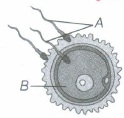
(a) Label A and B.
(b) Identify the process.
(c) What happens during the process and what is formed?
2.
A and B are the two types of animals. The animals like A undergo external fertilisation whereas animals like B undergo internal fertilisation. The animals like A lay eggs from which baby animals are hatched. On the other hand, in animals like B the young one develops inside the uterus of mother which then gives birth to the baby.
(a) What is the general name of animals like A?
(b) Give two examples of animals like A.
(c) What is the general name of animals like B?
(d) Write the names of two animals like B.
3.
Differentiate between internal fertilisation and external fertilisation.
4.
Define asexual reproduction. Describe two methods of asexual reproduction in animals.
5.
Write some examples of viviparous and oviparous animals.
6.
Name some organisms which are reproduced by parthenogenesis.
7.
Where does an embryo grow in case of external fertilisation?
8.
In markets, eggs of birds are available but never eggs of dogs, why?
9.
The eggs of frogs do not have shells for protection, yet they are safe in water, how?
10.
Name two main types of reproduction prevalent in animals.
11.
Hens and frogs are both oviparous exhibiting different types of fertilisation, explain.
12.
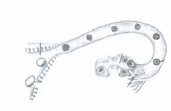
After observing figure above, answer the following.
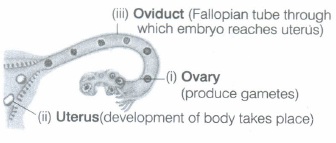
(a) Read the following statements and label them in the figure.
(i) The part which produces female gametes.
(ii) The part where development of the baby takes place.
(iii) The part through which the developing embryo passes to reach the uterus.
(b) Explain the future development of the embryo that would take place after it gets embedded in the uterus.
13.
Human egg has a head, middle piece and tail
14.
Amoeba reproduces by simply dividing itself into two.
15.
In adult human females, a single mature egg is released into an oviduct every month.
16.
External fertilisation takes place in frog.
17.
After fertilisation, the resulting cell which gives rise to a new individual is the
embryo
ovum
foetus
zygote
18.
Aquatic animals in which fertilisation occurs in water are said to be
viviparous without fertilisation
oviparous with external fertilisation
viviparous with internal fertilisation
oviparous with internal fertilisation
19.
In humans, the development of fertilised egg takes place in the
ovary
testis
oviduct
uterus
20.
Sets of reproductive terms are given below. Choose the set that has an incorrect combination.
Sperm, testis, sperm duct, penis
Menstruation, egg, oviduct, uterus
Sperm, oviduct, egg, uterus
Ovulation, egg, oviduct, uterus
21.
In human beings, the correct sequence of events during reproduction is
gamete formation, fertilisation, zygote formation embryo
embryo, zygote formation, fertilisation, gamete formation
fertilisation, gamete formation, embryo, zygote formation
gamete formation, fertilisation, embryo, zygote formation
22.
Amoeba is a _____ celled organism. It reproduces by _____ reproduction. The process of reproduction begins by the division of its into ____ two. This is followed by the division of its into _____ two. This type of reproduction is called ____ fission.
23.
Sperms are produced in ______
24.
An animal having both male and female reproductive organs is called ______
25.
The _____ divides repeatedly to form an embryo.
26.
______ is very important for continuation of a species.
1.
(a) A-sperm, B-ovum (egg).
(b) The process is fertilisation.
(c) During the process, the sperm nucleus fuses with the egg nucleus to form the zygote.
2.
(a) The general name of animals like A is oviparous animals.
(b) Frogs and fishes are examples of A.
(c) The general name of animals like B is viviparous animals.
(d) Cows and dogs are two animals like B.
3.
Difference between internal fertilisation and external fertilisation are
| Internal fertilisation | External fertilisation |
| It is the fertilisation that takes place inside the female body. | It is the fertilisation that takes place outside the female body, generally in water. |
| Sperms are released in female body. | Sperms and ova are released in water outside the female body. |
| It is common in terrestrial animals, e.q. humans, cats, dogs, etc. | It is very common in aquatic animals, e.q. frogs fishes, etc. |
4.
The mode of reproduction in which a single organism is able to produce one or more individuals of its kind is called asexual reproduction. It does not require both male and female parent.
The two methods of asexual reproduction in animals are given below:
(i) Budding It is the mode of asexual reproduction in which small bulges called buds develop and get separated from parent to form new individuals, e.g. in Hydra.
(ii) Binary fission It is the division of nucleus into two nuclei followed by the division of cytoplasm body. Each part receiving a nuclei and develops into two new individuals, e.g. in Amoeba.
5.
(i) Examples of viviparous animals Mammals like cat, dog, camecow, dog.
(ii) Examples of oviparous animals All birds, fishes, reptiles, amphibians.
6.
Organisms like honeybees, birds (turkey) and some lizards are reproduce by parthenogenesis.
7.
Embryo grows outside in open in case of external fertilisation.
8.
Birds are oviparous, lay eggs outside the female body, so their eggs are available in market, while dogs are viviparous, i.e. do not lay eggs but give birth to young ones.
9.
Frog's eggs are without any external covering or shell but a layer of jelly-like coat hold the eggs together, thus providing them protection.
10.
Two main types of reproduction prevalent in animals are asexual and sexual reproduction.
11.
Hens lay eggs after fertilisation, therefore their eggs are covered with hard shell to protect the young ones. This shows that fertilisation in hen is internal. The frogs on the other hand lay both sperms and eggs in water prior to fertilisation. Thus, the fertilisation in frog takes place in water, hence it is external.
12.
(a) The parts in the figure are labelled below:
(b) The embryo continues to develop after it gets embedded in the uterus. It divides and differentiates into three germ layers which give rise to different body parts such as hands, legs, head, eyes, ears, etc. This stage where all the body parts are distinct and easily identified in developing embryo is called foetus. After completion of development of foetus, mother gives birth to baby.
13.
(b)
14.
(a)
15.
(a)
16.
(a)
17.
(d)
zygote
18.
The animals in which fertilisation occur in water, i.e. they lay eggs and release sperms outside body and thus the young one too is formed outside the body in water. Such aquatic animals are oviparous with external fertilisation.
19.
(c)
oviduct
20.
(c)
Sperm, oviduct, egg, uterus
21.
(c)
fertilisation, gamete formation, embryo, zygote formation
22.
()
single, asexual, nucleus, cytoplasm, binary
23.
()
testes
24.
()
bisexual
25.
()
zygote
26.
()
Reproduction

8th Standard CBSE Syllabus & Materials
8th Standard CBSE
CBSE 8th Science Particulate Nature of Matter - New Model Questions Papers Study Material - QB365 Set A
NEW8th Standard CBSE
CBSE 8th Science Pressure, Winds, Stroms and Cyclones - New Model Questions Papers Study Material - QB365 Set A
NEW8th Standard CBSE
CBSE 8th Mathematics Quadrilaterals - New Model Questions Papers Study Material - QB365 Set A
NEW8th Standard CBSE
CBSE 8th Mathematics A story of Numbers - New Model Questions Papers Study Material - QB365 Set A



CBSE 8th Standard CBSE Subjects
CBSE Standards




