
 100% FREE ACCESS
12th Standard Syllabus & Materials
12th Standard
TN 12th Maths Applications of Matrices and Determinants Sample Question Papers Study Material - QB365 Set A
NEW12th Standard
TN 12th Computer Applications மின்னணு தரவு பரிமாற்றம் Sample Question Papers Study Material - QB365 Set A
NEW12th Standard
TN 12th Computer Applications மின் - வணிக பாதுகாப்பு அமைப்புகள் Sample Question Papers Study Material - QB365 Set A
NEW12th Standard
TN 12th Computer Applications மின்னணு செலுத்தல் முறைகள் Sample Question Papers Study Material - QB365 Set A
NEW12th Standard
TN 12th Computer Applications மின் - வணிகம் Sample Question Papers Study Material - QB365 Set A
NEW12th Standard
TN 12th Computer Applications திறந்த மூல கருத்துருக்கள் Sample Question Papers Study Material - QB365 Set A

Published on: 15/03/2022
Download Tamil Nadu 12th Standard Maths question papers, model tests, one-mark questions, important questions, and public exam papers in PDF format. Free study materials and answer keys for TN State Board students.
Questions + Answers key
Take MCQ Maths Test1.
Evaluate \(\int ^{3}_{2} \frac{\sqrt {x}}{\sqrt {5-x}+\sqrt {x}}\)dx.
2.
Assuming log10e = 0.4343, find an approximate value of log10 1003
3.
Use linear approximation to find an approximate value of \(\sqrt { 9.2 } \) without using a calculator.
4.
Find the value of
\({ cos }^{ -1 }\left( \frac { 1 }{ 2 } \right) +{ sin }^{ -1 }(-1)\)
5.
Find the angle between the lines \(\vec { r } =(\hat { i } +2\hat { j } +4\hat { k } )+t(2\hat { i } +2\hat { j } +\hat { k } )\) and the straight line passing through the points (5, 1, 4) and (9, 2, 12)
6.
Prove that \([\vec { a } -\vec { b } ,\vec { b } -\vec { c } ,\vec { c } -\vec { a } ]\) = 0
7.
Prove by vector method that an angle in a semi-circle is a right angle.
8.
Find the equation of the parabola whose vertex is (5, -2) and focus (2, -2)
9.
If y = 4x + c is a tangent to the circle x2 + y2 = 9, find c
10.
For what value of x, the inequality \(\frac { \pi }{ 2 } <{ cos }^{ -1 }(3x-1)<\pi \) holds?
11.
Find all the values of x such that -10\(\pi\)\(\le x\le\)10\(\pi\) and sin x = 0
12.
13.
Find the area of the region bounded between the parabola x2 = y and the curve y = |x|.
14.
Find the area of the region bounded by x−axis, the curve y = |cos x|, the lines x = 0 and x = \(\pi\).
15.
A right circular cylinder has radius r =10 cm. and height h = 20 cm. Suppose that the radius of the cylinder is increased from 10 cm to 10. 1 cm and the height does not change. Estimate the change in the volume of the cylinder. Also, calculate the relative error and percentage error.
16.
Identify the type of conic and find centre, foci, vertices, and directrices of each of the following :
18x2+12y2−144x+48y+120 = 0
17.
Find the vertex, focus, equation of directrix and length of the latus rectum of the following:
x2−2x+8y+17= 0
18.
Find the vector parametric, vector non-parametric and Cartesian form of the equation of the plane passing through the points (-1, 2, 0), (2, 2, -1)and parallel to the straight line \(\frac { x-1 }{ 1 } =\frac { 2y+1 }{ 2 } =\frac { z+1 }{ -1 } \)
19.
Show that the lines \(\frac { x-3 }{ 3 } =\frac { y-3 }{ -1 } =z-1=0\) and \(\frac { x-6 }{ 2 } =\frac { z-1 }{ 3 } ,y-2=0\) intersect. Also find the point of intersection.
20.
On lighting a rocket cracker it gets projected in a parabolic path and reaches a maximum height of 4 m when it is 6 m away from the point of projection. Finally it reaches the ground 12 m away from the starting point. Find the angle of projection.
21.
At a water fountain, water attains a maximum height of 4 m at horizontal distance of 0.5 m from its origin. If the path of water is a parabola, find the height of water at a horizontal distance of 0.75 m from the point of origin.
22.
A tunnel through a mountain for a four lane highway is to have a elliptical opening. The total width of the highway (not the opening) is to be 16 m, and the height at the edge of the road must be sufficient for a truck 4 m high to clear if the highest point of the opening is to be 5 m approximately. How wide must the opening be?
23.
If the normal at the point ‘t1’ on the parabola y2 = 4ax meets the parabola again at the point ‘t2’, then prove that t2 = -\(\left( { t }_{ 1 } + \frac { 2 }{ { t }_{ 1 } } \right) \)
24.
Find the centre, foci, and eccentricity of the hyperbola 11x2 − 25y2 −44x + 50y −256 = 0
25.
Find the domain of f(x) = sin-1 \((\frac{|x|-2}{3})+ \) cos-1 \((\frac{1-|x|}{4})\)
26.
By vector method, prove that cos(α + β) = cos α cos β - sin α sin β
27.
Find the area of the region bounded by 3x − 2y + 6 = 0 , x = −3, x = 1 and x-axis.
28.
Evaluate the following \(\int _{ 0 }^{ \pi /2 }{ { cos}^{ 7}x\quad dx } \)
29.
Evaluate the following definite integrals:
\(\int _{ 3 }^{ 4 }{ \frac { dx }{ { x }^{ 2 }-4 } } \)
30.
Assume that the cross section of the artery of human is circular. A drug is given to a patient to dilate his arteries. If the radius of an artery is increased from 2 mm to 2.1 mm, how much is cross-sectional area increased approximately?
31.
Find differential dy for each of the following function
y = (3 + sin(2x)) 2/3
32.
Find centre and radius of the following circles.
2x2+2y2−6x+4y+2 = 0
33.
If \(\hat { 2i } -\hat { j } +\hat { 3k } ,\hat { 3i } +\hat { 2j } +\hat { k } ,\hat { i } +\hat { mj } +\hat { 4k } \) are coplanar, find the value of m.
34.
Find the domain of the following functions :
\(tan^{-1}(\sqrt{9-x^{2}})\)
35.
The value of \(\int _{ -1 }^{ 2 }{ |x|dx } \) is
\(\frac{1}{2}\)
\(\frac{3}{2}\)
\(\frac{5}{2}\)
\(\frac{7}{2}\)
36.
\(\text { The value of } \int_{0}^{\frac{2}{3}} \frac{d x}{\sqrt{4-9 x^{2}}} \text { is }\)
\(\frac{\pi}{6}\)
\(\frac{\pi}{2}\)
\(\frac{\pi}{4}\)
\({\pi}\)
37.
The value of \(\int _{ 0 }^{ 1 }{ x{ (1-x) }^{ 99 }dx } \) is
\(\frac{1}{11000}\)
\(\frac{1}{10100}\)
\(\frac{1}{10010}\)
\(\frac{1}{10001}\)
38.
The area between y2 = 4x and its latus rectum is
\(\frac{2}{3}\)
\(\frac{4}{3}\)
\(\frac{8}{3}\)
\(\frac{5}{3}\)
39.
The change in the surface area S = 6x2 of a cube when the edge length varies from xo to xo+ dx is
12 xo+dx
12xo dx
6xo dx
6xo+ dx
40.
The percentage error of fifth root of 31 is approximately how many times the percentage error in 31?
\(\frac{1}{31}\)
\(\frac15\)
5
31
41.
Distance from the origin to the plane 3x − 6y + 2z + 7 = 0 is
0
1
2
3
42.
43.
If \(\vec { a } ,\vec { b } ,\vec { c } \) are non-coplanar, non-zero vectors such that \([\vec { a } ,\vec { b } ,\vec { c } ]\) = 3, then \({ \{ [\vec { a } \times \vec { b } ,\vec { b } \times \vec { c } ,\vec { c } \times \vec { a } }]\} ^{ 2 }\) is equal to
81
9
27
18
44.
If \(\vec { a } \) and \(\vec { b } \) are unit vectors such that \([\vec { a } ,\vec { b },\vec { a } \times \vec { b } ]=\frac { 1}{ 4 } \), then the angle between \(\vec { a } \) and \(\vec { b } \) is
\(\frac { \pi }{ 6 } \)
\(\frac { \pi }{ 4 } \)
\(\frac { \pi }{ 3 } \)
\(\frac { \pi }{ 2 } \)
45.
If \(\vec { a } .\vec { b } =\vec { b } .\vec { c } =\vec { c } .\vec { a } =0\) , then the value of \([\vec { a } ,\vec { b } ,\vec { c } ]\) is
\(\left| \vec { a } \right| \left| \vec { b } \right| \left| \vec { c } \right| \)
\(\frac{1}{3}\)\(\left| \vec { a } \right| \left| \vec { b } \right| \left| \vec { c } \right| \)
1
-1
46.
If \(\vec{a}\) and \(\vec{b}\) are parallel vectors, then \([\vec { a } ,\vec { c } ,\vec { b } ]\) is equal to
2
-1
1
0
47.
Area of the greatest rectangle inscribed in the ellipse \(\frac{x^{2}}{a^{2}}+\frac{y^{2}}{b^{2}}=1\) is
2ab
ab
\( \sqrt{ ab}\)
\(\frac { a }{ b } \)
48.
If x + y = k is a normal to the parabola y2 = 12x, then the value of k is
3
-1
1
9
49.
If P(x, y) be any point on 16x2 + 25y2 = 400 with foci F1 (3, 0) and F2 (-3, 0) then PF1 + PF2 is
8
6
10
12
50.
The length of the diameter of the circle which touches the x - axis at the point (1, 0) and passes through the point (2, 3).
\(\frac { 6 }{ 5 } \)
\(\frac { 5 }{ 3 } \)
\(\frac { 10 }{ 3 } \)
\(\frac { 3 }{ 5 } \)
51.
The eccentricity of the hyperbola whose latus rectum is 8 and conjugate axis is equal to half the distance between the foci is
\(\frac { 4 }{ 3 } \)
\(\frac { 4 }{ \sqrt { 3 } } \)
\(\frac { 2 }{ \sqrt { 3 } } \)
\(\frac { 3 }{ 2 } \)
52.
sin-1(2cos2x-1)+cos-1(1-2sin2x)=
\(\frac{\pi}{2}\)
\(\frac{\pi}{3}\)
\(\frac{\pi}{4}\)
\(\frac{\pi}{6}\)
53.
54.
\(\tan ^{-1}\left(\frac{1}{4}\right)+\tan ^{-1}\left(\frac{2}{9}\right)\) is equal to
\(\frac { 1 }{ 2 } \ { cos }^{ -1 }\left( \frac { 3 }{ 5 } \right) \)
\(\frac { 1 }{ 2 } { sin }^{ -1 }\left( \frac { 3 }{ 5 } \right) \)
\(\frac { 1 }{ 2 } {tan }^{ -1 }\left( \frac { 3 }{ 5 } \right) \)
\({ tan}^{ -1 }\left( \frac { 1}{ 2 } \right) \)
1.
Let us put I = \(\int ^{3}_{2} \frac{\sqrt {x}}{\sqrt {5-x}+\sqrt {x}}\) dx --- (1)
Applying the formula \(\int ^{a}_{b}\) f(x) dx =\(\int ^{a}_{b}\) f(a+b -x) dx, we get
I = \(\int ^{3}_{2} \frac{\sqrt {(2+3-x)}}{\sqrt {5-(2+3-x)}+\sqrt { {(2+3-x)}}}\) dx = \(\int ^{3}_{2} \frac{\sqrt {(5-x)}}{\sqrt {x}+\sqrt { {(5-x}}}\) dx -- (2)
Adding (1) and (2), we get
2I = \(\int ^{3}_{2} \frac{\sqrt {x} + \sqrt {5-x} }{\sqrt {x}+\sqrt { {5-x}}}\) dx =\(\int ^{3}_{2} \) dx = \([x]^{3}_{2}\) = 3 - 2 = 1
Hence, we get I = \(\frac{1}{2}\)
2.
log10e = 0.4343 to find log10g 1003
f(1000) = log101000 = log10103 = 3log10103 = 3 log1010
= 3(1) = 3
f'(x) = \(\frac1x\). log10e
f'(1000) = \(\frac{1}{1000}\)(0.4343)
∴ L(x) = f(x0) f'(x0) (x - x0)
= 3 + \(\frac{1}{1000}\) (0.4343) (3)
= 3 + \(\frac{1.3029}{1000}\)
= 3 + 0.0013029
log101003 = 3.0013029
3.
We need to find an approximate value of \(\sqrt { 9.2 } \) using linear approximation. Now by (3), we have f(x0+Δx) ≈ f(x0)+f'(x0)Δx. To do this, we have to identify an appropriate function f, a point x0 and Δx. Our choice should be such that the right side of the above approximate equality, should be computable without the help of a calculator. So, we choose
f(x) = \(\sqrt { x,{ x }_{ 0 } } \) = 9 and Δx = 0.2. Then f'(x0) = \(\frac { 1 }{ 2\sqrt { 9 } } \) and hence.
\(\sqrt { 9.2 } \) ≈ f(9) + f'(9)(0.2) = 3+\(\frac { 0.2 }{ 6 } \) = 3.03333
Now if we use a calculator, just to compare, we find \(\sqrt { 9.2 } \) = 3.03315. We see that our approximation is accurate to three decimal places and the error is 3.03315 - 3.03333 = 0.00018. [Also note that one could choose f (x) = \(\sqrt { 1+x,{ x }_{ 0 } } =8\) and Δx = 0.2. So the choice of f and x0 - are not necessarily unique].
So in the above example, the absolute error is 3.03315-3.03333 = -0.00018. Note that the absolute error says how much the error; but it does not say how good the approximation is. For instance, let us consider two simple cases
Case 1 : Suppose that the actual value of something is 5 and its approximated value is 4, then the absolute error is 5 − 4 = 1.
Case 2 : Suppose that the actual value of something is 100 and its approximated value is 95. In this case, the absolute error is 100 − 95 = 5. So the absolute error in the first case is smaller when compared to the second case.
Among these two approximations, which is a better approximation; and why? The absolute error does not give a clear picture about whether an approximation is a good one or not. On the other hand, if we calculate relative error or percentage of error (defined below), it will be easy to see how good an approximation is. If the actual value is zero, then we do know how close our approximate answer is to the actual value. So if the actual value is not zero.
4.
\({ cos }^{ -1 }\left( \frac { 1 }{ 2 } \right) +{ sin }^{ -1 }(-1)\)
Let \({ cos }^{ -1 }\left( \frac { 1 }{ 2 } \right) =x\) and -1 = sin y
\(\Rightarrow cosx=\frac { 1 }{ 2 } =cos\frac { \pi }{ 3 } \)
\(x=\frac { \pi }{ 3 } \)
\(siny=-1=-sin\left( \frac { -\pi }{ 2 } \right) \)
= \(-sin\left( \frac { -\pi }{ 2 } \right) \)
\(\left[ \because sin\left( -\theta \right) =-sin\ \theta\ and\ \frac { \pi }{ 2 } \varepsilon \left[ \frac { -\pi }{ 2 } ,\frac { \pi }{ 2 } \right] \right] \)
\(\Rightarrow y=\frac { -\pi }{ 2 } \)
\(\therefore { cos }^{ -1 }\left( \frac { 1 }{ 2 } \right) +{ sin }^{ -1 }\left( -1 \right) =x+y\)
= \(\frac { \pi }{ 3 } -\frac { \pi }{ 2 } =\frac { 2\pi -3\pi }{ 6 } =-\frac { \pi }{ 6 } \)
\(\therefore { cos }^{ -1 }\left( \frac { 1 }{ 2 } \right) +{ sin }^{ -1 }(-1)=-\frac {\pi }{ 6 } \)
5.
We know that the line \(\vec { r } =(\hat { i } +2\hat { j } +4\hat { k } )+t(2\hat { i } +2\hat { j } +\hat { k } )\) is parallel to the vector \(2\hat { i } +2\hat { j } +\hat { k } \).
Direction ratios of the straight line joining the two given points (5, 1, 4) and (9, 2, 12) are 4,1,8 and hence this line is parallel to the vector \(\hat { 4i } +\hat { j } +8\hat { k } \)
Therefore, the angle between the given two straight lines is
\(\theta ={ cos }^{ -1 }\left( \frac { \left| \vec { b } .\vec { d } \right| }{ \left| \vec { b } \right| \left| \vec { d } \right| } \right) \), where \(\vec { b } \) = \(2\hat { i } +2\hat { j } +\hat { k } \) and \(\vec { d } \) = \(\hat { 4i } +\hat { j } +8\hat { k } \)
Therefore, \(\theta ={ cos }^{ -1 }\left( \frac { \left| (2\hat { i } +2\hat { j } +\hat { k } ).(4\hat { i } +\hat { j } +8\hat { k } ) \right| }{ \left| 2\hat { i } +2\hat { j } +\hat { k } \right| \left| 4\hat { i } +\hat { j } +8\hat { k } \right| } \right) ={ cos }^{ -1 }\left( \frac { 2 }{ 3 } \right) \)
6.
LHS = \([\vec { a } -\vec { b } ,\vec { b } -\vec { c } ,\vec { c } -\vec { a } ]\) = 0
[∵ cross product is distributive]
\((\vec { a } -\vec { b } ).[(\vec { b } -\vec { c } )\times (\vec { c } -\vec { a } )]\)
= \((\vec { a } -\vec { b } ).[(\vec { b } \times \vec { c } -\vec { b } \times \vec { a } -\vec { c } \times \vec { c } +\vec { c } \times \vec { a } )\)
= \((\vec { a } -\vec { b } ).[\vec { b } \times \vec { c } -\vec { b } \times \vec { a } -0+\vec { c } \times \vec { a } ]\)
\([\because \vec { c } \times \vec { c } =0]\)
= \([\vec { a } \vec { b } \vec { c } ]-[\vec { a } \vec { b } \vec { a } ]+[\vec { a } \vec { c } \vec { a } ]-[\vec { b } \vec { b } \vec { c } ]+[\vec { b } \vec { b } \vec { a } ]-[\vec { b } \vec { c } \vec { a } ]\)
= \([\vec { a } \vec { b } \vec { c } ]-0+0-0+0-[\vec { b } \vec { c } \vec { a } ]\)
= \([\because [\vec { a } \vec { b } \vec { a } ]=[\vec { b } \vec { b } \vec { c } ]=0]\)
= \([\vec { a } \vec { b } \vec { c } ]-[\vec { a } \vec { b } \vec { c } ]\)
= 0 = RHS.
7.
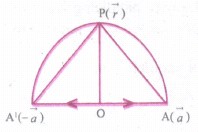
Let O be the centre of the semi-circle and AA1 be the diameter.
Let P be any point on the circumference of the semi circle.
Taking O as the origin, let the position vectors of A and P be a and \(\vec { r } \) respectively.
Let us prove that \(\angle A P B=90^{\circ}\)
W.K.T OA = OB = OP ( because of radius)
\(
\overrightarrow{P A} =\overrightarrow{P O}+\overrightarrow{O A}
\)
\(\overrightarrow{P B} =\overrightarrow{P O}+\overrightarrow{O B}
\)
\( =\overrightarrow{P O}-\overrightarrow{O A}
\)
\(\overrightarrow{P A} \cdot \overrightarrow{P B} =(\overrightarrow{P O}+\overrightarrow{O A})(\overrightarrow{P O}-\overrightarrow{O A})
\)
\( =\overrightarrow{P O}^{2}-\overrightarrow{O A}^{2}=0
\)
\(
\overrightarrow{P A} \perp \overrightarrow{P B}
\)
\( \Rightarrow \ \angle A P B=90^{\circ}
\). Hence proved.
8.
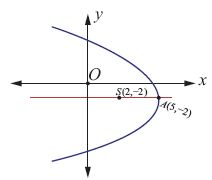
Given vertex A(5, -2) and focus S(2, -2) and the focal distance
AS = a = 3
Parabola is open left and symmetric about the line parallel to x -axis.
Then, the equation of the required parabola is
(y + 2)2 = −4(3)(x − 5)
y2 + 4y + 4 = −12x + 60
y2 + 4y +12x − 56 = 0
9.
The condition for the line y = mx + c to be a tangent to the circle x2 + y2 = a2 is c2 = a2(1 + m2) from
Then \(c=\pm \sqrt { 9\left( 1+16 \right) } \)
\(c=\pm 3\sqrt { 17 } \)
10.
Given \(\frac { \pi }{ 2 } <{ cos }^{ -1 }(3x-1)<\pi \)
\((cos2\frac { \pi }{ 2 } <3x-1\))
\(\Rightarrow 0<3x-1<-1\)
\(0+1<3x<-1+1\)
\(1<3x<0\)
11.
Given sin x = 0
\(\Rightarrow\) sin x = sin 0
\(\Rightarrow\) \(x=n\pi ,n\varepsilon z\)
Since \(-10\pi \le x\le 10\pi \) n can take the values only from -10 to +10.
\(\therefore\) \(x=n\pi ,\) When \(n=0,\pm ,\pm 2,\pm 3,\pm 4,\pm 5,\pm 6,\pm 7,\pm 8,\pm 9,\pm 10\)
12.
13.
Both the curves are symmetrical about y -axis
The curve y = |x| is \(y=\begin{cases} x\quad if\quad x\ge 0 \\ -x\quad if\quad x\le 0 \end{cases}\)
It intersects the parabola x2 = y at (1, 1) and (−1, 1). The area of the region bounded by the curves is sketched. It lies in the first quadrant as well as in the second quadrant. By symmetry, the required area is twice the area in the first quadrant.
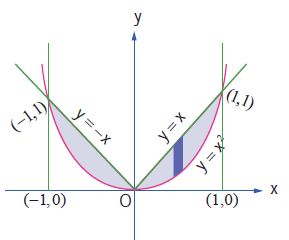
In the first quadrant, the upper curve is y = x, 0 \(\le x\le\)1 and the lower curve is y = x2 \(\le x\le\),0 1. Hence, the required area is given by
\(A=2\int _{ 0 }^{ 1 }{ \left[ { y }_{ U }-{ y }_{ L } \right] } dx=2\int _{ 0 }^{ 1 }{ \left[ x-{ x }^{ 2 } \right] dx } \)
\(=2{ \left[ \frac { { x }^{ 2 } }{ 2 } -\frac { { x }^{ 3 } }{ 3 } \right] }_{ 0 }^{ 1 }\)
\(=2\left( \frac { 1 }{ 2 } -\frac { 1 }{ 3 } \right) =\frac { 1 }{ 3 } \)
14.
The given curve is \(y=\begin{cases} cosx,0\le x\le \frac { \pi }{ 2 } \\ -cosx,\frac { \pi }{ 2 } \le x\le \pi \end{cases}\)
It lies above the x − axis. The required area is sketched. So, the required area is given by
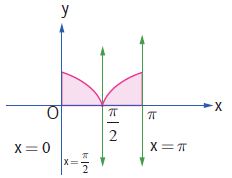
\(A=\int _{ 0 }^{ \pi }{ ydx=\int _{ 0 }^{ \frac { \pi }{ 2 } }{ cosxdx } +\int _{ \frac { \pi }{ 2 } }^{ \pi }{ (-cosx)dx } ={ [sin\quad x] }_{ 0 }^{ \frac { \pi }{ 2 } }-{ [sin\quad x] }_{ \frac { \pi }{ 2 } }^{ \pi } } \)
= [1-0]-[0-1] = 2
15.
Recall that volume of a right circular cylinder is given by V = \(\pi \)r2h where r is the radius and h is the height. So we have V (r) = \(\pi \)r2h = 20\(\pi \)r2
V (10.1) −V (10)≈ \(\frac { dV }{ dr } { { | }_{ r=10 } }\) (10.1 10) = 20\(\pi \)2(10(0.1))
Thus the estimate for the change in the volume is 40 \(\pi \) cm3
Exact calculation of the volume change gives
V (10.1) −V (10) = 2040.2\(\pi \) -2000\(\pi \) = 40.2\(\pi \) cm3.
So relative error = \(\frac { 40.2\pi -40\pi }{ 40.2\pi } \) = \(\frac { 1 }{ 201 } \) = 0.00497 and hence
the percentage error = relative error x 100 = \(\frac { 1 }{ 201 } \)x100 = 0.497%
16.
18x2+ 12y2 - 144x + 48y + 120 = 0
Given equation is
18x2 + 12y2 - 144x + 48y + 120 = 0
18x2 - 144x + 12y2 + 48y = -120
⇒ 18(x2 - 8x) + 12(y2 + 4y) = -120
⇒ 18(x2-8x+ 16-16)+ 12(y2 +4y+4-4) =-120
18(x - 4)2 - 288 + 12 (y + 2)2- 48 = -120
⇒ 18(x - 4)2+ 12(y + 2)2 = -120 + 288 + 48
⇒ 18(x - 4)2+ 12(y + 2)2 = 216
Dividing by 216 we get,
\(\frac { { 18(x-4) }^{ 2 } }{ 216 } +\frac { 12({ y+2) }^{ 2 } }{ 216 } =1\)
\(\Rightarrow \frac { { (x-4) }^{ 2 } }{ 12 } +\frac { ({ y+2) }^{ 2 } }{ 18 } =1\)
This is an equation of the ellipse with major axis parallel to y-axis,
∴ a2 = 18, b2 = 12
∴ c2 = a2 - b2 = 18 -12 = 6 ⇒ c = \(\sqrt { 6 } \)
e =\( \sqrt { 1-\frac { { b }^{ 2 } }{ { a }^{ 2 } } } =\sqrt { 1-\frac { 12 }{ 18 } } =\sqrt { \frac { 18-12 }{ 18 } } \)
\(=\sqrt{\frac{\not 6^1}{\not{18}}_{3}}=\sqrt{\frac{1}{3}}\)= \(\frac{1}{\sqrt 3}\)
(a) Center is (4, -2)
⇒ h = 4, k = -2
(b) Vertices are (h, k-a), (h, k + a)
⇒ (4, -2 - 3\(\sqrt { 2 } \)), (4, -2 + 3\(\sqrt { 2 } \))
[∴ a2 = 18 ⇒ a = \(\sqrt { 18 } \) = 3\(\sqrt { 2 } \)]
(c) Foci are (h, k - c), (h, k + c)
⇒ (4, -2 - \(\sqrt { 6 } \)), (4, -2 + \(\sqrt { 6 } \))
(d) Equation of directrices are y + 2 = \(\pm \frac { a }{ e } \)
⇒ y+ 2 = \(\pm \frac { a }{ e } \)
\(\Rightarrow y-2=\pm \frac { 3\sqrt { 2 } }{ \frac { 1 }{ \sqrt { 3 } } } =\pm 3\sqrt { 2 } \times \sqrt { 3 } =\pm 3\sqrt { 6 } \)
\(\Rightarrow y+2=\pm 3\sqrt { 6 } ,y+2=-3\sqrt { 6 } \)
\(\Rightarrow y=-2+3\sqrt { 6 } \) and \( y=-2-3\sqrt { 6 } \)
17.
x2-2x+ 8y+ 17 = 0
x2 - 2x = -8y - 17
Adding 1 both sides, we get
x2 - 2x + 1 = -8y - 17 + 1
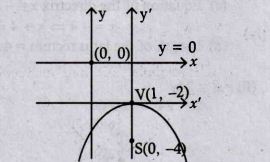
⇒ (x - 1)2 = -8y - 16 = -8(y + 2)
⇒ (x - 1)2 = -8(y + 2)
This is a open downward parabola, latus
rectum 4a = 8 ⇒ a = 2.
(a) Vertex is (1, -2)
⇒ h = 1, k = -2
(b) focus is (0 + h, - a + k)
⇒(0 + 1, -2-2)
⇒ (1, -4)
(c) Equation of directrix is y = k + a
⇒ y = -2 + 2 ⇒ y = 0
(d) Length of latus rectum is 4a = 8 units.
18.
The required plane is parallel to the given line and so it is parallel to the vector \(\vec { c } =\hat { i } +\hat { j } -\hat { k } \) and the plane passes through the points \(\vec { a } =-\hat { i } +2\hat { j } ,\vec { b } =2\hat { i } +2\hat { j } -\hat { k } \)
(i) vector equation of the plane in parametric form is \(\vec { r } =\vec { a } +s(\vec { b } -\vec { a } )+t\vec { c } \), where s, t ∈ R
which implies that \(\vec { r } =(-\hat { i } +2\hat { j } )+s(3\hat { i } -\hat { k } )+t(\hat { i } +\hat { j } -\hat { k } )\), where s, t ∈ R
(ii) vector equation of the plane in non-parametric form is \((\vec { r } -\vec { a } ).(\vec { b } -\vec { a } )\times \vec { c } )\) = 0
Now, \((\vec { b } -\vec { a } )\times \vec { c } =\left| \begin{matrix} \hat { i } & \hat { j } & \hat { k } \\ 3 & 0 & -1 \\ 1 & -1 & -1 \end{matrix} \right| =\hat { i } +2\hat { j } +3\hat { k } \)
we have \((\vec { r } -(-\hat { i } +2\hat { j } ).(\hat { i } +2\hat { j } +3\hat { k } )\) = 0 ⇒ \(\vec { r } .(\hat { i } +2\hat { j } +3\hat { k } )\) = 3
If \(\vec { r } .(\hat { i } +2\hat { j } +3\hat { k } )\) is the position vector of an arbitrary point on the plane, then from the above equation, we get the Cartesian equation of the plane as x + 2y + 3z = 3
19.
Given lines are \(\frac { x-3 }{ 3 } =\frac { y-3 }{ -1 } \)....(1)
and z-1 = 0
\(\Rightarrow\) z = 1
and \(\frac { x-6 }{ 2 } =\frac { z-1 }{ 3 } \) ...(2)
and y-2 = 0\(\Rightarrow\) y = 2
Substituting y = 2 and z = 1 in (1) we get
\(\frac { x-3 }{ 3 } =\frac { 2-3 }{ -1 } =\frac { -1 }{ -1 } =1\Rightarrow x-3=3\Rightarrow x=6\)
The point of intersection is (6, 2, 1)
Let us check whether (6, 2, 1) satisfies (1) and (2)
\((1)\rightarrow \frac { 6-6 }{ 2 } =\frac { 1-1 }{ 3 } \Rightarrow 0=0\)
\((2)\rightarrow \frac { 6-3 }{ 3 } =\frac { 1-3 }{ -1 } \Rightarrow -1=-1\)
Hence, the given two lines intersect and the point of intersection is (6, 2, 1).
20.
By taking the vertex; at the origin, the parabola is open downward.
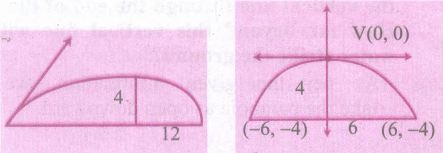
Its equation is x2 = -4ay
It passes through (6, -4)
∴ 36 = -4a(-4) ⇒ 4a = - \(\frac { 36 }{ 4 } \) = 9
∴ (1) becomes, x2 = -9y
To find the slope at (-6, -4)
Differentiating (1) with respect to 'x' we get,
2x = -9\(\frac { dy }{ dx } \)
⇒ \(\frac { dy }{ dx } =\frac { -2x }{ 9 } \)
At (-6, -4), \(\frac { dy }{ dx } =-2\frac { (-6) }{ 9 } =\frac { 12 }{ 9 } =\frac { 4 }{ 3 } \)
∴ \(tan\theta =\frac { 4 }{ 3 } \Rightarrow \theta ={ tan }^{ -1 }\left( \frac { 4 }{ 3 } \right) \)
∴ The angle of projection is tan-1 \(\left( \frac { 4 }{ 3 } \right) \)
21.

Let the equation of the parabola be
(x - h)2 = -4a(y - k).
Here the vertex is (0.5, 4)
Equation of the parabola is (x - 0.5)2
= -4a(y-4) ...(1)
O(0, 0) is a point on the parabola
(0 - 0.5)2 = -4a (0 - 4)
⇒ \({ \left( \frac { -1 }{ 2 } \right) }^{ 2 }=-4a(-4)\)
⇒ \(\frac { 1 }{ 4 } =16a\Rightarrow a=\frac { 1 }{ 64 } \)
∴ (1) becomes as (x - 0.5)2 = \(-4\times \frac { 1 }{ 64 } (y-4)\)
Also D(0.75, y1) is a point on the parabola
∴ (0.75 - 0.5)2 = \(\frac { -1 }{ 16 } ({ y }_{ 1 }-4)\)
⇒ \({ \left( \frac { 1 }{ 4 } \right) }^{ 2 }=\frac { -1 }{ 6 } ({ y }_{ 1 }-4)\)
\(\Rightarrow \frac{1}{\not 16}=\frac{1}{\not16}\left(y_{1}-4\right)\)
⇒ 1 = -y1 + 4
⇒ y1 = -1 + 4 = 3m
Height of the water at a horizontal distance of 0.75m is 3m
22.
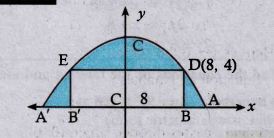
Let the equation of the ellipse be
\(\frac{x^{2}}{a^{2}}+\frac{y^{2}}{b^{2}}=1\)
Length of semi minor axis b = 5
\(\frac{x^{2}}{a^{2}}+\frac{y^{2}}{b^{2}}=1\)
Let BB' be the road width and AA' be the end points of the opening of the tunnel.
Let CB = 8, BD = 1,
D is (8, 4) lies on the ellipse
\(
\frac{8^{2}}{a^{2}}+\frac{4^{2}}{5^{2}}=1
\)
\( \Rightarrow a^{2}=\frac{25}{9} \times 64
\)
\( \Rightarrow a=\frac{40}{3}
\)
The width AA' = 2a
\(=\frac{80}{3}=26.66 \mathrm{~m}\)
The required width is 26.66 m.
23.
Equation of normal at 't1' to the parabola y2 = 4 axis is
y + xt1 = at13 + 2at1 ...(1)
(1) meets the-parabola y2 = 4ax at 't2'.
At 't2', the point on the parabola is x = at22, y = 2at2 (2) lies on (1)
∴ Substituting (2) in (1) we get,
2at2 + (at22)2t1 = at13 + 2at1
⇒ 2at2 + at1t22 = at13 + 2at1
⇒ 2a(t2 - t1) = -at1[t22 - t12]

⇒ 2 = -t1(t2+ t1)
⇒ \(\frac { -2 }{ { t }_{ 1 } } ={ t }_{ 2 }+{ t }_{ 1 }\Rightarrow { t }_{ 2 }=\frac { -2 }{ { t }_{ 1 } } { -t }_{ 1 }\)
⇒ t2 = -(t1 + \(\frac { -2 }{ { t }_{ 1 } } \))
Hence proved.
24.
Rearranging terms in the equation of hyperbola to bring it to standard form,
we have, 11(x2-4x)-25(y2-2y)-256 = 0
11(x− 2)2−25(y−1)2 = 256−44+25
11(x−2 )2− 25 (y−1)2 = 275
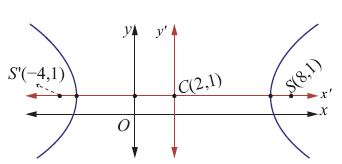
\(\frac { { \left( x-2 \right) }^{ 2 } }{ 25 } -\frac { { \left( y-1 \right) }^{ 2 } }{ 11 } =1\)
Centre (2, 1) a2 = 25, b2 = 11
c2 = a2 +b2
= 25 +11 = 36
Therefore, c = ±6
and e = \(\frac { c }{ a } =\frac { 6 }{ 5 } \)and the coordinates of foci are(8, 1) and(-4, 1) from figure.
25.
f(x) = sin-1 \((\frac{|x|-2}{3})+cos^-1(\frac{1-|x|}{4})\)
From the definition of sin-1
\(-1\le \frac { \left| x \right| -2 }{ 3 } \le 1\)
\(\Rightarrow -3\le \left| x \right| -2\le 3\)
\(\Rightarrow -3+2\le \left| x \right| \le \left| x \right| \le 3+2\)
\(\Rightarrow -1\le \left| x \right| \le 5\)
It reduces to
\(0\le \left| x \right| \le 5\)
\(\Rightarrow 0\le \left| x \right| and\left| x \right| \le 5\)
\(\Rightarrow \left| x \right| \ge 0and-5\le x\le 5\)
From the definition of cos-1x.
\(-1\le \frac { 1-\left| x \right| }{ 4 } \le 1\)
\(\Rightarrow -4\le 1-\left| x \right| \le 4\)
\(\Rightarrow -4-1\le \left| x \right| \le 4-1\)
\(\Rightarrow -5\le -\left| x \right| \le 3\)
\(\Rightarrow -3\le \left| x \right| >5\)
It reduces to
\(0\le \left| x \right| \le 5\)
\(-5\le |x|\le 5\)
From (1) & (2),
Domain is [-5, 5]
26.
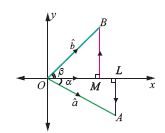
Let \(\hat { a } =\vec { OA } \) and \(\hat { b } =\vec { OB } \) be the unit vectors and which make angles α and β, respectively, with positive x-axis, where A and B are as in the diagram.
Draw AL and BM perpendicular to the x-axis. Then \(\left| \vec { OL } \right| =\left| \vec { OA } \right| \) cos α = cos α, \(\left| \vec { LA } \right| =\left| \vec { OA } \right| \) sin α = sin α
So, \(\vec { OL } =\left| \vec { OL } \right| \)\(\hat { i } \) = cos,α \(\hat { i } \), \(\overrightarrow { LA } \) = sin α (-\(\hat { j } \))
Therefore, \(\hat { a } =\overrightarrow { OA} = \overrightarrow { OL } +\overrightarrow { LA } \) = cos α \(\hat { i } \) - sin α \(\hat { j } \) ..(1)
Similarly \(\hat { b } \) = cos β \(\hat { i } \)+ sin β \(\hat { j } \) ....(2)
The angle between \(\hat { a } \) and \(\hat{b}\) is α + β and so,
\(\hat { a } .\hat { b } =\left| \hat { a } \right| \left| \hat { b } \right| \) cos (α + β) = cos (α + β) ... (3)
On the other hand, from (1) and (2)
\(\hat { a } .\hat { b } =(cos\alpha \hat { i } -sina\hat { j } )(cos\beta \hat { i } -sin\beta \hat { j } )\) = cos α cos β - sin α sin β....(4)
From (3) and (4), we get cos(α + β) = cos α cos β - sin α sin β
27.
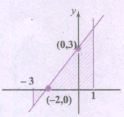
Given equation of line is 3x - 2y + 6 = 0
2y = 3x + 6 \(\Rightarrow\) y = \(\frac{3x+6}{2}\)
| x | 0 | -2 |
| t | 3 | 0 |
\(\therefore Area=\int _{ -3 }^{ -2 }{ -ydx+ydx } +\int _{ -2 }^{ 1 }{ ydx } \)
[\(\because\) the Area is below the x - axis]
\(=\frac { -1 }{ 2 } \int _{ -3 }^{ -2 }{ (3x+6)dx+\frac { 1 }{ 2 } \int _{ -2 }^{ 1 }{ (3x+6)dx } } \)
\(={ \left[ \frac { { 3x }^{ 2 } }{ 2 } +6x \right] }_{ -3 }^{ -2 }+\frac { 1 }{ 2 } { \left[ \frac { { 3x }^{ 2 } }{ 2 } +6x \right] }_{ -2 }^{ 1 }\)
\(=-\frac { 1 }{ 2 } \left[ \left( \frac { 12 }{ 2 } -12 \right) -\left( \frac { 27 }{ 2 } -18 \right) \right] +\frac { 1 }{ 2 } \left[ \left( \frac { 3 }{ 2 } +6 \right) -\left( \frac { 12 }{ 2 } -12 \right) \right] \)
\(=-\frac { 1 }{ 2 } \left[ (-6)-\left( \frac { 27-36 }{ 2 } \right) \right] +\frac { 1 }{ 2 } \left[ \left( \frac { 3+12 }{ 2 } \right) -(-6) \right] \)
\(=-\frac { 1 }{ 2 } \left[ -6+\frac { 9 }{ 2 } \right] +\frac { 1 }{ 2 } \left[ \frac { 15 }{ 2 } +6 \right] \)
\(\\ =-\frac { 1 }{ 2 } \left[ \frac { -3 }{ 2 } \right] +\frac { 1 }{ 2 } \left[ \frac { 27 }{ 2 } \right] =\frac { 3 }{ 4 } +\frac { 27 }{ 4 } =\frac { 30 }{ 4 } =\frac { 15 }{ 2 } \)
\(\therefore\) A = 7.5 sq.units
28.
\({ I }_{ n }=\int _{ 0 }^{ \pi /2 }{ { cos }^{ 7 }xdx=\frac { n-1 }{ n } { I }_{ n-2 },n\ge 2 } \)
\(\therefore { I }_{ 7 }=\int _{ 0 }^{ \pi /2 }{ { cos }^{ 7 }xdx=\frac { 6 }{ 7 } \times \frac { 4 }{ 5 } \times \frac { 2 }{ 3 } \times 1 } =\frac { 16 }{ 35 } \)
29.
\(\int _{ 3 }^{ 4 }{ \frac { dx }{ { x }^{ 2 }-4 } } \)
\(\int _{ 3 }^{ 4 }{ \frac { dx }{ { x }^{ 2 }-4 } } =\int _{ 3 }^{ 4 }{ \frac { dx }{ { x }^{ 2 }-{ 2 }^{ 2 } } } \)
\(\left[ \because \int { \frac { dx }{ { x }^{ 2 }-{ a }^{ 2 } } } =\frac { 1 }{ 2a } log\left| \frac { x-a }{ x+a } \right| +c\right] \)
\(=\frac { 1 }{ 4 } \left[ log\left( \frac { 4-2 }{ 4+2 } \right) -log\left( \frac { 3-2 }{ 3+2 } \right) \right] \)
\(=\frac { 1 }{ 4 } log\left[ \left( \frac { 2 }{ 6 } \right) - log \ \frac { 1 }{ 5 } \right] \\ =\frac { 1 }{ 4 } log\left( \frac { 1 }{ 3 } \times 5 \right) \)
\(=\frac { 1 }{ 4 } log\left( \frac { 5 }{ 3 } \right) \)
30.
Given r = 2 mm
dr = (2.1 - 2) = 0.1 mm
Area = πr2
Approximate area dA = 2πr dr
= 2π (2) (0.1)
= 4 π (0.1) = 0.4 π mm2
31.
Given = (3 + sin(2x)) 2/3
Taking differentilas,
dy = \(\frac23\)(3 + sin(2x)) 2/3-1 (cos 2x) (2)dx
dy = \(\frac { 4 }{ 3 } .\frac { cos2x }{ { (3+sin2x) }^{ \frac { 1 }{ 3 } } } dx\)
32.
Equation of the circle is
2x2 + 2y2 - 6x + 4y + 2 = 0
Dividing by 2, we get
x2 + y2 - 3x + 2y + 1 = 0
Here 2g = -3 ⇒ g = \(\frac { -3 }{ 2 } \)
2f = 2 ⇒ f = 1
and c = 1
∴ Centre is (-g, -f) = \(\left( \frac { 3 }{ 2 } ,-1 \right) \)
and r = \(\sqrt { { g }^{ 2 }+{ f }^{ 2 }-c } \) = \(\sqrt { { \left( \frac { 3 }{ 2 } \right) }^{ 2 }+{ 1 }^{ 2 }-1 } \)
= \(\sqrt { \frac { 9 }{ 4 } } =\frac { 3 }{ 2 } \) units.
33.
Since the given three vectors are coplanar, we have \(\left| \begin{matrix} 2 & -1 & 3 \\ 3 & 2 & 1 \\ 1 & m & 4 \end{matrix} \right| \) = 0 ⇒ m = -3
34.
Let \(f(x)={ tan }^{ -1 }\sqrt { 9-{ x }^{ 2 } } \)
\(\sqrt { 9-{ x }^{ 2 } } \varepsilon R\) but \(\sqrt { 9-{ x }^{ 2 } } \varepsilon R\)
\(\therefore \ 9-{ x }^{ 2 }\ge 0\)
\(\Rightarrow { x }^{ 2 }-9\ge 0\)
\(\Rightarrow (x+3)(x-3)\le 0\)
\(\Rightarrow \) Domain is [-3, 3]
35.
(c)
\(\frac{5}{2}\)
36.
(a)
\(\frac{\pi}{6}\)
37.
(b)
\(\frac{1}{10100}\)
38.
(c)
\(\frac{8}{3}\)
39.
(b)
12xo dx
40.
(b)
\(\frac15\)
41.
(b)
1
42.
(d)
43.
(a)
81
44.
(a)
\(\frac { \pi }{ 6 } \)
45.
(a)
\(\left| \vec { a } \right| \left| \vec { b } \right| \left| \vec { c } \right| \)
46.
(d)
0
47.
(a)
2ab
48.
(d)
9
49.
(c)
10
50.
(c)
\(\frac { 10 }{ 3 } \)
51.
(c)
\(\frac { 2 }{ \sqrt { 3 } } \)
52.
(a)
\(\frac{\pi}{2}\)
53.
(c)
54.
(d)
\({ tan}^{ -1 }\left( \frac { 1}{ 2 } \right) \)

12th Standard Syllabus & Materials
12th Standard
TN 12th Computer Applications வலையமைப்பு வடமிடல் Sample Question Papers Study Material - QB365 Set A
NEW12th Standard
TN 12th Computer Applications களப்பெயர் முறைமை (DNS) Sample Question Papers Study Material - QB365 Set A
NEW12th Standard
TN 12th Computer Applications வலையமைப்பு எடுத்துக்காட்டுகள் மற்றும் நெறிமுறைகள் Sample Question Papers Study Material - QB365 Set A
NEW12th Standard
TN 12th Computer Applications கணினி வலையமைப்பு ஓர் அறிமுகம் Sample Question Papers Study Material - QB365 Set A



Tamilnadu Stateboard 12th Standard Subjects
Maths

Chemistry

Physics

Biology

Computer Science

Business Maths and Statistics

Economics

Commerce

Accountancy

History

Computer Applications
Biology
Computer Technology
Computer Applications
Computer Science
Business Maths and Statistics
Commerce
Economics
Maths
Chemistry
Physics
Computer Technology
History
Accountancy

Tamil

English

French
Tamilnadu Stateboard Standards

