
 100% FREE ACCESS
12th Standard Syllabus & Materials
12th Standard
TN 12th Computer Applications மின்னணு தரவு பரிமாற்றம் Sample Question Papers Study Material - QB365 Set A
NEW12th Standard
TN 12th Computer Applications மின் - வணிக பாதுகாப்பு அமைப்புகள் Sample Question Papers Study Material - QB365 Set A
NEW12th Standard
TN 12th Computer Applications மின்னணு செலுத்தல் முறைகள் Sample Question Papers Study Material - QB365 Set A
NEW12th Standard
TN 12th Computer Applications மின் - வணிகம் Sample Question Papers Study Material - QB365 Set A
NEW12th Standard
TN 12th Computer Applications திறந்த மூல கருத்துருக்கள் Sample Question Papers Study Material - QB365 Set A
NEW12th Standard
TN 12th Computer Applications வலையமைப்பு வடமிடல் Sample Question Papers Study Material - QB365 Set A

Published on: 19/01/2020
REVISION TEST
Download Tamil Nadu 12th Standard Maths question papers, model tests, one-mark questions, important questions, and public exam papers in PDF format. Free study materials and answer keys for TN State Board students.
Questions + Answers key
Take MCQ Maths Test1.
If X~ B(n, p) such that 4P(X = 4) = P(X = 2) and n = 6. Find the distribution, mean and standard deviation of X.
2.
If w(x, y, z) = x2 y + y2z + z2x, x, y, z∈R, find the differential dw .
3.
Evaluate the following integrals using properties of integration:
\(\int _{ -\frac { \pi }{ 4 } }^{ \frac { \pi }{ 4 } }{ { sin }^{ 2 }xdx } \)
4.
An urn contains 5 mangoes and 4 apples. Three fruits are taken at randaom. If the number of apples taken is a random variable, then find the values of the random variable and number of points in its inverse images.
5.
6.
Find the points on the curve y2 - 4xy = x2 + 5 for which the tangent is horizontal.
7.
If \(2cos\alpha=x+\frac { 1 }{ x } \) and \(2cos\ \beta =y+\frac { 1 }{ y } \), show that \({ x }^{ m }{ y }^{ n }+\frac { 1 }{ { x }^{ m }{ y }^{ n } } =2cos(m\alpha +n\beta )\)
8.
Prove by vector method that the area of the quadrilateral ABCD having diagonals AC and BD is \(\frac { 1 }{ 2 } \left| \vec { AC } \times \vec { BD } \right| \).
9.
Verify the property (AT)-1 = (A-1)T with A = \(\left[ \begin{matrix} 2 & 9 \\ 1 & 7 \end{matrix} \right] \).
10.
If α, β and γ are the roots of the cubic equation x3+2x2+3x+4 = 0, form a cubic equation whose roots are, 2α, 2β, 2γ
11.
Find the domain of sin−1(2−3x2)
12.
Determine whether ∗ is a binary operation on the sets given below.
a*b = min (a, b) on A = {1, 2, 3, 4, 5}
13.
Solve \(\frac { dy }{ dx } +2y={ e }^{ -x }\)
14.
Find the slope of the tangent to the following curves at the respective given points
y = x4 + 2x2 − x at x = 1
15.
For each of the following differential equations, determine its order, degree (if exists)
\(y\left( \frac { dy }{ dx } \right) =\frac { x }{ \left( \frac { dy }{ dx } \right) +{ \left( \frac { dy }{ dx } \right) }^{ 3 } } \)
16.
If \(\vec{ a } =\hat { -3i } -\hat { j } +\hat { 5k } \), \(\vec{b}=\hat{i}-\hat{2j}+\hat{k} \), \(\vec{c}=\hat{4j}-\hat{5k} \ \) find\( \ {\vec a } .(\vec { b } \times \vec { c } )\)
17.
Prove that \(\left[ \begin{matrix} \cos { \theta } & -\sin { \theta } \\ \sin { \theta } & \cos { \theta } \end{matrix} \right] \) is orthogonal.
18.
If z1= 3 - 2i and z2 = 6 + 4i, find \(\frac { { z }_{ 1 } }{ z_{ 2 } } \) in the rectangular form.
19.
Let M = \(\left\{ \left( \begin{matrix} x & x \\ x & x \end{matrix} \right) :x\in R-\{ 0\} \right\} \) and let * be the matrix multiplication. Determine whether M is closed under ∗. If so, examine the commutative and associative properties satisfied by ∗ on M.
20.
Construct the truth table for \((p\overset { \_ \_ }{ \vee } q)\wedge (p\overset { \_ \_ }{ \vee } \neg q)\)
21.
For each of the following functions find the fx, fy, and show that fxy = fyx
f(x, y) = \(\frac { 3x }{ y+sinx \ } \)
22.
Let F(x, y) = x3 y + y2x + 7 for all (x, y)∈ R2. Calculate \(\frac { \partial F }{ \partial x } \)(-1, 3) and \(\frac { \partial F }{ \partial y } \)(-2, 1).
23.
Suppose the amount of milk sold daily at a milk booth is distributed with a minimum of 200 Iitres and a maximum of 600 litres with probability density function
\(\begin{cases} \begin{matrix} k & 200\le x\le 600 \end{matrix} \\ \begin{matrix} 0 & otherwise \end{matrix} \end{cases}\)
Find
(i) the value of k
(ii) the distribution function
(iii) the probability that daily sales will fall between 300 litres and 500 litres?
24.
Evaluate: \(\int _{ 0 }^{ \frac { \pi }{ 2 } }{ (\sqrt { tan\ x } +\sqrt { cot\ x } )dx } \)
25.
Solve the Linear differential equation:
\(\frac { dy }{ dx } +\frac { 3y }{ x } =\frac { 1 }{ { x }^{ 2 } } \), given that y = 2 when x = 1
26.
If \(\vec { a } =-2\hat { i } +3\hat { j } -2\hat { k } ,\vec { b } =3\hat { i } -\hat { j } +3\hat { k } ,\vec { c } =2\hat { i } -5\hat { j } +\hat { k } \) find \((\vec { a } \times \vec { b } )\times \vec { c } \) and \((\vec { a } \times \vec { b } )\times \vec { c } \). State whether they are equal.
27.
Discuss the nature of the roots of the following polynomials:
x2018+1947x1950+15x8+26x6+2019
28.
Solve the equation (x-2) (x-7) (x-3) (x+2)+19 = 0
29.
Find the equation of the tangent and normal to the circle x2+y2−6x+6y−8 = 0 at (2, 2) .
30.
If F(\(\alpha\)) = \(\left[ \begin{matrix} \cos { \alpha } & 0 & \sin { \alpha } \\ 0 & 1 & 0 \\ -\sin { \alpha } & 0 & \cos { \alpha } \end{matrix} \right] \), show that [F(\(\alpha\))]-1 = F(-\(\alpha\)).
31.
32.
The operation * defined by \(a * b =\frac{ab}{7}\) is not a binary operation on
Q+
Z
R
C
33.
The value of \(\int _{ 0 }^{ \infty }{ { e }^{ -3x }{ x }^{ 2 }dx } \) is
\(\frac{7}{27}\)
\(\frac{5}{27}\)
\(\frac{4}{27}\)
\(\frac{2}{27}\)
34.
If \(u(x, y)=e^{x^{2}+y^{2}}\),then \(\frac { \partial u }{ \partial x } \) is equal to
\(e^{x^{2}+y^{2}}\)
2xu
x2u
y2u
35.
Let X have a Bernoulli distribution with mean 0.4, then the variance of (2X - 3) is
0.24
0.48
0.6
0.96
36.
A random variable X has binomial distribution with n = 25 and p = 0.8 then standard deviation of X is
6
4
3
2
37.
The order and degree of the differential equation \(\sqrt { sinx } (dx+dy)=\sqrt { cos x } (dx-dy)\) is
1, 2
2, 2
1, 1
2, 1
38.
The position of a particle moving along a horizontal line of any time t is given by s(t) = 3t2 -2t- 8. The time at which the particle is at rest is
t = 0
\(\\ \\ \\ t=\cfrac { 1 }{ 3 } \)
t =1
t = 3
39.
40.
If A is a square matrix that IAI = 2, than for any positive integer n, |An| = _______
0
2n
2n
n2
41.
If A is a non-singular matrix such that A-1 = \(\left[ \begin{matrix} 5 & 3 \\ -2 & -1 \end{matrix} \right] \), then (AT)−1 =
\(\left[ \begin{matrix} -5 & 3 \\ 2 & 1 \end{matrix} \right] \)
\(\left[ \begin{matrix} 5 & 3 \\ -2 & -1 \end{matrix} \right] \)
\(\left[ \begin{matrix} -1 & -3 \\ 2 & 5 \end{matrix} \right] \)
\(\left[ \begin{matrix} 5 & -2 \\ 3 & -1 \end{matrix} \right] \)
42.
If A\(\left[ \begin{matrix} 1 & -2 \\ 1 & 4 \end{matrix} \right] =\left[ \begin{matrix} 6 & 0 \\ 0 & 6 \end{matrix} \right] \), then A =
\(\left[ \begin{matrix} 1 & -2 \\ 1 & 4 \end{matrix} \right] \)
\(\left[ \begin{matrix} 1 & 2 \\ -1 & 4 \end{matrix} \right] \)
\(\left[ \begin{matrix} 4 & 2 \\ -1 & 1 \end{matrix} \right] \)
\(\left[ \begin{matrix} 4 & -1 \\ 2 & 1 \end{matrix} \right] \)
43.
44.
The circle x2 + y2 = 4x + 8y +5 intersects the line 3x−4y = m at two distinct points if
15< m < 65
35< m <85
−85 < m < −35
−35 < m < 15
45.
46.
If sin-1 x+sin-1 y+sin-1 \(z = \frac{3\pi}{2}\), the value of x2017+y2018+z2019\(-\frac { 9 }{ { x }^{ 101 }+{ y }^{ 101 }+{ z }^{ 101 } } \)is
0
1
2
3
47.
According to the rational root theorem, which number is not possible rational zero of 4x7 + 2x4 - 10x3 - 5?
-1
\(\frac { 5 }{ 4 } \)
\(\frac { 4 }{ 5 } \)
5
48.
If z is a non zero complex number, such that 2iz2 = \(\bar { z } \) then |z| is
\(\cfrac { 1 }{ 2 } \)
1
2
3
49.
The conjugate of a complex number is \(\cfrac { 1 }{ i-2 } \). Then the complex number is
\(\cfrac { 1 }{ i+2 } \)
\(\cfrac { -1 }{ i+2 } \)
\(\cfrac { -1 }{ i-2 } \)
\(\cfrac { 1 }{ i-2 } \)
1.
X B(n, p)
Given 4P(X = 4) = P(X = 2) and n = 6.
4. [6C4p4 (1 - p)2] = 6C2p2 q4
⇒ 4p2 = q2
⇒ 4(1-q2) = q2
4(1-2q+q2) = q2
⇒ 3q2 - 8q +4 = 0
⇒ (q - 2)(3q - 2) = 0
\( -q=\frac { 2 }{ 3 } \ \ \ (q\neq2)\)
\(p = 1- q=\cfrac { 1 }{ 3 } \)
Distribution
P(X = x) = nCxpx (1- p)n-x, x = 0, 1,2, ... n
(i) \(P(X=x)= ^6C_{ x }\left( \frac { 1 }{ 3 } \right) ^{ x }\left( \frac { 2 }{ 3 } \right) ^{ 6-x }\) , x = 0,1,2..n
(ii) \(mean=np=6\times \frac { 1 }{ 3 } =2\)
(iii) standard deviation = \(\sqrt { npq } =\sqrt { 2 \times \frac {2}{ 3 } } \)
= \( { \frac { 2 }{ \sqrt 3 } } \)
2.
First let us find wx, wy, and wz
Now wx = 2xy + z2, wy = 2yz +x2 and wz = 2zx + y2.
Thus,by (15), the differential is
dw = (2xy + z2 )dx + (2yz + x2 )dy+ (2zx + y2 )dz.
3.
Let \(f(x)={ sin }^{ 2 }x\)
\(f(-x)={ (sin(-x)) }^{ 2 }={ sin }^{ 2 }x=f(x)\)
\(\therefore \int _{ -\frac { \pi }{ 4 } }^{ \frac { \pi }{ 4 } }{ { sin }^{ 2 }xdx } =2\int _{ 0 }^{ \frac { \pi }{ 4 } }{ { sin }^{ 2 }xdx } \)
\(cos\ 2x=1-2{ sin }^{ 2 }x\)
\(2{ sin }^{ 2 }x=1-cos2\)
\({ sin }^{ 2 }x=\frac { 1-cos\quad 2x }{ 2 } \)
\(=2\int _{ 0 }^{ \frac { \pi }{ 4 } }{ \left( \frac { 1-cos2x }{ 2 } \right) dx } \)
\(=\frac { 2 }{ 2 } { \left[ x-\frac { sin2x }{ 2 } \right] }_{ 0 }^{ \frac { \pi }{ 4 } }\)
\(=\frac { \pi }{ 4 } -\frac { sin\frac { \pi }{ 4 } }{ 2 } -0+\frac { sin0 }{ 2 } \)
\(\\ =\frac { \pi }{ 4 } -\frac { 1 }{ 2 } =\frac { \pi -2 }{ 4 } \)
4.
Let X be the random variable of getting apples Given 5 mangoes and 4 apples are in an urn
= {0, 1,2,3}
The sample space consists of 9C3 = 84
X = 0, X (3 mangoes) = 5C3 = 10
X = 1, X (2 mangoes and 1 apples) = 5C2 x 4C1 = 40
X = 2, X (1 mangoes and 2 apples) = 5C1 x 4C2 = 30
X = 3, X (apples) = 4C3 = 4
| Values of random variable | 0 | 1 | 2 | 3 | Total |
| No of points in inverse image | 10 | 40 | 30 | 4 | 84 |
5.
6.
Equation of the given curve is y2 - 4xy = x2 + 5..(1)
Differentiating with respect to 'x' we get,
\(2y\frac { dy }{ dx } -4\left[ x\frac { dy }{ dx } +y(1) \right] =2x\)
⇒ \(2y\frac { dy }{ dx } -4x\frac { dy }{ dx } -4y=2x\)
⇒ \(\frac { dy }{ dx } \) (2y -4x) = 2x + 4y
⇒ \(\frac { dy }{ dx } \) = \(\frac { x+2y }{ y-2x } \)
Since the tangent to the curve is horizontal, \(\frac { dy }{ dx } \) = 0
ஃ \(\frac { x+2y }{ y-2x } \) = 0
⇒ x+ 2y = 0
⇒ x = -2y .....(2)
Substituting (2) in (1) we get,
y2 - 4(-2y)y = (-1y)2 + 5
⇒ y2 + 8y2 = 4y2 + 5
⇒ y2 = 4y2 + 5
⇒ 5y2 = 5
⇒ y2 = 1
⇒ y = 土 1
From (2), When y = 1, x = - 2
When y = -1, x = 2
∴ The required points are (2, -1) and (-2,1)
7.
Given 2cos α = x+\(\frac { 1 }{ x } \)
⇒ 2cos α = \(\frac { { x }^{ 2 }+1 }{ x } \)
⇒ x2+1 = 2xcos α
⇒ x2-2x cos α+1 = 0
⇒ \(\frac { 2cos\alpha \pm \sqrt { (-2cos\alpha )^{ 2 }-4(1)(1) } }{ 2 } \)
= \(\frac { 2cos\alpha \pm \sqrt { 4cos^{ 2 }\alpha -4 } }{ 2 } \) \(\left[ \because \frac { b\pm \sqrt { { b }^{ 2 }-4ac } }{ 2a } \right] \)
= \(\frac { 2cos\alpha \pm \sqrt { -sin^{ 2 }\alpha } }{ 2 } \)
= \(\frac { 2cos\alpha \pm isin\alpha }{ 2 } \) [∵ sin2α+cos2α = 1]
⇒ x2 = cos α ± sin α
Also, 2cos β = y+\(\frac { 1 }{ y } \)
⇒ 2cos β = \(\frac { { y }^{ 2 }+1 }{ y } \)
⇒ y2-2y cos β+1 = 0
⇒ \(\frac { 2cos\beta \pm \sqrt { (-2cos^{ 2 }\beta ^{ 2 }-4(1)(1) } }{ 2 } \)
=\(\frac { 2cos\beta \pm \sqrt { 4cos^{ 2 }\beta } -4 }{ 2 } =\frac { 2cos\beta \pm 2isin\beta }{ 2 } \)
⇒ y = cosβ ± i sinβ
\({ x }^{ m }{ y }^{ n }+\cfrac { 1 }{ { x }^{ m }{ y }^{ n } } =2cos(m\alpha +n\beta )\)
xmyn = (cos α + i sin mα) (cos nβ + i sin nβ)
cos(mα+nβ)+i sin(mα+nβ)
\(\frac { 1 }{ { x }^{ m }{ y }^{ n } } \) = cos(mα+nβ)-i sin(mα+nβ)
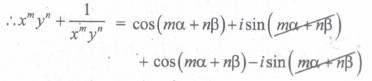
= 2cos(mα+nβ)
8.
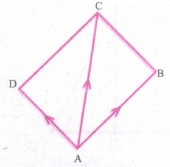
Vector area of quadrilateral ABCD
= vector area of ΔABC + vector area of ΔACD
\(\frac { 1 }{ 2 } (\vec { AB } \times \vec { AC } )+\frac { 1 }{ 2 } (\vec { AC } \times \vec { AD } )\)
= \(-\frac { 1 }{ 2 } (\vec { AC } \times \vec { AB } )+\frac { 1 }{ 2 } (\vec { AC } \times \vec { AD } )\)
\(\left[ \because \ \vec { b } \times \vec { a } =-(\vec { a } \times \vec { b } ) \right] \)
= \(\frac { 1 }{ 2 } \vec { AC } \times (-\vec { AB } +\vec { AD } )\)
= \(\frac { 1 }{ 2 } \vec { AC } \times (\vec { BA } +\vec { AD } )\) \([\because \vec { AB } =-\vec { BA } ]\)
= \(\frac { 1 }{ 2 } \vec { AC } \times \vec { BD } \) [By Δ law of addition]
∴ Area of the quadrilateral ABCD = \(\frac { 1 }{ 2 } \vec { AC } \times \vec { BD } \)
9.
For the given A, We get |A| = (2)(7) - (9)(1) = 14 - 9 = 5. So, A-1 = \(\frac { 1 }{ 5 } \left[ \begin{matrix} 7 & -9 \\ -1 & 2 \end{matrix} \right] =\left[ \begin{matrix} \frac { 7 }{ 5 } & -\frac { 9 }{ 5 } \\ -\frac { 1 }{ 5 } & \frac { 2 }{ 5 } \end{matrix} \right] \).
Then, (A-1)T = \(\left[ \begin{matrix} \frac { 7 }{ 5 } & -\frac { 1 }{ 5 } \\ -\frac { 9 }{ 5 } & \frac { 2 }{ 5 } \end{matrix} \right] =\frac { 1 }{ 5 } \left[ \begin{matrix} 7 & -1 \\ -9 & 2 \end{matrix} \right] \). ....(1)
For the given A, We get AT = \(\left[ \begin{matrix} 2 & 1 \\ 9 & 7 \end{matrix} \right] \). So |AT| = (2)(7) - (1)(9) = 5
Then, (AT)-1 = \(\frac { 1 }{ 5 } \left[ \begin{matrix} 7 & -1 \\ -9 & 2 \end{matrix} \right] \). ...(2)
From (1) and (2), we get (A-1)T = (AT)-1. Thus, we have verified the given property.
10.
The roots of x3+2x2+3x+4 = 0 are ∝, β, ૪
∴ ∝+β+૪ = -co-efficient of x2 = -2 ...(1)
∝β + β૪ + ૪∝ = co-effficient of x = 3 ....(2)
-∝β૪ = +4 ⇒ ∝β૪ = -4 ...(3)
Form a cubic equation whose roots are 2∝, 2β, 2૪
2∝+2β+2૪ = 2(∝+β+૪) = 2(-2) = -4 [from (1)]
4∝β+4β૪+4૪∝ = 4(∝β+β૪+୪∝) = 4(3) = 12 [from (2)]
(2∝)(2β)(2૪) = 8(∝β૪) = 8(-4) = -32 [from (3)]
∴ The required cubic equation is
x3-(2∝+2β+2૪)x2 + (2∝β+2β૪+2୪∝)x - (2∝)(2β)(2૪) = 0
⇒ x3+(-4)x2+12x+32 = 0
⇒ x3+4x2+12x+32 = 0
11.
We know that the domain of sin−1(x) is [-1, 1].
This leads to −1\(\le\)2 - 3x2\(\le\)1, Which implies -3\(\le\) -3x2\(\le\)-1
Now, -3\(\le\) -3x2, gives x2\(\le\)1 and ............(1)
-3\(\le\)-3x2\(\le\)-1, gives x2\(\ge\)\(\frac{1}{2}\) .........(2)
Combining the equations (1) and (2), we get \(\frac{1}{3}\le x^2\le 1\). That is \(\frac{1}{\sqrt3}\le |x|\le1\), Which gives \(x\in[-1,-1\frac{1}{\sqrt3}]\cup[\frac{1}{\sqrt3},1]\)
since a\(\le|x|\le b\) implies x \(\in[-b,-a]\cup[a,b]\).
12.
a *b = min (a, b) on A = {1,2,3,4, 5} Let a,b ∈A
A = {1,2, 3, 4, 5}
a*b = min {(a, b)}
Now, 1,2 ∈ A \(\Rightarrow\)1 * 2 = 1 ∈ A
3, 5 ∈ A \(\Rightarrow\) 3 * 5 = 3 ∈ A
Hence * is a binary operation on A
13.
Given that \(\frac{dy}{dx}+2y\) = e-x
This is a linear differential equation
Here P = 2 ; Q = e−x.
\(\int { pdx } =\int { 2dx } =2x\)
Thus, I.F.\(={ e }^{ \int { pdx } }={ e }^{ 2x }\)
Hence the solution of (1) is \({ ye }^{ \int { pdx } }=\int { { Qe }^{ \int { Pdx } }dx+C } \)
That is, \({ ye }^{ 2x }=\int { { e }^{ -x }{ e }^{ 2x }dx+C } or\quad { ye }^{ 2x }={ e }^{ x }+C\quad or\quad y={ e }^{ -x }+{ Xe }^{ -2x }\) required solution
14.
Given y = x4 + 2x2 - x
\(\frac { dy }{ dx } \) = 4x3 + 4x - 1
Slope of the tangent at x = 1 is
m = \(\left( \frac { dy }{ dx } \right) \)(x = 1)
= 4(1)3+ 4 (1) - 1
= 4+4-1 = 7
∴ m = 7
15.
\(y\left( \frac { dy }{ dx } \right) =\frac { x }{ \left( \frac { dy }{ dx } \right) +{ \left( \frac { dy }{ dx } \right) }^{ 3 } } \)
is the given differential equation.
\(\Rightarrow y{ \left( \frac { dy }{ dx } \right) }^{ 2 }+{ \left( \frac { dy }{ dx } \right) }^{ 4 }=x\)
The highest derivative is 1 and its maximum power is 4.
∴ Order 1, degree 4.
16.
By the defination of scalar triple product of three vectors,
We find, \(\hat { a } .(\hat { b } \times \hat { c } )\) = \(\left| \begin{matrix} -3 & -1 & 5 \\ 1 & -2 & 1 \\ 0 & 4 & -5 \end{matrix} \right| =-3\)
17.
Let A = \(\left[ \begin{matrix} \cos { \theta } & -\sin { \theta } \\ \sin { \theta } & \cos { \theta } \end{matrix} \right] \). Then, AT = \({ \left[ \begin{matrix} \cos { \theta } & -\sin { \theta } \\ \sin { \theta } & \cos { \theta } \end{matrix} \right] }^{ T }=\left[ \begin{matrix} \cos { \theta } & \sin { \theta } \\ -\sin { \theta } & \cos { \theta } \end{matrix} \right] \)
So, we get
AAT = \({ \left[ \begin{matrix} \cos { \theta } & -\sin { \theta } \\ \sin { \theta } & \cos { \theta } \end{matrix} \right] }\left[ \begin{matrix} \cos { \theta } & \sin { \theta } \\ -\sin { \theta } & \cos { \theta } \end{matrix} \right] \)
= \(\left[ \begin{matrix} \cos ^{ 2 }{ \theta +\sin ^{ 2 }{ \theta } } & \cos { \theta \sin { \theta } } -\sin { \theta \cos { \theta } } \\ \sin { \theta \cos { \theta -\cos { \theta \sin { \theta } } } } & \sin ^{ 2 }{ \theta } +\cos ^{ 2 }{ \theta } \end{matrix} \right] =\left[ \begin{matrix} 1 & 0 \\ 0 & 1 \end{matrix} \right] \) = I2
Similarly, we get ATA = I2. Hence AAT = ATA = I2 ⇒ A is orthogonal.
18.
Using the given value for z1 and z2 the value of \(\frac { { z }_{ 1 } }{ { z }_{ 2 } } =\frac { 3-2i }{ 6+4 } =\frac { 3-2i }{ 6+4i } \times \frac { 6-4i }{ 6-4i } \)
= \(\frac { \left( 18-8 \right) +i\left( 12-12 \right) }{ { 6 }^{ 2 }+{ 4 }^{ 2 } } =\frac { 10-24i }{ 52 } =\frac { 10 }{ 52 } =\frac { 24i }{ 52 } \)
= \(\frac { 5 }{ 26 } -\frac { 6 }{ 13 } i\)
19.
Given M = \(\left\{ \left( \begin{matrix} x & x \\ x & x \end{matrix} \right) :x\in R-\{ 0\} \right\} \) and * be the matrix multipilication.
Let A \(=\left( \begin{matrix} x & x \\ x & x \end{matrix} \right) \) and B = \(\left( \begin{matrix} y & y \\ y & y \end{matrix} \right) \in M\)
Where x, y ∈R-{0}.
\(A*B=\left( \begin{matrix} x & x \\ x & x \end{matrix} \right) \left( \begin{matrix} y & y \\ y & y \end{matrix} \right) \)
\(\\ =\left( \begin{matrix} 2xy & 2xy \\ 2xy & 2xy \end{matrix} \right) \in M\)
[∵ 2xy ∈R-{0}]
∴ M is closed under *.
Commutative property:
we know A*B =\(\left( \begin{matrix} 2xy & 2xy \\ 2xy & 2xy \end{matrix} \right) ..(1)\)
Let x,y∈R-{0}
Now B + A \(=\left( \begin{matrix} y & y \\ y & y \end{matrix} \right) \left( \begin{matrix} x & x \\ x & x \end{matrix} \right) \)
\(=\left( \begin{matrix} xy+xy & xy+xy \\ xy+xy & xy+xy \end{matrix} \right) \)
\(=\left( \begin{matrix} 2xy & 2xy \\ 2xy & 2xy \end{matrix} \right) \\ \)
From (1) &(2), A*B = B*A
∴ *has commutative property on M
Associative property:
Let A = \(\left( \begin{matrix} x & x \\ x & x \end{matrix} \right) \)
B =\(\left( \begin{matrix} y & y \\ y & y \end{matrix} \right) \) and
C = \(\left( \begin{matrix} z & z \\ z & z \end{matrix} \right) \)
for x, y, z ∈R-{0}
\((A*B)*C=\left( \begin{matrix} 2xy & 2xy \\ 2xy & 2xy \end{matrix} \right) *\left( \begin{matrix} z & z \\ z & z \end{matrix} \right) \)
\(=\left( \begin{matrix} 2xyz+2xyz & 2xyz+2xyz \\ 2xyz+2xyz & 2xyz+2xyz \end{matrix} \right) \)
\(=\left( \begin{matrix} 4xyz & 4xyz \\ 4xyz & 4xyz \end{matrix} \right) ...(1)\)
Now\(A*(B*C)=A*\left( \begin{matrix} 2yz & 2yz \\ 2yz & 2yz \end{matrix} \right) \)
\(=\left( \begin{matrix} x & x \\ x & x \end{matrix} \right) *\left( \begin{matrix} 2yz & 2yz \\ 2yz & 2yz \end{matrix} \right) \)
\(=\left( \begin{matrix} 4xyz & 4xyz \\ 4xyz & 4xyz \end{matrix} \right) ...(2)\\ \)
From (1)&(2), (a*B)*C = A*B*C)
Since matrix multiplication is associative, this axiom holds good for M.
20.
| p | q | ¬ q | \(r:(p\overset { \_ \_ }{ \vee } q)\) | s:\((p\overset { \_ \_ }{ \vee } \neg q)\) | r ∧ s |
| T | T | F | F | T | F |
| T | F | T | T | F | F |
| F | T | F | T | F | F |
| F | F | T | F | T | F |
Also the above result can be proved without using truth tables. This proof will be provided after studying the logical equivalence
21.
Given f(x, y) = \(\frac { 3x }{ y+sinx \ } \)
\({ f }_{ x }=\frac { \partial f }{ \partial x } \)
= \(\frac { (y+sin \ x)(3)-3x(cos \ x) }{ { (y+sin \ x) }^{ 2 } } \)
\(=\frac { 3y+3sin \ x-3x \ cos \ x }{ (y+sin{ x })^{ 2 } } \)
\({ f }_{ yx }=\frac { \partial ^{ 2 }f }{ \partial y\partial x } \)
\(=\frac { (y+{ sinx) }^{ 2 }[3]-(3y+3sinx-3xcosx)(2)(y+sinx)(1) }{ { (y+sinx) }^{ 3 } } \)
= \(\frac { (y+{ sinx) }-[3y+3sinx-6y-6sinx+6xcosx] }{ { (y+sinx) }^{ 4 } } \)
\({ f }_{ yx }=\frac { -3y-3sinx+6xcosx }{ { (y+sinx) }^{ 3 } } \) ......(1)
\({ f }_{ y }={ [3x[-1][y+sinx] }^{ -2 }\)
\(=\frac { -3x }{ (y+sin{ x) }^{ 2 } } \)
\(\therefore { f }_{ xy }=-3\left[ \frac { ({ y+sinx) }^{ 2 }(1)-x(2)(y+sinx)(cosx) }{ { (y+sinx) }^{ 4 } } \right] \)
\({ f }_{ xy }=\frac { -3(y+sinx)[y+sinx-2xcosx] }{ { (y+sinx) }^{ 4 } } \)
\({ f }_{ xy }=\frac { -3(y+sinx-2xcosx) }{ ({ y+sinx })^{ 3 } } \) ...(2)
From (1) and (3)
fxy = fyx
22.
First we shall calculate \(\frac { \partial F }{ \partial x } \)(x, y) then we evaluate it at (−1, 3) As we have already observed we find the derivative with respect to x holding y as a constant. That is,
\(\frac { \partial f }{ \partial x } (x,y)=\frac { \partial \left( { x }^{ 3 }y+{ y }^{ 2 }x+7 \right) }{ \partial x } =\frac { \partial \left( { x }^{ 3 }y \right) }{ \partial x } +\frac { \partial \left( { y }^{ 2 }x \right) }{ \partial x } +\frac { \partial (7) }{ \partial x } \)
= 3x2 y + y2 +0
= 3x2 y + y2 .
so, \(\frac { \partial F }{ \partial x } \) ( -1, 3) = 3( -1)2 3 + 32 = 18.
Next similarly we find partial derivative with respect to y.
\(\frac { \partial F }{ \partial y } \) (x, y) = \(\frac { \partial \left( { x }^{ 3 }y+{ y }^{ 2 }x+7 \right) }{ \partial y } =\frac { \partial \left( { x }^{ 3 }y \right) }{ \partial y } +\frac { \partial \left( { y }^{ 2 }x \right) }{ \partial y } +\frac { \partial (7) }{ \partial y } \)
= x3 + 2yx + 0
= x3 + 2yx.
Hence we have \(\frac { \partial F }{ \partial y } \) (-2, 1) = (-2)3 + 2(1)( -2) = -12.
Note that in the above example \(\frac { \partial F }{ \partial x } \) (x, y) = 3x2 y + y2 which is again a function of two variables.
So, we can take the partial derivative of this function with respect to x or y.
For instance, if we take G(x, y) = 3x2 y+y2 then we find \(\frac { \partial F }{ \partial x } \) = 6xy. Since G(x, y) = \(\frac { \partial F }{ \partial x } \), we have \(\frac { \partial G }{ \partial x } \)=\(\frac { \partial }{ \partial x } \)\(\left( \frac { \partial f }{ \partial x } \right) \) = 6xy.
We denote this as \(\frac { { \partial }^{ 2 }F }{ { \partial x }^{ 2 } } \) which is called the second order partial derivative of F with respect to x.
Also, \(\frac { \partial F }{ \partial y } \) = 3x2 + 2y. Since G (x, y) = \(\frac { \partial F }{ \partial x } \) we have \(\frac { \partial G }{ \partial y } =\frac { \partial }{ \partial y } \left( \frac { \partial F }{ \partial x } \right) \) = 3x2 + 2y.
We denote this as \(\frac { { \partial }^{ 2 }F }{ \partial y\partial x } \) which is called the mixed partial derivative of F with respect to x, y.
Similarly we can also calculate \(\frac { \partial }{ \partial x } \left( \frac { \partial F }{ \partial y } \right) \) = 3x2+2y.
Also, if we differentiate \(\frac { \partial F }{ \partial y } \) partially with respect to y we obtain \(\frac { { \partial }^{ 2 }F }{ { \partial y }^{ 2 } } \) which is called the second order partial derivatives of F with respect to y.
So for any function F defined on any subset {(x, y) | a < x < b, c < y < d} ⊂ R2 we have the following notation
\(\frac { { \partial }^{ 2 }F }{ { \partial x }^{ 2 } } =\frac { \partial }{ \partial x } \left( \frac { \partial F }{ \partial x } \right) ={ F }_{ xx' }\frac { { \partial }^{ 2 }F }{ { \partial x\partial y } } =\frac { \partial }{ \partial y } \left( \frac { \partial F }{ \partial y } \right) ={ F }_{ xy }\)
\(\frac { { \partial }^{ 2 }F }{ { \partial y\partial x } } =\frac { \partial }{ \partial y } \left( \frac { \partial F }{ \partial x } \right) ={ F }_{ yx' }\frac { { \partial }^{ 2 }F }{ { { \partial y }^{ 2 } } } =\frac { \partial }{ \partial y } \left( \frac { \partial F }{ \partial y } \right) ={ F }_{ yy }\)
All the above are called second order partial derivatives of F.
Similarly we can define higher order partial derivatives.
For example, \(\frac { { \partial }^{ 2 }F }{ { \partial y\partial x } } =\frac { \partial }{ \partial y } \left( \frac { \partial }{ \partial y } \left( \frac { \partial F }{ \partial x } \right) \right) \) and \(\frac { { \partial }^{ 2 }F }{ { \partial x\partial y\partial x } } =\frac { \partial }{ \partial x } \left( \frac { \partial F }{ \partial y } \left( \frac { \partial F }{ \partial x } \right) \right) \)
Next we shall see more examples on partial differentiation.
23.
Given \(\begin{cases} \begin{matrix} k & 200\le x\le 600 \end{matrix} \\ \begin{matrix} 0 & otherwise \end{matrix} \end{cases}\)
(i) Since f{x) is a probability density function
\(\int _{ -\infty }^{ \infty }{ f(x)d=1\Rightarrow \int _{ 200 }^{ 600 }{ kda } =1 } \)
\(\Rightarrow k[x]_{ 200 }^{ 600 }=1\Rightarrow k(600-200)=1\)
400 k = 1
\(\Rightarrow k=\frac { 1 }{ 400 } \)
(ii) The distribution function
= \(\int _{ -\infty }^{ x }{ f(u) } du\)
Case 1: x < 200
\(F(x) =\int _{ -\infty }^{ u }{ du } =0\)
Case 1: x < 200 ≤ x ≤ 600
\(\int _{ -\infty }^{ x }{ f(u) } du\)
\(F(x)=\int _{ -\infty }^{ 200 }{ f(u)du } =+\int _{ 200 }^{ x }{ f(u)du } \)
= \( =\frac { 1 }{ 400 }(x-200) =\frac { x }{ 400 } =\frac { 1 }{ 2 } \)
Case 3: x > 600
\(F(x) =\int _{ -\infty }^{ u }{ du } =0\)
\(f(x)= \begin{cases}0, & x<200 \\ \frac{x}{400}-\frac{1}{2}, & 200 \leq x \leq 600 \\ 0, & x>600\end{cases}\)
(iii) P(300 < x < 500)
= \(\int _{ 300 }^{ 500 }{ kdx=\frac { 1 }{ 400 } \left[ x \right] _{ 300 }^{ 500 } } \)
= \(\frac { 1 }{ 400 } \left[ 500-300 \right] =\frac { 200 }{ 400 } =\frac { 1 }{ 2 } \)
24.
Let I = \(\int _{ 0 }^{ \frac { \pi }{ 2 } }{ (\sqrt { tan\ x } +\sqrt { cot\ x } )dx } \) Then we get
\(I=\int _{ 0 }^{ \frac { \pi }{ 2 } }{ \left( \sqrt { \frac { sinx }{ cosx } } +\sqrt { \frac { cosx }{ sinx } } \right) dx } =\int _{ 0 }^{ \frac { \pi }{ 2 } }{ \frac { sinx+cosx }{ \sqrt { sinxcosx } } dx } =\sqrt { 2 } \int _{ 0 }^{ \frac { \pi }{ 2 } }{ \frac { sinx+cosx }{ \sqrt { 2sinxcosx } } dx } \)
\(=\sqrt { 2 } \int _{ 0 }^{ \frac { \pi }{2 } }{ \frac { (sinx+cosx)dx }{ \sqrt { 1-sinx-cosx{ ) }^{ 2 } } } } \)
Put u = sin x − cos x
Then, du = (cos x + sin x)dx .
When x = 0, u = −1
When x =\(\frac{\pi}{2}\), u = 1
\(\therefore I=\sqrt { 2 } \int _{ -1 }^{ 1 }{ \frac { du }{ \sqrt { 1-{ u }^{ 2 } } } =\sqrt { 2 } { [{ sin }^{ -1 }u] }_{ -1 }^{ 1 }=\sqrt { 2 } \left[ { sin }^{ -1 }(1)-{ sin }^{ -1 }(-1)) \right] } =\pi \sqrt { 2 } \)
25.
\(\frac { dy }{ dx } +\frac { 3y }{ x } =\frac { 1 }{ { x }^{ 2 } } \), given that y = 2 when x = 1
This is a linear differential equation.
\(\therefore P=\frac { 3 }{ x } ;Q=\frac { 1 }{ { x }^{ 2 } } \)
\(\int { pdx } =3\int { \frac { 1 }{ x } dx=3logx=log{ x }^{ 3 } } \)
\(\therefore I.F.={ e }^{ \int { pdx } }={ e }^{ log{ x }^{ 3 } }={ x }^{ 3 }\)
\(\therefore\) The solution is \({ ye }^{ \int { pdx } }=\int { Q{ e }^{ \int { pdx } }dx+c } \)
\(\Rightarrow { yx }^{ 3 }=\int { \frac { 1 }{ { x }^{ 2 } } .{ x }^{ 3 } } dx+c\)
\(\Rightarrow { yx }^{ 3 }=\int { xdx+c } \)
\(\Rightarrow { yx }^{ 3 }=\frac { { x }^{ 2 } }{ 2 } +c...(1)\)
When x = 1, y = 2
\(\Rightarrow 2{ (1) }^{ 3 }=\frac { 1 }{ 2 } +c\Rightarrow 2-\frac { 1 }{ 2 } =\frac { 3 }{ 2 } \)
\({ yx }^{ 3 }=\frac { { x }^{ 2 } }{ 2 } +\frac { 3 }{ 2 } \)
\({ 2x }^{ 3 }y={ x }^{ 2 }+3\)
26.
By definition, \(\vec { a } \times \vec { b } \) \(=\left| \begin{matrix} \hat { i } & \hat { j } & \hat { k } \\ -2 & 3 & -2 \\ 3 & -1 & 3 \end{matrix} \right| =7\hat { i } -7\hat { k } \)
Then, \((\vec { a } \times \vec { b } )\times \vec { c } =\left| \begin{matrix} \hat { i } & \hat { j } & \hat { k } \\ 7 & 0 & -7 \\ 2 & -5 & 1 \end{matrix} \right| =-35\hat { i } -21\hat { j } -35\hat { k } \)......(1)
\(\vec { b } \times \vec { c } =\left| \begin{matrix} \hat { i } & \hat { j } & \hat { k } \\ 3 & -1 & 3 \\ 2 & -5 & 1 \end{matrix} \right| =14\hat { i } +3\hat { j } -13\hat { k } \)
\(\vec { a } (\vec { b } \times \vec { c } )=\left| \begin{matrix} \hat { i } & \hat { j } & \hat { k } \\ -2 & 3 & -2 \\ 14 & 3 & -13 \end{matrix} \right| =-33\hat { i } -54\hat { j } -48\hat { k } \)....(2)
Therefore, equations (1) and (2) show that \((\vec { a } \times \vec { b } )\times \vec { c } \)\(\neq \)\((\vec { a } \times \vec { b } )\times \vec { c } \)
27.
Let P(x) be the polynomial under consideration.
The number of sign changes for P(x) and P(−x) are zero and hence it has no positive roots and no negative roots. Clearly zero is not a root. Thus the polynomial has no real roots and hence all roots of the polynomial are imaginary roots.
28.
We can solve this fourth degree equation by rewriting it suitably and adopting a technique of substitution. Rewriting the equation as
(x−2)(x−3)(x−7)(x+2)+19 = 0
the given equation becomes
(x2−5x+6)(x2−5x−14)+19 = 0 .
If we take x2 − 5x as y, then the equation becomes (y+6)(y−14)+19 = 0;
that is, y2-8y-65 = 0
Solving this we get solutions y = 13 and y = −5. Substituting this we get two quadratic equations
x2-5x-13 = 0 and x2-5x+5 = 0
which can be solved by usual techniques. The solutions obtained for these two equations together give solutions as \(\frac { 5\pm \sqrt { 77 } }{ 2 } ,\frac { 5\pm \sqrt { 5 } }{ 2 } \).
29.
Equation of the circle is x2 + y2 − 6x + 6y − 8 = 0
∴ Equation of the tangent at (x1, y1) is
xx1 + yy1 - \(\frac 62\) (x + x1) + \(\frac 62\) (y + y1) - 8 = 0
Given (x1, y1) is (2, 2)
Equation of the tangent at (2, 2) is
x(2) + y(2) - 3(x + 2) + 3(y + 2) - 8 = 0
\(\Rightarrow 2 x-2 y-3 x+\not 6+3 y+\not 6-8=0\)
⇒ -x + 5y - 8 = 0
⇒ x − 5y + 8 = 0
Equation of the normal is
yx1 - xy1 + g(y - y1) - f(x - x1) = 0
⇒ y(2) -x(2) - 3(y - 2) -3(x - 2) = 0
∵ 2g = -6
⇒ g = -3
2f = 6
⇒ f = 3
⇒ 2y - 2x - 3y + 6 - 3x + 6 = 0
⇒ -5x - y + 12 = 0
Another method for Normal:
Equation of tangent is perpendicular to normal
x - 5y + 8 = 0
Perpendicular equation be 5x + y + k = 0
At (2, 2)
10 + 2 + k = 0
k = -12
Therefore 5x + y - 12 = 0 be equation of normal.
30.
Given F (\(\alpha\)) = \(\left[ \begin{matrix} \cos { \alpha } & 0 & \sin { \alpha } \\ 0 & 1 & 0 \\ -\sin { \alpha } & 0 & \cos { \alpha } \end{matrix} \right] \)
Expanding along R1 we get,
|F(\(\alpha\))| = cos \(\alpha\) \(\left| \begin{matrix} 1 & 0 \\ 0 & cos\alpha \end{matrix} \right| -0+sin\alpha \left| \begin{matrix} 0 & 1 \\ -sin\alpha & 0 \end{matrix} \right| \)
= cos \(\alpha\) (cos - 0) + sin \(\alpha\) (0 + sin \(\alpha\))
= cos2 + sin2 \(\alpha\) = 1 ≠ 0
Since F (\(\alpha\)) is a non-singular matrix, [F(\(\alpha\))]-1 exists
Now, adj (F(\(\alpha\))) = \(\left[ \begin{matrix} +\left| \begin{matrix} 1 & 0 \\ 0 & cos\alpha \end{matrix} \right| & -\left| \begin{matrix} 0 & 0 \\ sin\alpha & cos\alpha \end{matrix} \right| & +\left| \begin{matrix} 0 & 1 \\ -sin\alpha & 0 \end{matrix} \right| \\ -\left| \begin{matrix} 0 & sin\alpha \\ 0 & cos\alpha \end{matrix} \right| & +\left| \begin{matrix} cos\alpha & sin\alpha \\ -sin\alpha & cos\alpha \end{matrix} \right| & -\left| \begin{matrix} cos\alpha & 0 \\ sin\alpha & 0 \end{matrix} \right| \\ +\left| \begin{matrix} 0 & sin\alpha \\ 1 & 0 \end{matrix} \right| & -\left| \begin{matrix} cos\alpha & sin\alpha \\ 0 & 0 \end{matrix} \right| & +\left| \begin{matrix} cos\alpha & 0 \\ 0 & 1 \end{matrix} \right| \end{matrix} \right] ^{ T }\)
=\(\left[ \begin{matrix} +(cos\alpha -0) & -(0) & +(0+sin\alpha ) \\ -(0) & +(cos^{ 2 }\alpha +sin^{ 2 }\alpha & -(0) \\ +(0-sin\alpha ) & -(0) & +(cos-0) \end{matrix} \right] ^{ T }\)
\(\left[ \begin{matrix} cos\alpha & 0 & +sin\alpha \\ 0 & 1 & 0 \\ -sin\alpha & 0 & cos\alpha \end{matrix} \right] =\left[ \begin{matrix} cos\alpha & 0 & -sin\alpha \\ 0 & 1 & 0 \\ +sin\alpha & 0 & cos\alpha \end{matrix} \right] \)
∴ F(\(\alpha\))-1 = \(\frac { 1 }{ |F(\alpha )| } \) adj (F(\(\alpha\)))
[F(\(\alpha\))]-1 = \(\frac { 1 }{ 1 } \left[ \begin{matrix} cos\alpha & 0 & -sin\alpha \\ 0 & 1 & 0 \\ +sin\alpha & 0 & cos\alpha \end{matrix} \right] \)
= \(\left[ \begin{matrix} cos\alpha & 0 & -sin\alpha \\ 0 & 1 & 0 \\ +sin\alpha & 0 & cos\alpha \end{matrix} \right] \) ..............(1)
Now, F(-\(\alpha\))=\(\left[ \begin{matrix} cos(-\alpha ) & 0 & sin(-\alpha ) \\ 0 & 1 & 0 \\ -s9n(-\alpha ) & 0 & cos(-\alpha ) \end{matrix} \right] \)
=\(\left[ \begin{matrix} cos\alpha & 0 & -sin\alpha \\ 0 & 1 & 0 \\ sin\alpha & 0 & cos\alpha \end{matrix} \right] \) ..............(2)
[∵ cos \(\alpha\) is an even function, cos (-\(\alpha\)) = cos \(\alpha\) and sin \(\alpha\) is an odd function, sin (-\(\alpha\)) = -sin\(\alpha\)]
From (1) and (2)
[F(\(\alpha\))]-1 = F (-\(\alpha\))
31.
(a)
32.
(b)
Z
33.
(d)
\(\frac{2}{27}\)
34.
(b)
2xu
35.
(d)
0.96
36.
(d)
2
37.
\({ I }_{ n }=\int _{ 0 }^{ \pi /2 }{ { cos }^{ 7 }xdx=\frac { n-1 }{ n } { I }_{ n-2 },n\ge 2 } \)
\(\therefore { I }_{ 7 }=\int _{ 0 }^{ \pi /2 }{ { cos }^{ 7 }xdx=\frac { 6 }{ 7 } \times \frac { 4 }{ 5 } \times \frac { 2 }{ 3 } \times 1 } =\frac { 16 }{ 35 } \)
38.
(b)
\(\\ \\ \\ t=\cfrac { 1 }{ 3 } \)
39.
(d)
40.
(c)
2n
41.
(d)
\(\left[ \begin{matrix} 5 & -2 \\ 3 & -1 \end{matrix} \right] \)
42.
(c)
\(\left[ \begin{matrix} 4 & 2 \\ -1 & 1 \end{matrix} \right] \)
43.
(d)
44.
(d)
−35 < m < 15
45.
(c)
46.
(a)
0
47.
(c)
\(\frac { 4 }{ 5 } \)
48.
(a)
\(\cfrac { 1 }{ 2 } \)
49.
(b)
\(\cfrac { -1 }{ i+2 } \)

12th Standard Syllabus & Materials
12th Standard
TN 12th Computer Applications களப்பெயர் முறைமை (DNS) Sample Question Papers Study Material - QB365 Set A
NEW12th Standard
TN 12th Computer Applications வலையமைப்பு எடுத்துக்காட்டுகள் மற்றும் நெறிமுறைகள் Sample Question Papers Study Material - QB365 Set A
NEW12th Standard
TN 12th Computer Applications கணினி வலையமைப்பு ஓர் அறிமுகம் Sample Question Papers Study Material - QB365 Set A
NEW12th Standard
TN 12th Computer Applications PHP-உடன் MySQL-ஐ இணைத்தல் Sample Question Papers Study Material - QB365 Set A



Tamilnadu Stateboard 12th Standard Subjects
Maths

Chemistry

Physics

Biology

Computer Science

Business Maths and Statistics

Economics

Commerce

Accountancy

History

Computer Applications
Biology
Computer Technology
Computer Applications
Computer Science
Business Maths and Statistics
Commerce
Economics
Maths
Chemistry
Physics
Computer Technology
History
Accountancy

Tamil

English

French
Tamilnadu Stateboard Standards

