
 100% FREE ACCESS
12th Standard Syllabus & Materials
12th Standard
TN 12th Computer Applications மின்னணு தரவு பரிமாற்றம் Sample Question Papers Study Material - QB365 Set A
NEW12th Standard
TN 12th Computer Applications மின் - வணிக பாதுகாப்பு அமைப்புகள் Sample Question Papers Study Material - QB365 Set A
NEW12th Standard
TN 12th Computer Applications மின்னணு செலுத்தல் முறைகள் Sample Question Papers Study Material - QB365 Set A
NEW12th Standard
TN 12th Computer Applications மின் - வணிகம் Sample Question Papers Study Material - QB365 Set A
NEW12th Standard
TN 12th Computer Applications திறந்த மூல கருத்துருக்கள் Sample Question Papers Study Material - QB365 Set A
NEW12th Standard
TN 12th Computer Applications வலையமைப்பு வடமிடல் Sample Question Papers Study Material - QB365 Set A

Published on: 08/01/2020
Download Tamil Nadu 12th Standard Maths question papers, model tests, one-mark questions, important questions, and public exam papers in PDF format. Free study materials and answer keys for TN State Board students.
Questions + Answers key
Take MCQ Maths Test1.
Find the binomial distribution function for each of the following.
(i) Five fair coins are tossed once and X denotes the number of heads.
(ii) A fair die is rolled 10 times and X denotes the number of times 4 appeared.
2.
Let X be a random variable denoting the life time of an electrical equipment having probability density function
\(f(x)=\begin{cases} \begin{matrix} { ke }^{ -2x } & forx>0 \end{matrix} \\ \begin{matrix} 0 & forx\le 0 \end{matrix} \end{cases}\)
Find
(i) the value of k
(ii) Distribution function
(iii) P(X < 2)
(iv) calculate the probability that X is at least for four unit of time
(v) P(X = 3)
3.
Evaluate the following integrals using properties of integration:
\(\int _{ -\frac { \pi }{ 4 } }^{ \frac { \pi }{ 4 } }{ { sin }^{ 2 }xdx } \)
4.
Prove that the function f (x) = x2 + 2 is strictly increasing in the interval (2,7) and strictly decreasing in the interval (−2, 0)
5.
Find two positive numbers whose product is 20 and their sum is minimum.
6.
Find the points on the curve y2 - 4xy = x2 + 5 for which the tangent is horizontal.
7.
Show that y = a cos(log x) + bsin (log x), x > 0 is a solution of the differential equation x2 y" + xy'+y = 0.
8.
Find the locus of z if |3z - 5| = 3 |z + 1| where z = x + iy.
9.
Represent the complex numbe \(1+i\sqrt { 3 } \) in polar form.
10.
Find the coordinates of the point where the straight line \(\vec { r } =(2\hat { i } -\hat { j } +2\hat { k } )+t(3\hat { i } +4\hat { j } +2\hat { k } )\) intersects the plane x−y+z−5 = 0.
11.
Find the exact number of real zeros and imaginary of the polynomial x9+9x7+7x5+5x3+3x.
12.
Find the domain of sin−1(2−3x2)
13.
Let A be Q\{1}. Define ∗ on A by x*y = x + y − xy . Is ∗ binary on A? If so, examine the existence of identity, existence of inverse properties for the operation ∗ on A.
14.
Verify whether the following compound propositions are tautologies or contradictions or contingency
(( p V q)∧ ¬ p) ➝ q
15.
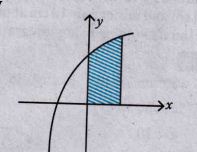
Find, by integration, the volume of the solid generated by revolving about the x-axis, the region enclosed by y = e−2x y = 0, x = 0 and x = 1
16.
Using integration find the area of the region bounded by triangle ABC, whose vertices A, B, and C are (−1, 1), (3, 2), and (0, 5) respectively
17.
Let U(x, y, z) = xyz, x = e-t, y = e-t cos t, z = sin t, t ∈ R. Find \(\frac{dU}{dt}\)
18.
Sketch the graph of the function \(y=\frac { 3x }{ { x }^{ 2 }-1 } \)
19.
Find the intervals of monotonicity and local extrema of the function f(x) = x log x + 3x.
20.
A tank contains 1000 litres of water in which 100 grams of salt is dissolved. Brine (Brine is a high-concentration solution of salt (usually sodium chloride) in water) runs in a rate of 10 litres per minute, and each litre contains 5 grams of dissolved salt. The mixture of the tank is kept uniform by stirring. Brine runs out at 10 litres per minute. Find the amount of salt at any time t.
21.
Solve the Linear differential equation:
\(\frac { dy }{ dx } +\frac { y }{ (1-x)\sqrt { x } } =1-\sqrt { x } \)
22.
Solve the cubic equations: 8x3 - 2x2 - 7x + 3 = 0
23.
Solve: (x - 4)(x - 7)(x - 2)(x + 1) = 16
24.
Solve \(tan^{ -1 }\left( \frac { x-1 }{ x-2 } \right) +tan^{ -1 }\left( \frac { x+1 }{ x+2 } \right) =\frac { \pi }{ 4 } \)
25.
A family of 3 people went out for dinner in a restaurant. The cost of two dosai, three idlies and two vadais is Rs. 150. The cost of the two dosai, two idlies and four vadais is Rs. 200. The cost of five dosai, four idlies and two vadais is Rs. 250. The family has Rs. 350 in hand and they ate 3 dosai and six idlies and six vadais. Will they be able to manage to pay the bill within the amount they had ?
26.
If z1, z2, and z3 are three complex numbers such that |z1| = 1, |z2| = 2|z3| = 3 and |z1 + z2 + z3| = 1, show that⏐9z1z2 +4z1z3 +z2z3 ⏐ = 6
27.
Find the inverse of each of the following by Gauss-Jordan method:
\(\left[ \begin{matrix} 2 & -1 \\ 5 & -2 \end{matrix} \right] \)
28.
Prove by vector method that the perpendiculars (altitudes) from the vertices to the opposite sides of a triangle are concurrent.
29.
Find the foci, vertices and length of major and minor axis of the conic 4x2 + 36y2 + 40x − 288y + 532 = 0
30.
Find the equation of the tangent and normal to the circle x2+y2−6x+6y−8 = 0 at (2, 2) .
31.
The curve y = ex is ________
convex
concave
convex upwards
concave upwards
32.
33.
The value of \(\int _{ 0 }^{ a }{ { (\sqrt { { a }^{ 2 }-{ x }^{ 2 } } ) }^{ 3 } } dx\) is
\(\frac { { \pi a }^{3 } }{ 16 } \)
\(\frac { 3\pi { a }^{ 4 } }{ 16 } \)
\(\frac { 3\pi { a }^{2 } }{ 8} \)
\(\frac { 3\pi { a }^{ 4 } }{ 8} \)
34.
The value of \(\int _{ 0 }^{ \infty }{ { e }^{ -3x }{ x }^{ 2 }dx } \) is
\(\frac{7}{27}\)
\(\frac{5}{27}\)
\(\frac{4}{27}\)
\(\frac{2}{27}\)
35.
If w (x, y, z) = x2 (y - z) + y2 (z - x) + z2(x - y), then \(\frac { { \partial }w }{ \partial x } +\frac { \partial w }{ \partial y } +\frac { \partial w }{ \partial z } \) is
xy + yz + zx
x(y + z)
y(z + x)
0
36.
The percentage error of fifth root of 31 is approximately how many times the percentage error in 31?
\(\frac{1}{31}\)
\(\frac15\)
5
31
37.
A random variable X has binomial distribution with n = 25 and p = 0.8 then standard deviation of X is
6
4
3
2
38.
39.
The abscissa of the point on the curve \(f\left( x \right) =\sqrt { 8-2x } \) at which the slope of the tangent is -0.25 ?
-8
-4
-2
0
40.
If a = cos θ + i sin θ, then \(\frac { 1+a }{ 1-a } \) = ___________
cot \(\frac { \theta }{ 2 } \)
cot θ
i cot \(\frac { \theta }{ 2 } \)
i tan\(\frac { \theta }{ 2 } \)
41.
\(cot\left( \frac { \pi }{ 4 } -{ cot }^{ -1 }3 \right) \)
7
6
5
none
42.
Which of the following is/are correct?
(i) Adjoint of a symmetric matrix is also a symmetric matrix.
(ii) Adjoint of a diagonal matrix is also a diagonal matrix.
(iii) If A is a square matrix of order n and λ is a scalar, then adj(λA) = λn adj(A).
(iv) A(adjA) = (adjA)A = |A| I
Only (i)
(ii) and (iii)
(iii) and (iv)
(i), (ii) and (iv)
43.
If A = \(\left[ \begin{matrix} 1 & \tan { \frac { \theta }{ 2 } } \\ -\tan { \frac { \theta }{ 2 } } & 1 \end{matrix} \right] \) and AB = I2, then B =
\(\left( \cos ^{ 2 }{ \frac { \theta }{ 2 } } \right) A\)
\(\left( \cos ^{ 2 }{ \frac { \theta }{ 2 } } \right) { A }^{ T }\)
\(\left( \cos ^{ 2 }{ \theta } \right) I\)
(Sin2\(\frac { \theta }{ 2 } \))A
44.
45.
If a vector \(\vec { \alpha } \) lies in the plane of \(\vec { \beta } \) and \(\vec { \gamma } \), then
\([\vec { \alpha } ,\vec { \beta } ,\vec { \gamma } ]\) = 1
\([\vec { \alpha } ,\vec { \beta } ,\vec { \gamma } ]\) = -1
\([\vec { \alpha } ,\vec { \beta } ,\vec { \gamma } ]\) = 0
\([\vec { \alpha } ,\vec { \beta } ,\vec { \gamma } ]\) = 2
46.
The values of m for which the line y = mx + \(2\sqrt { 5 } \) touches the hyperbola 16x2 − 9y2 = 144 are the roots of x2 − (a + b)x − 4 = 0, then the value of (a+b) is
2
4
0
-2
47.
The equation of the circle passing through the foci of the ellipse \(\frac{x^{2}}{16}+\frac{y^{2}}{9}=1\) having centre at (0, 3) is
x2 + y2 − 6y − 7 = 0
x2 + y2 − 6y + 7 = 0
x2+y2−6y−5 = 0
x2+y2−6y+5 = 0
48.
49.
If z is a complex number such that \(z \in \mathbb{C} \backslash \mathbb{R}\) and \(z+\frac { 1 }{ z } \epsilon R\), then |z| is
0
1
2
3
50.
According to the rational root theorem, which number is not possible rational zero of 4x7 + 2x4 - 10x3 - 5?
-1
\(\frac { 5 }{ 4 } \)
\(\frac { 4 }{ 5 } \)
5
51.
In each of the following cases, determine whether the following function is homogeneous or not. If it is so, find the degree.
f(x, y) = x2y + 6x3 + 7
52.
For the random variable X with the given probability mass function as below, find the mean and variance.
\(f(x)=\begin{cases} \begin{matrix} \frac { 1 }{ 10 } & x=2,5 \end{matrix} \\ \begin{matrix} \frac { 1 }{ 5 } & x=0,1,2,3,4 \end{matrix} \end{cases}\)
53.
Find the eccentricity of the ellipse with foci on x-axis if its latus rectum be equal to one half of its major axis.
54.
If A is a square matrix such that A3 = I, then prove that A is non-singular.
55.
Find the value of \(cos\left[ \frac { 1 }{ 2 } { cos }^{ -1 }\left( \frac { 1 }{ 8 } \right) \right] \)
56.
If \(\vec { a } =\hat { i } -2\hat { j } +3\hat { k }, \vec { b } =2\hat { i } +\hat { j } -2\hat { k }, \vec { c } =3\hat { i } +2\hat { j } +\hat { k } \) find \(\vec { a } .(\vec { b } \times \vec { c } )\).
1.
(i) Given that five fair coins are tossed once. Since the coins are fair coins the probability of getting an head in a single coin is
\(p=\frac { 1 }{ 2 } \) and \(q=1-p=\frac { 1 }{ 2 } \)
Let X denote the number of heads that appear in five coins. X is binomial random variable that takes on the values 0, 1, 2, 3, 4 and 5 and \(p=\frac { 1 }{ 2 } \) That is \(X\sim B\left( 5,\cfrac { 1 }{ 2 } \right) \)
Therefore the binomial distribution is
\(f(x)=\left( \begin{matrix} n \\ x \end{matrix} \right) p*\left( 1-p \right) ^{ n-x }\), x = 0, 1, 2,..,n
becomes
\(f(x)=\left( \begin{matrix} 5 \\ x \end{matrix} \right) \left( \cfrac { 1 }{ 2 } \right) ^{ x }\left( \cfrac { 1 }{ 2 } \right) ^{ n-x }\), x = 0, 1, 2,..,5
That is
\(f(x)=\left( \begin{matrix} 5 \\ x \end{matrix} \right) \left( \cfrac { 1 }{ 2 } \right) ^{ n }\), x = 0, 1, 2...,n
(ii) A fair die is rolled ten times and X denotes the number of times 4 appeared. X is binomial
random variable that takes on the values 0, 1, 2, 3,...10 , with n = 10 and \(p=\cfrac { 1 }{ 6 } \). That is \(X\sim B\left( 10,\cfrac { 1 }{ 6 } \right) \)
Probability of getting a four in a die is \(p=\frac { 1 }{ 2 } \) and \(q=1-p=\frac { 5 }{ 6 } \)
Therefore the binomial distribution is
\(f(x)=\left( \begin{matrix} 10 \\ x \end{matrix} \right) \left( \cfrac { 1 }{ 6 } \right) ^{ x }\left( \cfrac { 5 }{ 6 } \right) ^{ 10-x }\) x = 0, 1, 2,...,10
2.
(i) Since f (x) is a probability density function, f (x) ≥ 0 and \(\int _{ - }^{ \infty }{ f(x) } dx=1\)
That is \(\int _{ -\infty }^{ 0 }{ 0dx } +\int _{ 0 }^{ \infty }{ k{ e }^{ -2x }dx } =1\)
\(0+k\left( \frac { { e }^{ -2x } }{ -2 } \right) =1\Rightarrow k\left( \frac { { e }^{ -\infty }-{ e }^{ 0 } }{ -2 } \right) =1\Rightarrow k=2\)
Therefore the probability density function is
\(f\left( x \right) =\begin{cases} \begin{matrix} 2{ e }^{ -2x } & forx>0 \end{matrix} \\ \begin{matrix} 0 & forx \end{matrix}\le 0 \end{cases}\)
(ii) Distribution function
By definition the distribution function \(F(x)=P\left( x\le x \right) =\int _{ -\infty }^{ x }{ f(u) } du\)
When x≤0 \(F(x)=\int _{ -\infty }^{ x }{ F(u) } du=\int _{ -\infty }^{ x }{ odu=0 } \)
When x > 0 \(F(x)=\int _{ -\infty }^{ x }{ f(u) } du\int _{ -\infty }^{ x }{ 0du } +\int _{ 0 }^{ x }{ { 2e }^{ -2x }du\left( \frac { { e }^{ -2x } }{ -2 } \right) } =1-{ e }^{ 2x }\)
This gives \(F(x)=\begin{cases} \begin{matrix} 0 & forx\le 0 \end{matrix} \\ \begin{matrix} 1-{ e }^{ 2x } & forx>0 \end{matrix} \end{cases}\)
(iii) P(X < ) = P(X ≤2 ) = F(2 ) = 1-e2\(\times\)2 (since F(x) is continuous)
(iv) The probability that X is at least equal to four unit of time is
P(X ≥ 4 ) = 1 - P(X < 4 ) = 1- F( 4) = 1 - ( 1-e-2\(\times\)4) = e8
(v) In the continuous case, f (x) at x = a is not the probability that X takes the value a, that is f (x) at x = a is not equal to P( X ) a. If X is continuous type, P(X = a) = 0 for a ∈ R. Therefore P(x = 3) = 0.
3.
Let \(f(x)={ sin }^{ 2 }x\)
\(f(-x)={ (sin(-x)) }^{ 2 }={ sin }^{ 2 }x=f(x)\)
\(\therefore \int _{ -\frac { \pi }{ 4 } }^{ \frac { \pi }{ 4 } }{ { sin }^{ 2 }xdx } =2\int _{ 0 }^{ \frac { \pi }{ 4 } }{ { sin }^{ 2 }xdx } \)
\(cos\ 2x=1-2{ sin }^{ 2 }x\)
\(2{ sin }^{ 2 }x=1-cos2\)
\({ sin }^{ 2 }x=\frac { 1-cos\quad 2x }{ 2 } \)
\(=2\int _{ 0 }^{ \frac { \pi }{ 4 } }{ \left( \frac { 1-cos2x }{ 2 } \right) dx } \)
\(=\frac { 2 }{ 2 } { \left[ x-\frac { sin2x }{ 2 } \right] }_{ 0 }^{ \frac { \pi }{ 4 } }\)
\(=\frac { \pi }{ 4 } -\frac { sin\frac { \pi }{ 4 } }{ 2 } -0+\frac { sin0 }{ 2 } \)
\(\\ =\frac { \pi }{ 4 } -\frac { 1 }{ 2 } =\frac { \pi -2 }{ 4 } \)
4.
We have,
\(f'(x)=2x>0, \forall x\in(2,7)\) and
\(f'(x)=2x>0, \forall x\in(-2,0)\)
and hence the proof is completed.
5.
Let the two positive numbers be x and y.
Given xy = 20
\(\Rightarrow y=\frac { 20 }{ x } \)
Let f(x) = x+y
\(f(x)=x+\frac { 20 }{ x } \)
\(f'(x)=1-\frac { 20 }{ { x }^{ 2 } } \)
f'(x) = 0
\(\Rightarrow 1-\frac { 20 }{ { x }^{ 2 } } =0\)
\(\Rightarrow 1=\frac { 20 }{ { x }^{ 2 } } \)
\(\Rightarrow { x }^{ 2 }=20\)
\(\Rightarrow x=\pm \sqrt { 20 } \)
\(\Rightarrow x=\pm 2\sqrt { 5 } \)
∴ The critical number are \(2\sqrt { 5 } -2\sqrt { 5 } \)
\(f''(x)=\frac { 40 }{ { x }^{ 3 } } \)
When \(x=2\sqrt { 5 } \)
\(f''\left( x \right) =\frac { 40 }{ \left( 2\sqrt { 5 } \right) ^{ 3 } } >0\)
ஃ f(x) is minimum when \(x=2\sqrt { 5 } \)
When \(x=2\sqrt { 5 } ,y=\frac { 20 }{ 2\sqrt { 5 } } \)
= \(\frac { 10 }{ \sqrt { 5 } } \times \frac { \sqrt { 5 } }{ \sqrt { 5 } } =\frac { 10\sqrt { 5 } }{ 5 } =2\sqrt { 5 } \)
Hence the required positive numbers are \(2\sqrt { 5 } \)
Minimum sum = \(2\sqrt { 5 } \) + \(2\sqrt { 5 } \) = \(4\sqrt { 5 } \)
6.
Equation of the given curve is y2 - 4xy = x2 + 5..(1)
Differentiating with respect to 'x' we get,
\(2y\frac { dy }{ dx } -4\left[ x\frac { dy }{ dx } +y(1) \right] =2x\)
⇒ \(2y\frac { dy }{ dx } -4x\frac { dy }{ dx } -4y=2x\)
⇒ \(\frac { dy }{ dx } \) (2y -4x) = 2x + 4y
⇒ \(\frac { dy }{ dx } \) = \(\frac { x+2y }{ y-2x } \)
Since the tangent to the curve is horizontal, \(\frac { dy }{ dx } \) = 0
ஃ \(\frac { x+2y }{ y-2x } \) = 0
⇒ x+ 2y = 0
⇒ x = -2y .....(2)
Substituting (2) in (1) we get,
y2 - 4(-2y)y = (-1y)2 + 5
⇒ y2 + 8y2 = 4y2 + 5
⇒ y2 = 4y2 + 5
⇒ 5y2 = 5
⇒ y2 = 1
⇒ y = 土 1
From (2), When y = 1, x = - 2
When y = -1, x = 2
∴ The required points are (2, -1) and (-2,1)
7.
The given function is y = a cos(log x) + bsin (log x) ...(1)
where a, b are two arbitrary constants. In order to eliminate the two arbitrary constants, we have to differentiate the given function two times successively
Differentiating equation (1) with respect to x , we get
y' = -a sin (log x).\(\frac{1}{x}\)+ b cos (log x).\(\frac{1}{x}\Rightarrow\)xy' = -a sin(log x)+b cos (log x).
Again differentiating this with respect to x, we get
xy" + y' = -a cos(log x).\(\frac{1}{x}-b\) sin (log x).\(\frac{1}{x}\Rightarrow\)x2y" + xy'+ y = 0
Therefore, y = a cos(log x) + bsin (log x) is a solution of the given differential equation.
8.
Given |3z - 5| = 3 |z + 1
⇒ |3(x+iy)-5| = 3|x+iy+1|
⇒ |(3x-5)+3y| = 3|(x+1)+iy|
⇒ \(\sqrt { (3x-5)^{ 2 }+3^{ 2 } } =3\left[ \sqrt { (x+1)^{ 2 }+{ y }^{ 2 } } \right] \)
Squaring both sides we get,
(3x - 5)2 + 9 = 9 [(x + 1)2 + y2]
⇒ 9x2 - 30x + 25 + 9 = 9 [x2 + 2x + 1 + y2]
⇒ 48x - 16 = 0
⇒ 3x-1 = 0
9.
\(1+i\sqrt { 3 } \)
\(r=||z|=\sqrt { { 1 }^{ 2 }+\left( \sqrt { 3 } \right) ^{ 2 } } \)
|\(\theta ={ tan }^{ -1 }\left( \frac { 1 }{ \sqrt { 3 } } \right) =\frac { \pi }{ 3 } \)
Hence \(ang(z)=\frac { \pi }{ 3 } \)
Therefore, the polar form of \(1+i\sqrt { 3 } \) can be written as
\(1+i\sqrt { 3 } =2\left( cos\frac { \pi }{ 3 } +isin\frac { \pi }{ 3 } \right) \)
\(=2\left( cos\left( \frac { \pi }{ 3 } +2k\pi \right) +isin\left( \frac { \pi }{ 3 } +2k\pi \right) \right) ,k\varepsilon z\).
10.
Here, \(\vec { a } =(2\hat { i } -\hat { j } +2\hat { k } ),\vec { b } =(3\hat { i } +4\hat { j } +2\hat { k } )\).
The vector form of the given plane is \(\vec { r } .(\hat { i } -\hat { j } +\hat { k } )=5\). Then \(\vec { r } .(\hat { i } -\hat { j } +\hat { k } )=5\) and p = 5
We know that the position vector of the point of intersection of the line \(\vec { r } =\vec { a } +t\vec { b } \) and the plane
\(\vec { r } .\vec { d } =p\vec { u } =\vec { a } +\left( \frac { p-(\vec { a } .\vec { n } ) }{ \vec { b } .\vec { n } } \right) \vec { b } \), where \(\vec { b } .\vec { n } \neq \vec { 0 } \)
Clearly, we observe that \(\vec { b } .\vec { n } \neq \vec { 0 } \)
Now, \(\frac { p-(\vec { a } .\vec { n } ) }{ \vec { b } .\vec { n } } =\frac { 5-(2\hat { i } -\hat { j } +2\hat { k } ).(\hat { i } -\hat { j } +\hat { k } ) }{ (3\hat { i } +4\hat { j } +2\hat { k } ).(\hat { i } -\hat { j } +\hat { k } ) } =0\). Therefore, the position vector of the point of intersection of the given line and the given plane is
\(\hat { r } =(2\hat { i } -\hat { j } +2\hat { k } )+(0)(3\hat { i } +4\hat { j } +2\hat { k } )=2\hat { i } -\hat { j } +2\hat { k } \)
That is, the given straight line intersects the plane at the point (2, −1, 2)
Aliter:
The Cartesian equation of the given straight line is \(\frac { x-2 }{ 3 } =\frac { y+1 }{ 4 } =\frac { z-2 }{ 2 } =t\)(say)
We know that any point on the given straight line is of the form (3t+2, 4 t−1, 2 t+2). If the given line and the plane intersects, then this point lies on the given pane x−y+z−5 = 0.
So, (3t + 2)−(4t − 1) + (2t + 2) − 5 = 0 ⇒ t = 0.
Therefore, the given line intersects the given plane at the point (2, -1, 2)
11.
Let p(x) = x9 + 9x7 + 7x5 + 5x3 + 3x
p(x) has no sign change.
p(-x)⇒ (-x)9 + 9(-x)7 + 7(-x)5 + 5(-x)3 + 3(-x)
= -x9 - 9x7 - 7x5- 5x3 -3x
p(-x) also has no sign change
∴ p(x) has no positive and no negative root.
12.
We know that the domain of sin−1(x) is [-1, 1].
This leads to −1\(\le\)2 - 3x2\(\le\)1, Which implies -3\(\le\) -3x2\(\le\)-1
Now, -3\(\le\) -3x2, gives x2\(\le\)1 and ............(1)
-3\(\le\)-3x2\(\le\)-1, gives x2\(\ge\)\(\frac{1}{2}\) .........(2)
Combining the equations (1) and (2), we get \(\frac{1}{3}\le x^2\le 1\). That is \(\frac{1}{\sqrt3}\le |x|\le1\), Which gives \(x\in[-1,-1\frac{1}{\sqrt3}]\cup[\frac{1}{\sqrt3},1]\)
since a\(\le|x|\le b\) implies x \(\in[-b,-a]\cup[a,b]\).
13.
Existence of identity:
We have to find an element a' ∈ A such that
a*a' = a'*a = e
⇒ a + e-ae = a
⇒ a + e-ae = a
⇒ e-ae = 0
⇒ e(1-a) = 0
⇒ e = \(\frac{0}{1-a}\) = 0∈A
∴ A has an identity under *.
Existence of inverse:
For every a ∈ A, there exist a' ∈ A such that a*a' = a' * a = e
⇒ a+a'-aa' = 0 [∵e=0]
⇒ a+a'(1-a) = 0
⇒ a'(1-a) = -a
⇒ a' = \(\frac{-a}{1-a}\)
To prove that \(\frac{-a}{1-a}\)≠ 1
Suppose \(\frac{-a}{1-a}\) = 1
⇒ -a = 1-a
⇒ -a + a = 1 ⇒ 0 ≠ 1
∴ Our assumption is wrong
⇒ \(\frac{-a}{1-a}\) ≠ 1
∴ A has inverse for every element x ∈ A
14.
(( p V q)∧ ~p)) ➝ q
| p | q | p V q | ~p | ( p V q) ∧ ~q | ( p V q) ∧ ~q |
| T | T | T | F | F | T |
| T | F | T | F | F | T |
| F | T | T | T | T | T |
| F | F | F | T | F | T |
The statement (( p V q)∧ ~p) ➝ q is a tautology.
15.
Equation of the given curve is y = e-2x
Required Volume = \(\pi \int _{ 0 }^{ 1 }{ { { (e }^{ -2x }) }^{ 2 }dx } \)
\(=\pi \int _{ 0 }^{ 1 }{ { e }^{ -4x } } dx=\pi { \left[ \frac { { e }^{ -4x } }{ -4 } \right] }_{ 0 }^{ 1 }\)
\(=\frac { -\pi }{ 4 } \left[ { e }^{ -4 }-{ e }^{ -0 } \right] =-\frac { \pi }{ 4 } \left( { e }^{ -4 }-1 \right) \)
\(V=\frac { \pi }{ 4 } (1-{ e }^{ -4 })\) cubic units
16.
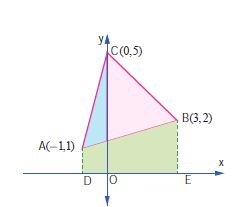
Equation of AB is \(\frac { y-1 }{ 2-1 } =\frac { x+1 }{ 3+1 } or\quad y=\frac { 1 }{ 4 } (x+5)\)
Equation of BC is \(\frac { y-5 }{ 2-5 } =\frac { x-0 }{ 3-0 } or\quad y=-x+5\)
Equation of AC is \(\frac { y-1 }{ 5-1 } =\frac { x+1 }{ 0+1 } or\quad y=4x+5\)
\(\therefore\) Area of \(\Delta\)ABC = Area DACO+ Area of OCBE − Area of DABE
\(=\int _{ -1 }^{ 0 }{ (4x+5)dx+\int _{ 0 }^{ 3 }{ (-x+5)dx-\frac { 1 }{ 4 } \int _{ -1 }^{ 3 }{ (x+5)dx } } } \)
\(\\ \\ \\ ={ \left[ \frac { { 4x }^{ 2 } }{ 2 } +5x \right] }_{ -1 }^{ 0 }+{ \left[ -\frac { { x }^{ 2 } }{ 2 } +5x \right] }_{ 0 }^{ 3 }-\frac { 1 }{ 4 } { \left[ \frac { { x }^{ 2 } }{ 2 } +5x \right] }_{ -1 }^{ 3 }\)
\(=0-(+2-5)+\left( -\frac { 9 }{ 2 } +15 \right) -0-\frac { 1 }{ 4 } \left[ \frac { 9 }{ 2 } +15 \right] +\frac { 1 }{ 4 } \left[ \frac { 1 }{ 2 } -5 \right] =\frac { 15 }{ 2 } \)
17.
Given u (x, y, z) = xyz; x = e-t y = e-t cas t; z = sin t
\(\frac { \partial u }{ \partial x } \) = yz; \(\frac { \partial u }{ \partial y } \) = xz; \(\frac { \partial u }{ \partial z } \) = xy
⇒ \(\frac { \partial u }{ \partial x } \) = et cas t sin t
\(\frac { \partial u }{ \partial y } \) = et sin t
\(\frac { \partial u }{ \partial z } \) = e-2t cas t and
\(\frac{dx}{dt}=-e^{-t}\)
⇒ \(\frac{dy}{dt}\) = e-t (- sin t) - cas t e-t
⇒ \(\frac{dz}{dt}\) = cos t
∴ By chain rule;
\(\frac { dw }{ dt } =\frac { \partial w }{ \partial x } .\frac { dx }{ dt } +\frac { \partial w }{ \partial y } .\frac { dy }{ dt } +\frac { \partial w }{ \partial z } .\frac { dz }{ dt } \)
∴ \(\frac { dw }{ dt } =\frac { \partial u }{ \partial x } .\frac { dx }{ dt } +\frac { \partial u }{ \partial y } .\frac { dy }{ dt } +\frac { \partial u }{ \partial z } .\frac { dz }{ dt } \)
= e-1 cos t sin t (-e-t) + e-t sin t (-e-t) + e-t sin t (-e-t sin t - e-t cos t)+ (-e-2t) cos t(cos t)
= -e-2t [(sin t cos t + sin2 t + sin t cos t - cos2 t]
= -e-2t [2 sin t cos t - (cos2 t - sin2 t)]
\(\frac { du }{ dt } \) = - e-2t, [sin 2t - cos2t]
[∵ cas 2 t = cos2 t - sin2 t and sin 2t = 2 sin t cos t]
18.
(1) The domain of f (x) is R \{−1,1}.
(2) Since f (−x,−y) = f (x, y) , the curve is symmetric about the origin.
(3) Putting y = 0, we get x = 0 . Hence the x -intercept is (0, 0).
(4) Putting x = 0, we get y = 0. Hence the y -intercept is (0, 0).
(5) To determine monotonicity, we find the first derivative as \(f'(x)\frac { -3\left( { x }^{ 2 }+1 \right) }{ { ({ x }^{ 2 }-1) }^{ 2 } } \)
Hence, f'( x) does not exist at x = −1,1. Therefore, critical numbers are x = −1, 1. The intervals of monotonicity is tabulated
| Interval | (-\(\infty\), -1) | (-1, 1) | (1, \(\infty\)) |
| Sign of f'(x) | - | - | - |
| Monotonicity | strictly decreasing | strictly decreasing | strictly decreasing |
6) Since there is no sign change in f'( x) when passing through critical numbers. There is no local extrema.
(7) To determine the concavity, we find the second derivative as \(f"(x)=\frac { 6x({ x }^{ 2 }-3) }{ { ({ x }^{ 2 }-1) }^{ 3 } } \) f"( x) = 0\(\Rightarrow\) x = 0 and f"(x) does not exist at x = −1, 1.
The intervals of concavity is tabulated.
| Interval | (-\(\infty\),-1) | (-1, 0) | (0,1) | (1,\(\infty\)) |
| Sign of f'(x) | - | + | - | + |
| Concavity | concave down |
concave up | concave down |
concave up |
(8) As x = −1 and 1are not in the domain of f(x) and at x = 0, the second derivative is zero and f"(x) changes its sign from positive to negative when passing through x = 0. Therefore, the point of inflection is (0, f (0)) = (0,0) .
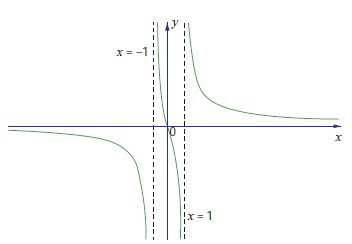
(9) \(\underset { x\rightarrow \pm \infty }{ lim } f(x)=\underset { x\rightarrow \pm }{ lim } \cfrac { 3x }{ { x }^{ 2 }-1 } =\underset { x\rightarrow \pm \infty }{ lim } \cfrac { 3 }{ x\frac { 1 }{ x } } =0\) Therefore y = 0 is a horizontal asymptote.
Since the denominator is zero, when x = 士1.\(\underset { x{ \rightarrow -1 }^{ - } }{ lim } \frac { 3x }{ { x }^{ 2 }-1 } -\infty ,\underset { x{ \rightarrow -1 }^{ + } }{ lim } \frac { 3x }{ { x }^{ 2 }-1 } =\infty ,\underset { x{ \rightarrow 1 }^{ - } }{ lim } \frac { 3x }{ { x }^{ 2 }-1 } -\infty ,\underset { x{ \rightarrow 1 }^{ + } }{ lim } \frac { 3x }{ { x }^{ 2 }-1 } =\infty .\)
Therefore x = −1 and x = 1 are vertical asymptotes.
The rough sketch of the curve is shown on the right side.
19.
The given function is defined and is differentiable at all \(x \in(0, \infty)\)
f(x) = x log x + 3x.
Therefore f'(x) = log x+1+3 = 4 + log x.
The stationary points are given by 4 + log x = 0
That is x = e-4
Hence the intervals of monotonicity are (0, e-4) and \((e^{-4}, \infty)\)
At \(x=e^{-5}\in(0,e^{-4})\), f'(e-5) = -1<0 and hence in the interval (0, e-4) -the function is strictly decreasing.
At \(x=e^{-3}\in(0,e^{-4})\), f'(e-3) = 1>0 and hence strictly increasing in the interval \((e^{-4}, \infty)\).
Since f′(x) changes from negative to positive when passing through x = e−4, the first derivative test tells us there is a local minimum at x = e-4 and it is f(e-4) = -e-4.
20.
Let x (t) denote the amount of salt in the tank at time t. Its rate of change is \(\frac{dx}{dt}\) = in flow rate − out flow rate
Now, 5 grams times 10 litres gives an inflow of 50 grams of salt. Also, the out flow of brine is 10 litres per minute. This is 10 /1000 = 0.01of the total brine content in the tank. Hence, the out flow of salt is 0.01 times x(t) , that is 0.01x(t).
Thus the differential equation for the model is \(\frac{dx}{dt}\)= 50 − 0.01x = −0.01(x − 5000)
This can be written as \(\frac{dx}{x-5000}=-(0.01)dt\)
Integrating both sides, we obtain log |x − 5000| = −0.01t + log C
or x-5000 = Ce-0.01t or x = 5000+Ce-0.01t
Initially, whent = 0, x = 100 , so 100 = 5000 +C .Thus, C = −4900 .
Hence, the amount of the salt in the tank at time t is x = 5000 -4900e-0.01
21.
The given linear differential euation is of the form
\(\frac{d y}{d x}+P y=Q \)
where \(\mathrm{P}=\frac{1}{(1-x) \sqrt{x}} ; \mathrm{Q}=1-\sqrt{x} \)
Take \(\sqrt{x}=\mathrm{t} \Rightarrow \mathrm{t}^2=x \)
\( x^{1 / 2}=\mathrm{t} \)
\( \frac{1}{2} x^{1 / 2-1} \mathrm{~d} x=\mathrm{dt} \Rightarrow \frac{1}{2} x^{-1 / 2} d x=\mathrm{dt} \)
\( \frac{1}{2 x^{1 / 2}} d x=\mathrm{dt} \Rightarrow \frac{1}{2 \sqrt{x}} d x=\mathrm{dt} \)
\( \frac{d x}{\sqrt{x}}=2 \mathrm{dt} \)
\( \text { I.F }=e^{\int P d x}=e^{\int \frac{1}{(1-x) \sqrt{x}} d x} \)
\( =e^{\int \frac{1}{1-t^{t^2} 2 d t}}=e^{\int \frac{2 d t}{1-1^2}} \)
\(\because \int \frac{d x}{a^2-x^2}=\frac{1}{2 x} \log \left|\frac{a+x}{a-x}\right| \)
\(\text { Here } a=1 ; x=t\)
\(=e^{\log \left(\frac{1+1}{1-t}\right)} \)
\(\mathrm{I} . \mathrm{F}=\frac{1+t}{1-t} \)
\({ I.F }=\frac{1+\sqrt{x}}{1-\sqrt{x}} \)
The solution is y\(\times \mathrm{I} . \mathrm{F}=\int \mathrm{Q} \times \mathrm{I}.Fd x+c\)
\( y\left(\frac{1+\sqrt{x}}{1-\sqrt{x}}\right)=\int(1-\sqrt{x}) \frac{1+\sqrt{x}}{1-\sqrt{x}} d x+c \)
\( =\int(1+\sqrt{x}) d x+c \)
\( y\left(\frac{1+\sqrt{x}}{1-\sqrt{x}}\right)=x+\frac{x^{3 / 2}}{3 / 2}+c \)
\( y\left(\frac{1+\sqrt{x}}{1-\sqrt{x}}\right)=x+\frac{2}{3} x^{3 / 2}+c \)
\( y\left(\frac{1+\sqrt{x}}{1-\sqrt{x}}\right)=x+\frac{2}{3} x \sqrt{x}+c \quad \because x^{3 / 2}=x \sqrt{x} \)
Which is the required solution
22.
Let f(x) = 8x3- 2x2 - 7x +3 = 0
Here sum of the co-efficients of odd terms = 8 - 7 = 1
and sum of the co-efficients of even terms = -2 +3 = 1
Hence, x = - 1 is a root of f(x)
Let us divide f(x) by (x + 1)
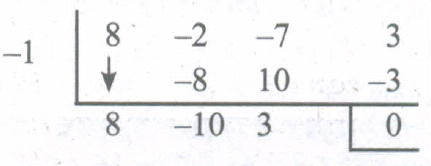
∴ The other factor is 8x2 - 10x + 3
\(\Rightarrow x=\frac { 10\pm \sqrt { 100-4(8)(3) } }{ 2\times 8 } \)
\(\Rightarrow x=\frac { 10\pm \sqrt { 100-96 } }{ 16 } \Rightarrow x=\frac { 10\pm 2 }{ 16 } \)
\(\Rightarrow x=\frac { 12 }{ 16 } \ or \)
\(x=\frac { 8 }{ 16 } \Rightarrow x=\frac { 3 }{ 4 } ,\frac { 1 }{ 2 } \)
∴ The roots are -1, \(\frac{1}{2},\frac{3}{4}\)
23.
(x-4)(x-7)(x-2)(x+1) = 16
Given (x - 4)(x -7)(x - 2)(x + 1) = 16
Rearrange the terms as
(x - 4)(x - 2)(x -7)(x + 1) = 16
⇒ (x2 - 6x + 8)(x2 - 6x -7) = 16
Put x2-6x = y
⇒ (y + 8) (y - 7) = 16
⇒ y2 +y - 56 - 16 = 0
⇒ (y+9)(y-8) = 0
⇒ y = -9, 8
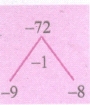
case (i)
When y = -9
⇒ x2-6x = -9
⇒ x2-6x+9 = 0
⇒ (x-3)2 = 0
⇒ x = 3, 3

case ii
When y = 8,
\(\Rightarrow x=\frac { 6\pm \sqrt { 36-4(1)(-8) } }{ 2 } \)
\(\Rightarrow x=\frac { 6\pm \sqrt { 36-32 } }{ 2 } \Rightarrow x=\frac { 6\pm \sqrt { 68 } }{ 2 } \)
\(\Rightarrow x=\frac { 6\pm 2\sqrt { 17 } }{ 2 } \Rightarrow x=\frac { 2(3\pm \sqrt { 17 } ) }{ 2 } \)
\(\Rightarrow x=3\pm \sqrt { 17 } \)
∴ The roots are 3, 3, 3 +\(\sqrt{17}\), and 3 -\(\sqrt{17}\)
24.
Now, \(tan^{ -1 }\left( \frac { x-1 }{ x-2 } \right) +tan^{ -1 }\left( \frac { x+1 }{ x+2 } \right) =tan^{ -1 }\left[ \frac { \frac { x-1 }{ x-2 } +\frac { x+1 }{ x+2 } }{ 1-\frac { x-1 }{ x-2 } \left( \frac { x+1 }{ x+2 } \right) } \right] =\frac { \pi }{ 4 } \)
Thus, \(\frac { \frac { x-1 }{ x-2 } +\frac { x+1 }{ x+2 } }{ 1-\frac { x-1 }{ x-2 } \left( \frac { x+1 }{ x+2 } \right) } \) = 1, which on simplification gives 2x2−4 = −3
Thus, x2 = \(\frac{1}{2}\)gives x = \(\pm \frac { 1 }{ \sqrt { 2 } } \)
25.
Let the cost of one dosa be Rs. x
The cost of one idli be Rs. y
and the cost of one vadai be Rs. z
By the given data,
2x+ 3y + 2z = 150
2x + 2y + 4z = 200
5x + 4y + 2z = 250
∴ Δ = \(\left| \begin{matrix} 2 & 3 & 2 \\ 2 & 2 & 4 \\ 5 & 4 & 2 \end{matrix} \right| \)
= \(2\left| \begin{matrix} 2 & 4 \\ 4 & 2 \end{matrix} \right| -3\left| \begin{matrix} 2 & 4 \\ 5 & 2 \end{matrix} \right| +2\left| \begin{matrix} 2 & 2 \\ 5 & 4 \end{matrix} \right| \)
= 2(4 - 16) - 3(4 - 20) + 2(8 - 10)
= 2(- 12) - 3(- 16) + 2(- 2)
= - 24 + 48 - 4 = 20
Δ1 = \(\left| \begin{matrix} 150 & 3 & 2 \\ 200 & 2 & 4 \\ 250 & 4 & 2 \end{matrix} \right| \)
Taking 50 common from C3 we get,
= 100\(\left| \begin{matrix} 3 & 3 & 1 \\ 4 & 2 & 2 \\ 5 & 4 & 1 \end{matrix} \right| \)
= \(100\left[ 3\left| \begin{matrix} 2 & 2 \\ 4 & 1 \end{matrix} \right| -3\left| \begin{matrix} 4 & 2 \\ 5 & 1 \end{matrix} \right| +1\left| \begin{matrix} 4 & 2 \\ 5 & 4 \end{matrix} \right| \right] \)
= 100[3(2 - 8) - 3(4 - 10) + 1(16 - 10)]
= 100[3(-6) - 3(- 6) + 6]
= 100[- 18 + 18 + 6] = 600
Δ2 = \(\left| \begin{matrix} 2 & 150 & 2 \\ 2 & 200 & 4 \\ 5 & 250 & 2 \end{matrix} \right| =100\left| \begin{matrix} 2 & 3 & 1 \\ 2 & 4 & 2 \\ 5 & 5 & 1 \end{matrix} \right| \)
= \(100\left[ 3\left| \begin{matrix} 4 & 2 \\ 5 & 1 \end{matrix} \right| -3\left| \begin{matrix} 2 & 2 \\ 5 & 1 \end{matrix} \right| +1\left| \begin{matrix} 2 & 4 \\ 5 & 5 \end{matrix} \right| \right] \)
= 100[2(4 - 10) - 3(2 - 10) + 1(10 - 20)]
= 100[2(- 6) - 3(- 8) + 1(- 10)]
= 100[- 12 + 24 - 10] = 100 [2] = 200
Δ3 = \(\left| \begin{matrix} 2 & 3 & 150 \\ 2 & 2 & 200 \\ 5 & 4 & 250 \end{matrix} \right| =50\left| \begin{matrix} 2 & 3 & 3 \\ 2 & 2 & 4 \\ 5 & 4 & 5 \end{matrix} \right| \)
= \(50\left[ 2\left| \begin{matrix} 2 & 4 \\ 4 & 5 \end{matrix} \right| -3\left| \begin{matrix} 2 & 4 \\ 5 & 5 \end{matrix} \right| +3\left| \begin{matrix} 2 & 2 \\ 4 & 4 \end{matrix} \right| \right] \)
= 50 [2(10 - 16) - 3(10 - 20) + 3(8 - 10)]
= 50[2(- 6) - 3(- 10) +3(- 2)]
= 50 [- 12 + 30 - 6] = 50 [12] = 600
∴ x = \(\frac { { \triangle }_{ 1 } }{ \triangle } =\frac { 600 }{ 20 } \) = 30
y = \(\frac { { \triangle }_{ 2 } }{ \triangle } =\frac { 200 }{ 20 } \) = 10
z = \(\frac { { \triangle }_{ 3 } }{ \triangle } =\frac { 600 }{ 20 } \) = 30
Hence, the price of one dosa be Rs. 30, one idli be Rs. 10 and the price of 1 vadai be Rs. 30.
Also the cost on dosa, six idlies and six vadai is
= 3x + 6y + 6z = 3(30) + 6(10) + 6(30)
= 90 + 60 + 180 = Rs. 330
Since the family had Rs. 350 in hand, they will be able to manage to pay the bill.
26.
Given |z1| = 1, |z2|= 2, |z3| = 3, |z1 + z2 + z3| = 1
|z1|2 = 12 ⇒ z1 \(\overline { { z }_{ 1 } } \) = 1 ⇒ z1 = \(\frac { 1 }{ { z }_{ 1 } } \)
|z2|2 = 4 ⇒ z2 \(\overline { { z }_{ 2 } } \) = 1 ⇒ z2 = \(\frac { 4 }{ { z }_{ 2 } } \)
|z3|2 = 9 ⇒ z3 \(\overline { { z }_{ 3 } } \) = 1 ⇒ z3 = \(\frac { 9 }{ { z }_{ 3 } } \)
∴ \(\left| 9,\frac { 1 }{ \overline { { z }_{ 1 } } } .\frac { 4 }{ \overline { { z }_{ 2 } } } +4.\frac { 1 }{ \overline { { z }_{ 1 } } } .\frac { 9 }{ \overline { { z }_{ 3 } } } +\frac { 4 }{ \overline { { z }_{ 2 } } } .\frac { 9 }{ \overline { z_{ 3 } } } \right| \)
\(\left| \frac { 36 }{ \overline { { z }_{ 1 } } \overline { { z }_{ 2 } } } +\frac { 36 }{ \overline { { z }_{ 1 } } \overline { { z }_{ 3 } } } +\frac { 36 }{ \overline { { z }_{ 2 } } \overline { { z }_{ 3 } } } \right| =\left| 36\left( \frac { \overline { { z }_{ 3 } } +\overline { { z }_{ 2 } } +\overline { { z }_{ 1 } } }{ \overline { { z }_{ 1 } } \overline { { z }_{ 2 } } \overline { { z }_{ 3 } } } \right) \right| \)
\(\\ \left[ \because |\overline { z_{ 1 } } +\overline { { z }_{ 2 } } +\overline { { z }_{ 3 } } |=|\overline { { z }_{ 1 }+{ z }_{ 2 }+{ z }_{ 3 } } | \right] \)
=\(\frac { 36|\overline { { z }_{ 1 }+{ z }_{ 2 }+{ z }_{ 3 } } | }{ |\overline { { z }_{ 1 } } ||\overline { { z }_{ 2 } } ||\overline { { z }_{ 3 } } | } =36\frac { |\overline { \overline { { z }_{ 1 } } +\overline { z_{ 2 } } +\overline { z_{ 3 } } | } }{ |\overline { { z }_{ 1 } } ||\overline { { z }_{ 2 } } ||\overline { { z }_{ 3 } } | } \)
\(\left[ \because |\overline { { z }_{ 1 } } |=|{ z }_{ 1 }|,|\overline { { z }_{ 2 } } =|{ z }_{ 21 }|,|\overline { { z }_{ 3 } } |=|\overline { { z }_{ 3 } } | \right] \)
\(=\frac{36(1)}{1(2)(3)}=\frac{\not 36}{\not 6}=6\)
∴ |9z1 + z2 + 4z1z3 + z2z3| = 6
27.
\(\left[ \begin{matrix} 2 & -1 \\ 5 & -2 \end{matrix} \right] \)
Let A =\(\left[ \begin{matrix} 2 & -1 \\ 5 & -2 \end{matrix} \right] \)
Applying Gauss - Jordan method, we get
[A|I2] =\(\left[ \begin{matrix} 2 & -1 \\ 5 & -2 \end{matrix}|\begin{matrix} 1 & 0 \\ 0 & 1 \end{matrix} \right] \)
\(\overset { { R }_{ 1 }\rightarrow { R }_{ 1 }\div 2 }{ \longrightarrow } \left[ \begin{matrix} 1 & -\frac { 1 }{ 2 } \\ 5 & -2 \end{matrix}|\begin{matrix} \frac { 1 }{ 2 } & 0 \\ 0 & 1 \end{matrix} \right] \)
\(\overset { { R }_{ 2 }\rightarrow { R }_{ 2 }-5{ R }_{ 1 } }{ \longrightarrow } \left[ \begin{matrix} 1 & -\frac { 1 }{ 2 } \\ 5 & -2 \end{matrix}|\begin{matrix} \frac { 1 }{ 2 } & 0 \\ -\frac { 5 }{ 2 } & 1 \end{matrix} \right] \)
\(\overset { { R }_{ 2 }\rightarrow { R }_{ 2 }\times 2 }{ \longrightarrow } \left[ \begin{matrix} 1 & -\frac { 1 }{ 2 } \\ 0 & 1 \end{matrix}|\begin{matrix} \frac { 1 }{ 2 } & 0 \\ -5 & 2 \end{matrix} \right] \)
\(\overset { { R }_{ 1 }\rightarrow { R }_{ 1 }+\frac { 1 }{ 2 } { R }_{ 2 } }{ \longrightarrow } \left[ \begin{matrix} 1 & 0 \\ 0 & 1 \end{matrix}|\begin{matrix} -2 & 1 \\ -5 & 2 \end{matrix} \right] \)
∴ We get A-1=\(\left[ \begin{matrix} -2 & 1 \\ -5 & 2 \end{matrix} \right] \)
28.
Consider a triangle ABC in which the two altitudes AD and BE intersect at O. Let CO be produced to meet AB at F. We take O as the origin and let \(\vec { OA } =\vec { a } \), \(\vec { OB } =\vec { b} \) and \(\vec { OC } =\vec { c } \)
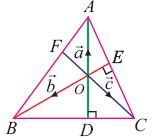
Since \(\vec { AD } \) is perpendicular to \(\vec { BC } \), we have \(\vec { OA } \) is perpendicular to \(\vec { BC } \), and
hence we get \(\vec { OA } \) . \(\vec { BC } \) = 0. That is, \(\vec { a } .(\vec { c } -\vec { b } )=0\), which means
\(\vec { a } .\hat{c}-\hat{a}.\hat{b}=0\)....(1)
Similarly, since \(\vec { BE } \) is perpendicular to \(\vec { CA } \), we have \(\vec { OB } \) is perpendicular to \(\vec { CA } \), and hence we get \(\vec { OB } .\vec { CA } \) = 0.
That is, \(\vec {b } .(\vec {a } -\vec { c } )=0\)
\(\vec { a } .\hat{c}-\hat{b}.\hat{c}=0\).......(2)
Adding equations (1) and (2), gives \(\vec { a } .\hat{c}-\hat{b}.\hat{c}=0\). That is, \(\hat{c}(\hat{a}-\hat{b})=0\)
That is \(\vec { OC } \) . \(\vec { BA } \) = 0.
Therefore, \(\vec { BA } \) is perpendicular to \(\vec { OC} \).
Which implies that \(\vec { CF} \) is perpendicular to \(\vec { AB } \).
Hence, the perpendicular drawn from C to the side AB passes through O. Therefore, the altitudes are concurrent.
29.
Completing the square on x and y of 4x2+36y2+40x−288y+532 = 0,
4(x2 + 10x + 25 − 25) + 36(y2 − 8y + 16 − 16) + 532 = 0 , gives
4(x2 + 10x + 25) + 36(y2 − 8y + 16) = −532 + 100 + 576
4(x + 5)2 + 36(y − 4)2 = 144.
Dividing both sides by 144, the equation reduces to \(\frac { { \left( x+5 \right) }^{ 2 } }{ 36 } \frac { { \left( y-4 \right) }^{ 2 } }{ 4 } =1\)
This is an ellipse with centre (-5, 4), major axis is parallel to x-axis, length of major axis is 12 and length of minor axis is 4. Vertices are (1, 4) and (-11, 4).
Now, c2 = a2−b2 = 36 − 4 = 32
and c = ±4 \(\sqrt { 2 } \)
Then the foci are (−5 − 4\(\sqrt { 2 } \), 4) and (−5 + 4\(\sqrt { 2 } \) , 4).
Length of the major axis = 2a = 12 units and
the length of the minor axis = 2b = 4 units.
30.
Equation of the circle is x2 + y2 − 6x + 6y − 8 = 0
∴ Equation of the tangent at (x1, y1) is
xx1 + yy1 - \(\frac 62\) (x + x1) + \(\frac 62\) (y + y1) - 8 = 0
Given (x1, y1) is (2, 2)
Equation of the tangent at (2, 2) is
x(2) + y(2) - 3(x + 2) + 3(y + 2) - 8 = 0
\(\Rightarrow 2 x-2 y-3 x+\not 6+3 y+\not 6-8=0\)
⇒ -x + 5y - 8 = 0
⇒ x − 5y + 8 = 0
Equation of the normal is
yx1 - xy1 + g(y - y1) - f(x - x1) = 0
⇒ y(2) -x(2) - 3(y - 2) -3(x - 2) = 0
∵ 2g = -6
⇒ g = -3
2f = 6
⇒ f = 3
⇒ 2y - 2x - 3y + 6 - 3x + 6 = 0
⇒ -5x - y + 12 = 0
Another method for Normal:
Equation of tangent is perpendicular to normal
x - 5y + 8 = 0
Perpendicular equation be 5x + y + k = 0
At (2, 2)
10 + 2 + k = 0
k = -12
Therefore 5x + y - 12 = 0 be equation of normal.
31.
(d)
concave upwards
32.
(c)
33.
(b)
\(\frac { 3\pi { a }^{ 4 } }{ 16 } \)
34.
(d)
\(\frac{2}{27}\)
35.
(d)
0
36.
(b)
\(\frac15\)
37.
(d)
2
38.
(c)
39.
(b)
-4
40.
(c)
i cot \(\frac { \theta }{ 2 } \)
41.
(a)
7
42.
(d)
(i), (ii) and (iv)
43.
(b)
\(\left( \cos ^{ 2 }{ \frac { \theta }{ 2 } } \right) { A }^{ T }\)
44.
(c)
45.
(c)
\([\vec { \alpha } ,\vec { \beta } ,\vec { \gamma } ]\) = 0
46.
(c)
0
47.
(a)
x2 + y2 − 6y − 7 = 0
48.
(c)
49.
(b)
1
50.
(c)
\(\frac { 4 }{ 5 } \)
51.
Given f(x, y) = x2y + 6x3 + 7
f(λx, λy) = λ2x2λy + 6λ3x3 + 7
= λ3 x2 y + 6λ3 x3 + 7
≠ λf(x, y)
There is no common λ in this equation.
It is not homogeneous
52.
| x | 0 | 1 | 2 | 3 | 4 | 5 |
| f(x) | \(\cfrac { 1 }{ 5 } \) | \(\cfrac { 1 }{ 5 } \) | \(\cfrac { 1 }{ 10 } \) | \(\cfrac { 1 }{ 5 } \) | \(\cfrac { 1 }{ 5 } \) | \(\cfrac { 1 }{ 10 } \) |
\(\therefore Mean=E(x)=\Sigma xf(x)=0\left( \frac { 1 }{ 5 } \right) +1\left( \frac { 1 }{ 5 } \right) +2\left( \frac { 1 }{ 10 } \right) +3\left( \frac { 1 }{ 5 } \right) +4\left( \frac { 1 }{ 5 } \right) +5\left( \frac { 1 }{ 10 } \right) \)
\(\frac { 1 }{ 5 } +\frac { 1 }{ 5 } +\frac { 3 }{ 5 } +\frac { 4 }{ 5 } +\frac { 1 }{ 2 } \)
= \(\frac { 2+2+6+8+5+ }{ 10 } =\frac { 23 }{ 10 } =2.3\)
= \(f({ x }^{ 2 })=\Sigma { x }^{ 2 }f(x)\)
= \({ 0 }^{ 2 }\left( \frac { 1 }{ 5 } \right) +{ 1 }^{ 2 }\left( \frac { 1 }{ 5 } \right) +2^{ 2 }\left( \frac { 1 }{ 10 } \right) +{ 3 }^{ 2 }\left( \frac { 1 }{ 5 } \right) +{ 4 }^{ 2 }\left( \frac { 1 }{ 5 } \right) +{ 5 }^{ 2 }\left( \frac { 1 }{ 10 } \right) \)
= \(0+\frac { 1 }{ 5 } +\frac { 4 }{ 10 } +\frac { 9 }{ 5 } +\frac { 16 }{ 5 } +\frac { 25 }{ 10 } \)
= \(\frac { 2+4+18+32+25 }{ 10 } =\frac { 81 }{ 10 } =8.1\)
= \(\frac { 2+4+18+32+25 }{ 10 } =\frac { 81 }{ 10 } =8.1\)
Variance = E(X2) - [E(X)]2
= 8.1- (2.3)2
= 8.1- 5.29
= 2.81
53.
Let the equation of the ellipse be \(\frac { { x }^{ 2 } }{ { a }^{ 2 } } +\frac { { y }^{ 2 } }{ { b }^{ 2 } } =1\)
Given, length of LR = \(\frac { 1 }{ 2 } \) (Length of major axis)
⇒ \(\frac { { 2b }^{ 2 } }{ a } =\frac { 1 }{ 2 } \) (2a) ⇒ \(\frac { 2{ b }^{ 2 } }{ a } \) = a ⇒ 2b2 = a2
∴ e = \(\sqrt { 1-\frac { { b }^{ 2 } }{ { a }^{ 2 } } } =\sqrt { 1-\frac { { b }^{ 2 } }{ { 2a }^{ 2 } } } =\sqrt { 1-\frac { 1 }{ 2 } } =\sqrt { \frac { 1 }{ 2 } } =\frac { 1 }{ \sqrt { 2 } } \)
54.
Given A3 = I ⇒ IA3I = |I|
⇒ |A.A.A| = 1
⇒ |A|. |A|·|A| = 1
⇒ |A|3 = 1
∴ |A| ≠ 0
Hence, A is non-singular.
55.
Consider cos\(\left[ \frac { 1 }{ 2 } { cos }^{ -1 }\left( \frac { 1 }{ 8 } \right) \right]\).
Let \( { cos }^{ -1 }\left( \frac { 1 }{ 8 } \right) =\theta .\)
Then \( cos\theta =\frac { 1 }{ 8 } and\quad \theta \in \left[ 0,\pi \right] \)
Now, cos\(\theta=\frac{1}{8}\) implies 2 cos2 \(\frac{\theta}{2}-1=\frac{1}{8}\).
Thus, cos\((\frac{\theta}{2})\) is positive
Thus, \(cos\left[ \frac { 1 }{ 2 } { cos }^{ -1 }\left( \frac { 1 }{ 8 } \right) \right] =cos\left( \frac { \theta }{ 2 } \right) =\frac { 3 }{ 4 } \)
56.
Given \(\vec { a } =\hat { i } -2\hat { j } +3\hat { k }, \vec { b } =2\hat { i } +\hat { j } -2\hat { k }, \vec { c } =3\hat { i } +2\hat { j } +\hat { k } \)
∴ \(\vec { a } .(\vec { b } \times \vec { c } )=\left| \begin{matrix} 1 & -2 & 3 \\ 2 & 1 & -2 \\ 3 & 2 & 1 \end{matrix} \right| \)
= \(1\left| \begin{matrix} 1 & -2 \\ 2 & 1 \end{matrix} \right| +2\left| \begin{matrix} 2 & -2 \\ 3 & 1 \end{matrix} \right| +3\left| \begin{matrix} 2 & 1 \\ 3 & 2 \end{matrix} \right| \)
= 1(1+4)+2(2+6)+3(4-3)
= 1(5)+2(8)+3(1)
= 5+16+3 = 24
\(\vec { a } .(\vec { b } \times \vec { c } )\) = 24

12th Standard Syllabus & Materials
12th Standard
TN 12th Computer Applications களப்பெயர் முறைமை (DNS) Sample Question Papers Study Material - QB365 Set A
NEW12th Standard
TN 12th Computer Applications வலையமைப்பு எடுத்துக்காட்டுகள் மற்றும் நெறிமுறைகள் Sample Question Papers Study Material - QB365 Set A
NEW12th Standard
TN 12th Computer Applications கணினி வலையமைப்பு ஓர் அறிமுகம் Sample Question Papers Study Material - QB365 Set A
NEW12th Standard
TN 12th Computer Applications PHP-உடன் MySQL-ஐ இணைத்தல் Sample Question Papers Study Material - QB365 Set A



Tamilnadu Stateboard 12th Standard Subjects
Maths

Chemistry

Physics

Biology

Computer Science

Business Maths and Statistics

Economics

Commerce

Accountancy

History

Computer Applications
Biology
Computer Technology
Computer Applications
Computer Science
Business Maths and Statistics
Commerce
Economics
Maths
Chemistry
Physics
Computer Technology
History
Accountancy

Tamil

English

French
Tamilnadu Stateboard Standards

