
 100% FREE ACCESS
12th Standard Syllabus & Materials
12th Standard
TN 12th Computer Applications மின்னணு தரவு பரிமாற்றம் Sample Question Papers Study Material - QB365 Set A
NEW12th Standard
TN 12th Computer Applications மின் - வணிக பாதுகாப்பு அமைப்புகள் Sample Question Papers Study Material - QB365 Set A
NEW12th Standard
TN 12th Computer Applications மின்னணு செலுத்தல் முறைகள் Sample Question Papers Study Material - QB365 Set A
NEW12th Standard
TN 12th Computer Applications மின் - வணிகம் Sample Question Papers Study Material - QB365 Set A
NEW12th Standard
TN 12th Computer Applications திறந்த மூல கருத்துருக்கள் Sample Question Papers Study Material - QB365 Set A
NEW12th Standard
TN 12th Computer Applications வலையமைப்பு வடமிடல் Sample Question Papers Study Material - QB365 Set A

Published on: 14/02/2020
Download Tamil Nadu 12th Standard Economics question papers, model tests, one-mark questions, important questions, and public exam papers in PDF format. Free study materials and answer keys for TN State Board students.
Questions + Answers key
Take MCQ Economics Test1.
During the past 67 years of planning, the population of India has increased from 36.1 crore in…………, to 121 crore in………..?
1951 and 2011
1981 and 2011
1991 and 2018
1971 and 2001
2.
Which among the following defines Repo Rate?
The rate at which banks place their surplus funds with the RBI
The rate at which banks can borrow against their excess SLR securities to meet additional liquidity requirements
The rate at which the Reserve Bank is prepared to buy or re-discount bills of exchange or other commercial paper eligible for purchase
The rate at which banks borrow funds from the Reserve Bank against eligible collatera
3.
Assertion: The principal factor affecting the development of an economy is the availability of natural resources.
Reason: The existence of natural resources in abundance is essential for development.
Both A and R are true and R is the correct explanation of A
Both A and R are true but R is not the correct explanation of A
A is true but R is false
A is false but R is true
4.
Scarcity induced inflation has happened in Venezula of the year ______.
2017
2018
2016
2008
5.
Who said this? “that level of employment at which any further increase in spending would result in an inflationary spiral of wages and prices”.
J.S.Mill
J.M.Keynes
Lerner
Pigou
6.
The correlation coefficient is used to determine:
A specific value of the y-variable given a specific value of the x-variable
A specific value of the x-variable given a specific value of the y-variable
The strength of the relationship between the x and y variables
None of these
7.
Match the correct codes
| 1 | Mercantilism | i | Takes an usversus- them view of trade |
| 2 | Free Trade theories | ii | Absolute Advantage |
| 3 | Free Trade refined | iii | David Ricardo |
| 4 | Comparative Advantage | iv | Heckscher - Ohlin |
(1) – (i) (2) – (ii) (3) – (iv) (4) – (iii)
(1) – (ii) (2) – (iii) (3) – (iv) (4) – (i)
(1) – (iv) (2) – (iii) (3) – (i) (4) – (ii)
(1) – (i) (2) – (ii) (3) – (iii) (4) – (iv)
8.
That part of personal income which is actually available to households for consumption and saving is called________
National Disposable Income
Personal Disposable Income
Personal Income
None
9.
Which of the following is correct?
1+ MPS = MPC
1- MPC = MPS
MPC + MPS > 1
MPC + MPS < 1
10.
The relationship between the ___________ and _________is generally explained in the form of a “Material Balance Model’’ developed by AlenKneese and R.V. Ayres.
economy and the ecosystem
society and the environment
ecosystem and society
economy and the environment
11.
What is the term coined by Manfred D Steger (2002) to denote the new market ideology of globalisation that connects nations together through international trade and aiming at global development?
Extended Capitalism
Confined Capitalism
Favourable Capitalism
None of above
12.
BENELUX is a form of
Free trade area
Economic Union
Common market
Customs union
13.
Favourable trade means value of exports are ________ Than that of imports.
More
Less
More or Less
Not more than
14.
When prices rise slowly, we call it
galloping inflation
mild inflation
hyper inflation
deflation
15.
Stagflation combines the rate of inflation with
Stagnation
employment
output
price
16.
The multiplier tells us how much _______ changes after a shift in _____.
Consumption, income
investment, output
savings, investment
output, aggregate demand
17.
Keynes attributes unemployment to_______.
A lack of effective supply
A lock of effective demand
A lack of both
None of the above
18.
The value of national income adjusted for inflation is called_________
Inflation Rate
Disposal Income
GNP
Real national income
19.
Quantity of a commodity accumulated at a point of time is termed as ____________..
production
stock
variable
flow
20.
Write a brief note on The Concurrent List
21.
What is central tendency?
22.
Write an example for “Positive Production Externality”
23.
Point out any two ways in which IBRD lends to member countries.
24.
What is the main difference between Adam Smith and Ricardo with regard to the emergence of foreign trade?
25.
Mention the functions of agriculture credit department.
26.
What is commodity money?
27.
Define full employment.
28.
What is the difference between NNP and NDP?
29.
Classify the economies based on status of development.
30.
What are the taxes levied and collected by the union but assigned to the states?
31.
Explain Adam Smith’s Theory of Absolute Cost Advantage.
32.
33.
Discuss the economic determinants of economic development.
34.
35.
36.
37.
How the Rate of Exchange is determined? Illustrate.
38.
What are the objectives of Monetary Policy? Explain.
39.
What are the causes and effects of inflation on the economy?
40.
Illustrate the working of Multiplier.
41.
Describe the types of unemployment.
42.
Discuss the importance of social accounting in economic analysis.
43.
Compare the features among Capitalism, Secularism and Mixedism
44.
List any of three scopes of statistics with explanation.
45.
Distinguish between Economic Development and Growth. (Any Three Points).
46.
Discuss the important statistical organizations (offices) in India.
47.
State any three characteristics of taxation.
48.
What is Multilateral Agreement?
49.
Explain the Net Barter Terms of Trade and Gross Barter Terms of Trade.
50.
Specify the functions of IFCI.
51.
State the propositions of Keynes’s Psychological Law of Consumption
52.
According to classical theory of employment, how wage reduction solve the problem of unemployment diagramatically explain.
53.
List out the uses of national income.
54.
| (a) | Capitalist economy | - | Free market economy |
| (b) | Equilibrium level | - | Need full employment |
| (c) | Effective demand | - | Aggregate deman |
| (d) | J.S.Mill | - | Enquiry into the nature and causes of wealth of nation |
1.
(a)
1951 and 2011
2.
(d)
The rate at which banks borrow funds from the Reserve Bank against eligible collatera
3.
(a)
Both A and R are true and R is the correct explanation of A
4.
(b)
2018
5.
(a)
J.S.Mill
6.
(c)
The strength of the relationship between the x and y variables
7.
(a)
(1) – (i) (2) – (ii) (3) – (iv) (4) – (iii)
8.
(a)
National Disposable Income
9.
(b)
1- MPC = MPS
10.
(d)
economy and the environment
11.
(a)
Extended Capitalism
12.
(d)
Customs union
13.
(a)
More
14.
(b)
mild inflation
15.
(a)
Stagnation
16.
(d)
output, aggregate demand
17.
(b)
A lock of effective demand
18.
(d)
Real national income
19.
(b)
stock
20.
Ithas 52 subjects important to both the Union and the State, such as Electricity, Trade Union, Economic and Social Planning, etc.
21.
1. Central value is called a measure of central tendency or an average or a measure of locations. There are five averages.
2. Among them mean, median and mode are called simple averages and the other two averages geometric mean and harmonic mean are called special averages.
22.
(i) The ideal location for beehives is orchards (first growing fields). While bees make honey, they also help in the pollination of apple blossoms.
(ii) The benefits accrue to both producers (honey as well as apple). This is called reciprocal untraded interdependency.
23.
1. Loans out of its own fund.
2. Loans out of borrowed capital and
3. Loans through Bank's guarantee.
24.
(i) According to Adam Smith, the basis of international trade was absolute cost advantage.
(ii) To Ricardo the basis of trade is comparative cost advantage.
(iii) Trade can take place even if the absolute cost difference is absent but there is comparative cost difference.
25.
(i) To maintain an expert staff to study all questions on agricultural credit.
(ii) To provide expert advice to Central and State Government, State Co-operative Banks.
(iii) To finance the rural sector through eligible institutions and to co-ordinate them.
26.
(i) Surplus goods were exchanged for money which in turn was exchanged for other needed goods.
(ii) Goods like furs, skins, salt, rice, wheat, utensils, weapons were used as money
27.
(i) "Full employment is the absence of involuntary unemployment." - Keynes
(ii) "Full employment is that level of employment at which any further increase in spending would result in an inflationary spiral of wages and prices" - Lerner
28.
(i) NDP = GDP - Depreciation.
(ii) NNP = GNP - Depreciation.
(iii) The difference between NDP and NNP is the net factor income from abroad.
(iv) In NDP it is excluded but in NNP it is included.
29.
Economies can be classified into different types based on the Status of Development are
1. Developed
2. Underdeveloped
3. Undeveloped and
4. Developing economies
30.
1. Duties in respect of succession to property other than agricultural land.
2. Estate duty in respect of property other than agricultural land.
3. Taxes on railway fares and freights.
4. Taxes other than stamp duties on transactions in stock exchanges and future markets.
5. Taxes on the sale or purchase of newspapers and on advertisements published therein
6. Terminal taxes on goods or passengers carried by railways, sea or air.
7. Taxes on the sale or purchase of goods other than newspapers where such sale or purchase taxes place in the course of inter-State trade or commerce.
31.
Adam Smith argued that all nations can be benefitted when there is free trade and specialisation in terms of their absolute cost advantage
The Theory
(i) According to Adam Smith, the basis of international trade was absolute cost advantage.
(ii) Trade between two countries would be mutually beneficial when one country produces a commodity at an absolute cost advantage over the other country which in turn produces another commodity at an absolute cost advantage over the first country.
Assumptions
1. There are two countries and two commodities (2 x 2 model).
2. Labour is the only factor of production
3. Labour units are homogeneous
4. The cost or price of a commodity is measured by the amount of labour required to produce it.
5. There is no transport cost.
Illustration
Absolute cost advantage theory can be illustrated with the help of the following example.
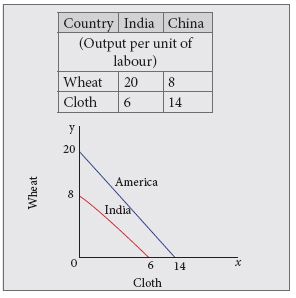
(iii) From the illustration, it is clear that India has an absolute advantage in the production of wheat over China and China has an absolute advantage in the production of cloth over India
(iv) Therefore, India should specialize in the production of wheat and import cloth from China. China should specialize in the production of cloth and import wheat from India
(v) This kind of trade would be mutually beneficial to both India and China.
32.
33.
Natural Resource:
(i) The existence of natural resources in abundance is essential for development.
(ii) But Japan, though it lacks natural resources imports them and achieves faster rate of economic development with the help of technology.
Capital Formation:
(i) Capital formation refers to the net addition to the existing stock of capital goods which are either tangible (plants, machinery) or intangible (health, education).
(ii) Capital formation helps increase productivity of labour, production and income.
(iii) Advanced techniques of production can be used and leads to better utilization of natural resources, industrialization and expansion of markets which are essential for economic progress.
Size of the Market:
(i) Large size of the market would stimulate production, increase employment and raise the National per capita income.
Structural Change:
(ii) Structural change refers to change in the occupational structure of the economy.
(iii) Any economy is divided into primary secondary and tertiary sector.
(iv) Any economy which is predominantly agricultural remains backward.
Financial System:
(i) Financial system implies the existence of an efficient and organized banking system in the country.
(ii) There should be an organized money market to facilitate easy availability of capital.
Marketable Surplus:
(i) It refers to the total amount of farm output cultivated by farmers over and above their family consumption needs.
(ii) This surplus brings income, raises purchasing power, employment and output in other sectors.
Foreign Trade:
(i) A country with favorable balance of trade is always developed.
Economic System:
(i) A country with free market system enjoys better growth rate compared to controlled economies.
34.
35.
36.
37.
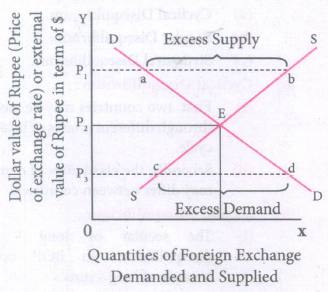
(i) The equilibrium rate of exchange is determined in the foreign exchange market according to the general theory of value, by the interaction of demand and supply,
(ii) Y axis represents exchange rate, be cos value of rupee in terms of dollars
(iii) X axis represents demand and supply of forex.
(iv) E is the equilibrium point where DD intersects SS. The exchange rate is P2.
38.
Introduction
(i) Monetary Policy is the macroeconomic policy laid down by the Central Bank towards the management of money, supply and interest rate. It is associated with Milton Friedman
1) Neutrality of Money
(i) Wicksteed, Hayek and Robertson are the chief exponents of neutral money.
(ii) They say that the monetary authority should aim at neutrality of money in the economy.
(iii) Monetary changes cause distortion and disturbances in the proper functioning of the economic system of the leading to all economic fluctuations.
2) Exchange Rate Stability
(i) It is a traditional objective from the Gold Standard period
(ii) When there was disequilibrium in the balance of payment, it was automatically corrected by movements.
(iii) It was popularly known as "Expand Currency and Credit when gold is coming in; Contract currency and credit when gold is going out."
(iv) If there is instability in the exchange rates, it would result in outflow or inflow of gold resulting in unfavorable balance of payments.
3) Price Stability
(i) Crustave Cassel and Keynes suggested price stabilization as a main objective of monetary policy.
(ii) Stable Price creates public confidence, promotes business activity and ensures equitable distribution of income and wealth leading to prosperity and welfare
(iii) Price stability does not mean price rigidity or price stagnation.
(iv) A mild increase in the price level provides a tonic for economic growth.
4) Full Employment
(i) Unemployment was socially dangerous, economically wasteful and morally deplorable.
(ii) Both Keynes' General Theory of Employment, Interest and Money in 1936, the objective of full employment became very important
5) Economic Growth
(i) Economic growth is the process whereby the real per capita income of a country increases
(ii) There is increase in the total physical or real output
(iii) Monetary policy should promote sustained and continuous economic growth by maintaining equilibrium between the total demand for money and total production capacity for creating increase in saving and investment.
(iv) Flexible monetary policy is the best solution.
6) Equilibrium in the Balance of Payments (BoP)
(i) World trade was faster than world liquidity.
(ii) Increasing deficit in BoP reduces the ability of an economy to achieve other objectives.
(iii) Many less developed countries reduce their imports which adversely affects development activities, so monetary authority should make efforts to bring equilibrium in the BoP.
39.
Causes:
Increase in Money Supply:
1. Increase in money supply leads to increase in aggregate demand.
2. The higher the growth rate of nominal money supply, the higher is the rate of inflation.
Increase in Disposable Income:
1. When disposable income increases, it raises their demand for goods and services.
2. Disposable income may increase with the rise in national income or reduction in taxes or saving of the people.
Increase in Public Expenditure:
1. Government activities have been expanding due to developmental activities and social welfare programmes.
2. This is also a cause for price rise.
Increase in Consumer Spending:
1. The demand for goods and services increases when they are given credit to buy goods on hire-purchase and instalment basis.
Cheap Monetary Policy:
1. Cheap monetary policy leads to increase in the money supply which raises demand for goods and services.
Deficit Financing:
1. To meet the expenses, government resorts to deficit financing by borrowing from the public and even by printing more notes.
2. This raises aggregate demand leading to inflation.
Black Assets, Activities and Money:
1. It leads to corruption, tax evasion.
2. People spend black money lavishly.
3. Black marketing and hoarding reduces the supply of goods and increases.
Repayment of Public Debt:
1. Whenever government repays its past internal debt to the public, money supply increases.
Increase in Exports:
1. When exports are encouraged, domestic supply of goods decline, prices rise.
Effects:
On Production:
1. When inflation is very moderate it is an incentive to traders and producers.
2. When profit increases the business men increase their investments in production leading to more employment and income.
3. Hyper inflation leads to depreciation of the value of money and discourages savings.
4. It may even drain out the foreign capital already invested in the country.
5. The reduced capital accumulation, discourage entrepreneurs and business men from taking business risk.
6. Inflation also leads to hoarding of essential goods by traders and consumers leading to still higher inflation rate.
7. Encourages investment in speculative activities rather than productive purposes.
On Distribution:
Debtors and Creditors:
1. During inflation debtors are the gainers.
2. Debtors had borrowed when the purchasing power of money was high and now repay the loans when the purchasing power of money is low due to rising prices.
Fixed-income Groups:
1. They are worst hit because their incomes being fixed has no relationship with the rising cost of living.
Entrepreneurs:
1. Inflation is a boon to manufacturers, traders, merchants, businessmen, because it serves as a tonic for business enterprise.
2. They get windfall gains as the prices of their stocks suddenly go up.
Investors:
1. Those who invest in fixed interest yielding bonds and securities lose during inflation.
2. Those who invest in shares stand to gain by rich dividends and appreciation in value of shares.
40.
Introduction
The concept of multiplier Was first developed by R.F. Khan in terms of employment. J.M Keynes redefined it as investment multiplier.
Definition
Multiplier is defined as the ratio of the change in national income to change in investment.
\(K=\Delta Y / \Delta I\)
The value of multiplier depends on MPC.
\(\mathrm{K}=\frac{1}{1-\mathrm{MPC}} \text { since } \mathrm{MPC}+\mathrm{MPS}=1\)
\(k=\frac{1}{N 118}\)
Multiplier is inversely related to MPS and directly with MPC.
If MPC is, 0.75, MPS is 0.25 then K=4.00
\(\frac{1}{1-0.75} \text { or } \frac{1}{0.25}=4\)
| MPC | MPS | k |
| 0.00 | 1.00 | 1 |
| 0.10 | 0.90 | 1.11 |
| 0.50 | 0.50 | 2.00 |
| 0.75 | 0.25 | 4.00 |
Working
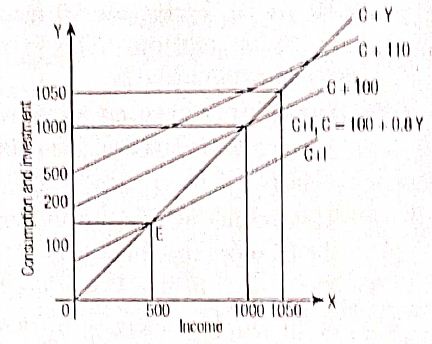
(i) Suppose government undertakes investment expenditure equal to र100 cr on public works.
(ii) Income of labourers and suppliers of materials increases by र100 cr
(iii) If MPC is 0.8 that is 80 %. र80 cr is spent on consumption र20 cr salved
(iv) Suppliers of goods get an income of र80 cr. They spend र64 cr (ie 80% of र80 cr).
(v) In this manner consumption expenditure and increase in income act in a chain like manner.
41.
Cyclical unemployment:
(i) During the downturn phase (recession and depression) of trade cycle, income and output fall leading to cyclical unemployment.
(ii) It is caused by deficiency of effective demand
Structural unemployment:
(i) Unemployment due to massive and deep rooted changes in economic structure leads to structural unemployment.
(ii) Lack of demand for the product or shift in demand to other products cause this type of unemployment.
(iii) (e.g.) rise in demand for mobile phones has adversely affected the demand for cameras, tape recorders
Disguised unemployment:
(i) It occurs in agriculture when more people are there than required. Even if some workers are withdrawn, production does not suffer.
Actual marginal productivity is zero, less or negative.
(i) Seasonal unemployment
1. In agriculture and agro based industries like sugar, production activities are carried out only in some seasons.
2. These industries offer employment only during that season in a year.
3. People remain unemployed during the off season.
4. Seasonal unemployment takes place from demand side also (eg) ice cream industry, holiday resorts
(ii) Frictional unemployment (Temporary unemployment)
1. It arises due to imbalance between supply of labour and demand for labour.
2. It is because of immobility of labour, lack of necessary skills, break down of machinery, shortage of raw materials.
3. The persons who lose jobs and in search of jobs also come under frictional unemployment
(iii) Educated unemployment
1. Educated people are underemployed or unemployed when qualification does not match the job.
2. Faulty education system, lack of employable skills, mass student turnout and preference for white collar jobs are highly responsible for educated unemployment.
42.
Introduction:
National income can be measured by the social accounting method. Under this method, the transactions among various sectors such as firms, households, government are recorded and their interrelationships traced.
Firms:
undertake productive activities. They employ factors of production to produce goods and services.
Households:
Households are consuming entities. They represent the factors of production, who receive payment for services rendered by them to firms. (i) Households consume the goods produced by the firms. There is a circular flow of money between these two groups.
Government:
The Government sector refers to the economic transactions of public bodies at all levels-centre, state and local. Their purchases may be financed through taxation, public borrowings. The government provides public health, education. They satisfy the collective wants of society. But Post Offices and railways are separated from the Government sector and included as "Firms".
Rest of the world:
It relates to international economic transactions - income, export, import external loan transaction, and allied overseas investment income and payments.
Capital sector:
(i) Capital sector refers to saving and investment activities. It includes the transactions of banks, insurance corporations, financial houses. These are not included under "Firms".
(ii) The economy is also divided into primary, secondary tertiary and quaternary sectors.
Conclusion:
The social accounting framework is useful for economists as well as policy makers, because it represents the major economic flows and statistical relationships among various sectors of the economic system. It is possible to forecast the trends of economy more accurately.
43.
| S.No | Features | Capitalism | Socialism | Mixedism |
|---|---|---|---|---|
| 1. | Ownership of Means of Production | Private Ownership | Public Ownership | Private Ownership and Public Ownership |
| 2. | Economic Motive | Profit | Social Welfare | Social Welfare and Profit Motive |
| 3. | Solution of Central Problems | Free Market System | Central Planning System | Central Planning System and Free Market System |
| 4. | Government Role | Internal Regulation only | Complete Involvement | Limited Role |
| 5. | Income Distribution | Unequal | Equal | Less unequal |
| 6. | Nature of Enterprise | Private Enterprise | Government Enterprise | Both Private and State Enterprises |
| 7. | Economic Freedom | Complete Freedom | Lack of Freedom | Limited Freedom |
| 8 | Major Problem | Inequally | Inefficiency | Inequality and Inefficiency |
44.
Statistics and Economics
Statistical data and techniques are immensely useful in solving many economic problems such as fluctuation in wages, prices, production, distribution of income and wealth and so on.
Statistics and Firms
Statistics is widely used in many firms to find whether the product is conforming to specifications or not.
Statistics and Commerce
Statistics are life blood of successful commerce. Market survey plays an important role to exhibit the present conditions and to forecast the likely changes in future.
45.
| S.No | Economic Development | Economic Growth |
|---|---|---|
| (i) | Related to Underdeveloped Countries | Related to developed (or) advanced countries. |
| (ii) | Rising of income levels in poor countries. | Rising of income levels in rich countries |
| (iii) | It is discontinuous and spontaneous changes in the station if any state | It is gradual and steady changes in the long run. |
46.
Central Statistical Office (CSO)
(i) It is responsible for co-ordination of statistical activities in the country and for evolving and maintaining statistical standards.
(ii) It compiles National Accounts, conducts Annual Survey of Industries and Economic Census, compiles Index of Industrial Production and Consumer Price Indices.
(iii) It deals with social statistics, training, international co-operation, Industrial Classification, etc.
National Sample Survey
Organisation
NSSO has four divisions:
(i) Survey Design and Research Division
(ii) Field Operations. Division
(iii) Data Processing Division
(iv) Co-ordination and Publication Division
The Programme Implementation Wing has 3 Divisions:
(i) Twenty Point Programme
(ii) Infrastructure Monitoring and Project Monitoring
(iii) Member of Parliament Local Area Development Scheme.
1. There is National Statistical Commission and one autonomous Institute, i.e., Indian Statistical Institute.
47.
(i) A tax is a compulsory payment made to the government. Refusal to pay the tax is punishable.
(ii) There is no quid pro quo between a taxpayer and public authorities.
(iii) Tax payer cannot claim any specific benefit against the payment of a tax.
(iv) Every tax involves some sacrifice on the part of the tax payer.
(v) A tax is not levied as a fine or penalty for breaking law.
48.
(i) It is a multinational legal or trade agreements between countries.
(ii) It is an agreement between more than two countries but not many.
49.
Net Barter Terms of Trade
1. This was developed by Taussig in 1927.
2. The ratio between the prices of exports and of imports is called net barter terms of trade.
3. Viner calls it commodity terms of trade.
4. \(\mathrm{T}_{\mathrm{n}}=\left(\mathrm{P}_{\mathrm{x}} / \mathrm{P}_{\mathrm{m}}\right) \times 100\)
5. Tn is Net Barter Terms of Trade
6. Px is Index number of export prices
7. Pm is Index number of import prices
8. This measures the gain from International Trade.
9. If Tn is greater than 100, it is terms of trade which means that for a rupee of export, more of imports can be received by a country.
Gross Barter Terms of Trade
1. Developed by Taussig in 1927 as an improvement over the net terms of trade.
2. It is an index of relationship between total physical quantity of imports and the total physical quantity of exports.
\(\mathrm{Tg}=\left(\mathrm{Q}_{\mathrm{m}} / \mathrm{Q}_{\mathrm{x}}\right) \times 100\)
3. Qm is Index of import quantities
4. Qx is Index of export quantities
5. If for a given quantity of export, more quantity of import can be consumed by a country, the terms of trade are favourable.
50.
The IFCI does the following functions
(i) Providing long-term loans in rupees and foreign currencies.
(ii) Underwriting of equity, preference and debenture issues.
(iii) Subscribing to equity, preference and debenture issues.
(iv) Guaranteeing the deferred payments for machinery imported from abroad or purchased in India
(v) Guaranteeing of loans raised in foreign currency from foreign financial institutions.
51.
(i) When income incrcases, consumption expenditure also incrcases but by a smaller amount.
(ii) The increased income will be divided in some proportion between consumption expenditure and saving.
(iii) Increase in income always leads to an increase in both consumption and saving.
52.
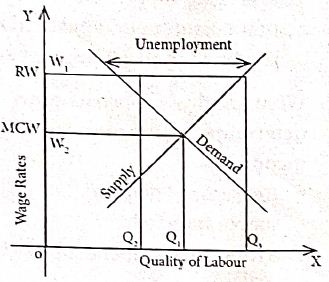
(i) Classical unemployment occurs when real wages are kept above the market clearing wage rate, leading to a surplus of labour supplied.
(ii) Classical unemployment is also called real wage unemployment.
(iii) Unemployment occurs when the worker is willing to accept (Real Wages)(RW) is in excess of those an employer is willing to pay (Market Clearing Wage)(MCW).
(iv) Real wage may be above the equilibrium level because of minimum wage policies or union bargaining.
(v) classical unemployment of Q1-Q2 can be solved by a wage cut.
(vi) If wages are allowed to fall to the market clearing level, unemployment is solved
53.
(i) National income is of great importance for the economy of a country.
(ii) National income helps us to know the relative importance and contribution of each sector. We could find how income is produced, how it is distributed, how much is spent, saved or taxed.
(iii) National income data is used to build economic models in short run and long run.
(iv) Data regarding gross income, output, saving & consumption is used in economic planning.
(v) National income data is used to build economic models in short run and long run.
(vi) It is used to make international comparison, inter - regional comparison and inter - temporal comparison of growth of the economy during different periods.
(vii) If income is equally distributed, the per capita income will reflect the economic welfare of the country.
54.
Capitalist economy - Free market economy

12th Standard Syllabus & Materials
12th Standard
TN 12th Computer Applications களப்பெயர் முறைமை (DNS) Sample Question Papers Study Material - QB365 Set A
NEW12th Standard
TN 12th Computer Applications வலையமைப்பு எடுத்துக்காட்டுகள் மற்றும் நெறிமுறைகள் Sample Question Papers Study Material - QB365 Set A
NEW12th Standard
TN 12th Computer Applications கணினி வலையமைப்பு ஓர் அறிமுகம் Sample Question Papers Study Material - QB365 Set A
NEW12th Standard
TN 12th Computer Applications PHP-உடன் MySQL-ஐ இணைத்தல் Sample Question Papers Study Material - QB365 Set A



Tamilnadu Stateboard 12th Standard Subjects

Maths

Chemistry

Physics

Biology

Computer Science

Business Maths and Statistics
Economics

Commerce

Accountancy

History

Computer Applications
Biology
Computer Technology
Computer Applications
Computer Science
Business Maths and Statistics
Commerce
Economics
Maths
Chemistry
Physics
Computer Technology
History
Accountancy

Tamil

English

French
Tamilnadu Stateboard Standards

