
 100% FREE ACCESS
8th Standard CBSE Syllabus & Materials
8th Standard CBSE
CBSE 8th Social Science Theme D - Factors of Production - New Model Questions Papers Study Material - QB365 Set A
NEW8th Standard CBSE
CBSE 8th Social Science Theme C - Universal Franchise and India's Electoral System - New Model Questions Papers Study Material - QB365 Set A
NEW8th Standard CBSE
CBSE 8th Social Science Theme B - The Rise of the Marathas - New Model Questions Papers Study Material - QB365 Set A
NEW8th Standard CBSE
CBSE 8th Social Science Theme B - Reshaping India's Political Map - New Model Questions Papers Study Material - QB365 Set A
NEW8th Standard CBSE
CBSE 8th Social Science Theme A - Natural Resources and Their Use - New Model Questions Papers Study Material - QB365 Set A
NEW8th Standard CBSE
CBSE 8th Science Keeping Time with Skies - New Model Questions Papers Study Material - QB365 Set A

Published on: 02/03/2019
Revision Test On Geography
Download CBSE Class 8th Standard CBSE Social Science question papers, sample papers, important questions, and previous year solved papers in PDF format. Get free study materials, NCERT solutions, and exam preparation resources for Class 8th Standard CBSE Social Science
Questions + Answers key
Take MCQ Social Science Test
1.
On what basis can minerals be identified?
2.
Pick up a stone, a leaf, a paper straw and a twig. Think of how you can use these as resources? See the example given below and get creative!
| You can use a stone ... | Use/Utility |
| To play stapu | toy |
| As a paper-weight | tool |
| To crush spices | tool |
| To decorate your garden/room | decoration piece |
| To open a bottle | tool |
| In a catapult | weapon |
3.
Circle those resources from Amma's list that have no commercial values as yet:
Amma's List:
1. Cotton cloth
2. Iron ore
3. Intelligence
4. Medicinal plants
5. Medical knowledge
6. Coal deposits
7. Beautiful scenery
8. Agricultural land
9. Clean environment
10. Old folk songs
11. Good weather
12. Resourcefulness
13. A good singing voice
14. Grand mother's home remedies
15. Affection from friends and family.
4.
An average urban Indian uses about 150 litres of water every day.
| Use | Litres per person per day |
| Drinking | 2 |
| Cooking | 4 |
| Bathing | 20 |
| Flushing | 40 |
| Washing clothes | 40 |
| Washing utensils | 20 |
| Gardening | 23 |
| Total | 150 |
Can you suggest some ways to bring down this amount?
5.
List uses of any five minerals.
6.
One of the way to conserve minerals is :
Recycling of minerals
Reducing waste in the process of mining
Only (b)
Both (a) and (b)
7.
Which one of the following explains the term Weathering?
Marginal land kept fallow for a certain period to restore their fertility.
Breaking up and decaying of exposed rocks due to various factors.
Groups of plant in areas having similar climatic condition.
Land covered with grass shrubs on which animals graze freely.
8.
Which one of the following statement is correct?
Handloom textile industry is labour intensive industry
Manufacturing is known as a tertiary activity.
Most of the industries use raw materials obtained from the sea.
Iron and Steel Industry is known as Sunrise Industry
9.
The main cause for the uneven distribution of the resources is/are:
Technological skills
Using fossil fuels at fast pace
Development level
Different natural conditions
10.
In Mexico, shifting agriculture is called:
Ladang
Jhumming
Milpa
Roca
11.
Industrial disaster occurred in Bhopal on
3rd December, 1974
3rd December, 1980
3rd December, 1983
3rd December, 1984
12.
The types of resources on the basis of origin are
actual and potential
renewable-and non-renewable
ubiquitous and localised
biotic and abiotic
13.
The use of land is determined by factors such as
(i) topography
(ii) soil
(iii) climate
(iv) mineral
Choose the correct option.
(i), (ii) and (iii)
(i), (iii) and (iv)
(ii), (iii) and (iv)
All are correct.
14.
Golden fibre refers to
tea
cotton
jute
15.
Which one of the followings is not a characteristic of minerals?
They are created by natural processes.
They have a definite chemical composition.
They are inexhaustible.
Their distribution is uneven.
16.
What are the main factors responsible for soil degradation ?
17.
Read the following lines of a hindi poem:
"Rahiman paani raakhiye
Bin paani sab soon.
Paani gaye na ubre
Moti, manus, Choon "
It was written by the poet Abdul Rahim Khankhana. One of the nine gems of Akbar's court.
Now answer the following questions:
(i) What source is the poet talking about?
(ii) Write at least five points what would happen if this resource disappeared.
18.
Look carefully at the given graph and answer the questions that follow
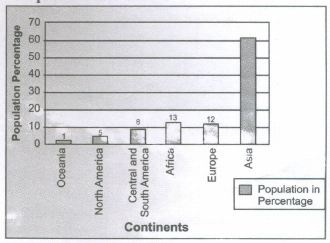
(i) Which continent has the lowest share of population
(ii) Which continent has about 12% of the world population?
(iii) Which two continents have the greatest percentage of population?
(iv) Which two continents have the lowest share of population?
(v) How much percentage of the world's population does Asia support alone?
19.
Activity Discuss some more reasons which are responsible for changes of land use pattern. Has your place undergone any change in the land use pattern in recent years?
Find out from your parents and elderly people. You can conduct an interview by asking the following questions.
| Place | When your grand parents were in their 30s |
When your parents were in their 30s |
Why do you think this is happening? |
Are common areas and open spaces disappearing |
| Rural | - | - | - | - |
| Number of cattle and poultry owned | - | - | - | - |
| Number of trees and ponds in the village | - | - | - | - |
| Main occupation of the head of the family | - | - | - | - |
| Urban | ||||
| Number of cars owned | - | - | - | - |
| Number of rooms in the house | - | - | - | - |
| Number of metalled roads | - | - | - | - |
| Number of flyovers in the city | - | - | - | - |
| Number of parks and playgrounds | - | - | - | - |
Based on the table you have just completed, draw a picture of land use patterns that you foresee in your neighbourhood after 20 years. Why do you think that land use patterns change over the years?
20.
What are the bad effects of population explosion on society? How does population pyramid help in understanding the population of the country?
21.
An irrigation method which is useful in dry region is __________.
22.
__________ helps in transferring the physical material into valuable resources.
23.
____________is the staple diet of tropical and subtropical regions.
24.
The difference between the birth rate and the death rate of a country is called the________
25.
Industries can be classified on the basis of raw materials, size and ________
26.
Actual resources are those whose quantity is _____________________
27.
In commercial grain farming, crops are grown for_______purpose.
28.
.......minerals contain metal in raw form.
29.
USA
30.
Write down the advantages and disadvantages of coal.
31.
Explain briefly some agricultural activities that can reduce wastage of water.
32.
What are the important categories of Natural resources? Explain with examples.
33.
Which are the major food crops of the world? Explain in brief the climatic conditions required to grow them?
34.
What would the shape of the population pyramid be, if a country has both high birth rate and death rate?
35.
In the recent period, sharp decline in the number of particular species is noticed, why?
36.
Write three methods of water conservation.
37.
Why is the distribution of resources unequal all over the earth ?
38.
What do you understand by resource conservation?
39.
What is Green Revolution?
40.
Human resources refer to the number and abilities of the people.
41.
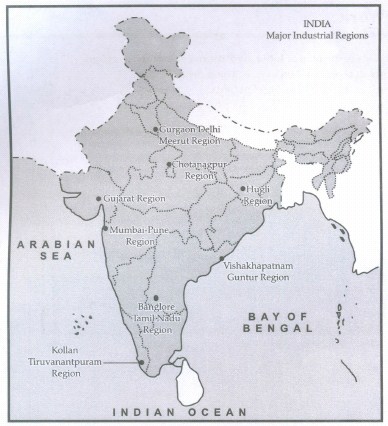
Mention the major industrial regions of India and show them on the outline map of India.
1.
Minerals can be identified on the following basis:
(i) Physical Properties :
1.Density
2.Colour
3. Hardness 2
(ii) Chemical Properties:
1. Solubility
2.
| You can use a leaf ... | Use/Utility |
| For colour printing | tool |
| Pasting in drawing pictures | material |
| To stick in a scrapbook | material |
| To write on a dry leaf as a paper | material |
| You can use a twig ... | Use/Utility |
| To make fire from dry twig | tool |
| To stick in scrap book | material |
| To make picture frame for drawing | material |
| You can use a straw ... | Use/Utility |
| To make pictures | tool |
| To make water bubbles | tool |
| To make a book mark | tool |
| To make sand pictures with the help of a twig | tool |
3.
Old folk songs, Good weather, A good singing voice, grandmother's home remedies, Affection from friends and family.
4.
Yes,we can bring down this use by avoiding wastage and by being rational and judicious.
Some ways to bring down this amount are are as follows:
(i) We can use half drunk water, and also the water which is left after washing vegetables for gardening purpose. It will automatically reduce the amount of water for gardening use.
(ii) We can put a two litre water bottle in the flush tank to reduce the water level in it. So that we can reduce water consumption during every single flush.
(iii) Do not use dishwasher because it consumes much water during washing utensils.
5.
Minerals are used in various fields like:
(i) Iron ore is used for manufacturing of machines, agricultural implements and items of general use.
(ii) Copper is another metal used in everything from coins to pipes.
(iii) Silicon, used in the computer industry is obtained from quartz.
(iv) Aluminum obtained from its ore bauxite is used in automobiles and aeroplanes, and bottling industry, buildings and even in kitchen cookware.
(v) Mica is used in electrical and electronic industries.
6.
(d)
Both (a) and (b)
7.
(b)
Breaking up and decaying of exposed rocks due to various factors.
8.
(a)
Handloom textile industry is labour intensive industry
9.
(a)
Technological skills
10.
(c)
Milpa
11.
(d)
3rd December, 1984
12.
(d)
biotic and abiotic
13.
(d)
All are correct.
14.
(c)
jute
15.
(c)
They are inexhaustible.
16.
The main factors responsible for soil degradation are:
(i) Landslides: It involves large-scale displacement of soil and rocks from the hilly areas, leading to soil degradation in mountainous regions.
(ii) Rain wash: It includes washing up of the topsoil in the areas of high precipitation.
(iii)Floods : Floods are another most important cause responsible for the soil degradation in terms of quantity as well as quality.
(iv) Deforestation : Large-scale forest destruction by man to fulfill their own needs is one of the major causes responsible for soil destruction.
(v) Overgrazing : It reduces the usefulness of the land and is one of the causes of desertification and erosion.
(vi) Overuse of chemicals : Excessive use of fertilizers and pesticides to increase the agricultural production is one of the major causes for soil pollution.
(vii) Urbanization : Large-scale urbanization is the major cause for the destruction of fertile soil due to encroachment of the fertile areas.
17.
(i) The resource here is water.
(ii) Water is an important resource as it is not only necessary for our daily work, but also needed to produce electricity. The life of other living beings also depends on it.
If this resource disappears from the earth, then we will face the following problems:
(a) All life will disappear from earth.
(b) No plants and trees will grow in the absence of water.
(c) All the vegetation would dry up.
(d) Allthe animals and human beings are dependent on plants for oxygen and food. So they will not get any food and the level of carbon dioxide will increase in atmosphere, hence animals and human beings would die.
(e) All the human activities would come to an end.
(f) No industry would exist on the surface of the earth.
(g) The earth would completely dry up and get scorched.
18.
(i) Oceania has the lowest share of population
(ii) Europe has about 12%of the world population.
(iii) Asia and Africa have the greatest percentage of population.
(iv) Oceania and North America are the two continents that have the lowest share of population.
(v) Asia alone supports about 61% of the world's population.
19.
| Place | When your grand parents were in their 30s |
When your parents were in their 30s |
Why do you think this is happening? |
Are common areas and open spaces disappearing |
| Rural | ||||
| Number of cattle and poultry owned | Cattle:02 per family | -01 | Because of shifting to other jobs from agriculture. |
Yes |
| Number of trees and ponds in the village | Trees: 150 Ponds:12 |
10 01 |
Because of ever increasing population | Yes |
| Main occupation of the head of the family | Agriculture | Small shop | Due to unproductive land and its small size | NIL |
| Urban | ||||
| Number of cars owned | NIL | 01 car per household | Due to increase in income. | NIL |
| Number of rooms in the house | 4 | 2 | Due to division among members. | Yes |
| Number of metalled roads | 1 | 4 | Due to increase in transport facilities | Yes |
| Number of flyovers in the city | NIL | 4 | Due to congestion on the road. | Yes |
| Number of parks and playgrounds | 2 and 4 | 2 and 2 | Due to growth of population. | - |
Land use patterns change over years due to:
(i) Increase in population leading to increase in demand for land for agriculture, transport, housing complexes, industries and so on.
(ii) Change in occupation from primary to tertiary, quaternary activities.
20.
Bad effects of population explosion on our society are:
(i) A pressure upon resources as there are more people and their quick depletion.
(ii) An increased number of poverty-stricken individuals as little food is distributed among more people, then starvation. malnutrition or poor diet with ill health and diet-deficiency diseases would increase.
(iii) Loss of natural environment (forests and such) and loss of ecosystems because they are destroyed to make way for farming and urban developments to accommodate the rising population.
(iv) Irreversible loss of arable land and increase in desertification.
Population pyramid is also called the age-sex pyramid. Population pyramid shows:
(i) The total population which is divided into various age groups. For example 5 to 9 years, 10 to 14 years.
(ii) The percentage of the total population, subdivided into males and females, in each of those groups.
(iii) The numbers of children (below 15 years) are shown at the bottom and reflect the level of births.
(iv) The size of the top shows the numbers of aged people (above 65 years) and reflects the number of deaths.
21.
()
Drip irrigation
22.
()
Skill
23.
()
Rice
24.
()
Natural growth rate
25.
()
Ownership
26.
()
known
27.
()
Commercial
28.
()
Metallic
29.
()
The world's largest geothermal power plant producer
30.
The advantages of coal are:
(i) It is abundantly available in the earth.
(ii) It is one of the most primitive source of energy.
The disadvantages of coal are:
(i) The transportation cost of coal is very high.
(ii) It is one of the most polluting fuel as it produces lots of smoke when burnt and is responsible for global warming.
31.
Water is used for irrigating the fields. Due to illiterate and ignorant farmers, lot of water is wasted.
As a result, some new approaches have been introduced, such as :
(i) Lining of the canal to minirnise water losses through seepage.
(ii) Use of sprinklers to irrigate the field and to control loss of water evaporation.
(iii) Drip or trickle irrigation to be practised in dry areas.
32.
Generally, Natural resources are categorised into Renewable and Non-renewable resources.
(i)The resources which get renewed or replenished quickly are called Renewable Resources. Some of them are unlimited and are not affected by human activities. For example, Solar and Wind energy.
(ii)Resources which have limited stock and take millions of years to get renewed are known as Nonrenewable Resources.
For example, Coal, Petroleum and Natural Gas.
33.
The major food crops of the world are Wheat, Rice, Maize, and Millets.
The climatic conditions required for their growth are:
(i) Rice grows best in alluvial clayey soil, which can retain water. It also needs high temperature, high humidity, and rainfall.
(ii) Wheat grows best in well-drained loamy soil. It requires moderate temperature and rainfall during growing season and bright sunshine at the time of harvest.
(iii) Maize requires well-drained fertile soils. It also requires moderate temperature, rainfall and lot of sunshine.
(iv) Jowar, Bajra, and Ragi are called millets. They are also known as coarse grains. They can grow on less fertile and sandy soils. They need low rainfall and high to moderate temperature.
34.
(i) A country that has high birth rate and high death rate will have a population pyramid that is broad at the base and rapidly narrows towards the top.
(ii) This is because although a large number of children are born, a large percentage of them die in their infancy, few become adult and very few reach the old age.
(iii) For example, Kenya has a high birth rate, as well as a high death rate.
35.
Poaching of animals for collection and illegal trade of hides, skins, nails, teeth, horns; change of climate and human interference are the main reasons behind this.
36.
Three important methods of water conservation are:
(i) To slow down the rate of surface run-off, we must grow plants and vegetation.
(ii) We must promote rainwater harvesting technique to collect the rain water.
(iii) In agriculture, sprinkle or drip irrigation methods must be used.
37.
The distribution of natural resources depends upon a number of physical factors like terrain, climate and altitude, which is varied, so the distribution of resources is unequal all over the earth.
38.
Resource conservation refers to the balanced and careful use of the resources in order to give them time to get renewed.
39.
Green revolution refers to that tremendous increase in agricultural production, which was possible due to the adoption of new agricultural strategy.
40.
(a)
41.
India has eight industrial regions and they are:
(i) Mumbai-Pune Region: It extends from Thane to Pune and the adjoining districts of Nasik and Sholapur.
(ii) Hugli Region: It extends from Bansbaria in the north to Birlanagar in the south.
(iii) Bangalore- Tamil Nadu Region: It extends from Banglore to all parts of Tamil Nadu except Villupuram.
(iv) Gujarat Region: It lies between Ahmedabad and Vadodara in the south to Jamnagar in the west.
(v) Chhotanagpur Region: It extends over Jharkhand, northern Odisha and western West Bengal.
(vi) Vishakhapatnam-Guntur Region: It extends from Vishakhapatnam district to Kurnool and Prakasam district in the south.
(vii) Gurgaon-Delhi-Merrut Region: It includes Gurgaon, Delhi, Shahadara, Faridabad, Ghaziabad, Meerut, Modinagar, Ambala, Agra and Mathura.
(viii) Kollam- Thiruvananthapuram Region: It is spread over Thiruvananthapuram, Kollam, Alwaye, Ernakulam, and Alappuzha districts.

8th Standard CBSE Syllabus & Materials
8th Standard CBSE
CBSE 8th Science Particulate Nature of Matter - New Model Questions Papers Study Material - QB365 Set A
NEW8th Standard CBSE
CBSE 8th Science Pressure, Winds, Stroms and Cyclones - New Model Questions Papers Study Material - QB365 Set A
NEW8th Standard CBSE
CBSE 8th Mathematics Quadrilaterals - New Model Questions Papers Study Material - QB365 Set A
NEW8th Standard CBSE
CBSE 8th Mathematics A story of Numbers - New Model Questions Papers Study Material - QB365 Set A



CBSE 8th Standard CBSE Subjects
CBSE Standards




