
 100% FREE ACCESS
8th Standard CBSE Syllabus & Materials
8th Standard CBSE
CBSE 8th Social Science Theme D - Factors of Production - New Model Questions Papers Study Material - QB365 Set A
NEW8th Standard CBSE
CBSE 8th Social Science Theme C - Universal Franchise and India's Electoral System - New Model Questions Papers Study Material - QB365 Set A
NEW8th Standard CBSE
CBSE 8th Social Science Theme B - The Rise of the Marathas - New Model Questions Papers Study Material - QB365 Set A
NEW8th Standard CBSE
CBSE 8th Social Science Theme B - Reshaping India's Political Map - New Model Questions Papers Study Material - QB365 Set A
NEW8th Standard CBSE
CBSE 8th Social Science Theme A - Natural Resources and Their Use - New Model Questions Papers Study Material - QB365 Set A
NEW8th Standard CBSE
CBSE 8th Science Keeping Time with Skies - New Model Questions Papers Study Material - QB365 Set A

Published on: 30/07/2018
In this question paper prepared from the chapter Ruling the Countryside - Company Establishes Power. The important questions are covers from the Higher Order Thinking Questions and Value Based Questions.
Download CBSE Class 8th Standard CBSE Social Science question papers, sample papers, important questions, and previous year solved papers in PDF format. Get free study materials, NCERT solutions, and exam preparation resources for Class 8th Standard CBSE Social Science
Questions + Answers key
Take MCQ Social Science Test
1.
The Indigo Commission was set-up to enquire into the system of indigo production. Whom did the Commission hold guilty?
The ryots
The government
The planters
Both 'a' and 'b'
2.
Who was the Governor of Madras in 1819 to 1826?
Thomas Munro
William Bentinck
Thomas Disilva
Warren Hastings
3.
Who was William Morris?
A famous actor
A famous cricketer
A famous poet and artist
A famous scientist
4.
What do you mean by Mahal in British revenue records?
Farmer and fields
A village or a group of villages
Seeds and crops
Local name of land revenue
5.
The East India Company was appointed as the Diwan of Bengal in
1760
1762
1764
1765
6.
What were the circumstances which led to the eventual collapse of indigo production in Bengal?
7.
How was the Mahalwari system different from the Permanent Settlement?
8.
Describe the main features of the Permanent Settlement.
9.
What happened to the weekly bazaar during the economic crisis of Bengal?
10.
Why were the planters reluctant to expand the area under nij cultivation?
11.
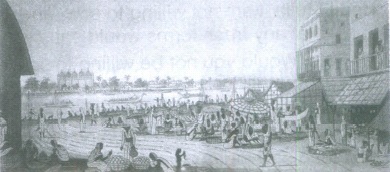
Look at the above picture and answer the following questions:
(i) What is shown in the picture?
(ii) Why did peasants and artisans from rural area regularly come to these markets?
(iii) When were these markets badly affected?
12.
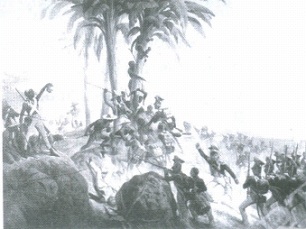
(i) What is shown in the picture?
(ii) Where did French planters produce indigo?
(iii) What did the African slaves do when they rose in rebellion in 1791?
(iv) What is the other name of this rebellion?
(v) When did France abolish slavery? What was its consequences?
13.
Describe different stages of the production of indigo.
14.
The Champaran movement was against .................
15.
The international demand for indigo was affected by the discovery of .................
16.
Growers of woad in Europe saw ..................... as a crop which would provide competition to their earnings.
17.
Indigo was cultivated by the ______________ in Brazil, the ___________ in Jamaica and the ____________ in Venezuela.
18.
Ryotwari system was also known as _____________
19.
The conditions of under-tenants in Bengal was described by H.T. Colebrook in 1806.
20.
The Blue Rebellion started in 1857.
21.
Permanent Settlement recognised the rajas and taluqdars as zamindars.
22.
By the first decade of the 19th century, cultivation system developed and the prices in market rose.
23.
Mahalwari system came into effect in 1825.
24.
How did Company purchase goods in India before 1865?
25.
Why did cloth dyers prefer indigo to woad as dye?
26.
Who created Kalamkari print?
27.
Why did European cloth manufacturers have to depend on woad?
28.
When and who appointed the Company as the Diwan of Bengal?
1.
(c)
The planters
2.
(a)
Thomas Munro
3.
(c)
A famous poet and artist
4.
(b)
A village or a group of villages
5.
(d)
1765
6.
Under the following circumstances, the indigo production in Bengal was led to the eventual collapse:
(i) Local zamindars and village headmen began to support the ryots.
(ii) The British Government was worried about the possibility of another revolt. After the revolt of 1857. So, the Lieutenant Governor toured the region.
(iii) British official Ashley Eden issued a notice that ryots would not be compelled to accept indigo contracts.
(iv) The British Government set-up the Indigo Commission to enquire about the system of indigo production.
(v) The Commission held the planters guilty and criticised them for adopting coercive methods.
7.
| Mahalwari System | Permanent Settlement |
| Mahalwari system, it was decided that the rate of revenue was to be revised periodically, not permanently fixed | Under the PermanentSettlement, the rate of revenue was fixed permanently, i.e. it was not to be increased ever in the future. |
| In the Permanent Settlement, the zamindars were given the charge of collecting revenue from the peasants and paying it to the Company. | The Mahalwari system, the charge of collecting the revenue and paying it to the Company was given to the village headman. |
| The Mahalwari system came into effect in 1822. | The Permanent Settlement was introduced by the Company in 1793. |
8.
The main features of the Permanent Settlement were:
(i) By the terms of the settlement, the rajas and taluqdars were recognized as zamindars.
(ii) Zamindars were asked to collect rent from the peasants and pay revenue to the Company.
(iii) The amount to be paid by the zamindars was fixed permanently, i.e. it was not to be increased ever in future.
(iv) It would ensure a regular flow of revenue into the company's coffers and at the same time encourage the zamindars to invest in improving the land.
(v) As the rate of revenue was fixed, the zamindar would benefit from the increased production of land.
9.
The weekly markets in Bengal were very popular. Peasants and artisans from rural areas regularly came to these markets (which were known as haats) to sell their goods and buy what they needed. Local people came in large numbers to buy necessary things. During the economic crisis of Bengal, these markets were badly affected as common men did not have enough money to satisfy their basic needs.
10.
The planters were reluctant to expand the area under nij cultivation because of the following reasons:
(i) Indigo could be cultivated only on fertile lands, but these were already densely populated. The planters hardly got large areas in compact blocks.
(ii) The planters needed a large number of labour at a time when peasants were busy with rice cultivation.
(iii) Nij cultivation on a large scale also required many ploughs and bullocks. They could not get the supplies from peasants as their ploughs and bullocks were busy on rice fields. Investing on purchase and maintenance of ploughs was a big problem.
11.
(i) A weekly market (which is known as haat) in Murshidabad in Bengal is shown in the picture.
(ii) Peasants and artisans from rural areas regularly came to these weekly markets to sell the goods they produced and to buy the goods they required.
(iii) These markets were badly affected during the economic crisis. At the time of economic crisis, artisanal production was in decline and agricultural cultivation showed signs of collapse.
12.
(i) The Slave Revolt in St Domingue in August 1791 is shown in the above picture.
(ii) In the 18th century, French planters produced indigo and sugar in the French colony of St Domingue in the Caribbean islands.
(iii) The African slaves who worked on the plantations rose in rebellion in 1791. They killed 4000 Whites and burned and destroyed 180 sugar plantations and hundreds of coffee and indigo plantations.
(iv) The other name of the Slave Revolt is Haitian Revolt.
(v) In 1792, France abolished slavery in the French colonies.
These events led to the collapse of the indigo plantations on the Caribbean islands. By 1792, slave rebels controlled one-third of the island. The success of this slave rebellion caused the newly elected Legislative Assembly in France to grant civil and political rights to free men in the colonies.
13.
After harvest, the indigo plant was taken to the vats in the indigo factory. Three or four vats were needed to manufacture the dye. Each vat had a separate function.
Leaves of the indigo plant were first soaked in warm water in the fermenting vat for several hours. When the plants fermented, the liquid began to boil and bubble. Now, the rotten leaves were taken out and the liquid drained into the second vat, known as the beater vat.
The solution was continuously stirred and beaten with paddles. When the liquid gradually turned green and then blue, lime water was added to the vat. Gradually, the indigo separated out in flakes. A muddy sediment settled at the bottom of the vat and a clear liquid rose to the surface. The liquid was drained off and the sediment, i.e. the indigo pulp transferred to another vat, known as the settling vat. Then the pulp was pressed and dried for sale.
14.
()
indigo planters
15.
()
synthetic dyes
16.
()
indigo
17.
()
Portuguese, English, Spanish
18.
()
Munro system
19.
(b)
20.
(a)
21.
(b)
22.
(b)
23.
(a)
24.
()
Before 1865, the East India Company had purchased goods in India by importing gold and silver from Britain.
25.
()
Cloth dyers preferred indigo as a dye, as it produced a rich blue colour, whereas the dye from woad was pale and dull.
26.
()
The weavers of Andhra Pradesh created Kalamkan prints.
27.
()
European cloth manufacturers had to depend on woad for violet and blue dyes because only small amounts of Indian indigo reached the European market and its price was very high.
28.
()
On 12th August, 1765, the Mughal emperor Shah Alam II appointed the East India Company as the Diwan of Bengal.

8th Standard CBSE Syllabus & Materials
8th Standard CBSE
CBSE 8th Science Particulate Nature of Matter - New Model Questions Papers Study Material - QB365 Set A
NEW8th Standard CBSE
CBSE 8th Science Pressure, Winds, Stroms and Cyclones - New Model Questions Papers Study Material - QB365 Set A
NEW8th Standard CBSE
CBSE 8th Mathematics Quadrilaterals - New Model Questions Papers Study Material - QB365 Set A
NEW8th Standard CBSE
CBSE 8th Mathematics A story of Numbers - New Model Questions Papers Study Material - QB365 Set A



CBSE 8th Standard CBSE Subjects
CBSE Standards




