
 100% FREE ACCESS
6th Standard Syllabus & Materials
6th Standard
TN 6th Tamil பருவம் 1 - இயல் 1 - மொழி -தமிழ்த்தேன் - இன்பத்தமிழ் Sample Question Papers Study Material - QB365 Set A
NEW6th Standard
TN 6th English T1 - Supplementary - The Apple Tree and The Farmer Sample Question Papers Study Material - QB365 Set A
NEW6th Standard
TN 6th English T1 - Prose - When The Trees Walked Sample Question Papers Study Material - QB365 Set A
NEW6th Standard
TN 6th Social Science T3 - CIV - Road Safety Sample Question Papers Study Material - QB365 Set A
NEW6th Standard
TN 6th Social Science T3 - CIV - Local Bodies - Rural and Urban Sample Question Papers Study Material - QB365 Set A
NEW6th Standard
TN 6th Social Science T3 - CIV - Democracy Sample Question Papers Study Material - QB365 Set A

Published on: 04/01/2019
VI STD Model Question
Download Tamil Nadu 6th Standard Maths question papers, model tests, one-mark questions, important questions, and public exam papers in PDF format. Free study materials and answer keys for TN State Board students.
Questions + Answers key
Take MCQ Maths Test1.
Observe the calendar showing the month of January 2019.
| JANUARY 2019 | ||||||
|---|---|---|---|---|---|---|
| S | M | T | W | T | F | S |
| 1 | 2 | 3 | 4 | 5 | ||
| 6 | 7 | 8 | 9 | 10 | 11 | 12 |
| 13 | 14 | 15 | 16 | 17 | 18 | 19 |
| 20 | 21 | 22 | 23 | 24 | 25 | 26 |
| 27 | 28 | 29 | 30 | 31 | ||
Answer the following questions
i) Sort out the prime and composite numbers from the calendar.
ii) Sort out the odd and even numbers.
iii) Sort out the multiples of 6; multiples of 4; the common multiples of 4 and 6 and LCM of the two numbers.
iv) Sort out the dates which fall on Monday.
2.
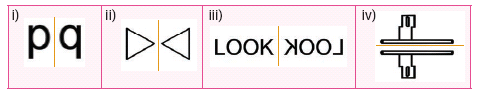
Draw the reflection image of the following figures about the given line.

3.
Fill in the blanks.
i) 2 cm2 = _____ mm2
ii) 18 m2 = _____ cm2
iii) 5 km2 = _____ m2
4.
Find the perimeter of a triangle whose sides are 3 cm, 4 cm and 5 cm
5.
Arrange the following integers in descending order.
i) 14, 27, 15, −14, −9, 0, 11, −17
ii) −99, −120, 65, −46, 78, 400, −600
iii) 111, −222, 333, −444, 555, −666, 7777, −888
6.
In the above situation, find the quantity of milk left over. So subtract \(3{1\over4}\)from \(5{1\over2}\)
7.
The teacher had given the same situation mentioned above and asked two students Ravi and Arun to solve it. They came out with the answers for \({1\over2}+{1\over 4}\)
8.
___________ symmetry occurs when an object slides to new position
9.
______ is an integer which is neither positive nor negative
10.
There are ______ integers from −5 to +5 (both inclusive).
11.
The number which has its own reciprocal is ________
12.
\(7{3\over4}+6{1\over2}=\)_________
13.
The reflection of the name RANI is 
14.
A shape has reflection symmetry if it has a line of symmetry
15.
All negative integers are greater than zero
16.
Each of the integers −18, 6, −12, 0 is greater than −20.
17.
\(3{1\over2}\)can be written as \(3+{1\over2}\)
18.
Prepare a daily time schedule for evening study at home
19.
Find the line of symmetry and the order of rotational symmetry of the given regular polygons and complete the following table and answer the questions given below
| Shape | Equilateral triangle |
Square |
Regular pentagon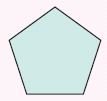 |
Regular hexagon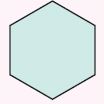 |
Regular octagon |
| Number of lines of symmetry | |||||
| Order of rotational symmetry |
i) A regular polygon of 10 sides will have ______ lines of symmetry.
ii) If a regular polygon has 10 lines of symmetry, then its order of rotational symmetry is _______
iii) A regular polygon of 'n' sides has _______ lines of symmetry and the order of rotational symmetry is _______.
20.
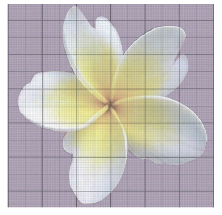
Find the approximate area of the flower in the given square grid.
21.
A rectangle has length 40 cm and breadth 20 cm. How many squares with side 10 cm can be formed from it.
22.
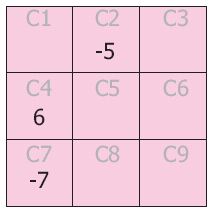
Complete the table using the following hints:
C1: the first non-negative integer.
C3: the opposite to the second negative integer.
C5: the additive identity in whole numbers.
C6: the successor of the integer in C2.
C8: the predecessor of the integer in C7.
C9: the opposite to the integer in C5
23.
Divide the following :
\(i) \ {3\over7}\div4\)
\(ii)\ {4\over3}\div{5\over9}\)
\(iii)\ 4{1\over5}\div3{3\over 4}\)
\(iv)\ 9{2\over3}\div1{2\over3}\)
24.
The difference between 6th term and 5th term in the Fibonacci sequence is
6
8
5
3
25.
Which word has a vertical line of symmetry?
DAD
NUN
MAM
EVE
26.
If two identical rectangles of perimeter 30 cm are joined together, then the perimeter of the new shape will be
equal to 60 cm
less than 60 cm
greater than 60 cm
equal to 45 cm
27.
The number which determines marking the position of any number to its opposite on a number line is
-1
0
1
10
28.
If \({6\over7}={A\over49}\)then the value of A is
42
36
25
48
29.
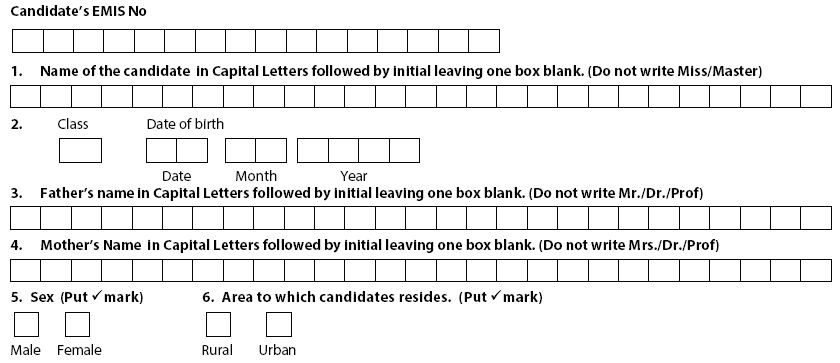
Fill in the following information
30.
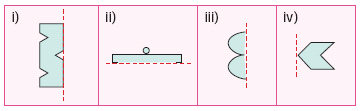
Complete the other half of the following figures such that the dotted line is the line of symmetry
31.
The area of a rectangular shaped photo is 820 sq. cm. and its width is 20 cm. What is its length? Also find its perimeter
32.
If 15 km east of a place is denoted as + 15 km, what is the integer that represents 15 km west of it?
33.
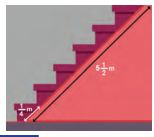
The length of the staircase is 5 \(\frac{1}{2}\) m If one step is set at \(\frac{1}{4}\) m then how many steps will be there in the staircase?
1.
i) Prime numbers = 2, 3, 5, 7, 11, 13, 17, 19, 23, 29, 31
Composite numbers = 4, 6, 8, 9, 10, 12, 14, 15, 16, 18, 21, 22, 24, 25, 26, 27, 28, 30
ii) Odd numbers = 1, 3, 5, 7, 9, 11, 13, 15, 17, 19, 21, 23, 25, 27, 29, 31
Even numbers = 2, 4, 6, 8, 10, 12, 14, 16, 18, 20, 22, 24, 26, 28
iii) Multiplies of 6 = 6, 12, 18, 24, 30,
Multiplies of 4 = 4, 8, 12, 16, 20, 24, 28
Common multiples = 12, 24
LCM = 12
iv) Monday falls on = 7, 14, 21, 28
2.
3.
i) 2 cm2 = 2 \(\times\)100 = 200 mm2
ii) 18 m2 =18 \(\times\)10000 = 1,80,000 cm2
iii) 5 km2 = 5 \(\times\) 1000000 = 50,00,000 m2
4.
a = 3 cm
b = 4 cm
c = 5 cm
P = (a + b + c) units
= 3 + 4 + 5 = 12 cm
Perimeter of the triangle is 12 cm.
5.
i) 27, 15, 14, 11, 0, −9, −14, −17
ii) 400, 78, 65, −46, −99, −120, −600
iii) 777, 555, 333, 111, −222, −444, −666, −888
6.
The quantity of milk left over = \(5{1\over2}-3{1\over4}\)
Here, note that 5 > 3 and \({1\over2}>{1\over4}\)
The whole numbers 5 and 3 and the fractional numbers \(1\over2\) and \(1\over4\)can be subtracted separately
So, \(5{1\over2}-3{1\over4}=(5-3)+\left({1\over 2}-{1\over4}\right)\)
\(=2+\left({2\over 4}-{1\over4}\right)\)
\(=2+{1\over4}={1\over4}\)litres
7.
Ravi’s way
Common Multiple of 2 and 4 = 4.
Equivalent Fractions of
\({1\over2}={1\times2\over 2\times2}={2\over4}\)
Now, add \({1\over 3}+{1\over 4}={2\over4}+{1\over 4}\)
\(={2+1\over 4+4}={3\over8}\)
Therefore Venkat has bought \(3\over 8\) litres of milk.
Arun’s way
Common Multiple of 2 and 4 = 4.
Equivalent Fractions of
\({1\over 2}={1\times2\over 2\times2}={2\over4}\)
Now, add
\({1\over 3}+{1\over 4}={2\over4}+{1\over 4}\)\({1\over 3}+{1\over 4}={2\over4}+{1\over 4}\)
\(={2+1\over 4}={3\over4}\)
Therefore Venkat has bought \(3\over4\) litres of milk.
8.
()
Translation
9.
()
0
10.
()
11
11.
()
1
12.
()
\(14{1\over4}\)
13.
(b)
14.
(a)
15.
(b)
16.
(a)
17.
(a)
18.
| Time | Activity |
| 5.00 p.m. to 6.00 p.m. | Games |
| 6.00 p.m. to 8.00 p.m | Study |
| 8.00 p.m. to 8.30 p.m | Supper |
| 8.30 p.m. to 9.00 p.m | Recreation |
| 9.00 p.m. to 10.00 p.m | Study |
| 10.00 p.m | Sleep |
19.
| Shape | Equilateral triangle |
Square |
Regular pentagon |
Regular hexagon |
Regular octagon |
| Number of lines of symmetry | 3 | 4 | 5 | 6 | 8 |
| Order of rotational symmetry | 3 | 4 | 5 | 6 | 8 |
(i) A regular polygon of 10 sides will have 10 lines of symmetry.
(ii) If a regular polygon has, 10 lines of symmetry, then its order ofrotational symmetry is 10
(iii) A regular polygon of 'n' sides has n, n lines of symmetry and the order of rotational symmetry is n.
20.
From the figure,
Complete squares = 9
half squares = \(\cfrac { 13 }{ 2 } \)
\(\therefore\) Approximate area = Complet esquares + half squares
= \(9+\cfrac { 13 }{ 2 } \)
= \(\cfrac { 18+13 }{ 2 } =\cfrac { 31 }{ 2 } \)
= 15.5 sq.units
21.
length = 40 cm
breadth = 20 cm
Side of the square = 10 cm
Area of the rectangle = lb
= ( 40 \(\times\) 20)cm2
= 800 cm2
(side) s = 10cm
Area of a square (S2) = 102 = 100 cm2
No. of square = \(\cfrac { 800 }{ 100 } =8\)
22.
|
C1 |
C2 -5 |
C3 2 |
| C4 6 |
C5 0 |
C6 -4 |
| C7 -7 |
C8 -8 |
C9 0 |
C3: The opposite to the second negative integer.
C5: The additive identity in whole numbers.
C6: The successor of the integer in C2.
C8: The predecessor of the integer in C7.
C9: The opposite to the integer in C5.
23.
(i) \(\cfrac { 3 }{ 7 } \div 4\)
= \(\cfrac { 3 }{ 7 } \times \cfrac { 1 }{ 4 } =\cfrac { 3\times 1 }{ 7\times 4 } =\cfrac { 3 }{ 28 } \)
(ii) \(\cfrac { 4 }{ 3 } \div \cfrac { 5 }{ 9 } \)
= \(\cfrac { 4 }{ 3 } \times \cfrac { 9 }{ 5 } \)
= \(\cfrac { 4\times 3 }{ 5 } =\cfrac { 12 }{ 5 } =2\cfrac { 2 }{ 5 } \)
(iii) \(4\cfrac { 1 }{ 5 } \div 3\cfrac { 3 }{ 4 } \)
= \(\cfrac { 21 }{ 5 } \div \cfrac { 15 }{ 4 } \)
= \(\cfrac { 21 }{ 5 } \times \cfrac { 4 }{ 15 } =\cfrac { 7\times 4 }{ 5\times 5 } =\cfrac { 28 }{ 25 } =1\cfrac { 3 }{ 25 } \)
(iv) \(9\cfrac { 2 }{ 3 } \div 1\cfrac { 2 }{ 3 } \)
= \(\cfrac { 29 }{ 3 } \div \cfrac { 5 }{ 3 } \)
= \(\cfrac { 29 }{ 3 } \times \cfrac { 3 }{ 5 } =\cfrac { 29 }{ 5 } 5\cfrac { 4 }{ 5 } \)
24.
(d)
3
25.
(c)
MAM
26.
(b)
less than 60 cm
27.
(b)
0
28.
(a)
42
29.
Candidate’s EMIS No
| 1 | 0 | 0 | 0 | 0 | 0 | 1 |
1. Name of the candidate in Capital Letters followed by initial leaving one box blank. (Do not write Miss/Master)
| R | A | N | J | I | T | H | A |
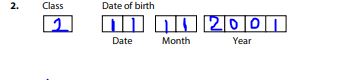
3. Father’s name in Capital Letters followed by initial leaving one box blank. (Do not write Mr./Dr./Prof)
| G | U | R | U |
4. Mother’s Name in Capital Letters followed by initial leaving one box blank. (Do not write Mrs./Dr./Prof)
| U | M | A |

30.

31.
Area of a rectangle = 820 sq. cm
Width (b) = 20 cm
Length (l) =?
Perimeter =?
\(I=\cfrac { A }{ b } \)
= \(\cfrac { 820 }{ 20 } =41\\ \)
= =2(41+20)
= 2 (61) = 122 cm
\(\therefore\) I = 41 cm , P = 122 cm
32.
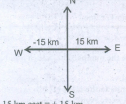
15 km east = + 15 km
\(\therefore\) 15 km west = - 15 km
33.
Length of the staircase = \(5\cfrac { 1 }{ 2 } \) m
To one step = \(\cfrac { 1 }{ 4 } \) m
No. of the steps will be there = \(\cfrac { 5\frac { 1 }{ 2 } }{ \frac { 1 }{ 4 } } \)
= \(\cfrac { \frac { 11 }{ 2 } }{ \frac { 1 }{ 4 } } \Rightarrow \cfrac { 11 }{ 2 } \times \cfrac { 4 }{ 1 } =22\)
22 steps will be there in the staircase.

6th Standard Syllabus & Materials
6th Standard
TN 6th Social Science T3 - GEO - Understanding Disaster Sample Question Papers Study Material - QB365 Set A
NEW6th Standard
TN 6th Social Science T3 - GEO - Globe Sample Question Papers Study Material - QB365 Set A
NEW6th Standard
TN 6th Social Science T3 - GEO - Asia and Europe Sample Question Papers Study Material - QB365 Set A
NEW6th Standard
TN 6th Social Science T3 - HIS - South Indian Kingdoms Sample Question Papers Study Material - QB365 Set A



Tamilnadu Stateboard 6th Standard Subjects
Tamilnadu Stateboard Standards




