
 100% FREE ACCESS
12th Standard Syllabus & Materials
12th Standard
TN 12th Computer Applications மின்னணு தரவு பரிமாற்றம் Sample Question Papers Study Material - QB365 Set A
NEW12th Standard
TN 12th Computer Applications மின் - வணிக பாதுகாப்பு அமைப்புகள் Sample Question Papers Study Material - QB365 Set A
NEW12th Standard
TN 12th Computer Applications மின்னணு செலுத்தல் முறைகள் Sample Question Papers Study Material - QB365 Set A
NEW12th Standard
TN 12th Computer Applications மின் - வணிகம் Sample Question Papers Study Material - QB365 Set A
NEW12th Standard
TN 12th Computer Applications திறந்த மூல கருத்துருக்கள் Sample Question Papers Study Material - QB365 Set A
NEW12th Standard
TN 12th Computer Applications வலையமைப்பு வடமிடல் Sample Question Papers Study Material - QB365 Set A

Published on: 23/07/2019
slip test
Download Tamil Nadu 12th Standard Maths question papers, model tests, one-mark questions, important questions, and public exam papers in PDF format. Free study materials and answer keys for TN State Board students.
Questions + Answers key
Take MCQ Maths Test1.
If α, β, and γ are the roots of the equation x3 + px2 + qx + r = 0, find the value of \(\Sigma \frac { 1 }{ \beta \gamma } \) in terms of the coefficients.
2.
If α and β are the roots of the quadratic equation 2x2−7x+13 = 0 , construct a quadratic equation whose roots are α2 and β2.
3.
If α and β are the roots of the quadratic equation 17x2+43x−73 = 0 , construct a quadratic equation whose roots are α + 2 and β + 2.
4.
Prove that a line cannot intersect a circle at more than two points.
5.
If the equations x2 + px + q = 0 and x2 + p'x + q' = 0 have a common root, show that it must be equal to \(\frac { pq'-p'q }{ q-q' } \) or \(\frac { q-q' }{ p'-p } \).
6.
Find the sum of squares of roots of the equation 2x4- 8x3+ 6x2-3 = 0.
7.
Form a polynomial equation with integer coefficients with \(\sqrt { \frac { \sqrt { 2 } }{ \sqrt { 3 } } } \) as a root.
8.
Find the monic polynomial equation of minimum degree with real coefficients having 2 -\(\sqrt{3}\)i as a root.
9.
A 12 metre tall tree was broken into two parts. It was found that the height of the part which was left standing was the cube root of the length of the part that was cut away. Formulate this into a mathematical problem to find the height of the part which was left standing.
1.
Since α, β, and γ are the roots of the equation x3+ px2+ qx + r = 0, we have
Σ1 α + β + γ = -p and Σ3 αβγ = -r
\(\Sigma \frac { 1 }{ \beta \gamma } =\frac { 1 }{ \beta \gamma } +\frac { 1 }{ \gamma \alpha } +\frac { 1 }{ \alpha \beta } =\frac { \alpha +\beta +\gamma }{ \alpha \beta \gamma } =\frac { -p }{ -r } =\frac { p }{ r } \).
2.
Since α and β are the roots of the quadratic equation, we have α + β =\(\frac { 7 }{ 2 } \) and αβ = \(\frac { 13 }{ 2 } \).
Thus, to construct a new quadratic equation,
Sum of the roots = α2+β2 = (α+β)2-2αβ =\(\frac { -3 }{ 4 } \)
Product of the roots = α2β2 = (αβ)2 = \(\frac { 169 }{ 4 }\)
Thus a required quadratic equation is x2+\(\frac { 3 }{ 4 } x+\frac { 169 }{ 4 } \)= 0.
From this we see that 4x2+3x+169 = 0 is a quadratic equation with roots α2 and β2.
3.
Since α and β are the roots of 17x2+ 43x −73 = 0 , we have α + β =\(\frac { -43 }{ 17 } \) and αβ =\(\frac { -73 }{ 17 } \).
We wish to construct a quadratic equation with roots α + 2 and β + 2. Thus, to construct such a quadratic equation, calculate
the sum of the roots = α + β + 4 = \(\frac { -4 }{ 17 } +4=\frac { 25 }{ 17 } \) and
the product of the roots = αβ + 2(α+β)+4 = \(\frac { -73 }{ 17 } +2\left( \frac { -43 }{ 17 } \right) +4=\frac { -91 }{ 17 } \)
Hence a quadratic equation with required roots is x2-\(\frac { 25 }{ 17 } x-\frac { 91 }{ 17 } \) = 0
Multiplying this equation by 17, gives 17x2−25x−91 = 0
which is also a quadratic equation having roots α + 2 and β + 2
4.
By choosing the coordinate axes suitably, we take the equation of the circle as x2+ y2 = r2 and the equation of the straight line as y = mx + c. We know that the points of intersections of the circle and the straight line are the points which satisfy the simultaneous equation
x2 + y2 = r2
y = mx + c .......... (2)
If we substitute mx + c for y in (1), we get
x2+(mx + c)2- r2 = 0
which is same as the quadratic equation
(1+m2)x2+2mcx+(c2- r2) = 0 ............(3)
This equation cannot have more than two solutions, and hence a line and a circle cannot intersect at more than two points.
It is interesting to note that a substitution makes the problem of solving a system of two equations in two variables into a problem of solving a quadratic equation.
Further we note that as the coefficients of the reduced quadratic polynomial are real, either both roots are real or both imaginary. If both roots are imaginary numbers, we conclude that the circle and the straight line do not intersect. In the case of real roots, either they are distinct or multiple roots of the polynomial. If they are distinct, substituting in (2), we get two values for y and hence two points of intersection. If we have equal roots, we say the straight line touches the circle as a tangent. As the polynomial (3) cannot have only one simple real root, a line cannot cut a circle at only one point.
5.
Given equation are \({ x }^{ 2 }px+q=0\) ............(1)
and \({ x }^{ 2 }+p'x+q'=0\) ..........(2)
Let ∝ be the common root for (1) and (2)
∴ ∝2 + p∝ + q = 0 .........(3)
and ∝2+ p'∝ + q' = 0 .............(4)
Solving (3) and (4) by cross multiplication method we get
p q 1 p
p' q' 1 p'
\(\Rightarrow \frac { { \alpha }^{ 2 } }{ pq'-p'q } =\frac { \alpha }{ q-q' } =\frac { 1 }{ p'-p } \)
consider \(\frac { { \alpha }^{ 2 } }{ pq'-p'q } =\frac { \alpha }{ q-q' } \)
\(\Rightarrow \frac { { \alpha }^{ 2 } }{ \alpha } =\frac { pq'-p'q }{ q-q' } \)
\(\alpha =\frac { pq'-p'q }{ q-q } \)
Consider \(\frac { \alpha }{ q-q' } =\frac { 1 }{ p'-p } \Rightarrow \alpha =\frac { q-q' }{ p'-p } \)
Hence its roots are \(\frac { pq'-p'q }{ q-q' } or\quad \frac { q-q' }{ p'-p } \)
6.
Given equation is 2x4- 8x + 6x2- 3 = 0
Here a = 2, b = -8, c = 6, d = 0, e = -3
Let ∝, β, ૪ and \(\delta \) be the roots of equation (1)
Then by Vieta's formula,
\(\sum { _{ 1 }= } \alpha +\beta +\gamma +\delta =\frac { -b }{ a } =\frac { -(-8) }{ 2 } =4\)
\(\sum { _{ 2 } } =\alpha \beta +\alpha \gamma +\alpha \delta +\beta \gamma +\beta \delta +\gamma \delta =\frac { c }{ a } =\frac { 6 }{ 2 } =3\)
\(\sum { _{ 3 } } =\alpha \beta \gamma +\alpha \beta \delta +\alpha \gamma \delta +\beta \gamma \delta =\frac { -d }{ a } =\frac { 0 }{ a } \)
\(\sum { _{ 4 } } =\alpha \beta \gamma \delta =\frac { e }{ a } =\frac { -3 }{ 2 } \)
Now, (a+b+c+d)2 = a2+b2+c2+d2+2(ab+ac+ad+bc+cd)
⇒ n∝2+β2+૪2+\(\delta\)2 = (∝ + β + ૪ + \(\delta\))2-2(\(\alpha \beta +\alpha \gamma +\alpha \delta +\beta \gamma +\beta \delta +\gamma \delta \))
∝2 + β2 + ૪2 = 42-2(3) = 16 - 6 = 10
7.
Since \(\sqrt { \frac { \sqrt { 2 } }{ \sqrt { 3 } } } \) is a root, x-\(\sqrt { \frac { \sqrt { 2 } }{ \sqrt { 3 } } } \) is a factor. To remove the outermost square root, we take x +\(\sqrt { \frac { \sqrt { 2 } }{ \sqrt { 3 } } } \) as another factor and find their product.
\(\left( x+\sqrt { \frac { \sqrt { 2 } }{ \sqrt { 3 } } } \right) \left( x-\sqrt { \frac { \sqrt { 2 } }{ \sqrt { 3 } } } \right) ={ x }^{ 2 }-\frac { \sqrt { 2 } }{ \sqrt { 3 } } \)
Still we didn’t achieve our goal. So we include another factor x2+\(\sqrt { \frac { \sqrt { 2 } }{ \sqrt { 3 } } } \) and get the product.
\(\left( { x }^{ 2 }-\frac { \sqrt { 2 } }{ \sqrt { 3 } } \right) \left( { x }^{ 2 }+\frac { \sqrt { 2 } }{ \sqrt { 3 } } \right) ={ x }^{ 4 }-\frac { 2 }{ 3 } \)
So, 3x4- 2 = 0 is a required polynomial equation with the integer coefficients.
Now we identify the nature of roots of the given equation without solving the equation. The idea comes from the negativity, equality to 0, positivity of Δ = b2- 4ac.
8.
Since 2-\(\sqrt{3}\)i is a root of the required polynomial equation with real coefficients, 2 +\(\sqrt{3}\)i is also a root. Hence the sum of the roots is 4 and the product of the roots is 7. Thus x2-4x + 7= 0 is the required monic polynomial equation.
9.
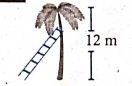
Given that the height of the tree is 12m.
Let x m be the standing part and (12 -x)m be the broken part.
Given \(x=\sqrt [ 3 ]{ 12-x } \)
\(\Rightarrow x=(12-x)^{ \frac { 1 }{ 3 } }\)
Taking power 3 both sides, we get
⇒ x3 = 12-x
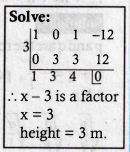
⇒ x3+ x -12 = 0
which is the required mathematical problem.

12th Standard Syllabus & Materials
12th Standard
TN 12th Computer Applications களப்பெயர் முறைமை (DNS) Sample Question Papers Study Material - QB365 Set A
NEW12th Standard
TN 12th Computer Applications வலையமைப்பு எடுத்துக்காட்டுகள் மற்றும் நெறிமுறைகள் Sample Question Papers Study Material - QB365 Set A
NEW12th Standard
TN 12th Computer Applications கணினி வலையமைப்பு ஓர் அறிமுகம் Sample Question Papers Study Material - QB365 Set A
NEW12th Standard
TN 12th Computer Applications PHP-உடன் MySQL-ஐ இணைத்தல் Sample Question Papers Study Material - QB365 Set A



Tamilnadu Stateboard 12th Standard Subjects
Maths

Chemistry

Physics

Biology

Computer Science

Business Maths and Statistics

Economics

Commerce

Accountancy

History

Computer Applications
Biology
Computer Technology
Computer Applications
Computer Science
Business Maths and Statistics
Commerce
Economics
Maths
Chemistry
Physics
Computer Technology
History
Accountancy

Tamil

English

French
Tamilnadu Stateboard Standards

