
 100% FREE ACCESS
8th Standard CBSE Syllabus & Materials
8th Standard CBSE
CBSE 8th Social Science Theme D - Factors of Production - New Model Questions Papers Study Material - QB365 Set A
NEW8th Standard CBSE
CBSE 8th Social Science Theme C - Universal Franchise and India's Electoral System - New Model Questions Papers Study Material - QB365 Set A
NEW8th Standard CBSE
CBSE 8th Social Science Theme B - The Rise of the Marathas - New Model Questions Papers Study Material - QB365 Set A
NEW8th Standard CBSE
CBSE 8th Social Science Theme B - Reshaping India's Political Map - New Model Questions Papers Study Material - QB365 Set A
NEW8th Standard CBSE
CBSE 8th Social Science Theme A - Natural Resources and Their Use - New Model Questions Papers Study Material - QB365 Set A
NEW8th Standard CBSE
CBSE 8th Science Keeping Time with Skies - New Model Questions Papers Study Material - QB365 Set A

Published on: 13/12/2018
The important questions provided below will also make students familiar with the marking scheme and the difficulty level of the exam. The important questions for CBSE class 8 Science are prepared by subject experts according to the latest syllabus of CBSE. Students are advised to solve these important questions which can make them more focused on their exam and also bring a sense of discipline and seriousness in their exam preparation.
The Central Board of Secondary Education (CBSE) is a prestigious educational board which comes under the Union Government of India. Here, you will get the clue that from where and how the questions are being framed from the chapter Perimeter and Area for CBSE Class 8 Science. These questions can provide students a chapter wise preparation strategy so that they can prepare for their exam more efficiently.
The National Council of Education and Training sets the curriculum for all schools that follow the Central Board of Secondary Education (CBSE) across the nation. Creative questions were added in this question paper in order to enhance the student's knowledge and get the idea that how to answer strategic questions asked in the board exams. This question paper is designed based on the academic syllabus. Sample papers should be practiced in examination condition at home or school and also show it to your teachers for checking or compare with the answers provided.
From this post, questions are covered from the chapter Sound and questions are covered from the book back and creative questions.
Download CBSE Class 8th Standard CBSE Science question papers, sample papers, important questions, and previous year solved papers in PDF format. Get free study materials, NCERT solutions, and exam preparation resources for Class 8th Standard CBSE Science
Questions + Answers key
Take MCQ Science Test
1.
Pitch of sound is determined by its
frequency
speed
amplitude
loudness
2.
Vibrations in a body produce
sound
pressure
density
current
3.
The normal range of vocal cords in women is
20 mm
10 mm
15 mm
40 mm
4.
The loudness of sound depends on
its amplitude
its time period
its frequency
its speed
5.
Sound can travel through
gases only
solids only
liquids only
solids, liquids and gases
6.
Unpleasant sounds are called ______
7.
The other name of human voice box is............
8.
Sound which is pleasing to our ears is called..............
9.
A tight membrane vibrates at a much...............frequency than a loose one
10.
Shrillness of a sound is determined by the..........of vibration
11.
What do you mean by vacuum? What happens to the loudness of sound in vacuum?
12.
Define: (i) an oscillation (ii) Hertz
13.
Explain the reason for not hearing of the screams of a bat by us.
14.
Explain the process, how bat sure ultrasonic waves to catch a prey
15.
Lightning and thunder take place in the sky at the same time and at the same distance from us. Lightning is seen earlier and thunder is heard later. Can you explain why?
16.
Compare the sound of drum and whistle.
17.
Can you say that the frequency of the voice of a child is higher than that of an adult?
18.
Mention the factor on which the quality of sound or voice depends.
19.
We cannot see vibrations in most of the cases. Explain why
20.
How can noise pollution be controlled?
21.
Explain in detail how sound travel slower than light.
22.
How does the amplitude affect the loudness of voice?
23.
Write a precaution to prevent eardrum damage.
24.
Write a common ill effect of noise pollution.
25.
What is the other name of voice box?
26.
Define sound.
1.
(a)
frequency
2.
(a)
sound
3.
(c)
15 mm
4.
(a)
its amplitude
5.
(d)
solids, liquids and gases
6.
()
Noise
7.
()
larynx
8.
()
music
9.
()
higher
10.
()
frequency
11.
The decreasing amount of air decreases loudness of sound. When air is removed completely from a vessel, it is said that there is a vacuum. If all air is sucked from the vessel the sound would stop completely. The sound cannot travel through a vacuum.
12.
(i) Oscillation: The to and fro motion of an object is called vibration. This motion is also called oscillatory motion.
(ii) Hertz : The number of oscillations per second is called the frequency in Hertz (Hz). A frequency of 1 Hz is one oscillation per second.
13.
As we know that the audible frequency range for human being is 20 Hz to 20 kHz. So, it is an obvious thing that the frequency of bat is beyond this range due to which, we are usually unable to hear the screams of a bat.
14.
Since, the ultrasonic waves produce by the bats are high pitched which are not heard by the human beings. So, these ultrasonic waves after striking the insect send back an echo which is heard by the bat and finally it gets over on the insect and catches it
15.
Lightning is seen earlier than the sound of thunder because light travels faster than sound. Hence, it reaches us before the sound does.
16.
The frequency determines the shrillness or pitch of a sound. A drum vibrates with low frequency. Therefore, it produces low pitched sound. Whistle has a high frequency and therefore, produces a sound of higher pitch.
17.
Yes, as the sound of children is shriller than the sound of adults. So, the frequency of sound produced by a child is more than that of an adult.
18.
The factor on which the quality of sound depends is the looseness or the tightness of the vocal cord.
19.
In most of the cases, we cannot see the vibrations because of its small amplitude.
20.
Presence of excessive noise in the surrounding may cause noise pollution, which is harmful to human health. Here are some measures to limit noise pollution:
(i) Noise producing industries should be set up away from residential areas.
(ii) Silencing devices must be installed in aircraft engines, transport vehicles, industrial machines and heavy appliances.
(iii)Use of automobile horn should be minimized.
(iv) TVand music system should be run at low volumes.
(v) Trees must be planted along the sides of the roads and around buildings to cut down the sounds reaching the residents
21.
As we know that the speed of sound in air is about 340 m/s and the speed of light in air is 300,000,000 m/s. It means that sound travels at a slow speed while light travels much faster than sound.
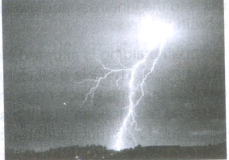
So, though sound may take a few seconds to travel a distance of a few hundred metres, light will take practically negligible time to reach a distance of even a few kilometres. e.g. in the rainy season, the flash of lightning is observed first and the sound of thunder is heard a little later (though both are produced at the same time in clouds) (see figure). It is because of the very high speed of light that we see the flash of lightning first and it is due to comparatively low speed of sound that the thunder is heard a little later.
22.
()
Higher is the amplitude, louder is the voice
23.
()
Never put a sharp, pointed or hard thing into your ear.
24.
()
Hypertension.
25.
()
Larynx
26.
()
Sound is a type of energy that makes us hear.

8th Standard CBSE Syllabus & Materials
8th Standard CBSE
CBSE 8th Science Particulate Nature of Matter - New Model Questions Papers Study Material - QB365 Set A
NEW8th Standard CBSE
CBSE 8th Science Pressure, Winds, Stroms and Cyclones - New Model Questions Papers Study Material - QB365 Set A
NEW8th Standard CBSE
CBSE 8th Mathematics Quadrilaterals - New Model Questions Papers Study Material - QB365 Set A
NEW8th Standard CBSE
CBSE 8th Mathematics A story of Numbers - New Model Questions Papers Study Material - QB365 Set A



CBSE 8th Standard CBSE Subjects
CBSE Standards




