
 100% FREE ACCESS
8th Standard CBSE Syllabus & Materials
8th Standard CBSE
CBSE 8th Social Science Theme D - Factors of Production - New Model Questions Papers Study Material - QB365 Set A
NEW8th Standard CBSE
CBSE 8th Social Science Theme C - Universal Franchise and India's Electoral System - New Model Questions Papers Study Material - QB365 Set A
NEW8th Standard CBSE
CBSE 8th Social Science Theme B - The Rise of the Marathas - New Model Questions Papers Study Material - QB365 Set A
NEW8th Standard CBSE
CBSE 8th Social Science Theme B - Reshaping India's Political Map - New Model Questions Papers Study Material - QB365 Set A
NEW8th Standard CBSE
CBSE 8th Social Science Theme A - Natural Resources and Their Use - New Model Questions Papers Study Material - QB365 Set A
NEW8th Standard CBSE
CBSE 8th Science Keeping Time with Skies - New Model Questions Papers Study Material - QB365 Set A

Published on: 30/07/2018
In this chapter Square and Square Roots contains important questions in CBSE 8th Standard Mathematics. It also covered with the most important questions in Control and Coordination.
Students, subscribe and get plenty of question paper with answer key. For subscription please click here.
Download CBSE Class 8th Standard CBSE Mathematics question papers, sample papers, important questions, and previous year solved papers in PDF format. Get free study materials, NCERT solutions, and exam preparation resources for Class 8th Standard CBSE Mathematics
Questions + Answers key
Take MCQ Mathematics Test
1.
Find the value of \(\frac { \sqrt { 24 } +\sqrt { 216 } }{ \sqrt { 96 } } \)
2.
Find the value of \(\sqrt { 16+\sqrt { 81 } } \)
3.
Find the square root, by division method. 12.96
4.
Find the square root of each of the following numbers by division method.3481
5.
Find the square root of the following by long division method. 27.04
6.
Find the square root of the following by long division method 5625
7.
Show that 600 is not a perfect square.
8.
Using prime factorisation, find the square roots of 11025
9.
Estimate the value of the following to the nearest whole number.\(\sqrt { 500 } \)
10.
By repeated subtraction of odd number starting from 1, find whether the following numbers are perfect squares or not. If the number is a perfect square, then find its square root. 121
11.
In a right angled \(\Delta\) ABC, if \(\angle\)B=90°, AB=12 cm and BC=5 cm, then find AC.
12.
Find the least number that must be added to 1500. so as to get a perfect square. Also, find the square root of the perfect square.
13.
A perfect square number having m digits, where m is even will have square root with
\(\frac { m }{ 2 } digits\)
\(\frac { m+1 }{ 2 } digits\)
m + 1 digits
\(\frac { m }{ 3 } digits\)
14.
The hypotenuse of a right angled triangle with its base and perpendicular of lengths 3x, 4x respectively is
25x
7 x
5x
16x
15.
Which of the following cannot be a perfect square?
441
198
676
All of these
16.
A square board has an area of 121 square units. How long is each side of the board?
11 units
12 units
13 units
14 units
17.
169 is the square of
11
12
13
14
18.
The least number by which 125 be multiplied to make it a perfect square is ____________
19.
\(\sqrt { 2.89 } \) = _____________
20.
The square root of 24025 will have _____________ digits.
21.
The unit's digit in the square of 1456 is ________________
22.
For every natural number m > 1, 2m, m2 - 1, m2 + 1 form a Pythagorean triplet.
23.
The square of 2.3 is 5.29.
24.
1000 is a perfect square.
25.
There is one square number between 160 and 170.
26.
The sum of two perfect squares is a perfect square.
27.
The square of 87 will have 3 at the unit's place.
1.
\(\because \quad \sqrt { 24 } =\sqrt { 2\times 2\times 2\times 3 } =2\sqrt { 6 } \)
\(\sqrt { 216 } =\sqrt { 3\times 3\times 3\times 2\times 2\times 2 } =6\sqrt { 6 } \)
\(\sqrt { 96 } =\sqrt { 2\times 2\times 2\times 2\times 2\times 3 } =4\sqrt { 6 } \)
So, \(\frac { 2\sqrt { 6 } +6\sqrt { 6 } }{ 4\sqrt { 6 } } =\frac { \sqrt { 6 } (2+6) }{ 4\sqrt { 6 } } \)
\(=\frac { 8\sqrt { 6 } }{ 4\sqrt { 6 } } =\frac { 8 }{ 4 } =2\)
2.
We have, \(\sqrt { 16+\sqrt { 81 } } =\sqrt { 16+9 } =\sqrt { 25 } =5\)
3.
3.6
4.
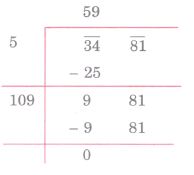
Therefore, \(\sqrt { 3481 } \)= 59
5.
5.2
6.
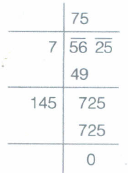
\(\therefore \ \sqrt { 5625 } =75\)
7.
We have,
\(600=\underline { 2\times 2 } \times 2\times 3\times \underline { 5\times 5 } \)
Here, the numbers 2 and 5 are in pair, but a pair of 2 and 3 is missing.
So, to get a perfect square, we will multiply 600 by 6.
| 2 | 600 |
| 2 | 300 |
| 2 | 150 |
| 3 | 75 |
| 5 | 25 |
| 5 | 5 |
| 1 |
8.
We have, 11025
| 5 | 11025 |
| 5 | 2205 |
| 3 | 441 |
| 3 | 147 |
| 7 | 49 |
| 7 | 7 |
| 1 |
\(\therefore \quad 11025=\underline { 5\times 5 } \times \underline { 3\times 3 } \times \underline { 7\times 7 } \)
or \(\sqrt { 11025 } =5\times 3\times 7=105\)
9.
Given square root number is \(\sqrt { 500 } \).
We know that,
222 = 484 and 232 = 529
So, 500 lies between 484 and 529.
i.e. 484 < 500 < 529 \(\Rightarrow\) 222 < 500 < 232
\(\Rightarrow\) 22 < \(\sqrt { 500 } \) < 23 [taking square root]
Thus, 484 is much closer to 500 than 529.
So, \(\sqrt { 500 } \) is nearest to whole number 22.
10.
Given number is 121.
Now, we subtract successive odd numbers starting from 1 as follows:
121 - 1 = 120,
117 - 5 = 112,
120 - 3 = 117,
112 - 7 = 105,
105 - 9 = 96, 96 -11 = 85,
85 -13 = 72, 72 -15 = 57,
57-17 = 40, 40 - 19 = 21, 21 - 21 = 0
We observe that the number 121 reduced to zero after subtracting first 11 odd numbers. So, 121 is a perfect square.
\(\therefore \ \sqrt { 121 } =11\)
Hence, the square root of 121 is 11.
11.
According to Pythagoras theorem,
(Hypotenuse)2 = (Base)2 + (Perpendicular)2
Clearly, the side opposite to 90° is hypotenuse
AC = Hypotenuse
AB = Base
BC = Perpendicular
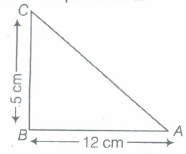
(AC)2 = (AB)2 + (BC)2
\(\Rightarrow\) (AC)2 =(12)2 +(5)2
\(\Rightarrow\) (AC)2=144+25
\(\Rightarrow\) (AC)2 =169
\(\Rightarrow\) AC =\(\sqrt { 169 } \) = 13 cm
12.
We have, 1500
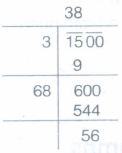
We see that, 382 < 1500 < 392
So, number to be added = 392 - 1500
= 1521 - 1500 = 21
Therefore, the perfect square is 1500 + 21 = 1521 and \(\sqrt { 1521 } \)= 39
So, the required number is 21 and the square root is 39.
13.
(a)
\(\frac { m }{ 2 } digits\)
14.
(c)
5x
15.
(b)
198
16.
(a)
11 units
17.
(c)
13
18.
()
5
19.
()
1.7
20.
()
3
21.
()
Six
22.
(a)
23.
(a)
24.
(b)
25.
(a)
26.
(b)
27.
(b)

8th Standard CBSE Syllabus & Materials
8th Standard CBSE
CBSE 8th Science Particulate Nature of Matter - New Model Questions Papers Study Material - QB365 Set A
NEW8th Standard CBSE
CBSE 8th Science Pressure, Winds, Stroms and Cyclones - New Model Questions Papers Study Material - QB365 Set A
NEW8th Standard CBSE
CBSE 8th Mathematics Quadrilaterals - New Model Questions Papers Study Material - QB365 Set A
NEW8th Standard CBSE
CBSE 8th Mathematics A story of Numbers - New Model Questions Papers Study Material - QB365 Set A



CBSE 8th Standard CBSE Subjects
CBSE Standards




