
 100% FREE ACCESS
12th Standard Syllabus & Materials
12th Standard
TN 12th Computer Applications மின்னணு தரவு பரிமாற்றம் Sample Question Papers Study Material - QB365 Set A
NEW12th Standard
TN 12th Computer Applications மின் - வணிக பாதுகாப்பு அமைப்புகள் Sample Question Papers Study Material - QB365 Set A
NEW12th Standard
TN 12th Computer Applications மின்னணு செலுத்தல் முறைகள் Sample Question Papers Study Material - QB365 Set A
NEW12th Standard
TN 12th Computer Applications மின் - வணிகம் Sample Question Papers Study Material - QB365 Set A
NEW12th Standard
TN 12th Computer Applications திறந்த மூல கருத்துருக்கள் Sample Question Papers Study Material - QB365 Set A
NEW12th Standard
TN 12th Computer Applications வலையமைப்பு வடமிடல் Sample Question Papers Study Material - QB365 Set A

Published on: 18/01/2021
test
Download Tamil Nadu 12th Standard Chemistry question papers, model tests, one-mark questions, important questions, and public exam papers in PDF format. Free study materials and answer keys for TN State Board students.
Questions + Answers key
Take MCQ Chemistry Test1.
Using the Lagrange’s mean value theorem determine the values of x at which the tangent is parallel to the secant line at the end points of the given interval:
f (x) = (x − 2)(x − 7), x ∈ [3,11]
2.
A thermometer was taken from a freezer and placed in a boiling water. It took 22 seconds for the thermometer to raise from −10°C to 100°C. Show that the rate of change of temperature at some time t is 5°C per second.
3.
Prove, using mean value theorem, that \(|sin \alpha-sin\beta|\le |\alpha-\beta|, \alpha, \beta \in R\)
4.
Prove using the Rolle’s theorem that between any two distinct real zeros of the polynomial \(a_{n}x^{n}+a_{n-1}x^{n-1}+...+a_{1}x+a_{0}\) there is a zero of the polynomial \(na_{n}x^{n-1}+(n-1)a_{n-1}x^{n-2}+...+a_{1}\)
5.
Without actually solving show that the equation x4+2x3-2 = 0 has only one real root in the interval (0, 1).
6.
A particle moves along a straight line in such a way that after t seconds its distance from the origin is s = 2t2 + 3t metres.
7.
A point moves along a straight line in such a way that after t seconds its distance from the origin is s = 2t2 + 3t metres.
(i) Find the average velocity of the points between t = 3 and t = 6 seconds.
(ii) Find the instantaneous velocities at t = 3 and t = 6 seconds.
8.
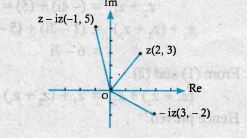
Given the complex number z = 2 + 3i, represent the complex numbers in Argand diagram z, −iz , and z−iz
9.
If \(\vec { a } ,\vec { b } ,\vec { c } \) are three non-coplanar vectors represented by concurrent edges of a parallelepiped of volume 4 cubic units, find the value of \((\vec { a } +\vec { b } ).(\vec { b } \times \vec { c } )+(\vec { b } +\vec { c } ).(\vec { c } \times \vec { a } )+(\vec { c } +\vec { a } )(\vec { a } \times \vec { b } )\)
10.
Solve tan-1 2x + tan-1 3x = \(\frac{\pi}{4}\), if 6x2 < 1
11.
Prove by vector method that the area of the quadrilateral ABCD having diagonals AC and BD is \(\frac { 1 }{ 2 } \left| \vec { AC } \times \vec { BD } \right| \).
12.
For any two complex number z1 and z2 such that |z1| = |z2| = 1 and z1z2 \(\neq \) -1, then show that \(\frac { { z }_{ 1 }+{ z }_{ 2 } }{ 1+{ z }_{ 1 }{ z }_{ 2 } } \) is real number.
13.
If α, β and γ are the roots of the cubic equation x3+2x2+3x+4 = 0, form a cubic equation whose roots are, 2α, 2β, 2γ
14.
If G is the centroid of a ΔABC, prove that (area of ΔGAB) = (area of ΔGBC) = (area of ΔGCA) = \(\frac{1}{3}\) (area of ΔABC)
15.
Find the domain of f(x) = sin-1 \((\frac{|x|-2}{3})+ \) cos-1 \((\frac{1-|x|}{4})\)
16.
The equation of the tangent to the curve x = t cost, y = t sin t at the origin is __________
x = 0
y = 0
x +y = 0
x + y = 7
17.
If a particle moves in a straight line according to s = t3-6t2-15t, the time interval during which the velocity is negative and acceleration is positive is __________
2 < t < 5
2 ≤ t ≤ 5
t ≥ 2
t ≤ 2
18.
19.
If \(f(x)=\left\{\begin{array}{ll} 2 x & 0 \leq x \leq a \\ 0 & \text { otherwise } \end{array}\right.\) is a probability density function of a random variable, then the value of a is
1
2
3
4
20.
Four buses carrying 160 students from the same school arrive at a football stadium. The buses carry, respectively, 42, 36, 34, and 48 students. One of the students is randomly selected. Let X denote the number of students that were on the bus carrying the randomly selected student. One of the 4 bus drivers is also randomly selected. Let Y denote the number of students on that bus. Then E(X) and E(Y) respectively are
50,40
40,50
40.75,40
41,41
21.
What is the value of the limit \(\lim _{x \rightarrow 0}\left(\cot x-\frac{1}{x}\right) \text { is }\)
0
1
2
∞
22.
The position of a particle moving along a horizontal line of any time t is given by s(t) = 3t2 -2t- 8. The time at which the particle is at rest is
t = 0
\(\\ \\ \\ t=\cfrac { 1 }{ 3 } \)
t =1
t = 3
23.
If \(\sqrt { a+ib } \) = x + iy, then possible value of \(\sqrt { a-ib }\) is ___________
x2+y2
\(\sqrt { { x }^{ 2 }+{ y }^{ 2 } } \)
x+iy
x-iy
24.
If \(\left| \overset { \rightarrow }{ a } \times \overset { \rightarrow }{ b } \right| =\overset { \rightarrow }{ a } .\overset { \rightarrow }{ b } \), then the angle between the vector \(\overset { \rightarrow }{ a } \) and \(\overset { \rightarrow }{ b } \) is _____________
\(\frac { \pi }{ 4 } \)
\(\frac { \pi }{ 3 } \)
\(\frac { \pi }{ 6 } \)
\(\frac { \pi }{ 2 } \)
25.
The angle between the vectors \(\overset { \wedge }{ i } -\overset { \wedge }{ j } \) and \(\overset { \wedge }{ j } -\overset { \wedge }{ k } \) is _______________
\(\frac { \pi }{ 3 } \)
\(\frac { -2\pi }{ 3 } \)
\(\frac { -\pi }{ 3 } \)
\(\frac { 2\pi }{ 3 } \)
26.
Th point of curve y = 2x2 - 6x - 4 at which the targent is parallel to x - axis is __________
\(\left( \frac { 5 }{ 2 } ,\frac { -7 }{ 12 } \right) \)
\(\left( \frac { -5 }{ 2 } ,\frac { -7 }{ 2 } \right) \)
\(\left( \frac { -5 }{ 2 } ,\frac { 17 }{ 12 } \right) \)
\(\left( \frac { 3 }{ 2 } ,\frac { -7 }{ 2 } \right) \)
27.
28.
If θ is the angle between the vectors \(\overset { \rightarrow }{ a } \) and \(\overset { \rightarrow}{b} \), then sin θ is ___________
\(\frac { \overset { \rightarrow }{ a } .\overset { \rightarrow }{ b } }{ \left| \overset { \rightarrow }{ a } \right| \left| \overset { \rightarrow }{ b } \right| } \)
\(\frac { \left| \overset { \rightarrow }{ a } \times \overset { \rightarrow }{ b } \right| }{ \overset { \rightarrow }{ a } .\overset { \rightarrow }{ b } } \)
\(\sqrt { 1-{ \left( \frac { \overset { \rightarrow }{ a. } \overset { \rightarrow }{ b } }{ \left| \overset { \rightarrow }{ a } \right| \left| \overset { \rightarrow }{ b } \right| } \right) }^{ 2 } } \)
0
29.
The number of vectors of unit length perpendicular to the vectors \(\left( \overset { \wedge }{ i } +\overset { \wedge }{ j } \right) \) and \(\left( \overset { \wedge }{ j } +\overset { \wedge }{ k } \right) \)is __________
1
2
3
\(\infty\)
30.
If tan-1(cot \(\theta\)) = 2\(\theta\), then\(\theta\) = _____________
\(\pm 3\)
\(\pm \frac { \pi }{ 4 } \)
\(\pm \frac { \pi }{ 6 } \)
none
31.
If a parabolic reflector is 20 cm in diameter and 5 cm in diameter and 5 cm deep, then its focus is ____________
(0, 5)
(5, 0)
(10, 0)
(0, 10)
32.
If \({ sin }^{ -1 }x-cos^{ -1 }x=\frac { \pi }{ 6 } \) then ___________
\(\frac { 1 }{ 2 } \)
\(\frac { \sqrt { 3 } }{ 2 } \)
\(\frac { -1 }{ 2 } \)
none of these
33.
34.
The quadratic equation whose roots are ∝ and β is ___________
(x - ∝)(x -β) = 0
(x - ∝)(x + β) = 0
∝ + β = \(\frac{b}{a}\)
∝ β = \(\frac{-c}{a}\)
35.
If AT is the transpose of a square matrix A, then ___________
|A| ≠ |AT|
|A| = |AT|
|A| + |AT| =0
|A| = |AT| only
36.
The augmented matrix of a system of linear equations is \(\left[\begin{array}{cccc} 1 & 2 & 7 & 3 \\ 0 & 1 & 4 & 6 \\ 0 & 0 & \lambda-7 & \mu+5 \end{array}\right]\). The system has infinitely many solutions if
\(\lambda=7, \mu \neq-5\)
\(\lambda=-7, \mu=5\)
\(\lambda \neq 7, \mu \neq-5\)
\(\lambda=7, \mu=-5\)
37.
If A = \(\left[ \begin{matrix} 2 & 0 \\ 1 & 5 \end{matrix} \right] \) and B = \(\left[ \begin{matrix} 1 & 4 \\ 2 & 0 \end{matrix} \right] \) then |adj (AB)| =
-40
-80
-60
-20
38.
If the distance of the point (1, 1, 1) from the origin is half of its distance from the plane x + y + z + k = 0, then the values of k are
\(\pm 3\)
\(\pm 6\)
-3, 9
3, -9
39.
If the line \(\frac { x-2 }{ 3 } =\frac { y-1 }{ -5 }= \frac {z+2 }{ 2 } \) lies in the plane x + 3y - αz + β = 0, then (α, β) is
(-5, 5)
(-6, 7)
(5, -5)
(6, -7)
40.
41.
The circle passing through (1, -2) and touching the axis of x at (3, 0) passing through the point
(-5, 2)
(2, -5)
(5, -2)
(-2, 5)
42.
The ellipse \(E_{1}: \frac{x^{2}}{9}+\frac{y^{2}}{4}=1\) is inscribed in a rectangle R whose sides are parallel to the coordinate axes. Another ellipse E2 passing through the point (0, 4) circumscribes the rectangle R. The eccentricity of the ellipse is
\(\frac { \sqrt { 2 } }{ 2 } \)
\(\frac { \sqrt { 3 } }{ 2 } \)
\(\frac { 1 }{ 2 } \)
\(\frac { 3 }{ 4 } \)
43.
The circle x2 + y2 = 4x + 8y +5 intersects the line 3x−4y = m at two distinct points if
15< m < 65
35< m <85
−85 < m < −35
−35 < m < 15
44.
sin-1(2cos2x-1)+cos-1(1-2sin2x)=
\(\frac{\pi}{2}\)
\(\frac{\pi}{3}\)
\(\frac{\pi}{4}\)
\(\frac{\pi}{6}\)
45.
If sin-1 x+sin-1 y+sin-1 \(z = \frac{3\pi}{2}\), the value of x2017+y2018+z2019\(-\frac { 9 }{ { x }^{ 101 }+{ y }^{ 101 }+{ z }^{ 101 } } \)is
0
1
2
3
46.
47.
The polynomial x3 - kx2 + 9x has three real zeros if and only if, k satisfies
|k| ≤ 6
k = 0
|k| > 6
|k| ≥ 6
48.
49.
Find the domain of the following functions
\(\frac{1}{2}tan^{-1}(1-x^2)-\frac{\pi}{4}\)
1.
Given f (x) = (x − 2)(x − 7), x ∈ [3,11]
a) f(x) is continuous in [3, 11]
b) f(x) is differentiable in (3, 11)
c) f(11) = (11-2)(11-7)
= (9) (4) = 36
f(3) = (3 - 2)(3 - 7)
= (1)(-4) = - 4
∴ By Lagrange's mean value theorem, there exists c ∈ [3,11] such that f'(c) = \(\frac { f(b)-f(a) }{ b-a } \)
\(\left[ \begin{matrix} f(x)\begin{matrix} = & (x \end{matrix}- & 2) & \begin{matrix} (x & - \end{matrix}7) \\ \begin{matrix} = & { x }^{ 2 } \end{matrix}- & 7x & -2x\begin{matrix} + & 14 \end{matrix} \\ \begin{matrix} = & { x }^{ 2 } \end{matrix}- & 9x & +\begin{matrix} 14 & \end{matrix} \end{matrix} \right] \)
⇒ 2c - 9 = \(\frac{36+4}{11-3}\)
⇒ 3c - 9 = \(\frac{40}{8}\) = 5
⇒ 2c = 14
⇒ c = 7 ∈ [3 , 11]
2.
Let f (t) be the temperature at time t. By the mean value theorem, we have
\(f'(c)=\frac{f(b)-f(a)}{b-a}\)
= \(\frac{100-(-10)}{22}\)
= \(\frac{110}{22}\)
= 5°C per second.
Hence the instantaneous rate of change of temperature at some time t should be 5°C per second.
3.
Let f (x) = sin x which is a differentiable function in any open interval. Consider an interval \([\alpha, \beta]\). Applying the mean value theorem there exists \(c \in (\alpha, \beta)\) such that,
\(\frac{sin \beta - sin \alpha}{\beta-\alpha}=f'(c)=cos(c)\)
Therefore, \(\frac{sin \beta - sin \alpha}{\beta-\alpha}=|cos(c)|\le1\)
Hence, \(|sin\alpha-sin\beta|\le |\alpha-\beta|\)
Remark
If we take \(\beta=0\) in the above problem, we ge \(|sin \alpha|\le |\alpha|\)
4.
Let P(x) = \(a_{n}x^{n}+a_{n-1}x^{n-1}+...+a_{1}x+a_{0}\). Let \(\alpha<\beta \) be two real zeros of P(x). Therefore, \(P(\alpha)=P(\beta)=0.\) Since P(x) is continuous in \([\alpha, \beta]\) and differentiable in \((\alpha, \beta)\) by an application of Rolle’s theorem there exists \(\gamma \in (\alpha,\beta)\) such that \(P'(\gamma)=0\). Since,
\(P'(x)=na_{n}x^{n-1}+(n-1)a_{n-1}x^{n-2}+...+a_{1}\) which completes the proof.
5.
Let f (x) = x4 + 2x3-2
Then f (x) is continuous in [0, 1] and differentiable in (0, 1)
Now, f'(x) = 4x3+6x2
If f'(x) = 0, then
2x2(2x+3) = 0
Therefore, \(x=0, -\frac{3}{2}\) but \(0,-\frac{3}{2} \notin (0,1)\).
Thus, \(f'(x)>0, \forall x\in (0,1)\).
Hence by the Rolle’s theorem there do not exist \(a,b \in(0,1)\) such that, f(a) = 0 = f(b). Therefore the equation f(x ) = 0 cannot have two roots in the interval (0, 1) . But, f (0, 2) = −2 < 0 and f (1) = 1 > 0 tells us the curve y f = (x) crosses the x -axis between 0 and 1 only once by the Intermediate value theorem. Therefore the equation x4 + 2x3 − 2 = 0 has only one real root in the interval (0, 1) .
6.
7.
Given s = 2t2 + 3t
s(3) = 2 \(\times\) 32 + 3 (3)
= 2\(\times\)9+9
= 27 m ....(1)
s(6) = 2\(\times\) 62 + 3 (6)
= 72 + 18 = 90m ... (2)
Average velocity = \(\frac { s(6)-s(3) }{ 6-3 } \)
= \(\frac { 90-27 }{ 3 } \) = 21 m/s
(ii) Instantaneous Velocity V(t) = \(\frac { ds }{ dt } \)
Instantaneous Velocity at t = 3
= V(3) = 15 m/sec
Instantaneous Velocity at t = 6
= V(6) = 27m/sec
8.
z = 2+3t
-iz = -i(2+3i)
= 2i -3i2 = -2i+3
= 3 - 2i
z - iz = 2+ 3i-3+2i
= -1+5i
9.
Given \(\vec { a } ,\vec { b } ,\vec { c } \) are concurrent edges of a parallelepiped, and its volume is 4 cubic units.
\(\vec { a } .(\vec { b } \times \vec { c } )\) = \(\pm 4\) ..(1)
Consider
\((\vec { a } +\vec { b } ).(\vec { b } \times \vec { c } )+(\vec { b } +\vec { c } ).(\vec { c } \times \vec { a } )+(\vec { c } +\vec { a } )(\vec { a } \times \vec { b } )\)
= \(\vec { a } .(\vec { b } \times \vec { c } )+\vec { b } .(\vec { b } \times \vec { c } )+\vec { b } .(\vec { c } \times \vec { a } )+\vec { c } .(\vec { c } \times \vec { a } )+\vec { c } .(\vec { a } \times \vec { b } )+\vec { a } .(\vec { a } \times \vec { b } )\)
= \(\vec { a } .(\vec { b } \times \vec { c } )+0+\vec { b } .(\vec { b } \times \vec { c } )+0+\vec { b } .(\vec { c } \times \vec { a } )+0\)
\([\because \vec { a } .(\vec { a } \times \vec { b } )=0]\)
= \(\vec { a } .(\vec { b } \times \vec { c } )+\vec { a } .(\vec { b } \times \vec { c } )+\vec { a } .(\vec { b } \times \vec { c } )\)
\(\left[ \because [\vec { a } \vec { b } \vec { c } ]=[\vec { a } \vec { b } \vec { c } ]=[\vec { a } \vec { b } \vec { c } ] \right] \)
= \(3[\vec { a } .(\vec { b } \times \vec { c } )]=3(\pm 4)\) using (1)
= ±12
10.
Now, tan-1 2x + tan-1 3x = \({ tan }^{ -1 }\left( \frac { 2x+3x }{ 1-6x^{ 2 } } \right) \), since 6x2 < 1.
So, \(tan^{ -1 }\left( \frac { 5x }{ 1-6x^{ 2 } } \right) =\frac { \pi }{ 4 } \), Which implies \(\frac { 5x }{ 1-6x^{ 2 } } =tan\frac { \pi }{ 4 } \) = 1
Thus, 1-6x2 = 5x , which gives 6x2+5x−1 = 0
Hence, x = \(\frac{1}{6},-1\). But x = -1 does not satisfy 6x2 < 1.
Observe that x = −1 makes the left side of the equation negative whereas the right side is a positive number.
Thus, x = −1 is not a solution.
Hence, x = \(\frac{1}{6}\) is the only solution of the equation.
11.
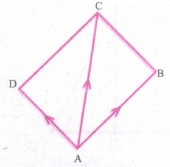
Vector area of quadrilateral ABCD
= vector area of ΔABC + vector area of ΔACD
\(\frac { 1 }{ 2 } (\vec { AB } \times \vec { AC } )+\frac { 1 }{ 2 } (\vec { AC } \times \vec { AD } )\)
= \(-\frac { 1 }{ 2 } (\vec { AC } \times \vec { AB } )+\frac { 1 }{ 2 } (\vec { AC } \times \vec { AD } )\)
\(\left[ \because \ \vec { b } \times \vec { a } =-(\vec { a } \times \vec { b } ) \right] \)
= \(\frac { 1 }{ 2 } \vec { AC } \times (-\vec { AB } +\vec { AD } )\)
= \(\frac { 1 }{ 2 } \vec { AC } \times (\vec { BA } +\vec { AD } )\) \([\because \vec { AB } =-\vec { BA } ]\)
= \(\frac { 1 }{ 2 } \vec { AC } \times \vec { BD } \) [By Δ law of addition]
∴ Area of the quadrilateral ABCD = \(\frac { 1 }{ 2 } \vec { AC } \times \vec { BD } \)
12.
Given |z1| = |z2| = 1
⇒ z1 \(\bar { z } \) = 1
⇒ z1 = \(\frac { 1 }{ \bar { { z }_{ 1 } } } \)
and z1 z2 ≠ -1
Also z2\(\bar { { z }_{ 2 } } \) = 1
⇒ z2 = \(\frac { 1 }{ \bar { { z }_{ 2 } } } \)
Consider \(\frac { z_{ 1 }+{ z }_{ 2 } }{ 1+{ z }_{ 1 }{ z }_{ 2 } } \)
∴ \(\frac { z_{ 1 }+{ z }_{ 2 } }{ 1+{ z }_{ 1 }{ z }_{ 2 } } =\frac { \frac { 1 }{ \bar { { z }_{ 1 } } } +\frac { 1 }{ \bar { { z }_{ 2 } } } }{ 1+\frac { 1 }{ \bar { { z }1 } } .\frac { 1 }{ \bar { { z }_{ 2 } } } } =\frac { \frac { \bar { { z }_{ 2 } } +\bar { { z }_{ 1 } } }{ \bar { { z }_{ 1 } } \bar { { z }_{ 2 } } } }{ \frac { \bar { { z }_{ 1 } } \bar { { z }_{ 2 } } +1 }{ \bar { { z }_{ 1 } } \bar { { z }_{ 2 } } } } \)
= \(\frac { \bar { { z }_{ 2 } } +\bar { { z }_{ 1 } } }{ \bar { { z }_{ 1 } } \bar { { z }_{ 2 } } +1 } \)
= \(\left( \frac { \overline { { z }_{ 1 }{ +z }_{ 2 } } }{ 1+{ z }_{ 1 }{ z }_{ 2 } } \right) \)
∴ \(\frac { z_{ 1 }+{ z }_{ 2 } }{ 1+{ z }_{ 1 }{ z }_{ 2 } } =\frac { \frac { 1 }{ \bar { { z }_{ 1 } } } +\frac { 1 }{ \bar { { z }_{ 2 } } } }{ 1+\frac { 1 }{ \bar { { z }1 } } .\frac { 1 }{ \bar { { z }_{ 2 } } } } =\frac { \frac { \bar { { z }_{ 2 } } +\bar { { z }_{ 1 } } }{ \bar { { z }_{ 1 } } \bar { { z }_{ 2 } } } }{ \frac { \bar { { z }_{ 1 } } \bar { { z }_{ 2 } } +1 }{ \bar { { z }_{ 1 } } \bar { { z }_{ 2 } } } } \) is real [∵ z = \(\bar { z } \) ⇒ is real]
13.
The roots of x3+2x2+3x+4 = 0 are ∝, β, ૪
∴ ∝+β+૪ = -co-efficient of x2 = -2 ...(1)
∝β + β૪ + ૪∝ = co-effficient of x = 3 ....(2)
-∝β૪ = +4 ⇒ ∝β૪ = -4 ...(3)
Form a cubic equation whose roots are 2∝, 2β, 2૪
2∝+2β+2૪ = 2(∝+β+૪) = 2(-2) = -4 [from (1)]
4∝β+4β૪+4૪∝ = 4(∝β+β૪+୪∝) = 4(3) = 12 [from (2)]
(2∝)(2β)(2૪) = 8(∝β૪) = 8(-4) = -32 [from (3)]
∴ The required cubic equation is
x3-(2∝+2β+2૪)x2 + (2∝β+2β૪+2୪∝)x - (2∝)(2β)(2૪) = 0
⇒ x3+(-4)x2+12x+32 = 0
⇒ x3+4x2+12x+32 = 0
14.
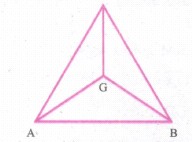
Let the position vector of the vertices of ΔABC be \(\vec { a } \), \(\vec { b } \) and \(\vec { c } \) respectively.
Since G is the centroid of ΔABC, \(\vec { OG } =\frac { \vec { a } +\vec { b } +\vec { c } }{ 3 } \)
Are of ΔGAB, = \(|\vec { AB } \times \vec { AG } |=|(\vec { OB } -\vec { OA } )\times (\vec { OG } -\vec { OA } )|\)
= \(\left| (\vec { b } -\vec { a } )\times \left( \frac { \vec { a } +\vec { b } +\vec { c } }{ 3 } -\vec { a } \right) \right| \)
= \(\left| (\vec { b } -\vec { a } )\times \left( \frac { \vec { a } +\vec { b } +\vec { c } -3\vec { a } }{ 3 } \right) \right| \)
= \(\left| (\vec { b } -\vec { a } )\times \left( \frac { \vec { b } +\vec { c } +2\vec { a } }{ 3 } \right) \right| \)
= \(\frac { 1 }{ 3 } |(\vec { b } -\vec { a } )\times (\vec { a } +\vec { 0 } -2\vec { a } )|\)
= \(\frac { 1 }{ 3 } |\vec { b } \times \vec { b } +\vec { b } \times \vec { c } -2\vec { b } \times \vec { a } -\vec { a } \times \vec { b } -\vec { a } \times \vec { c } +2\vec { a } \times \vec { a } |\)
[∵ cross product is distributive]
= \(\frac { 1 }{ 3 } |\vec { b } \times \vec { c } +2\vec { a } \times \vec { b } -\vec { a } \times \vec { b } +\vec { c } \times \vec { a } |\)
= \(\frac { 1 }{ 3 } |\vec { a } \times \vec { b } +\vec { b } \times \vec { c } +\vec { c } \times \vec { a } |\) \( [\because \vec { b } \times \vec { b } =\vec { 0 } ,\vec { a } \times \vec { a } =\vec { 0 } ,.(1)\vec { a } \times \vec { b } =-\vec { b } \times \vec { a } ]\)
Area of ΔGAC = \(|\vec { CA } \times \vec { AG } |\)
= \(|(\vec { OA } -\vec { OC } )\times (\vec { OG } -\vec { OA } )|\)
\(\left| (\vec { a } -\vec { c } )\times \left( \frac { \vec { a } +\vec { b } +\vec { c } }{ 3 } -\vec { a } \right) \right| \)
= \(\left| (\vec { c } -\vec { a } )\times \left( \frac { \vec { a } +\vec { b } +\vec { c } -3\vec { a } }{ 3 } \right) \right| \)
= \(\frac { 1 }{ 3 } |(\vec { a } -\vec { c } )\times (\vec { b } +\vec { c } -2\vec { a } )|\)
= \(\frac { 1 }{ 3 } |\vec { a } \times \vec { b } +\vec { a } \times \vec { c } -2\vec { a } \times \vec { a } -\vec { c } \times \vec { b } -\vec { c } \times \vec { c } +2\vec { c } \times \vec { a } |\)
= \(\frac { 1 }{ 3 } |\vec { a } \times \vec { b } -\vec { c } \times \vec { a } +\vec { b } \times \vec { c } +2\vec { c } \times \vec { a } |\)
= \(\frac { 1 }{ 3 } |\vec { a } \times \vec { b } +\vec { b } \times \vec { c } +\vec { c } \times \vec { a } |\)
Also area of ΔGBC = \(|\vec { BC } \times \vec { BG } |\)
= \(|\vec { OC } -\vec { OB } )\times (\vec { OG } -\vec { OB } )|\)
= \(\left| (\vec { c } -\vec { a } )\times \left( \frac { \vec { a } +\vec { b } +\vec { c } -\vec { b } }{ 3 } \right) \right| \)
= \(\left| (\vec { c } -\vec { a } )\times \left( \frac { \vec { a } +\vec { b } -2\vec { a } }{ 3 } \right) \right| \)
\(\frac { 1 }{ 3 } |(\vec { c } -\vec { b } )\times (\vec { a } +\vec { c } -2\vec { b } )|\)
= \(\frac { 1 }{ 3 } |\vec { c } \times \vec { a } +\vec { c } \times \vec { c } -2\vec { c } \times \vec { b } -\vec { b } \times \vec { a } -\vec { b } \times \vec { c } +2\vec { b } \times \vec { b } |\)
= \(\frac { 1 }{ 3 } |\vec { c } \times \vec { a } +2\vec { b } \times \vec { c } +\vec { a } \times \vec { b } -\vec { b } \times \vec { c } |\)
\(\frac { 1 }{ 3 } |\vec { c } \times \vec { a } +\vec { b } \times \vec { c } +\vec { a } \times \vec { b } |\)
From (1), (2) and (3),
Area of ΔGAB = Area of ΔGAC = Area of ΔGBC
= \(\frac { 1 }{ 3 } |\vec { a } \times \vec { b } +\vec { b } \times \vec { c } +\vec { c } \times \vec { a } |\)
= \(\frac { 1 }{ 3 } \) Area of ΔABC.
15.
f(x) = sin-1 \((\frac{|x|-2}{3})+cos^-1(\frac{1-|x|}{4})\)
From the definition of sin-1
\(-1\le \frac { \left| x \right| -2 }{ 3 } \le 1\)
\(\Rightarrow -3\le \left| x \right| -2\le 3\)
\(\Rightarrow -3+2\le \left| x \right| \le \left| x \right| \le 3+2\)
\(\Rightarrow -1\le \left| x \right| \le 5\)
It reduces to
\(0\le \left| x \right| \le 5\)
\(\Rightarrow 0\le \left| x \right| and\left| x \right| \le 5\)
\(\Rightarrow \left| x \right| \ge 0and-5\le x\le 5\)
From the definition of cos-1x.
\(-1\le \frac { 1-\left| x \right| }{ 4 } \le 1\)
\(\Rightarrow -4\le 1-\left| x \right| \le 4\)
\(\Rightarrow -4-1\le \left| x \right| \le 4-1\)
\(\Rightarrow -5\le -\left| x \right| \le 3\)
\(\Rightarrow -3\le \left| x \right| >5\)
It reduces to
\(0\le \left| x \right| \le 5\)
\(-5\le |x|\le 5\)
From (1) & (2),
Domain is [-5, 5]
16.
(b)
y = 0
17.
(a)
2 < t < 5
18.
(c)
19.
(a)
1
20.
(c)
40.75,40
21.
(a)
0
22.
(b)
\(\\ \\ \\ t=\cfrac { 1 }{ 3 } \)
23.
(d)
x-iy
24.
(a)
\(\frac { \pi }{ 4 } \)
25.
(d)
\(\frac { 2\pi }{ 3 } \)
26.
(d)
\(\left( \frac { 3 }{ 2 } ,\frac { -7 }{ 2 } \right) \)
27.
(d)
28.
(c)
\(\sqrt { 1-{ \left( \frac { \overset { \rightarrow }{ a. } \overset { \rightarrow }{ b } }{ \left| \overset { \rightarrow }{ a } \right| \left| \overset { \rightarrow }{ b } \right| } \right) }^{ 2 } } \)
29.
(b)
2
30.
(c)
\(\pm \frac { \pi }{ 6 } \)
31.
(b)
(5, 0)
32.
(b)
\(\frac { \sqrt { 3 } }{ 2 } \)
33.
(b)
34.
(a)
(x - ∝)(x -β) = 0
35.
(b)
|A| = |AT|
36.
(d)
\(\lambda=7, \mu=-5\)
37.
(b)
-80
38.
(d)
3, -9
39.
(b)
(-6, 7)
40.
(c)
41.
(c)
(5, -2)
42.
(c)
\(\frac { 1 }{ 2 } \)
43.
(d)
−35 < m < 15
44.
(a)
\(\frac{\pi}{2}\)
45.
(a)
0
46.
(b)
47.
(d)
|k| ≥ 6
48.
(b)
49.
Let \(g(x)=\frac { 1 }{ 2 } { tan }^{ -1 }\left( 1-{ x }^{ 2 } \right) -\frac { \pi }{ 4 } \)
By the definition of tan-1 x, it is a function with
the entire real line \(\left( -\infty ,\infty \right) \) as its domain.
\(\therefore \) Domain of \(g(x)=\frac { 1 }{ 2 } { tan }^{ -1 }\left( 1-{ x }^{ 2 } \right) -\frac { \pi }{ 4 } \)is R
\(\therefore \) Domain of g(x) is R.

12th Standard Syllabus & Materials
12th Standard
TN 12th Computer Applications களப்பெயர் முறைமை (DNS) Sample Question Papers Study Material - QB365 Set A
NEW12th Standard
TN 12th Computer Applications வலையமைப்பு எடுத்துக்காட்டுகள் மற்றும் நெறிமுறைகள் Sample Question Papers Study Material - QB365 Set A
NEW12th Standard
TN 12th Computer Applications கணினி வலையமைப்பு ஓர் அறிமுகம் Sample Question Papers Study Material - QB365 Set A
NEW12th Standard
TN 12th Computer Applications PHP-உடன் MySQL-ஐ இணைத்தல் Sample Question Papers Study Material - QB365 Set A



Tamilnadu Stateboard 12th Standard Subjects

Maths
Chemistry

Physics

Biology

Computer Science

Business Maths and Statistics

Economics

Commerce

Accountancy

History

Computer Applications
Biology
Computer Technology
Computer Applications
Computer Science
Business Maths and Statistics
Commerce
Economics
Maths
Chemistry
Physics
Computer Technology
History
Accountancy

Tamil

English

French
Tamilnadu Stateboard Standards

