
 100% FREE ACCESS
6th Standard CBSE Syllabus & Materials
6th Standard CBSE
CBSE 6th Social Science The Value of Work - New Sample Question Papers Study Material - QB365 Set A
NEW6th Standard CBSE
CBSE 6th Social Science Family and Community - New Sample Question Papers Study Material - QB365 Set A
NEW6th Standard CBSE
CBSE 6th Social Science India's Cultural Roots - New Sample Question Papers Study Material - QB365 Set A
NEW6th Standard CBSE
CBSE 6th Social Science India,That is Bharat - New Sample Question Papers Study Material - QB365 Set A
NEW6th Standard CBSE
CBSE 6th Social Science Timeline and sources of history - New Sample Question Papers Study Material - QB365 Set A
NEW6th Standard CBSE
CBSE 6th Social Science Oceans and Continents - New Sample Question Papers Study Material - QB365 Set A

Published on: 01/08/2018
Some of the important questions are prepared from this chapter The Earth in the Solar System. The important questions are covers from the Higher Order Thinking Questions and Value Based Questions
Download CBSE Class 6th Standard CBSE Social Science question papers, sample papers, important questions, and previous year solved papers in PDF format. Get free study materials, NCERT solutions, and exam preparation resources for Class 6th Standard CBSE Social Science
Questions + Answers key
Take MCQ Social Science Test
1.
Why does the moon have spots?
2.
Why is the sun called as the head of the solar system?
3.
How did ancient people determine direction during night?
4.
Why do we see only one side of the moon always?
5.
How does a planet differ from a star?
6.
Ursa major is an example of which of the following?
Star
Satellite
Constellation
Planet
7.
The galaxy to which our solar system belong is known as
Milky Path galaxy
Milky Way galaxy
Milky Way orbit galaxy
Milky Galaxy
8.
Which one of the following is the smallest and the nearest planet to the sun in solar system?
Venus
Mercury
Mars
Jupiter
9.
How much time does Mercury take to complete one round of the sun?
27 days
365 days
88 days
100 days
10.
Which is the third nearest planet to the sun?
Venus
Earth
Mercury
11.
The small bear constellation is better known as the _________ .
12.
Meteroids heat up and burn due to _________ .
13.
The planets do not possess ________ and ________ .
14.
__________ is the third nearest planet to the sun.
15.
A huge system of stars is called _________.
16.
Which planet takes maximum time in completing one orbit around the sun?
17.
Give an example of dwarf planet?
18.
Which is the smallest and largest planet in the solar system?
19.
How many planets are there in the solar system?
20.
Why do we not feel the heat and light of the stars?
21.
Name few planets which have rings around them?
22.
Name any man-made Indian satellite.
23.
Give some examples of constellation?
24.
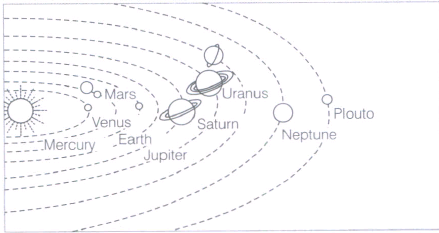
(i) How many satellites does Mars have?
(ii) How many planets are there in above picture?
25.
Write a note on galaxy and universe?
26.
How is planet different from satellites in origin and characteristics?
1.
Moon has mountains, plains and depressions on its surface which casts shadow on moon's surface and it appears as spots from the Earth.
2.
The sun is huge and made-up of extremely hot gases. It is at the centre of solar system. It provides the pulling force that binds the entire solar system. Apart from this, the sun is the ultimate source of heat and light for the solar system. These are the reasons which make the sun the head of the solar family.
3.
The ancient people determined directions during night with the help of stars. The Pole Star always remains to the same direction and indicates North direction.
4.
The moon takes 27 days to complete a spin of the Earth which is similar to its time of one revolution and because of its revolution, we can see only one side of the moon.
5.
(i) The planet moves around the sun while the star remains fixed.
(Ii) The planet doesn't have its own light and heat but stars have their own light and heat.
(iii) The planets are generally smaller in size than stars.
6.
(c)
Constellation
7.
(b)
Milky Way galaxy
8.
(b)
Mercury
9.
(c)
88 days
10.
(b)
Earth
11.
()
Saptarishi
12.
()
Friction
13.
()
Heat and light
14.
()
The Earth
15.
()
galaxy
16.
()
Neptune takes 164 years in completing one orbit around trre sun, which is the highest among other planets.
17.
()
Ceres-2003, UB 313, Pluto
18.
()
Mercury is the smallest and Jupiter is the largest planet in the solar system.
19.
()
There are eight planets in our solar system.
20.
()
The great distance of stars from the Earth makes it impossible to feel the heat and light of the stars.
21.
()
Jupiter, Uranus and Saturn.
22.
()
INSAT, EDUSAT, IRS etc.
23.
()
Ursa Major or Big Bear, small bear.
24.
(i) Mars has two satellites.
(ii) There are eight planets in above picture.
25.
Galaxy A galaxy is a huge system of billions of stars and clouds of dust and gases. There are millions of galaxies in the universe. These galaxies altogether make the universe.
Akash Ganga or Milky Way is the example of galaxy. It appears as a river of light flowing in the sky, .
Universe Universe is the combination of millions of galaxies. The size of universe is very difficult to imagine and scientists still are working on it to know more about the universe.
26.
Satellite is a celestial body that moves around the planet in the same way as the planets move around the sun, A satellite may be artificial or natural.
Some of the planets have different number of satellites, Saturn has maximum number of satellites Artificial satellites are sent in the orbit of the Earth through rocket.
Planets move around the sun in fixed path (orbit). These paths are elongated, The various planets take different time to complete a round of sun depending upon the distance of particular planet from the sun.

6th Standard CBSE Syllabus & Materials
6th Standard CBSE
CBSE 6th Social Science Locating Places on the Earth - New Sample Question Papers Study Material - QB365 Set A
NEW6th Standard CBSE
CBSE 6th Science A Journey Through States of Water - New Sample Question Papers Study Material - QB365 Set A
NEW6th Standard CBSE
CBSE 6th Science Temperature and its Measurement - New Sample Question Papers Study Material - QB365 Set A
NEW6th Standard CBSE
CBSE 6th Science Materials Around Us - New Sample Question Papers Study Material - QB365 Set A



CBSE 6th Standard CBSE Subjects
CBSE Standards




