
 100% FREE ACCESS
8th Standard Syllabus & Materials
8th Standard
TN 8th Tamil இயல் 3 - கல்வி கரையில - வினைமுற்று Important Questions And Answers Study Material - QB365 Set A
NEW8th Standard
TN 8th Tamil இயல் 2 - ஈடில்லா இயற்கை - மயங்கொலிகள் Important Questions And Answers Study Material - QB365 Set A
NEW8th Standard
TN 8th Tamil இயல் 2 - ஈடில்லா இயற்கை -பட்டமரம் Important Questions And Answers Study Material - QB365 Set A
NEW8th Standard
TN 8th Tamil இயல் 2 - ஈடில்லா இயற்கை - இயற்கையை போற்றுவோம் Important Questions And Answers Study Material - QB365 Set A
NEW8th Standard
TN 8th Tamil இயல் 1 - தமிழ் இன்பம் - ஆழிக்கு இணை Important Questions And Answers Study Material - QB365 Set A
NEW8th Standard
TN 8th Tamil இயல் 2-ஈடில்லா இயற்கை - திருக்குறள் Important Questions And Answers Study Material - QB365 Set A

Published on: 29/06/2019
Most Important Questions In Advent of the Europeans of 8th social state board english medium
Download Tamil Nadu 8th Standard Social Science question papers, model tests, one-mark questions, important questions, and public exam papers in PDF format. Free study materials and answer keys for TN State Board students.
Questions + Answers key
Take MCQ Social Science Test
1.
Tranqueber on the Tamilnadu coast was a trade centre of the _______.
The Portuguese
The British
The French
The Danish
2.
Who among the following Europeans were the last to come India as traders?
The British
The French
The Danish
The Portuguese
3.
The Mughal Emperor _________permitted the English to trade in India.
4.
The printing press in India was set up by _________ at Goa in 1556.
5.
Bartholomew Diaz, a Portuguese sailor was patronized by _______.
6.
National Archives of India (NAI) is located in ________.
7.
The Danish
8.
The Dutch
9.
The place where historical documents are preserved is called archives.
10.
Ananda Rangam was a translator served under British.
11.
Coins are one of the material sources.
12.
i) Governor Nino de Cunha moved Portuguese capital from Cochin to Goa.
ii) Portuguese were the last to leave from in India.
iii) The Dutch founded their first factory at Surat.
iv) Sir Thomas Roe was sent to Jahangir’s court by King James I of England.
a) i & ii are Correct.
b) ii & iv are Correct.
c) iii is correct.
d) i, ii & iv are correct.
13.
1. Francis Day - Denmark
2. Pedro Cabral - Portugal
3. Captain Hawkins - Britain
4. Colbert - France
14.
Name the important factories established by the Dutch in India.
15.
Why Prince Henry is called ‘Henry the Navigator’?
16.
Write about the importance of Coins?
17.
Give a short note on Archives?
18.
How did the fall of Constantinople affect the European nations?
19.
How did the British establish their trading centres in India?
20.
How did the Portuguese establish their trading centres in India?
21.
Give an account of the sources of Modern India.
22.
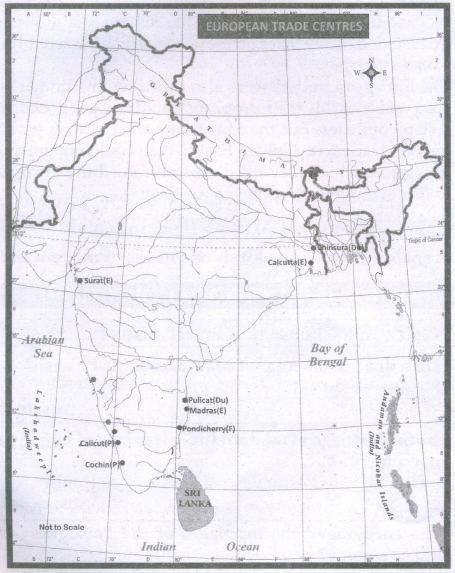
On the river map of India, mark the following trading centres of the Europeans.
1) Calicut
2) Cochin
3) Madras
4) Pondicherry
5) Surat
6) Chinsura
7) Pulicat
8) Calcutta
1.
(d)
The Danish
2.
(b)
The French
3.
()
Jahangir
4.
()
Portuguese
5.
()
King - John II
6.
()
New Delhi
7.
1616
8.
1602
9.
(a)
10.
(b)
11.
(b)
12.
d) i, ii & iv are correct.
13.
Francis Day - Denmark
14.
1. Pulicat
2. Surat
3. Chinsura
4. Kasim bazar
5. Patna
6. Nagapatnam
7. Balasore
8. Cochin
15.
1. Among the entire European nations Portugal was the foremost to make a dynamic attempt to discover a sea route to India.
2. Prince Henry of Portugal encouraged his countrymen to take up the adventurous life of exploring the unknown regions of the world.
3. So, he is commonly known as the "Navigator".
16.
1. Coins are a good source to know about administrative history.
2. The first coinage in modern india under the crown was issued in 1862.
3. Edward VII ascended after Queen Victoria and the coins issued by him bore his model.
4. The Reserve Bank of India was formally set up in 1935 and was empowered to issue Government of India notes.
5. The first paper currency issued by RBI in January 1938 was 5 rupee notes bearing the portrait of King George VI.
17.
1. Archives is the place where historical documents are preserved.
2. The National Archives of india is located in New Delhi.
3. It has main source of information for understanding past administrative machinery as well as a guide to the present and future generations related to all matters.
4. It contains authentic evidence for knowing the political, social, economic, cultural and scientific life and activities of the people of India.
18.
1) The fall of constantinople is an important landmark in the history of the world.
2) As far as trade was concerned, Constantinople was located at a vantage point through which the trade betwwwn east and west was carried on.
3) In 1453 Constantinople was captured by the Turks. They blocked the route to the East by the eastern Mediterranean.
4) They levied heavy taxes on the goods which passed through constantinople.
5) The European traders were also disturbed by the Turks.
6) As a result of this the Europeans were not prepared to lose the trade with golden East as they could not get things like spices which they liked most. It forced the Europeans to discover new sea routes to the East.
19.
1. The East India Company was founded with permission of Elizabeth the Queen of England in 1600.
2. Emperor Jahangir permitted the English to establish their factory in 1613 at Surat.
3. Surat initially became the headquarters of the English.
4. In 1615, Sir Thomas Roe was sent to Jahangir's court by King James I of England.
5. He remained at Agra for three years.
6. He succeeded in concluding a commercial treaty with the emperor.
7. Sir Thomas Roe, established the English trading centres at Surat, Agra, Ahmadabad and Broach.
8. English established their first factory in 1611 at Masulipatam.
9. In 1639, the English merchant, Francis Day, obtained Madras as a lease from Chennappa Nayaka, the ruler of Chandragiri.
10. The East India Company built its famous factory known as Fort St. George.
11. In 1668, the East India Company acquired the island at an annual rent of £ (pounds) 10 from Charles II.
12. In 1690 a factory was established at Sutanuti.
13. The Zamindari of the three villages of Sutanuti, Kalikata and Govindpur was acquired by the British in 1698.
14. The new fortified settlement at Sutanuti was named as 'Fort William' in 1700.
15. After the Battle of Plassey in 1757 and the Battle of Buxar in 1764, the Company became a political Power.
20.
Vasco da Gama:
(i) Vasco da Gama came to India in 1501 with 20 ships and founded a trading centre at Cannanore.
(ii) Then he established factories at Calicut and Cochin
Francisco de Almeida:
(i) In 1505, Francisco de Almeida was the first Governor for the Portuguese possessions in India.
(ii) He had the aim of developing the naval power of the Portuguese in India.
(iii) He followed the policy was known as the "Blue Water Policy".
(iv) He defeated the combined Muslim fleet in a naval battle near Diu.
Alfonso de Albuquerque:
(i) The real founder of the Portuguese power in India was Alfonso de Albuquerque.
(ii) He captured Goa from the Sultan of Bijapur in November 1510.
(iii) He established the Portuguese authority over Ormuz in Persian Gulf in 1515.
Nino de Cunha:
(i) Nino de Cunha moved capital from Cochin to Goa in 1530. In 1534, he acquired Bassein from Bahadur Shah of Gujarat
(ii) In 1537, he occupied Diu. Later, they wrested Daman from the local chiefs of Gujarat.
(iii) In 1548, they occupied Salsette.
(iv) Thus during the 16th century, Portuguese succeeded in capturing Goa, Daman, Diu, Salsette, Bassein, Chaul and Bombay on the western coast.
(v) He succeeded in acquiring Hooghly on the Bengal coast and San Thome on the Madras coast.
21.
1) The sources for the history of modern indaia help us to know the political, socio-economic and cultural development in the country.
2) From the very beginning, the Europeans recorded their official transactions in india on state papers.
3) This records are very valuable to know about their relations in India.
4) Archives are the store houses of precious historical informations.
5) People began to know easily about the fields like art, literature, history and science through Written sources.
6) Many paintings and statues are the main sources of modern Indian history.
7) They give us a lot of information and the achievement of national leaders and historical personalities.
8) Museums help to preserve and promote our cultural heritage.
9) Coins are a good source to know about administrative history.
22.

8th Standard Syllabus & Materials
8th Standard
TN 8th Tamil இயல் 3 - கல்வி கரையில - பாடறிந்து ஒழுகுதல் Important Questions And Answers Study Material - QB365 Set A
NEW8th Standard
TN 8th Tamil இயல் 3-கல்வி கரையில - பல்துறைக் கல்வி Important Questions And Answers Study Material - QB365 Set A
NEW8th Standard
TN 8th Tamil இயல் 3-கல்வி கரையில - புத்தியைத் தீட்டு Important Questions And Answers Study Material - QB365 Set A
NEW8th Standard
TN 8th Tamil இயல் 2 - ஈடில்லா இயற்கை - தமிழர் மருத்துவம் ( நேர்காணல்) Important Questions And Answers Study Material - QB365 Set A



Tamilnadu Stateboard 8th Standard Subjects
Tamilnadu Stateboard Standards



