
 100% FREE ACCESS
12th Standard Syllabus & Materials
12th Standard
TN 12th Computer Applications மின்னணு தரவு பரிமாற்றம் Sample Question Papers Study Material - QB365 Set A
NEW12th Standard
TN 12th Computer Applications மின் - வணிக பாதுகாப்பு அமைப்புகள் Sample Question Papers Study Material - QB365 Set A
NEW12th Standard
TN 12th Computer Applications மின்னணு செலுத்தல் முறைகள் Sample Question Papers Study Material - QB365 Set A
NEW12th Standard
TN 12th Computer Applications மின் - வணிகம் Sample Question Papers Study Material - QB365 Set A
NEW12th Standard
TN 12th Computer Applications திறந்த மூல கருத்துருக்கள் Sample Question Papers Study Material - QB365 Set A
NEW12th Standard
TN 12th Computer Applications வலையமைப்பு வடமிடல் Sample Question Papers Study Material - QB365 Set A

Published on: 07/04/2020
INTRODUCTION TO MACRO ECONOMICS
Download Tamil Nadu 12th Standard Economics question papers, model tests, one-mark questions, important questions, and public exam papers in PDF format. Free study materials and answer keys for TN State Board students.
Questions + Answers key
Take MCQ Economics Test
1.
Match the correct codes
| 1 | Profit | i | Capitalism |
| 2. | Social Welfare | ii | Socialism |
| 3. | Social Welfare and Profit Motive | iii | Capitalist Economy |
| 4. | Free Market System | iv | Mixed Economy |
(1) – (i) (2) – (ii) (3) – (iii) (4) – (iv)
(1) – (ii) (2) – (iii) (3) – (iv) (4) – (i)
(1) – (iv) (2) – (iii) (3) – (i) (4) – (ii)
(1) – (i) (2) – (ii) (3) – (iv) (4) – (iii)
2.
Match the correct codes
| 1. | “The General Theory of Employment, Interest and Money |
i. | A.J.Brown |
| 2. | Globalism The term coined by Manfred D Steger |
ii. | 1936 |
| 3. | The word ‘Macro’ is derived from the Greek word ‘Makros’ meaning |
iii. | 2002 |
| 4. | “A system by which people earn their living" | iv. | Large |
(1) – (i) (2) – (ii) (3) – (iv) (4) – (iii)
(1) – (ii) (2) – (iii) (3) – (iv) (4) – (i)
(1) – (iv) (2) – (iii) (3) – (i) (4) – (ii)
(1) – (i) (2) – (ii) (3) – (iii) (4) – (iv)
3.
With what kinds of topics does macroeconomics concern itself?
Economic activities of individual firms, households, and other organizations
Forces of supply and demand in a particular market
Consumer behavior and firms output decisions
Aggregate economic phenomena like the rate of unemployment and inflation
4.
For an economy consisting of households and businesses only, which of the following is consistent with the circular flow of income and production?
Households are producers of goods and services and consumers of resources
Households are users of resources, and businesses are sources of saving
Households are suppliers of resources and consumers of goods and services
Businesses are users of taxes, and households are sources of taxes.
5.
The government may impose industrial safety regulations and occupational licensing requirements in which of the following economic systems?
laissez-faire economy
laissez-faire economy
mixed market economy
macroeconomic system
6.
Which of the following is a basic characteristic of Capitalism?
economic decisions occur in markets
income is distributed on the basis of “need.”
private ownership of property is illegal
none of the above answers are correct
7.
Unlike a market economy, a command economy uses
more centralized planning in economic decision making
consumer sovereignty to make production decisions
its resources more efficiently
price signals in economic decision making
8.
Which of the following could not be considered a major economic system?
capitalism
communism
socialism
secularism
9.
In the circular-flow diagram
Spending on goods and services flow from firms to households
Goods and services flow from households to firms
Factors of production flow from firms to households
Income from factors of production flows from firms to households
10.
In the circular-flow diagram
Firms are sellers in the resource market and the product market
Households are sellers in the resource market
Firms are buyers in the product market
Spending on goods and services flow from firms to households
11.
Which of the following statements regarding the circular-flow diagram is true?
If Vijay works for XYZ Solutions Ltd. and receives a salary payment, the transaction takes place in the market for goods and services.
If Vijay works for XYZ Solutions Ltd. and receives a salary payment, the transaction takes place in the market for goods and services.
None of these answers
The factors of production are owned by households.
12.
Which of the following is a limitation of the simple circular flow model?
Product markets are ignored
Resource markets are ignored.
The determination of product and resource prices is not explained.
Households are included, but not businesses.
13.
The simple circular flow model shows that:
Households are on the buying side of both product and resource market
Businesses are on the selling side of both product and resource markets
Households are on the selling side of the resource market and on the buying side of the product market
Businesses are on the buying side of the product market and on the selling side of the resource market.
14.
The interaction of individuals and firms in a market can be described as a _______ of money, goods and services and resources through product and factor markets.
Constant flow
Stable flow
Circular Flow
Circular Flow
15.
In a free-market economy the allocation of resources is determined by:
Votes taken by consumers
A central planning authority
By consumer preferences
The level of profits of firms
16.
Assertion: National plans are drawn up by the Government and both private and public sectors abide.
Reason: The central planning authority prepares the economic plans.
Both A and R are true and R is the correct explanation of A
Both A and R are true but R is not the correct explanation of A.
A is true but R is false
A is false but R is true.
17.
Assertion: In a mixed economy, all the resources are owned and operated by the government.
Reason: Public welfare is the main motive behind all economic activities in mixed economy.
Both A and R are true and R is the correct explanation of A.
Both A and R are true but R is not the correct explanation of A.
A is true but R is false.
Both A and R are false.
18.
Assertion: Each individual and organization produce only those goods which ensure high profit.
Reason: Profit is the driving force behind all economic activities in a capitalistic economy
Both A and R are true and R is the correct explanation of A.
Both A and R are true but R is not the correct explanation of A
A is true but R is false
A is false but R is true
19.
Assertion: The means of production in a capitalistic economy are publicly owned.
Reason: Manufacturers produce goods and services with profit motive
Both A and R are true and R is the correct explanation of A.
Both A and R are true but R is not the correct explanation of A.
A is true but R is false
A is false but R is true
20.
Assertion: Economic System refers to the manner in which individuals and institutions are connected together to carry out economic activities in a particular area.
Reason: It is the methodology of doing economic activities to meet the needs of the society.
Both A and R are true and R is the correct explanation of A.
Both A and R are true but R is not the correct explanation of A.
A is true but R is false.
A is false but R is true.
21.
Assertion: The major problems of most resource - rich nations are poverty and unemployment.
Reason: A clear understanding about the magnitude of poverty and unemployment facilitates allocation of resources and initiation corrective measures
Both A and R are true and R is the correct explanation of A
Both A and R are true but R is not the correct explanation of A
A is true but R is false.
A is false but R is true
22.
Which of the following is not a macroeconomic goal?
Full Employment
Price Stability
Economic Security
All of the above are macro economic goals
23.
Find the incorrect match
Capitalistic Economy - Capitalism
Command Economy - Socialism
Socialistic Economy - Globalism
Mixed Economy- Mixedism
24.
Given the chart, find the missing activity of an economy.
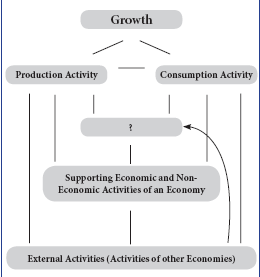
Foreign Activity
Excess Activity
Exchange Activity
Government Activity
25.
Given the chart, find the missing system of economy
Pure Mixed
Capitalist Learning
Mixed Learning
Marxis
26.
Find the missing flow from households to government in the diagram
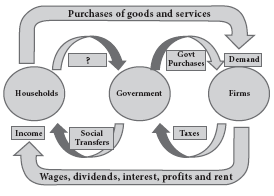
Revenue
Fees
Taxes
None of the above
27.
Find the odd one out
C + I
C + I + G + (X – M)
C + I + G
(X – M)
28.
Identify which of following is not a feature of mixed economy?
Coexistence of Public and Private Sectors
Solution to Economic Problems
Equality of Income
Freedom and Control
29.
Match the items in the List – I with items in List – II. Select the correct answer from the code given below
| List – I | List – II |
|---|---|
| I. Ownership of Means of Production | 1. Free market System |
| II. Economic Motives | 2. Private Ownership |
| III. Solution of Central Problems | 3. Internal Regulation Only |
| IV. Government Role | 4. Profit |
| I | II | III | IV |
| 3 | 2 | 1 | 4 |
| I | II | III | IV |
| 2 | 4 | 1 | 3 |
| I | II | III | IV |
| 2 | 3 | 4 | 1 |
| I | II | III | IV |
| 3 | 4 | 1 | 2 |
30.
Assertion: Planning is an integral part of a Capitalist economy.
Reason: In socialist system, all decisions are undertaken by the central planning authority
Both (A) and (R) are true and (R) is the correct explanation of (A).
Both (A) and (R) are true, but (R) is not the correct explanation of (A)
(A) is true, but (R) is false
(A) is false, but (R) is true
31.
Assertion: The government has a limited role in a capitalistic economy.
Reason: The government provides basic services such as, defense, public health, education, etc.
Both (A) and (R) are true and (R) is the correct explanation of (A).
Both (A) and (R) are true, but (R) is not the correct explanation of (A).
(A) is true, but (R) is false
(A) is false, but (R) is true
32.
Assertion: Each individual and organization produce only those goods which ensure high profit.
Reason: Profit is the driving force behind all economic activities in a capitalistic economy
Both (A) and (R) are true and (R) is the correct explanation of (A).
Both (A) and (R) are true, but (R) is not the correct explanation of (A).
(A) is true, but (R) is false
(A) is false, but (R) is true
33.
Assertion: The term coined by Manfred D Steger (2002) to denote the new market ideology of globalization.
Reason: The ideology connects nations together through international trade and aiming at global development.
Both (A) and (R) are true and (R) is the correct explanation of (A).
Both (A) and (R) are true, but (R) is not the correct explanation of (A).
(A) is true, but (R) is false
(A) is false, but (R) is true.
34.
What shows flows of income, goods and services and factors of production between economic agents such as firms, households, government and nations
Circular Flow
Regular Flow
Cost Flow
Expenditure Flow
35.
Pick basic composition of three sector of model of economy
Y = C + I + G + (X – M)
Y = C + I + G
Y = C + S
Y = C + I
36.
Pick basic composition of three sector of model of economy.
Y = C + I + G + (X – M)
Y = C + I + G
Y = C + S
Y = C + I
37.
Pick basic composition of two sector of model of economy
Y = C + I + G + (X – M)
Y = C + I + G
Y = C + S
Y = C + I
38.
The firm sector generates its _________ by selling goods and services to the household sector.
revenue
sales
expenditure
cost
39.
From the households sectors receives the income?
households sector
government expenditure
external sector
firm sector
40.
How many models of circular flow of economy are there?
One
Three
Five
Two
41.
_______used in economic analysis are classified as stock and flow
Models
Variables
Charts
Equations
42.
Which of the following system leads to leads to frequent violent economic fluctuations and crises?
Free market system
Restricted market system
Black market system
New market system
43.
What is considered as the heart of any capitalistic economy?
Sales mechanism
Price mechanism
Demand mechanism
Exchange mechanism
44.
Identify which is not an example of capitalistic economy.
The USA economy
Germany economy
Indian economy
Australia economy
45.
What is the term coined by Manfred D Steger (2002) to denote the new market ideology of globalisation that connects nations together through international trade and aiming at global development?
Extended Capitalism
Confined Capitalism
Favourable Capitalism
None of above
46.
Identify which is not a part of classification of economy based on Level of National Income
Foreign Income Economies
Low Income Economies
Middle Income Economies
High Income Economies
47.
Identify which is not a part of classification of economy based on System of Activities
Capitalistic Economies
Institutional Economies
Socialistic Economies
Mixed Economies
48.
Identify which is not a part of classification of economy based on Status of Development
Mixed Economy
Developed and underdeveloped economie
Undeveloped economies
Developing economies
49.
How the economy is divided based Nature of Functioning?
Static and Dynamic Economies
Developed and underdeveloped economies
Capitalist and Socialist economics
None of above
50.
Identify which of the following is not an external activity?
import and export
international relations
emigration and immigration
central bank policy
51.
What supports the production and consumption activities?
production activity
consumption activity
distribution activity
exchange activity
52.
Who defined the following statement for an economy? “An economy is a cooperation of producers and workers to make goods and services that satisfy the wants of the consumers".
A.J. Brown
J.R. Hicks
J.S. Mill
J.M. Keynes
53.
Who defined the following statement for an economy? “A system by which people earn their living.”
J.R. Hicks
A.J. Brown
J.S. Mill
J.M. Keynes
54.
The growth and development of an economy and the factors determining them could be understood only through________
macro analysis
micro analysis
positive analysis
rational analysis
55.
Inflation refers to steady ________ in general price level.
decrease
increase
constant
flat
56.
Identify which is not a subject matters covered in Macro Economics
employment
national income
inflation
Profit maximization
57.
Macro economics in its modern form, began with John Maynard Keynes and his book “The General Theory of Employment, Interest and Money” published in______?
1936
1963
1935
1937
58.
Who was the Norwegian economist and co-recipient of the first Nobel Prize?
JM Keynes
JR Hicks
Ragnar Frisch
Adam Smith
59.
The subject Economics is classified into two branches, namely,
Micro Economics and Minor Economics
Micro Economics and Macro Economics
Positive and Normative economics
Deductive and inductive economics
60.
Capitalism leads to ___________.
Central planning
Class struggle
Welfare
All the above
61.
Identify the economic system where all decision are under taken by the central planning authority.
Socialist economy
Globalistic economy
Mixed economy
Capitalistic economy
62.
Identify the economic system where only public ownership of production exists.
Capitalistic economy
Socialistic economy
Globalistic economy
Mixed economy
63.
Identify the stock variable.
Wealth
Income
Foreign exchange
Money
64.
Identify the Father of Scientific Socialism.
Adamsmith
J.M. Keynes
Karl Marx
Marshall
65.
________ is a combination of both capitalism and socialism.
Socialistic economy
Capitalistic economy
Traditional economy
Mixed economy
66.
In addition to household and firms, inclusion of the government sector make this model a ________ model.
Single sector model
Two sector model
Three sector model
Four sector model
67.
_________ sector sells the entire output to house holds.
Firm
House hold
Government
Foreign trade
68.
Non-interference of the state is a characteristic features of the ___________.
Socialist Economy
Capitalist Economy
Traditional Economy
Command Economy
69.
Absence of Price Mechanism is a characteristic feature of the ___________.
Socialist economy
Capitalist economy
Traditional economy
Mixed economy
70.
The right to property exists largely in _______.
Traditional society
Capitalism
Socialism
Mixed economy
71.
Market forces are _________.
Supply and price
Demand and price
Prices of commodity
Supply and demand
72.
Socialist Economy promote __________.
Social welfare motive
Collective welfare motive
Profit motive
Both 'a' and 'b'
73.
Combination of both capitalism and socialism ________.
Capitalist Economy
Traditional Economy
Mixed Economy
Socialist Economy
74.
Example for Mixed Economy ________.
India
France
China
Both 'a' and 'b'
75.
Father of socialism _________.
Adamsmith
J.M. Keynes
Karl Marx
J.R. Hicks
76.
Planned economy is also known as _________.
Capitalist Economy
Socialist Economy
Mixed Economy
All the above
77.
Macro economics is also known as __________.
Price theory
Income theory
Business cycle
Poverty and unemployment
78.
Macro means ________.
Large
Aggregate
Economy as a whole
All the above
79.
Micro means __________.
Large
Big
Small
Both 'a' and 'b'
80.
A steady fall in general price level is termed as ___________.
Deflation
Inflation
Trade
To achieve growth
81.
The Circular Flow Model that represents an open Economy
Two Sector Model
Three Sector Model
Four Sector Model
All the above
82.
Identify the sectors of a Two Sector Model.
Households and Firms
Private and Public
Internal and External
Firms and Government
83.
Identify the flow variable
money supply
assests
income
foreign exchange reserves
84.
Quantity of a commodity accumulated at a point of time is termed as ____________..
production
stock
variable
flow
85.
An economic system where the economic activities of a nation are done both by the private and public together is termed as__________
Capitalistic Economy
Socialistic Economy
Globalisic Economy
Mixed Economy
86.
Identify The Father of Socialism
J M Keynes
Karl Marx
Adam Smith
Samuelson
87.
The country following Capitalism is ________________
Russia
America
India
China
88.
Who is referred as ‘Father of Capitalism’?
Adam Smith
Karl Marx
Thackeray
J M Keynes
89.
Economic system representing equality in distribution is _________.
Capitalism
Globalism
Mixedism
Socialism
90.
Identify the economic system where only private ownership of production exists
Capitalistic Economy
Socialistic Economy
Globalisic Economy
Mixed Economy
91.
An economy consists of
consumption sector
Production sector
Government sector
All the above
92.
Indicate the fundamental economic activities of an economy
Production and Distribution
Production and Exchange
Production and Consumption
Production and Marketing
93.
Identify the necessity of Economic policies
to solve the basic problems
to overcome the obstacles
to achieve growth
all the above
94.
A steady increase in general price level is termed as_____________.
wholesale price index
Business Cycle
Inflation
National Income
95.
96.
Macro economics is a study of_________
individuals
firms
a nation
aggregates
97.
Identify the other name for Macro Economics.
Price Theory
Income Theory
Market Theory
Micro Theory
98.
Who is regarded as Father of Modern Macro Economics?
Adam Smith
J M Keynes
Ragnar Frisch
Karl Marx
99.
100.
The branches of the subject Economics are
Wealth and Welfare
Production and Consumption
Demand and Supply
Micro and Macro
1.
(d)
(1) – (i) (2) – (ii) (3) – (iv) (4) – (iii)
2.
(b)
(1) – (ii) (2) – (iii) (3) – (iv) (4) – (i)
3.
(d)
Aggregate economic phenomena like the rate of unemployment and inflation
4.
(c)
Households are suppliers of resources and consumers of goods and services
5.
(c)
mixed market economy
6.
(a)
economic decisions occur in markets
7.
(a)
more centralized planning in economic decision making
8.
(d)
secularism
9.
(a)
Spending on goods and services flow from firms to households
10.
(b)
Households are sellers in the resource market
11.
(d)
The factors of production are owned by households.
12.
(c)
The determination of product and resource prices is not explained.
13.
(c)
Households are on the selling side of the resource market and on the buying side of the product market
14.
(c)
Circular Flow
15.
(c)
By consumer preferences
16.
(c)
A is true but R is false
17.
(d)
Both A and R are false.
18.
(a)
Both A and R are true and R is the correct explanation of A.
19.
(d)
A is false but R is true
20.
(a)
Both A and R are true and R is the correct explanation of A.
21.
(b)
Both A and R are true but R is not the correct explanation of A
22.
(d)
All of the above are macro economic goals
23.
(c)
Socialistic Economy - Globalism
24.
(c)
Exchange Activity
25.
(b)
Capitalist Learning
26.
(a)
Revenue
27.
(d)
(X – M)
28.
(c)
Equality of Income
29.
(b)
| I | II | III | IV |
| 2 | 4 | 1 | 3 |
30.
(d)
(A) is false, but (R) is true
31.
(b)
Both (A) and (R) are true, but (R) is not the correct explanation of (A).
32.
(a)
Both (A) and (R) are true and (R) is the correct explanation of (A).
33.
(a)
Both (A) and (R) are true and (R) is the correct explanation of (A).
34.
(a)
Circular Flow
35.
(a)
Y = C + I + G + (X – M)
36.
(b)
Y = C + I + G
37.
(d)
Y = C + I
38.
(a)
revenue
39.
(d)
firm sector
40.
(b)
Three
41.
(b)
Variables
42.
(a)
Free market system
43.
(b)
Price mechanism
44.
(c)
Indian economy
45.
(a)
Extended Capitalism
46.
(d)
High Income Economies
47.
(c)
Socialistic Economies
48.
(a)
Mixed Economy
49.
(a)
Static and Dynamic Economies
50.
(d)
central bank policy
51.
(d)
exchange activity
52.
(b)
J.R. Hicks
53.
(b)
A.J. Brown
54.
(a)
macro analysis
55.
(b)
increase
56.
(d)
Profit maximization
57.
(a)
1936
58.
(c)
Ragnar Frisch
59.
(b)
Micro Economics and Macro Economics
60.
(b)
Class struggle
61.
(a)
Socialist economy
62.
(b)
Socialistic economy
63.
(a)
Wealth
64.
(c)
Karl Marx
65.
(d)
Mixed economy
66.
(c)
Three sector model
67.
(a)
Firm
68.
(b)
Capitalist Economy
69.
(a)
Socialist economy
70.
(b)
Capitalism
71.
(d)
Supply and demand
72.
(d)
Both 'a' and 'b'
73.
(c)
Mixed Economy
74.
(d)
Both 'a' and 'b'
75.
(c)
Karl Marx
76.
(b)
Socialist Economy
77.
(b)
Income theory
78.
(d)
All the above
79.
(c)
Small
80.
(a)
Deflation
81.
(c)
Four Sector Model
82.
(a)
Households and Firms
83.
(c)
income
84.
(b)
stock
85.
(d)
Mixed Economy
86.
(b)
Karl Marx
87.
(b)
America
88.
(a)
Adam Smith
89.
(d)
Socialism
90.
(a)
Capitalistic Economy
91.
(d)
All the above
92.
(c)
Production and Consumption
93.
(d)
all the above
94.
(c)
Inflation
95.
(b)
96.
(d)
aggregates
97.
(b)
Income Theory
98.
(b)
J M Keynes
99.
(c)
100.
(d)
Micro and Macro

12th Standard Syllabus & Materials
12th Standard
TN 12th Computer Applications களப்பெயர் முறைமை (DNS) Sample Question Papers Study Material - QB365 Set A
NEW12th Standard
TN 12th Computer Applications வலையமைப்பு எடுத்துக்காட்டுகள் மற்றும் நெறிமுறைகள் Sample Question Papers Study Material - QB365 Set A
NEW12th Standard
TN 12th Computer Applications கணினி வலையமைப்பு ஓர் அறிமுகம் Sample Question Papers Study Material - QB365 Set A
NEW12th Standard
TN 12th Computer Applications PHP-உடன் MySQL-ஐ இணைத்தல் Sample Question Papers Study Material - QB365 Set A



Tamilnadu Stateboard 12th Standard Subjects

Maths

Chemistry

Physics

Biology

Computer Science

Business Maths and Statistics
Economics

Commerce

Accountancy

History

Computer Applications
Biology
Computer Technology
Computer Applications
Computer Science
Business Maths and Statistics
Commerce
Economics
Maths
Chemistry
Physics
Computer Technology
History
Accountancy

Tamil

English

French
Tamilnadu Stateboard Standards
