
12th Standard Syllabus & Materials
12th Standard
TN 12th Tamil செல்வத்துள் எல்லாம் தலை - வாழ்வியல் இலக்கியம் - திருக்குறள் Sample Question Papers Study Material - QB365 Set A
NEW12th Standard
TN 12th Tamil எல்லா உயிரும் தொழும் - இலக்கணம் -தொன்மம் Sample Question Papers Study Material - QB365 Set A
NEW12th Standard
TN 12th Tamil எல்லா உயிரும் தொழும் - செய்யுள்-புறநானுறு Sample Question Papers Study Material - QB365 Set A
NEW12th Standard
TN 12th Tamil நாடு சமூகம் திருவாகம் மனிதம் - உரைநடை உலகம் -இலக்கியத்தில் மேலாண்மை Sample Question Papers Study Material - QB365 Set A
NEW12th Standard
TN 12th Tamil அருமை உடைய செயல் -இலக்கணம் -படைப்பாக்க உத்திகள் Sample Question Papers Study Material - QB365 Set A
NEW12th Standard
TN 12th Tamil அருமை உடைய செயல் - துணைப்பாடம் -நடிகர் திலகம் Sample Question Papers Study Material - QB365 Set A

Published on: 22/08/2026
Download Tamil Nadu 12th Standard Accountancy question papers, model tests, one-mark questions, important questions, and public exam papers in PDF format. Free study materials and answer keys for TN State Board students.
Questions + Answers key
Take MCQ Accountancy Test
1.
Praveena and Dhanya are partners sharing profits in the ratio of 7:3. They admit Malini into the firm. The new ratio among Praveena, Dhanya and Malini is 5:2:3. Calculate the sacrificing ratio.
2.
Anjali and Nithya are partners of a firm sharing profits and losses in the ratio of 5:3. They admit Pramila on 1.1.2018. On that date, their balance sheet showed accumulated loss of Rs. 40,000 on the asset side of the balance sheet. Give the journal entry to transfer the accumulated loss on admission.
3.
Vimal and Athi are partners sharing profits in the ratio of 2:1. Jeyam is admitted for 1/4 share in the profits. Calculate the new profit sharing ratio and sacrificing ratio.
4.
What is gaining ratio?
5.
Calculate quick ratio of Ananth Constructions Ltd from the information given below.
| Particulars | Rs. |
|---|---|
| Total current liabilities | 1,00,000 |
| Total current assets | 2,50,000 |
| Inventories | 50,000 |
| Prepaid expenses | 15,000 |
6.
Why are the shares forfeited?
7.
What is meant by calls in arrear?
8.
What is over-subscription?
9.
From the following particulars of Maria Ltd. and Kala Ltd. prepare a common-size income statement for the year ended 31st March, 2019.
| Particulars | Maria Ltd | Kala Ltd |
|---|---|---|
| Rs | Rs. | |
| Revenue from operations | 1,00,000 | 2,00,000 |
| Other income | 10,000 | 30,000 |
| Expenses | 70,000 | 1,20,000 |
Maria Ltd: Other income: 10%; Total revenue: 110%; Expenses: 70%; Profit before tax: 40%
Kala Ltd: Other income: 15%; Total revenue: 115%; Expenses: 60%; Profit before tax: 55%)
10.
Prepare common-size income statement for the following particulars of Raja Ltd. for the year ended 31st March, 2017
| Particulars | 2016-17 |
|---|---|
| Rs. | |
| Revenue from operations | 4,50,000 |
| Other income | 67,500 |
| Expenses | 1,35,000 |
11.
From the following particulars, prepare comparative income statement of Daniel Ltd.
| Particulars |
2015-16 |
2016-17 Rs. |
|---|---|---|
| Revenue from operations | 40,000 | 50,000 |
| Operating expenses | 25,000 | 27,500 |
| Income tax (% of the profit before tax) | 30 | 30 |
12.
Suresh, Senthamarai and Raj were partners in a firm sharing profits and losses in the ratio of 3:2:1. Suresh retired from partnership. The goodwill of the firm on the date of retirement was valued at Rs. 36,000. Pass necessary journal entries for goodwill on the assumption that the fluctuating capital system is followed.
13.
Rahul, Ravi and Rohit are partners sharing profits and losses in the ratio of 5:3:2. Rohit retires and the share is taken by Rahul and Ravi in the ratio of 3:2. Find out the new profit sharing ratio and gaining ratio.
14.
What does return on investment ratio indicate?
15.
What is quick ratio?
16.
What is a group in Tally ERP 9?
17.
18.
What is super profit?
19.
What is goodwill?
20.
21.
The following is the balance sheet of James and Justina as on 1.1.2017. They share the profits and losses equally.
| Liabilities | Rs. | Rs. | Assets | Rs. |
|---|---|---|---|---|
| Capital accounts: | Buildings | 70,000 | ||
| James | 40,000 | Stock | 30,000 | |
| Justina | 50,000 | 90,000 | Debtors | 20,000 |
| Creditors | 30,000 | Bank | 15,000 | |
| Reserve fund | 15,000 | Prepaid insurance | 5,000 | |
| 1,40,000 | 1,40,000 |
On the above date, Balan is admitted as a partner with 1/5 share in future profits. Following are the terms for his admission:
(i) Balan brings Rs. 25,000 as capital.
(ii) His share of goodwill is Rs. 10, 000 and he brings cash for it.
(iii) The assets are to be valued as under:
Building Rs.80, 000; Debtors Rs. 18,000; Stock Rs. 33,000
Prepare necessary ledger accounts and the balance sheet after admission.
22.
Roja, Neela and Kanaga are partners sharing profits and losses in the ratio of 4:3:3. On 1st April 2017, Roja retires and on retirement, the following adjustments are agreed upon.
(i) Increase the value of building by Rs. 30,000.
(ii) Depreciate stock by Rs. 5,000 and furniture by Rs. 12,000.
(iii) Provide an outstanding liability of Rs. 1,000
Pass journal entries and prepare revaluation account.
23.
United Industries Ltd. issued shares of Rs.10 each at 10% premium payable Rs.3 on application, Rs.4 on allotment (including premium), Rs.2 on first call and Rs.2 on second and final call.
Journalise the transactions relating to forfeiture of shares for the following situations:
(i) Manoj who holds 250 shares failed to pay the second and final call and his shares were forfeited.
(ii) Manoj who holds 250 shares failed to pay the allotment money and first call and second and final call and his shares were forfeited.
(iii) Manoj who holds 250 shares failed to pay the allotment money and first call money and his shares were forfeited after the first call.
24.
Calculate operating profit ratio under the following cases.
Case 1: Revenue from operations Rs. 8,00,000, Operating profit Rs. 2,00,000.
Case 2: Revenue from operations Rs. 20,00,000, Operating cost Rs. 14,00,000.
Case 3: Revenue from operations Rs. 10,00,000, Gross profit 25% on revenue from operations, Operating expenses Rs. 1,00,000.
25.
Prepare common-size balance sheet of Maria Ltd. as on 31st March, 2018.
| Particulars | 31st March 2018 |
|---|---|
| Rs. | |
| I EQUITY AND LIABILITIES | |
| Shareholders’ funds | 4,00,000 |
| Non-current liabilities | 3,20,000 |
| Current liabilities | 80,000 |
| Total | 8,00,000 |
| II ASSETS | |
| Non-current assets | 6,00,000 |
| Current assets | 2,00,000 |
| Total | 8,00,000 |
26.
The following balance sheet has been prepared from the books of Pearl on 1-4-2018.
| Liabilities | Rs. | Assets | Rs. |
|---|---|---|---|
| Capital | 2,26,000 | Buildings | 1,00,000 |
| Sundry creditors: | Furniture | 10,000 | |
| Maya A/c | 24,000 | Stock | 20,000 |
| Sundry debtors | |||
| Peter | 50,000 | ||
| Cash in hand | 15,000 | ||
| Cash at bank | 55,000 | ||
| 2,50,000 | 2,50,000 |
During the year the following transactions took place.
(a) Wages paid by cash Rs. 2,000
(b) Salaries paid by cheque Rs. 5,000
(c) Cash purchases made for Rs. 3,000
(d) Good purchased on credit from Yazhini Rs. 15,000
(e) Goods sold on credit to Jothi Rs. 25,000
(f) Payment made to Yazhini through NEFT Rs. 5,000
(g) Cash received from Peter Rs. 30,000
(h) Cash sales made for Rs. 6,000
(i) Depreciate buildings at 10%
(j) Closing stock on 31.03.2019 Rs. 15,000
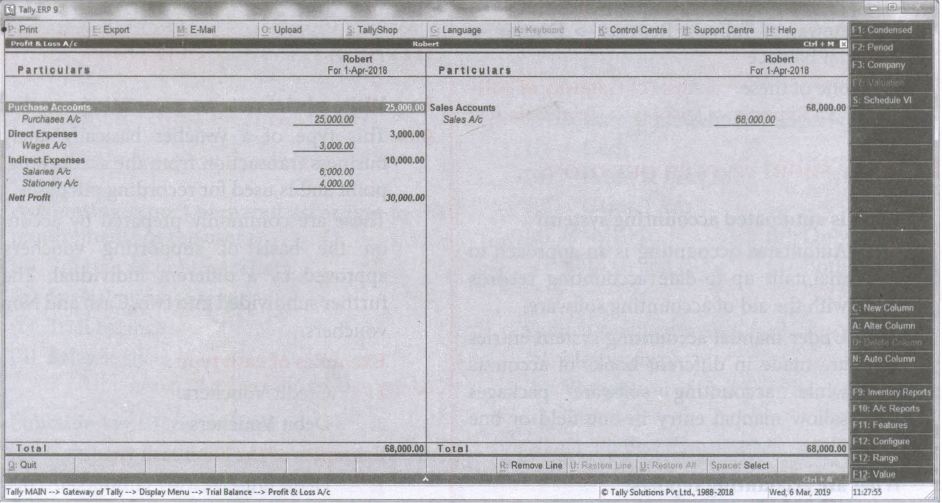
You are required to prepare trading and profit and loss account for the year ended 31-03-2019 and a balance sheet as on that date using Tally.
27.
The following particulars are available in respect of the business carried on by a partnership firm:
(i) Profits earned: 2016: Rs. 25,000; 2017: Rs. 23,000 and 2018: Rs. 26,000.
(ii) Profit of 2016 includes a non-recurring income of Rs. 2,500.
(iii) Profit of 2017 is reduced by Rs. 3,500 due to stock destroyed by fire.
(iv) The stock was not insured. But, it is decided to insure the stock in future. The insurance premium is estimated to be Rs. 250 per annum.
You are required to calculate the value of goodwill of the firm on the basis of 2 years purchase of average profits of the last three years.
28.
James and Kamal are sharing profits and losses in the ratio of 5:3. They admit Sunil as a partner giving him 1/5 share of profits. Find out the sacrificing ratio.
1:3
3:1
5:3
3:5
29.
If the old profit sharing ratio is more than the new profit sharing ratio of a partner, the difference is called
Capital ratio
Sacrificing ratio
Gaining ratio
None of these
30.
Revaluation A/c is a
Real A/c
Nominal A/c
Personal A/c
Impersonal A/c
31.
32.
At the time of retirement of a partner, determination of gaining ratio is required
To transfer revaluation profit or loss
To distribute accumulated profits and losses
To adjust goodwill
None of these
33.
On retirement of a partner from a partnership firm, accumulated profits and losses are distributed to the partners in the
New profit sharing ratio
Old profit sharing ratio
Gaining ratio
Sacrificing ratio
34.
In a common-size balance sheet, if the percentage of non-current assets is 75, what would be the percentage of current assets?
175
125
25
100
35.
Which of the following statements is not true?
All the limitations of financial statements are applicable to financial statement analysis also.
Financial statement analysis is only the means and not an end.
Expert knowledge is not required in analysing the financial statements
Interpretation of the analysed data involves personal judgement
36.
The term ‘fund’ refers to
Current liabilities
Working capital
Fixed assets
Non-current assets
37.
Supreme Ltd. forfeited 100 shares of Rs.10 each for non-payment of final call of Rs.2 per share. All these shares were re-issued at Rs.9 per share. What amount will be transferred to capital reserve account?
Rs.700
Rs.800
Rs.900
Rs.1,000
38.
If a share of Rs.10 on which Rs.8 has been paid up is forfeited. Minimum reissue price is
Rs.10 per share
Rs.8 per share
Rs.5 per share
Rs.2 per share
39.
A preference share is one
(i) which carries preferential right with respect to payment of dividend at fixed rate
(ii) which carries preferential right with respect to repayment of capital on winding up
Only (i) is correct
Only (ii) is correct
Both (i) and (ii) are correct
Both (i) and (ii) are incorrect
40.
Cost of revenue from operations Rs. 3,00,000; Inventory in the beginning of the year Rs. 60,000; Inventory at the close of the year Rs. 40,000. Inventory turnover ratio is
2 times
3 times
6 times
8 times
41.
To test the liquidity of a concern, which of the following ratios are useful?
(i) Quick ratio
(ii) Net profit ratio
(iii) Debt-equity ratio
(iv) Current ratio
Select the correct answer using the codes given below:
(i) and (ii)
(i) and (iv)
(ii) and (iii)
(ii) and (iv)
42.
43.
In which voucher type credit purchase of furniture is recorded in Tally
Receipt voucher
Journal voucher
Purchase voucher
Payment voucher
44.
Rs. 25,000 withdrawn from bank for office use. In which voucher type, this transaction will be recorded?
Contra Voucher
Receipt Voucher
Payment Voucher
Sales Voucher
45.
Salary account comes under which of the following head?
Direct Incomes
Direct Expenses
Indirect Incomes
Indirect Expenses
46.
47.
Super profit is the difference between
Capital employed and average profit
Assets and liabilities
Average profit and normal profit
Current year’s profit and average profit
48.
Varun and Barath are partners sharing profits and losses 5:4. They admit Dhamu into partnership. The new profit sharing ratio is agreed at 1:1:1. Dhamu’s share of goodwill is valued at Rs. 15,000 of which he pays Rs .10,000 in cash. Pass necessary journal entries for adjustment of goodwill on the assumption that the fluctuating capital method is followed.
49.
From the following information, calculate debt equity ratio:
| Particulars | Rs. |
|---|---|
| I EQUITY AND LIABILITIES | |
| 1. Shareholders' funds | |
| (a) Share capital | |
| Equity share capital | 1,00,000 |
| (b) Reserves and surplus | 60,000 |
| 2. Non-current liabilities | |
| Long-term borrowings (Debentures) | 80,000 |
| 3. Current liabilities | |
| (a) Trade payables | 50,000 |
| (b) Other current liabilities | |
| Outstanding expenses | 30,000 |
| Total | 3,20,000 |
50.
Rathna, Baskar and Ibrahim are partners sharing profits and losses in the ratio of 2:3:4 respectively. Rathna died on 31st December, 2018. Final amount due to her showed a credit balance of Rs. 1,00,000. Pass journal entries if,
(a) The amount due is paid off immediately by cheque.
(b) The amount due is not paid immediately.
(c) Rs. 60,000 is paid immediately by cheque.
51.
From the following particulars, calculate the Trend percentages of Kavitha Ltd.
| Particulars | Rs.in thousands | ||
|---|---|---|---|
| 2015-16 | 2016-17 | 2017-18 | |
| Revenue from operations | 100 | 125 | 150 |
| Other income | 20 | 25 | 30 |
| Expenses | 100 | 120 | 80 |
| Income tax | 30% | 30% | 30% |
52.
Lakshith was holding 50 shares of Rs.10 each on which he paid Rs.2 on application but could not pay Rs.4 on allotment and Rs.2 on first call. Directors forfeited the shares after the first call. Give journal entry for recording the forfeiture of shares.
53.
54.
From the following information, find out the value of goodwill by capitalisation method:
(i) Average profit Rs. 20,000
(ii) Normal rate of return 10%
(iii) Capital employed Rs. 1,50,000
1.
Old ratio of Praveena and Dhanya = 7:3 that is \(\frac{7}{10}:\frac{3}{10}\)
New ratio of Paveena, Dhanya and Malini = 5:2:3 that is, \(\frac{5}{10};\frac{2}{10};\frac{3}{10}\)
Share sacrificed = Old share - New share
Praveena \(=\frac { 7 }{ 10 } -\frac { 5 }{ 10 } =\frac { 7-5 }{ 10 } =\frac { 2 }{ 10 } \)
Dhanya \(=\frac { 3 }{ 10 } -\frac { 2 }{ 10 } =\frac { 3-2 }{ 10 } =\frac { 1 }{ 10 } \)
Sacrificing ratio ofPraveena and Dhanya is \(\frac { 2 }{ 10 } :\frac { 1 }{ 10 } \) that is 2:1
2.
| Date | Particulars | L.F | Debit Rs. |
Credit Rs. |
|---|---|---|---|---|
| 2018 January 1 | Anjali's capital A/c (40,000\(\times\)5/8) Dr | 25,000 | ||
| Nithya's capital A/c (40,000 \(\times\) 3/8) Dr | 15,000 | |||
| To Profit and loss A/c | 40,000 | |||
| (Accumulated loss transferred to old partner's capital account in the old profit sharing ratio) |
3.
Computation of sacrificing ratio and new profit sharing ratio:
Since share sacrificed, proportion of share sacrificed and new profit sharing ratio are not given, it is assumed that the existing partners sacrifice in their old profit sharing ratio, that is, 2:1. Sacrificing ratio of Vimal and Athi is 2:1
Let the total share be 1
Jeyam’s share = \(\frac { 1 }{ 4 } \)
Remaining share = \(1-\frac { 1 }{ 4 } =\frac { 4-1 }{ 4 } \)
= \(\frac { 3 }{ 4 } \)
New share of old partners = Remaining share × Old share
Vimal = \(\frac { 3 }{ 4 } \times \frac { 2 }{ 3 } =\frac { 6 }{ 12 } \)
Athi = \(\frac { 3 }{ 4 } \times \frac { 1 }{ 3 } =\frac { 3 }{ 12 } \)
Share of new partner Jeyam = \(\frac { 1 }{ 4 } \)
In order to equalise the denominator, multiply and divide by 3
Jeyam’s share = \(\frac { 1 }{ 4 } \times \frac { 3 }{ 3 } =\frac { 3 }{ 12 } \)
New profit sharing ratio of Vimal, Athi and Jeyam = \(\frac { 6 }{ 12 } :\frac { 3 }{ 12 } :\frac { 3 }{ 12 } \) that is, 2 : 1 : 1.
4.
Gaining Ratio is the proportion of the profit which is gained by the continuing partner.
Gaining ratio = Ratio of share gained by the Conitinuing partners.
Share gained = New share - Old share
5.
Quick ratio = \(\frac{Quick\ assets}{Current\ liabilities}\) = \(\frac{1,85,000}{1,00,000}\) = 1.85:1
Quick assets = Current assets – Inventories – Prepaid expenses
= 2,50,000 – 50,000 – 15,000
= Rs.1,85,000
6.
When a shareholder defaults in making payment of allotment andlor call money, the shares may be forfeited. On forfeiture, the share allotment is cancelled and to that extent paid up share capital a reduced. The person ceases to be a shareholder of the company after the shares are forfeited.
7.
When a shareholder fails to pay the amount due on allotment or on calls, the amount remaining unpaid is known a calls in arrears. In other words, the amount called up but not paid is calls in arrear.
8.
When the number of shares applied for is more than the number of shares offered for subscription, it is said to be over subscription.
9.
| Particulars | Maria Ltd | Kala Ltd | ||
|---|---|---|---|---|
| Absolute amount |
Percentage of revenue from operations |
Absolute amount |
Percentage of revenue from operations |
|
| Rs. | Rs. | Rs. | ||
| Revenue from Operations | 1,00,000 | 100 | 2,00,000 | 100 |
| Add: Other income | 10,000 | 10 | 30,000 | 15 |
| 1,10,000 | 110 | 2,30,000 | 115 | |
| Less: Expenses | 70,000 | 70 | 1,20,000 | 60 |
| Profit before tax | 40,000 | 40 | 1,10,000 | 55 |
Note: In Maria Ltd:
Computation of percentage for other income = \(\frac{10,000}{1,00,000}\) x 100 = 10%
Percentage for Expenses = \(\frac{70,000}{1,00,000}\) x 100 = 70%
Percentage for before tax = \(\frac{40,000}{1,00,000}\) x 100 = 40%
In Kala Ltd:
Percentage for other income \(\frac{30,000}{2,00,000}\) x 100 = 15%
Percentage for Expenses = \(\frac{1,20,000}{2,00,000}\) x 100 = 60%
Percentage for profit before tax = \(\frac{1,10,000}{2,00,000}\) x 100 = 55%
10.
| Particulars | Absolute amount Rs. | Percentage of revenue from operations |
|---|---|---|
| Revenue from Operations | 4,50,000 | 100 |
| Add: Other income | 67,500 | 15 |
| Total revenue | 5,17,500 | 115 |
| Less: Expenses | 1,35,000 | 30 |
| Profit before tax | 3,82,500 | 85 |
Note:
Computation of percentage for other income = \(\frac{67,500}{4,50,00}\times\) = 15
Percentage for Total revenue = \(\frac{5,17,500}{4,50,000}\times100\) = 115%
Percentage for Expenses = \(\frac{1,35,000}{4,50,000}\times\)100 = 30%
Percentage for Profit before tax = \(\frac{3,82,500}{4,50,000}\) x 100 = 85%
11.
| Particulars | 2015-16 Rs. | 2016-17 Rs. | Absolute amount of increase (+) or decrease (-) Rs. |
Percentage increase (+) or decrease (-) |
|---|---|---|---|---|
| Revenue from Operations | 40,000 | 50,000 | + 10,000 | + 25 |
| Less: Operating expenses | 25,000 | 27,500 | + 2,500 | + 10 |
| Profit before tax | 15,000 | 22,500 | + 7,500 | + 50 |
| Less: Income tax | 4,500 | 6750 | + 2,250 | + 50 |
| Profit after tax | 10,500 | 15,750 | + 5,250 | + 50 |
Note:
Percentage increase for revenue from operations = \(\frac{10,000}{40,000}\) x 100 = 25%
Percentage increase for operating expenses = \(\frac{2,500}{25,000}\) x 100 = 10%
Percentage increase for profit before tax = \(\frac{7,500}{15,000}\) x 100 = 50%
Percentage increase for income for Income tax = \(\frac{2250}{4500}\) x 100 = 50%
Percentage increase for profit after tax = \(\frac{5250}{10,500}\) x 100 = 50%
12.
As the new profit sharing ratio and gain made by the continuing partners is not mentioned, it is assumed that they gain in their old profit sharing ratio of 2:1. Therefore, gaining ratio is 2:1.
Suresh’s share of goodwill \(=36000\times\frac{3}{6}=Rs.18000\)
| Date | Particulars | L.f | Debit Rs. |
Credit Rs. |
|
|---|---|---|---|---|---|
| Senthamari’s capital A/c (18,000 × 2/3) | Dr. | 12,000 | |||
| Raj’s capital A/c (18,000 × 1/3) | Dr. | 6,000 | |||
| To Suresh’s capital A/c | 18,000 | ||||
| (Suresh’s share of goodwill adjusted) |
13.
Rohit's share \(\frac{2}{10}\)
Share gained = Retiring partner’s share × Proportion of share gained
Rahul = \(\frac{2}{10}\times\frac{3}{5}=\frac{6}{50}\)
Ravi = \(\frac{2}{10}\times\frac{2}{5}=\frac{4}{50}\)
Gaining ratio \(\frac{6}{50}:\frac{4}{50}\) that is, 3 : 2
New share of continuing partners = Old share + Share gained
Rahul \(=\frac{5}{10}+\frac{6}{50}=\frac{25+6}{50}=\frac{31}{50}\)
Ravi \(=\frac{3}{10}+{4}{50}=\frac{15+4}{50}=\frac{19}{50}\)
The new profit sharing ratio of Rahul and Ravi is \(\frac{31}{50}:\frac{19}{50}\) that is 31 : 19.
14.
(i) Return on investment shows the proportion of net profit. before interest and tax to capital employed (shareholders' funds and long term debts).
(ii) This ratio measures how efficiently the capital employed is used in the business.
(iii) It is an overall measure of profitability of a business concern.
(iv) It is computed as below: Return on Investment (ROI)
= \(\frac { Net\ profit\ before\ interest\ and\ tax }{ Capital\ employed } \) x 100
Capital employed = Share holder's fund + Non currebt liablities greater the return on investment better is the profitability of a business and vice versa
15.
(i) Quick ratio gives the proportion of quick assets to current liabilities.
(ii) It indicates whether the business concern is in a position to pay its current liabilities as and when they become due, out of its quick assets.
(iii) It is otherwise called liquid ratio or acid test ratio.
(iv) It is calculated as follows:
Quick ratio = \(\frac { Quick\ assets }{ Current\ liabilities } \).
Quick assets = Current assets - Inventries - prepaid expenses. higher the Quick ratio better is the short - term financial position of an enterprises.
16.
Group is a collection of ledgers of the same nature. There are predefined groups of accounts which are widely used in accounts of many orgaisation groups are categorised as primary group and sub - groups.
17.
18.
Super profit is the excess of average profit over the normal profit. Average profit is calculated by dividing the total adjusted actual profit of certain number of years by the total number of such years. Normal profit is the profit earned by the similar business, firms under normal conditions.
Normal profit = Capital employed \(\times\) Normal rate of return.
Capital employed = Fixed assets + Current assets - Current liabilities.
19.
Goodwill is the good name or reputation of the business which brings benefit to the business. It enables the business to earn more profit. It is the present value of a firm's future excess earnings. It is an intangible asset as it has no physical existence.
20.
21.
| Particulars | Rs | Rs | Particulars | Rs |
|---|---|---|---|---|
| To Deptors A/c | 2000 | By Building A/C | 10,000 | |
| To profit revaluaion | By Stock Ale | 3,000 | ||
| to transferred | ||||
| Jame's capital A/c | 5,500 | |||
| Justona's capital a/c | 5,500 | 11,000 | ||
| 13,000 | 13,000 |
| Particulars | James Rs |
Justina Rs |
Balan Rs |
Particulars |
James Rs |
Justina Rs |
Balan Rs |
|---|---|---|---|---|---|---|---|
| To Balance c/d | 58,000 | 68,000 | 25,000 | By Balance b/d | 40,000 | 50,000 | - |
| By Reserve fund A/c | 7,500 | 7,500 | - | ||||
| By Bank Ale | - | - | 25,000 | ||||
| By Revaluation AI | 5,500 | 5,500 | - | ||||
| By Bank A/c share of good will | 5,000 | 5,000 | - | ||||
| 58,000 | 68,000 | 25,000 | 58,000 | 68,000 | 25,000 | ||
| By Balance bid | 58,000 | 68,000 | 25,000 |
| Particulars | Rs | Particulars | Rs |
|---|---|---|---|
| To Balance b/d | 15,000 | By Balance c/d | 50,000 |
| To Balan's capital A/c | 25,000 | ||
| To Jame's capital A/c | 5,000 | ||
| To Justina's capital A/c | 5,000 | ||
| 50,000 | 50,000 |
| Liabilities | Rs | Rs | Assets | Rs | Rs |
|---|---|---|---|---|---|
| Capital Account | Building | 70,000 | |||
| James's A/c | 58,000 | Add: Appreciation | 10,000 | 80,000 | |
| Justina A/c | 68,000 | Stock | 30,000 | ||
| Balan A/c | 25,000 | 1,51,000 | Less: Appreciation | 3,000 | 33,000 |
| Creditors | 35,000 | Debtors | 20,000 | ||
| Less: Undervalued | 2,000 | 18,000 | |||
| Bank | 50,000 | ||||
| Prepaid insurance | 5,000 | ||||
| 1,86,000 | 1,86,000 |
22.
| Date | Particulars | L.F | Debit Rs |
Credit Rs |
|
|---|---|---|---|---|---|
| 2017 | Building A/c | Dr | 30,000 | ||
| April 1 | To Revaluation A/c | 30,000 | |||
| (Value of building inreased) | |||||
| 2017 | Revaluation A/c | Dr | 18,000 | ||
| April1 | To Stock A/c | 5,000 | |||
| To Furniture A/c | 12,000 | ||||
| To Outstanding liability A/c | 1,000 | ||||
| (Decrease in value of assets and outstanding liability recorded | |||||
| 2017 | Revaluation A/c | Dr | 12,000 | ||
| April1 | To Roja's capital A/c | 4,800 | |||
| To Neela's capital A/c | 3,600 | ||||
| To Kanaga's capital A/c | 3,600 | ||||
| (profit on recaluation distributed) |
| Particulars | Rs | Rs | Particulars | Rs |
|---|---|---|---|---|
| To Stock A/c | 5,000 | By Building A/c | 30,000 | |
| To Furniture A/c | 12,000 | |||
| To Outstanding liability A/c | 1,000 | |||
| To Profit on revaluation transferred to | ||||
| Roja's capital A/c | 4,800 | |||
| Neela's capital A/c | 3,600 | |||
| Kanaga's capital A/c | 3,600 | |||
| 12,000 | ||||
| 30,000 | 30,000 | |||
23.
(i) When final call money is not paid.
| Date | Particulars | L.F. | Debit Rs. | Credit Rs. | |
|---|---|---|---|---|---|
| Equity Share capital A/c (250 x 10) | Dr | 2,500 | |||
| To Equity Share second and final call A/c (250 x 2) | 500 | ||||
| To Forfeited shares A/c (250 x 8) | 2,000 | ||||
| (250 Shares forfeited) |
Since the premium amount is received by the company, premium should not be cancelled.
(ii) When allotment, first call money and second and final call money is not paid.
| Date | Particulars | L.F. | Debit Rs. | Credit Rs. | |
|---|---|---|---|---|---|
| Share capital A/c (250 x 10) | Dr | 2,500 | |||
| Share premium A/c (250 x 1) | Dr | 250 | |||
| To Share allotment A/c (250 x 4) | 1,000 | ||||
| To Share first call A/c (250 x 2) | 500 | ||||
| To Share Second and final call A/c (250 x 2) | 500 | ||||
| To Shares Forfeited A/c (250 x 3) | 750 | ||||
| (250 Shares Forfeited) |
(iii) When allotment and first call money is not paid.
| Date | Particulars | L.F. | Debit Rs. | Credit Rs. | |
|---|---|---|---|---|---|
| Share capital A/c (250 x 8) | Dr | 2,000 | |||
| Share premium A/c (250 x 1) | Dr | 250 | |||
| To Share allotment A/c (250 x 4) | 1,000 | ||||
| To Share first call A/c (250 x 2) | 500 | ||||
| To Shares Forfeited A/c (250 x 3) | 750 | ||||
| (250 Shares Forfeited) |
24.
Case 1: Operating profit ratio = \(\frac { Operating\ profit }{ Revenue\ from\ operations } \) \(\times\) 100
=\(\frac { 2,00,000 }{ 8,00,000 } \) \(\times\) 100 = 25%
Case 2: Operating profit ratio = \(\frac { Operating\ profit }{ Revenue\ from\ operations } \) \(\times\) 100
Operating profit = Revenue from operations - Operating Cost
= Rs.20,00,000 - 14,00,000 = Rs.6,00,000
∴ Operating profit ratio = \(\frac { 6,00,000 }{ 20,00,000 } \) \(\times\) 100 = 30%
Case 3: Operating profit ratio = \(\frac { Operating\ profit }{ Revenue\ from\ operations } \) \(\times\) 100
Operating profit = Gross profit - Operating expenses
Gross profit = 25% of 10,00,000 = Rs.2,50,000
Operating profit = 2,50,000 - 1,00,000 = Rs.1,50,000
∴ Operating profit ratio = \(\frac { 1,50,000 }{ 10,00,000 } \) \(\times\) 100 = 15%
25.
| Particulars | Absolute amount | Percentage of total assets |
| Rs. | ||
| I EQUITY AND LIABILITIES | ||
| Shareholders’ funds | 4,00,000 | 50 |
| Non-current liabilities | 3,20,000 | 40 |
| Current liabilities | 80,000 | 10 |
| Total | 8,00,000 | 100 |
| II ASSETS | ||
| Non-current assets | 6,00,000 | 75 |
| Current assets | 2,00,000 | 25 |
| Total | 8,00,000 | 100 |
26.
Following steps are to be followed to enter the transactions in Tally ERP 9
1. To create company:
Company Info > Create Company
Type the Name as Peral and keep all other fields as they are and choose 'Yes' to accept.
2. To maintain accounts only:
Gateway of Tally > F11 Accounting Features > General > Maintain accounts only: Yes > Accept Yes
3. To create ledger accounts with opening balances:
Gateway of Tally > Masters > Accounts Info> Ledgers> Single Ledger> Create
| Creation of | Name | Under | Opening balance | Accept |
|---|---|---|---|---|
| Bright’s Capital A/c | Bright’s Capital A/c | Capital Account | 2,26,000 | Yes |
| Ramesh A/c (Sundry creditors) | Ramesh A/c | Sundry Creditors | 24,000 | Yes |
| Machinery A/c | Machinery A/c | Fixed Assets | 1,00,000 | Yes |
| Furnitures A/c | Furnitures A/c | Fixed Assets | 10,000 | Yes |
| Opening stock | Opening stock | Stock-in -Hand | 20,000 | Yes |
| Shankar A/c (Sundry debtors) | Shankar A/c | Sundry Debtors | 50,000 | Yes |
| Cash in hand | Cash | Cash-in-Hand | 15,000 | Yes |
| Cast at bank | Bank | Bank Accounts | 55,000 | Yes |
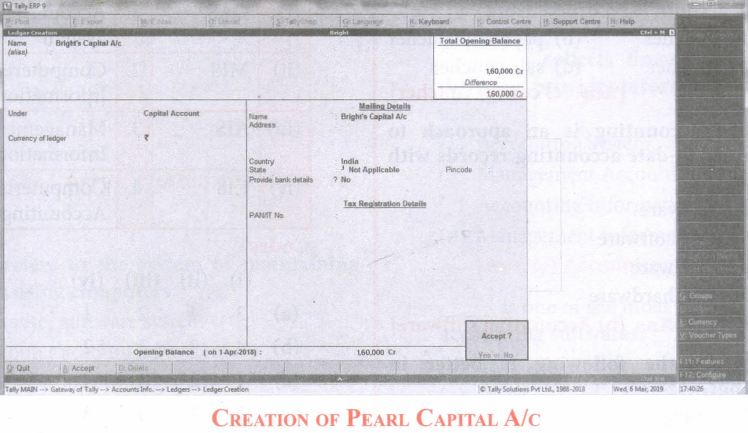
Note:
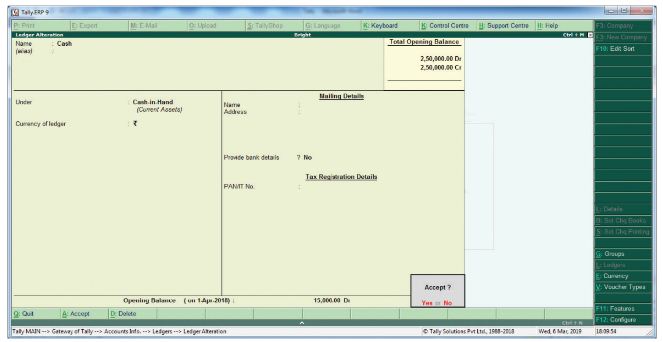
Cash account need not be created as it is a default ledger. Only the opening balance has to be recorded by altering the cash account.
To record the opening balance of Cash
Gateway of Tally > Masters > Accounts Info > Ledgers > Single Ledger > Alter
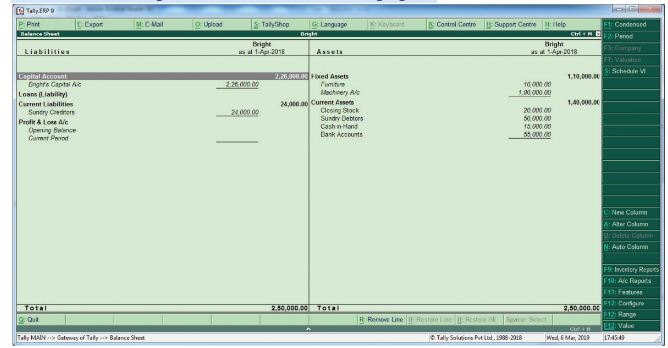
After creating the ledgers and recording the opening balances of ledger accounts the balance sheet of Bright is shown as in the following figure:
4. To create ledger accounts for transactions
| Creation of | Name | Under | Accept |
| Wages A/c | Wages A/c | Direct Expenses | Yes |
| Salaries A/c | Rent A/c | Indirect Expenses | Yes |
| Purchases A/c | Purchases A/c | Purchases Account | Yes |
| Senthamarai A/c | Senthamarai A/c | Sundry Creditors A/c | Yes |
| Sales A/c | Sales A/c | Sales Account | Yes |
| Pushparaj A/c | Pushparaj A/c | Sundry Debtors A/c | Yes |
| Depreciation A/c | Depreciation A/c | Indirect Expenses | Yes |
5. To enter transactions through vouchers
Gateway of Tally > Transactions > Accounting Vouchers
Example: Wages of Rs. 2,000 paid by Cash
F5: Payment Voucher
Account: Cash
Particulars: Wages A/c
Amount: Rs. 2,000
Narration: Wages paid by cash
Accept: Yes
In the similar way, record the other transactions. Use Payment Voucher for Salaries paid and payment to Senthamarai.
Use Purchase Voucher for credit purchases from Senthamarai and cash purchases.
Use Sales Voucher for credit sales to Pushparaj and cash sales.
Use Receipt Voucher for cash received from Shankar.
Use Journal Voucher for depreciation.
To record closing stock:
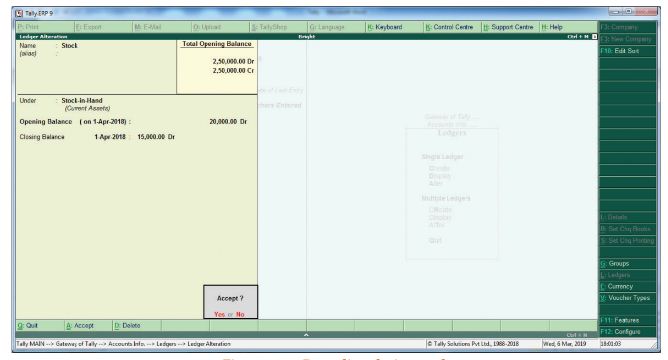
Since maintain accounts only is set to 'Yes' and integrate accounts and inventory is set to "No" under accounting features. Stock has to be recorded manually. Hence the closing stock has to be recorded by altering the stock account and while entering the data of closing stock, the date of opening stock has to be entered. The following procedure is to be followed:
Gateway of Tally > Masters > Accounts Info > Ledgers > Single Ledger > Alter > Stock > Closing balance > Date (opening date) > Amount > Accept Yes
6. To view reports:
(i) To view Profit and Loss Account:
F10: A/c Reports > Profit & Loss A/c > Alt + F1 (detailed) (or)
Gateway of Tally > Report > Profit & Loss A/c > Alt + F1 (detailed)
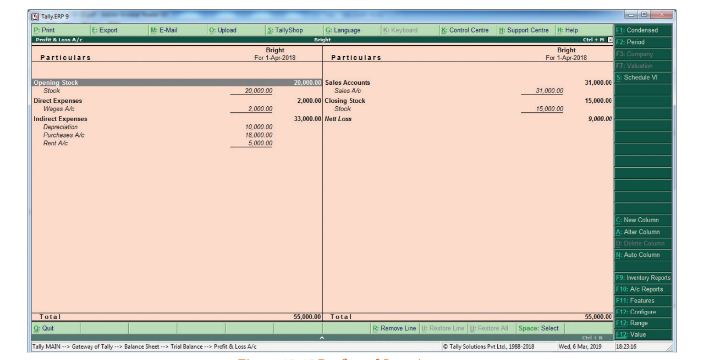
(ii) To view Balance sheet:
F10: A/c Reports > Balance sheet > Alt + F1 (detailed) (or)
Gateway of Tally > Reports > Balance Sheet > Alt + F1 (detailed)
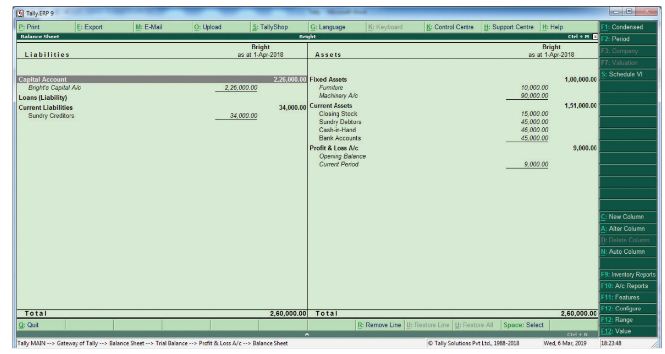
27.
| Particulars | 2016 Rs. | 2017 Rs. | 2018 Rs. |
|---|---|---|---|
| Profit | 25,000 | 23,000 | 26,000 |
| Less: Non -recurring income | 2,500 | - | - |
| 22,500 | 23,000 | 26,000 | |
| Add: Stock destroyed by fire (abnormal loss) | - | 3,500 | - |
| Profit after adjustments | 1,30,000 | 1,20,000 | 2,30,000 |
Average profit \(=\frac{Total\ profit}{Number\ of\ years}\)
\(=\frac{22,000+26,000+26,000}{3}\)
\(=\frac{75,000}{3}\) = Rs. 25,000
| Rs. | |
|---|---|
| Average profit before adjusting insurance premium payable in future |
25,000 |
| Less: Insurance premium payable in future | 250 |
| Average profit | 24,750 |
Goodwill = Average profit \(\times\) Number of years of purchase
= 24,750 \(\times\) 2 = 49,500
Goodwill = Rs. 49,500
28.
(c)
5:3
29.
(b)
Sacrificing ratio
30.
(b)
Nominal A/c
31.
(c)
32.
(c)
To adjust goodwill
33.
(b)
Old profit sharing ratio
34.
(c)
25
35.
(c)
Expert knowledge is not required in analysing the financial statements
36.
(b)
Working capital
37.
(a)
Rs.700
38.
(d)
Rs.2 per share
39.
(c)
Both (i) and (ii) are correct
40.
(c)
6 times
41.
(b)
(i) and (iv)
42.
(a)
43.
(b)
Journal voucher
44.
(a)
Contra Voucher
45.
(d)
Indirect Expenses
46.
(b)
47.
(c)
Average profit and normal profit
48.
Calculation of sacrificing ratio
Sacrificing ratio = Old share - New share
Varun \(=\frac { 5 }{ 9 } =\frac { 1 }{ 3 } =\frac { 5-3 }{ 9 } =\frac { 2 }{ 9 } \)
Bharath \(=\frac { 4 }{ 9 } =\frac { 1 }{ 3 } =\frac { 4-3 }{ 9 } =\frac { 1 }{ 9 } \)
Therefore, sacrificing ratio is 2 : 1
| Date | Particulars | L.F | Debit Rs. |
Credit Rs. |
|---|---|---|---|---|
| Cash A/c Dr | 10,000 | |||
| Damn's capital A/c Dr | 5,000 | |||
| To Varun's capital A/c (2/3) | 10,000 | |||
| To Bharath's Capital A/c (1/3) | 5,000 | |||
| (Share of goodwill of Damu credited to old partner's capital account) |
49.
Debt equity ratio = \(\frac{Long\ term\ debt}{Shareholders'funds}\) = \(\frac{80,000}{1,60,000}\) = 0.5:1
Long term debt = Debentures = Rs.80,000
Shareholders’ funds = Equity share capital + Reserves and surplus
= 1,00,000 + 60,000 = Rs.1,60,000
(ii) Proprietary ratio
Proprietary ratio gives the proportion of shareholders’ funds to total assets. Proprietary ratio shows the extent to which the total assets have been financed by the shareholders’ funds. It is calculated as follows:
Proprietary ratio = \(\frac{Shareholders'funds}{Total\ assets}\)
Higher the proprietary ratio, greater is the satisfaction for lenders and creditors, as the firm is less dependent on external sources of finance.
50.
| Date | Particulars | L.F | Debit Rs. |
Credit Rs. |
|
|---|---|---|---|---|---|
| (a) Rathna’s Executor A/c | Dr. | 1,00,000 | |||
| To Bank A/c | 1,00,000 | ||||
| (Amount due paid immediately) | |||||
| (b) Rathna’s Executor A/c | Dr. | 1,00,000 | |||
| To Rathna’s Executor loan A/c | 1,00,000 | ||||
| (Amount due transferred to loan account) | |||||
| (c) Rathna’s Executor A/c | 1,00,000 | ||||
| To Bank A/c | 60,000 | ||||
| To Rathna’s Executor loan A/c | 40,000 | ||||
| (Rs. 60,000 paid and the balance transferred to loan account) |
51.
| Particular | Rs. in thousands | Trends percentage | ||||
|---|---|---|---|---|---|---|
| 2015-16 | 2016-17 | 2017-18 | 2015-16 | 2016-17 | 2017-18 | |
| Revenue from operations | 100 | 125 | 150 | 100 | 125 | 150 |
| Add: Other income | 20 | 25 | 30 | 100 | 125 | 150 |
| Total revenue | 120 | 150 | 180 | 100 | 125 | 150 |
| Less: Expenses | 100 | 120 | 80 | 100 | 120 | 80 |
| Project before tax | 20 | 30 | 100 | 100 | 150 | 500 |
| Less Income tax (30%) | 6 | 9 | 30 | 100 | 150 | 500 |
| Profit after tax | 14 | 21 | 70 | 100 | 150 | 500 |
Note: 2016 -17
Percentage for Revenue from operations = \(\frac{125}{100}\) x 100 = 125%
Percentage of other income = \(\frac{25}{20}\) x 100 = 125%
Percentage of total revenue = \(\frac{150}{120}\) x 100 = 125%
Percentage for expenses = \(\frac{120}{100}\) x 100 = 120%
Percentage for before tax = \(\frac{30}{20}\) x 100 = 150%
Percentage for profit before tax = \(\frac{21}{14}\) x 100 = 150%
In 2017 - 18
Percentage for revenue from operations = \(\frac{150}{100}\) x 100 = 150%
Percentage for other income = \(\frac{25}{20}\) x 100 = 125%
Percentage of total revenue \(\frac{180}{120}\) x 100 = 150%
Percentage for expenses = \(\frac{80}{100}\) x 100 = 80%
Percentage for profit before tax = \(\frac{100}{20}\) x 100 = 500%
Percentage for profit after tax = \(\frac{70}{14}\) x 100 = 500%
52.
| Date | Particulars | L.F | Debit Rs. | Credit Rs. | |
|---|---|---|---|---|---|
| Share capital A/c (50 x 8) | Dr | 400 | |||
| To Share allotment A/c (50 x 4) | 200 | ||||
| To Share first call A/c (50 x 2) | 100 | ||||
| To Forfeited shares A/c (50 x 2) | 100 | ||||
| (Shares forfeited) |
53.
54.
Capitalised value of the business = \(\frac{Average\ profit}{Normal\ rate\ of\ return}\times100\)
= \(\frac{20,000}{10}\times100\)
= Rs. 2,00,000
Capital employed = Fixed assets (excluding goodwill) + Current assets - Current Liabilities
Capital employed = Tangible assets of the firm - Liabilities of the firm
Net tangible assets = 2,20,000 - 70,000 = Rs. 1,50,000
Goodwill = Total capitalised value of the average profit - Capital employed
= 2,00,000 - 1,50,000
= Rs. 50,000

12th Standard Syllabus & Materials
12th Standard
TN 12th Tamil அருமை உடைய செயல் - செய்யுள்-தேவாரம் Sample Question Papers Study Material - QB365 Set A
NEW12th Standard
TN 12th Tamil அருமை உடைய செயல் - செய்யுள்-பெருமாள் திருமொழி Sample Question Papers Study Material - QB365 Set A
NEW12th Standard
TN 12th Tamil அருமை உடைய செயல் - செய்யுள்-தெய்வமணிமாலை * Sample Question Papers Study Material - QB365 Set A
NEW12th Standard
TN 12th Tamil நாகரிகம், தொழில், வணிகம், ஆளுமை - உரைநடை உலகம் -திரைமொழி Sample Question Papers Study Material - QB365 Set A



Tamilnadu Stateboard 12th Standard Subjects

Maths

Chemistry

Physics

Biology

Computer Science

Business Maths and Statistics

Economics

Commerce
Accountancy

History

Computer Applications
Biology
Computer Technology
Computer Applications
Computer Science
Business Maths and Statistics
Commerce
Economics
Maths
Chemistry
Physics
Computer Technology
History
Accountancy

Tamil

English

French
Tamilnadu Stateboard Standards


