
12th Standard Syllabus & Materials
12th Standard
TN 12th Computer Applications மின்னணு தரவு பரிமாற்றம் Sample Question Papers Study Material - QB365 Set A
NEW12th Standard
TN 12th Computer Applications மின் - வணிக பாதுகாப்பு அமைப்புகள் Sample Question Papers Study Material - QB365 Set A
NEW12th Standard
TN 12th Computer Applications மின்னணு செலுத்தல் முறைகள் Sample Question Papers Study Material - QB365 Set A
NEW12th Standard
TN 12th Computer Applications மின் - வணிகம் Sample Question Papers Study Material - QB365 Set A
NEW12th Standard
TN 12th Computer Applications திறந்த மூல கருத்துருக்கள் Sample Question Papers Study Material - QB365 Set A
NEW12th Standard
TN 12th Computer Applications வலையமைப்பு வடமிடல் Sample Question Papers Study Material - QB365 Set A

Published on: 22/08/2026
Download Tamil Nadu 12th Standard Biology question papers, model tests, one-mark questions, important questions, and public exam papers in PDF format. Free study materials and answer keys for TN State Board students.
Questions + Answers key
Take MCQ Biology Test
1.
The bacteria responsible for causing Crown Gall:
Escherichia coli
Bacillus subtilis
Bacillus thuringiensis
Agrobacterium tumefaciens
2.
Identify the mutant variety of castor.
Sharbathi Sonora variety
Aruna variety
Reimei variety
Erectiferm variety
3.
Number of chromosomes (2n) in Ophioglossum is _________
1226
1622
1262
2126
4.
Some of the characteristics of Bt cotton are ______.
Long fibre and resistant to aphids
Medium yield, long fibre and resistant to beetle pests
high yield and production of toxic protein crystals which kill dipteran pests.
High yield and resistant to ball worms
5.
Assertion (A): Agrobacterium tumefaciens is popular in genetic engineering because this bacterium is associated with the root nodules of all cereals and pulse crops
Reason(R): A gene incorporated in the bacterial chromosomal genome gets automatically transferred to the cross with which bacterium is associated.
Both assertion and reason are true. But reason is correct explanation of assertion.
Both assertion and reason are true. But reason is not correct explanation of assertion.
Assertion is true, but reason is false.
Assertion is false, but reason is true
Both assertion and reason are false.
6.
Match the Following :
| Column A | Column B |
| 1 Exonuclease | a. add or remove phosphate |
| 2 Endonuclease | b. binding the DNA fragments |
| 3 Alkaline Phosphatase | c. cut the DNA at terminus |
| 4 Ligase | d. cut the DNA at middle |
| 1 | 2 | 3 | 4 |
| a | b | c | d |
| 1 | 2 | 3 | 4 |
| c | d | b | a |
| 1 | 2 | 3 | 4 |
| a | c | b | d |
| 1 | 2 | 3 | 4 |
| c | d | a | b |
7.
Consider the following statements:
I. Recombinant DNA technology is popularly known as genetic engineering is a stream of biotechnology which deals with the manipulation of genetic materials by man invitro
II. pBR322 is the first artificial cloning vector developed in 1977 by Boliver and Rodriguez from E.coli plasmid
III. Restriction enzymes belongs to a class of enzymes called nucleases.
Choose the correct option regarding above statements
I & II
I & III
II & III
I,II & III
8.
9.
Which of the following sentences are correct?
1. The offspring exhibit only parental combinations due to incomplete linkage
2. The linked genes exhibit some crossing over in complete linkage
3. The separation of two linked genes are possible in incomplete linkage
4. Crossing over is absent in complete linkage
1 and 2
2 and 3
3 and 4
1 and 4
10.
An allohexaploidy contains ______.
Six different genomes
Six copies of three different genomes
Two copies of three different genomes
Six copies of one genome
11.
12.
Golden rice is a bio-fortified rice developed by rDNA technology. It differs from its parental strain by possessing 'psy' gene, 'crt-l' gene and 'lyc' gene which are responsible for beta - carotene synthesis.
(a) Name the sources of the above mentioned genes.
(b) Which disease can be controlled / prevented if a person's diet bas golden rice?
13.
How Sharbati Sonora was developed by Dr. M.S. Swaminathan et. al?
14.
15.
What are the enzymes you can used to cut terminal end and internal phospho di ester bond of nucleotide sequence?
16.
What are the materials used to grow microorganism like Spirulina?
17.

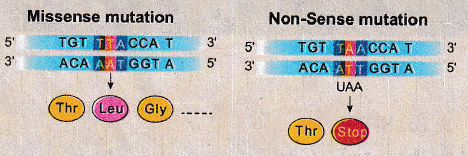
From the above figure identify the type of mutation and explain it.
18.
19.
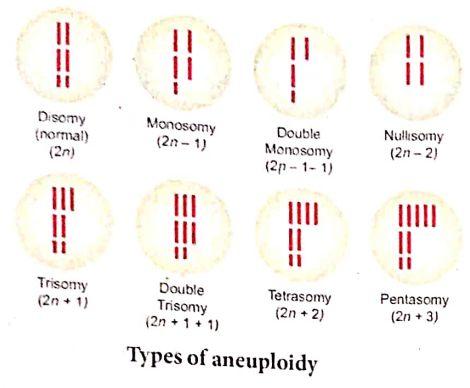
Draw the diagram of different types of aneuploidy.
20.
What is Genome editing? Explain CRISPR.
21.
22.
List any three characteristic features of multiple allele.
23.
24.
How will you identify a vector ?
25.
What do you know about the word pBR332?
26.
27.
Is there any possibilities to transfer a suitable desirable gene to host plant without vector? Justify your answer.
28.
Mention the application of Biotechnology.
29.
What is gene mapping? Write its uses
30.
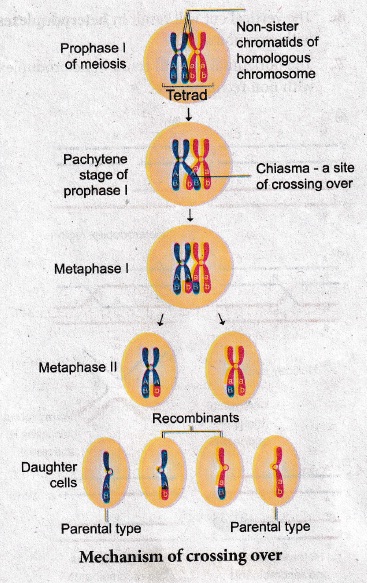
Explain the mechanism of crossing over.
1.
(d)
Agrobacterium tumefaciens
2.
(b)
Aruna variety
3.
(c)
1262
4.
(d)
High yield and resistant to ball worms
5.
(a)
Both assertion and reason are true. But reason is correct explanation of assertion.
6.
(d)
| 1 | 2 | 3 | 4 |
| c | d | a | b |
7.
(d)
I,II & III
8.
(c)
9.
(c)
3 and 4
10.
(c)
Two copies of three different genomes
11.
12.
(a) 'psy' gene is obtained from Daffodil plant (Narcissus pseudonarcissus).
(i) 'crt-l ' gene is from Erwinia uredovora bacterium.
(ii) 'lyc' gene is from wild-type rice endosperm.
(b) Golden rice can control Xerophthalmia.
13.
Sharbati Sonora is a mutant variety of wheat, which is developed from Mexican variety (Sonora 64) by irradiating of gamma rays.
14.
15.
Restriction endonuclease. e.g: Hind II, EcoR I, Pvul, Bam H I, Taq I.
16.
Spirulina can be grown easily on materials like waste water from potato processing plants (containing starch), straw, molasses, animal manure and even sewage, to produce large quantities.
17.
(i) A type of structural chromosomal abbrevation.
Reverse tandem duplication
(ii) The duplicated segment is located immediately after the normal segment but the gene sequence order will be reversed.
18.
19.
20.
(i) Genome editing or gene editing is a group of technologies that has the ability to change an organism's DNA.
(ii) These technologies allow genetic material to be added, removed, or altered at particular locations in the genome. Several approaches to genome editing have been developed.
(iii) A recent one is known as CRISPR-Cas9 which is short form of Clustered Regularly Interspaced Short Palindromic Repeats and CRlSPR-associated Protein 9.
(iv) The CRISPR-Cas9 system has generated a lot of excitement in the scientific community because it is faster, cheaper, more accurate and more efficient than other existing genome editing methods.
21.
22.
Multiple alleles of a series always occupy the same locus in the homologous chromosome. Therefore, no crossing over occurs within the alleles of a series.
(i) Multiple alleles are always responsible for the same character.
(ii) The wild type alleles of a series exhibit dominant character whereas mutant type will influence dominance or an intermediate phenotypic effect.
(iii) Proterminal synapsis: Pairing starts from the telomeres
(iv) Random synapsis: Pairing may start from anywhere.
23.
24.
Properties of Vectors:
1. Vectors are able to replicate autonomously to produce multiple copies of them along with their DNA insert in the host cell.
2. It should be small in size and of low molecular weight, less than 10 Kb (kilo base pair) in size so that entry/transfer into host cell is easy.
3. Vector must contain an origin of replication so that it can independently replicate within the host.
4. It should contain a suitable marker such as antibiotic resistance, to permit its detection in transformed host cell.
5. Vector should have unique target sites for integration with DNA insert and should have the ability to integrate with DNA insert it carries into the genome of the host cell. Most of the commonly used cloning vectors have more than one restriction site. These are Multiple Cloning Site (MCS) or polylinker. Presence of MCS facilitates the use of restriction enzyme of choice.
25.
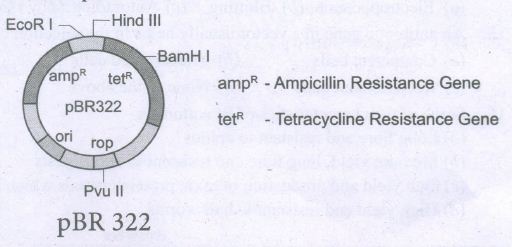
(i) pBR 322 plasmid is a reconstructed plasmid and most widely used as cloning vector;
(ii) It contains 4361 base pairs. In pBR, p denotes plasmid, Band R respectively the names of scientist Boliver and Rodriguez who developed this plasmid.
(iii) The number 322 is the number of plasmid developed from their laboratory.
(iv) It contains ampR and tetR two different antibiotic resistance genes and recognition sites for several restriction enzymes.
(v) ori and antibiotic resistance genes. Rop codes for the proteins involved in the replication of the plasmid.
26.
27.
Direct or Vector less Gene Transfer
In the direct gene transfer methods, the foreign gene of interest is delivered into the host plant without the help of a vector, The following are some of the common methods of direct gene transfer in plants.
(i) Chemical mediated gene transfer: Certain chemicals like polyethylene glycol (PEG) and dextran sulphate induce DNA uptake into plant protoplasts.
(ii) Microinjection: The DNA is directly injected into the nucleus using fine tipped glass needle or micro pipette to transform plant cells. The protoplasts are immobilized on a solid support (agarose on a microscopic slide) or held with a holding pipette under section.
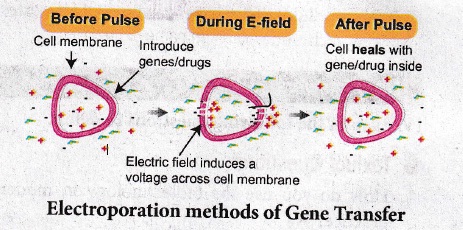
(iii) Electroporation Methods of Gene Transfer: A pulse of high voltage is applied to protoplasts, cells or tissues which makes transient pores in the plasma membrane through which uptake of foreign DNA occurs.
(iv) Liposome mediated method of Gene transfer: Liposomes the artificial phospholipid vesicles are useful in gene transfer. The gene or DNA is transferred from liposome into vacuole of plant cells. It is carried out by encapsulating DNA into the vacuole. This technique is advantageous because the liposome protects the introduced DNA from being damaged by the acidic pH and protease enzymes present in the vacuole. Liposome and tonoplast of vacuole fusion resulted in gene transfer. This process is called lipofection.
.jpg)
(v) Biolistics: The foreign DNA is coated onto the surface of minute gold or tungsten particles (1-3 \(\mu\)m) and bombarded onto the target tissue or cells using a particle gun (also called as gene gun/ micro projectile gun/shotgun) Then the bombarded cells or tissues are cultured on selected medium to regenerate plants from the transformed cells.
28.
Applications of Biotechnology
1. Biotechnology is one of the most important applied interdisciplinary sciences of the 21st century. It is the trusted area that enables us to find the beneficial way of life.
2. Biotechnology has wide applications in various sectors like agriculture, medicine, environment and commercial industries.
3. This science has an invaluable outcome like transgenic varieties of plants e.g. transgenic cotton (Bt-cotton), rice, tomato, tobacco, cauliflower, potato and banana.
4. The development of transgenics as pesticide resistant, stress resistant and disease resistant varieties of agricultural crops is the immense outcome of biotechnology.
5. The synthesis of human insulin and blood protein in E.coli and utilized for insulin deficiency disorder in human is a breakthrough in biotech industries in medicine.
6. The synthesis of vaccines, enzymes, antibiotics, dairy products and beverages are the products of biotech industries.
7. Biochip based biological computer is one of the successes of biotechnology.
8. Genetic engineering involves genetic manipulation, tissue culture involves aseptic cultivation of totipotent plant cell into plant clones under controlled atmospheric conditions.
9. Single cell protein from Spirulina is utilized in food industries.
10. Production of secondary metabolites, biofertilizers, biopesticides and enzymes.
11. Biomass energy, biofuel, bioremediation and phytoremediation for environmental biotechnology.
29.
The diagrammatic representation of position of genes and related distances between the adjacent genes is called gene mapping.
Uses
(i) Used to determine gene order.
(i) Identify the locus of a gene.
(i) Calculate the distance between genes.
(i) Useful in predicting results of dihybrid and trihybrid crosses.
(i) Allows the geneticists to understand the overall genetic complexity of particular organism.
30.
Crossing over is a process that includes four stages.
1. Synapsis
(i) Pairing between two homologous chromosomes is initiated during sub stage zygotene stage of prophase I of meiosis I
(ii) Homologous chromosomes are aligned side by side resulting in the formation of bivalents. It also occurs in zygotene sub-stage of prophase I of meiosis I tetrads.This pairing phenomenon is called synapsis.
2.Tetrad Formation
(i) Each homologous chromosome of a bivalent begin to form two identical sister chromatids.
(ii) They remain held together by a centromere at this stage each bivalent has four chromatids. This stage is called tetrad stage.
3. Cross Over
After tetrad formation, crossing over occurs in pachytene stage.
The non-sister chromatids of homologous pair make a contact at one or more points. These points of contact are called Chiasmata.
At chiasma, X-shaped structures are formed, where breaking and rejoining of two chromatids occur. This results in reciprocal exchange of equal and corresponding segments between them synapsis and chiasma formation are facilitated by protein filaments called synaptonemal complex.
4. Terminalisation
After crossing over, chiasma starts to move towards the terminal end of chromatids known as terminalisation. As a result, complete separation of homologous chromosomes occurs.

12th Standard Syllabus & Materials
12th Standard
TN 12th Computer Applications களப்பெயர் முறைமை (DNS) Sample Question Papers Study Material - QB365 Set A
NEW12th Standard
TN 12th Computer Applications வலையமைப்பு எடுத்துக்காட்டுகள் மற்றும் நெறிமுறைகள் Sample Question Papers Study Material - QB365 Set A
NEW12th Standard
TN 12th Computer Applications கணினி வலையமைப்பு ஓர் அறிமுகம் Sample Question Papers Study Material - QB365 Set A
NEW12th Standard
TN 12th Computer Applications PHP-உடன் MySQL-ஐ இணைத்தல் Sample Question Papers Study Material - QB365 Set A



Tamilnadu Stateboard 12th Standard Subjects

Maths

Chemistry

Physics
Biology

Computer Science

Business Maths and Statistics

Economics

Commerce

Accountancy

History

Computer Applications
Biology
Computer Technology
Computer Applications
Computer Science
Business Maths and Statistics
Commerce
Economics
Maths
Chemistry
Physics
Computer Technology
History
Accountancy

Tamil

English

French
Tamilnadu Stateboard Standards


