
12th Standard Syllabus & Materials
12th Standard
TN 12th English Poem - 6 - Incident of the French Camp Sample Question Papers Study Material - QB365 Set A
NEW12th Standard
TN 12th English Prose - 6 - On the Rule of the Road Sample Question Papers Study Material - QB365 Set A
NEW12th Standard
TN 12th English Prose - 5 - The Chair Sample Question Papers Study Material - QB365 Set A
NEW12th Standard
TN 12th English Supplementary - 4 - The Midnight Visitor Sample Question Papers Study Material - QB365 Set A
NEW12th Standard
TN 12th English Poem - 4 - Ulysses Sample Question Papers Study Material - QB365 Set A
NEW12th Standard
TN 12th English Prose - 4 - The Summit Sample Question Papers Study Material - QB365 Set A

Published on: 22/08/2026
Download Tamil Nadu 12th Standard Business Maths and Statistics question papers, model tests, one-mark questions, important questions, and public exam papers in PDF format. Free study materials and answer keys for TN State Board students.
Questions + Answers key
Take MCQ Business Maths and Statistics Test
1.
Find the differential equation of the following
x2 + y2 = a2
2.
Find the differential equation of the following
xy = c2
3.
Solve: ydx − xdy = 0
4.
Find the order and degree of the following differential equations
\(\frac { { d }^{ 2 }y }{ d{ x }^{ 2 } } +3{ \left( \frac { dy }{ dx } \right) }^{ 2 }+4y=0\)
5.
Find the differential equation of the following
y = cx + c − c3
6.
Solve: cosx(1 + cos y)dx − sin y(1 + sin x)dy = 0
7.
Solve \(\frac { dy }{ dx } \) = ex−y+ x2e− y
8.
9.
Find the differential equation of the family of curves y = ex (acos x + bsin x) where a and b are arbitrary constants.
10.
Find the differential equation of the family of all straight lines passing through the origin.
11.
Solve the differential equation \(\frac { dy }{ dx } =\frac { x-y }{ x+y } \)
12.
The sum of Rs. 2,000 is compounded continuously, the nominal rate of interest being 5% per annum. In how many years will the amount be double the original principal? (loge2 = 0.6931)
13.
The normal lines to a given curve at each point(x,y) on the curve pass through the point (1, 0). The curve passes through the point (1, 2). Formulate the differential equation representing the problem and hence find the equation of the curve.
14.
Solve 3extan ydx +(1 + ex)sec2ydy = 0 given y(0) = \(\frac { \pi }{ 4 } \)
15.
Find the differential equation of the family of straight lines y = mx + c when
(i) m is the arbitrary constant
(ii) c is the arbitrary constant
(iii) m and c both are arbitrary constants.
16.
The particular integral of the differential equation is \(\frac { { d }^{ 2 }y }{ d{ x }^{ 2 } } -8\frac { dy }{ dx } \) + 16y = 2e4x ______.
\(\frac { { x }^{ 2 }{ e }^{ 4x } }{ 2! } \)
\(\frac { { e }^{ 4x } }{ 2! } \)
x2e4x
xe4x
17.
The differential equation of y = mx + c is ______.(m and c are arbitrary constants)
\(\frac { { d }^{ 2 }y }{ d{ x }^{ 2 } } \) = 0
y = x \(\frac { dy }{ dx } \) + c
xdy + ydx = 0
ydx − xdy = 0
18.
The complementary function of (D2+ 4)y = e2x is ______.
(Ax +B)e2x
(Ax +B)e−2x
A cos 2x + B sin 2x
Ae−2x+ Be2x
19.
If y = cx + c− c3 then its differential equation is ______.
\(y=\frac { dy }{ dx } +\frac { dy }{ dx } -{ \left( \frac { dy }{ dx } \right) }^{ 3 }\)
\(y={ \left( \frac { dy }{ dx } \right) }^{ 3 }=x\frac { dy }{ dx } -\frac { dy }{ dx } \)
\(\frac { dy }{ dx } +y={ \left( \frac { dy }{ dx } \right) }^{ 3 }-x\frac { dy }{ dx } \)
\(\frac { { d }^{ 3 }y }{ d{ x }^{ 3 } } =0\)
20.
The integrating factor of the differential equation \(\frac{dx}{dy}+Px=Q\) is ______.
eഽPdx
\(\int P d x\)
ഽPdy
eഽPdy
21.
The differential equation formed by eliminating a and b from \(y=a e^{x}+b e^{-x}\) is ______.
\(\frac{d^{2} y}{d x^{2}}-y=0\)
\(\frac{d^{2} y}{d x^{2}}-\frac{d y}{d x}=0\)
\(\frac { { d }^{ 2 }y }{ { dx }^{ 2 } } =0\)
\(\frac { { d }^{ 2 }y }{ { dx }^{ 2 } } -x=0\)
22.
23.
The order and degree of the differential equation \(\left(\frac{d^{2} y}{d x^{2}}\right)^{\frac{3}{2}}-\sqrt{\left(\frac{d y}{d x}\right)}-4=0\) are respectively ______.
2 and 6
3 and 6
1 and 4
2 and 4
24.
The order and degree of the differential equation \(\sqrt { \frac { { d }^{ 2 }y }{ { dx }^{ 2 } } } =\sqrt { \frac { dy }{ dx } +5 } \) are respectively ______.
2 and 3
3 and 2
2 and 1
2 and 2
25.
The degree of the differential equation \(\frac { { d }^{ 4 }y }{ { dx }^{ 4 } } { -\left( \frac { { d }^{ 2 }y }{ { dx }^{ 2 } } \right) }^{ 4 }+\frac { dy }{ dx } =3\) ______.
1
2
3
4
1.
Differentiating w.r.t 'x' we get, 2x + 2y\(\frac { dy }{ dx } \)= 0
Dividing by 2, we get,
x+y\(\frac { dy }{ dx } \) = 0
2.
Differentiating w.r.t 'x' we get,
x.\(\frac { dy }{ dx } \) + y(1) = 0 [Product rule]
⇒ x\(\frac { dy }{ dx } \) + y = 0 which is the required differentiated equation.
3.
Given ydx - xdy = 0
⇒ y dx = x dy
Separating the variables we get,
\(\frac { dx }{ x } =\frac { dy }{ y } \)
Integrating both sides we get,
\(\int { \frac { dx }{ x } } =\int { \frac { dy }{ y } } \)
log x = log y+ log c
log x = log y
[∵ log m+log n = log mn]
x = cy
4.
\(\frac { { d }^{ 2 }y }{ d{ x }^{ 2 } } +3{ \left( \frac { dy }{ dx } \right) }^{ 2 }+4y=0\)
Highest order derivative is \(\frac { { d }^{ 2 }y }{ d{ x }^{ 2 } }\)
∴ order = 2
Power of the highest order derivative \(\frac { { d }^{ 2 }y }{ d{ x }^{ 2 } }\) is 1.
∴ Degree = 1
5.
Given equation is y = cx + c - c3 ....(1)
Differentiating w.r.t 'x' we get,
\(\frac { dy }{ dx } \) = c(1) + 0-0
⇒ \(\frac { dy }{ dx } \) = c ....(2)
Substituting (2) in (1) we get,
y=\(x\left( \frac { dy }{ dx } \right) +\left( \frac { dy }{ dx } \right) -\left( \frac { dy }{ dx } \right) ^{ 3 }\) which is the required differential equation.
6.
cos x(1 + cos y)dx − sin y(1 + sin x)dy
Separating the variables we get
\(\frac { \cos x }{ 1+\sin x } dx=\frac { \sin y }{ 16 \cos y } dy\)
Integrating both sides we get
\(\int { \frac { \cos x }{ 1+\sin x } } dx=\int { \frac { \sin y }{ 16 \cos y } } dy\)
put 1 + sin x = t ⇒ cos x dx = dt
Also 1 + cosy = s ⇒ -siny dy = ds
⇒ siny dy = -ds
⇒ \(\int { \frac { dt }{ t } } =-\int { \frac { ds }{ s } } \)
⇒ log t = log s + log c
⇒ log t = log\(\left( \frac { c }{ s } \right) \)
[∵ log m- logn=log\(\frac{m}{n}\)]
⇒ t=\(\frac { c }{ s } \)
⇒ 1+sinx =\(\frac { c }{ 1+cosy } \)
[∵ t = 1 + sin x & s = 1 + cos y]
⇒ (1 + sin x)(1 + cos y) = c
7.
Given \(\frac { dy }{ dx } \) = ex−y + x2e−y = e−yex + e−yx2
= e−y(ex + x2)
Separating the variables, we get eydy=(ex + x2)dx
Integrating, we get ഽeydy = ഽ(ex+x2)dx
ey = ex + \(\frac { x^{ 3 } }{ 3 } \) + c
8.
9.
y = ex (acos x + bsin x) (1)
Differentiating (1) w.r.t x, we get
\(\frac { dy }{ dx } \) = ex (acos x + bsin x)+ ex (−a sin x + b cos x)
= y + ex (−asin x + bcos x) (from (1))
⇒ \(\frac { dy }{ dx } \) - y = ex (−a sin x + bcos x) (2)
Again differentiating, we get
\(\frac { { d }^{ 2 }y }{ { dx }^{ 2 } } -\frac { dy }{ dx } \) = ex (−a sin x + b cos x) + ex (−a cos x − b sin x)
\(\frac { { d }^{ 2 }y }{ { dx }^{ 2 } } -\frac { dy }{ dx } \)= ex (−a sin x + bcos x) − ex (a cos x + b sin x)
\(\frac { { d }^{ 2 }y }{ { dx }^{ 2 } } -\frac { dy }{ dx } \) = \(\left( \frac { dy }{ dx } -y \right) -y\) (from (1) and (2))
⇒\(\frac { { d }^{ 2 }y }{ { dx }^{ 2 } } -\frac { dy }{ dx } \)+2y = 0, which is the requited differential equation.
10.
Let the equation of straight lines passing through the origin be
y = mx ..(1)
where m is the arbitrary constant
Differentiating w.r.t 'x' we get,
\(\frac { dy }{ dx } \)= m(1) ⇒ \(\frac { dy }{ dx } \) = m .....(2)
Substituting (2) in (1) we get,
\(y=x\frac { dy }{ dx } \).
11.
\(\frac { dy }{ dx } =\frac { x-y }{ x+y } \) ..... (1)
This is a homogeneous differential equation.
Now put y = vx and \(\frac { dy }{ dx } =v+x\frac { dv }{ dx } \)
∴ (1) ⇒ \(v+x\frac { dv }{ dx } =\frac { x-vx }{ x+vx } \)
\(=\frac { 1-v }{ 1+v } \)
\(x\frac { dv }{ dx } =\frac { 1-v }{ 1+v } -v\)
\(=\frac { 1-2v-{ v }^{ 2 } }{ 1+v } \)
\(\frac { 1+v }{ { v }^{ 2 }+2v-1 } dv=\frac { -dx }{ x } \)
Multiply 2 on both sides
\(\frac { 2+v }{ { v }^{ 2 }+2v-1 } dv=-2\frac { -dx }{ x } \)
On Integration
ഽ\(\frac { 2+v }{ { v }^{ 2 }+2v-1 } \)dv = -2ഽ\(\frac { -dx }{ x } \)
log(v2+2v − 1) = −2log x + log c
v2+2v − 1 = \(\frac { c }{ { x }^{ 2 } } \)
x2(v2+2v−1) = c
Now, Replace \(v=\frac { y }{ x } \)
\({ x }^{ 2 }\left[ \frac { { { y }^{ 2 } } }{ { x }^{ 2 } } +\frac { 2y }{ x } -1 \right] =c\)
y2 + 2xy − x2 = c is the solution
12.
Let P be the principal at time ‘t’
\(\frac { dP }{ dt } =\frac { 5 }{ 100 } P=0.05P\)
⇒ ഽ\(\frac { dP }{ P } \) = ഽ0.05 dt + c
loge P = 0.05t + c
P = e0.05tec
P = c1e0.05t (1)
Given P = 2000 when t = 0
⇒ c1 = 2000
∴ (1) ⇒ P = 2000e0.05t
To find t , when P = 4000
(2) ⇒ 4000 = 2,000e0.05t
2 = e0.05t
0.05t = log2
t = \(\frac { 0.0931 }{ 0.05 } \) = 14 years (approximately)
13.
Slope of the normal at any point P(x, y) = -\(\frac { dx }{ dy } \)
Let Q be (1, 0)
Slope of the normal PQ is \(\frac { { y }_{ 2 }-{ y }_{ 1 } }{ { x }_{ 2 }-{ x }_{ 1 } } \)
i.e, \(\frac { y-0 }{ x-1 } =\frac { y }{ x-1 } \)
∴ \(\frac { dx }{ dy } =\frac { y }{ x-1 } \) ⇒ \(\frac { dx }{ dy } =\frac { y }{ 1-x } \), which is the differential equation
i.e., (1− x)dx = ydy
ഽ(1−x)dx = ഽydy + c
\(x-\frac { { x }^{ 2 } }{ 2 } =\frac { { y }^{ 2 } }{ 2 } +c\) ....(1)
Since it passes through (1,2)
1 - \(\frac { 1 }{ 2 } =\frac { 4 }{ 2 } +c\)
\(c=\frac { 1 }{ 2 } -2=\frac { 4 }{ 2 } +c\)
Put \(c = \frac { -3 }{ 2 } \) in (1)
\(x-\frac { { x }^{ 2 } }{ 2 } =\frac { { y }^{ 2 } }{ 2 } -\frac { 3 }{ 2 } \)
2x − x2 = y2 − 3
⇒ y2 = 2x−x2 + 3, which is the equation of the curve
14.
Given 3ex tan y dx + (1 + ex)sec2y dy = 0
3ex tan y dx = −(1 + ex)sec2 y dy
\(\frac { { 3e }^{ x } }{ 1+{ e }^{ x } } dx=-\frac { { sec }^{ 2 }y }{ tany } dy\)
Integrating, we get 3ഽ\(\frac { { 3e }^{ x } }{ 1+{ e }^{ x } } dx\) = -ഽ\(\frac { { sec }^{ 2 }y }{ tany } dy\) + c
3log(1+ ex ) = −log tan y + log c \(\left[ \therefore \int { \frac { f'(x) }{ f(x) } dx=logf(x) } \right] \)
log(1+ex)3 + log tan y = log c
log [(1 + ex)3 tan y ] = log c
(1+ex)3 tan y = c (1)
Given y(0) = \(\frac { \pi }{ 4 } \) (i.e) y = \(\frac { \pi }{ 4 } \) at x =0
(1) ⇒ (1 +e0 )3 tan \(\frac { \pi }{ 4 } \) = c
23 (1) = c
⇒ c = 8
Hence the required solution is (1 +ex)3 tan y = 8
15.
(i) m is an arbitrary constant
y = mx + c ...(1)
Differentiating w.r. to x ,
we get \(\frac{dy}{dx}\) = m ...(2)
Now we eliminate m from (1) and (2)
For this substitute (2) in (1)
y = x \(\frac{dy}{dx}\) + c
x \(\frac{dy}{dx}\) - y + c = 0 which is the required differential equation of first order
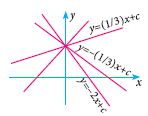
(ii) c is an arbitrary constant
Differentiating (1), we get \(\frac{dy}{dx}\) = m
Here c is eliminated from the given equation
∴ \(\frac{dy}{dx}\) = m is the required differential equation.
JPG.JPG)
(iii) both m and c are arbitrary constants
Since m and c are two arbitrary constants differentiating (1) twice we get
\(\frac{dy}{dx}\) = m
\(\frac { { d }^{ 2 }y }{ { dx }^{ 2 } } \) = 0
Here m and c are eliminated from the given equation.
\(\frac { { d }^{ 2 }y }{ { dx }^{ 2 } } \) = 0 which is the required differential equation.
JPG.JPG)
16.
(c)
x2e4x
17.
(a)
\(\frac { { d }^{ 2 }y }{ d{ x }^{ 2 } } \) = 0
18.
(c)
A cos 2x + B sin 2x
19.
(a)
\(y=\frac { dy }{ dx } +\frac { dy }{ dx } -{ \left( \frac { dy }{ dx } \right) }^{ 3 }\)
20.
(d)
eഽPdy
21.
(a)
\(\frac{d^{2} y}{d x^{2}}-y=0\)
22.
(b)
23.
(a)
2 and 6
24.
(c)
2 and 1
25.
(a)
1

12th Standard Syllabus & Materials
12th Standard
TN 12th English Supplementary - 3 - The Hour of Truth (Play) Sample Question Papers Study Material - QB365 Set A
NEW12th Standard
TN 12th English Poem - 3 - All the World’s a Stage Sample Question Papers Study Material - QB365 Set A
NEW12th Standard
TN 12th English Prose - 3 - In Celebration of Being Alive Sample Question Papers Study Material - QB365 Set A
NEW12th Standard
TN 12th English Supplementary - 2 - Life of Pi Sample Question Papers Study Material - QB365 Set A



Tamilnadu Stateboard 12th Standard Subjects

Maths

Chemistry

Physics

Biology

Computer Science
Business Maths and Statistics

Economics

Commerce

Accountancy

History

Computer Applications
Biology
Computer Technology
Computer Applications
Computer Science
Business Maths and Statistics
Commerce
Economics
Maths
Chemistry
Physics
Computer Technology
History
Accountancy

Tamil

English

French
Tamilnadu Stateboard Standards


