
 100% FREE ACCESS
12th Standard Syllabus & Materials
12th Standard
TN 12th Maths Applications of Matrices and Determinants Sample Question Papers Study Material - QB365 Set A
NEW12th Standard
TN 12th Computer Applications மின்னணு தரவு பரிமாற்றம் Sample Question Papers Study Material - QB365 Set A
NEW12th Standard
TN 12th Computer Applications மின் - வணிக பாதுகாப்பு அமைப்புகள் Sample Question Papers Study Material - QB365 Set A
NEW12th Standard
TN 12th Computer Applications மின்னணு செலுத்தல் முறைகள் Sample Question Papers Study Material - QB365 Set A
NEW12th Standard
TN 12th Computer Applications மின் - வணிகம் Sample Question Papers Study Material - QB365 Set A
NEW12th Standard
TN 12th Computer Applications திறந்த மூல கருத்துருக்கள் Sample Question Papers Study Material - QB365 Set A

Published on: 22/08/2026
Download Tamil Nadu 12th Standard Business Maths and Statistics question papers, model tests, one-mark questions, important questions, and public exam papers in PDF format. Free study materials and answer keys for TN State Board students.
Questions + Answers key
Take MCQ Business Maths and Statistics Test
1.
Find the missing term from the following data.
| x | 20 | 30 | 40 |
| y | 51 | - | 34 |
2.
Prove that
∇Δ = Δ - ∇
3.
Solve: \(\frac { dy }{ dx } \) + ex+yex = 0
4.
Find (i) Δeax
(ii) Δ2ex
(iii) Δ log x
5.
Solve the following differential equations: \(\frac { { d }^{ 2 }y }{ { dx }^{ 2 } } +16y=0\)
6.
Find the order and degree of the following differential equations.
\(\frac { dy }{ dx } +2y={ x }^{ 3 }\)
7.
Find f(3) from the following data:
| x | 1 | 2 | 3 | 4 | 5 |
| f(x) | 2 | 5 | - | 14 | 32 |
8.
If f(x) = x2 + 3x then show that Δf(x) = 2x + 4
9.
Construct a forward difference table for y = f(x) = x3+2x+1 for x = 1,2,3,4,5
10.
Solve the following differential equations: (4D2+4D−3)y = e2x
11.
Find the differential equation corresponding to y = ae4x + be−x where a, b are arbitrary constants.
12.
Find the differential equation of the family of all straight lines passing through the origin.
13.
Find f(2.8) from the following table.
| x | 0 | 1 | 2 | 3 |
| f(x) | 1 | 2 | 11 | 34 |
14.
Using Newton’s forward interpolation formula find the cubic polynomial.
| x | 0 | 1 | 2 | 3 |
| f(x) | 1 | 2 | 1 | 10 |
15.
Find the missing entries from the following
| x | 0 | 1 | 2 | 3 | 4 | 5 |
| y = f(x) | 0 | - | 8 | 15 | - | 35 |
16.
Evaluate \(\Delta \)\(\left[ \frac { 5x+12 }{ { x }^{ 2 }+5x+6 } \right] \) by taking ‘1’ as the interval of differencing.
17.
Suppose that the quantity demanded Q4 = 13 - 6P + 2\(\frac { dp }{ dt } +\frac { { d }^{ 2 }p }{ { dt }^{ 2 } } \) and quantity supplied Qs = − 3 + 2p, where p is the price. Find the equilibrium price for market clearance.
18.
Solve the following differential equations (D2+D−6)y=e3x + e−3x
19.
Solve the following homogeneous differential equations.
\(x\frac { dy }{ dx } =x+y\).
20.
Find the differential equation of the family of straight lines y = mx + c when
(i) m is the arbitrary constant
(ii) c is the arbitrary constant
(iii) m and c both are arbitrary constants.
21.
The complementary function of the differential equations (D2-D)y = ex is _____________
A+Bex
(Ax+B)ex
A+Be-x
(A+Bx)e-x
22.
(1 + Δ) (1 - ∇) is ______________
0
1
-1
(1 - ∇ . Δ)
23.
If f (x)=x2 + 2x + 2 and the interval of differencing is unity then Δf (x) _______.
2x −3
2x +3
x + 3
x − 3
24.
∇ ≡ _______.
1+E
1 - E
1− E−1
1+ E−1
25.
If h = 1, then Δ(x2) = _______.
2x
2x −1
2x +1
1
26.
Δf(x) = _______.
f(x+ h)
f(x) − f(x+h)
f(x + h) − f(x)
f (x) − f(x−h)
27.
A homogeneous differential equation of the form \(\frac { dy }{ dx } \) = f\(\left( \frac { y }{ x } \right) \) can be solved by making substitution, ______.
y = v x
v = y x
x = v y
x = v
28.
If sec2 x is an integrating factor of the differential equation \(\frac { dy }{ dx } \) + Py Q then P = ______.
2 tan x
sec x
cos2 x
tan2 x
29.
The differential equation of y = mx + c is ______.(m and c are arbitrary constants)
\(\frac { { d }^{ 2 }y }{ d{ x }^{ 2 } } \) = 0
y = x \(\frac { dy }{ dx } \) + c
xdy + ydx = 0
ydx − xdy = 0
30.
The differential equation formed by eliminating a and b from \(y=a e^{x}+b e^{-x}\) is ______.
\(\frac{d^{2} y}{d x^{2}}-y=0\)
\(\frac{d^{2} y}{d x^{2}}-\frac{d y}{d x}=0\)
\(\frac { { d }^{ 2 }y }{ { dx }^{ 2 } } =0\)
\(\frac { { d }^{ 2 }y }{ { dx }^{ 2 } } -x=0\)
1.
Since only two values of yare given, the polynomial which fits the data is of degree 1.
Hence 2nd differences are zeros
∴ Δ2(y0) = 0
⇒ (E-1)2yo=0
⇒(E2 - 2E + 1) yo = 0
⇒y2 - 2y1 +yo = 0
⇒34 - 2y1 + 51 = 0
⇒85 - 2y1 =0
⇒2y1 + 85 ⇒ y1 = \(\frac{85}{2}\)
⇒y1 = 42.5
2.
LHS = Δ∇ = (E-1) \(\left( \frac { E-1 }{ E } \right) \)
.JPG)
= Δ - ∇ [∵ Δ = E -1 & ∇ = \(\frac { E-1 }{ E } \) ]
= RHS
Hence Proved.
3.
⇒ \(\frac { dy }{ dx } \) = -ex(1+y)
Separating the variables we get,
⇒ \(\frac { dy }{ 1+y } \) = -ex dx
⇒ log(1+y) = -ex+c
4.
(i) Δeax = ea(x+h)−ex
= eaX.eh-eax [∵ am+n = am.an]
= eax[eh-1]
(ii) Δ2ex = Δ.[Δex]
= Δ[ex+h - ex]
= Δ[exeh - ex]
= Δex [eh - 1]
= (eh - 1)Δex
= (eh−1).(eh−1).ex
= (eh−1)2.ex
(iii) Δ log x = log(x+h) − log x
= log \(\frac{x + h}{x}\)
= log \(\left( \frac { x }{ x } +\frac { h }{ x } \right) \)
= log \(\left( 1+\frac { h }{ x } \right) \)
5.
The auxiliary equation is m2 + 16 = 0
m2 = -16
⇒ m2 = ±\(\sqrt { -16 } \) = ±4i
Hence α = 0 and β = 4
∴ Complementary function CF is
eax = [A cos βx + B sin βx]
CF = e0x[A cos 4x + B sin 4x]
= A cos 4x + B sin 4x
[∵ eo= 1]
∴ The general solution is y = A cos 4x + B sin 4x
6.
The highest derivative is first order and its power is one
∴ order : 1
degree : 1
7.
Since four values of f(x) are given
\(
\Delta^{4} \mathrm{y}_{0}=0 \\
(\mathrm{E}-1)^{4} \mathrm{y}_{0}=0
\)
\(
\left(E^{4}-4 E^{3}+6 E^{2}-4 E+1\right) y_{0}=0
\)
\(y_{4}-4 y_{3}+6 y_{2}-4 y_{1}+y_{0}=0
\)
\(32-4(14)+6 y_{2}-4(5)+2=0
\)
\(6 y_{2}=56+20-32-2=42
\)
\(y_{2}=7
\)
8.
Given f(x) = x2+ 3h
LHS = Δ f(x)
= f(x + h) - f(x)
= [(x + h)2 + 3 (x + h)] - [x2 + 3x]

= h2 + 2xh + 3h
when h = 1,
LHS = 12 + 2x(1) + 3(1)
= 1+2x+3
= 2x+4= RHS
Hence proved.
9.
y = f(x) = x3+2x+1 for x = 1,2,3,4,5
| x | y | Δy | Δ2y | Δ3y | Δ4y |
|---|---|---|---|---|---|
| 1 | 4 | ||||
| 9 | |||||
| 2 | 13 | 12 | |||
| 21 | 6 | ||||
| 3 | 34 | 18 | 0 | ||
| 39 | 6 | ||||
| 4 | 73 | 24 | |||
| 63 | |||||
| 5 | 136 | ||||
10.
The auxiliary equation is 4m2 + 4m - 3 = 0
∴ (2m +3)(2m - 1) = 0
⇒ m = \(\frac { -3 }{ 2 } \) and m =\(\frac { 1 }{ 2 } \)
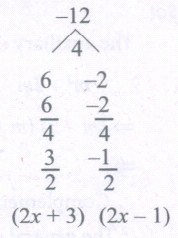
∴ Complementary function CF is \(Ae^{ \frac { -3x }{ 2 } }+Be^{ \frac { 1x }{ 2 } }\)
Particular Integral PI =\(\frac { 1 }{ \phi (D) } \)
PI=\(\frac { 1 }{ 4{ D }^{ 2 }+4D-3 } \).e2x
=\(\frac { 1 }{ (2D+3)(2D-1) } \).e2x
=\(\frac { 1 }{ 4\left( D+\frac { 3 }{ 2 } \right) \left( D-\frac { 1 }{ 2 } \right) } \).e2x
=\(\frac { e^{ 2x } }{ 4\left( 2+\frac { 3 }{ 2 } \right) \left( 2-\frac { 1 }{ 2 } \right) } \)
=\(\frac { e^{ 2x } }{ 4\left( \frac { 7 }{ 2 } \right) \left( \frac { 5 }{ 2 } \right) } =\frac { { e }^{ 2x } }{ 21 } \)
General solution is y = CF + PI
⇒ y=\({ Ae }^{ \frac { -3x }{ 2 } }+Be^{ \frac { x }{ 2 } }=\frac { { e }^{ 2x } }{ 21 } \).
11.
Given y = ae4x + be−x. (1)
Here a and b are arbitrary constants
From (1), \(\frac { dy }{ dx } \) = 4ae4x− be−x (2)
and \(\frac { { d }^{ 2 }y }{ { dx }^{ 2 } } \) = 16ae4x+ be−x (3)
(1) + (2) ⇒ \(y+\frac { dy }{ dx } \) = 5ae4x (4)
= (2) + (3) ⇒ \(\frac { dy }{ dx } +\frac { { d }^{ 2 }y }{ { dx }^{ 2 } } \) = 20ae4x
= 4(5ae4x)
= \(4\left( y+\frac { dy }{ dx } \right) \)
\(\frac { dy }{ dx } +\frac { { d }^{ 2 }y }{ { dx }^{ 2 } } =4y+4\frac { dy }{ dx } \)
⇒ \(\frac { { d }^{ 2 }y }{ { dx }^{ 2 } } -3\frac { dy }{ dx } -4y=0\) which is the required differential equation
12.
Let the equation of straight lines passing through the origin be
y = mx ..(1)
where m is the arbitrary constant
Differentiating w.r.t 'x' we get,
\(\frac { dy }{ dx } \)= m(1) ⇒ \(\frac { dy }{ dx } \) = m .....(2)
Substituting (2) in (1) we get,
\(y=x\frac { dy }{ dx } \).
13.
Given
| x | 0 | 1 | 2 | 3 |
| f(x) | 1 | 2 | 11 | 34 |
Find f(2.8)
Since the required value 2.8 is at the end of the table, apply Newton's backward interpolation formula.
xn + nh = 2.8 ⇒ 3 + n (1) = 2.8
⇒ n = 2.8 - 3 = -0.2
The difference table is
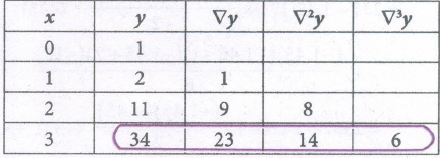
Newton's backward interpolation formula is
y(x = xn + nh) = \(\frac { n }{ 1! } { \triangledown y }_{ n }+\frac { n(n+1) }{ 2! } { \triangledown }^{ 2 }{ y }_{ n }+\frac { n(n+1)(n+2) }{ 3! } { \triangledown }^{ 3 }{ y }_{ n }\)
⇒ y(2.8) = 34 + (-0.2) (23) + \(\frac { (-0.2)(-0.2+1) }{ 2 } (14)+\frac { (0.2)(-0.2+1)(-0.2+2) }{ 6 } \)(16)
⇒ y(2.8) = 34 - 4.6 + (-0.2) (0.8) (7) + (-0.2) (0.8) (1.8)
⇒ y(2.8) = 34 - 4.6 - 1.12- 0.288
⇒ y(2.8) = 27.992
14.
The forward interpolation formula is
\({ y }_{ ({ x=x }_{ 0 }+nh) }={ y }_{ 0 }+\frac { n }{ 1! } =\triangle { y }_{ 0 }+\frac { n(n-1) }{ 2! } { \triangle }^{ 2 }{ y }_{ 0 }+\frac { n(n-1)(n-2) }{ 3! } { \triangle }^{ 3 }{ y }_{ 0 }+...\)
Here x0 + nh = x ⇒ x0 = 0, h = 1
∴ 0 + n = x ⇒ n = x.
The difference table is
| x | y = f(x) | Δy | Δ2y | Δ3y |
|---|---|---|---|---|
| 0 | 1 | |||
| 1 | ||||
| 1 | 2 | -2 | ||
| -1 | 12 | |||
| 2 | 1 | 10 | ||
| 9 | ||||
| 3 | 10 |
\({ y }_{ (n=x) }={ y }_{ 0 }+\frac { n }{ 1! } =\triangle { y }_{ 0 }+\frac { n(n-1) }{ 2! } { \triangle }^{ 2 }{ y }_{ 0 }+\frac { n(n-1)(n-2) }{ 3! } { \triangle }^{ 3 }{ y }_{ 0 }+...\)
\(y=1+\frac { n }{ 1! } (1)+\frac { n(n-1) }{ 2! } (-2)+\frac { n(n-1)(n-2) }{ 6 } (12)\)
⇒ y = 1 + x + (x2 - x)(-1) + x(x2 - 3x + 2) (2)
⇒ y = 1 + x - x2 + x + 2x3 - 6x2 + 4x
⇒ y = 1+ 6x - 7x2 + 2x3
Hence, the cubic polynomial is 2x3 - 7x2+ 6x + 1.
15.
Let the missing entries by y1 and y4
Since only four values of f(x) are given, the polynomial which fits the data is of degree 3.
Hence fourth differences are zero.
∴ Δ4yk = 0 ⇒ (E - 1)4yk = 0
(E4 - 4E3 + 6E2- 4E + 1) yk = 0
Put k = 0 in (1) we get,
(E4 - 4E3 + 6E2 - 4E + 1)y0 = 0
⇒ y4 - 4y3 + 5y2 - 4y1 + y0 = 0
⇒ y4 - 4(15) + 6(8) - 4(y1) + 0 = 0
⇒ y4 - 60 + 48 - 4y1 = 0
⇒ y4 - 4y1 - 12 = 0
⇒ y4 - 4y1 = 12 (2)
put k = 1 in (1) we get
(E4- 4E3 + 6E2 - 4E + 1) y1 = 0
⇒ y5 - 4y4 + 6y3 - 4y2 + y1 = 0
⇒ 35 - 4y4 + 6 (15) - 4 (8) +y1 = 0
⇒ 35 - 4y4 + 90 - 32 +y1 = 0
⇒ 4y4 +y1 = -93 (3)
| (2) x 4 ➝ | 4y4 - 16y1 | = 48 |
| (3) ➝ | -4y4 + y1 | = -93 |
| Adding | -15y1 | = -45 |
⇒ y1 = \(\frac{-45}{-15}\) = 3
⇒ y1 = 3.
Substituting y1 = 3 in (2) we get,
y4 - 4(3) = 12
y4 - 12 = 12
⇒ y4 = 12 + 12
⇒ y4 = 24
Hence the missing entries are 3 and 24.
16.
\(\Delta \)\(\left[ \frac { 5x+12 }{ { x }^{ 2 }+5x+6 } \right] \)
By Partial fraction method
\(\frac { 5x+12 }{ { x }^{ 2 }+5x+6 } =\frac { A }{ x+3 } +\frac { B }{ x+2 } \)
\(A=\frac { 5x+12 }{ x+12 } [x=-3]=\frac { -15+12 }{ -1 } =\frac { -3 }{ -1 } =-3\)
\(B=\frac { 5x+12 }{ x+3 } \)[x = -2] \(=\frac { 2 }{ 1 } =2\)
\(\frac { 5x+12 }{ { x }^{ 2 }+5x+6 } = \left[ \frac { 3 }{ x+3 } +\frac { 2 }{ x+2 } \right] \)
\(\Delta \frac { 5x+12 }{ { x }^{ 2 }+5x+6 } =\Delta \left[ \frac { 3 }{ x+3 } +\frac { 2 }{ x+2 } \right] \)
\(=\left[ \frac { 3 }{ x+1+3 } -\frac { 3 }{ x+3 } \right] +\left\{ \frac { 2 }{ x+1+2 } -\frac { 2 }{ x+2 } \right\} \)
\(=3\left[ \frac { 1 }{ x+4 } -\frac { 1 }{ x+3 } \right] +2\left[ \frac { 1 }{ x+3 } -\frac { 1 }{ x+2 } \right] \)
\(=\left[ \frac { -3 }{ (x+4)(x+3) } -\frac { 2 }{ (x+3)(2+3) } \right] \)
\(=\frac { -5x-14 }{ (x+2)(x+3)(x+4) } \)
17.
Given Qd = 13 - 6p + 2\(\frac { dp }{ dt } +\frac { { d }^{ 2 }p }{ dt^{ 1 } } \) Qs = - 3 + 2p
At equilibrium Qd = Qs
⇒ 13 - 6p + 2\(\frac { dp }{ dt } +\frac { { d }^{ 2 }p }{ dt^{ 1 } } \) = - 3 + 2p
⇒ \(\frac { { d }^{ 2 }p }{ dt^{ 2 } } +2\frac { dp }{ dt } \) - 6p + 13 + 3 - 2p = 0
⇒ \(\frac { { d }^{ 2 }p }{ dt^{ 2 } } +2\frac { dp }{ dt } \) - 8p + 16 = 0
⇒ \(\frac { { d }^{ 2 }p }{ dt^{ 2 } } +2\frac { dp }{ dt } \) - 8p = - 16
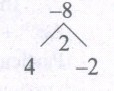
The auxiliary equation is m2 + 2m - 8 = 0
⇒ (m + 4) (m - 2) = 0
⇒ m = - 4, 2
The roots are real and different.
∴ Complementary function CF is Ae-4t + Be2t
Particular Integral PI = \(\\ \frac { 1 }{ \phi (D) } \).f(t)
=\(\frac { 1 }{ { D }^{ 2 }+2D-8 } .(-16)=\frac { -16.e^{ 0x } }{ (D+4)(D-2) } \)
PI = \(\frac { -16 }{ (0+4)(0-2) } =\frac { -16 }{ -8 } \) = 2
∴ P = CF + PI
∴ The general solution is
P = Ae-4t + Be2t + 2
18.
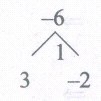
The auxiliary equation is m2 + m - 6 = 0
⇒ (m + 3) (m - 2) = 0
⇒ m = -3, 2
The roots are real and different.
∴ The complementary function CF is Ae-3x + Bex
Particular Integral
PI1=\(\frac { 1 }{ \phi (D) } \)f1(x)
=\(\frac { 1 }{ ({ D }^{ 2 }+D-6) } \)e3x
PI1=\(\frac { { e }^{ 3x } }{ (D+3)(D-2) } =\frac { { e }^{ 3x } }{ (3+3)(3-2) } \)
= \(\frac { { e }^{ 3x } }{ 6(1) } =\frac { e^{ 3x } }{ 6 } \)
PI2 = \(\frac { 1 }{ \phi (D0 } { f }_{ 2 }(x)=\frac { e^{ -3x } }{ (D+3)(D-2) } \)
= x\(\frac { { e }^{ -3x } }{ (-3-2) } \) [∵ when D = - 3, D + 3 = 0]
PI2 = \(-\frac { x }{ 5 } \)e-3x
∴ y = CF+PI1+PI2
∴ The general solution is
y = Ae-3x+Be2x+\(\frac { { e }^{ 3x } }{ 6 } -\frac { x }{ 5 } \)e-3x
19.
\(\frac { dy }{ dx } =\frac { x+y }{ x } \)
Since the numerator and denominator are homogeneous functions of degree 1,
put y = vx ⇒ \(\frac { dy }{ dx } =v(1)+x.\frac { dv }{ dx } \)
∴ v + x\(\frac { dv }{ dx } \) = \(\frac { x+vx }{ x } \)

⇒ x\(\frac { dv }{ dx } \) = 1 + v - v = 1
⇒ x\(\frac { dv }{ dx } \) = 1
Separating the variables we get
\(\frac { dv }{ 1 } =\frac { dx }{ x } \)
Integrating both sides we get,
\(\int { dv } =\int { \frac { dx }{ x } } \)
\(\int { \frac { dx }{ x } } =\int { dv } \) ⇒ log x = v + log c
⇒ log\(\left( \frac { x }{ c } \right) =v\Rightarrow \frac { x }{ c } \) = ev
x = c.ev
Replace v by y/x we get,
x = cey/x.
20.
(i) m is an arbitrary constant
y = mx + c ...(1)
Differentiating w.r. to x ,
we get \(\frac{dy}{dx}\) = m ...(2)
Now we eliminate m from (1) and (2)
For this substitute (2) in (1)
y = x \(\frac{dy}{dx}\) + c
x \(\frac{dy}{dx}\) - y + c = 0 which is the required differential equation of first order
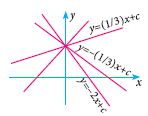
(ii) c is an arbitrary constant
Differentiating (1), we get \(\frac{dy}{dx}\) = m
Here c is eliminated from the given equation
∴ \(\frac{dy}{dx}\) = m is the required differential equation.
JPG.JPG)
(iii) both m and c are arbitrary constants
Since m and c are two arbitrary constants differentiating (1) twice we get
\(\frac{dy}{dx}\) = m
\(\frac { { d }^{ 2 }y }{ { dx }^{ 2 } } \) = 0
Here m and c are eliminated from the given equation.
\(\frac { { d }^{ 2 }y }{ { dx }^{ 2 } } \) = 0 which is the required differential equation.
JPG.JPG)
21.
(a)
A+Bex
22.
(b)
1
23.
(b)
2x +3
24.
(c)
1− E−1
25.
(c)
2x +1
26.
(c)
f(x + h) − f(x)
27.
(a)
y = v x
28.
(a)
2 tan x
29.
(a)
\(\frac { { d }^{ 2 }y }{ d{ x }^{ 2 } } \) = 0
30.
(a)
\(\frac{d^{2} y}{d x^{2}}-y=0\)

12th Standard Syllabus & Materials
12th Standard
TN 12th Computer Applications வலையமைப்பு வடமிடல் Sample Question Papers Study Material - QB365 Set A
NEW12th Standard
TN 12th Computer Applications களப்பெயர் முறைமை (DNS) Sample Question Papers Study Material - QB365 Set A
NEW12th Standard
TN 12th Computer Applications வலையமைப்பு எடுத்துக்காட்டுகள் மற்றும் நெறிமுறைகள் Sample Question Papers Study Material - QB365 Set A
NEW12th Standard
TN 12th Computer Applications கணினி வலையமைப்பு ஓர் அறிமுகம் Sample Question Papers Study Material - QB365 Set A



Tamilnadu Stateboard 12th Standard Subjects

Maths

Chemistry

Physics

Biology

Computer Science
Business Maths and Statistics

Economics

Commerce

Accountancy

History

Computer Applications
Biology
Computer Technology
Computer Applications
Computer Science
Business Maths and Statistics
Commerce
Economics
Maths
Chemistry
Physics
Computer Technology
History
Accountancy

Tamil

English

French
Tamilnadu Stateboard Standards


