
 100% FREE ACCESS
12th Standard Syllabus & Materials
12th Standard
TN 12th Maths Applications of Matrices and Determinants Sample Question Papers Study Material - QB365 Set A
NEW12th Standard
TN 12th Computer Applications மின்னணு தரவு பரிமாற்றம் Sample Question Papers Study Material - QB365 Set A
NEW12th Standard
TN 12th Computer Applications மின் - வணிக பாதுகாப்பு அமைப்புகள் Sample Question Papers Study Material - QB365 Set A
NEW12th Standard
TN 12th Computer Applications மின்னணு செலுத்தல் முறைகள் Sample Question Papers Study Material - QB365 Set A
NEW12th Standard
TN 12th Computer Applications மின் - வணிகம் Sample Question Papers Study Material - QB365 Set A
NEW12th Standard
TN 12th Computer Applications திறந்த மூல கருத்துருக்கள் Sample Question Papers Study Material - QB365 Set A

Published on: 22/08/2026
Download Tamil Nadu 12th Standard Business Maths and Statistics question papers, model tests, one-mark questions, important questions, and public exam papers in PDF format. Free study materials and answer keys for TN State Board students.
Questions + Answers key
Take MCQ Business Maths and Statistics Test
1.
In a Binomial distribution if n = 5 and P(x = 3) =2 P(x = 2), find p
2.
In a Poisson distribution 3 P(X = 2) = P(X = 4), then find the parameter of the distribution.
3.
What is standard error?
4.
A server channel monitored for an hour was found to have an estimated mean of 20 transactions transmitted per minute. The variance is known to be 4. Find the standard error.
5.
The mean of a binomial distribution is 5 and standard deviation is 2. Determine the distribution.
6.
In a book of 520 pages, 390 typo-graphical errors occur. Assuming Poisson law for the number of errors per page, find the probability that a random sample of 5 pages will contain no error.
7.
8.
What is mean by null Hypothesis? How will you define the Critical Region and Acceptance Region in testing of hypothesis?
9.
An biased coin is tossed six times. What is the probability of obtaining four or more heads?
10.
The standard deviation of a sample of size 50 is 6.3. Determine the standard error whose population standard deviation is 6?
11.
12.
Mention the properties of binomial distribution.
13.
14.
The probability that a student get the degree is 0.4 Determine the probability that out of 5 students
(i) one will be graduate
(ii) atleast one will be graduate
15.
The mean score of 500 students for an examination is 40 and S.D is 25. Determine the limit of the marks of the central 60% of the candidates. [P(0 < z1 < 0.84) = 0.30]
16.
A sample of 400 individuals is found to have a mean height of 67.47 inches. Can it be reasonably regarded as a sample from a large population with mean height of 67.39 inches and standard deviation 1.30 inches at 0.05 level of significance?
17.
18.
A sample of 100 measurements at breaking strength of cotton thread gave a mean of 7.4 and a standard deviation of 1.2 gms. Find 95% confidence limits for the mean breaking strength of cotton thread.
19.
If the heights of 500 students are normally distributed with mean 68.0 inches and standard deviation 3.0 inches , how many students have height
(a) greater than 72 inches
(b) less than or equal to 64 inches
(c) between 65 and 71 inches
20.
21.
If 18% of the bolts produced by a machine are defective, determine the probability that out of the 4 bolts chosen at random
(i) exactly one will be defective
(ii) none will be defective
(iii) atmost 2 will be defective
1.
\(
\mathrm{P}(\mathrm{X} =\mathrm{x})=n \mathrm{C}_{x} p^{x} q^{n-x}
\)
\(\mathrm{P}(\mathrm{X} =3)=2 \mathrm{P}(\mathrm{x}=2)
\)
\(5 \mathrm{C}_{3} \mathrm{p}^{3} \mathrm{q}^{2} =2\left(5 \mathrm{C}_{2} \mathrm{p}^{2} \mathrm{q}^{3}\right)
\)
\(\mathrm{p} =2 \mathrm{q}
\)
\(\mathrm{p} =2(1-\mathrm{p}) \Rightarrow 3 \mathrm{p}=2 \Rightarrow \mathrm{p}=\frac{2}{3}\)
2.
Let λ be the parameter
Given 3. P(X = 2) = P(X = 4)
⇒ 3. \(\frac { { e }^{ -\lambda }.{ \lambda }^{ 2 } }{ 2! } =\frac { e^{ -\lambda }.{ \lambda }^{ 4 } }{ 4! } \)
\(\frac { 3{ \lambda }^{ 2 } }{ 2 } =\frac { { \lambda }^{ 4 } }{ 4\times 3\times 2 } \)
⇒ 36λ2 = λ4
λ4-36λ2 = 0
⇒ λ2(λ2-36) = 0
⇒ λ2 = 0 or λ2 = 36
⇒ λ = 6 since λ > 0
3.
The standard deviation of the sampling distribution of a statistic is known as its Standard Error.
4.
Givens \(\sigma^2\) = 4 which implies \(\sigma\) = 2, n = 1 hour = 60 min, \(\bar { X } \) = 20/min
Standard Error \(=\frac { \sigma }{ \sqrt { n } } =\frac { 2 }{ \sqrt { 60 } } =0.2582\)
5.
Given mean of a binomial distribution is 5
np = 5 ....(1)
Also, standard deviation is 2 ⇒ Variance = 22 = 4
∴ npq = 4...(2)
(2) \(\div \) (1) given, \(\frac { npq }{ np } \)=\(\frac { 4 }{ 5 } \)
⇒ q = \(\frac { 4 }{ 5 } \)
p = 1-q = \(1-\frac { 4 }{ 5 } =\frac { 1 }{ 5 } \)
Substituting p = \(\frac { 1 }{ 5 } \) in (1) we get
n\(\left( \frac { 1 }{ 5 } \right) \) = 5 ⇒ n = 25
∴ The binomial distribution is nCx pxqn-x, x = 0,1,2,....n
⇒ 25Cx \(\left( \frac { 1 }{ 5 } \right) ^{ x }\left( \frac { 4 }{ 5 } \right) ^{ 25-x }\), x = 0,1,2,....25.
6.
The average number of typographical errors per page in the book is given by \(\lambda\) = (390/520) = 0.75.
Hence using Poisson probability law, the probability of x errors per page is given by
\(P(X=x)=\frac { { e }^{ -\lambda }{ \lambda }^{ x } }{ x! } ={ e }^{ -0.75 }=\frac{(0.75)^x}{x!}\) x = 0,1,2,3……
The required probability that a random sample of 5 pages will contain no error is given by :
[P(X = 0)]5 = (e-0.75)5 = e-3.75
7.
8.
Null hypothesis :
"Null hypothesis is the hypothesis which is tested for possible rejection under the assumption that it is true", and it is denoted by Ho.
For example : If we want to find the population mean has a specified value \(\mu _o\) then the null hypothesis Ho is set as follows \(H_{0}: \mu=\mu_{0}\)
Critical region or Rejection region :
A region corresponding to a test statistic in the sample space which tends to rejection of Ho is called critical region or region of rejection.
9.
Let x be the random variable denoting the number of heads
\(
\mathrm{p} =\frac{1}{2}, \mathrm{q}=\frac{1}{2}, \mathrm{n}=6
\)
\(\mathrm{P}(\mathrm{X} =\mathrm{x})=n C_{x} p^{x} q^{x-x}
\)
\(\mathrm{P}(\mathrm{X} \geq 4) =\mathrm{P}(\mathrm{X}=4)+\mathrm{P}(\mathrm{X}=5)+\mathrm{P}(\mathrm{X}=6)
\)
\( =6 C_{4}\left(\frac{1}{2}\right)^{4}\left(\frac{1}{2}\right)^{2}+6 C_{5}\left(\frac{1}{2}\right)^{5}\left(\frac{1}{2}\right)^{1}+6 C_{6}\left(\frac{1}{2}\right)^{6}
\)
\( =\frac{1}{2^{6}}\left[6 C_{2}+6 C_{1}+6 C_{0}\right]=\frac{11}{32}=0.34375\)
10.
Sample size n = 50
Sample S.D s = 6.3
Population S.D \(\sigma\) = 6
The standard error for sample S.D is given by
\(S.E=\sqrt { \frac { { \sigma }^{ 2 } }{ 2n } } =\frac { 6 }{ \sqrt { 2(50) } } =\frac { 6 }{ \sqrt { 100 } } =0.6\)
Thus standard error for sample S.D = 0.6.
11.
12.
(i) Binomial distribution is symmetrical if p = q = 0.5. It is skew symmetric if p≠q. It is positively skewed if p < 0.5 and it is negatively skewed if p > 0.5.
(ii) For binomial distribution, variance is less than mean.
Variance = npq = (np)q < np < mean.
13.
14.
Probability of getting a degree p = 0.4
∴ q = 1– p
= 1 - 0.4
= 0.6
(i) P (one will be a graduate) = P(X = 1) = 5C1 (0.4)(0.6)4
= 0.2592
(ii) P ( atleast one will be a graduate) = 1–P (none will be a graduate)
= 1-5C0(P0)(Q)5-0
= 1-5C0(0.4)0(0.6)5
= 1-0.0777
= 0.9222
15.
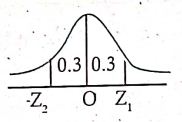
\(
\mathrm{Z}_{\mathrm{i}} =\frac{x_{2}-\mu}{\sigma}
\)
\(0.84 =\frac{x_{2}-40}{25}
\)
\(x_{2} =61
\)
\(\mathrm{Z}_{2} =\frac{x_{1}-\mu}{\sigma}
\)
\(-0.84 =\frac{x_{i}-40}{25}
\)
\(x_{2} =19
\)
60% of students score between 19 and 61.
16.
Given Sample size n = 400
Sample mean \(\\ \bar { X } =67.47\)inches
Population mean μ = 67.39 & σ = 1.30 inches)
Null Hypotheses Ho:
μ = 67.39 inches (i.e., the sample has been drawn from the population with μ = 67.39 & σ = 1.30 inches)
Alternative Hypotheses H1:
μ ≠ 67.39 inches (two tail test)
(i.e., the sample has not been drawn from the population with μ = 67.39 & σ = 1.30 inches) The level of significance a = 5% = 0.05
Applying the test statistic,
\(Z=\frac { \bar { X } -\mu }{ \frac { \sigma }{ \sqrt { n } } } \)
\(\Rightarrow Z=\frac { 67.47-67.39 }{ \frac { 1.30 }{ \sqrt { 400 } } } =\frac { 0.08 }{ 0.065 } =1.2308\)
\(\therefore |Z|=1.2308\)
The significant value \({ Z }_{ \frac { \alpha }{ 2 } }=1.96\)
Here \(Z={ Z }_{ \frac { \alpha }{ 2 } }i.e.,1.2308<1.96\)
Inference: Since \({ Z }_{ \frac { \alpha }{ 2 } }\)at 5% level of significance the null hypothesis Ho is accepted.
Hence, we conclude that the sample has been drawn from the population with mean height 67.39 inches and standard deviation 1.30 inches.
17.
18.
Given, sample size = 100, \(\bar x\) = 7.4, since σ is unknown but s = 1.2 is known.
In this problem, we consider \(\breve { \sigma } =s\quad { Z }_{ \frac { \alpha }{ 2 } }=1.96\)
\(S.E=\frac { \breve { \sigma } }{ \sqrt { n } } =\frac { s }{ \sqrt { n } } =\frac { 1.2 }{ \sqrt { 100 } } =0.12\)
Hence 95% confidence limits for the population mean are
\(\bar { x } -{ Z }_{ \frac { \alpha }{ 2 } }\frac { \sigma }{ \sqrt { n } } <\mu <\bar { x } +{ Z }_{ \frac { \alpha }{ 2 } }\frac { \sigma }{ \sqrt { n } } \)
\(7.4-(1.96\times 0.12)\le \mu \le 7.4+(1.96\times 0.12)\)
\(7.4-0.2352\le \mu \le 7.4+0.2352\)
\(7.165\le \mu \le 7.635\)
This implies that the probability that the true value of the population mean breaking strength of the cotton threads will fall in this interval (7.165,7.635) at 95%.
19.
Given μ = 68.0, σ = 3.0
(a) P(X>72)
When X = 72, Z = \(\frac { X-\mu }{ \sigma } \)
= \(\frac { 72-68 }{ 3 } =\frac { 4 }{ 3 } \) = 1.33
∴ P(X>72) = P(Z>1.33)
= P(0
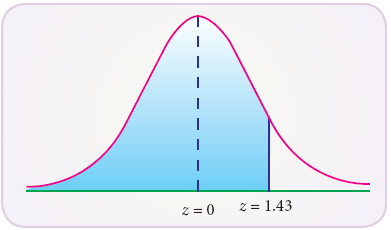
∴ Prob of 1 student having height more than 72 inches is 0.0918.
Out of 500 students, number of students having height more than 72 inches is 0.0918 x 500 = 45.9
= 0.46 (approximately).
(b) P(X ≤ 64)
When X = 64, Z = \(\frac { X-\mu }{ \sigma } \)
= \(\frac { 64-68 }{ 3 } =\frac { -4 }{ 3 } \) = -1.33
∴ P(X≤64) = P(Z≤-1.33)
= P(-∞
= 0.0918
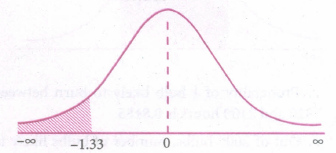
∴ Probability of 1 student having height less than 64 inches is 0.0918
∴ Out of 500 students, number of students having height less than 64 inches is = 0.0918 x 500 = 45.9 = 46 (approximately).
(c) P(65
= \(\frac { 65-68 }{ 3 } =\frac { 3 }{ 3 } \) = 1
When X = 71, Z = \(\frac { X-\mu }{ \sigma } \)
= \(\frac { 71-68 }{ 3 } =\frac { 3 }{ 3 } \) = 1
∴ P(65
= 2. P(0
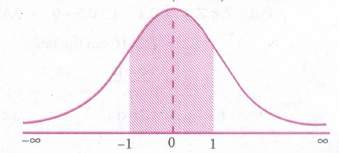
∴ Probability of 1 student having height between 65 and 71 inches is 0.6826
∴ Out of 500 students, number of students having height between 65 and 71 inches is 0.6826 x 500 = 341.37
= 342 (approximately)
20.
21.
(i) P (Exactly one defective bolt)
= P(X = 1)
= 4C1 (0.18)1 (0.82)3 [p(x) = nCx pxqn-x, n = 4, x = 1]
= 4(0.18) (0.82)3
= (0.72) (0.5513)
P(X = 1) = 0.3969
(ii) P (none will be defective)
= P(X = 0)
=4C0 (0.18)0 (0.82)4 [p(x) = nCx pxqn-x, n = 4, x = 0]
= (0.82)4
[4C0 = 1 and (0.18)0 = 1]
P(X = 0) = 0.4521.
(iii) P (atmost 2 will be defective)
= P(X≤2)
= P(X = 0) + P(X = 1) + P(X = 2)
= 0.4521 + 0.3969 + 4C2 (0.18)2 (0.82)2
= 0.849 + 6(0.18)2 (0.82)2
= 0.849 + 0.1307 = 0.9797.

12th Standard Syllabus & Materials
12th Standard
TN 12th Computer Applications வலையமைப்பு வடமிடல் Sample Question Papers Study Material - QB365 Set A
NEW12th Standard
TN 12th Computer Applications களப்பெயர் முறைமை (DNS) Sample Question Papers Study Material - QB365 Set A
NEW12th Standard
TN 12th Computer Applications வலையமைப்பு எடுத்துக்காட்டுகள் மற்றும் நெறிமுறைகள் Sample Question Papers Study Material - QB365 Set A
NEW12th Standard
TN 12th Computer Applications கணினி வலையமைப்பு ஓர் அறிமுகம் Sample Question Papers Study Material - QB365 Set A



Tamilnadu Stateboard 12th Standard Subjects

Maths

Chemistry

Physics

Biology

Computer Science
Business Maths and Statistics

Economics

Commerce

Accountancy

History

Computer Applications
Biology
Computer Technology
Computer Applications
Computer Science
Business Maths and Statistics
Commerce
Economics
Maths
Chemistry
Physics
Computer Technology
History
Accountancy

Tamil

English

French
Tamilnadu Stateboard Standards


