
12th Standard Syllabus & Materials
12th Standard
TN 12th Computer Applications மின்னணு தரவு பரிமாற்றம் Sample Question Papers Study Material - QB365 Set A
NEW12th Standard
TN 12th Computer Applications மின் - வணிக பாதுகாப்பு அமைப்புகள் Sample Question Papers Study Material - QB365 Set A
NEW12th Standard
TN 12th Computer Applications மின்னணு செலுத்தல் முறைகள் Sample Question Papers Study Material - QB365 Set A
NEW12th Standard
TN 12th Computer Applications மின் - வணிகம் Sample Question Papers Study Material - QB365 Set A
NEW12th Standard
TN 12th Computer Applications திறந்த மூல கருத்துருக்கள் Sample Question Papers Study Material - QB365 Set A
NEW12th Standard
TN 12th Computer Applications வலையமைப்பு வடமிடல் Sample Question Papers Study Material - QB365 Set A

Published on: 22/08/2026
Download Tamil Nadu 12th Standard Chemistry question papers, model tests, one-mark questions, important questions, and public exam papers in PDF format. Free study materials and answer keys for TN State Board students.
Questions + Answers key
Take MCQ Chemistry Test
1.
Which one of the following is a bio-degradable polymer?
HDPE
PVC
Nylon 6
PHBV
2.
Nylon is an example of _______.
polyamide
polythene
polyester
poly saccharide
3.
α -D (+) Glucose and β-D (+) glucose are ______.
Epimers
Anomers
Enantiomers
Conformational isomers
4.
If one strand of the DNA has the sequence ‘ATGCTTGA’, then the sequence of complementary strand would be ______.
TACGAACT
TCCGAACT
TACGTACT
TACGRAGT
5.
The pyrimidine bases present in DNA are ______.
Cytosine and Adenine
Cytosine and Guanine
Cytosine and Thiamine
Cytosine and Uracil
6.
Vitamin B2 is also known as ______.
Riboflavin
Thiamine
Nicotinamide
Pyridoxine
7.
Which one given below is a non-reducing sugar?
Glucose
Sucrose
maltose
Lactose
8.
If the initial concentration of the reactant is doubled, the time for half reaction is also doubled. Then the order of the reaction is______.
Zero
one
Fraction
none
9.
10.
For a first order reaction, the rate constant is 6.909 min-1 the time taken for 75% conversion in minutes is _______.
\(\left( \frac { 3 }{ 2 } \right) { \log 2 }\)
\(\left( \frac { 2 }{ 3 } \right) \log2\)
\(\left( \frac { 3 }{ 2 } \right) \log\left( \frac { 3 }{ 4 } \right) \)
\(\left( \frac { 2 }{ 3 } \right) \log\left( \frac { 4 }{ 3 } \right) \)
11.
The addition of a catalyst during a chemical reaction alters which of the following quantities?
Enthalpy
Activation energy
Entropy
Internal energy
12.
The most common oxidation state of actinoids is _______.
+2
+3
+4
+6
13.
Which of the following lanthanoid ions is diamagnetic?
Eu2+
Yb2+
Ce2+
Sm2+
14.
15.
The magnetic moment of Mn2+ ion is _______.
5.92BM
2.80BM
8.95BM
3.90BM
16.
Write the rate expression for the following reactions, assuming them as elementary reactions.
i) 3A + 5B2 ⟶ 4CD
ii) X2 + Y2 ⟶ 2XY
17.
Give two examples for zero order reaction.
18.
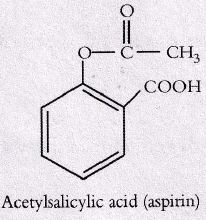
Write the structural formula of aspirin.
19.
What are antibiotics?
20.
Name the Vitamins whose deficiency cause i) rickets ii) scurvy
21.
22.
Write Arrhenius equation and explains the terms involved.
23.
Write the electronic configuration of Ce4+ and Co2+.
24.
25.
What are food preservatives?
26.
Give any three difference between DNA and RNA.
27.
Show that in case of first order reaction, the time required for 99.9% completion is nearly ten times the time required for half completion of the reaction.
28.
29.
Define rate law and rate constant.
30.
Compare lanthanoids and actinoids.
31.
Which is more stable? Fe3+ or Fe2+? Why ?
32.
Derive the integrated rate law for a first order reaction.
33.
Elucidate the structure of glucose.
1.
(d)
PHBV
2.
(a)
polyamide
3.
(b)
Anomers
4.
(a)
TACGAACT
5.
(c)
Cytosine and Thiamine
6.
(a)
Riboflavin
7.
(b)
Sucrose
8.
t1/2 α \(\frac{1}{[A_{0}]^{n-1}}\)...(1)
If [A0 = 2[A0]; then t1/2 = 2t1/2
2t1/2 α \(\frac{1}{[2A_{0}]^{n-1}}\)...(2)
(2)/(1) = \(2= \frac{1}{[2A_{0}]^{n-1}} \times \frac{1}{[A_{0}]^{n-1}}\)
\(2= \frac {[2A_{0}]^{n-1}} {[A_{0}]^{n-1}}\)
\(2= \frac {1} {2}^{n-1}\)
2 = (2-1)n-1
21 = (2-n+1)
n = 0
9.
(a)
10.
\(k=\frac { 2.303 }{ t } \log\frac { \left[ { A }_{ 0 } \right] }{ \left[ A \right] } \)
[A0] = 100: [A] = 25
\(6.909=\frac { 2.303 }{ t } \log\frac { \left[ {100 } \right] }{ \left[ 25\right] } \)
\(t =\frac { 2.303 }{ 6.909 } \log(4)\)
\(t =\frac { 1 }{ 3 } \log(2^2)\)
\(= \left( \frac { 2 }{ 3 } \right) \log2\)
11.
A catalyst provides a new path to the reaction with low activation energy. i.e., it lowers the activation energy.
12.
(b)
+3
13.
Yb2+ - 4f14 - no unpaired electrons - diamagnetic
14.
(b)
15.
Mn2+ ⇒ 3d5 contains 5 unpaired electrons
n = 5,
\( \sqrt{n(n+ 2)} \) BM
\(= \sqrt{5(5+ 2)} = \sqrt{35} = 5.92 BM\)
16.
i) 3A + 5B2 ⟶ 4CD
Rate = k[A]3 [B2]5
ii) X2 + Y2 ⟶ 2XY
Rate = k[X2 ] [Y2]
17.
1. Photochemical reaction between H2 and Cl2 ; \(\mathrm{H}_{2(\mathrm{g})}+\mathrm{Cl}_{2(\mathrm{g})} \stackrel{h v}{\longrightarrow} 2 \mathrm{HCl}_{(\mathrm{g})}\)
2. Decomposition of N2O on hot platinum surface \(\mathrm{N}_{2} \mathrm{O}_{(\mathrm{g})} \rightleftharpoons \mathrm{N}_{2(\mathrm{~g})}+\frac{1}{2} \mathrm{O}_{2(\mathrm{~g})}\)
18.
Aspirin is o-acetyl salicylic acid
19.
(i) Many micro organisms (bacteria, fungi and moulds) produce certain chemicals which inhibit the growth or metabolism of some other micro organism. Such chemicals are called antibiotics.
(ii) Eg: Penicillin from the mould penicillium notatum
20.
i) Rickets - Vitamin - D (Cholecalciferol - (D3) Ergocalciferol - (D2)
ii) Scurvy (bleeding gums) - vitamin - C (Ascorbic acid)
21.
22.
Arrhenius equation is,
\(k=Ae^\left ({ \frac { -Ea }{ RT } } \right )\)
Here,
A \(\rightarrow\) Frequency factor
Ea \(\rightarrow\) Activation energy of the reaction
R \(\rightarrow\) Gas constant
T \(\rightarrow\) Absolute temperature (in K)
23.
Electronic configuration of Ce4+ = [Xe] 4f05d06s0
Electronic configuration of Co2+ = [Ar]3d7
24.

.JPG)
25.
(i) Preservatives are chemicals added to food which are capable of inhibiting, retarding or arresting the process of fermentation, acidification or other decomposition of food by the growth of micro organisms (or)
(ii) Chemical substances which are added to food that prevents the spoilage of food materials by destroying the food - spoiling micro-organisms are called food preservatives.
(iii) Eg: sodium benzoate, NaCl, Acetic acid Sodium metabisulphite, potassium meta bisulphite etc.
26.
| DNA | RNA |
|---|---|
| DNA is mainly present in nucleus, mitochondria and chloroplast | RNA is mainly present in cytoplasm, nucleolus and ribosomes |
| It contains deoxyribose sugar | It contains ribose sugar |
| Base pair A = T. G≡C | Base pair A = U. C≡G |
| Double stranded molecules | Single stranded molecules |
| It's life time is high | It is short lived |
| It is stable and not hydrolysed easily by alkalis | It is unstable and hydrolyzed easily by alkalis |
| It can replicate itself | It cannot replicate itself It is formed from DNA |
27.
Let [A0] = 100;
When t = t99.9%; [A] = (100-99.9) = 0.1
\(k=\frac { 2.303 }{ t } \log\left( \frac { [{ A }_{ 0 }] }{ [A] } \right) \)
\({ t }_{ 99.9\% }=\frac { 2.303 }{ K } \log\left( \frac { 100 }{ 0.1 } \right) \)
\({ t }_{ 99.9\% }=\frac { 2.303 }{ K } \log1000\)
\({ t }_{ 99.9\% }=\frac { 2.303 }{ K } (3)\)
\({ t }_{ 99.9\% }=\frac { 6.909 }{ K } \)
\({ t }_{ 99.9\% }=10\times \frac { 0.69 }{ K } \)
\({ t }_{ 99.9\% }={ 10 } t_{ 1/2 }\)
28.
29.
Rate law:
(i) Rate law or rate equation is an expression which relates the rate of a reaction with rate constant and the concentration of reactants.
(ii) For xA + yB → products
(iii) The rate law is r = k[A]m[B]n
Rate constant:
(i) It is the rate of the reaction when the concentration of the reactants are taken unity.
In above rate law if[A] = [B] = 1, rate constant k = Rate
30.
| S.No | Lanthanoids | Actinoids |
|---|---|---|
| 1. | Differentiating electron enters in 4f orbital | Differentiating electron enters in 5f orbital |
| 2. | Binding energy of 4f orbitals are higher | Binding energy of 5f orbitals are lower |
| 3. | They show less tendency to form complexes | They show greater tendency to form complexes |
| 4. | Most of the lanthanoids are colourless | Most of the actinoids are coloured For Example: U3+ (red) U4+ (green). |
| 5. | They do not form oxo cations | They do form oxo cations such as UO22+, NpO22++ etc. |
| 6. | Besides +3 oxidation states lanthanoids show +2 and +4 oxidation states in few cases | Besides +3 oxidation states actinoids show higher oxidation states such as +4, +5, +6 and +7 |
31.
(i) Fe3+ - electronic configuration - [Ar] 3d5
(ii) It has exactly half-filled stable electronic configuration.
(iii) Fe2+ - electronic configuration -[Ar]3d6
(iv) It has only partially filled d-orbitals.
Hence Fe3+ is more stable than Fe2+.
32.
A reaction whose rate depends on the reactant concentration raised to the first power is called a first order reaction. Let us consider the following Cl2 first order reaction,
A → product
Rate law can be expressed as
Rate = k[A]1
Where, k is the first order rate constant
\(\frac{-\mathrm{d}[\mathrm{A}]}{\mathrm{dt}}=\mathrm{k}[\mathrm{A}]^{1} \)
\(\Rightarrow \frac{-\mathrm{d}[\mathrm{A}]}{[\mathrm{A}]}=\mathrm{kdt}\) .....(1)
Integrate the above equation between the limits of time t = 0 and time equal to t, while the concentration varies from the initial concentration [A0] to [A] at the later time.
\(\int_{\left[A_{0}\right]}^{[A]} \frac{-d[A]}{[A]}=k \int_{0}^{t} d t \)
\((-\ln [A])_{\left[A_{0}\right]}^{[A]}=k(t)_{0}^{t} \)
\(-\ln [A]-\left(-\ln \left[A_{0}\right]\right)=k(t-0) \)
\(-\ln [\mathrm{A}]+\ln \left[\mathrm{A}_{0}\right]=\mathrm{kt} \)
\(\ln \left(\frac{\left[\mathrm{A}_{0}\right]}{[\mathrm{A}]}\right)=\mathrm{kt}\) .....(2)
This equation is in natural logarithm. To convert it into usual logarithm with base 10, we have to multiply the term by 2.303.
\(2.303 \log \left(\frac{\left[A_{0}\right]}{[A]}\right)=k t \)
\(k=\frac{2.303}{t} \log \left(\frac{\left[A_{0}\right]}{[A]}\right)\) .....(3)
33.
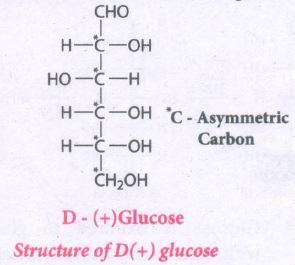
Structure of glucose: Glucose is an aldohexose. It is optically active with four asymmetric carbons. Its solution is dextrorotatory and hence it is also called as dextrose. The proposed structure of glucose is shown in the figure which was derived based on the following evidences
(i) Elemental analysis and molecular weight determination show that the molecular formula of glucose is C6H120 6'
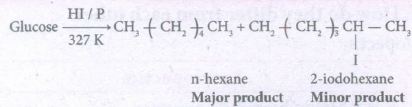
(ii) On reduction with concentrated HI and red phosphorus at 373K, glucose gives a mixture of n hexane and 2, iodohexane indicating that the six carbon atoms are bonded linearly.
(iii) Glucose reacts with hydroxylamine to form oxime and with HCN to form: cyanohydrin. These reactions indicate the I presence of carbonyl group in glucose
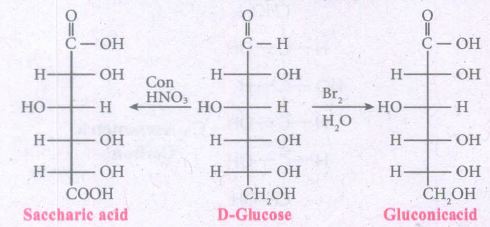
(v) Glucose is oxidised to gluconic acid with ammonical silver nitrate (Tollen's reagent) and alkaline copper sulphate (Fehling's solution). Tollens reagent is I reduced to metallic silver and Fehlings I solution to cuprous oxide which appears as red precipitate. These reactions further: confirm the presence of an aldehyde group
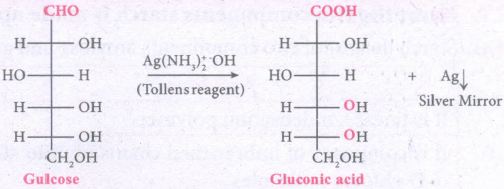
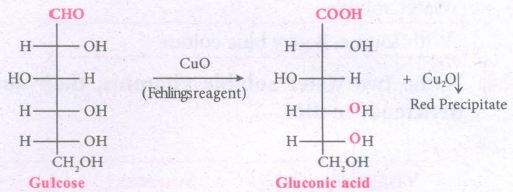
(vi) Glucose forms penta acetate with acetic anhydride suggesting the presence of five alcohol groups.
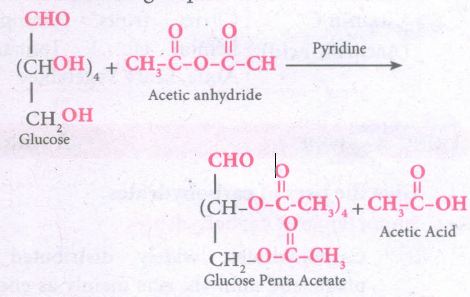
(vii) Glucoseis a stable compound and does not undergo dehydration easily. It indicates that not more than orie hydroxyl group is bonded to a single carbon atom. Thus the five hydroxyl groups are attached to five different carbon atoms and the sixth carbon is an aldehyde group.

12th Standard Syllabus & Materials
12th Standard
TN 12th Computer Applications களப்பெயர் முறைமை (DNS) Sample Question Papers Study Material - QB365 Set A
NEW12th Standard
TN 12th Computer Applications வலையமைப்பு எடுத்துக்காட்டுகள் மற்றும் நெறிமுறைகள் Sample Question Papers Study Material - QB365 Set A
NEW12th Standard
TN 12th Computer Applications கணினி வலையமைப்பு ஓர் அறிமுகம் Sample Question Papers Study Material - QB365 Set A
NEW12th Standard
TN 12th Computer Applications PHP-உடன் MySQL-ஐ இணைத்தல் Sample Question Papers Study Material - QB365 Set A



Tamilnadu Stateboard 12th Standard Subjects

Maths
Chemistry

Physics

Biology

Computer Science

Business Maths and Statistics

Economics

Commerce

Accountancy

History

Computer Applications
Biology
Computer Technology
Computer Applications
Computer Science
Business Maths and Statistics
Commerce
Economics
Maths
Chemistry
Physics
Computer Technology
History
Accountancy

Tamil

English

French
Tamilnadu Stateboard Standards


