
 100% FREE ACCESS
12th Standard Syllabus & Materials
12th Standard
TN 12th Computer Applications மின்னணு தரவு பரிமாற்றம் Sample Question Papers Study Material - QB365 Set A
NEW12th Standard
TN 12th Computer Applications மின் - வணிக பாதுகாப்பு அமைப்புகள் Sample Question Papers Study Material - QB365 Set A
NEW12th Standard
TN 12th Computer Applications மின்னணு செலுத்தல் முறைகள் Sample Question Papers Study Material - QB365 Set A
NEW12th Standard
TN 12th Computer Applications மின் - வணிகம் Sample Question Papers Study Material - QB365 Set A
NEW12th Standard
TN 12th Computer Applications திறந்த மூல கருத்துருக்கள் Sample Question Papers Study Material - QB365 Set A
NEW12th Standard
TN 12th Computer Applications வலையமைப்பு வடமிடல் Sample Question Papers Study Material - QB365 Set A

Published on: 28/11/2025
Download Tamil Nadu 12th Standard Chemistry question papers, model tests, one-mark questions, important questions, and public exam papers in PDF format. Free study materials and answer keys for TN State Board students.
Questions + Answers key
Take MCQ Chemistry Test
1.
The charges on the sol particles can be determined by _______.
Tyndall effect
Brownian
electrophoresis
none
2.
\(\alpha=\frac{\Lambda_{\mathrm{m}}}{\Lambda_{\mathrm{m}}^{0}}\) is called _______.
dissociation constant
Degree of dissociation
Ionisation Constant
Degree of hydrolysis
3.
Which of the following is Secondary cell?
Laclanche cell
Lithium ion battery
Mercury button cell
both (a) and (c)
4.
The conjugate base of OH- is _______.
O2
O2-
O-
H2O
5.
The thermal decomposition of HI on gold surface is an example for this order reaction ______.
second
Zero
first
third
6.
The percentage of free space in simple cubic arrangement is _______.
47.69%
28%
26.52%
34.75%
7.
To get pure alumina Al2O3, Sodium meta aluminate is neutralised by _______.
H2SO4
HCI
NaOH
CO2
8.
The preliminary step in metallurgical process is ________.
Roasting
Concentration of ore
Calcination
Smelting
9.
_______ is the reciprocal of resistance.
specific conductance
molar conductance
specific resistance
conductance
10.
Low molar conductivity at high concentration is due to _______.
High attractive force between oppositely charged ions
Viscous drag due to greater solvation
Both High attractive force between oppositely charged ions and Viscous drag due to greater solvation
Neither High attractive force between oppositely charged ions and Viscous drag due to greater solvation
11.
An example for 1 : 1 electrolyte is ______.
H2SO4
Na2SO4
NaCI
Al2(SO4)3
12.
Which among the following is the strongest reducing agent?
F2
Cl2
Zn
Li
13.
Hydrogenation of benzoyl chloride in the presence of Pd on BaSO4 gives _______.
phenol
benzoic acid
benzyl alcohol
benzaldehyde
14.
Schiff's reagent gives pink colour with _______.
acetone
acetaldehyde
ethyl alcohol
methyl acetate
15.
______enzyme hydrolyses starch into maltose.
pepsin
diastase
zymase
urease
16.
The iron catalyst used in the synthesis of ammonia in Haber's process is poisoned by _______.
AS2O3
V2O5
H25
Glycerine
17.
Henderson equation for a weak acid and its salt is _______.
pH = pKb+ log (Salt) / (Acid)
pH = pKa + log (Salt) / (Acid)
pH = pKa + log (Salt) / (Base)
pH = pKa + log (Acid) / (Salt)
18.
_______ is used as an antifreeze in automobiles radiators.
Ethanol
Propanol
Methanol
Benzyl alcohol
19.
Formation of o and p - hydroxy benzaldehyde from phenol on treatment with CHCl3 and NaOH is _______.
Riemer-Tiemann reaction
Kolbe's reaction
Coupling reaction
Hydrogenation
20.
Ionic product of water increases when _______.
Pressure decreases
H+ ions are added
OH- ions are added
temperature increases
21.
Alcohols are soluble in polar solvents like water due to ______.
intermolecular hydrogen bonding
intramolecular hydrogen
co-ordiate bonding
ionic bonding
22.
Which type of colloid is a sol?
Solid in liquid
Liquid in solid
Soild in solid
Gas in solid
23.
The ionization constant of phenol is higher than that of ethanol because ______.
phenoxide ion is bulkier than ethoxide
phenoxide ion is stronger base than ethoxide.
phenoxide ion is stablized through delocalisation.
phenoxide ion is less stable than ethoxide ion.
24.
The major product of the following reaction
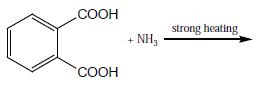
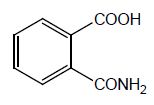
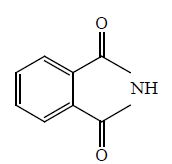
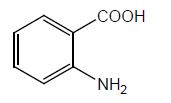
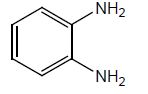
25.
C6H5NO2 \(\overset { Fe/Hel }{ \longrightarrow } A\overset { { NaNO }_{ 2 }/HCl }{ \underset { 273K }{ \longrightarrow } } B\overset { { H }_{ 2 }O }{ \underset { 283 }{ \longrightarrow } } C \) C' is _______.
C6H5 - OH
C6H5 - CH2OH
C6H5 - COH
C6H5NH2
26.
27.
Aniline + benzoylchloride \(\overset { NaOH }{ \longrightarrow } \)C6H5 - NH - COC6 H5 this reaction is known as ______.
Friedel – crafts reaction
HVZ reaction
Schotten – Baumann reaction
none of these
28.
Which one of the following will not undergo Hofmann bromamide reaction.
CH3CONHCH3
CH3CH2CONH2
CH3CONH2
C6H5CONH2
29.
The reagent used to distinguish between acetaldehyde and benzaldehyde is _______.
Tollens reagent
Fehling’s solution
2,4 – dinitrophenyl hydrazine
semicarbazide
30.
CH3Br \(\overset { KCN }{ \longrightarrow } (A)\overset { { H }_{ 2 }{ O }^{ + } }{ \longrightarrow } (B)\overset { { PCl }_{ 5 } }{ \longrightarrow } \) (C) product (c) is ______.
acetylchloride
chloro acetic acid
\(\alpha\)- chlorocyano ethanoic acid
none of these
31.
The reactions
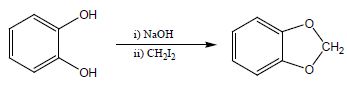 is an example of ______.
Wurtz reaction
cyclic reaction
Williamson reaction
Kolbe reactions
32.
Which one of the following will react with phenol to give salicyladehyde after hydrolysis.
Dichlo methane
trichloroethane
trichloro methane
CO2
33.
34.
The coagulation values in millimoles per litre of the electrolytes used for the coagulation of As2S3 are given below
(I) (NaCl) = 52
(II) ((BaCl2) = 0.69
(III) (MgSO4) = 0.22
The correct order of their coagulating power is ________.
III > II > I
I > II > III
I > III > II
II > III > I
35.
36.
Hair cream is _____.
gel
emulsion
solid sol
sol.
37.
A gas X at 1 atm is bubbled through a solution containing a mixture of 1MY- and 1MZ- at 25oC. If the reduction potential of Z>Y>X, then_____.
Y will oxidize X and not Z
Y will oxidize Z and not X
Y will oxidize both X and Z
Y will reduce both X and Z
38.
Among the following cells
I) Leclanche cell
II) Nickel – Cadmium cell
III) Lead storage battery
IV) Mercury cell
Primary cells are ____.
I and IV
I and III
III and IV
II and III
39.
During electrolysis of molten sodium chloride, the time required to produce 0.1mole of chlorine gas using a current of 3A is _____.
55 minutes
107.2 minutes
220 minutes
330 minutes
40.
H2PO4- the conjugate base of _______.
PO43−
P2O5
H3PO4
HPO42-
41.
Which of these is not likely to act as Lewis base?
BF3
PF3
CO
F–
42.
pH of a saturated solution of Ca(OH)2 is 9. The Solubility product (Ksp) of Ca(OH)2 _______.
0.5 × 10⁻¹⁵
0.25 × 10⁻¹⁰
0.125 × 10⁻¹⁵
0.5 × 10⁻¹⁰
43.
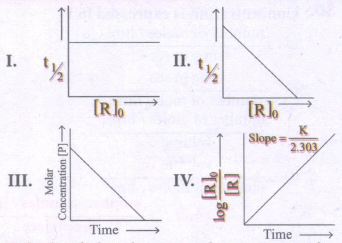
Which of the above graphs is correct for first order reactions?
I, II
II, III
I, IV
I, III
44.
A reaction having equal activation energies for forward and reverse reactions has ______.
ΔG = 0
ΔH = 0
ΔH = ΔG = ΔS = 0
ΔS = 0
45.
In an hexagonal crystal _______.
a=b=c,∝ =β=૪=90°
a=b=c,∝ =β=૪≠90°
a=b≠c,∝ =β=૪=90°
a=b≠c,∝ =β=90°૪=120°
46.
A regular three dimensional arrangement of identical points in space is called _______.
Unit cell
Space lattice
Primitive
Crystallography
47.
Which of the following is characteristic of ionic solids?
Very low value of electrical conductivity in the molten state
Brittle nature
Very strong forces of attractions
Anisotropic nature
48.
Which of the following defects decreases the density of the crystal?
Interstitial defect
Vacancy defect
Frankel defect
None of these above
49.
Semiconductors are purified by_______ method.
Zone refining
Electrolytic refining
Mond's process
Bessemerisation
50.
Malachite has______ composition.
2CuCO3.Cu(OH)2
CuCO3.Cu(OH)2
Cu2O
Cu2S
51.
In the froth-floatation process the collectors such as pine oil and xanthates, etc enhance.
Non-wettability of the mineral particles in froth.
Non-wettability of the mineral particles in water
Non-wettability of the gangue particles in froth
Non-wettability of the gangue particles in water
52.
The correct difference between first and second order reactions is that________.
A first order reaction can be catalysed; a second order reaction cannot be catalysed.
The half life of a first order reaction does not depend on [A0]; the half life of a second order reaction does depend on [A0].
The rate of a first order reaction does not depend on reactant concentrations; the rate of a second order reaction does depend on reactant concentrations.
The rate of a first order reaction does depend on reactant concentrations; the rate of a second order reaction does not depend on reactant concentrations.
53.
For a first order reaction, the rate constant is 6.909 min-1 the time taken for 75% conversion in minutes is _______.
\(\left( \frac { 3 }{ 2 } \right) { \log 2 }\)
\(\left( \frac { 2 }{ 3 } \right) \log2\)
\(\left( \frac { 3 }{ 2 } \right) \log\left( \frac { 3 }{ 4 } \right) \)
\(\left( \frac { 2 }{ 3 } \right) \log\left( \frac { 4 }{ 3 } \right) \)
54.
For a reaction Rate = k[acetone]3/2 then unit of rate constant and rate of reaction respectively is _______.
(mol L-1 S-1),(mol1/2 L1/2 S-1)
(mol-1/2 L1/2 s-1),(mol L-1 s-1)
(mol1/2 L1/2 s-1),(mol L-1 s-1)
(mol L s-1),(mol1/2 L1/2 s)
55.
The crystal with a metal deficiency defect is ________.
NaCl
FeO
ZnO
KCl
56.
The yellow colour in NaCl crystal is due to ________.
excitation of electrons in F centers
reflection of light from Cl- ion on the surface
refraction of light from Na+ ion
all of the above
57.
The ratio of close packed atoms to tetrahedral hole in cubic packing is ________.
1:1
1:2
2:1
1:4
58.
In the Ellingham diagram, for the formation of carbon monoxide________.
\(\left( \cfrac { \Delta { S }^{ 0 } }{ \Delta T } \right) \) is negative
\(\left( \cfrac { \Delta { G }^{ 0 } }{ \Delta T } \right) \) is positive
\(\left( \cfrac { \Delta { G }^{ 0 } }{ \Delta T } \right) \) is negative
initially \(\left( \cfrac { \Delta T }{ \Delta { G }^{ 0 } } \right) \) is positive, after 700oC,\(\left( \cfrac { \Delta { G }^{ 0 } }{ \Delta T } \right) \) is negative
59.
Electrochemical process is used to extract_______.
Iron
Lead
Sodium
silver
60.
Roasting of sulphide ore gives the gas (A).(A) is a colourless gas. Aqueous solution of (A) is acidic. The gas (A) is______.
CO2
SO3
SO2
H2S
1.
(c)
electrophoresis
2.
(b)
Degree of dissociation
3.
(b)
Lithium ion battery
4.
(b)
O2-
5.
(b)
Zero
6.
(a)
47.69%
7.
(d)
CO2
8.
(b)
Concentration of ore
9.
(d)
conductance
10.
(c)
Both High attractive force between oppositely charged ions and Viscous drag due to greater solvation
11.
(c)
NaCI
12.
(d)
Li
13.
(d)
benzaldehyde
14.
(b)
acetaldehyde
15.
(b)
diastase
16.
(c)
H25
17.
(b)
pH = pKa + log (Salt) / (Acid)
18.
(c)
Methanol
19.
(a)
Riemer-Tiemann reaction
20.
(d)
temperature increases
21.
(a)
intermolecular hydrogen bonding
22.
(a)
Solid in liquid
23.
(c)
phenoxide ion is stablized through delocalisation.
24.
(b)
25.
(a)
C6H5 - OH
26.
(d)
27.
(c)
Schotten – Baumann reaction
28.
(a)
CH3CONHCH3
29.
(b)
Fehling’s solution
30.

31.
(c)
Williamson reaction
32.
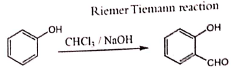
trichloro methane
33.
(c)
34.
coagulating power ∝ 1/coagulation value
35.
(b)
36.
Emulsion-Dispersed phase
Dispersion meduun -liquid
37.
Z is tie strongest oxidising agent (High SRP)
X is the strongest reducing agent (Low SRP)
38.
(a)
I and IV
39.
mass of 1 mole of CI2 gas = 71
∴ mass of 0.1 mole of Cl2 gas = 7.1 g mol-1
m = Zlt
t = m/ZI
\(= \frac{7.1}{\frac{71}{2 \times 96500} \times 3}\) (2Cl- ➝ Cl2 + 2e-)
\(= \frac{2 \times 96500 \times 7.1}{71 \times 3}\)
= 6433.33s = 107.2 min
40.
H3PO4 + H - OH ⇌ H3O+ + H2PO4-
acid 1 base 1 acid 2 base 2
\(\therefore\) H2PO4- the conjugate base of H3PO4
41.
BF3 → electron deficient → Lewis acid
PF3 → electron rich → Lewis base
CO → having lone pair of electron → Lewis base
F → unshared pair of electron → Lewis base
42.
Ca(OH)2 ⇌ Ca2+ + 2OH-
Given that pH = 9
pOH = 14 - 9 = 5
[pOH = - log10 [OH]]
[OH-] = 10 [pOH]
[OH] = 10-5 M
Ksp = [Ca2+] [OH-]
= 10-5/2 x (10-5)2 = 0.5 x 10⁻¹⁵
43.
(c)
I, IV
44.
(b)
ΔH = 0
45.
(d)
a=b≠c,∝ =β=90°૪=120°
46.
(b)
Space lattice
47.
(c)
Very strong forces of attractions
48.
(b)
Vacancy defect
49.
(a)
Zone refining
50.
(b)
CuCO3.Cu(OH)2
51.
(b)
Non-wettability of the mineral particles in water
52.
\({ t }_{ 1/2 }=\frac { 0.6932 }{ k } \)
For a second order reaction
\(\mathrm{t}_{1 / 2}=\frac{2^{\mathrm{n}-1}-1}{(\mathrm{n}-1) \mathrm{k} \cdot\left[\mathrm{A}_{0}\right]^{\mathrm{n}-1}}\)
n = 2
\(\mathrm{t}_{1 / 2}=\frac{2^{\mathrm{2}-1}-1}{(\mathrm{n}-1) \mathrm{k} \cdot\left[\mathrm{A}_{0}\right]^{\mathrm{2}-1}}\)
\(\mathrm{t}_{1 / 2} =\frac{1}{ \mathrm{k}\left[\mathrm{A}_{0}\right]}\)
53.
\(k=\frac { 2.303 }{ t } \log\frac { \left[ { A }_{ 0 } \right] }{ \left[ A \right] } \)
[A0] = 100: [A] = 25
\(6.909=\frac { 2.303 }{ t } \log\frac { \left[ {100 } \right] }{ \left[ 25\right] } \)
\(t =\frac { 2.303 }{ 6.909 } \log(4)\)
\(t =\frac { 1 }{ 3 } \log(2^2)\)
\(= \left( \frac { 2 }{ 3 } \right) \log2\)
54.
Rate = k[A]n
Rate = \(\frac{-\mathrm{d}[\mathrm{A}]}{\mathrm{dt}}\)
unit of rate = \(\frac{mol L^{-1}}{s}\)=mol L-1/s-1
unit of rate constant
\(=\frac{ (mol{ L }^{ -1 }{ S }^{ -1 }) }{ ({ mol }{ L }^{ -1 })^n } \)
= mol1-nLn-1s-1
in the case
rate = k [Acetone]3/2
n = 3/2
= mol1-(3/2)L(3/2)-1s-1
(mol-(1/2) L(1/2) s-1).
55.
(b)
FeO
56.
(a)
excitation of electrons in F centers
57.
If number of close packed atoms = N, then
The number of Tetrahedral holes formed = 2N
The number of Octahedral holes formed = N
Therefore, N:2N = 1:2
58.
(c)
\(\left( \cfrac { \Delta { G }^{ 0 } }{ \Delta T } \right) \) is negative
59.
(c)
Sodium
60.
(c)
SO2

12th Standard Syllabus & Materials
12th Standard
TN 12th Computer Applications களப்பெயர் முறைமை (DNS) Sample Question Papers Study Material - QB365 Set A
NEW12th Standard
TN 12th Computer Applications வலையமைப்பு எடுத்துக்காட்டுகள் மற்றும் நெறிமுறைகள் Sample Question Papers Study Material - QB365 Set A
NEW12th Standard
TN 12th Computer Applications கணினி வலையமைப்பு ஓர் அறிமுகம் Sample Question Papers Study Material - QB365 Set A
NEW12th Standard
TN 12th Computer Applications PHP-உடன் MySQL-ஐ இணைத்தல் Sample Question Papers Study Material - QB365 Set A



Tamilnadu Stateboard 12th Standard Subjects

Maths
Chemistry

Physics

Biology

Computer Science

Business Maths and Statistics

Economics

Commerce

Accountancy

History

Computer Applications
Biology
Computer Technology
Computer Applications
Computer Science
Business Maths and Statistics
Commerce
Economics
Maths
Chemistry
Physics
Computer Technology
History
Accountancy

Tamil

English

French
Tamilnadu Stateboard Standards


