
12th Standard Syllabus & Materials
12th Standard
TN 12th Computer Applications மின்னணு தரவு பரிமாற்றம் Sample Question Papers Study Material - QB365 Set A
NEW12th Standard
TN 12th Computer Applications மின் - வணிக பாதுகாப்பு அமைப்புகள் Sample Question Papers Study Material - QB365 Set A
NEW12th Standard
TN 12th Computer Applications மின்னணு செலுத்தல் முறைகள் Sample Question Papers Study Material - QB365 Set A
NEW12th Standard
TN 12th Computer Applications மின் - வணிகம் Sample Question Papers Study Material - QB365 Set A
NEW12th Standard
TN 12th Computer Applications திறந்த மூல கருத்துருக்கள் Sample Question Papers Study Material - QB365 Set A
NEW12th Standard
TN 12th Computer Applications வலையமைப்பு வடமிடல் Sample Question Papers Study Material - QB365 Set A

Published on: 22/08/2026
Download Tamil Nadu 12th Standard Chemistry question papers, model tests, one-mark questions, important questions, and public exam papers in PDF format. Free study materials and answer keys for TN State Board students.
Questions + Answers key
Take MCQ Chemistry Test
1.
Which one of the following reaction is an example of disproportionation reaction.
Aldol condensation
cannizaro reaction
Benzoin condensation
none of these
2.
Which one of the following reduces tollens reagent
formic acid
acetic acid
benzophenone
none of these
3.
In the following reaction, \(HC\equiv CH \overset { { H }_{ 2 }{ SO }_{ 4 } }{ \underset { HgS{ O }_{ 4 } }{ \longrightarrow } } X\) Product ‘X’ will not give _______.
Tollen’s test
Victor meyer test
Iodoform test
Fehling solution test
4.
Which of the following fluro compounds is most likely to behave as a Lewis base?
BF3
PF3
CF4
SiF4
5.
Conjugate base for Bronsted acids H2O and HF are _______.
OH- and H2FH+, respectively
H3O+ and F-, respectively
OH- and F-, respectively
H3O+ and H2F+, respectively
6.
pH of a saturated solution of Ca(OH)2 is 9. The Solubility product (Ksp) of Ca(OH)2 _______.
0.5 × 10⁻¹⁵
0.25 × 10⁻¹⁰
0.125 × 10⁻¹⁵
0.5 × 10⁻¹⁰
7.
Which of the following oxidation states is most common among the lanthanoids?
+4
+2
+5
+3
8.
9.
Which one of the following ions has the same number of unpaired electrons as present in V3+?
Ti3+
Fe3+
Ni2+
Cr3+
10.
Which of the following d block element has half filled penultimate d sub shell as well as half filled valence sub shell?
Cr
Pd
Pt
none of these
11.
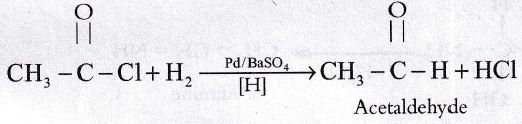
What is Rosenmund reduction?
12.
Write two tests of carboxylic acid.
13.
Write the structures of A and B in the following reaction. Name the reaction involved.
\({ CH }_{ 3 }COCl\overset { pd/Ba{ SO }_{ 4 } }{ \underset { { H }_{ 2 } }{ \longrightarrow } } A\overset { { NH }_{ 2 }OH }{ \longrightarrow } B\)
14.
15.
What are Lewis acids and bases? Give two example for each.
16.
Write the electronic configuration of Ce4+ and Co2+.
17.
What are interstitial compounds?
18.
How will you prepare benzoic acid using Grignard reagent.
19.
Write the pH value of the following substances:
A) Vinegar
B) Black coffee
C) Baking soda
D) Soapy water
20.
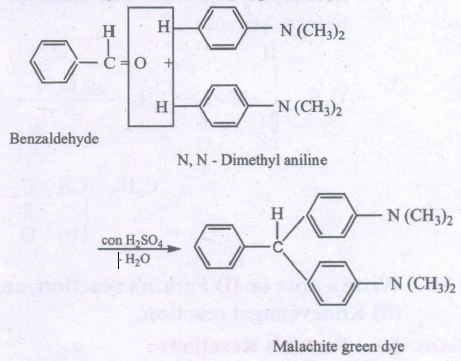
What is Malachite green dye? Explain its preparation?
21.
Write the expression for the solubility product of Ca3(PO4)2
22.
Calculate the pH of 1.5\(\times\)10-3 M solution of Ba(OH)2
23.
Compare lanthanoids and actinoids.
24.
Which is more stable? Fe3+ or Fe2+? Why ?
25.
26.
27.
Describe the preparation of potassium dichromate.
28.
Discuss the mechanism of aldol condensation.
29.
Derive an expression for Ostwald’s dilution law.
1.
(b)
cannizaro reaction
2.

3.
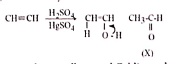
4.
BF3 → electron deficient → Lewis acid
PF3 → electron rich → Lewis base
CF4 → neutral → neither Lewis acid nor base
SiF4 → neutral → neither Lewis acid nor base
5.
H2O + H2O ⇌ H3O+ + OH-
acid 1 base 1 acid 2 base 2
HF + H2O ⇌ H3O+ + F-
acid 1 base 1 acid 2 base 2
∴ Conjugate bases are OH- and F- respectively.
6.
Ca(OH)2 ⇌ Ca2+ + 2OH-
Given that pH = 9
pOH = 14 - 9 = 5
[pOH = - log10 [OH]]
[OH-] = 10 [pOH]
[OH] = 10-5 M
Ksp = [Ca2+] [OH-]
= 10-5/2 x (10-5)2 = 0.5 x 10⁻¹⁵
7.
(d)
+3
8.
(b)
9.
(c)
Ni2+
10.
Cr ⇒ [Ar]3d54s1
11.
Aldehydes can be prepared by the hydrogenation of acid chloride, in the presence of Pd supported by barium sulphate
12.
(i) Aqueous solution of carboxylic acids turn blue litmus into red colour.
(ii) Carboxylic acids give brisk effervescence with sodium bicarbonate due to the I evolution of CO2,
13.
\(\underset { acetylhloride }{ { CH }_{ 3 }COCl } \overset { { H }_{ 2 }/Pd/Ba{ SO }_{ 4 } }{ \longrightarrow } \underset { Acetaldehude(A) }{ { CH }_{ 3 }CHO } \)
This reaction is Rosenmund reduction.
\({ CH }_{ 3 }CHO\overset { { NH }_{ 2 }OH }{ \underset { -{ { H }_{ 2 }O } }{ \longrightarrow } } \underset { Acetaldoxime }{ { CH }_{ 3 }CH=NOH } \)
The above reaction is nucleophilic addition reaction followed by elimination of water.
14.
15.
(i) Lewis acid: It is a species that accepts an electron pair. Eg: \(\mathrm{Ag}^{+} ; \mathrm{BF}_{3} ; \mathrm{A} / \mathrm{Cl}_{3}\)
(ii) Lewis base: It is a species that donates an electron pair. Eg: \( \mathrm{Cl}^{-} ; \mathrm{NH}_{3} ; \mathrm{H}_{2} \mathrm{O}\)
16.
Electronic configuration of Ce4+ = [Xe] 4f05d06s0
Electronic configuration of Co2+ = [Ar]3d7
17.
An interstitial compound or alloy is a compound that is formed when small atoms like hydrogen, boron, carbon or nitrogen are trapped in the interstitial holes in a metal lattice. They are usually non-stoichiometric compounds. Transition metals form a number of interstitial compounds such as TiC, ZrH1.92, Mn4N etc.
Properties of interstitial compound
(i) They are hard and show electrical and thermal conductivity.
(ii) They have high melting points higher than those of pure metals.
(iii) Transition metal hydrides are used as powerful reducing agents
(iv) Metallic carbides are chemically inert.
18.
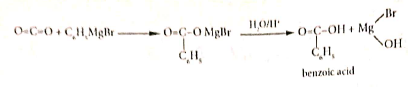
19.
| Substance | pH value | ||
| A | Vinegar | < 7 | 2 |
| B | Black coffee | < 7 | 5 |
| C | Baking soda | > 7 | 9 |
| D | Soapy water | > 7 | 12 |
20.
Benzaldehyde condenses with tertiary aromatic amines like N, N - dimethyl aniline in the presence of strong acids to from triphenyl methane dye or malachite green dye.
21.
\(\mathrm{Ca}_{3}\left(\mathrm{PO}_{4}\right)_{2} \rightleftharpoons 3 \mathrm{Ca}^{2+}_{(aq)}+2 \mathrm{PO}_{4_{(aq)}}^{3-}\\\)
(s) (3s) (2s)
\(K_{sp}=[Ca^{2+}]^{3}[PO_{4}^{3-}]^{2}\)
\(K_{sp}=(3s)^{3}(2s)^{2}\)
\(K_{sp}=27s^{3}.4s^{2}\)
\(K_{sp}=108s^{5}\)
(or)
\(K_{s p} =m^{m} \cdot n^{n} \cdot(s)^{m+n} \)
\(K_{\text {sp }} =3^{3} \cdot 2^{2} \cdot(s)^{3+2} \)
\(K_{s p} =27 \times 4 \times(s)^{5} \)
\(=108(s)^{5}=108 s^{5}\)
22.
Considering Ba(OH)2 to be a strong base:
\(\text { Normality } =\text { Molarity } \times \text { Acidity } \)
\(=1.5 \times 10^{-3} \times 2\)
\({\left[\mathrm{OH}^{-}\right] } =3 \times 10^{-3} \)
\(\mathrm{pOH} =-\log _{10}[\mathrm{OH}^-] \)
\(=-\log _{10}\left(3 \times 10^{-3}\right) \)
\(=-\left[\log _{10} 3+3 \log 10\right] \)
= 3-log 3
= 3-0.4771
= 2.5229
\(\mathrm{pH} =14-\mathrm{pOH} \)
= 14-2.5229
pH = 11.4771 = 11.48
23.
| S.No | Lanthanoids | Actinoids |
|---|---|---|
| 1. | Differentiating electron enters in 4f orbital | Differentiating electron enters in 5f orbital |
| 2. | Binding energy of 4f orbitals are higher | Binding energy of 5f orbitals are lower |
| 3. | They show less tendency to form complexes | They show greater tendency to form complexes |
| 4. | Most of the lanthanoids are colourless | Most of the actinoids are coloured For Example: U3+ (red) U4+ (green). |
| 5. | They do not form oxo cations | They do form oxo cations such as UO22+, NpO22++ etc. |
| 6. | Besides +3 oxidation states lanthanoids show +2 and +4 oxidation states in few cases | Besides +3 oxidation states actinoids show higher oxidation states such as +4, +5, +6 and +7 |
24.
(i) Fe3+ - electronic configuration - [Ar] 3d5
(ii) It has exactly half-filled stable electronic configuration.
(iii) Fe2+ - electronic configuration -[Ar]3d6
(iv) It has only partially filled d-orbitals.
Hence Fe3+ is more stable than Fe2+.
25.
26.
27.
Potassium permanganate is prepared from pyrolusite (MnO2).
(i) Conversion of (MnO2) to potassium manganate
Powdered ore is fused with KOH in the presence of air, green coloured potassium manganate is formed.
\(2 \mathrm{MnO}_{2}+4 \mathrm{KOH}+\mathrm{O}_{2} \rightarrow 2 \mathrm{~K}_{2} \mathrm{MnO}_{4}+2 \mathrm{H}_{2} \mathrm{O}\\ \quad \quad \quad \quad \quad \quad \quad \quad \quad \quad Potassium \ manganate \ (green)\)
(ii) Oxidation of potassium manganate to (O3) potassium permanganate
(a) Chemical oxidation
In this method, potassium manganate is treated with ozone (O3) or chlorine to get potassium permanganate.
\(2 \mathrm{MnO}_{4}^{2-}+\mathrm{O}_{3}+\mathrm{H}_{2} \mathrm{O} \rightarrow 2 \mathrm{MnO}_{4}^{-}+2 \mathrm{OH}^{-}+\mathrm{O}_{2} \)
\(2 \mathrm{MnO}_{4}^{2-}+\mathrm{Cl}_{2} \rightarrow 2 \mathrm{MnO}_{4}^{-}+2 \mathrm{Cl}^{-}\)
(b) Electrolytic oxidation
In this method, aqueous solution of potassium manganate is electrolysed in the presence of alkali.
\(\mathrm{K}_{2} \mathrm{MnO}_{4} \rightleftharpoons 2 \mathrm{~K}^{+}+\mathrm{MnO}_{+}^{2-} \)
\(\mathrm{H}_{2} \mathrm{O} \rightleftharpoons \mathrm{H}^{+}+\mathrm{OH}^{-}\)
Manganate ions are converted into permanganate ions at anode.
\(2 \mathrm{MnO}_{4}^{2-} \rightleftharpoons 2 \mathrm{MnO}_{4}^{-}+2 \mathrm{e}^{-}\\ Green \quad \quad Purple\)
H2 is liberated at the cathode.
\(2 \mathrm{H}^{+}+2 \mathrm{e}^{-} \rightarrow \mathrm{H}_{2} \uparrow\)
The purple coloured solution is concentrated by evaporation and forms crystals of potassium permanganate on cooling.
28.
This reaction is catalysed by base. The carbanion generated is nucleophilic in nature. Hence it can bring about nucleophilic attack on carbonyl group
Step 1: The carbanion is formed as the a-hydrogen atom is removed as a proton by the base

Step 2: The carbanion attacks the carbonyl carbon of another unionised aldehyde molecule
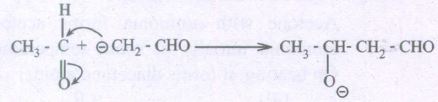
Step 3: The alkoxide ion formed is protonated by water to give 'aldol'.
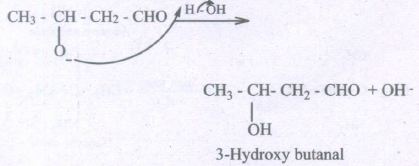
29.
(i) Ostwald's dilution law relates the dissociation constant of the weak acid (Ka) with its degree of dissociation (α) and the concentration (c).
where \(\alpha=\frac{\text { Number of moles dissociated }}{\text { Total number of moles }}\)
(ii) The dissociation of acetic acid can be represented as
\(\mathrm{CH}_{3} \mathrm{COOH} \rightleftharpoons \mathrm{H}^{+}+\mathrm{CH}_{3} \mathrm{COO}^{-}\)
The dissociation constant of acetic acid is,
\({ K }_{ a }=\frac { \left[ { H }^{ + } \right] \left[ { CH }_{ 3 }COO^{ - } \right] }{ \left[ { CH }_{ 3 }COOH \right] } \) ........(1)
| CH3COOH | H+ | CH3COO- | |
| Initial number of moles | 1 | - | - |
| Degree of dissociation of CH3COOH | α | - | - |
| Number of moles at equilibrium | 1-α | α | α |
| Equilibrium concentration | (1-α)C | αC | αC |
Substituting the equilibrium concentration in equation (1)
\({ K }_{ a }=\cfrac { \left( \alpha C \right) \left( \alpha C \right) }{ \left( 1-\alpha \right) C } \)
\({ K }_{ a }=\cfrac { { \alpha }^{ 2 }C }{ 1-\alpha } \) .......(2)
(iii) We know that weak acid dissociates only to a very small extent compared to one, a is so small and hence in the denominator (1 - α) ⋍1. The above expression (2) now becomes,
ka =a2C \(\Rightarrow { \alpha }^{ 2 }=\cfrac { { k }_{ a } }{ C } \) ; \(\alpha =\sqrt { \cfrac { { K }_{ a } }{ C } } \)
(iv) When dilution increases, the degree of dissociation of weak electrolyte also increases. This is called Ostwald's dilution law
Also \(;\left[\mathrm{H}^{+}\right]=\alpha \mathrm{C}\) and \(\left[\mathrm{H}^{+}\right]=\left(\sqrt{\frac{\mathrm{K}_{\mathrm{a}}}{\mathrm{C}}}\right) \mathrm{C}=\sqrt{\frac{\mathrm{K}_{\mathrm{a}} \mathrm{C}^{2}}{\mathrm{C}}}=\sqrt{\mathrm{K}_{\mathrm{a}} \cdot \mathrm{C}}\)
Similarly for a weak base
\(\begin{aligned} & \mathrm{K}_{\mathrm{b}}=\alpha^2 \mathrm{C} ; \quad \therefore \alpha=\sqrt{\frac{\mathrm{k}_{\mathrm{b}}}{\mathrm{C}}}, \\ \end{aligned}\)
\(\begin{aligned} & {\left[\mathrm{OH}^{-}\right] \alpha \mathrm{C}=\sqrt{\frac{\mathrm{K}_{\mathrm{b}}}{\mathrm{C}}} \times \mathrm{C}=\sqrt{\frac{\mathrm{K}_{\mathrm{b}} \mathrm{C}^2}{\mathrm{C}}}=\sqrt{\mathrm{K}_{\mathrm{b}} \mathrm{C}}} \end{aligned}\)

12th Standard Syllabus & Materials
12th Standard
TN 12th Computer Applications களப்பெயர் முறைமை (DNS) Sample Question Papers Study Material - QB365 Set A
NEW12th Standard
TN 12th Computer Applications வலையமைப்பு எடுத்துக்காட்டுகள் மற்றும் நெறிமுறைகள் Sample Question Papers Study Material - QB365 Set A
NEW12th Standard
TN 12th Computer Applications கணினி வலையமைப்பு ஓர் அறிமுகம் Sample Question Papers Study Material - QB365 Set A
NEW12th Standard
TN 12th Computer Applications PHP-உடன் MySQL-ஐ இணைத்தல் Sample Question Papers Study Material - QB365 Set A



Tamilnadu Stateboard 12th Standard Subjects

Maths
Chemistry

Physics

Biology

Computer Science

Business Maths and Statistics

Economics

Commerce

Accountancy

History

Computer Applications
Biology
Computer Technology
Computer Applications
Computer Science
Business Maths and Statistics
Commerce
Economics
Maths
Chemistry
Physics
Computer Technology
History
Accountancy

Tamil

English

French
Tamilnadu Stateboard Standards


