
 100% FREE ACCESS
12th Standard Syllabus & Materials
12th Standard
TN 12th Computer Applications மின்னணு தரவு பரிமாற்றம் Sample Question Papers Study Material - QB365 Set A
NEW12th Standard
TN 12th Computer Applications மின் - வணிக பாதுகாப்பு அமைப்புகள் Sample Question Papers Study Material - QB365 Set A
NEW12th Standard
TN 12th Computer Applications மின்னணு செலுத்தல் முறைகள் Sample Question Papers Study Material - QB365 Set A
NEW12th Standard
TN 12th Computer Applications மின் - வணிகம் Sample Question Papers Study Material - QB365 Set A
NEW12th Standard
TN 12th Computer Applications திறந்த மூல கருத்துருக்கள் Sample Question Papers Study Material - QB365 Set A
NEW12th Standard
TN 12th Computer Applications வலையமைப்பு வடமிடல் Sample Question Papers Study Material - QB365 Set A

Published on: 28/11/2025
Download Tamil Nadu 12th Standard Chemistry question papers, model tests, one-mark questions, important questions, and public exam papers in PDF format. Free study materials and answer keys for TN State Board students.
Questions + Answers key
Take MCQ Chemistry Test
1.
Calculate i) degree of hydrolysis, ii) the constant hydrolysis and iii) pH of 0.1M CH3COONa solution (pKa for CH3COOH is 4.74).
2.
50ml of 0.05M HNO3 is added to 50ml of 0.025M KOH. Calculate the pH of the resultant solution.
3.
Benzene diazonium chloride in aqueous solution decomposes according to the equation \({ C }_{ 6 }{ H }_{ 5 }{ N }_{ 2 }Cl\longrightarrow { C }_{ 6 }{ H }_{ 5 }Cl+{ N }_{ 2 }\)Starting with an initial concentration of 10g L-1, the volume of N2 gas obtained at 50 °C at different intervals of time was found to be as under:
| t(min) | 6 | 12 | 18 | 24 | 30 | \(\infty \) |
| Vol of N2 (ml) | 19.3 | 32.6 | 41.3 | 46.5 | 50.4 | 58.3 |
Show that the above reaction follows the first order kinetics. What is the value of the rate constant?
4.
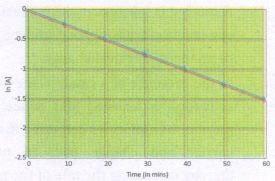
Describe the graphical representation of first order reaction.
5.
Calculate the concentration of OH- in a fruit juice which contains \(2\times10^{-3}\) M, H3O+ ion. Identify the nature of the solution.
6.
When aqueous ammonia is added to CuSO4 solution, the solution turns deep blue due to the formation of tetra ammine copper (II) complex,\({ [Cu({ H }_{ 2 }O)_4] }_{ (aq) }^{ 2+ }+ 4{ NH }_{ 3 }(aq)\rightleftharpoons { [Cu{ ({ NH }_{ 3 }) }_{ 4 }] }_{ (aq) }^{ 2+ }\) among H2O and NH3 Which is stronger Lewis base.
7.
Rate constant k of a reaction varies with temperature T according to the following Arrhenius equation \(\log K=\log A-\frac { { E }_{ a } }{ 2.303R } \left( \frac { 1 }{ T } \right) \)Where Ea is the activation energy. When a graph is plotted for log k Vs \(\frac{1}{T}\) a straight line with a slope of -4000K is obtained. Calculate the activation energy.
8.
9.
Identify the order for the following reactions
(i) Rusting of Iron
(ii) Radioactive disintegration of 92U238
(iii) 2A+3B⟶ products ;rate = k[A]1/2[B]2
10.
Derive an expression for Ostwald’s dilution law.
11.
The time for half change in a first order decomposition of a substance A is 60 seconds. Calculate the rate constant. How much of A will be left after 180 seconds?
1.
(a) CH3COONa is a salt of weak acid
(CH3COOH) and a strong base (NaOH).
Hence, the solutions is alkaline due to hydrolysis.
\(CH_{3}COO^{-}_{(aq)}+H_{2}O_{(aq)}\rightleftharpoons CH_{3}COOH_{(aq)}+OH^{-}_{(aq)}\)
(i)\(h=\sqrt{\frac{K_{w}}{K_{a}\times C}}\)
Given that pKa =4.74
pKa = -log Ka
ie., Ka = antilog of (-pKa)
= antilog of (-4.74)
= antilog of (-5 + 0.26)
= 10-5 \(\times\) 1.8 = 1.8 \(\times\) 10-5
[antilog of 0.26 = 1.82 \( \simeq\) 1.8]
\(\therefore\) h=\(\sqrt{\frac{1\times10^{-14}}{1.8\times10^{-5}\times0.1}}\)
h = 7.5 x 10⁻⁵
(ii) \(K_{h}=\frac{K_{w}}{K_{a}}=\frac{1\times10^{-14}}{1.8\times10^{-5}}\)
\(=5.56\times10^{-10}\)
iii) \(pH=7+\frac{pK_{a}}{2}+\frac{logC}{2}\)
= \(7+\frac{4.74}{2}+\frac{log0.1}{2}\)
= 7 + 2.37 - 0.5
= 8.87
2.
\(\mathrm{M} =\frac{\mathrm{V}_{1} \mathrm{M}_{1}-\mathrm{V}_{2} \mathrm{M}_{2}}{\mathrm{~V}_{1}+\mathrm{V}_{2}} \)
\(=\frac{(50 \times 0.05)-(50 \times 0.025)}{50+50} \)
\(\text { Molarity }=\frac{\text { Number of millimoles }}{\mathrm{V}_{\mathrm{m} l}}\)
\(=\frac{2.5-1.25}{100}=\frac{1.25}{100}=0.0125 \mathrm{M} \)
\(\mathrm{pH} =-\log _{10}\left[\mathrm{H}^{+}\right] \)
\(=-\log _{10} 0.0125 \)
Normality = Molarity \(\times\) basicity
\(=-\log _{10}\left(1.25 \times 10^{-2}\right) \)
\(=-\left[\log _{10} 1.25-2 \log _{10} 10\right] \)
\(=2-\log _{10} 1.25=2-0.0969 \)
pH = 1.9031
3.
For a first order reaction
\(k=\frac { 2.303 }{ t } \log\frac { \left[ { A }_{ 0 } \right] }{ \left[ A \right] } \)
\(k=\frac { 2.303 }{ t } \log\frac { { V }_{ \infty } }{ { V }_{ \infty }-{ V }_{ 1 } } \)
V∞= 58.3 ml.
| t(min) | Vt | V∞=Vt | \(k=\frac { 2.303 }{ t } \log\frac { { V }_{ \infty } }{ { V }_{ \infty }-{ V }_{ t } } \) |
| 6 | 19.3 | 58.3-19.3=39.0 | \(k=\frac { 2.303 }{ 6 } \log\left( \frac { 58.3 }{ 39 } \right) =0.0670\) min-1 |
| 12 | 32.6 | 58.3-32.6=25.7 | \(k=\frac { 2.303 }{ 12 } \log\left( \frac { 58.3 }{ 25.7 } \right) =0.06838\) min-1 |
| 18 | 41.3 | 58.3-41.3=17.0 | \(k=\frac { 2.303 }{ 18 } \log\left( \frac { 58.3 }{ 17 } \right) =0.06838\) min-1 |
| 24 | 46.5 | 58.3-46.5=11.8 | \(k=\frac { 2.303 }{ 24 } \log\left( \frac { 58.3 }{ 11.8 } \right) =0.0666\) min-1 |
| 30 | 50.4 | 58.3 - 50.4 = 7.9 | \(k=\frac{2.303}{30} \log \left(\frac{58.3}{7.9}\right)=0.067\) min-1 |
| Mean value of k = 0.0674 min-1 |
As the rate constants are constant through out it is a first order reaction.
4.
A Reaction whose rate depends on the reactant concentration raised to the first power is called a first order reaction. For a first order reaction,
A ⟶ product
Rate law can be expressed as
Rate = k[A]-1
\(\frac { -d\left[ A \right] }{ \left[ A \right] } =k dt\) ...(1)
Integrate the above equation between the limits of time t = 0 and time equal to t, while the concentration varies from the initial: concentration [Ao] to [A] at the later time.
\(\int _{ { [A }_{ 0 }] }^{ [A] }{ \frac { -d\left[ A \right] }{ \left[ A \right] } } =k\int _{ 0 }^{ t }{ dt } \)
\({ \left( -In\left[ A \right] \right) }_{ \left[ { A }_{ 0 } \right] }^{ \left[ A \right] }=k{ \left( t \right) }_{ 0 }^{ t }\)
\(-In\left[ A \right] -\left( In\left[ { A }_{ 0 } \right] \right) =k\left( t-0 \right) \)
\(-In\left[ A \right] -\left( In\left[ { A }_{ 0 } \right] \right) =kt\)
\(In\left( \frac { \left[ { A }_{ 0 } \right] }{ \left[ A \right] } \right) =kt\) ...(2)
This equation is in natural logarithm. To convert it into usual logarithm with base 10, we have to multiply the term by 2.303.
\(2.303\quad log\left( \frac { \left[ { A }_{ 0 } \right] }{ \left[ A \right] } \right) =kt\)
\(k=\frac { 2.303 }{ t } log\left( \frac { \left[ { A }_{ 0 } \right] }{ \left[ A \right] } \right) \) ...(3)
Equation (2) can be written in the form
y = mx+c as below
In [A0]-In[A] = kt
In[A] = In[A0]-kt
⇒ y = c + mx
If we follow the reaction by measuring the concentration of the reactants at regular time interval 't' a plot of In[A] against 't' yields a straight line with a negative slope. From this, the rate constant is calculated.
5.
Given that H3O+ = \(2\times10^{-3}M\)
\(K_{w}=[H_{3}O^{+}][OH^{-}]\)
\(\therefore [OH^{-}]=\frac{K_{w}}{[H_{3}O^{+}]}=\frac{1\times10^{-14}}{2\times10^{-3}}=0.5\times10^{-11}M\)
\(2\times10^{-3} >>0.5\times10^{-11}\)
i.e., [H3O+]>>[OH-], hence the juice is acidic in nature
6.
(i) According to Lewis theory a species that donates a pair of electron is called Lewis base.
(ii) Nitrogen more in NH3 is less electro negative than oxygen in water. So the non - bonded electron pair on nitrogen is more available for sharing than a non - bonded electron pair on oxygen atom. So NH3 is a stronger lewis base than H2O.
7.
\(\log K=\log A-\frac { { E }_{ a } }{ 2.303R } \left( \frac { 1 }{ T } \right) \)
y = c + mx
\(m=-\frac { { E }_{ a } }{ 2.303R } \)
Ea = -2.303 Rm
Ea = -2.303 x 8.314 x (-4000)
Ea = 76,589J mol-1
Ea = 76.589 KJ mol-1
8.
9.
(i) First order reaction
(ii) First order reaction
(iii) \(\frac{1}{2}+2=2 \frac{1}{2}\); Pseudo first order reaction
10.
(i) Ostwald's dilution law relates the dissociation constant of the weak acid (Ka) with its degree of dissociation (α) and the concentration (c).
where \(\alpha=\frac{\text { Number of moles dissociated }}{\text { Total number of moles }}\)
(ii) The dissociation of acetic acid can be represented as
\(\mathrm{CH}_{3} \mathrm{COOH} \rightleftharpoons \mathrm{H}^{+}+\mathrm{CH}_{3} \mathrm{COO}^{-}\)
The dissociation constant of acetic acid is,
\({ K }_{ a }=\frac { \left[ { H }^{ + } \right] \left[ { CH }_{ 3 }COO^{ - } \right] }{ \left[ { CH }_{ 3 }COOH \right] } \) ........(1)
| CH3COOH | H+ | CH3COO- | |
| Initial number of moles | 1 | - | - |
| Degree of dissociation of CH3COOH | α | - | - |
| Number of moles at equilibrium | 1-α | α | α |
| Equilibrium concentration | (1-α)C | αC | αC |
Substituting the equilibrium concentration in equation (1)
\({ K }_{ a }=\cfrac { \left( \alpha C \right) \left( \alpha C \right) }{ \left( 1-\alpha \right) C } \)
\({ K }_{ a }=\cfrac { { \alpha }^{ 2 }C }{ 1-\alpha } \) .......(2)
(iii) We know that weak acid dissociates only to a very small extent compared to one, a is so small and hence in the denominator (1 - α) ⋍1. The above expression (2) now becomes,
ka =a2C \(\Rightarrow { \alpha }^{ 2 }=\cfrac { { k }_{ a } }{ C } \) ; \(\alpha =\sqrt { \cfrac { { K }_{ a } }{ C } } \)
(iv) When dilution increases, the degree of dissociation of weak electrolyte also increases. This is called Ostwald's dilution law
Also \(;\left[\mathrm{H}^{+}\right]=\alpha \mathrm{C}\) and \(\left[\mathrm{H}^{+}\right]=\left(\sqrt{\frac{\mathrm{K}_{\mathrm{a}}}{\mathrm{C}}}\right) \mathrm{C}=\sqrt{\frac{\mathrm{K}_{\mathrm{a}} \mathrm{C}^{2}}{\mathrm{C}}}=\sqrt{\mathrm{K}_{\mathrm{a}} \cdot \mathrm{C}}\)
Similarly for a weak base
\(\begin{aligned} & \mathrm{K}_{\mathrm{b}}=\alpha^2 \mathrm{C} ; \quad \therefore \alpha=\sqrt{\frac{\mathrm{k}_{\mathrm{b}}}{\mathrm{C}}}, \\ \end{aligned}\)
\(\begin{aligned} & {\left[\mathrm{OH}^{-}\right] \alpha \mathrm{C}=\sqrt{\frac{\mathrm{K}_{\mathrm{b}}}{\mathrm{C}}} \times \mathrm{C}=\sqrt{\frac{\mathrm{K}_{\mathrm{b}} \mathrm{C}^2}{\mathrm{C}}}=\sqrt{\mathrm{K}_{\mathrm{b}} \mathrm{C}}} \end{aligned}\)
11.
(i) Order of the reaction =1; \(\mathrm{t}_{1 / 2}=60 \mathrm{~s} ; \mathrm{k}=?\)
\(\mathrm{k}=\frac{0.6932}{\mathrm{t}_{\frac{1}{2}}} \)
\(=\frac{0.6932}{60} \)
\(k =1.155 \times 10^{-2} \mathrm{~s}^{-1}\)
(ii) \(\left[\mathrm{A}_{0}\right]=100 \% ; \mathrm{t}=180 \mathrm{~s} ;[\mathrm{A}]=? ; \mathrm{k}=1.155 \times 10^{-2} \mathrm{~s}^{-1}\)
For first order reaction
\(\mathrm{k}=\frac{2.303}{\mathrm{t}} \log \frac{\left[\mathrm{A}_{0}\right]}{[\mathrm{A}]} \)
\(1.155 \times 10^{-2} =\frac{2.303}{180} \log \left(\frac{100}{[A]}\right) \)
\(\frac{0.01155 \times 180}{2.303} =\log \left(\frac{100}{[A]}\right) \)
\(0.9027 =\log 100-\log [\mathrm{A}] \)
\(\log [\mathrm{A}] =\log 100-0.9027 \)
\(\log [A]=2-0.9027 \)
\(\log [A]=1.0972 \)
[A] = antilog of (1.0972)
[A] =12.51 %

12th Standard Syllabus & Materials
12th Standard
TN 12th Computer Applications களப்பெயர் முறைமை (DNS) Sample Question Papers Study Material - QB365 Set A
NEW12th Standard
TN 12th Computer Applications வலையமைப்பு எடுத்துக்காட்டுகள் மற்றும் நெறிமுறைகள் Sample Question Papers Study Material - QB365 Set A
NEW12th Standard
TN 12th Computer Applications கணினி வலையமைப்பு ஓர் அறிமுகம் Sample Question Papers Study Material - QB365 Set A
NEW12th Standard
TN 12th Computer Applications PHP-உடன் MySQL-ஐ இணைத்தல் Sample Question Papers Study Material - QB365 Set A



Tamilnadu Stateboard 12th Standard Subjects

Maths
Chemistry

Physics

Biology

Computer Science

Business Maths and Statistics

Economics

Commerce

Accountancy

History

Computer Applications
Biology
Computer Technology
Computer Applications
Computer Science
Business Maths and Statistics
Commerce
Economics
Maths
Chemistry
Physics
Computer Technology
History
Accountancy

Tamil

English

French
Tamilnadu Stateboard Standards


