
 100% FREE ACCESS
12th Standard Syllabus & Materials
12th Standard
TN 12th Computer Applications மின்னணு தரவு பரிமாற்றம் Sample Question Papers Study Material - QB365 Set A
NEW12th Standard
TN 12th Computer Applications மின் - வணிக பாதுகாப்பு அமைப்புகள் Sample Question Papers Study Material - QB365 Set A
NEW12th Standard
TN 12th Computer Applications மின்னணு செலுத்தல் முறைகள் Sample Question Papers Study Material - QB365 Set A
NEW12th Standard
TN 12th Computer Applications மின் - வணிகம் Sample Question Papers Study Material - QB365 Set A
NEW12th Standard
TN 12th Computer Applications திறந்த மூல கருத்துருக்கள் Sample Question Papers Study Material - QB365 Set A
NEW12th Standard
TN 12th Computer Applications வலையமைப்பு வடமிடல் Sample Question Papers Study Material - QB365 Set A

Published on: 28/11/2025
Download Tamil Nadu 12th Standard Chemistry question papers, model tests, one-mark questions, important questions, and public exam papers in PDF format. Free study materials and answer keys for TN State Board students.
Questions + Answers key
Take MCQ Chemistry Test
1.
This is a square planar co-ordination complex in which two similar ligands are in adjacent positions ________.
trans platin
cis platin
both (a) & (b)
none of these
2.
Carboxy peptidase is a protease enzyme that is important in digestion contains a _______ ion coordinated to the protein.
Fe
Mg
Mn
Zn
3.
Chlorophyll a green pigment present in green plants and algae, is a co-ordination complex containing________ as central metal ion surrounded by a modified porphyrin ligand called Corrin ring.
Fe2+
Mg2+
Fe3+
Zn2+
4.
_________, a pigment present in plants acting is a photo sensitizer in the photosynthesis is also a coordination compound.
Hemoglobin
Chlorophyll
Chlorophyll 'a'
Chlorophyll 'd'
5.
Which statement is incorrect?
[Ni(CO4] - Tetrahedral, paramagnetic
[Ni(CN)4]2- - Square planar, diamagnetic
[Ni(CO)4] - Tetrahedral, diamagnetic
[Ni(Cl4)]2- - Tetrahedral, paramagnetic
6.
Among the following complexes, which one shows Zero Crystal field stabilization (CFSE) is _______.
[Mn(H2O)3]3+
[Fe(H2O)6]3+
[Co(H2O)6]2+
[Co(H2O)6]3+
7.
The radius of Na+ ion is 95 pm and Cl- ion 181 pm. The co-ordination number of Na+ is _______.
4
6
8
3
8.
Co-ordination number of Ni in [Ni(C2O4)3]4- is _______.
3
6
4
2
9.
According spectrochemical series which of the following ligand produces strongest field and cause maximum splitting?
F-
CO
H2O
Cl-
10.
The type of isomerism found in the complexes [Co(NO2)(NH3)5]SO4 and [Co(SO4)(NH3)5] NO2 _______.
Hydrate isomerism
Coordination isomerism
Linkage isomerism
Ionisation
11.
Choose the correct statement.
Square planar complexes are more stable than octahedral complexes
The spin only magnetic moment of [Cu(Cl)4]2- is BM and it has square planar structure.
Crystal field splitting energy \(\left( { \Delta }_{ 0 } \right) \) [FeF6]4- is higher than the \((\Delta _{ 0 })\) of [Fe(CN)6]4-
crystal field stabilization energy of [V(H2O)6]2+ is higher than the crystal field stabilization of [Ti(H2O)6]2+
12.
Fac-mer isomerism is shown by _______.
[CO(en)3]3+
[Co(NH3)4(Cl)2]+
[Co(NH3)3(Cl)3]
[Co(NH3)5Cl]SO4
13.
Which of the following is paramagnetic in nature?
[Zn(NH3)4]2+
[Co(NH3)6]3+
[Ni(H2O)6]2+
[Ni(CN)4]2-
14.
Formula of tris(ethane-1, 2-diamine)iron(II)phosphate _______.
[Fe(CH3-CH(NH2)2)3](PO4)3
[Fe(H2N-CH2-CH2-NH2)3](PO4)
[Fe(H2N-CH2-CH2-NH2)3](PO4)2
[Fe(H2N-CH2-CH2-NH2)3]3(PO4)2
15.
A complex in which the oxidation number of the metal is zero is_______.
K4[Fe(CN)6]
[Fe(CN)3(NH3)3]
[Fe(CO)5]
both (b) and (c)
16.
Which one of the following complexes is not expected to exhibit isomerism?
[Ni(NH3)4(H2O)2]2+
[Pt(NH3)2Cl2]
[Co(NH3)5SO4]Cl
[FeCl6]3-
17.
Which kind of isomerism is possible for a complex [Co(NH3)4Br2]CI?
geometrical and ionization
geometrical and optical
optical and ionization
geometrical only
18.
Which one of the following pairs represents linkage isomers?
[Cu(NH3)4][PtCl4] and [Pt(NH3)4][CuCl4]
[Co(NH3)5(NO3)]SO4 and [Co(NH3)5(ONO)]
[Co(NH3)4(NCS)2]Cl and [Co(NH3)4(SCN)2]Cl
both (b) and (c)
19.
How many geometrical isomers are possible for [Pt(Py)(NH3)(Br)(Cl)]
3
4
0
15
20.
Which type of isomerism is exhibited by [Pt(NH3)2Cl2]?
Coordination isomerism
Linkage isomerism
Optical isomerism
Geometrical isomerism
21.
Which one of the following will give a pair of enantiomorphs?
[Cr(NH3)6][Co(CN)6]
[Co(en)2Cl2]Cl
[Pt(NH3)4][PtCl4]
[Co(NH3)4Cl2]NO2
22.
In which of the following coordination entities the magnitude of Δ0 will be maximum?
[Co(CN)6]3-
[Co(C2O4)3]3-
[Co(H2O)6]3+
[Co(NH3)6]3+
23.
Crystal field stabilization energy for high spin d5 octahedral complex is _______.
-0.6\({ \Delta }_{ 0 }\)
0
2(P-\({ \Delta }_{ 0 }\))
2(P+\({ \Delta }_{ 0 }\))
24.
A magnetic moment of 1.73BM will be shown by one among the following.
TiCl4
[CoCl6]4-
[Cu(NH3)4]2+
[Ni(CN)4]2-
25.
26.
As per IUPAC guidelines, the name of the complex [Co(en)2(ONO)Cl]Cl is _______.
chloro bis ethylenediamine nitrocobalt(III) chloride
chloridobis(ethane-1, 2-diamine)nitro K-O Cobaltate(III) chloride
chloridobis(ethane-1, 2-diammine)nitrito K-O Cobalt(II) chloride
chloridobis(ethane-1, 2-diamine)nitrito K-O Cobalt(III) chloride
27.
Oxidation state of Iron and the charge on the ligand NO in [Fe(H2O)5NO]SO4 are_______.
+2 and 0 respectively
+3 and 0 respectively
+3 and -1 respectively
+1 and +1 respectively
28.
A complex has a molecular formula MSO4Cl.6H2O. The aqueous solution of it gives white precipitate with Barium chloride solution and no precipitate is obtained when it is treated with silver nitrate solution. If the secondary valence of the metal is six, which one of the following correctly represents the complex?
[M(H2O)4Cl]SO4.2H2O
[M(H2O)6]SO4
[M(H2O)5Cl]SO4.H2O
[M(H2O)3Cl]SO4.3H2O
29.
An excess of silver nitrate is added to 100ml of a 0.01M solution of Pentaaquachlorochromium (III)chloride. The number of moles of AgCl precipitated would be _______.
0.02
0.002
0.01
0.2
30.
The sum of primary valence and secondary valence of the metal M in the complex [M(en)2(Ox)]Cl is________.
3
6
-3
9
1.
(b)
cis platin
2.
(d)
Zn
3.
(b)
Mg2+
4.
(b)
Chlorophyll
5.
(a)
[Ni(CO4] - Tetrahedral, paramagnetic
6.
(b)
[Fe(H2O)6]3+
7.
(b)
6
8.
(b)
6
9.
(b)
CO
10.
(d)
Ionisation
11.
(d)
crystal field stabilization energy of [V(H2O)6]2+ is higher than the crystal field stabilization of [Ti(H2O)6]2+
12.
(c)
[Co(NH3)3(Cl)3]
13.
a) Zn2+ (d10 ⇒ diamagnetic)
b) Co3+ (d6 Low spain ⇒ t2g6 e0g ; diamagnetic)
c) Ni2+ (d8 Low spain ⇒ t2g6 e2g ; paramagnetic)
d) [Ni(CN)4]2+ (dsp2 ; square planar, diamagnetic)
14.
[Fe(H2N-CH2-CH2-NH2)3]3(PO4)2
[Fe(en)3]2+(\(PO_{4}^{3-}\))
15.
a) Fe2+ b) Fe3+ c) Fe0
16.
Option (a) and (b) -geometrical isomerism is possible
Option (c) - ionization isomerism is possible
Option (d) - no possibility to show either constitutional isomerism or stereo isomerism
17.
For [MA4B2]4+ complexes - geometrical isomerism is possible
{[Co(NH3)4Br2]CI,[Co(NH3)4Br CI]Br} - ionisation isomers
18.
(a) coordination isomers
(b) no isomerism ( different molecular formula)
(c)⬅NCS; ⬅SCN coordinating atom differs : linkage isomers
19.
Three isomers. If we consider any one of the ligands as reference (say Py), the arrangement of other three ligands (NH3, Br- and Cl-) with respect to (Py) gives three geometrical isomers.
20.
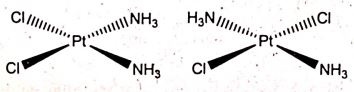
21.
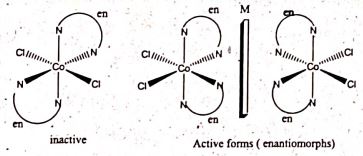
Complexes given in other options (a), (c) and (d) have symmetry elements and hence they are optically inactive.
22.
In all the complexes, the central metal ion is Co3+, among the given ligands CN- is the strongest ligand, which causes large crystal
field splitting i.e maximum Δ0
23.
The electronic configuration t2g3, e2g
[ 3 x (-0.4)+ 2(0.6)]Δ0
[-1.2 + 1.2] Δ0 = 0
24.
Ti4+ (d0 ⇒ 0BM)
Co2+ (d7 spain free ⇒ t2g5, e2g; n = 3; μ = 3.9BM)
Cu2+ (d9 Low spain ⇒ t2g6, e3g; n = 1; μ = 1.732BM)
Ni2+ (d8 Low spain ⇒ t2g6, e2g; n = 2; μ = 2.44 BM)
25.
(d)
26.
(d)
chloridobis(ethane-1, 2-diamine)nitrito K-O Cobalt(III) chloride
27.
[\( \overset{+}{Fe}\)(H2O)5\( \overset{+}{NO}\)]2+ SO2-4
+1 and +1 respectively
28.
Molecular formula: MSO4Cl.6H2O
Formation of white precipitate with Barium chloride indicates that SO2-4 ions are outside the coordination sphere, and no precipitate with AgNO3 solution indicates that the Cl- ions are inside the coordination sphere. Since the coordination number of M is 6.Cl- and 5 H2O are ligands, remaining 1 H2O molecular and SO2-4 are in the outer coordination sphere.
29.
The complex is [M(H2O)5Cl]Cl2
1000 ml of 1 M solution of the complex gives 2 moles of Cl- ions 1000 ml of 0.01 M solution of the complex will give
\(\frac{100 ml \times 0.01M \times 2Cl^-}{1000 ml \times 1M}\)
= 0.002 moles of Cl- ions
30.
In the complex [M(en)2(Ox)]Cl For the central metal ion M3+
The primary valence is = +3
The secondary valence = 6
sum of primary valence and secondary valence = 3 + 6 = 9

12th Standard Syllabus & Materials
12th Standard
TN 12th Computer Applications களப்பெயர் முறைமை (DNS) Sample Question Papers Study Material - QB365 Set A
NEW12th Standard
TN 12th Computer Applications வலையமைப்பு எடுத்துக்காட்டுகள் மற்றும் நெறிமுறைகள் Sample Question Papers Study Material - QB365 Set A
NEW12th Standard
TN 12th Computer Applications கணினி வலையமைப்பு ஓர் அறிமுகம் Sample Question Papers Study Material - QB365 Set A
NEW12th Standard
TN 12th Computer Applications PHP-உடன் MySQL-ஐ இணைத்தல் Sample Question Papers Study Material - QB365 Set A



Tamilnadu Stateboard 12th Standard Subjects

Maths
Chemistry

Physics

Biology

Computer Science

Business Maths and Statistics

Economics

Commerce

Accountancy

History

Computer Applications
Biology
Computer Technology
Computer Applications
Computer Science
Business Maths and Statistics
Commerce
Economics
Maths
Chemistry
Physics
Computer Technology
History
Accountancy

Tamil

English

French
Tamilnadu Stateboard Standards


