
 100% FREE ACCESS
12th Standard Syllabus & Materials
12th Standard
TN 12th Computer Applications மின்னணு தரவு பரிமாற்றம் Sample Question Papers Study Material - QB365 Set A
NEW12th Standard
TN 12th Computer Applications மின் - வணிக பாதுகாப்பு அமைப்புகள் Sample Question Papers Study Material - QB365 Set A
NEW12th Standard
TN 12th Computer Applications மின்னணு செலுத்தல் முறைகள் Sample Question Papers Study Material - QB365 Set A
NEW12th Standard
TN 12th Computer Applications மின் - வணிகம் Sample Question Papers Study Material - QB365 Set A
NEW12th Standard
TN 12th Computer Applications திறந்த மூல கருத்துருக்கள் Sample Question Papers Study Material - QB365 Set A
NEW12th Standard
TN 12th Computer Applications வலையமைப்பு வடமிடல் Sample Question Papers Study Material - QB365 Set A

Published on: 28/11/2025
Download Tamil Nadu 12th Standard Chemistry question papers, model tests, one-mark questions, important questions, and public exam papers in PDF format. Free study materials and answer keys for TN State Board students.
Questions + Answers key
Take MCQ Chemistry Test
1.
2.
The correct statement regarding RNA and DNA respectively is ______.
the sugar component in RNA is an arabinos and the sugar component in DNA is ribose
the sugar component in RNA is 2’-deoxyribose and the sugar component in DNA is arabinose
the sugar component in RNA is an arabinose and the sugar component in DNA is 2’-deoxyribose
the sugar component in RNA is ribose and the sugar component in DNA is 2’-deoxyribose
3.
Secondary nitro alkanes react with nitrous acid to form _______.
red solution
blue solution
green solution
yellow solution
4.
The correct structure of the product ‘A’ formed in the reaction ______.
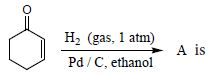


5.
In the reaction sequence, Ethane \(\overset { HOCl }{ \longrightarrow } A\overset { x }{ \longrightarrow } \) ethan -1, 2 - diol. A and X respectively are ________.
Chloroethane and NaOH
ethanol and H2SO4
2 – chloroethan -1-ol and NaHCO3
ethanol and H2O
6.
Which one of the following is an example for homogeneous catalysis?
manufacture of ammonia by Haber’s process
manufacture of sulphuric acid by contact process
hydrogenation of oil
Hydrolysis of sucrose in presence of all HCl
7.
The molar conductivity of a 0.5 mol dm-3 solution of AgNO3 with electrolytic conductivity of 5.76 ×10⁻³ S cm−1at 298 K is______.
2.88 S cm2mol-1
11.52 S cm2mol-1
0.086 S cm2mol-1
28.8 S cm2mol -1
8.
Concentration of the Ag+ ions in a saturated solution of Ag2C2O4 is 2.24 ×10⁻⁴mol L-1 solubility product of Ag2C2O4 is_______.
2.42 × 10⁻⁸mol3L-3
2.66 × 10⁻¹²mol3L-3
4.5 × 10⁻¹¹mol3L-3
5.619 × 10⁻¹²mol3L-3
9.
After 2 hours, a radioactive substance becomes \(\left( \frac { 1 }{ 16 } \right) ^{ th }\) of original amount Then the half life (in min) is _______.
60 minutes
120 minutes
30 minutes
15 minutes
10.
Schottky defect in a crystal is observed when ______.
unequal number of anions and anions are missing from the lattice
Equal number of cations and anions are missing from the lattice
an ion leaves its normal site and occupies an interstitial site
no ion is missing from its lattice
11.
A magnetic moment of 1.73BM will be shown by one among the following.
TiCl4
[CoCl6]4-
[Cu(NH3)4]2+
[Ni(CN)4]2-
12.
Among the transition metals of 3d series, the one that has highest negative \(\left( \frac { M^{ 2+ } }{ M } \right) \) standard electrode potential is _______.
Ti
Cu
Mn
Zn
13.
In which of the following, NH3 is not used?
Nessler's reagent
Reagent for the analysis of IV group basic radical
Reagent for the analysis of III group basic radical
Tollen's reagent
14.
Which of the following metals has the largest abundance in the earth’s crust?
Aluminium
Calcium
Magnesium
Sodium
15.
Which one of the following is not feasible
Zn(s) + Cu2+(aq) \(\rightarrow\) Cu(s) + Zn2+(aq)
Cu(s)+ Zn2+(aq)\(\rightarrow\) Zn(s) + Cu2+(aq)
Cu(s) + 2Ag+(ag)\(\rightarrow\) 2Ag(s) + Cu2+(aq)
Fe(s) + Cu2+(aq) \(\rightarrow\) Cu(s)+ Fe2+(aq)
1.
(a)
2.
(d)
the sugar component in RNA is ribose and the sugar component in DNA is 2’-deoxyribose
3.
(b)
blue solution
4.
(b)
5.
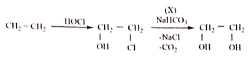
6.
(d)
Hydrolysis of sucrose in presence of all HCl
7.
Λ = k/W x 10−3 mol−1 dm3
\(=\frac{ 5.76 \times 10^{−3} S cm^{−1} \times 10^{−3}}{0.5} = mol^{-1} dm^{3}\)
\(=\frac{ 5.76 \times 10^{−3} S cm^{−1} \times 10^{−3}}{0.5}\) S cm-1 mol−1 dm3
= 11.52 S cm2mol-1
8.
\(\mathrm{Ag}_{2} \mathrm{C_2O_4} \rightleftharpoons 2 \mathrm{Ag}_{}^{+}+\mathrm{C_2O}_{4{}}^{2-}\)
\(\left[\mathrm{Ag}^{+}\right]=2 .24 \) ×10-4mol L-1
\(\mathrm{C_2O}_{4{}}^{2-} = \frac {2.24 \times 10 ^{-4}}{2}\) mol L-1
= 1.12 ×10⁻⁴mol L-1
Ksp = [Ag]2 [C2O42-]
= (2.24 ×10⁻⁴mol L-1) (1.12 ×10⁻⁴mol L-1)
= 5.619 × 10⁻¹²mol3L-3
9.
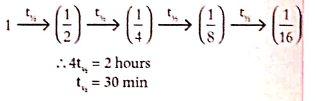
10.
(b)
Equal number of cations and anions are missing from the lattice
11.
Ti4+ (d0 ⇒ 0BM)
Co2+ (d7 spain free ⇒ t2g5, e2g; n = 3; μ = 3.9BM)
Cu2+ (d9 Low spain ⇒ t2g6, e3g; n = 1; μ = 1.732BM)
Ni2+ (d8 Low spain ⇒ t2g6, e2g; n = 2; μ = 2.44 BM)
12.
(a)
Ti
13.
(a)
Nessler's reagent
14.
(a)
Aluminium
15.
(b)
Cu(s)+ Zn2+(aq)\(\rightarrow\) Zn(s) + Cu2+(aq)

12th Standard Syllabus & Materials
12th Standard
TN 12th Computer Applications களப்பெயர் முறைமை (DNS) Sample Question Papers Study Material - QB365 Set A
NEW12th Standard
TN 12th Computer Applications வலையமைப்பு எடுத்துக்காட்டுகள் மற்றும் நெறிமுறைகள் Sample Question Papers Study Material - QB365 Set A
NEW12th Standard
TN 12th Computer Applications கணினி வலையமைப்பு ஓர் அறிமுகம் Sample Question Papers Study Material - QB365 Set A
NEW12th Standard
TN 12th Computer Applications PHP-உடன் MySQL-ஐ இணைத்தல் Sample Question Papers Study Material - QB365 Set A



Tamilnadu Stateboard 12th Standard Subjects

Maths
Chemistry

Physics

Biology

Computer Science

Business Maths and Statistics

Economics

Commerce

Accountancy

History

Computer Applications
Biology
Computer Technology
Computer Applications
Computer Science
Business Maths and Statistics
Commerce
Economics
Maths
Chemistry
Physics
Computer Technology
History
Accountancy

Tamil

English

French
Tamilnadu Stateboard Standards


