
 100% FREE ACCESS
12th Standard Syllabus & Materials
12th Standard
TN 12th Maths Applications of Matrices and Determinants Sample Question Papers Study Material - QB365 Set A
NEW12th Standard
TN 12th Computer Applications மின்னணு தரவு பரிமாற்றம் Sample Question Papers Study Material - QB365 Set A
NEW12th Standard
TN 12th Computer Applications மின் - வணிக பாதுகாப்பு அமைப்புகள் Sample Question Papers Study Material - QB365 Set A
NEW12th Standard
TN 12th Computer Applications மின்னணு செலுத்தல் முறைகள் Sample Question Papers Study Material - QB365 Set A
NEW12th Standard
TN 12th Computer Applications மின் - வணிகம் Sample Question Papers Study Material - QB365 Set A
NEW12th Standard
TN 12th Computer Applications திறந்த மூல கருத்துருக்கள் Sample Question Papers Study Material - QB365 Set A

Published on: 28/11/2025
Download Tamil Nadu 12th Standard Chemistry question papers, model tests, one-mark questions, important questions, and public exam papers in PDF format. Free study materials and answer keys for TN State Board students.
Questions + Answers key
Take MCQ Chemistry Test
1.
What is flocculation value?
2.
What is meant by auto ionisation of water? Explain.
3.
Write the integrated rate equations for zero and first order reaction. Give their half life period expression also.
4.
Explain the function of a salt bridge in an electrochemical cell.
5.
Calculate the molar conductance of 0.025M aqueous solution of calcium chloride at 25°C. The specific conductance of calcium chloride is 12.04 x 10⁻² Sm-1.
6.
Define the term: space lattice.
7.
An atom crystallizes in fcc crystal lattice and has a density of 10 gcm−3 with unit cell edge length of 100pm. Calculate the number of atoms present in 1 g of crystal.
8.
Which of the following is incorrect?
Enzymes can be inhibited (poisoned)
Catalytic activity of enzymes is decreased by coenzymes.
Enzyme catalysis is highly specific in nature
The rate of enzyme catalysed reaction varies with the pH of the system
9.
A device that converts energy of combustion of fuels like H2 and methane, directly, into electrical energy is known as _______.
Electrolytic cell
Dry cell
Ni-Cd cell
Fuel cell
10.
A metal can be protected from corrosion by _______.
Painting
Galvanizing
Cathode Protection
All the above
11.
pH = 7 + 1/2 pKa - 1/2 pKb is the expression for the pH determination of the hydrolysis of ______.
Sodium chloride
Ammonium acetate
Ammonium chloride
Sodium acetate
12.
Inversion of sucrose in acidic aqueous medium follows ________ order reaction.
zero
second
first
third
13.
The number of close packed spheres is 'n'. The number of tetrahedral voids generated is equal to _______.
n
2n
2n2
3n
14.
Which of the following is not a favourable condition for physical adsorption?
high pressure
negative ΔH
higher critical temperature of absorbate
high temperature
15.
When sodium acetate is added to acetic acid, the degree of ionisation of acetic acid _______.
increases
decreases
dose not change
becomes zero
16.
Activation energy of a chemical reaction can be determined by ______.
Evaluating rate constants at two different temperatures
Evaluating velocities of reaction at two different temperatures
Evaluating rate constant at standard temperature
Changing concentration of reactants
17.
If 75% of a first order reaction was completed in 60 minutes, 50% of the same reaction under the same conditions would be completed in_______.
20 minutes
30 minutes
35 minutes
75 minutes
18.
Explain phase transfer catalysis with an example.
19.
Derive the integrated rate law for a first order reaction.
20.
Derive Henderson - Hasselbalch equation
21.
Describe the construction of Daniel cell. Write the cell reaction.
22.
The time for half change in a first order decomposition of a substance A is 60 seconds. Calculate the rate constant. How much of A will be left after 180 seconds?
23.
What is an order of a reaction?
24.
How are colloids purified by a) Dialysis (b) Electro dialysis?
25.
How can be metals prevented from corrosion?
26.
Calculate the packing efficiency in simple cubic arrangement.
27.
Calculate the pH of 0.1M CH3COOH solution. Ka = 1.8 x 10⁻⁵.
28.
What are emulsifying agent?
1.
The precipitation power of electrolyte is determined by finding the minimum concentration (millimoles/ lit) required to cause precipitation of a sol in 2 - hours. This value is called flocculation value. The smaller the flocculation value greater will be precipitation.
2.
When an acidic or a basic substance is dissolved in water, depending upon its nature, it can either donate (or) accept a proton. In addition to that the pure water itself has a little tendency to dissociate. i.e, one water molecule donates a proton to an another water molecule. This is known as auto ionisation of water and it is represented as
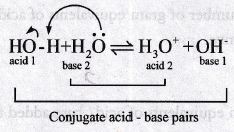
In the above ionisation, one water molecule acts as an acids while the another water molecule acts as a base.
3.
Integrated rate equation for zero order reaction:
\(k=\frac{[A]_{0}-[A]}{t} ; t_{\frac{1}{2}}=\frac{[A]_{0}}{2 k}\)
Integrated rate equation for first order reaction.
\(k=\frac{2.303}{t} \log \frac{a}{a-x} ; t_{\frac{1}{2}}=\frac{0.693}{k}\)
4.
The main functions of the salt bridge are
(i) To complete the electrical circuit by the allowing only ions to flow from one solution to other without mixing the two solutions.
(ii) To maintain electrical neutrality of the solution in the two half cells.
5.
Molar conductance = Λm = \( \frac{k\ (Sm^{-1})\times10^{-3}}{M} mol^{-1}m^{3} \)
\(= \frac{(12.04 \times 10^{-2} Sm^{-1}) \times 10^{-3} (mol^{-1}m^{3})} {0.025}\)
= 481.6 x 10⁻⁵ Sm2mol-1
6.
Space Lattice:
An infinite three dimensional array of points showing how atoms (or) molecules are arranged in a crystal is known as space lattice. The points are known as lattice points.
7.
\(\operatorname{Density}(\rho)=\frac{\mathrm{nM}}{\mathrm{a}^{3} \mathrm{~N}_{\mathrm{A}}} \)
\(\rho=10 \mathrm{~g} \mathrm{~cm}^{-3} ; \mathrm{a}=100 \mathrm{pm}=1 \times 10^{-8} \mathrm{~cm} ; \mathrm{N}_{\mathrm{A}}=6.023 \times 10^{23} ; \mathrm{n}=4 ; \mathrm{M}=? \)
\(M=\frac{\rho \mathrm{a}^{3} \mathrm{N_{A}}}{n} \)
\(=\frac{10 \times\left(1 \times 10^{-8}\right)^{3} \times 6.023 \times 10^{23}}{4} \)
\(=\frac{6.023}{4} \)
= 1.505 g /mol
No. of moles \(=\frac{\text { Mass }}{\text { Molar mass }}=\frac{1}{1.505}\)
= 0.664 moles
Hence number of atoms = 0.664 x 6.023 x 1023 = 3.99 x 10²³ atoms
8.
(b)
Catalytic activity of enzymes is decreased by coenzymes.
9.
(d)
Fuel cell
10.
(d)
All the above
11.
(b)
Ammonium acetate
12.
(c)
first
13.
(b)
2n
14.
(d)
high temperature
15.
(b)
decreases
16.
(a)
Evaluating rate constants at two different temperatures
17.
t75% = 2t50%
t50% = (t75%/2) = (60/2) = 30 minutes
18.
(i) Suppose the reactant of a reaction is present in one solvent and the other reactant is present in an another solvent.The reaction between them is very slow, if the solvents are immiscible.
(ii) As the solvents form separate phases, the reactants have to migrate across the boundary to react. But migration of reactants across the boundary is not easy.
(iii) For such situations a third solvent is added which is miscible with both.
(iv) So, the phase boundary is eliminated reactants freely mix and react fast.
(v) But for large scale production of any product, use of a third solvent is not convenient as it may be expensive. For such problems phase transfer catalysis provides a simple solution, which avoids the use of solvents. It directs the use of phase transfer catalyst (a phase transfer reagent) to facilitate transport of a reactant in one solvent to the other solvent where the second reactant is present.
(vi) As the reactants are now brought together, they rapidly react and form the product.
(vii) Example:
Substitution of Cl- and CN- in the following reaction.
\(\mathrm{R}-\mathrm{Cl}+\mathrm{NaCN} \rightarrow \mathrm{R}-\mathrm{CN}+\mathrm{NaCl}\)
organic phase aqueous phase organic phase aqueous phase
\(\mathrm{R}-\mathrm{Cl}=1 \text {-Chloro octane } \)
\(\mathrm{R}-\mathrm{CN}=1 \text {-Cyano octane }\)
(viii) By direct heating of two phase mixture of organic 1-chloro octane with aqueous sodium cyanide for several days, 1-cyano octane is not obtained. However, if a small amount of quaternary ammonium salt like tetra alkyl ammonium chloride is added, a rapid transition of 1-cyano octane occurs in about 100 % yield after 1 or 2 hours. In this reaction, the tetra alkyl ammonium cation, which has hydrophobic and hydrophilic ends, transports CN- from the aqueous phase to the organic phase using its hydrophilic end and facilitates the reaction with 1 -chloro octane as shown below:
\(\mathrm{NaCN}+\mathrm{R}_{4} \mathrm{~N}^{+} \mathrm{Cl}^{-} \rightarrow \mathrm{R}_{4} \mathrm{~N}^{+} \mathrm{CN}^{-}+\mathrm{NaCl}\\ \text{Aqueous phase} \quad \quad \quad \text{It moves to organic phase}\)
\(\mathrm{R}_{4} \mathrm{~N}^{+} \mathrm{CN}^{-}+\quad \quad \quad \quad \quad \mathrm{R}-\mathrm{Cl} \rightarrow \mathrm{R}-\mathrm{CN}+\quad\quad \mathrm{R}_{4} \mathrm{~N}^{+} \mathrm{Cl}^{-}\\ Both \ in \ organic \ phase \quad organic \ phase \quad \quad \text{It moves to aqueous phase, releases Cl- organic phase again picks up CN- and transports it.}\)
(iv) So phase transfer catalyst, speeds up the reaction by transporting one reactant from one phase to another.
19.
A reaction whose rate depends on the reactant concentration raised to the first power is called a first order reaction. Let us consider the following Cl2 first order reaction,
A → product
Rate law can be expressed as
Rate = k[A]1
Where, k is the first order rate constant
\(\frac{-\mathrm{d}[\mathrm{A}]}{\mathrm{dt}}=\mathrm{k}[\mathrm{A}]^{1} \)
\(\Rightarrow \frac{-\mathrm{d}[\mathrm{A}]}{[\mathrm{A}]}=\mathrm{kdt}\) .....(1)
Integrate the above equation between the limits of time t = 0 and time equal to t, while the concentration varies from the initial concentration [A0] to [A] at the later time.
\(\int_{\left[A_{0}\right]}^{[A]} \frac{-d[A]}{[A]}=k \int_{0}^{t} d t \)
\((-\ln [A])_{\left[A_{0}\right]}^{[A]}=k(t)_{0}^{t} \)
\(-\ln [A]-\left(-\ln \left[A_{0}\right]\right)=k(t-0) \)
\(-\ln [\mathrm{A}]+\ln \left[\mathrm{A}_{0}\right]=\mathrm{kt} \)
\(\ln \left(\frac{\left[\mathrm{A}_{0}\right]}{[\mathrm{A}]}\right)=\mathrm{kt}\) .....(2)
This equation is in natural logarithm. To convert it into usual logarithm with base 10, we have to multiply the term by 2.303.
\(2.303 \log \left(\frac{\left[A_{0}\right]}{[A]}\right)=k t \)
\(k=\frac{2.303}{t} \log \left(\frac{\left[A_{0}\right]}{[A]}\right)\) .....(3)
20.
(i) The concentration of hydronium ion in an acidic buffer solution depends on the ratio of the concentration of the weak acid to the concentration of its conjugate base present in the solution i.e.,
\(\left[ { H }_{ 3 }{ O }^{ + } \right] ={ K }_{ a }\frac { [{ acid] }_{ aq } }{ [{ base] }_{ aq } } \)
(ii) The weak acid is dissociated only to a small extent. Moreover, due to common ion effect, the dissociation is further suppressed and hence the equilibrium concentration of the acid is nearly equal to the initial concentration of the unionised acid. Similarly, the concentration of the conjugate base is nearly equal to the initial concentration of the added salt.
\(\left[ { H }_{ 3 }{ O }^{ + } \right] ={ K }_{ a }\frac { [{ acid] } }{ [{ salt] } } \)
(iii) Here [acid] and [salt] represent the initial concentration of the acid and salt, respectively used to prepare the buffer solution
Taking logarithm on both sides of the equation
\(\log\left[ { H }_{ 3 }{ O }^{ + } \right] ={ \log K }_{ a }+\log\frac { [{ acid] } }{ [{ salt] } } \)
reverse the sign on both sides
- \(\log\left[ { H }_{ 3 }{ O }^{ + } \right] ={- \log K }_{ a }-\log\frac { [{ acid] } }{ [{ salt] } } \)
We know that
pH = -log [H3O+] and pKa = -log Ka
\(\Rightarrow pH={ pK }_{ a }-\log\frac { [{ acid] } }{ [{ salt] } } \)
\(\Rightarrow pH={ pK }_{ a }+\log\frac { [{ acid] } }{ [{ salt] } } \)
Similarly for a basic buffer,
pOH = \({ pK }_{ a }+\log\frac { [{ acid] } }{ [{ salt] } } \)
21.
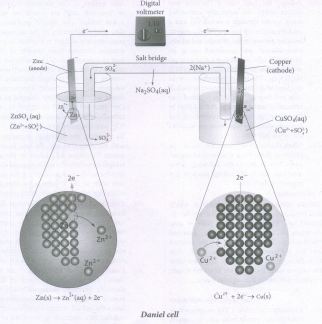
1. Daniel cell is a galvanic cell. This is a voltaic cell also.
(a) The separation of half reaction is the basis for the construction of Daniel cell. It consists of two half cells.
(i) Oxidation half cell: A metallic zinc strip that dips into an aqueous solution of zinc sulphate taken in a beaker, as shown in Figure
(ii) Reduction half cell: A copper strip that dips into an aqueous solution of copper sulphate taken in a beaker, as shown in Figure
(iii) Joining the half cells:
(a) The zinc and copper strips are externally connected using a wire through a switch (k) and a load (example: volt meter). The electrolytic solution present in the cathodic and anodic compartment are connected using an inverted U tube containing a agar-agar gel mixed with an inert electrolyte such as KCI, Na2SO4 etc.,
(b) The ions of inert electrolyte do not react with other ions present in the half I cells and they are not either oxidised (or) reduced at the electrodes. The solution in the salt bridge cannot get poured out, but through which the ions can move into (or) out of the half cells.
(c) When the switch (k) closes the circuit, the electrons flows from zinc strip to copper strip. This is due to the following redox reactions which are taking place at the respective electrodes.
(iv) Anodic oxidation:
(i) zinc strip acts as the anode.
(ii) Here,oxidation occurs.
The electrode at which the oxidation occur is called the anode. In Daniel cell, the oxidation take place at zinc electrode, i.e., zinc is oxidised to Zn2+ ions and the electrons.
The Zn2+ ions enters the solution and the electrons enter the zinc metal, then flow through the external wire and then enter the copper strip.
Electrons are liberated at zinc electrode and hence it is negative (-ve).
\(Zn_{ (s) }\longrightarrow { { Zn }^{ 2+ }_{ (aq) }+{ 2e }^{ - } } \) (loss of electron-oxidation)
(v) Cathodic reduction:
As discussed earlier. the electrons flow through the circuit from zinc to copper, where the Cu2+ ions in the solution accept the electrons, get reduced to copper and the same get deposited on the electrode Here, the electrons are consumed and hence it is positive (+ve).
\({ Cu }_{ (aq) }^{ 2+ }+{ 2e }^{ - }\longrightarrow { { Cu }_{ (s) } } \)(gain of electron - reduction)
b) When a Zinc metal strip is placed in a copper sulphate solution, the blue colour of the solution fades and the copper is deposited on the zinc strip as red - brown crust due to the following spontaneous chemical reaction.
\(\mathrm{Zn}_{(\mathrm{s})}+\mathrm{CuSO}_{4(\mathrm{aq})} \rightarrow \mathrm{ZnSO}_{4(\mathrm{aq})}+\mathrm{Cu}_{(\mathrm{s})}\)
The energy produced in the above reaction is lost to the surroundings as heat.
In the above redox reaction, Zinc is oxidised to Zn2+ ions and the Cu2+ ions are reduced to metallic copper. The half reactions are represented as below.
\(\mathrm{Zn}_{(\mathrm{s})} \rightarrow \mathrm{Zn}^{2+}{ }_{(\mathrm{aq})}+2 \mathrm{e}^{-} \text {(oxidation) } \)
\(\mathrm{Cu}^{2+}{ }_{(\mathrm{aq})}+2 \mathrm{e}^{-} \rightarrow \mathrm{Cu}_{(\mathrm{s})} \text { (reduction) }\)
If we perform the above two half reactions separately in an apparatus as shown in figure, some of the energy produced in the reaction will be converted into electrical energy.
22.
(i) Order of the reaction =1; \(\mathrm{t}_{1 / 2}=60 \mathrm{~s} ; \mathrm{k}=?\)
\(\mathrm{k}=\frac{0.6932}{\mathrm{t}_{\frac{1}{2}}} \)
\(=\frac{0.6932}{60} \)
\(k =1.155 \times 10^{-2} \mathrm{~s}^{-1}\)
(ii) \(\left[\mathrm{A}_{0}\right]=100 \% ; \mathrm{t}=180 \mathrm{~s} ;[\mathrm{A}]=? ; \mathrm{k}=1.155 \times 10^{-2} \mathrm{~s}^{-1}\)
For first order reaction
\(\mathrm{k}=\frac{2.303}{\mathrm{t}} \log \frac{\left[\mathrm{A}_{0}\right]}{[\mathrm{A}]} \)
\(1.155 \times 10^{-2} =\frac{2.303}{180} \log \left(\frac{100}{[A]}\right) \)
\(\frac{0.01155 \times 180}{2.303} =\log \left(\frac{100}{[A]}\right) \)
\(0.9027 =\log 100-\log [\mathrm{A}] \)
\(\log [\mathrm{A}] =\log 100-0.9027 \)
\(\log [A]=2-0.9027 \)
\(\log [A]=1.0972 \)
[A] = antilog of (1.0972)
[A] =12.51 %
23.
The order of a chemical reaction with respect to each reactant is defined as the exponent to which the concentration term of that reactant, in the rate law, is raised. The overall order of the reaction is defined as the sum of the exponents to which the concentration terms in the rate law are raised.
24.
Dialysis:
1. The separation of electrolytes from a colloid using a semipermeable membrane(dialyser) is called dialysis.
2. In this method, the colloidal solution is taken in a bag made up of semipermeable membrane.
3. It is suspended in a trough of flowing water, the electrolytes diffuse out of the membrane and they are carried away by water.
Electrodialysis:
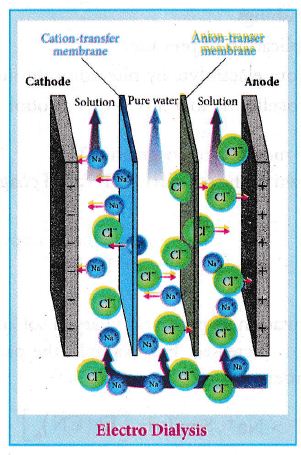
1. The presence of electric field increases the speed of removal of electrolytes from colloidal solution.
2. The colloidal solution containing an electrolyte as impurity is placed between two dialysing membranes enclosed into two compartments filled with water.
3. When current is passed, the impurities pass into water compartment and get removed periodically.
4. This process is faster then dialysis, as the rate of diffusion of electrolytes is increased by the application of electricity.
25.
This can be achieved by the following methods.
i) Coating metal surface by paint.
ii) Galvanizing - by coating with another metal such as zinc. zinc is stronger reducing agent than iron and hence it can be more easily corroded than iron. i.e., instead of iron, the zinc is oxidised.
iii) Cathodic protection - In this technique, unlike galvanising the entire surface of the metal to be protected need not be covered with a protecting metal. Instead, metals such as Mg or zinc which is corroded more easily than iron can be used as a sacrificial anode and the iron material acts as a cathode. So iron is protected, but Mg or Zn is corroded.
(a) Passivation - The metal is treated with strong oxidising agents such as concentrated HNO3. As a result, a protective oxide layer is formed on the surface of metal.
(b) Alloy formation - The oxidising tendency of iron can be reduced by forming its alloy with other more anodic metals.
Example, stainless steel - an alloy of Fe and Cr.
26.
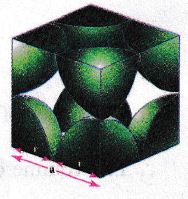
\(\text { Packing efficiency }=\frac{\text { Total volume occupied by spheres in a unit cell }}{\text { Volume of the unit cell }} \times 100\)
Volume of the cube with edge length 'a' is a3
Let 'r' is the radius of the sphere (a) = 2 r
\(r=\frac{a}{2}\)
Volume of the sphere with radius 'r'.
\(\mathrm{V}=\frac{4}{3} \pi \mathrm{r}^{3}=\frac{4}{3} \pi\left(\frac{\mathrm{a}}{2}\right)^{3} \)
\(\mathrm{~V}=\frac{4}{3} \pi \frac{\mathrm{a}^{3}}{8}=\frac{\pi \mathrm{a}^{3}}{6}\) .....(1)
In a simple cubic arrangement, number of spheres belongs to a unit cell equal to one.
Total volume occupied by the spheres in SC unit cell \(=1 \times \frac{\pi \mathrm{a}^{3}}{6}\) ....(2)
Dividing (1) by (2)
\(\text {Packing fraction } =\frac{\frac{\pi a^{3}}{6}}{\left(a^{3}\right)} \times 100=\frac{100 \pi}{6} \)
= 52.38%
27.
\({\left[\mathrm{H}^{+}\right]=\sqrt{\mathrm{KaC}}=\sqrt{1.8 \times 10^{-6}}} \)
\(=1.34 \times 10^{-3} \)
\(\mathrm{pH}=-\log \left[\mathrm{H}^{+}\right] \)
= 2.88
28.
(i) Emulsions of oil and water are unstable and sometimes they separate into two layers on standing.
(ii) For the stabilization of an emulsion, a third component called emulsifying a ent is usually added.
(iii) The emulsifying agent forms an interfacial film between suspended particles and the medium.

12th Standard Syllabus & Materials
12th Standard
TN 12th Computer Applications வலையமைப்பு வடமிடல் Sample Question Papers Study Material - QB365 Set A
NEW12th Standard
TN 12th Computer Applications களப்பெயர் முறைமை (DNS) Sample Question Papers Study Material - QB365 Set A
NEW12th Standard
TN 12th Computer Applications வலையமைப்பு எடுத்துக்காட்டுகள் மற்றும் நெறிமுறைகள் Sample Question Papers Study Material - QB365 Set A
NEW12th Standard
TN 12th Computer Applications கணினி வலையமைப்பு ஓர் அறிமுகம் Sample Question Papers Study Material - QB365 Set A



Tamilnadu Stateboard 12th Standard Subjects

Maths
Chemistry

Physics

Biology

Computer Science

Business Maths and Statistics

Economics

Commerce

Accountancy

History

Computer Applications
Biology
Computer Technology
Computer Applications
Computer Science
Business Maths and Statistics
Commerce
Economics
Maths
Chemistry
Physics
Computer Technology
History
Accountancy

Tamil

English

French
Tamilnadu Stateboard Standards


