
 100% FREE ACCESS
12th Standard Syllabus & Materials
12th Standard
TN 12th Computer Applications மின்னணு தரவு பரிமாற்றம் Sample Question Papers Study Material - QB365 Set A
NEW12th Standard
TN 12th Computer Applications மின் - வணிக பாதுகாப்பு அமைப்புகள் Sample Question Papers Study Material - QB365 Set A
NEW12th Standard
TN 12th Computer Applications மின்னணு செலுத்தல் முறைகள் Sample Question Papers Study Material - QB365 Set A
NEW12th Standard
TN 12th Computer Applications மின் - வணிகம் Sample Question Papers Study Material - QB365 Set A
NEW12th Standard
TN 12th Computer Applications திறந்த மூல கருத்துருக்கள் Sample Question Papers Study Material - QB365 Set A
NEW12th Standard
TN 12th Computer Applications வலையமைப்பு வடமிடல் Sample Question Papers Study Material - QB365 Set A

Published on: 28/11/2025
Download Tamil Nadu 12th Standard Chemistry question papers, model tests, one-mark questions, important questions, and public exam papers in PDF format. Free study materials and answer keys for TN State Board students.
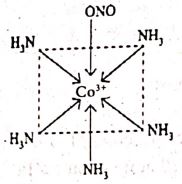
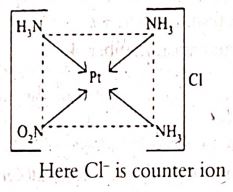
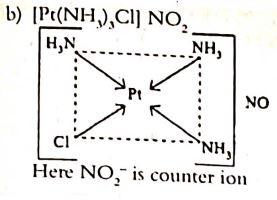
Questions + Answers key
Take MCQ Chemistry Test
1.
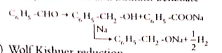
Phenyl methanal is reacted with concentrated NaOH to give two products X and Y. X reacts with metallic sodium to liberate hydrogen X and Y are ________.
sodium benzoate and phenol
Sodium benzoate and phenyl methanol
phenyl methanol and sodium benzoate
none of these
2.
A zero order reaction X ⟶ Product, with an initial concentration 0.02M has a half life of 10 min. if one starts with concentration 0.04M, then the half life is
10 s
5 min
20 min
cannot be predicted using the given information
3.
As per IUPAC guidelines, the name of the complex [Co(en)2(ONO)Cl]Cl is _______.
chloro bis ethylenediamine nitrocobalt(III) chloride
chloridobis(ethane-1, 2-diamine)nitro K-O Cobaltate(III) chloride
chloridobis(ethane-1, 2-diammine)nitrito K-O Cobalt(II) chloride
chloridobis(ethane-1, 2-diamine)nitrito K-O Cobalt(III) chloride
4.
The basic structural unit of silicates is _______.
\(\left( SiO_{ 3 } \right) ^{ 2- }\)
\(\left( SiO_{ 4 } \right) ^{ 2- }\)
\(\left( Sio \right) ^{ - }\)
\(\left( SiO_{ 4 } \right) ^{ 4- }\)
5.
Which of the metal is extracted by Hall-Heroult process?
Al
Ni
Cu
Zn
6.
Describe the electrolysis of molten NaCl using inert electrodes
7.
Which is more stable? Fe3+ or Fe2+? Why ?
8.
Give any three characteristics of ionic crystals.
9.
A hydride of 2nd period alkali metal (A) on reaction with compound of Boron (B) to give a reducing agent (C). Identify A, B and C.
10.
Explain the following terms with suitable examples.
(i) Gangue
(ii) slag
11.
What is the action of HCN on
(i) propanone
(ii) 2,4-dichlorobenzaldehyde
iii) ethanal
12.
When aqueous ammonia is added to CuSO4 solution, the solution turns deep blue due to the formation of tetra ammine copper (II) complex,\({ [Cu({ H }_{ 2 }O)_4] }_{ (aq) }^{ 2+ }+ 4{ NH }_{ 3 }(aq)\rightleftharpoons { [Cu{ ({ NH }_{ 3 }) }_{ 4 }] }_{ (aq) }^{ 2+ }\) among H2O and NH3 Which is stronger Lewis base.
13.
A zero order reaction is 20% complete in 20 minutes. Calculate the value of the rate constant. In what time will the reaction be 80% complete?
14.
What is crystal field stabilization energy (CFSE)?
15.
Give the basic requirement for vapour phase refining.
16.
Indicate the possible type of isomerism for the following complexes and draw their isomers
(i) [Co(en3)][Cr(CN)6]
(ii) [Co(NH3)5(NO2)]2+
(iii) [Pt(NH3)3(NO2)]Cl
17.
How will you prepare
i. Acetic anhydride from acetic acid
ii. Ethylacetate from methylacetate
iii. Acetamide from methylcyanide
iv. Lactic acid from ethanal
v. Acetophenone from acetylchloride
vi. Ethane from sodium acetate
vii. Benzoic acid from toluene
viii. Malachitegreen from benzaldehyde
ix. Cinnamic acid from benzaldehyde
x. Acetaldehyde from ethyne
18.

Identify A,B,C,D and write the complete equation
19.
The time for half change in a first order decomposition of a substance A is 60 seconds. Calculate the rate constant. How much of A will be left after 180 seconds?
1.
2.
for n ≠ 1 t1/2 = \(\frac{2^{n-1} -1}{(n- 1) k[A_{0}]^{-1}}\)
for n = 0; t1/2 = \(\frac{1}{2 k[A_{0}]^{-1}}\)
t1/2 = \(\frac{[A_{0}]}{2 k}\)
t1/2 α [A0] ...(1)
Given [A0] = 0.002 M; t1/2 = 10 min
[A0] = 0.04M; t1/2 = ?
Substitute in (1)
10 min α 0.02 M...(2)
t1/2 α 0.04M ....(3)
(3)(2)
⇒ t1/2 / 10 min
= 0.04 M/0.02 M
t1/2 = 2 x 10 min = 20 min
3.
(d)
chloridobis(ethane-1, 2-diamine)nitrito K-O Cobalt(III) chloride
4.
(d)
\(\left( SiO_{ 4 } \right) ^{ 4- }\)
5.
(a)
Al
6.
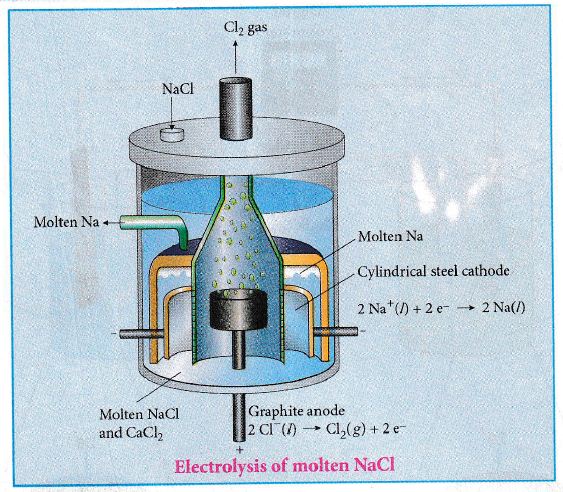
(i) The electrolytic cell consists of two iron electrodes dipped in molten sodium chloride and they are connected to an external DC power supply via a key as shown in the figure. The electrode which is attached to the negative end of the power supply is called the cathode, and the one which attached to the positive end is called the anode. Once the key is closed, the external DC power supply drives the electrons to the cathode and at the same time pull the electrons from the anode.
Cell reactions:
Na+ ions are attracted towards cathode, where they combines with the electrons and reduced to liquid sodium.
Cathode (reduction)
\(N a_{(l)}^{+}+e^{-} \rightarrow N a_{(l)} \quad ; \quad E^{0}=-2.71 V\)
Similarly, Cl- ions are attracted towards anode where they lose their electrons and oxidised to chlorine gas.
Anode (oxidation)
2CI-(l) ⟶ CI2(g) + 2e- E0 = -1.36V
The overall reaction is
2Na+(l) + 2Cl-(l)➝ 2Na(l) + Cl2(g) ; E° = - 4.07V
(ii) The negative E° value shows that the above reaction is a non-spontaneous one.
(iii) Hence, we have to supply a voltage greater than 4.07V to cause the electrolysis of molten NaCI.
(iv) In electrolytic cell, oxidation occurs at the anode and reduction occur at the cathode as in a galvanic cell.
(v) But the sign of the electrodes is the reverse i.e., in the electrolytic cell cathode is -ve and anode is +ve.
7.
(i) Fe3+ - electronic configuration - [Ar] 3d5
(ii) It has exactly half-filled stable electronic configuration.
(iii) Fe2+ - electronic configuration -[Ar]3d6
(iv) It has only partially filled d-orbitals.
Hence Fe3+ is more stable than Fe2+.
8.
(i) Ionic solids have high melting points.
(ii) These solids do not conduct electricity, because the ions are fixed in their lattice positions.
(iii) They are hard so strong external force can change the relative positions of ions.
9.
A hydride of 2nd period alkali metal (A) is lithium hydride (LiH).
Lithium hydride (A) reacts with diborane (B) to give lithium borohydride (C) which is acts as a reducing agent.
B2H6 + 2 LiH \(\xrightarrow[]{ether}\) 2 LiBH4
[Diborane (B)] [Lithium hydride (A)] [Lithium borohydride (C)]
Result:
| Compound | Formula | Name |
| A | LiH | Lithium hydride |
| B | B2H6 | Diborane |
| C | LiBH4 | Lithium borohydride |
10.
(i) Gangue: The ores are associated with nonmetallic impurities, rocky materials and siliceous matter which are collectively known as gangue.
Eg: SiO2 is the gangue present in the iron ore (Fe2O3)
(ii) Slag: In the smelting process, a flux combines with Silica gangue forming slag.
CaO(s) + SiO2(s) → CaSiO3(s)
Flux + gangue → Slag
11.
.JPG)
(ii) 2,4-dichlorobenzaldehyde.
.JPG)
(iii) ethanal
.JPG)
12.
(i) According to Lewis theory a species that donates a pair of electron is called Lewis base.
(ii) Nitrogen more in NH3 is less electro negative than oxygen in water. So the non - bonded electron pair on nitrogen is more available for sharing than a non - bonded electron pair on oxygen atom. So NH3 is a stronger lewis base than H2O.
13.
(i) Let A = 100M, [A0] - [A] = 20M,
For the zero order reaction
\(k=\left( \frac { \left[ { A }_{ 0 } \right] -\left[ A \right] }{ t } \right) \)
(i) 20% completion \(k=\left( \frac { 20M }{ 20min } \right) \) = 1 mol L-1 min-1
(ii) 80% completion
\(\mathrm{K}=1 \mathrm{~mol} \mathrm{~L}{ }^{-1} \mathrm{~s}^{-1} ;\left[\mathrm{A}_{0}\right]=100 \mathrm{M} ;\left[\mathrm{A}_{0}\right]-[\mathrm{A}]=80 \mathrm{M} ; \mathrm{t}=?\)
\(\therefore t=\left(\frac{\left[A_{O}\right]-[A]}{K}\right)=\frac{80}{1}=80 \mathrm{mins}\)
14.
The CFSE is defined as the energy of the electronic configuration in the ligand field minus the energy of the electronic configuration in the isotropic field.
CFSE (\(\Delta\)Eo) = {ELf}-{Eiso}
={[nt2g(-0.4) + neg(0.6)]\(\Delta\)o + npP} - {n'pP}
Here, nt2g is the number of electrons in t2g orbitals;
neg is number of electrons in eg orbitals;
np is number of electron pairs in the ligand field; &
n'p is the number of electron pairs in the isotropic field (barycenter).
P - pairing energy
15.
In this method, the metal is treated with a suitable reagent which can form a volatile compound with the metal.
Then the volatile compound is decomposed to give the pure metal.
16.
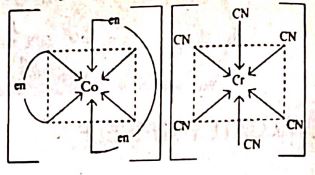
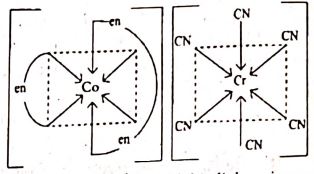
(i) [Co(en3)][Cr(CN)6] - Exhibits coordination isomerism
(a) [Co(en3)][Cr(CN)6]
b) [Cr(en3)][Co(CN)6]
(ii) [Co(NH3)5(NO2)]2+ - Exhibits linkage isomerism
a) [Co(NH3)5(NO2)]2+ - N attached
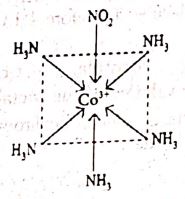
b) [Co(NH3)5(ONO2)]2+ - O attached
(iii) [Pt(NH3)3(NO2)]Cl - Exhibits ionisation isomerism
a) [Pt(NH3)3(NO2)]Cl
17.
(i) Acetic anhydride from acetic acid:
.JPG)
Carboxylic acid on heating in the presence of a strong dehydrating agent such as P2O5 forms acid anhydride.
(ii) Ethylacetate from methyl acetate:
1. In presence of a little acid, methyl acetate is cleaved by ethyl alcohol to form ethyl acetate.
\(\underset{Methyl \ acetate }{\mathrm{CH}_{3} \mathrm{COOCH}_{3}}+ \underset{Propyl \ alcohol} {\mathrm{C}_{2} \mathrm{H}_{5} \mathrm{OH}} \stackrel{\mathrm{H}^{+}}{\rightleftharpoons} \underset { Ethyl \ acetate}{\mathrm{CH}_{3} \mathrm{COOC}_{2} \mathrm{H}_{5}}+\mathrm{CH}_{3} \mathrm{OH} \)
2. This is called 'trans esterification'.
Acetamide from methyl cyanide:
Partial hydrolysis of alkyl cyanides with cold con HCl gives amides.
.JPG)
(iv) Lactic acid from ethanal
.JPG)
Acetophenone frorr acetylchloride:
Friedel Crafts acetylation of, benzene with CH3COCI/AICI3
.JPG)
Ethane from sodium acetate:
\(\underset{Sodium \ acetate}{2 \mathrm{CH}_{3}} \mathrm{COONa}+2 \mathrm{H}_{2} \mathrm{O} \stackrel{\text { Electrolysis }}{\longrightarrow} \underset{Ethane}{\mathrm{CH}_{3}}-\mathrm{CH}_{3}+2 \mathrm{CO}_{2}+\mathrm{H}_{2}+2 \mathrm{NaOH} \)
This is Kolbe's electrolysis.
Benzoic acid from toluene:
Toluene is oxidised by acidified KMnO4
\(\mathrm{C}_{6} \mathrm{H}_{5} \mathrm{CH}_{3} \frac{\mathrm{H}^{+} / \mathrm{KMnO}_{4}}{(\mathrm{O})} \mathrm{C}_{6} \mathrm{H}_{5} \mathrm{COOH}\)
Malachite green from benzaldehyde:
Benzaldehyde condenses with tertiary aromatic amines like N, N - dimethyl aniline in the presence of strong acids to form triphenyl methane dye.
.JPG)
Cinnamic acid from benzaldehyde:
.JPG)
Acedaldehyde from ethyne:
.JPG)
18.
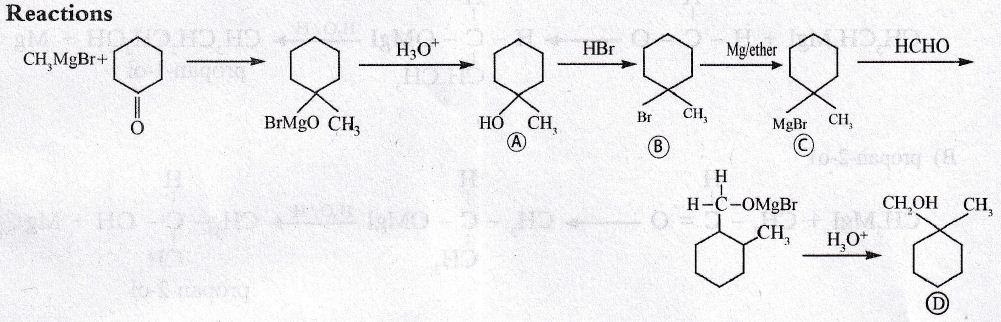
19.
(i) Order of the reaction =1; \(\mathrm{t}_{1 / 2}=60 \mathrm{~s} ; \mathrm{k}=?\)
\(\mathrm{k}=\frac{0.6932}{\mathrm{t}_{\frac{1}{2}}} \)
\(=\frac{0.6932}{60} \)
\(k =1.155 \times 10^{-2} \mathrm{~s}^{-1}\)
(ii) \(\left[\mathrm{A}_{0}\right]=100 \% ; \mathrm{t}=180 \mathrm{~s} ;[\mathrm{A}]=? ; \mathrm{k}=1.155 \times 10^{-2} \mathrm{~s}^{-1}\)
For first order reaction
\(\mathrm{k}=\frac{2.303}{\mathrm{t}} \log \frac{\left[\mathrm{A}_{0}\right]}{[\mathrm{A}]} \)
\(1.155 \times 10^{-2} =\frac{2.303}{180} \log \left(\frac{100}{[A]}\right) \)
\(\frac{0.01155 \times 180}{2.303} =\log \left(\frac{100}{[A]}\right) \)
\(0.9027 =\log 100-\log [\mathrm{A}] \)
\(\log [\mathrm{A}] =\log 100-0.9027 \)
\(\log [A]=2-0.9027 \)
\(\log [A]=1.0972 \)
[A] = antilog of (1.0972)
[A] =12.51 %

12th Standard Syllabus & Materials
12th Standard
TN 12th Computer Applications களப்பெயர் முறைமை (DNS) Sample Question Papers Study Material - QB365 Set A
NEW12th Standard
TN 12th Computer Applications வலையமைப்பு எடுத்துக்காட்டுகள் மற்றும் நெறிமுறைகள் Sample Question Papers Study Material - QB365 Set A
NEW12th Standard
TN 12th Computer Applications கணினி வலையமைப்பு ஓர் அறிமுகம் Sample Question Papers Study Material - QB365 Set A
NEW12th Standard
TN 12th Computer Applications PHP-உடன் MySQL-ஐ இணைத்தல் Sample Question Papers Study Material - QB365 Set A



Tamilnadu Stateboard 12th Standard Subjects

Maths
Chemistry

Physics

Biology

Computer Science

Business Maths and Statistics

Economics

Commerce

Accountancy

History

Computer Applications
Biology
Computer Technology
Computer Applications
Computer Science
Business Maths and Statistics
Commerce
Economics
Maths
Chemistry
Physics
Computer Technology
History
Accountancy

Tamil

English

French
Tamilnadu Stateboard Standards


