
 100% FREE ACCESS
12th Standard Syllabus & Materials
12th Standard
TN 12th Computer Applications மின்னணு தரவு பரிமாற்றம் Sample Question Papers Study Material - QB365 Set A
NEW12th Standard
TN 12th Computer Applications மின் - வணிக பாதுகாப்பு அமைப்புகள் Sample Question Papers Study Material - QB365 Set A
NEW12th Standard
TN 12th Computer Applications மின்னணு செலுத்தல் முறைகள் Sample Question Papers Study Material - QB365 Set A
NEW12th Standard
TN 12th Computer Applications மின் - வணிகம் Sample Question Papers Study Material - QB365 Set A
NEW12th Standard
TN 12th Computer Applications திறந்த மூல கருத்துருக்கள் Sample Question Papers Study Material - QB365 Set A
NEW12th Standard
TN 12th Computer Applications வலையமைப்பு வடமிடல் Sample Question Papers Study Material - QB365 Set A

Published on: 28/11/2025
Download Tamil Nadu 12th Standard Chemistry question papers, model tests, one-mark questions, important questions, and public exam papers in PDF format. Free study materials and answer keys for TN State Board students.
Questions + Answers key
Take MCQ Chemistry Test
1.
If the rate expression of a chemical reaction is given by rate = K[A]m[B]n.
The order of the reaction is m
The order of the reaction is n
The order of the reaction is m + n
The order of the reaction is m - n
2.
The battery used in pacemakers is ________.
Lead storage battery
Daniel cell
Leclanche cell
Mercury button battery
3.
For the given cell Cr(s)|Cr3+(aq)||Cu2+(aq)|Cu(s) which is correct?
Cr is the anode
Cu is the anode
Overall cell reaction is 2Cr3+(aq) +3Cu(s) ⟶ 2Cr(s) + 3Cu2+(aq)
Cu is the anode and Overall cell reaction is 2Cr3+(aq) +3Cu(s) ⟶ 2Cr(s) + 3Cu2+(aq)
4.
A device in which spontaneous chemical reaction generates electric current ________.
Galvanic cell
Voltaic cell
Daniel cell
All the above
5.
HO CH2 CH2 – OH on heating with periodic acid gives ______.
methanoic acid
Glyoxal
methanol
CO2
6.
In H2-O2 fuel cell the reaction occur at cathode is _______.
O2(g) + 2H2O(l) + 4e- ⟶ 4OH− (aq)
H+(aq) + OH− (aq) ⟶ H2O (l)
2H2 (g) + O2 (g) ⟶ 2H2O (g)
H+ + e- ⟶ 1/2 H2
7.
Consider the following half cell reactions.
Mn2+ + 2e- ➝ Mn Eo = -1.18V
Mn2+ ➝ Mn3+ + e- Eo = -1.51V
The Eo for the reaction 3Mn2+➝ Mn + 2Mn3+, and the possibility of the forward reaction are respectively.
2.69V and spontaneous
-2.69 and non spontaneous
0.33V and Spontaneous
4.18V and non spontaneous
8.
Which order reaction obeys the expression \({ t }_{ \frac { 1 }{ 2 } }\alpha \frac { 1 }{ \left[ A \right] } ?\)
First
Second
Third
Zero
9.
If the initial concentration of the reactant is doubled, the time for half reaction is also doubled. Then the order of the reaction is______.
Zero
one
Fraction
none
10.
Among the following graphs showing variation of rate constant with temperature (T) for a reaction, the one that exhibits Arrhenius behavior over the entire temperature range is _______.

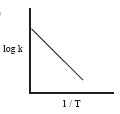
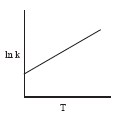
both (b) and (c)
11.
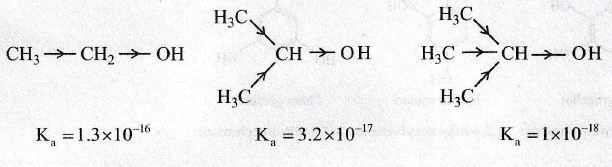
Compare the acidity of 1o, 20 and 30 alcohols.
12.
Mention the uses of Kohlraush's law.
13.
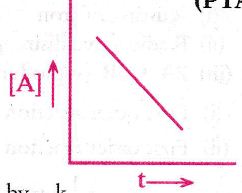
For the general reaction A → B. Plot of concentration of AVs time is given in the graph below. Answer the following questions on the basis of this graph.
i) What is the order of the reaction?
ii) What is the slope of the curve?
iii) What is the unit of rate constant?
14.
How is phenol prepared from
i) chloro benzene
ii) isopropyl benzene
15.
Why is AC current used instead of DC in measuring the electrolytic conductance?
16.
State Faraday’s Laws of electrolysis
17.
Derive integrated rate law for a zero order reaction A\(\longrightarrow \) product.
18.
Write a note on coupling reaction.
19.
Write the cell representation:
a) \(\mathrm{Zn}_{(\mathrm{s})}+\mathrm{Cu}_{(\mathrm{aq})}^{2+} \rightarrow \mathrm{Zn}_{(\mathrm{aq})}^{2+}+\mathrm{Cu}_{(\mathrm{s})}\)
b) \(2 \mathrm{Cr}_{(\mathrm{s})}+3 \mathrm{Cu}_{(\mathrm{aq})}^{2+} \rightarrow 2 \mathrm{Cr}_{(\mathrm{aq})}^{3+}+3 \mathrm{Cu}_{(\mathrm{s})}\)
20.
Calculate the half-life period of zero order reaction.
21.
How are the following conversions effected
i) benzylchloride to benzylalcohol
ii) benzyalalcohol to benzoic acid
22.
Write a note on sacrificial protection.
23.
A zero order reaction is 20% complete in 20 minutes. Calculate the value of the rate constant. In what time will the reaction be 80% complete?
24.
Explain Victor Meyer's test's of distinguishing of 10, 20, and 30 alcohols with equations.
a) CH3CH2OH
.JPG)
.JPG)
25.
Describe the construction and working of Lithium - ion battery
26.
Derive Arrhenius equation to calculate activation energy from the rate constant k1 and k2 at temperature T1 and T2 respectively.
27.

Identify A,B,C,D and write the complete equation
28.
29.
Show that for a first order reaction the time required for 99.9% completion is about 10 times its half life period.
1.
(c)
The order of the reaction is m + n
2.
(d)
Mercury button battery
3.
(a)
Cr is the anode
4.
(d)
All the above
5.
(c)
methanol
6.
(a)
O2(g) + 2H2O(l) + 4e- ⟶ 4OH− (aq)
7.
Mn2+ + 2e- ➝ Mn Eo = -1.18V
Mn2+ ➝ Mn3+ + e- Eo = -1.51V
3Mn2+➝ Mn3+ + 2Mn3+ Eocell = ?
Eocell = (Eoox )+ (Eored)
= 1.51 - 1.18 and non spontaneous
= -2.69V
Since E°is ve ΔG is +ve and the given forward cell reaction is non- spontaneous
8.
(b)
Second
9.
t1/2 α \(\frac{1}{[A_{0}]^{n-1}}\)...(1)
If [A0 = 2[A0]; then t1/2 = 2t1/2
2t1/2 α \(\frac{1}{[2A_{0}]^{n-1}}\)...(2)
(2)/(1) = \(2= \frac{1}{[2A_{0}]^{n-1}} \times \frac{1}{[A_{0}]^{n-1}}\)
\(2= \frac {[2A_{0}]^{n-1}} {[A_{0}]^{n-1}}\)
\(2= \frac {1} {2}^{n-1}\)
2 = (2-1)n-1
21 = (2-n+1)
n = 0
10.
\(k=A{ e }^{ -\left( \frac { { E }_{ a } }{ RT } \right) }\)
In k = In A - \({ \left( \frac { { E }_{ a } }{ R } \right) }\) \(\left( \frac { 1 }{ T } \right) \)
This equation is of the form of a straight line y = mx+c
A plot of In k Vs \(\left( \frac { 1 }{ T } \right) \) gives a straight line with a negative slope.
11.
1. The acidic nature of the alcohol is due to the polar nature of O-H bond.
2. When an electron with drawing -I groups such as - Cl,-F etc, is attached to the carbon bearing the OH group it withdraws the electron density towards itself and thereby facilitating the proton donation. In contrast, the electron releasing group such as alkyl group increases the electron density on oxygen and decreases the polar nature of O-H bond, Hence it results in the decrease in acidity.
\(\begin{array}{lll}1^{0} \text { alcohol }> & 2^{0} \text { alcohol }> & 3^{\circ} \text { alcohol. } \\ \text { Only one alkyl } & \text { two alkyl } & \text { three alkyl } \\ \text { group } & \text { groups } & \text { groups }\end{array}\)
12.
1. To calculate the molar conductance at infinite dilution of a weak electrolyte
2. To calculate the degree of dissociation of a weak electrolyte
3. To calculate the solubility of a sparingly soluble salts
13.
i) It is a zero order reaction as the graph is satisfying the equation \([\mathrm{A}]=\left[\mathrm{A}_{0}\right]-\mathrm{kt}.\)
ii) The slope of the curve is the negative of the rate constant that is denoted by -k.
iii) Unit of rate constant is Ms-1 or mol L-1 S-1.
14.
(i) Chloro benzene:
When Chlorobenzene is hydrolysed with 6-8% NaOH at 300 bar and 633K in a closed vessel, sodium phenoxide is formed which on treatment with dilute HCl gives phenol.
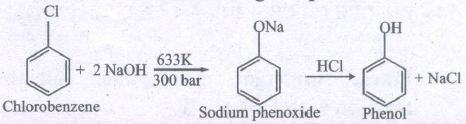
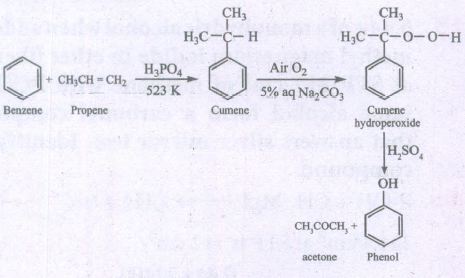
(ii) isopropyl benzene:
A mixture of benzene and propene is heated at 523K in a closed vessel in presence of H3PO4 catalyst gives cumene (isopropylbenzene). On passing air to a mixture of cumene and 5% aqueous sodium carbonate solution, cumene hydro peroxide is formed by oxidation. It is treated with dilute acid to get phenol and acetone. Acetone is also an important byproduct in this reaction.
15.
(a) If we apply DC current through the conductivity cell, it will lead to the electrolysis of the solution taken in the cell.
(b) So, AC current is used for this measurement to prevent electrolysis.
16.
First law:
The mass of the substance (m) liberated at an electrode during electrolysis is directly proportional to the quantity of charge (Q) passed through the cell.
m α Q \(\left[\because \mathrm{I}=\frac{\mathrm{Q}}{\mathrm{t}} \Rightarrow \mathrm{Q}=\mathrm{It}\right]\)
m α It
m = ZIt
Where Z = electro chemical equivalent of the substance
I = current
t = time of passage of current
Second law:
When the same quantity of charge is passed through the solutions of different electrolytes, the amount of substances liberated at the respective electrodes are directly proportional to their electrochemical equivalents.
m α Z
\(\frac{m_{1}}{Z_{1}}=\frac{m_{2}}{Z_{2}}\)
m = mass of the metal deposited
Z = electro chemical equivalent
17.
A reaction in which the rate is independent of the concentration of the reactant over a wide range of concentration is called a zero order reaction.
Let us consider the following by hypothetical zero order reaction.
A⟶ product
The rate law can be written as,
Rate = k[A]0
\(\frac { -d\left[ A \right] }{ dt } =k(1)\ \ \ \therefore \left( { \left[ A \right] }^{ 0 }=1 \right) \)
\(\Rightarrow -d\left[ A \right] =kdt\)
Integrate the above equation between the limits of [A0] at zero time and [A] at some later time 't',
\(-\int _{ \left[ { A }_{ 0 } \right] }^{ \left[ A \right] }{ d\left[ A \right] } =k\int _{ 0 }^{ t }{ dt } \)
\(-{ \left( \left[ A \right] \right) }_{ \left[ { A }_{ 0 } \right] }^{ \left[ A \right] }=k{ \left( t \right) }_{ 0 }^{ t }\)
[A0] - [A] = kt
\(k=\frac { \left[ { A }_{ 0 } \right] -\left[ A \right] }{ t } \)
Straight line equation y = mx + c
ie., \(\left[ A \right] =-kt+\left[ { A }_{ 0 } \right] \)
⇒ y = c + mx
A plot [A] vs time gives a straight line with a slope of -k and y intercept of [A0]
18.
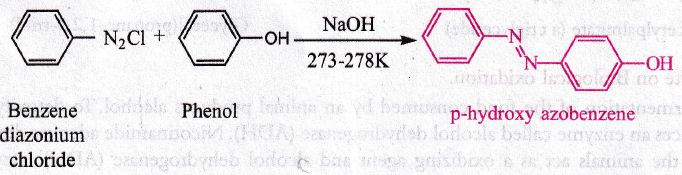
Phenol couples with benzene diazonium chloride in an alkaline solution to form p-hydroxy azo benzene (a red orange dye)
19.
a) \(Z n_{(s)}\left|\mathrm{Zn}_{(a q)}^{2+} \| \mathrm{Cu}_{(\mathrm{aq})}^{2+}\right| \mathrm{Cu}\)
b) \(\mathrm{Cr}_{(\mathrm{s})}\left|\mathrm{Cr}_{(\mathrm{aq})}^{3+} \| \mathrm{Cu}_{(\mathrm{aq})}^{2+}\right| \mathrm{Cu}_{(\mathrm{s})}\)
20.
Integrated rate equation for zero order reaction:
\(k=\frac{[A]_{0}-[A]}{t} ; t_{\frac{1}{2}}=\frac{[A]_{0}}{2 k}\)
Integrated rate equation for first order reaction.
\(k=\frac{2.303}{t} \log \frac{a}{a-x} ; t_{\frac{1}{2}}=\frac{0.693}{k}\)
21.
(i) Benzylchloride to benzylalcohol
\(\underset { Benzyl \ chloride }{ { C }_{ 6 }{ H }_{ 5 }{ CH }_{ 2 }Cl } + NaOH { \longrightarrow } \underset { Benzyl \ alcohol }{ { C }_{ 6 }{ H }_{ 5 }{ CH }_{ 2 }OH } +NaCl\)
(ii) benzyalalcohol to benzoic acid
\(\underset { Benzyl \ alcohol }{\mathrm{C}_{6} \mathrm{H}_{5} \mathrm{CH}_{2} \mathrm{OH} }\stackrel{\mathrm{Na}_{2} \mathrm{Cr}_{2} \mathrm{O}_{7} / \mathrm{H}^{+}}{\longrightarrow}\underset { Benzaldehyde } {\mathrm{C}_{6} \mathrm{H}_{5} \mathrm{CHO}}\stackrel{\mathrm{Na}_{2} \mathrm{CrO}_{7} / \mathrm{H}^{+}}{\longrightarrow} \underset { Benzoic \ acid } {\mathrm{C}_{6} \mathrm{H}_{5} \mathrm{COOH}}\)
22.
Cathodic protection:
In this technique, unlike galvanising the entire surface of the metal to be protected need not be covered with a protecting metal. Instead, metals such as Mg or zinc which is corroded more easily than iron can be used as a sacrificial anode and the iron material acts as a cathode. So iron is protected, but Mg or Zn is corroded. This known as sacrificial protection. (or) Cathodic protection.
23.
(i) Let A = 100M, [A0] - [A] = 20M,
For the zero order reaction
\(k=\left( \frac { \left[ { A }_{ 0 } \right] -\left[ A \right] }{ t } \right) \)
(i) 20% completion \(k=\left( \frac { 20M }{ 20min } \right) \) = 1 mol L-1 min-1
(ii) 80% completion
\(\mathrm{K}=1 \mathrm{~mol} \mathrm{~L}{ }^{-1} \mathrm{~s}^{-1} ;\left[\mathrm{A}_{0}\right]=100 \mathrm{M} ;\left[\mathrm{A}_{0}\right]-[\mathrm{A}]=80 \mathrm{M} ; \mathrm{t}=?\)
\(\therefore t=\left(\frac{\left[A_{O}\right]-[A]}{K}\right)=\frac{80}{1}=80 \mathrm{mins}\)
24.
(i) This test is based on the behaviour of the different nitro alkanes formed by the three types of alcohols with nitrous acid and it consists of the following steps.
i) Alcohols are converted into alkyl iodide by treating it with I2 / P.
ii) Alkyl iodide so formed is then treated with AgNO2 to form nitro alkanes.
iii) Nitro alkanes are finally treated with HNO2 (mixture of NaNO2 / HCl) and the resultant solution is made alkaline with KOH.
Result:
1. Primary alcohol gives red colour.
2. Secondary alcohol gives blue colour.
3. No colouration will be observed in case of tertiary alcohol.
.JPG)
.JPG)
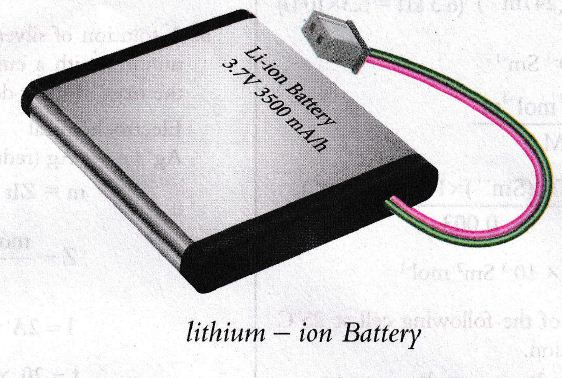
25.
Anode: Porus graphite
Cathode: Transition metal oxide such as CoO2
Electrolyte: Lithium salt in an organic solvent
(i) Oxidation at anode
\(\mathrm{Li}_{(\mathrm{s})} \rightarrow \mathrm{Li}_{(\mathrm{aq})}^{+}+\mathrm{e}^{-}\)
(ii) Reduction at cathode
\(\mathrm{Li}^{+}+\mathrm{CoO}_{2(\mathrm{~s})}+\mathrm{e}^{-} \rightarrow \mathrm{LiCoO}_{2(\mathrm{~s})}\)
(iii) Overall reactions
\(\mathrm{Li}_{(\mathrm{s})}+\mathrm{CoO}_{2} \rightarrow \mathrm{LiCoO}_{2(\mathrm{~s})}\)
(iv) Both electrodes allow Li+ ions to move in and out of their structures.
(v) During discharge, the Li+ ions produced at the anode move towards cathode through the non - aqueous electrolyte.
(vi) When a potential greater than the emf produced by the cell is applied across the electrode, the cell reaction is reversed and now the Li+ ions move from cathode to anode where they become embedded on the porous graphite electrode. This is known as intercalation.
Uses:
Used in cellular phones, laptops, computers, digital cameras, etc...
26.
According to Arrhenius, activation energy of the reaction is the minimum energy that a molecule must have to posses to react.
\(\mathrm{k}=\mathrm{A} e^{-\left(\frac{E_{a}}{R T}\right)}\)
Where A is the frequency factor
R is the gas constant
Ea is the activation energy of the reaction
T is the absolute temperature. (in k)
Taking logarithm on both side of the equation (1)
\(\ln \mathrm{k}=\ln \mathrm{A}+\ln \mathrm{e}^{-\left(\frac{E_{a}}{R T}\right)} \)
\(\ln \mathrm{k}=\ln \mathrm{A}-\left(\frac{\mathrm{E}_{\mathrm{a}}}{\mathrm{RT}}\right) \quad(\therefore \ln \mathrm{e}=1) \)
\(\ln \mathrm{k}=\ln \mathrm{A}-\left(\frac{\mathrm{E}_{\mathrm{a}}}{\mathrm{R}}\right)\left(\frac{1}{\mathrm{~T}}\right)\)
At temperature T = T1; the rate constant k = k1
\(\ln \mathrm{k}_{1}=\ln \mathrm{A}-\left(\frac{\mathrm{E}_{\mathrm{a}}}{\mathrm{RT}_{1}}\right)\)
At temperature T = T2; the rate constant k = k2
\(\ln \mathrm{k}_{2}=\ln \mathrm{A}-\left(\frac{\mathrm{E}_{\mathrm{a}}}{\mathrm{RT}_{2}}\right)\)
(4)-(3)
\(\ln \mathrm{k}_{2}-\ln \mathrm{k}_{1}=-\left(\frac{\mathrm{E}_{\mathrm{a}}}{\mathrm{RT}_{2}}\right)+\left(\frac{\mathrm{E}_{\mathrm{a}}}{\mathrm{RT}_{1}}\right) \)
\(\Rightarrow \ln \left(\frac{\mathrm{k}_{2}}{\mathrm{k}_{1}}\right)=\frac{\mathrm{E}_{\mathrm{a}}}{\mathrm{R}}\left(\frac{1}{\mathrm{~T}_{1}}-\frac{1}{\mathrm{~T}_{2}}\right) \)
\(2.303 \log \left(\frac{\mathrm{k}_{2}}{\mathrm{k}_{1}}\right)=\frac{\mathrm{E}_{\mathrm{a}}}{\mathrm{R}}\left(\frac{\mathrm{T}_{2}-\mathrm{T}_{1}}{\mathrm{~T}_{1} \mathrm{~T}_{2}}\right) \)
\(\log \left(\frac{\mathrm{k}_{2}}{\mathrm{k}_{1}}\right)=\frac{\mathrm{E}_{\mathrm{a}}}{2.303 \mathrm{R}}\left(\frac{\mathrm{T}_{2}-\mathrm{T}_{1}}{\mathrm{~T}_{1} \mathrm{~T}_{2}}\right) \)
\(\ln \mathrm{k}_{2}-\ln \mathrm{k}_{1}=-\left(\frac{\mathrm{E}_{\mathrm{a}}}{\mathrm{RT}_{2}}\right)+\left(\frac{\mathrm{E}_{\mathrm{a}}}{\mathrm{RT}_{1}}\right)\)
This equation can be used to calculate Ea from rate constants k1 and k2 at temperatures T1 and T2.
27.
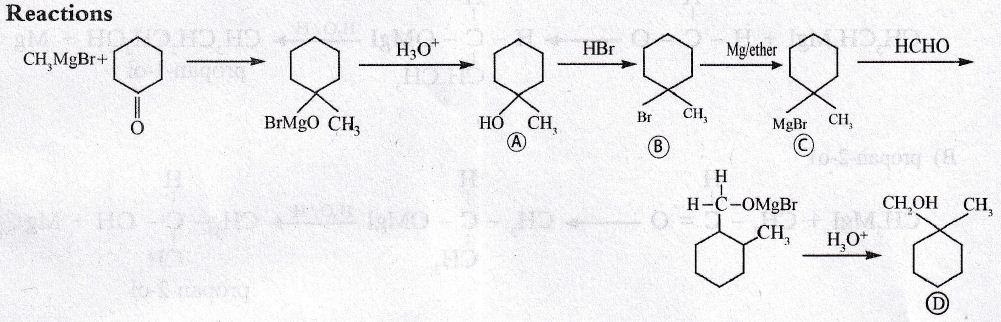
28.
29.
Given data: Time required for 99.9% completion is about 10 times its half life period. Prove that for a first order reaction the time required for 99.9% completion is about 10 times its half life period.
Formula: \(k=\frac { 2.303 }{ t } \log { \frac { a }{ a-x } } \)
\({ t }_{ \frac { 1 }{ 2 } }=\frac { 0.693 }{ k } \)
Solution:
\({ t }_{ 99.9 }=\frac { 2.303 }{ k } \log\frac { 100 }{ 100-99.9 } \)
\(=\frac { 2.303 }{ k } \log\frac { 100 }{ 0.1 } \)
\(=\frac { 2.303 }{ k } \log1000\)
\({ t }_{ 99.9 }=\frac { 2.303\times 3 }{ k } \)
\({ t }_{ 99.9 }=\frac { 6.909 }{ k } ;\)
\({ t }_{ \frac { 1 }{ 2 } }=\frac { 0.693 }{ k } \) \(\therefore k=\frac { 0.693 }{ { t }_{ \frac { 1 }{ 2 } } } \)
\(\frac { { t }_{ 99.9\% } }{ { t }_{ \frac { 1 }{ 2 } } } =\frac { 6.909 }{ k } \times \frac { k }{ 0.693 }\)
\({ t }_{ 99.9 }=\frac { 6.909 }{ 0.693 } \times { t }_{ \frac { 1 }{ 2 } }\)
t99.9 = 10 x t1/2
Time required for 99.9% completion of the reaction = 10t1/2

12th Standard Syllabus & Materials
12th Standard
TN 12th Computer Applications களப்பெயர் முறைமை (DNS) Sample Question Papers Study Material - QB365 Set A
NEW12th Standard
TN 12th Computer Applications வலையமைப்பு எடுத்துக்காட்டுகள் மற்றும் நெறிமுறைகள் Sample Question Papers Study Material - QB365 Set A
NEW12th Standard
TN 12th Computer Applications கணினி வலையமைப்பு ஓர் அறிமுகம் Sample Question Papers Study Material - QB365 Set A
NEW12th Standard
TN 12th Computer Applications PHP-உடன் MySQL-ஐ இணைத்தல் Sample Question Papers Study Material - QB365 Set A



Tamilnadu Stateboard 12th Standard Subjects

Maths
Chemistry

Physics

Biology

Computer Science

Business Maths and Statistics

Economics

Commerce

Accountancy

History

Computer Applications
Biology
Computer Technology
Computer Applications
Computer Science
Business Maths and Statistics
Commerce
Economics
Maths
Chemistry
Physics
Computer Technology
History
Accountancy

Tamil

English

French
Tamilnadu Stateboard Standards


