
 100% FREE ACCESS
12th Standard Syllabus & Materials
12th Standard
TN 12th Computer Applications மின்னணு தரவு பரிமாற்றம் Sample Question Papers Study Material - QB365 Set A
NEW12th Standard
TN 12th Computer Applications மின் - வணிக பாதுகாப்பு அமைப்புகள் Sample Question Papers Study Material - QB365 Set A
NEW12th Standard
TN 12th Computer Applications மின்னணு செலுத்தல் முறைகள் Sample Question Papers Study Material - QB365 Set A
NEW12th Standard
TN 12th Computer Applications மின் - வணிகம் Sample Question Papers Study Material - QB365 Set A
NEW12th Standard
TN 12th Computer Applications திறந்த மூல கருத்துருக்கள் Sample Question Papers Study Material - QB365 Set A
NEW12th Standard
TN 12th Computer Applications வலையமைப்பு வடமிடல் Sample Question Papers Study Material - QB365 Set A

Published on: 28/11/2025
Download Tamil Nadu 12th Standard Chemistry question papers, model tests, one-mark questions, important questions, and public exam papers in PDF format. Free study materials and answer keys for TN State Board students.
Questions + Answers key
Take MCQ Chemistry Test
1.
Secondary nitro alkanes react with nitrous acid to form _______.
red solution
blue solution
green solution
yellow solution
2.
C5H13N reacts with HNO2 to give an optically active compound – The compound is _______.
pentan – 1- amine
pentan – 2- amine
N,N – dimethylpropan -2-amine
diethyl methyl amine
3.
Aniline + benzoylchloride \(\overset { NaOH }{ \longrightarrow } \)C6H5 - NH - COC6 H5 this reaction is known as ______.
Friedel – crafts reaction
HVZ reaction
Schotten – Baumann reaction
none of these
4.
CH3CH2 Br \(\overset { aqNaOH }{ \underset { \Delta }{ \longrightarrow } } A\overset { { KMnO }_{ 4 }{ /H }^{ + } }{ \underset { \Delta }{ \longrightarrow } } B\overset { { NH }_{ 3 } }{ \underset { \Delta }{ \longrightarrow } } C\overset { { Br }_{ 2 }/NaOH }{ \longrightarrow } D\) D' is________.
bromomethane
α - bromo sodium acetate
methanamine
acetamide
5.
Which one of the following will not undergo Hofmann bromamide reaction.
CH3CONHCH3
CH3CH2CONH2
CH3CONH2
C6H5CONH2
6.
The pH of 10-5M KOH solution will be _______.
9
5
19
none of these
7.
If the solubility product of lead iodide is 3.2 × 10⁻⁸, its solubility will be _______.
2 × 10⁻³M
4 × 10⁻⁴M
1.6 × 10⁻⁵M
1.8 × 10⁻⁵M
8.
Which of these is not likely to act as Lewis base?
BF3
PF3
CO
F–
9.
Conjugate base for Bronsted acids H2O and HF are _______.
OH- and H2FH+, respectively
H3O+ and F-, respectively
OH- and F-, respectively
H3O+ and H2F+, respectively
10.
The solubility of BaSO4 in water is 2.42 × 10⁻³gL-1 at 298K. The value of its solubility product(Ksp) will be (Given molar mass of BaSO4 =233g mol-1)
1.08 × 10⁻¹⁴mol2L-2
1.08 × 10⁻¹²mol2L-2
1.08 × 10⁻¹⁰mol2L-2
1.08 × 10⁻⁸mol2L-2
11.
Which of the following is strongest acid among all?
HI
HF
HBr
HCl
12.
P4O6 reacts with cold water to give _______.
H3PO3
H4P2O7
HPO3
H3PO4
13.
Solid (A) reacts with strong aqueous NaOH liberating a foul smelling gas(B) which spontaneously burn in air giving smoky rings. A and B are respectively_________.
P4(red) & PH3
P4(white) & PH3
S8 & H2S
P4(white) & H2S
14.
An element belongs to group 15 and 3rd period of the periodic table, its electronic configuration would be_______.
1s2 2s2 2p4
1s2 2s2 2p3
1s2 2s2 2p6 3s2 3p2
1s2 2s2 2p6 3s2 3p3
15.
Which is true regarding nitrogen?
least electronegative element
has low ionisation enthalpy than oxygen
d- orbitals available
ability to form pπ-pπ bonds with itself
16.
Classify the following as acid (or) base using Arrhenius concept
i)HNO3 ii) Ba(OH)2 iii) H3PO4 iv) CH3COOH
17.
Calculate the pH of 0.1M CH3COOH solution. Dissociation constant of acetic acid is \(1.8\times10^{-5}\).
18.
A solution of 0.10M of a weak electrolyte is found to be dissociated to the extent of 1.20% at 25oC. Find the dissociation constant of the acid.
19.
Calculate the pH of 0.001M HCl solution
20.
Complete the following reaction
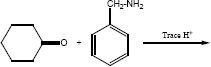
21.
There are two isomers with the formula CH3NO2. How will you distinguish between them?
22.
Write down the possible isomers of the C4H9NO2 give their IUPAC names.
23.
24.
Chalcogens belongs to p-block. Give reason.
25.
Establish a relationship between the solubility product and molar solubility for the following
a) BaSO4
b) Ag2(CrO4)
26.
Calculate i) degree of hydrolysis, ii) the constant hydrolysis and iii) pH of 0.1M CH3COONa solution (pKa for CH3COOH is 4.74).
27.
Calculate pH of 10-7 M HCl
28.
How will you convert diethylamine into
i) N, N – diethylacetamide
ii) N – nitrosodiethylamine
29.
Write the expression for the solubility product of Ca3(PO4)2
30.
Calculate the pH of 1.5\(\times\)10-3 M solution of Ba(OH)2
31.
Give the uses of sulphuric acid.
32.
Give the uses of helium.
33.
What are interhalogen compounds? Give examples.
34.
Calculate the i) hydrolysis constant, ii) degree of hydrolysis and iii) pH of 0.05M sodium carbonate solution (pKa for HCO3− is 10.26).
35.
a) Explain the buffer action in a basic buffer containing equimolar ammonium hydroxide and ammonium chloride.
b) Calculate the pH of a buffer solution consisting of 0.4M CH3COOH and 0.4M CH3COONa . What is the change in the pH after adding 0.01 mol of HCl to 500ml of the above buffer solution. Assume that the addition of HCl causes negligible change in the volume. Given: (Ka = 1.8 × 10⁻⁵. )
36.
How will you distinguish between primary secondary and tertiary alphatic amines.
37.
Write short notes on the following
i. Hofmann’s bromide reaction
ii. Ammonolysis
iii. Gabriel phthalimide synthesis
iv. Schotten – Baumann reaction
v. Carbylamine reaction
vi. Mustard oil reaction
vii. Coupling reaction
viii. Diazotisation
ix. Gomberg reaction
38.
How will you convert nitrobenzene into
i. 1,3,5 - trinitrobenzene
ii. o and p- nitrophenol
iii. m – nitro aniline
iv. azoxybenzene
v. hydrozobenzene
vi. N – phenylhydroxylamine
vii. aniline
39.
What happens when
i. 2 – Nitropropane boiled with HCl
ii. Nitrobenezene undergo electrolytic reduction in strongly acidic medium.
iii. Oxidation of tert – butylamine with KMnO4
iv. Oxidation of acetoneoxime with trifluoroperoxy acetic acid
40.
Derive an expression for Ostwald’s dilution law.
41.
Explain common ion effect with an example.
42.
Discuss the Lowry – Bronsted concept of acids and bases.
43.
Give the balanced equation for the reaction between chlorine with cold NaOH and hot NaOH.
1.
(b)
blue solution
2.
(b)
pentan – 2- amine
3.
(c)
Schotten – Baumann reaction
4.
(c)
methanamine
5.
(a)
CH3CONHCH3
6.
KOH → K+ + OH-
10-5M 10-5M 10-5M
[OH-] = 10-5M
pH = 14 - pOH
pH= 14-(-log [OH-])
= 14 + log [OH-]
= 14 + log 10-5
= 14 - 5 = 9
7.
PbI2(s) ⇌ Pb2+(aq) + 2I-(aq)
Ksp = (s) (2s)2
3.2 × 10-8 = 4s3
s = (3.2 × 10⁻⁸/4)1/3
= ( 8 x 10⁻⁹)1/3
= 2 x 10⁻³ M
8.
BF3 → electron deficient → Lewis acid
PF3 → electron rich → Lewis base
CO → having lone pair of electron → Lewis base
F → unshared pair of electron → Lewis base
9.
H2O + H2O ⇌ H3O+ + OH-
acid 1 base 1 acid 2 base 2
HF + H2O ⇌ H3O+ + F-
acid 1 base 1 acid 2 base 2
∴ Conjugate bases are OH- and F- respectively.
10.
BaSO4 ⇌ Ba2+ + SO42-
Ksp = (s) (s)
Ksp = (s)2
= (2.42 × 10⁻³gL-1)2
\(=\frac{2.42 \times 10^{-3} gL^{-1}}{233 \text{ g mol}^{-1}}\)
= (0.01038 x 10⁻³)2
= (1.038 x x 10-5)2
= 1.077 x 10-10
= 1.08 × 10⁻¹⁰mol2L-2
11.
(a)
HI
12.
(a)
H3PO3
13.
(b)
P4(white) & PH3
14.
(d)
1s2 2s2 2p6 3s2 3p3
15.
(d)
ability to form pπ-pπ bonds with itself
16.
i) HNO3 \(\stackrel{H_{2} O}{\rightleftharpoons}\) H+(aq) + NO-3(aq) [Acid]
ii) Ba(OH)2 \(\stackrel{H_{2} O}{\rightleftharpoons}\) Ba2+(aq) + 2OH-(aq) [base]
iii) H3PO4 \(\stackrel{H_{2} O}{\rightleftharpoons}\) 2H+(aq) + HPO42-(aq) [Acid]
iv) CH3COOH \(\stackrel{H_{2} O}{\rightleftharpoons}\) CH3COO- (aq) + H+(aq) [Acid]
17.
pH=-log[H+]
For weak acids,
\(= \sqrt{k_a \times C}\)
=\(\sqrt{1.8\times10^{-5}\times0.1}\)
=\(1.34 \times10^{-3}\) M
\(pH=-\log(1.34\times10^{-3})\)
= 3-log1.34
= 3-0.1271
= 2.8729 \(\simeq\) 2.87
18.
Given that \(\alpha=1.20\)%=\(\frac{1.20}{100}\times1.2\times10^{-2}\)
\(K_{a}=\alpha^{2}c\)
\(=(1.2\times10^{-2})^{2}(0.1)=1.44\times10^{-4}\times10^{-1}\)
=\(1.44\times10^{-5}\)
19.
\(\underset{0.001M}{HCl}\overset{H_{2}O}{\rightleftharpoons }\underset{0.001M}{H_{3}O^{+}}+\underset{0.001M}{Cl^{-}}\)
H3O+ from the auto ionisation of H2O (10-7M) is negligible when compared to the H3O+ from 10-3M HCl.
Hence [H3O+] = 0.001 mol dm-3
pH = -log10 [H3O+]
= -log10(0.001)
= -log10(10-3) = 3
20.
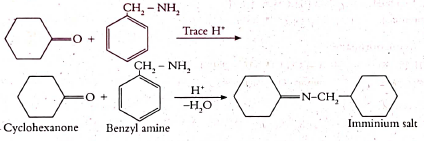
21.
a) Primary and secondary nitroalkanes, having α-H, also show an equilibrium mixture of two tautomers namely nitro - and aci - form
.JPG)
b) Difference:
| S.No | Nitro form | Aci - form |
| 1. | Less acidic in nature. | More acidic |
| 2. | Dissolves in NaOH slowly | Dissolves in NaOH instantly |
| 3. | Decolourises FeCl3 solution | With FeCl3 gives reddish brown colour |
| 4. | Electrical conductivity is low | Electrical conductivity is high |
22.
| Isomerism | Structural formula of isomers |
| Chain isomerism: They differ in the length of carbon chain. |
.JPG) |
| Position isomerism: They differ in the position of nitro group. |
.JPG) |
| Functional isomerism: Nitroalkanes exhibit functional isomerism with alkylnitrites |
\( \mathrm{CH}_{3} \mathrm{CH}_{2} \mathrm{CH}_{2} \mathrm{CH}_{2}-\mathrm{NO}_{2} \text { and } \mathrm{CH}_{3} \mathrm{CH}_{2} \mathrm{CH}_{2} \mathrm{CH}_{2}-\mathrm{O}-\mathrm{N}=\mathrm{O}\\ \quad 1 - nitrobutane \quad \quad \quad \quad \quad \quad \quad butyl \ nitrite\) |
23.
24.
(i) The Chalcogens belong to group (16).
(ii) The group consists of elements: Oxygen, Sulphur, Selenium, Tellurium and Polonium.
(iii) These are ore forming elements as most of the ores are oxides and sulphides.
(iv) Chalcos meaning 'ore formers'.
25.
a) \(BaSO_{4}(s)\overset{H_{2}O}{\rightleftharpoons }Ba^{2+}(aq)+SO^{2+}_{4}(aq)\)
\(K_{sp}=[Ba^{2+}][SO^{2-}_{4}]\) = (s) (s)
Ksp = s2
b) \(Ag_{2}CrO_{4}(s)\overset{H_{2}O}{\rightleftarrows }2Ag^{+}(aq)+CrO_{4}^{2-}(aq)\)
\(K_{sp}=[Ag^{+}]^{2}[CrO)^{2-}_{4}]\)
= (2s)2 (s)
Ksp = 4S3
26.
(a) CH3COONa is a salt of weak acid
(CH3COOH) and a strong base (NaOH).
Hence, the solutions is alkaline due to hydrolysis.
\(CH_{3}COO^{-}_{(aq)}+H_{2}O_{(aq)}\rightleftharpoons CH_{3}COOH_{(aq)}+OH^{-}_{(aq)}\)
(i)\(h=\sqrt{\frac{K_{w}}{K_{a}\times C}}\)
Given that pKa =4.74
pKa = -log Ka
ie., Ka = antilog of (-pKa)
= antilog of (-4.74)
= antilog of (-5 + 0.26)
= 10-5 \(\times\) 1.8 = 1.8 \(\times\) 10-5
[antilog of 0.26 = 1.82 \( \simeq\) 1.8]
\(\therefore\) h=\(\sqrt{\frac{1\times10^{-14}}{1.8\times10^{-5}\times0.1}}\)
h = 7.5 x 10⁻⁵
(ii) \(K_{h}=\frac{K_{w}}{K_{a}}=\frac{1\times10^{-14}}{1.8\times10^{-5}}\)
\(=5.56\times10^{-10}\)
iii) \(pH=7+\frac{pK_{a}}{2}+\frac{logC}{2}\)
= \(7+\frac{4.74}{2}+\frac{log0.1}{2}\)
= 7 + 2.37 - 0.5
= 8.87
27.
If we do not consider [H3O]+ from the ionisation of H2O,
then [H3O+] = [HCl] = 10-7M
i.e., pH = 7, which is a pH of a neutral solution. We know that HCl solution is acidic whatever may be the concentration of HCl i.e, the pH value should be less than 7. In this case the concentration of the acid is very low (10-7M) Hence, the H3O+ (10-7M) formed due to the auto ionisation of water cannot be neglected.
so, in this case we should consider [H3O+] from ionisation of H2O
[H3O+] = 10-7 (from HCl) + 10-7 (from water)
= 10-7 (1+1)
= \(2\times10^{-7}\)
pH = -log10[H3O+]
=\(-\log_{10}(2\times10^{-7})=-[\log2+\log_{10}10^{-7}]\)
=\(-\log2-(-7)\log_{10}^{10}\)
= 7-log2
= 7-0.3010 = 0.6990 = 6.70
= 6.70
28.
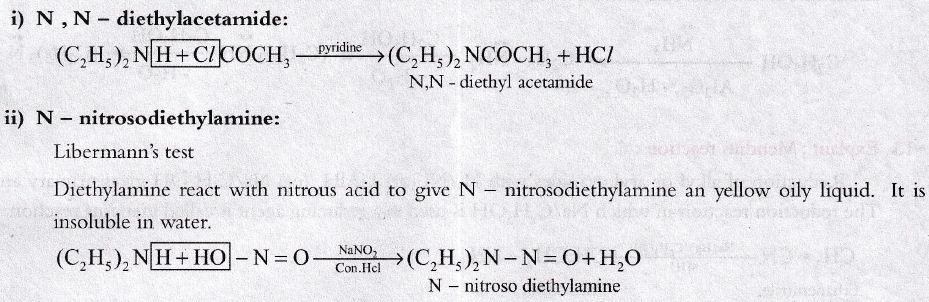
29.
\(\mathrm{Ca}_{3}\left(\mathrm{PO}_{4}\right)_{2} \rightleftharpoons 3 \mathrm{Ca}^{2+}_{(aq)}+2 \mathrm{PO}_{4_{(aq)}}^{3-}\\\)
(s) (3s) (2s)
\(K_{sp}=[Ca^{2+}]^{3}[PO_{4}^{3-}]^{2}\)
\(K_{sp}=(3s)^{3}(2s)^{2}\)
\(K_{sp}=27s^{3}.4s^{2}\)
\(K_{sp}=108s^{5}\)
(or)
\(K_{s p} =m^{m} \cdot n^{n} \cdot(s)^{m+n} \)
\(K_{\text {sp }} =3^{3} \cdot 2^{2} \cdot(s)^{3+2} \)
\(K_{s p} =27 \times 4 \times(s)^{5} \)
\(=108(s)^{5}=108 s^{5}\)
30.
Considering Ba(OH)2 to be a strong base:
\(\text { Normality } =\text { Molarity } \times \text { Acidity } \)
\(=1.5 \times 10^{-3} \times 2\)
\({\left[\mathrm{OH}^{-}\right] } =3 \times 10^{-3} \)
\(\mathrm{pOH} =-\log _{10}[\mathrm{OH}^-] \)
\(=-\log _{10}\left(3 \times 10^{-3}\right) \)
\(=-\left[\log _{10} 3+3 \log 10\right] \)
= 3-log 3
= 3-0.4771
= 2.5229
\(\mathrm{pH} =14-\mathrm{pOH} \)
= 14-2.5229
pH = 11.4771 = 11.48
31.
(i) Sulphuric acid is used in the manufacture of fertilisers, ammonium sulphate and super phosphates and other chemicals such as HCl, HNO3.
(ii) It is used as a drying agent and also used in the preparation of pigments, explosives etc.
32.
(i) Helium is used to provide inert atmosphere in electric-arc welding of metals.
(ii) Helium has lowest boiling point hence used in cryogenics.
(iii) It is much less denser than air and hence used for filling air balloons.
33.
Each halogen combines with other halogens to form a series of compounds are called interhalogen compounds.
Example: AB type: BrF
AB3 type: ICI3
34.
Na2CO3 is a salt of weak acid H2CO3 and a strong base NaOH
\(\therefore\) Na2CO3(aq) ⟶ 2Na+(aq) + CO32-(aq)
CO32-(aq) + H2O(l) ⇌ HCO3-(aq) + OH-(aq)
i) pKa = 10.26
pKa =- log Ka
Ka = antilog of (-pKa)
Ka = antilog (- 10.26)
= antilog \((\bar{11} .74)\)
= 5.5 x 10⁻¹¹
\(\therefore h =\sqrt { \frac { { K }_{ w } }{ { K }_{ a } \times C } } \)
\(h =\sqrt { \frac { 1\times { 10 }^{ -14 } }{ 5.5\times { 10 }^{ -11 } \times { 0.05 }} } =\sqrt { 9\times { 10 }^{ -4 } } = 6.03 \times 10^{-2}\)
ii) Kh = Kw/Ka
= 1 x 10-14/5.5 x 10-11
= 1.8 x 10⁻⁴
iii) pH = 7 + pKa/2 + log C/2
= 7 + 10.26/2 = log 0.05/2
= 7 + 5.13 - 0.65
= 11. 48
35.
a) Dissociation of buffer components
\(NH_4OH_{aq} \rightleftharpoons NH^{+}_{4(aq)}+OH^{-}_{(aq)}\)
NH4Cl ⟶ NH4 + + Cl+
Addition of H+
The added H+ ions are neutralized by NH4OH and there is no appreciable decrease in pH
NH4OH(aq) + H+ ⟶ NH4(aq) + + H2O(l)
Addition of OH-
NH4+(aq)OH-(aq) ⟶ NH4 + + OH(aq)
The added OH- ions react with NH4+ to produce unionized NH4OH. Since NH4OH is a weak base, there is no appreciable increase in pH.
b) pH = pKa + log [Acid]/[Salt]
pka = -log10 Ka
pka = -log 1.8 x 10-5
=- [log 1.8-5 log 10]
= 5-log 1.8
pKa= 5-0.2553
pKa = 4.7447
pH = 4.7447 + log (0.4/0.4)
pH = 4.7447 + log 1
pH = 4.7447 + 0
pH = 4.74
ii) Addition of 0.01 mol HCl to 500 ml of buffer
Added [H+] = 0.01 mol/500mL = 0.01 mol/1/2 L
CH3COOH(aq) ⇌ CH3COO-(aq) + H+(aq)
\(\underset{0.4-\alpha}{\mathrm{CH}_{3} \mathrm{COONa}_{\text {(aq) }}} \rightarrow \underset{\alpha} {\mathrm{CH}_{3} \mathrm{COO}_{(\text {aq })}^{-}}+\underset{\alpha}{\mathrm{Na}^{+}{ }_{(aq)}}\)
\(\underset{0.02}{\mathrm{CH}_{3} \mathrm{COO^-}+ HCl} \rightarrow \underset{0.02} {\mathrm{CH}_{3} \mathrm{COOH}}+\underset{0.02}{\mathrm{Cl}^{+}}\)
[CH3COOH] = 0.4 - a + 0.02
= 0.42 - a \(\simeq\) 0.42
[CH3COO] = 0.4 - a + 0.02
= 0.38 + a \(\simeq\) 0.38
\(\left[\mathrm{H}^{+}\right]=\mathrm{K}_{\mathrm{a}} \frac{\left[\mathrm{CH}_{3} \mathrm{COOH}\right]}{\left[\mathrm{CH}_{3} \mathrm{COO}^{-}\right]}\)
\([H^+] = \frac{(1.8 \times 10^{-5})(0.42)}{(0.38)}\)
[H+] = 1.99 x 10⁻⁵
pH = - log (1.99 x 10⁻⁵)
= 5 - log 1.99
= 5 - 0.30 = 4.70
36.
| S.No | Reagents or Reaction | Primary amine RNH2 | Secondary amine R2NH | Tertiary amine R3N |
|---|---|---|---|---|
|
1. |
Carbylamine reaction or with CHCl3/KOH |
Carbylamine is formed (unpleasant smell) |
- | - |
| 2. | Mustard oil reaction or CS2/HgCl2 (Hoffmann's mustard oil test) |
Alkyl isothiocyanate is formed (Mustard oil odour) |
- | - |
| 3. | HNO2 (or) NaNO2 / HCl |
Alcohol is formed +H2 | Yellow oily nitrosoamine is formed, insoluble in water. (Liberman's Test) |
Forms nitrite in cold, soluble in water. |
| 4. | CH3COCl | N-acetyl derivative is formed | N,N- diacetyl derivative is formed |
- |
| 5. | Diethyl oxalate Hoffmann's method |
Solid oxamide is formed | Liquid oxamic ester is formed |
- |
| 6. | Benzene sulphonyl chloride in presence of excess. KOH (Hinsberg's reaction) |
N- alkyl benzene sulphonamide is formed (soluble) |
N, N - dialkyl benzene sulphonamide is formed (Insoluble). |
- |
| 7. | With RX | 1 mol → 2o amine 2 mol → 3o amine 3 mol → Quarternary salt |
1 mol → 3o amine 2 mol → Quarternary salt |
1 mol → Quarternary salt |
37.
Hoffmann's bromide reaction:
When Amides are treated with bromine in the presence of aqueous or ethanolic solution of KOH, primary amines with one carbon atom less than the parent amides are obtained.
\(\underset { \quad \quad \quad amide\\ R=Alkyl(or)Aryl }{ R-\overset { \underset { || }{ O } }{ C } -{ NH }_{ 2 } } \overset { { Br }_{ 2 }/KOH }{ \longrightarrow } \underset { Primary\quad amine }{ R-{ NH }_{ 2 }+{ K }_{ 2 }{ CO }_{ 3 } } +KBr+{ H }_{ 2 }O\)
(ii) Hoffmann's ammonolysis:
When Alkyl halides (or) benzylhalides are heated with alcoholic ammonia in a sealed tube, mixtures of 1°, 2° and 3° amines and quaternary ammonium salts are obtained.
\( { CH }_{ 3 }-Br\overset { \ddot { N } { H }_{ 3 } }{ \underset { \Delta }{ \longrightarrow } } \underset { { 1 }^{ 0 }-amine }{ { CH }_{ 3 }-\ddot { N } { H }_{ 2 } } \overset { { CH }_{ 3 }-Br }{ \longrightarrow } \underset { { 3 }^{ o }-amine }{ \left( { CH }_{ 3 } \right) _{ 2 }\ddot { N } H } \overset { { CH }_{ 3 }Br }{ \longrightarrow } \underset { 3^{ o }-amine }{ \left( { { CH }_{ 3 } } \right) _{ 3 }\ddot { N } } \overset { CH_{ 3 }Br }{ \longrightarrow } \underset { Quartenary \ ammonium\ bromide }{ \left( { CH }_{ 3 } \right) _{ 4 }\overset { + }{ N } { Br }^{ - } } \)
This is a nucleophilic substitution, the halide ion of alkyl halide is substituted by the -NH2 group. The product primary amine so formed can also has a tendency to act as a nucleophile and hence if excess alkyl halide is taken, further nucleophilic substitution takes place leading to the formation of quarternary ammonium salt. However, if the process is carried out with excess ammonia, primary amine is obtained as the major product. The order of reactivity of alkylhalides with amines
RI > RBr > RCl
(iii) Gabriel phthalimide synthesis:
Gabriel synthesis is used for the preparation of Aliphatic primary amines. Phthalimide on treatment with ethanolic KOH forms potassium salt of phthalimide which on heating with alkyl halide followed by alkaline hydrolysis gives primary amine. Aniline cannot be prepared by this method because the arylhalides do not undergo nucleophilic substitution with the anion formed by phthalimide.
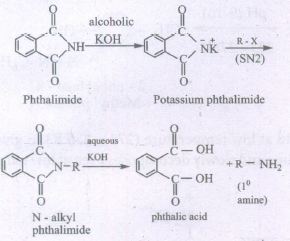
(iv) Schotten - Baumann reaction :
Aniline reacts with benzoylchloride (C6H5COCI) in the presence of NaOH to give N - phenyl benzamide. This reaction is known as Schotten - Baumann reaction. The acylation and benzoylation are nucleophilic substitutions.
\(\underset { Aniline }{ { C }_{ 6 }{ H }_{ 5 }-{ NH }_{ 2 } } +\underset { Benzoyl\quad chloride }{ { C }_{ 6 }{ H }_{ 5 }-\overset { \underset { || }{ O } }{ C } -Cl } \overset { Pyridine }{ \longrightarrow } \underset { N-phenyl\quad benzamide }{ { C }_{ 6 }{ H }_{ 5 }-NH-\overset { \underset { || }{ O } }{ C } -{ C }_{ 6 }{ H }_{ 5 } } +HCl\)
(v) Carbylamine reaction :
Aliphatic (or) aromatic primary amines react with: chloroform and alcoholic KOH to give isocyanides (carbylamines), which has an unpleasant smell. This reaction is known as carbylamines test. This test used to identify the primary amines.
\(\underset { Ethylamine }{ { C }_{ 2 }{ H }_{ 5 }-{ NH }_{ 2 } } +\underset { Chloroform }{ { CHCl }_{ 3 }+3KOH } \longrightarrow \underset { Ethylisocyanide }{ { C }_{ 2 }{ H }_{ 5 }-NC } +3KCl+3{ H }_{ 2 }O\)
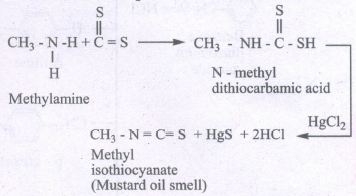
(vi) Mustard oil reaction:
(a) When primary amines are treated with carbon disulphide (CS2), N - alkyldithio carbonic acid is formed which on subsequent treatment with HgCI2, gives an alkyl isothiocyanate.
(b) When aniline is treated with carbon disulphide, or heated together, S-diphenylthio urea is formed, which on boiling with strong HCI, phenyl isothiocyanate (phenyl mustard oil), is formed.
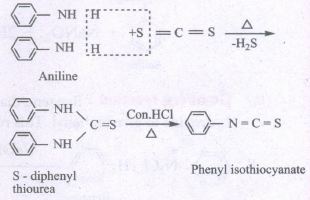
These reactions are known as Hofmann - Mustard oil reaction. This test is used to identify the primary amines.
(vii) Coupling reactions (or) p-hydroxyazobenzene, p-aminoazobenzene, 2-phenyl azo-4-methyl phenol:
Benzene diazonium chloride reacts with electron rich aromatic compounds like phenol, aniline to form brightly coloured azo compounds. Coupling generally occurs at the para position. If para position is occupied then coupling occurs at the ortho position. Coupling tendency is enhanced if an electron donating group is present at the para - position to -N2CI- group. This is an electrophilic substitution.
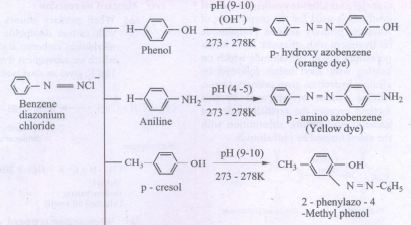
Aryl fluorides and iodides cannot be prepared by direct halogenation and the cyano group cannot be introduced by nucleophilic substitution of chlorine in chlorobenzene. For introducing such a halide group. cyano group -OH, NO2, etc.. benzenediazonium chloride is a very good intermediate Diazo compounds obtained from the coupling reactions of diazonium salts are coloured and are used as dyes.
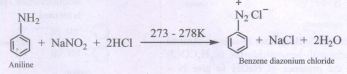
(viii) Diazotisation :
Aniline reacts with nitrous acid at low temperature (273 - 278 K) to give benzene. Diazonium chloride which is stable for a short time and slowly decomposes even at low temperatures.This reaction is known as diazotization
(ix) Gomberg reaction :
Benzene diazonium chloride reacts with benzene in the presence of sodium hydroxide to give biphenyl. This reaction in known as the Gomberg reaction

38.
Nitrobenzene into 1,3,5 - trinitro benzene
.JPG)
Nitrobenzene 1,3,5 - trinitro benzene
ii. Nitrobenzene into o - and p - nitro phenols
.JPG)
iii. Nitrobenzene into m - nitro aniline
.JPG) + 6NH3 + 2H2O + 3S
+ 6NH3 + 2H2O + 3S
iv. Nitrobenzene into azoxybenzene
.JPG) +3H2O
+3H2O
v. Nitrobenzene into hydrazobenzene
.JPG)
vi. Nitrobenzene into N - phenyl hydrazobenzene
.JPG)
vii. Nitrobenzene into aniline
.JPG)
39.
i) 2 - nitro propane is boiled with HCI:
.JPG)
It gives acetone.
ii) Nitrobenzene on electrolytic reduction in strongly acidic medium:
.JPG)
It gives aniline, phenyl hydroxylamine and p - amino phenol
iii) Oxidation of text – butylamine with KMnO4:
.JPG)
It gives 2 - methyl - 2- nitro propane is obtained.
iv) Oxidation of acetoneoxime with trifluoroperoxy acetic acid.
.JPG)
It gives 2 - nitro propane.
40.
(i) Ostwald's dilution law relates the dissociation constant of the weak acid (Ka) with its degree of dissociation (α) and the concentration (c).
where \(\alpha=\frac{\text { Number of moles dissociated }}{\text { Total number of moles }}\)
(ii) The dissociation of acetic acid can be represented as
\(\mathrm{CH}_{3} \mathrm{COOH} \rightleftharpoons \mathrm{H}^{+}+\mathrm{CH}_{3} \mathrm{COO}^{-}\)
The dissociation constant of acetic acid is,
\({ K }_{ a }=\frac { \left[ { H }^{ + } \right] \left[ { CH }_{ 3 }COO^{ - } \right] }{ \left[ { CH }_{ 3 }COOH \right] } \) ........(1)
| CH3COOH | H+ | CH3COO- | |
| Initial number of moles | 1 | - | - |
| Degree of dissociation of CH3COOH | α | - | - |
| Number of moles at equilibrium | 1-α | α | α |
| Equilibrium concentration | (1-α)C | αC | αC |
Substituting the equilibrium concentration in equation (1)
\({ K }_{ a }=\cfrac { \left( \alpha C \right) \left( \alpha C \right) }{ \left( 1-\alpha \right) C } \)
\({ K }_{ a }=\cfrac { { \alpha }^{ 2 }C }{ 1-\alpha } \) .......(2)
(iii) We know that weak acid dissociates only to a very small extent compared to one, a is so small and hence in the denominator (1 - α) ⋍1. The above expression (2) now becomes,
ka =a2C \(\Rightarrow { \alpha }^{ 2 }=\cfrac { { k }_{ a } }{ C } \) ; \(\alpha =\sqrt { \cfrac { { K }_{ a } }{ C } } \)
(iv) When dilution increases, the degree of dissociation of weak electrolyte also increases. This is called Ostwald's dilution law
Also \(;\left[\mathrm{H}^{+}\right]=\alpha \mathrm{C}\) and \(\left[\mathrm{H}^{+}\right]=\left(\sqrt{\frac{\mathrm{K}_{\mathrm{a}}}{\mathrm{C}}}\right) \mathrm{C}=\sqrt{\frac{\mathrm{K}_{\mathrm{a}} \mathrm{C}^{2}}{\mathrm{C}}}=\sqrt{\mathrm{K}_{\mathrm{a}} \cdot \mathrm{C}}\)
Similarly for a weak base
\(\begin{aligned} & \mathrm{K}_{\mathrm{b}}=\alpha^2 \mathrm{C} ; \quad \therefore \alpha=\sqrt{\frac{\mathrm{k}_{\mathrm{b}}}{\mathrm{C}}}, \\ \end{aligned}\)
\(\begin{aligned} & {\left[\mathrm{OH}^{-}\right] \alpha \mathrm{C}=\sqrt{\frac{\mathrm{K}_{\mathrm{b}}}{\mathrm{C}}} \times \mathrm{C}=\sqrt{\frac{\mathrm{K}_{\mathrm{b}} \mathrm{C}^2}{\mathrm{C}}}=\sqrt{\mathrm{K}_{\mathrm{b}} \mathrm{C}}} \end{aligned}\)
41.
(i) The dissociation of a weak acid (CH3COOH) is suppressed in the presence of a salt (CH3COONa) containing an ion common to the weak electrolyte. It is called the common ion effect.
(ii) Consider the dissociation of a weak acid, acetic acid whose ionisation is incomplete.
CH3COOH(aq) ⇌ H+(aq) + CH3COO-(aq)
(iii) If the salt sodium acetate with common ion CH3COO- is added to the above equilibrium, it dissociates completely increasing.
CH3COONa(aq)⟶Na+(aq) + CH3COO-(aq)
(iv) Hence, the overall concentration of CH3COO- is increased, and the acid dissociation equilibrium is disturbed.
(v) So, in order to maintain the equilibrium, the excess CH3COO- ions combines with H+ ions to produce much more unionized CH3COOH i.e, the equilibrium will shift towards the left. In other words, the dissociation of CH3COOH is suppressed.
42.
(i) An acid is defined as a substance that has a tendency to donate a proton to another substance and base is a substance that has a tendency to accept a proton form other substance.
(ii) In other words, an acid is a proton donor and a base is a proton acceptor.
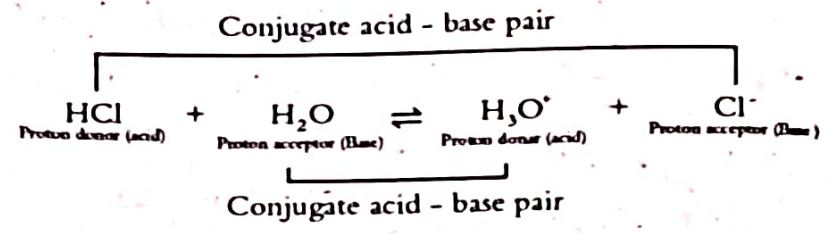
(iii) When hydrogen chloride is dissolved in water, it donates a proton to the later. Thus, HCI behaves as an acid and H2O is base. The proton transfer from the acid to base can be represented as
HCI + H2O ⇌ H3O+ + Cl-
(iv) When ammonia is dissolved in water, it accepts a proton from water. In this case, ammonia (NH3) acts as a base and H2O is acid. The reaction is represented as
H2O + NH3 ⇌ NH4+ + OH-
(v) Let us consider the reverse reaction following equilibrium.
\(\underset { proton\ donar\\ \quad \quad \ (acid) }{ HCl } +\underset { Proton\ acceptor\\ \quad \quad \quad \quad (base) }{ { H }_{ 2 }O } \leftrightharpoons \underset { Proton\ donar\\ \quad \quad \quad \quad \ (acid) }{ { H }_{ 2 }{ O }^{ + } } +\underset { Proton\ acceptor\\ \quad \quad \quad \quad \ (base) }{ { Cl }^{ - } } \)
H3O+ donates a proton to Cl- to form HCI i.e., the products also behave as acid and base.
(vi) In general, Lowry - Bronsted (acid - base) reaction is represented as
Acid1 + Base2 ⇌ Acid2 + Base1
(vii) The species that remains after the donation of a proton is a base (Base1) and is called the conjugate base of the Bronsted acid (Acid1). In other words, chemical species that differ only by a proton are called conjugate acid - base pairs.
43.
Chlorine reacts with cold dilute alkali to give chloride and hypochlorite, while with hot concentrated alkali chlorides and chlorates are formed.
\(\mathrm{Cl}_{2}+\mathrm{H}_{2} \mathrm{O} \rightarrow \mathrm{HCl}+\underset{\text { Hypochlorous acid }}{\mathrm{HOCl}} \)
\(\mathrm{HCl}+\mathrm{NaOH} \rightarrow \mathrm{NaCl}+\mathrm{H}_{2} \mathrm{O} \)
\(\mathrm{HOCl}+\mathrm{NaOH} \rightarrow \mathrm{NaOCl}+\mathrm{H}_{2} \mathrm{O} \)
(Sodium hypo chlorite)
Overall Reaction
3Cl2 + 6NaOH \(\rightarrow\) NaClO3 + 5NaCl + 3H2O
(Sodium Chlorate)

12th Standard Syllabus & Materials
12th Standard
TN 12th Computer Applications களப்பெயர் முறைமை (DNS) Sample Question Papers Study Material - QB365 Set A
NEW12th Standard
TN 12th Computer Applications வலையமைப்பு எடுத்துக்காட்டுகள் மற்றும் நெறிமுறைகள் Sample Question Papers Study Material - QB365 Set A
NEW12th Standard
TN 12th Computer Applications கணினி வலையமைப்பு ஓர் அறிமுகம் Sample Question Papers Study Material - QB365 Set A
NEW12th Standard
TN 12th Computer Applications PHP-உடன் MySQL-ஐ இணைத்தல் Sample Question Papers Study Material - QB365 Set A



Tamilnadu Stateboard 12th Standard Subjects

Maths
Chemistry

Physics

Biology

Computer Science

Business Maths and Statistics

Economics

Commerce

Accountancy

History

Computer Applications
Biology
Computer Technology
Computer Applications
Computer Science
Business Maths and Statistics
Commerce
Economics
Maths
Chemistry
Physics
Computer Technology
History
Accountancy

Tamil

English

French
Tamilnadu Stateboard Standards


