
 100% FREE ACCESS
12th Standard Syllabus & Materials
12th Standard
TN 12th Maths Applications of Matrices and Determinants Sample Question Papers Study Material - QB365 Set A
NEW12th Standard
TN 12th Computer Applications மின்னணு தரவு பரிமாற்றம் Sample Question Papers Study Material - QB365 Set A
NEW12th Standard
TN 12th Computer Applications மின் - வணிக பாதுகாப்பு அமைப்புகள் Sample Question Papers Study Material - QB365 Set A
NEW12th Standard
TN 12th Computer Applications மின்னணு செலுத்தல் முறைகள் Sample Question Papers Study Material - QB365 Set A
NEW12th Standard
TN 12th Computer Applications மின் - வணிகம் Sample Question Papers Study Material - QB365 Set A
NEW12th Standard
TN 12th Computer Applications திறந்த மூல கருத்துருக்கள் Sample Question Papers Study Material - QB365 Set A

Published on: 28/11/2025
Download Tamil Nadu 12th Standard Chemistry question papers, model tests, one-mark questions, important questions, and public exam papers in PDF format. Free study materials and answer keys for TN State Board students.
Questions + Answers key
Take MCQ Chemistry Test
1.
Henderson - Hasselbalch equation is ______.
\(\mathrm{pH}=\mathrm{pK}_{\mathrm{a}}+\log \frac{[\mathrm{salt}]}{[\mathrm{acid}]}\)
\(\mathrm{pH}=\mathrm{pK}_{\mathrm{a}}+\log \frac{[\mathrm{salt}]}{[\mathrm{base}]}\)
\(\mathrm{pH}=\mathrm{pK}_{\mathrm{a}}+\log \frac{[\text { acid }]}{[\mathrm{salt}]}\)
\(\mathrm{pOH}=\mathrm{pK}_{\mathrm{b}}+\log \frac{[\text { base }]}{[\mathrm{salt}]}\)
2.
The electronic configuration of polonium is ______.
[He] 2s22p4
[Ne] 3s23p4
[Xe] 4f145d106s26p4
[Ar] 3d104s25p4
3.
The number of secondary alcoholic group in glycerol is _______.
1
2
3
0
4.
Terylene is an example of _______.
polyamide
polythene
polyester
polysaccharide
5.
6.
Which of the following is an analgesic?
Streptomycin
Chloromycetin
Asprin
Penicillin
7.
Complete hydrolysis of cellulose gives ______.
L-Glucose
D-Fructose
D-Ribose
D-Glucose
8.
The number of sp2 and sp3 hybridised carbon in fructose are respectively ______.
1 and 4
4 and 2
5 and 1
1 and 5
9.
Among the following the achiral amino acid is ______.
2-ethylalanine
2-methylglycine
2-hydroxymethylserine
Tryptophan
10.
The order of basic strength for methyl substituted amines in aqueous solution is _________.
N(CH3)3> N(CH3)2H> N(CH3)H2> NH3
N(CH3)H2>N(CH3)2H > N(CH3)3>NH3
NH3> N(CH3)H2> N(CH3)2 H>N(CH3)3
N(CH3)2H>N(CH3)H2> N(CH3)3> NH3
11.
The product formed by the reaction an aldehyde with a primary amine ________.
carboxylic acid
aromatic acid
schiff ’s base
ketone
12.
Which one of the following will not undergo Hofmann bromamide reaction.
CH3CONHCH3
CH3CH2CONH2
CH3CONH2
C6H5CONH2
13.
Which one of the following reduces tollens reagent
formic acid
acetic acid
benzophenone
none of these
14.
Ethanoic acid \(\overset { P/{ Br }_{ 2 } }{ \longrightarrow } \) 2-bromoethanoic acid. This reaction is called _______.
Finkelstein reaction
Haloform reaction
Hell – Volhard – Zelinsky reaction
none of these
15.
16.
On reacting with neutral ferric chloride, phenol gives ______.
red colour
violet colour
dark green colour
no colouration.
17.
Which of the following compound can be used as antifreeze in automobile rediators?
methanol
ethanol
Neopentyl alcohol
ethan -1, 2-diol
18.
19.
Match the following
| a | Pure nitrogen | i | Chlorine |
| b | Haber process | ii | Sulphuric acid |
| c | Contact process | iii | Ammonia |
| d | Deacons Process | iv | Sodium azide (or) Barium azide |
Which of the following is the correct option?
| A | B | C | D |
| i | ii | iii | iv |
| A | B | C | D |
| ii | iv | i | iii |
| A | B | C | D |
| iii | iv | ii | i |
| A | B | C | D |
| iv | iii | ii | i |
20.
Collodion is a 4% solution of which one of the following compounds in alcohol – ether mixture?
Nitroglycerine
Cellulose acetate
Glycoldinitrate
Nitrocellulose
21.
The most effective electrolyte for the coagulation of As2S3Sol is _______.
NaCl
Ba(NO3)2
K3[Fe(CN)6]
Al2(SO4)3
22.
While charging lead storage battery _______.
PbSO4 on cathode is reduced to Pb
PbSO4 on anode is oxidised to PbO2
PbSO4 on anode is reduced to Pb
PbSO4 on cathode is oxidised to Pb
23.
During electrolysis of molten sodium chloride, the time required to produce 0.1mole of chlorine gas using a current of 3A is _____.
55 minutes
107.2 minutes
220 minutes
330 minutes
24.
Faraday constant is defined as_______.
charge carried by 1 electron
charge carried by one mole of electrons
charge required to deposit one mole of substance
charge carried by 6.22 ×10¹⁰ electrons
25.
If the solubility product of lead iodide is 3.2 × 10⁻⁸, its solubility will be _______.
2 × 10⁻³M
4 × 10⁻⁴M
1.6 × 10⁻⁵M
1.8 × 10⁻⁵M
26.
Which of these is not likely to act as Lewis base?
BF3
PF3
CO
F–
27.
Conjugate base for Bronsted acids H2O and HF are _______.
OH- and H2FH+, respectively
H3O+ and F-, respectively
OH- and F-, respectively
H3O+ and H2F+, respectively
28.
In an hexagonal crystal _______.
a=b=c,∝ =β=૪=90°
a=b=c,∝ =β=૪≠90°
a=b≠c,∝ =β=૪=90°
a=b≠c,∝ =β=90°૪=120°
29.
Which of the following is not coloured?
Mn2+
Zn2+
Cr3+
Cu2+
30.
If the initial concentration of the reactant is doubled, the time for half reaction is also doubled. Then the order of the reaction is______.
Zero
one
Fraction
none
31.
For a first order reaction, the rate constant is 6.909 min-1 the time taken for 75% conversion in minutes is _______.
\(\left( \frac { 3 }{ 2 } \right) { \log 2 }\)
\(\left( \frac { 2 }{ 3 } \right) \log2\)
\(\left( \frac { 3 }{ 2 } \right) \log\left( \frac { 3 }{ 4 } \right) \)
\(\left( \frac { 2 }{ 3 } \right) \log\left( \frac { 4 }{ 3 } \right) \)
32.
The addition of a catalyst during a chemical reaction alters which of the following quantities?
Enthalpy
Activation energy
Entropy
Internal energy
33.
The yellow colour in NaCl crystal is due to ________.
excitation of electrons in F centers
reflection of light from Cl- ion on the surface
refraction of light from Na+ ion
all of the above
34.
The vacant space in bcc lattice unit cell is ________.
48%
23%
32%
26%
35.
The number of unit cells in 8 gm of an element X (atomic mass 40) which crystallizes in bcc pattern is (NA is the Avogadro number)________.
6.023 x 10²³
6.023 x 10²²
60.23 x 10²³
\(\left( \frac { 6.023\times { 10 }^{ 23 } }{ 8\times 40 } \right) \)
36.
Which of the following is paramagnetic in nature?
[Zn(NH3)4]2+
[Co(NH3)6]3+
[Ni(H2O)6]2+
[Ni(CN)4]2-
37.
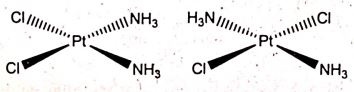
Which type of isomerism is exhibited by [Pt(NH3)2Cl2]?
Coordination isomerism
Linkage isomerism
Optical isomerism
Geometrical isomerism
38.
A magnetic moment of 1.73BM will be shown by one among the following.
TiCl4
[CoCl6]4-
[Cu(NH3)4]2+
[Ni(CN)4]2-
39.
Which of the following oxidation states is most common among the lanthanoids?
+4
+2
+5
+3
40.
Permanganate ion changes to ________ in acidic medium.
MnO42−
Mn2+
Mn3+
MnO2
41.
The correct order of increasing oxidizing power in the series _______.
VO2+ < Cr2O72- < MnO4-
Cr2O72- < VO2+ < MnO4-
Cr2O72- < MnO4- < VO2+
MnO4- < Cr2O72- < VO2+
42.
Which of these is not a monomer for a high molecular mass silicone polymer?
Me3SiCl
PhSiCl3
MeSiCl3
Me2SiCl2
43.
Most easily liquefiable gas is _______.
Ar
Ne
He
Kr
44.
The basicity of pyrophosphorous acid ( H4P2O5) is _______.
4
2
3
5
45.
An element belongs to group 15 and 3rd period of the periodic table, its electronic configuration would be_______.
1s2 2s2 2p4
1s2 2s2 2p3
1s2 2s2 2p6 3s2 3p2
1s2 2s2 2p6 3s2 3p3
46.
Carbon atoms in fullerene with formula C60 have _______hybridisation.
sp3 hybridised
sp hybridised
sp2 hybridised
partially sp2 and partially sp3 hybridised
47.
Which of the following metals has the largest abundance in the earth’s crust?
Aluminium
Calcium
Magnesium
Sodium
48.
49.
Electrochemical process is used to extract_______.
Iron
Lead
Sodium
silver
50.
Bauxite has the composition ______.
Al2O3
Al2O3.nH2O
Fe2O3.2H2O
None of these
1.
(a)
\(\mathrm{pH}=\mathrm{pK}_{\mathrm{a}}+\log \frac{[\mathrm{salt}]}{[\mathrm{acid}]}\)
2.
(c)
[Xe] 4f145d106s26p4
3.
(a)
1
4.
(c)
polyester
5.
(a)
6.
(c)
Asprin
7.
(d)
D-Glucose
8.
(d)
1 and 5
9.
(c)
2-hydroxymethylserine
10.
(d)
N(CH3)2H>N(CH3)H2> N(CH3)3> NH3
11.
(c)
schiff ’s base
12.
(a)
CH3CONHCH3
13.

14.
(c)
Hell – Volhard – Zelinsky reaction
15.
(d)
16.
(b)
violet colour
17.
(d)
ethan -1, 2-diol
18.
(c)
19.
(d)
| A | B | C | D |
| iv | iii | ii | i |
20.
Pyroxylin(nitro cellulose)
21.
As2S3 is a negatively charged colloid. It will be most effectively coagulated by the cation with greater valency. i.e., Al3+.
22.
Charging anode:
PbSO4(s) + 2e- ➝ Pb(s) + SO42-(aq)
Cathode:
PbSO4(s) + 2H2O(I) ➝ PbO2(s) + SO42-(aq) + 2e-
23.
mass of 1 mole of CI2 gas = 71
∴ mass of 0.1 mole of Cl2 gas = 7.1 g mol-1
m = Zlt
t = m/ZI
\(= \frac{7.1}{\frac{71}{2 \times 96500} \times 3}\) (2Cl- ➝ Cl2 + 2e-)
\(= \frac{2 \times 96500 \times 7.1}{71 \times 3}\)
= 6433.33s = 107.2 min
24.
IF = 96500 C = charge of one mole of e- charge of 6.022 x 10⁻²³ electron
25.
PbI2(s) ⇌ Pb2+(aq) + 2I-(aq)
Ksp = (s) (2s)2
3.2 × 10-8 = 4s3
s = (3.2 × 10⁻⁸/4)1/3
= ( 8 x 10⁻⁹)1/3
= 2 x 10⁻³ M
26.
BF3 → electron deficient → Lewis acid
PF3 → electron rich → Lewis base
CO → having lone pair of electron → Lewis base
F → unshared pair of electron → Lewis base
27.
H2O + H2O ⇌ H3O+ + OH-
acid 1 base 1 acid 2 base 2
HF + H2O ⇌ H3O+ + F-
acid 1 base 1 acid 2 base 2
∴ Conjugate bases are OH- and F- respectively.
28.
(d)
a=b≠c,∝ =β=90°૪=120°
29.
(b)
Zn2+
30.
t1/2 α \(\frac{1}{[A_{0}]^{n-1}}\)...(1)
If [A0 = 2[A0]; then t1/2 = 2t1/2
2t1/2 α \(\frac{1}{[2A_{0}]^{n-1}}\)...(2)
(2)/(1) = \(2= \frac{1}{[2A_{0}]^{n-1}} \times \frac{1}{[A_{0}]^{n-1}}\)
\(2= \frac {[2A_{0}]^{n-1}} {[A_{0}]^{n-1}}\)
\(2= \frac {1} {2}^{n-1}\)
2 = (2-1)n-1
21 = (2-n+1)
n = 0
31.
\(k=\frac { 2.303 }{ t } \log\frac { \left[ { A }_{ 0 } \right] }{ \left[ A \right] } \)
[A0] = 100: [A] = 25
\(6.909=\frac { 2.303 }{ t } \log\frac { \left[ {100 } \right] }{ \left[ 25\right] } \)
\(t =\frac { 2.303 }{ 6.909 } \log(4)\)
\(t =\frac { 1 }{ 3 } \log(2^2)\)
\(= \left( \frac { 2 }{ 3 } \right) \log2\)
32.
A catalyst provides a new path to the reaction with low activation energy. i.e., it lowers the activation energy.
33.
(a)
excitation of electrons in F centers
34.
Packing efficiency = 68%
\(\therefore\)empty space percentage = 100 - 68 = 32%
35.
In bcc unit cell,
2 atoms = 1 unit cell
Number of atoms in 8 g of element is, Number of moles = 8g / 40 g mol-1 = 0.2 mol
1 mole contains 6.023 x10²³ atoms
0.2 mole contains 0.2 x 6.023 x 1023 atoms
[1 unit cell / 2 atoms] x 0.2 x 6.023 x 1023
= 6.023 x 10²² unit cells.
36.
a) Zn2+ (d10 ⇒ diamagnetic)
b) Co3+ (d6 Low spain ⇒ t2g6 e0g ; diamagnetic)
c) Ni2+ (d8 Low spain ⇒ t2g6 e2g ; paramagnetic)
d) [Ni(CN)4]2+ (dsp2 ; square planar, diamagnetic)
37.
38.
Ti4+ (d0 ⇒ 0BM)
Co2+ (d7 spain free ⇒ t2g5, e2g; n = 3; μ = 3.9BM)
Cu2+ (d9 Low spain ⇒ t2g6, e3g; n = 1; μ = 1.732BM)
Ni2+ (d8 Low spain ⇒ t2g6, e2g; n = 2; μ = 2.44 BM)
39.
(d)
+3
40.
MnO-4 + 8H+ + 5e- → Mn2+ + 4H2O
41.
+5 +6 +7
VO2+ < Cr2O72- < MnO4-
Greater the oxidation state, higher is the oxidising power.
42.
(a)
Me3SiCl
43.
(d)
Kr
44.
(b)
2
45.
(d)
1s2 2s2 2p6 3s2 3p3
46.
(c)
sp2 hybridised
47.
(a)
Aluminium
48.
(b)
49.
(c)
Sodium
50.
(b)
Al2O3.nH2O

12th Standard Syllabus & Materials
12th Standard
TN 12th Computer Applications வலையமைப்பு வடமிடல் Sample Question Papers Study Material - QB365 Set A
NEW12th Standard
TN 12th Computer Applications களப்பெயர் முறைமை (DNS) Sample Question Papers Study Material - QB365 Set A
NEW12th Standard
TN 12th Computer Applications வலையமைப்பு எடுத்துக்காட்டுகள் மற்றும் நெறிமுறைகள் Sample Question Papers Study Material - QB365 Set A
NEW12th Standard
TN 12th Computer Applications கணினி வலையமைப்பு ஓர் அறிமுகம் Sample Question Papers Study Material - QB365 Set A



Tamilnadu Stateboard 12th Standard Subjects

Maths
Chemistry

Physics

Biology

Computer Science

Business Maths and Statistics

Economics

Commerce

Accountancy

History

Computer Applications
Biology
Computer Technology
Computer Applications
Computer Science
Business Maths and Statistics
Commerce
Economics
Maths
Chemistry
Physics
Computer Technology
History
Accountancy

Tamil

English

French
Tamilnadu Stateboard Standards


