
 100% FREE ACCESS
12th Standard Syllabus & Materials
12th Standard
TN 12th Computer Applications மின்னணு தரவு பரிமாற்றம் Sample Question Papers Study Material - QB365 Set A
NEW12th Standard
TN 12th Computer Applications மின் - வணிக பாதுகாப்பு அமைப்புகள் Sample Question Papers Study Material - QB365 Set A
NEW12th Standard
TN 12th Computer Applications மின்னணு செலுத்தல் முறைகள் Sample Question Papers Study Material - QB365 Set A
NEW12th Standard
TN 12th Computer Applications மின் - வணிகம் Sample Question Papers Study Material - QB365 Set A
NEW12th Standard
TN 12th Computer Applications திறந்த மூல கருத்துருக்கள் Sample Question Papers Study Material - QB365 Set A
NEW12th Standard
TN 12th Computer Applications வலையமைப்பு வடமிடல் Sample Question Papers Study Material - QB365 Set A

Published on: 28/11/2025
Download Tamil Nadu 12th Standard Chemistry question papers, model tests, one-mark questions, important questions, and public exam papers in PDF format. Free study materials and answer keys for TN State Board students.
Questions + Answers key
Take MCQ Chemistry Test
1.
Give the differences between primary and secondary structure of proteins.
2.
Why is desorption important for a substance to act as good catalyst?
3.
What is the difference between a sol and a gel?
4.
Heat of adsorption is greater for chemisorptions than physisorption. Why?
5.
Give two important characteristics of physisorption.
6.
Which sweetening agent are used to prepare sweets for a diabetic patient?
7.
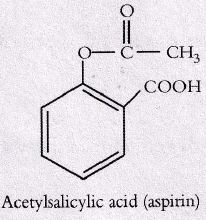
Write the structural formula of aspirin.
8.
How the tranquilizers work in body.
9.
Name one substance which can act as both analgesic and antipyretic.
10.
What are antibiotics?
11.
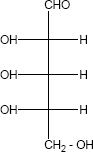
Is the following sugar, D – sugar or L – sugar?
12.
Write the structure of all possible dipeptides which can be obtained form glycine and alanine
13.
Write a note on denaturation of proteins.
14.
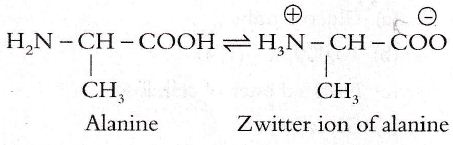
Write the Zwitter ion structure of alanine
15.
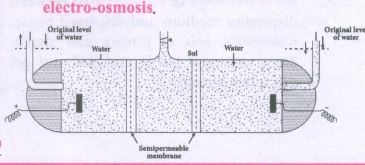
Write a note on electro osmosis.
16.
Addition of Alum purifies water. Why?
17.
Why are lyophillic colloidal sols are more stable than lyophobic colloidal sol.
18.
Classify the following as linear, branched or cross linked polymers
a) Bakelite
b) Nylon-6,6
c) polythene (HDPE)
d) polythene (LDPE)
19.
Write a note on vulcanization of rubber
20.
How is terylene prepared?
21.
What are anti fertility drugs? Give examples.
22.
What are food preservatives?
23.
How do antiseptics differ from disinfectants?
24.
25.
26.
What are reducing and non – reducing sugars?
27.
Give any three difference between DNA and RNA.
1.
Primary structure of Proteins:
Proteins are polypeptide chains, made up of amino acids are connected through peptide bonds. The relative arrangement of the amino acids in the polypeptide chain is called the primary structure of the protein. Knowledge of this is essential as even small changes have potential to alter the overall structure and function of a protein.
\(\mathrm{H}_{2} \mathrm{~N}-\mathrm{Gly}-\mathrm{Met}-\mathrm{Phe}-\mathrm{Cys}-\mathrm{Arg}-\mathrm{Asp}-\mathrm{COOH}\)
α - Helix:
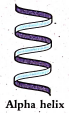
In the α-helix sub-structure, the amino acids are arranged in a right handed helical (spiral) structure and are stabilised by the hydrogen bond between the carbonyl oxygen of one amino acid (n residue) with amino hydrogen of the fifth residue (n + 4th residue). The side chains of the residues protrude outside of the helix. Each turn of an α-helix contains about 3.6 residues and is about 5.4 Å long. The amino acid proline produces a kink in the helical structure and often called as a helix breaker due to its rigid cyclic structure.
1. Linear sequence of aminoacids
2. Linear
3. Composed of peptide bonds formed between amino acids.
Secondary structure of Proteins:
The amino acids in the polypeptide chain forms highly regular shapes (sub-structures) through the hydrogen bond between the carbonyl oxygen (-C=O) and the neighbouring amine hydrogen (-NH) of the main chain. α-Helix and β-strands or sheets are two most common substructures formed by proteins.
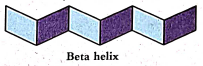
β-Strand:
β-Strands are extended peptide chain rather than coiled. The hydrogen bonds occur between main chain carbonyl group one such strand and the amino group of the adjacent strand resulting in the formation of a sheet like structure. This arrangement is called β-sheets.
2.
(a) The product or the unreacted reactant has to be removed from the surface of the catalyst. Desorption helps this.
(b) It makes the catalyst free for the next reaction (ie) adsorption of new reactants.
3.
| S.no | Sol | Gel |
| (a) | The liquid state of collidal solution | The solid (or) semi solid stage of a colloidal solution. |
| (b) | Very low viscosity | Very high viscosity |
| (c) | It does not have definite structure. | It possesses definite structure. |
4.
In Chemisorptions the molecules are held on the surface by attractive forces by formation of chemical bonds. As strong bond is formed nearly 400 kJ / mol is given out as heat of adsorption chemical bonds are much stronger, whereas the Vander Waal's forces in physisorption is weaker.
5.
(i) It is instantaneous.
(ii) It is non-specific.
(iii) No transfer of electrons.
(iv) Multilayer of adsorbate is formula.
6.
(i) Sucralose is used as sugar substituent like Sorbitol, Xylitol and Mannitol. All these have sweetness. They are metabolised without the influence of insulin.
(ii) Artificial sweetening agents like Aspartarne, Alitame and Saccharin are also used. These have negligible nutritional value.
Example : Saccharin,Aspartame, Sucralose, Alitame
7.
Aspirin is o-acetyl salicylic acid
8.
(i) They are neurologically active drugs.
(ii) It acts on the central nervous system by blocking the neurotransmitter dopamine in the brain.
Uses : Reducing stress & anxiety, To cure sleep disorders & severe mental disease.
Ex : (i) Major tranquilizers : Haloperidol, Clozapine
(ii) Minor tranquilizers :Diozepam(Valium), alprazolam.
9.
Aspirin (o - acetyl salicylic acid) - is a substance which lowers body temperature and also reduces body pain. So it acts as both analgesic and antiphyretic.
10.
(i) Many micro organisms (bacteria, fungi and moulds) produce certain chemicals which inhibit the growth or metabolism of some other micro organism. Such chemicals are called antibiotics.
(ii) Eg: Penicillin from the mould penicillium notatum
11.
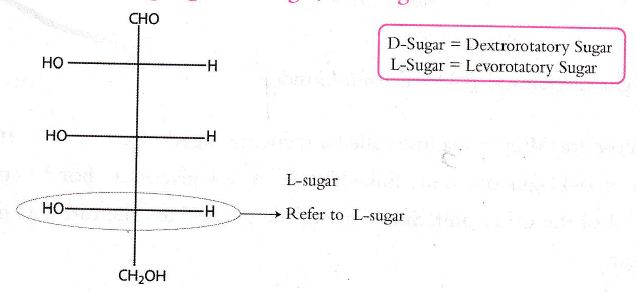
(a) C4 carbon of the given sugar contains H and OH on the same configuration like C4 carbon in L-Glyceraldehyde. Therefore the sugar is L-sugar.
(b) Because the H and OH on C4 carbon are in the same configuration as the Hand OH on C4 carbon in L-Glyceraldehyde
12.
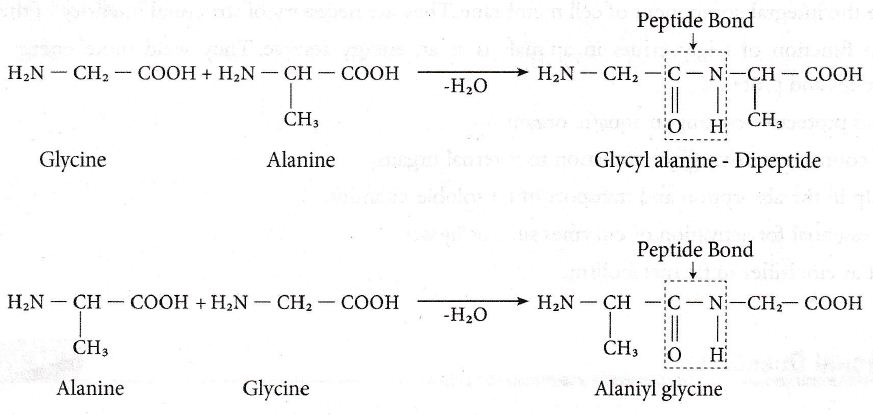
∴ Two dipeptides structures are possible from glycine and alanine. They are glycyl alanine and Alanyl glycine.
13.
(i) Each protein has a unique three-dimensional structure formed by interactions such as disulphide bond, hydrogen bond, hydrophobic and electrostatic interactions. These interactions cain be disturbed when the protein is exposed to a higher temperature, certain chemicals such as urea, alteration of pH, ionic strength etc., It leads to the loss of the three-dimensional structure partially or completely. The process of a losing its higher order structure without losing the primary structure, is called denaturation. When a protein denatures, its biological function is also lost.
(ii) Since the primary structure is intact, this process can be reversed in certain proteins. This can happen spontaneously upon restoring the original conditions or with the help of special enzymes called cheperons (proteins that help proteins to fold correctly).
(iii) Example: coagulation of egg white by action of heat.
14.
15.
A sol is electrically neutral. Hence the medium carries an equal but opposite charge to that of dispersed particles. When sol particles are prevented from moving, under the influence of electric field the medium moves in a direction opposite to that of the sol particles. This movement of dispersion medium under the influence of electric potential is called electro osmosis.
16.
(i) Purification of drinking water is activated by coagulation of suspended impurities in water by using alums containing \(\mathrm{Al}^{3+}\left(\mathrm{K}_{2} \mathrm{SO}_{4} \mathrm{Al}_{2}\left(\mathrm{SO}_{4}\right)_{3} \cdot 24 \mathrm{H}_{2} \mathrm{O}\right)\) Alum has a negative charge and tends to disperse in water very fast.
(ii) The increased size as well as the lack of repelling charges cause the alum particles to settle down at the bottom or rise up and float in water. After the particles are neutralized, they clump together because of the London dispersive force which are part of vander Waal's forces. The weak inter molecular force arising from quantum induced instantaneous polarisation multi poles in molecules causes even non polar particles to attract each other due to the corelated movements of the electrons in interacting molecules. Then they settle down.
17.
(i) In lyophillic colloids or sols definite attractive force or affinity exists between dispersion medium and dispersed phase. Examples: sols of protein and starch. They are more stable and will not get precipitated easily.
(ii) In a lyophobic colloids, no attractive force exists between the dispersed phase and dispersion medium. They are less stable and precipitated readily, but cannot be produced again by just adding the dispersion medium.
Examples: sols of gold, silver, platinum and copper.
18.
a) Bakelite - Cross linked polymer
b) Nylon - Linear polymer
c) polythene (HDPE) - Linear polymer
d) polythene (LDPE) - Branched polyner
19.
(i) Natural rubber is mixed with 3-5% sulphur and heated at 100-150°C causes cross-linking of the cis-1,4-polyisoprene chains through disulphide (-S-S-) bonds.
(ii) The physical properties of rubber can be altered by controlling the amount of sulphur that is used for vulcanization.
(iii) In sulphur rubber, made with about 1 to 3% sulphur is soft and stretchy.When 3 to 10% sulphur is used the resultant rubber is somewhat harder but flexible.
20.
(i) Monomers :Ethylene glycol and terepathalic acid (or) dimethyl terephthalate.
(ii) Catalyst : Zinc acetate and antimony trioxide.
(iii) Temperature : 500 K
(iv) Product : Terylene

(v) Uses : blending with cotton or wool fibres and as glass reinforcing materials in safety helmets
21.
Anti fertility drugs are synthetic hormones that suppresses ovulation and fertilisation. They are used in birth control pills.
eg: Synthetic Oestrogen : Ethynylestradiol, Menstranol,
Synthetic Progestrone : Norethindrone, Norethynodrel etc.
22.
(i) Preservatives are chemicals added to food which are capable of inhibiting, retarding or arresting the process of fermentation, acidification or other decomposition of food by the growth of micro organisms (or)
(ii) Chemical substances which are added to food that prevents the spoilage of food materials by destroying the food - spoiling micro-organisms are called food preservatives.
(iii) Eg: sodium benzoate, NaCl, Acetic acid Sodium metabisulphite, potassium meta bisulphite etc.
23.
| S.No | Antiseptics | Disinfectants |
| 1. | Antiseptics are medicines applied to living tissues (living humans). | Disinfectants are applied to inanimated objects. |
| 2. | All the antiseptics are disinfectants. | All the disinfectants are not antiseptics. |
| 3. | They are not ingested or swallowed. Eg: Povidone - iodine. |
They can be injected or swallowed. Eg :Hydrogen peroxide, Chlorine compounds |
24.
25.
26.
i) Reducing sugars:
1. Sugars which reduce Tollen's reagent or Fehling's solution or Benedict's solution are called reducing sugars.
2. These contain either α - hydroxyl ketone or cyclical hemi acetal or hemi ketal or structures in equilibrium with open chain forms having a free- CHO or C=O group.
3. E.g. a) All monosaccharide's like D - glucose, D - fructose (aldoses and ketoses)
b) Sugars like Lactose and maltose except sucrose.
ii) Non - reducing sugars:
1. Sugars which do not reduce either Tollen's reagent, Fehling's solution or Benedict's solution are called non-reducing sugars.
2. They contain a stable acetal or ketal structures which cannot be opened into a free carbonyl group.
E.g. Sucrose, starch, cellulose, glycogen, dextrin etc.
27.
| DNA | RNA |
|---|---|
| DNA is mainly present in nucleus, mitochondria and chloroplast | RNA is mainly present in cytoplasm, nucleolus and ribosomes |
| It contains deoxyribose sugar | It contains ribose sugar |
| Base pair A = T. G≡C | Base pair A = U. C≡G |
| Double stranded molecules | Single stranded molecules |
| It's life time is high | It is short lived |
| It is stable and not hydrolysed easily by alkalis | It is unstable and hydrolyzed easily by alkalis |
| It can replicate itself | It cannot replicate itself It is formed from DNA |

12th Standard Syllabus & Materials
12th Standard
TN 12th Computer Applications களப்பெயர் முறைமை (DNS) Sample Question Papers Study Material - QB365 Set A
NEW12th Standard
TN 12th Computer Applications வலையமைப்பு எடுத்துக்காட்டுகள் மற்றும் நெறிமுறைகள் Sample Question Papers Study Material - QB365 Set A
NEW12th Standard
TN 12th Computer Applications கணினி வலையமைப்பு ஓர் அறிமுகம் Sample Question Papers Study Material - QB365 Set A
NEW12th Standard
TN 12th Computer Applications PHP-உடன் MySQL-ஐ இணைத்தல் Sample Question Papers Study Material - QB365 Set A



Tamilnadu Stateboard 12th Standard Subjects

Maths
Chemistry

Physics

Biology

Computer Science

Business Maths and Statistics

Economics

Commerce

Accountancy

History

Computer Applications
Biology
Computer Technology
Computer Applications
Computer Science
Business Maths and Statistics
Commerce
Economics
Maths
Chemistry
Physics
Computer Technology
History
Accountancy

Tamil

English

French
Tamilnadu Stateboard Standards


