
 100% FREE ACCESS
12th Standard Syllabus & Materials
12th Standard
TN 12th Computer Applications மின்னணு தரவு பரிமாற்றம் Sample Question Papers Study Material - QB365 Set A
NEW12th Standard
TN 12th Computer Applications மின் - வணிக பாதுகாப்பு அமைப்புகள் Sample Question Papers Study Material - QB365 Set A
NEW12th Standard
TN 12th Computer Applications மின்னணு செலுத்தல் முறைகள் Sample Question Papers Study Material - QB365 Set A
NEW12th Standard
TN 12th Computer Applications மின் - வணிகம் Sample Question Papers Study Material - QB365 Set A
NEW12th Standard
TN 12th Computer Applications திறந்த மூல கருத்துருக்கள் Sample Question Papers Study Material - QB365 Set A
NEW12th Standard
TN 12th Computer Applications வலையமைப்பு வடமிடல் Sample Question Papers Study Material - QB365 Set A

Published on: 28/11/2025
Download Tamil Nadu 12th Standard Chemistry question papers, model tests, one-mark questions, important questions, and public exam papers in PDF format. Free study materials and answer keys for TN State Board students.
Questions + Answers key
Take MCQ Chemistry Test
1.
Which is the monomer of neoprene in the following?
.JPG)
\(\mathrm{CH}_{2}=\mathrm{CH}-\mathrm{C} \equiv \mathrm{CH}\)
\(\mathrm{CH}_{2}=\mathrm{CH}-\mathrm{CH}=\mathrm{CH}_{2}\)
.JPG)
2.
Natural rubber has _______.
alternate cis- and trans-configuration
random cis- and trans-configuration
all cis-configuration
all trans-configuration
3.
Which of the following amino acids are achiral?
Alanine
Leucine
Proline
Glycine
4.
Which one of the following rotates the plane polarized light towards left?
D(+) Glucose
L(+) Glucose
D(-) Fructose
D(+) Galactose
5.
Secondary nitro alkanes react with nitrous acid to form _______.
red solution
blue solution
green solution
yellow solution
6.
Which one of the following will not undergo Hofmann bromamide reaction.
CH3CONHCH3
CH3CH2CONH2
CH3CONH2
C6H5CONH2
7.
Carbolic acid is _____.
Phenol
Picri cacid
benzoic acid
phenylacetic acid
8.
Fog is colloidal solution of _______.
solid in gas
gas in gas
liquid in gas
gas in liquid
9.
The button cell used is watches function as follows
Zn (s) + Ag2O (s) + H2O (l) ⇌ 2Ag (s) + Zn2+ (aq) + 2OH-(aq) the half cell potentials are Ag2O (s) + H2O (l) + 2e- → 2Ag (s) + 2OH- (aq) Eo = 34V and Zn (s) → Zn2+ (aq) + 2e− E0 = 0.76V . The cell potential will be_______.
0.84V
1.34V
1.10V
0.42V
10.
For a first order reaction A ⟶ product with initial concentration x mol L-1, has a half life period of 2.5 hours. For the same reaction with initial concentration \(\left( \frac { x }{ 2 } \right) \) mol L-1 the half life is
(2.5 x 2) hours
\(\left( \frac { 2.5 }{ 2 } \right) \) hours
2.5 hours
Without knowing the rate constant, t1/2 cannot be determined from the given data
11.
Graphite and diamond are ________.
Covalent and molecular crystals
ionic and covalent crystals
both covalent crystals
both molecular crystals
12.
The sum of primary valence and secondary valence of the metal M in the complex [M(en)2(Ox)]Cl is________.
3
6
-3
9
13.
Which one of the following ions has the same number of unpaired electrons as present in V3+?
Ti3+
Fe3+
Ni2+
Cr3+
14.
Which is true regarding nitrogen?
least electronegative element
has low ionisation enthalpy than oxygen
d- orbitals available
ability to form pπ-pπ bonds with itself
15.
Roasting of sulphide ore gives the gas (A).(A) is a colourless gas. Aqueous solution of (A) is acidic. The gas (A) is______.
CO2
SO3
SO2
H2S
16.
Bauxite has the composition ______.
Al2O3
Al2O3.nH2O
Fe2O3.2H2O
None of these
17.
Describe adsorption theory of catalysis
18.
How will you distinguish between primary secondary and tertiary alphatic amines.
19.
What are drugs? How are they classified.
20.
Give the differences between primary and secondary structure of proteins.
21.
Discuss the Lowry – Bronsted concept of acids and bases.
22.
Write the postulates of Werner’s theory.
23.
Give the balanced equation for the reaction between chlorine with cold NaOH and hot NaOH.
24.
Describe briefly allotropism in p- block elements with specific reference to carbon.
25.
Explain zone refining process with an example.
26.
Addition of Alum purifies water. Why?
27.
Write Kolbe’s reaction.
28.
State Faraday’s Laws of electrolysis
29.
Write a note on vulcanization of rubber
30.
What are reducing and non – reducing sugars?
31.
Define rate law and rate constant.
32.
Which is more stable? Fe3+ or Fe2+? Why ?
33.
Explain briefly seven types of unit cell.
34.
Give the uses of helium.
35.
36.
Why does bleeding stop by rubbing moist alum
37.
Define anode and cathode
38.
How is propanoic acid is prepared starting from
(a) an alcohol
(b) an alkylhalide
(c) an alkene
39.
What are antibiotics?
40.
Name the Vitamins whose deficiency cause i) rickets ii) scurvy
41.
What are Lewis acids and bases? Give two example for each.
42.
What are actinides? Give three examples.
43.
Write the formula for the co-ordination compounds.
44.
Define unit cell.
45.
Describe the structure of diborane.
46.
What is inert pair effect?
1.
(a)
2.
(c)
all cis-configuration
3.
(d)
Glycine
4.
(c)
D(-) Fructose
5.
(b)
blue solution
6.
(a)
CH3CONHCH3
7.
(a)
Phenol
8.
dispersion medium-gas
dispersed phase-liquid
9.
Anodic Oxidation: (Reverse the given reaction)
(Eoox ) = 0.76 V Cathodic reduction
Eocell = (Eoox )+ (Eored)
= 0.76 + 0.34 = 1.1 V
10.
For a first order reaction
t1/2 = \(\frac { 0.693 }{ { k }}\)
t1/2 does not depend on the initial concentration and it remains constant (whatever may be the initial concentration)
t1/2 = 2.5 hrs
11.
(c)
both covalent crystals
12.
In the complex [M(en)2(Ox)]Cl For the central metal ion M3+
The primary valence is = +3
The secondary valence = 6
sum of primary valence and secondary valence = 3 + 6 = 9
13.
(c)
Ni2+
14.
(d)
ability to form pπ-pπ bonds with itself
15.
(c)
SO2
16.
(b)
Al2O3.nH2O
17.
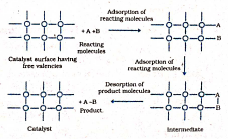
1. Langmuir explained the action of catalyst in heterogeneous catalysed reactions based on adsorption. The reactant molecules are adsorbed on the catalyst surfaces, so this can also be called as contact catalysis.
2. According to this theory, various steps involved in a heterogeneous catalyse reaction are given as follows:
(i) Reactant molecules diffuse from bulk to the catalyst surface.
(ii) The reactant molecules are adsorbed on the surface of the catalyst.
(iii) The adsorbed reactant molecules are activated and form activated complex which is decomposed to form the products.
(iv) The product molecules are desorbed.
(v) The product diffuse away from the surface of the catalyst.
18.
| S.No | Reagents or Reaction | Primary amine RNH2 | Secondary amine R2NH | Tertiary amine R3N |
|---|---|---|---|---|
|
1. |
Carbylamine reaction or with CHCl3/KOH |
Carbylamine is formed (unpleasant smell) |
- | - |
| 2. | Mustard oil reaction or CS2/HgCl2 (Hoffmann's mustard oil test) |
Alkyl isothiocyanate is formed (Mustard oil odour) |
- | - |
| 3. | HNO2 (or) NaNO2 / HCl |
Alcohol is formed +H2 | Yellow oily nitrosoamine is formed, insoluble in water. (Liberman's Test) |
Forms nitrite in cold, soluble in water. |
| 4. | CH3COCl | N-acetyl derivative is formed | N,N- diacetyl derivative is formed |
- |
| 5. | Diethyl oxalate Hoffmann's method |
Solid oxamide is formed | Liquid oxamic ester is formed |
- |
| 6. | Benzene sulphonyl chloride in presence of excess. KOH (Hinsberg's reaction) |
N- alkyl benzene sulphonamide is formed (soluble) |
N, N - dialkyl benzene sulphonamide is formed (Insoluble). |
- |
| 7. | With RX | 1 mol → 2o amine 2 mol → 3o amine 3 mol → Quarternary salt |
1 mol → 3o amine 2 mol → Quarternary salt |
1 mol → Quarternary salt |
19.
A drug is a substance that is used to modify or explore physiological systems or pathological states for the benefit of the recipient. It is used for the purpose of diagnosis, prevention, cure/relief of a disease.
a) Classification of drugs:
Drugs are classified based on their properties such as chemical structure, pharmacological effect, target system, site of action etc.
b) Classification based on the chemical structure:
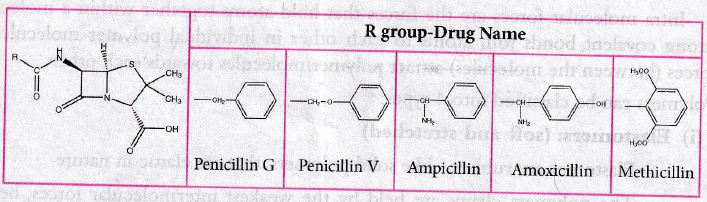
In this classification, drugs with a common chemical skeleton are classified into a single group. For example, ampicillin, amoxicillin, methicillin etc.. all have similar structure and are classified into a single group called penicillin. Similarly, we have other group of drugs such as opiates, steroids, catecholamines etc. Compounds having similar chemical structure are expected to have similar chemical properties. However, their biological actions are not always similar. For example, all drugs belonging to penicillin group have same biological action, while groups such as barbiturates, steroids etc.. have different biological action.
Penicillins
Classification based on Pharmacological effect:
In this classification, the drugs are grouped based on their biological effect that they produce on the recipient. For example, the medicines that have the ability to kill the pathogenic bacteria are grouped as antibiotics. This kind of grouping will provide the full range of drugs that can be used for a particular condition (disease). The physician has to carefully choose a suitable medicine from the available drugs based on the clinical condition of the recipient.
Examples:
Antibiotic drugs: amoxicillin, ampicillin, cefixime, cefpodoxime, erythromycin, tetracycline etc.. Antihypertensive drugs: propranolol, atenolol, metoprolol succinate, amlodipine etc...
Classification based on the target system (drug action):
In this classification, the drugs are grouped based on the biological system/process, that they target in the recipient. This classification is more specific than the pharmacological classification. For example, the antibiotics streptomycin and erythromycin inhibit the protein synthesis (target process) in bacteria and are classified in a same group. However, their mode of action is different. Streptomycin inhibits the initiation of protein synthesis, while erythromycin prevents the incorporation of new amino acids to the protein.
Classification based on the site of action (molecular target):
The drug molecule interacts with biomolecules such as enzymes, receptors etc, which are referred as drug targets. We can classify the drug based on the drug target with which it binds. This classification is highly specific compared to the others. These compounds often have a common mechanism of action, as the target is the same.
20.
Primary structure of Proteins:
Proteins are polypeptide chains, made up of amino acids are connected through peptide bonds. The relative arrangement of the amino acids in the polypeptide chain is called the primary structure of the protein. Knowledge of this is essential as even small changes have potential to alter the overall structure and function of a protein.
\(\mathrm{H}_{2} \mathrm{~N}-\mathrm{Gly}-\mathrm{Met}-\mathrm{Phe}-\mathrm{Cys}-\mathrm{Arg}-\mathrm{Asp}-\mathrm{COOH}\)
α - Helix:
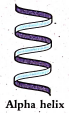
In the α-helix sub-structure, the amino acids are arranged in a right handed helical (spiral) structure and are stabilised by the hydrogen bond between the carbonyl oxygen of one amino acid (n residue) with amino hydrogen of the fifth residue (n + 4th residue). The side chains of the residues protrude outside of the helix. Each turn of an α-helix contains about 3.6 residues and is about 5.4 Å long. The amino acid proline produces a kink in the helical structure and often called as a helix breaker due to its rigid cyclic structure.
1. Linear sequence of aminoacids
2. Linear
3. Composed of peptide bonds formed between amino acids.
Secondary structure of Proteins:
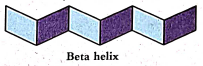
The amino acids in the polypeptide chain forms highly regular shapes (sub-structures) through the hydrogen bond between the carbonyl oxygen (-C=O) and the neighbouring amine hydrogen (-NH) of the main chain. α-Helix and β-strands or sheets are two most common substructures formed by proteins.
β-Strand:
β-Strands are extended peptide chain rather than coiled. The hydrogen bonds occur between main chain carbonyl group one such strand and the amino group of the adjacent strand resulting in the formation of a sheet like structure. This arrangement is called β-sheets.
21.
(i) An acid is defined as a substance that has a tendency to donate a proton to another substance and base is a substance that has a tendency to accept a proton form other substance.
(ii) In other words, an acid is a proton donor and a base is a proton acceptor.
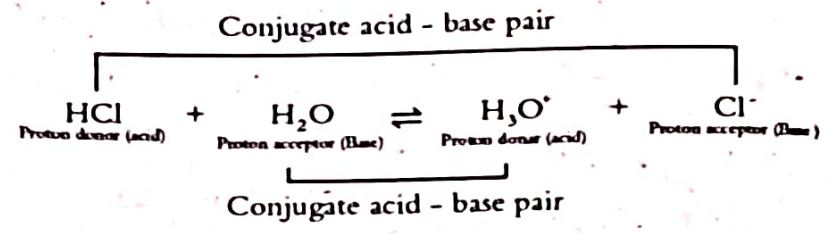
(iii) When hydrogen chloride is dissolved in water, it donates a proton to the later. Thus, HCI behaves as an acid and H2O is base. The proton transfer from the acid to base can be represented as
HCI + H2O ⇌ H3O+ + Cl-
(iv) When ammonia is dissolved in water, it accepts a proton from water. In this case, ammonia (NH3) acts as a base and H2O is acid. The reaction is represented as
H2O + NH3 ⇌ NH4+ + OH-
(v) Let us consider the reverse reaction following equilibrium.
\(\underset { proton\ donar\\ \quad \quad \ (acid) }{ HCl } +\underset { Proton\ acceptor\\ \quad \quad \quad \quad (base) }{ { H }_{ 2 }O } \leftrightharpoons \underset { Proton\ donar\\ \quad \quad \quad \quad \ (acid) }{ { H }_{ 2 }{ O }^{ + } } +\underset { Proton\ acceptor\\ \quad \quad \quad \quad \ (base) }{ { Cl }^{ - } } \)
H3O+ donates a proton to Cl- to form HCI i.e., the products also behave as acid and base.
(vi) In general, Lowry - Bronsted (acid - base) reaction is represented as
Acid1 + Base2 ⇌ Acid2 + Base1
(vii) The species that remains after the donation of a proton is a base (Base1) and is called the conjugate base of the Bronsted acid (Acid1). In other words, chemical species that differ only by a proton are called conjugate acid - base pairs.
22.
Most of the elements exhibit, two types of valence namely primary valence and secondary valence and each element tend to satisfy both the valences.
The primary valence is referred the oxidation state of the metal atom.
The secondary valence as the coordination number. For example, according to Werner, the primary and secondary valences of cobalt are 3 and 6 respectively.
The primary valence of a metal ions ae always satisfied by negative ions.
For example in the complex CoCI3.6NH3. The primary valence of Co is +3 and is satisfied by 3CI- ions.
The secondary valence is satisfied by negative ions, neutral molecules, positive ions or the combination of these.
For example, in CoCl3.6NH3 complex primary valence of cobalt +3 and it is satisfied by 3 CI-.
The secondary valence of cobalt is 6 and is satisfied by six neutral ammonia molecules. where as in CoCI6.NH3.
Secondary valence of Co = 5{It is satisfied five neutral molecules and a Cl- ion}
According to Werner, there are two spheres of attraction around a metal atom/ion in a complex.
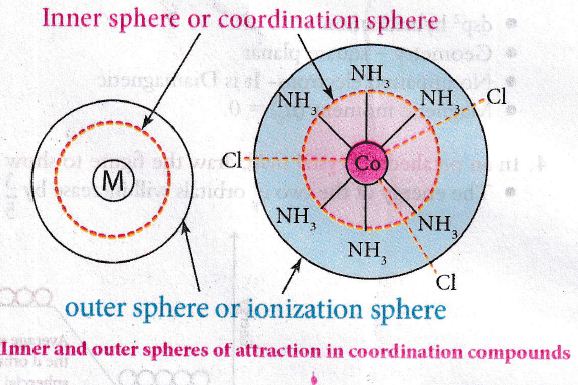
The inner /coordination sphere:
The groups present in this sphere are firmly attached to the metal.
The outer sphere / ionisation sphere:
The groups present in this sphere are loosely bound to the central metal ion and hence can be separated into ions upon dissolving the complex in a suitable solvent.
The primary valencies are non-directional. while the secondary valencies are directional.
The geometry of the complex is determined by the special arrangement of the groups which satisfy the secondary valence.
| Secondary valence | Geometry |
| 4 | Tetrahedral / Square planar |
| 6 | Octahedral |
23.
Chlorine reacts with cold dilute alkali to give chloride and hypochlorite, while with hot concentrated alkali chlorides and chlorates are formed.
\(\mathrm{Cl}_{2}+\mathrm{H}_{2} \mathrm{O} \rightarrow \mathrm{HCl}+\underset{\text { Hypochlorous acid }}{\mathrm{HOCl}} \)
\(\mathrm{HCl}+\mathrm{NaOH} \rightarrow \mathrm{NaCl}+\mathrm{H}_{2} \mathrm{O} \)
\(\mathrm{HOCl}+\mathrm{NaOH} \rightarrow \mathrm{NaOCl}+\mathrm{H}_{2} \mathrm{O} \)
(Sodium hypo chlorite)
Overall Reaction
3Cl2 + 6NaOH \(\rightarrow\) NaClO3 + 5NaCl + 3H2O
(Sodium Chlorate)
24.
Allotropism:
1. Some elements exist in more than one crystalline or molecular forms in the same physical state
(a) In Greek "allos" means ⇒ Another
(b) "trope" means ⇒ Change
2. The different forms of an element are called allotropes.
Allotropy of carbon:
Carbon exists as diamond, graphite, fullerenes, carbon nanotubes and graphene.
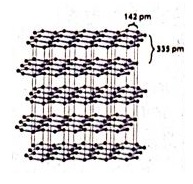
Graphite:
1. Graphite is the most stable allotropic form of carbon at normal temperature and pressure.
2. It is soft and conducts electricity.
3. It is composed of flat two dimensional sheets of carbon atoms.
4. Each sheet is a hexagonal.
5. It is "sp2" hybridised.
6. C-C bond length is 1.41 Å
7. Each C-atom forms three σ bonds with three neighbouring carbon atoms using three of its valence electrons and the fourth electron present in the unhybridised p-orbital form a π-bond.
8. The successive C-sheets are held together by weak Vander Waals forces.
9 The distance successive sheet is 3.40 Å.
10. It is used as a lubricant either on its own or as a graphited oil.
Diamond:
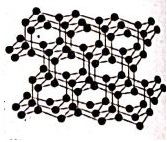
1. It is very hard.
2. It is "sp3" hybridised.
3. C-C bond length is 1.54 Å
4. It is used for sharpening hard tools, cutting glasses, making bores and rock drilling.
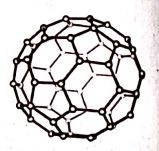
Fullerenes:
1. These allotropes are discrete molecules such as \(C_{32}, C_{50}, C_{60}, C_{70}, C_{76}\) etc.
2. It has cage like structure
3. The C60 molecules have a "soccer" ball like structure and is called buckminster fullerene or buckyballs.
4. It has a fused ring structure consists of 20 six membered rings and 12 five membered ring.
5. Each carbon atom is "sp2" hybridised.
6. It has three σ bonds and a delocalised π bond giving aromatic character to these molecules.
7. The C-C bond distance is 1.44 Å
8. The C=C bond distance is 1.38 Å.
Carbon nanotubes:
1. Carbon nanotubes, another recently discovered allotropes, have graphite like tubes with fullerene ends.
2. Along the axis, these nanotubes are stronger than steel and conduct electricity.
3. These have many applications in nanoscale electronics, catalysis, polymers and medicine.
Graphene:
It has a single planar sheet of "sp2" hybridised carbon atoms that are densely packed in a "honeycomb crystal" lattice.
25.
Zone refining :
1. Zone refining method is based on the principles of fractional crystallisation.
2. When an impure metal is melted and allowed to solidify, the impurities will prefer to be in the molten region. In this process the impure metal is taken in the form of a rod.
3. One end of the rod is heated using a mobile induction heater which results in melting of the metal on that portion of the rod.
4. When the heater is slowly moved to the other end the pure metal crystallises while the impurities will move on to the adjacent molten zone.
5. As the heater moves further away, the molten zone containing impurities also moves along with it.
6. The process is repeated several times by moving the heater in the same direction again and again to get pure metal.
7. This process is carried out in an inert gas atmosphere to prevent the oxidation of metals.
8. Elements such as germanium (Ge), silicon (Si) and galium (Ga) that are used as semiconductor are refined using this process.
26.
(i) Purification of drinking water is activated by coagulation of suspended impurities in water by using alums containing \(\mathrm{Al}^{3+}\left(\mathrm{K}_{2} \mathrm{SO}_{4} \mathrm{Al}_{2}\left(\mathrm{SO}_{4}\right)_{3} \cdot 24 \mathrm{H}_{2} \mathrm{O}\right)\) Alum has a negative charge and tends to disperse in water very fast.
(ii) The increased size as well as the lack of repelling charges cause the alum particles to settle down at the bottom or rise up and float in water. After the particles are neutralized, they clump together because of the London dispersive force which are part of vander Waal's forces. The weak inter molecular force arising from quantum induced instantaneous polarisation multi poles in molecules causes even non polar particles to attract each other due to the corelated movements of the electrons in interacting molecules. Then they settle down.
27.
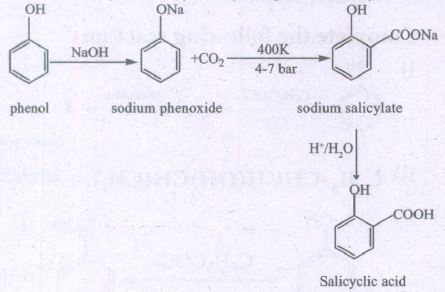
In this reaction, phenol is first converted into sodium phenoxide which is more reactive than phenol towards electrophilic substitution reaction with CO2, Treatment of sodium phenoxide with CO2 at 400 K, 4-7 bar pressure followed by acid hydrolysis gives salicylic acid.
28.
First law:
The mass of the substance (m) liberated at an electrode during electrolysis is directly proportional to the quantity of charge (Q) passed through the cell.
m α Q \(\left[\because \mathrm{I}=\frac{\mathrm{Q}}{\mathrm{t}} \Rightarrow \mathrm{Q}=\mathrm{It}\right]\)
m α It
m = ZIt
Where Z = electro chemical equivalent of the substance
I = current
t = time of passage of current
Second law:
When the same quantity of charge is passed through the solutions of different electrolytes, the amount of substances liberated at the respective electrodes are directly proportional to their electrochemical equivalents.
m α Z
\(\frac{m_{1}}{Z_{1}}=\frac{m_{2}}{Z_{2}}\)
m = mass of the metal deposited
Z = electro chemical equivalent
29.
(i) Natural rubber is mixed with 3-5% sulphur and heated at 100-150°C causes cross-linking of the cis-1,4-polyisoprene chains through disulphide (-S-S-) bonds.
(ii) The physical properties of rubber can be altered by controlling the amount of sulphur that is used for vulcanization.
(iii) In sulphur rubber, made with about 1 to 3% sulphur is soft and stretchy.When 3 to 10% sulphur is used the resultant rubber is somewhat harder but flexible.
30.
i) Reducing sugars:
1. Sugars which reduce Tollen's reagent or Fehling's solution or Benedict's solution are called reducing sugars.
2. These contain either α - hydroxyl ketone or cyclical hemi acetal or hemi ketal or structures in equilibrium with open chain forms having a free- CHO or C=O group.
3. E.g. a) All monosaccharide's like D - glucose, D - fructose (aldoses and ketoses)
b) Sugars like Lactose and maltose except sucrose.
ii) Non - reducing sugars:
1. Sugars which do not reduce either Tollen's reagent, Fehling's solution or Benedict's solution are called non-reducing sugars.
2. They contain a stable acetal or ketal structures which cannot be opened into a free carbonyl group.
E.g. Sucrose, starch, cellulose, glycogen, dextrin etc.
31.
Rate law:
(i) Rate law or rate equation is an expression which relates the rate of a reaction with rate constant and the concentration of reactants.
(ii) For xA + yB → products
(iii) The rate law is r = k[A]m[B]n
Rate constant:
(i) It is the rate of the reaction when the concentration of the reactants are taken unity.
In above rate law if[A] = [B] = 1, rate constant k = Rate
32.
(i) Fe3+ - electronic configuration - [Ar] 3d5
(ii) It has exactly half-filled stable electronic configuration.
(iii) Fe2+ - electronic configuration -[Ar]3d6
(iv) It has only partially filled d-orbitals.
Hence Fe3+ is more stable than Fe2+.
33.
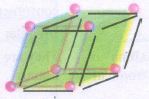
There are seven types of unit cell, Cubic, tetragonal, orthorhombic, hexagonal, monoclinic, triclinic and rhombohedral. They differ in the arrangement of their crystallographic axes and angles.
i) Cubic: a = b = c; α = β = ૪ = 90o.
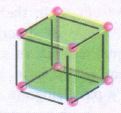
ii) Tetragonal: a = b ≠ c; α = β = ૪ = 90°.
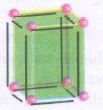
iii) Orthorhombic: a ≠ b ≠ c; α = β = ૪ = 90°.
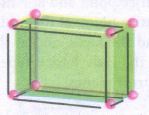
iv) Hexagonal: a = b ≠ c; α = β = 90o, ૪ = 120o.
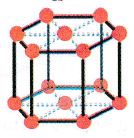
v) Monoclinic: a ≠ b ≠ c; α = ૪ = 90o, β ≠ 90o,
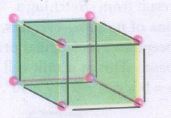
vi) Triclinic: a ≠ b ≠ c; α ≠ β ≠ ૪ ≠ 90o.
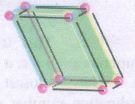
vii) Rhombohedral: a = b = c; α = β = ૪ ≠ 90o.
34.
(i) Helium is used to provide inert atmosphere in electric-arc welding of metals.
(ii) Helium has lowest boiling point hence used in cryogenics.
(iii) It is much less denser than air and hence used for filling air balloons.
35.
36.
(a) Blood is a colloidal sol. When we rub the injured part with moist alum, coagulation of blood takes place.
(b) Coagulation stops bleeding. Moist alum is an electrolyte.
37.
(i) Anode: The electrode at which the oxidation occurs is called anode. (loss of electrons)
(ii) Cathode: The electrode at which the reduction occurs is called cathode. (gain of electrons)
38.
An alcohol:
.JPG)
An alkylhalide:
.JPG)
An alkene:
.JPG)
39.
(i) Many micro organisms (bacteria, fungi and moulds) produce certain chemicals which inhibit the growth or metabolism of some other micro organism. Such chemicals are called antibiotics.
(ii) Eg: Penicillin from the mould penicillium notatum
40.
i) Rickets - Vitamin - D (Cholecalciferol - (D3) Ergocalciferol - (D2)
ii) Scurvy (bleeding gums) - vitamin - C (Ascorbic acid)
41.
(i) Lewis acid: It is a species that accepts an electron pair. Eg: \(\mathrm{Ag}^{+} ; \mathrm{BF}_{3} ; \mathrm{A} / \mathrm{Cl}_{3}\)
(ii) Lewis base: It is a species that donates an electron pair. Eg: \( \mathrm{Cl}^{-} ; \mathrm{NH}_{3} ; \mathrm{H}_{2} \mathrm{O}\)
42.
The fourteen elements following actinoids is from thorium to lawrencium are called actinides.
Examples: Uranium, Thorium, Neptunium
43.
a) potassiumhexacyanidoferrate(II) - Potassiumhexacyanidoferrate(II) - K4[Fe(CN)6]
b) Pentacarbonyliron(0) - [Fe(CO)5]
c) Pentaamminenitrito −kNcobalt(III)ion - [Co(NH3)5(NO2)]2+
d) Hexaamminecobalt(III) Sulphate - [CO(NH3)6](SO4)3
e) Sodiumtetrafluoridodihydroxidochromate(III) - Na2[CrF4(OH)2]
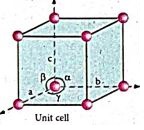
44.
(i) A basic repeating structural unit of a crystalline solid is called a unit cell.
(ii) A crystal is consisted of large number of unit cells.
45.
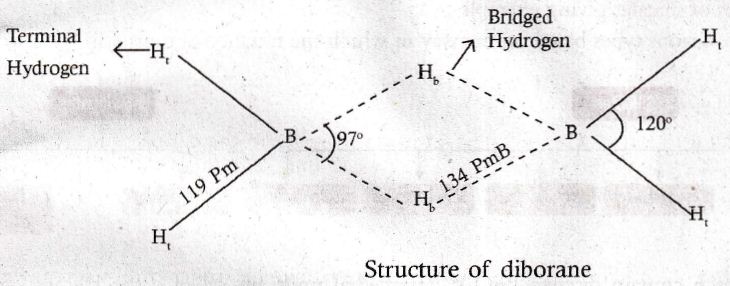
(i) In diborane two BH2 units are linked by two bridged hydrogens.
(ii) It has eight B-H bonds.
(iii) Diborane has only 12 valance electrons.
(iv) The four terminal B-H- bonds is "2c - 2e" bond (two centre - two electron bond.)
(v) Two three centred B - H - B bonds two electrons each. "(3c - 2e)"
(vi) In diborane, the boron is "sp3" hybridised
(vii) Three of the four "sp3" hydridised orbitals contains single electron and the fourth orbital is empty.
46.
(i) In heavier post transition metals, the outers electrons (ns) have a tendency to remain inert and show reluctance to take part in the bonding, which is known as inert pair effect.
(ii) This effect is also observed in groups 14, 15 and 16.

12th Standard Syllabus & Materials
12th Standard
TN 12th Computer Applications களப்பெயர் முறைமை (DNS) Sample Question Papers Study Material - QB365 Set A
NEW12th Standard
TN 12th Computer Applications வலையமைப்பு எடுத்துக்காட்டுகள் மற்றும் நெறிமுறைகள் Sample Question Papers Study Material - QB365 Set A
NEW12th Standard
TN 12th Computer Applications கணினி வலையமைப்பு ஓர் அறிமுகம் Sample Question Papers Study Material - QB365 Set A
NEW12th Standard
TN 12th Computer Applications PHP-உடன் MySQL-ஐ இணைத்தல் Sample Question Papers Study Material - QB365 Set A



Tamilnadu Stateboard 12th Standard Subjects

Maths
Chemistry

Physics

Biology

Computer Science

Business Maths and Statistics

Economics

Commerce

Accountancy

History

Computer Applications
Biology
Computer Technology
Computer Applications
Computer Science
Business Maths and Statistics
Commerce
Economics
Maths
Chemistry
Physics
Computer Technology
History
Accountancy

Tamil

English

French
Tamilnadu Stateboard Standards


