
 100% FREE ACCESS
12th Standard Syllabus & Materials
12th Standard
TN 12th Computer Applications மின்னணு தரவு பரிமாற்றம் Sample Question Papers Study Material - QB365 Set A
NEW12th Standard
TN 12th Computer Applications மின் - வணிக பாதுகாப்பு அமைப்புகள் Sample Question Papers Study Material - QB365 Set A
NEW12th Standard
TN 12th Computer Applications மின்னணு செலுத்தல் முறைகள் Sample Question Papers Study Material - QB365 Set A
NEW12th Standard
TN 12th Computer Applications மின் - வணிகம் Sample Question Papers Study Material - QB365 Set A
NEW12th Standard
TN 12th Computer Applications திறந்த மூல கருத்துருக்கள் Sample Question Papers Study Material - QB365 Set A
NEW12th Standard
TN 12th Computer Applications வலையமைப்பு வடமிடல் Sample Question Papers Study Material - QB365 Set A

Published on: 22/08/2026
Download Tamil Nadu 12th Standard Computer Applications question papers, model tests, one-mark questions, important questions, and public exam papers in PDF format. Free study materials and answer keys for TN State Board students.
Questions + Answers key
Take MCQ Computer Applications Test
1.
Write a short note on EDI via VAN.
2.
Write short notes on an Associative array.
3.
How do you call a function in PHP?
4.
What are the advantages of using functions in PHP?
5.
Write the features System defined Functions.
6.
Write a note on UN/EDIFACT.
7.
List the various layers of EDI.
8.
What is the syntax for defining a function in PHP?
9.
Explain the user-defined function with suitable examples.
10.
Differentiate Associative array and Indexed array?
11.
12.
Briefly explain various types of EDI.
13.
Explain Indexed array and Associate array in PHP.
14.
Explain Function concepts in PHP.
15.
Write any two EDI Standards.
16.
How do you create an indexed array in PHP?
17.
What is an array in PHP and what are its main types?
18.
What are the different types of functions PHP?
19.
What is a function?
20.
What is Multi-Dimensional Array?
21.
List few types of business documents that are transmitted through EDI.
22.
Define EDI.
1.
(i) EDI via VAN (Value Added Network) is where EDI documents are transferred with the support of third party network service providers.
(ii) Many businesses prefer this network model to protect them from the updating ongoing complexities of network technologies.
2.
An associative array is a data structure that stores a collection of key-value pairs. The keys are used to identify the values, and the values can be of any data type. The keys in an associative array are often called "labels" because they label or identify the corresponding values.
We can create an associative array in PHP,
(i) by enclosing a comma-separated list of key-value pairs in square brackets (or)
(ii) by using the array() function.
Syntax
| $array Variable = [ "keyl"=>"valuel", "key2"=>"value2", "key3" => "value3" , , , "key N => "valueN" ]; |
or | $array Variable = ( "keyl"=>"valuel", "key2"=>"value2", "key3" => "value3" , , , "key N => "valueN" ); |
3.
Calling a function is another name for executing the function. A function is called simply by using the function name, along with an argument list, as a statement.
Syntax
functionName(); (or)
function Name(argument list);
4.
There are several advantages of using functions in PHP:
(i) Code reuse: Functions allow us to reuse code, which can save us time and effort when writing and maintaining our code.
(ii) Testing and debugging: Functions allow us to test and debug our code more easily, as we can test individual functions separately from the rest of the code.
(iii) Modularity: Functions allow us to break down our code into smaller, modular pieces, which can make it easier to maintain and modify.
5.
System Defined Functions: A function is already created by system it is a reusable piece or block of code that performs a specific action. Functions can either return values when called or can simply perform an operation without returning any value.
Features of System defined functions:
1. System defined functions are otherwise called as predefined or built-in functions.
2. PHP has over 700 built in functions that performs different tasks.
3. Built in functions are functions that exists in PHP installation package.
6.
(i) United Nations/Electronic Data Interchange for Administration, Commerce and Transport (UN/EDIFACT) is an international EDI - standard developed under the supervision of the United Nations.
(ii) In 1987, the UN / EDIFACT syntax rules were approved as ISO: ISO9735 standard by the International Organization for Standardization.
(iii) EDIFACT includes a set of internationally agreed standards, catalogs and guidelines for electronic exchange of structured data between independent computer systems.
(iv) It is a cross-industry, standard data format of electronic data for commercial transactions.
(v) Maintenance and further development of this standard goes through the United Nations Center for Trade Facilitation and Electronic Business (UN/CEFACT), which is affiliated to the UN Economic Commission for Europe (UNECE).
7.
Electronic data interchange architecture specifies four different layers namely
(i) Semantic layer
(ii) Standards translation layer
(iii) Transport layer
(iv) Physical layer
8.
Syntax
function functionName([parameter list])
{
// code to be executed
}
9.
A user defined function by using the 'function' keyword, followed by the name of the function and a set of parentheses.
The general syntax for creating a function in PHP:
Function definition (or declaration)
Syntax
function functionName([parameter list])
{
// code to be executed
}
Explanation:
(i) The 'function' keyword is used to define a function.
(ii) functionName is the name of the function.
It can be any valid PHP identifier, as long as it is not a reserved word.
(iii) parameter list is a comma-separated list of variables. These parameters are optional and we can have as many or as few as we like.
(iv) Inside the curly braces, we can put any code we want the function to execute.
This can include PHP statements, loops, conditions, and so on.
10.
| Associative Array | Indexed Array |
| (i) Associative arrays have strings as keys and behave like two-column tables (like array) (ie, (0, 0), (0, 1), etc. | (i) Keys of an indexed array are integers and beginning at 0 (zero). (ie, 0, 1,2, etc) |
| (ii) First column is the key which is used to access the value | (ii) Indexed arrays are used when you identify things by their position. |
| (iii) They have key-value pairs | (iii) Value is accessed using indexes |
| (iv) Syntax array (key => value, key => value, key => value, etc.); key = Specifies the key (numeric or string) value = Specifies the value |
(iv) Syntax \(\$\)student = array ("SName1", "SName2", "SName3"); |
| (v) Example \(\$\)Marks =array("Student1" => "35", "Student2" => "17", "Student3" => "43") echo "studentl mark is" . \(\$\)Marks['student1']. "is eligible for qualification"; echo "student2 mark is" . \(\$\)Marks['Student2'] . "is not eligible for qualification'; ?> |
(v) Example \(\$\)teacher_name= array(" Iniyan", "Kavin","Nilani"); echo "The students name are " . \(\$\)teacher_ name[0] . ", " . \(\$\)\(\$\)teacher_narnel1] . " and " . \(\$\)teacher_name[2] . "."; |
11.
12.
The types of EDI were constructed based on how EDI communication connections and the conversion were organized. Thus based on the medium used for transmitting EDI documents the following are the major EDI types:
(i) Direct EDI
(ii) EDI via VAN
(iii) EDI via FTP/VPN, SFTP, FTPS
(iv) Web EDI
(v) Mobile EDI
1. Direct EDI/point-to-point : It is also called as Point-to-Point EDI. It establishes a direct connection between various business stakeholders and partners individually. This type of EDI suits to larger businesses with a lot of day to day business transactions.
2. EDI via VAN : EDI via VAN (Value Added Network) is where EDI documents are transferred with the support of third party network service providers.Many businesses prefer this network model to protect them from the updating ongoing complexities of network technologies.
3. EDI via FTP/VPN, SFTP, FTPS : When protocols like FTP/VPN, SFTP and FTPS are used to exchange of EDI based documents through the Internet or Intranet it is called as EDI via FTP/VPN, SFTP, FTPS.
4. Web EDI : Web based EDI conducts EDI using an web browser via the Internet. Here the businesses are allowed to use any browser to transfer data to their business partners.Web based EDI is easy and convenient for small and medium organizations.
5. Mobile EDI - When smartphones or other such handheld devices are used to transfer EDI documents it is called as mobile EDI.Mobile EDI applications considerably increase the speed of EDI transactions.
13.
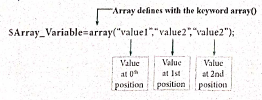
Indexed array:
An indexed array is an array that uses a numeric index to access its elements. The index is a number that starts at 0 for the first element and increases by 1 for each subsequent element.
We can create an indexed array in PHP,
(i) by enclosing a comma-separated list of values in square brackets (or)
(ii) by using the array() function.
Syntax
$array Variable=[element1, element2, element 3, ... elementN];
(or)
$arrayVariable array( element1, element2, element3.... elementN);
Examples
(a) $fruits = ['apple, "banana, 'orange'];
(b) $fruits = array('apple, "banana, 'orange');
Associative array
An associative array is a data structure that store a collection of key-value pairs. The keys are used to identify the values, and the values can be of any data type. The keys in an associative array are often called "labels" because they label or identify the corresponding values.
We can create an associative array in PHP,
(i) by enclosing a comma-separated list of key-value pairs in square brackets (or)
(ii) by using the array() function.
Syntax
| $arrayVariable [ "key1" => "value1", "key2"=>"value2", "key3"=>"value3" "key N=> "valueN" ]; |
Example
$student [
"Name" => "Ram",
"Age" => 25,
"Place" => "Trichy"
];
14.
Function in PHP:
A block of segment in a program that performs a specific operation such as Insert, Execute, Delete, Calculate etc.
A function is a type of sub-routine or procedure in a program.
The function can be divided into three types as follows.
(i) User defined Function
(ii) Pre-defined or System defined or Built-in Function
(iii) Parameterized Function
(i) User defined Function
PHP gives a privilege to user to write own specific operation inside of existing program module.
Two important steps the programmer has to create for users defined functions are
(a) Function Declaration
(b) Function Calling
(a) Function Declaration
A user defined function declaration begins with the keyword "Function".
User can write any custom logic inside in function block.
Syntax:
function functionName()
{
custom logic code to be executed;
}
(b) Function Calling
A function declaration part will be executed by a call to the function.
Programmer has to create function calling part inside the respective program.
Syntax:
functionName();
(ii) Pre-defined or System defined or built-in Function
Built-in functions are functions that exist in PHP installation package.
Functions can either return values when called or can simply perform an operation without returning any value.
Example:
rename_function()
This function renames original name to new name.
Parameter is also called as arguments just like variables.
Arguments are mentioned after the function name and inside the parenthesis.
There is no limit for sending arguments, just separate them with a comma notation.
Examples :
Parameterized function with one argument, two arguments respectively.
(i) function School Name ($sname)
(ii) function School Name ($sname, $strength)
15.
The most widely used EDI message standards are the United Nations EDIFACT and the ANSI X12.
16.
We can create an indexed array in PHP.
(i) by enclosing a comma-separated list of values in square brackets (or)
(ii) by using the array() function.
17.
An array is a special data type. It can hold many values under a single variable name. An array element can be any type of data.
There are three main types of arrays in PHP:
1. Indexed array
2. Associative array
3. Multi-dimensional array
18.
(i) Built-in funtions
(ii) User-defined functions
19.
Functions are an important feature of PHP, and are used to reuse code. A function is a block code that performs a specific task.
20.
A multidimensional array is an array containing one or more arrays.
21.
EDI documents the following are the major EDI types.
(i) Direct EDI
(ii) EDI via VAN
(iii) EDIvia FTP/VPN, SFTP,FTPS
(iv) Web EDI
(v) Mobile EDI.
22.
The Electronic Data Interchange (EDI) is the exchange of business documents between one trade partner and another electronically. It is transferred through a dedicated channel or through the Internet in a predefined format without much human intervention.

12th Standard Syllabus & Materials
12th Standard
TN 12th Computer Applications களப்பெயர் முறைமை (DNS) Sample Question Papers Study Material - QB365 Set A
NEW12th Standard
TN 12th Computer Applications வலையமைப்பு எடுத்துக்காட்டுகள் மற்றும் நெறிமுறைகள் Sample Question Papers Study Material - QB365 Set A
NEW12th Standard
TN 12th Computer Applications கணினி வலையமைப்பு ஓர் அறிமுகம் Sample Question Papers Study Material - QB365 Set A
NEW12th Standard
TN 12th Computer Applications PHP-உடன் MySQL-ஐ இணைத்தல் Sample Question Papers Study Material - QB365 Set A



Tamilnadu Stateboard 12th Standard Subjects

Maths

Chemistry

Physics

Biology

Computer Science

Business Maths and Statistics

Economics

Commerce

Accountancy

History
Computer Applications
Biology
Computer Technology
Computer Applications
Computer Science
Business Maths and Statistics
Commerce
Economics
Maths
Chemistry
Physics
Computer Technology
History
Accountancy

Tamil

English

French
Tamilnadu Stateboard Standards


