
12th Standard Syllabus & Materials
12th Standard
TN 12th Computer Applications மின்னணு தரவு பரிமாற்றம் Sample Question Papers Study Material - QB365 Set A
NEW12th Standard
TN 12th Computer Applications மின் - வணிக பாதுகாப்பு அமைப்புகள் Sample Question Papers Study Material - QB365 Set A
NEW12th Standard
TN 12th Computer Applications மின்னணு செலுத்தல் முறைகள் Sample Question Papers Study Material - QB365 Set A
NEW12th Standard
TN 12th Computer Applications மின் - வணிகம் Sample Question Papers Study Material - QB365 Set A
NEW12th Standard
TN 12th Computer Applications திறந்த மூல கருத்துருக்கள் Sample Question Papers Study Material - QB365 Set A
NEW12th Standard
TN 12th Computer Applications வலையமைப்பு வடமிடல் Sample Question Papers Study Material - QB365 Set A

Published on: 22/08/2026
Download Tamil Nadu 12th Standard Economics question papers, model tests, one-mark questions, important questions, and public exam papers in PDF format. Free study materials and answer keys for TN State Board students.
Questions + Answers key
Take MCQ Economics Test
1.
Rate of change in savings to change in income:
APS
APC
MPS
MPC
2.
K=1/MPS= ____________
\(\frac{ΔP}{ΔQ}\)
\(\frac{C}{4}\times\frac{ΔP}{ΔQ}\)
Value of multiplier
Value of accelerator
3.
Accelerator (β) = _________
C + I
1/1 - MPC
\(\frac{ΔC}{ΔC}\)
ΔC/ΔY
4.
5.
Online Banking is also known as.
E-Banking
Internet Banking
RTGS
NEFT
6.
7.
Lender of the last resort is one of the functions of.
Central Bank
Commercial banks
Land Development Banks
Co-operative banks
8.
Who will act as the banker to the Government of India?
SBI
NABARD
ICICI
RBI
9.
Bank credit refers to
Bank Loans
Advances
Bank loans and advances
Borrowings
10.
_____inflation is in no way dangerous to the economy.
walking
running
creeping
galloping
11.
Fisher’s Quantity Theory of money is based on the essential function of money as
measure of value
store of value
medium of exchange
standard of deferred payment
12.
The study of alternating fluctuations in business activity is referred to in Economics as
Boom
Recession
Recovery
Trade cycle
13.
_________is a decrease in the rate of inflation.
Disinflation
Deflation
Stagflation
Depression
14.
Irving Fisher’s Quantity Theory of Money was popularized in
1908
1910
1911
1914
15.
According to Keynes, investment is a function of the MEC and ____.
Demand
Supply
Income
Rate of interest
16.
17.
As income increases, consumption will______
fall
not change
fluctuate
increase
18.
The MPC is equal to :
Total spending / total consumption
Total consumption / total income
Change in consumption / change in income
none of the above
19.
If the Keynesian consumption function is C=10+0.8Y then, when disposable income is Rs 100, what is the marginal propensity to consume?
₹ 0.8
₹ 800
₹ 810
₹ 0.81
20.
An increase in the marginal propensity to consume will:
Lead to consumption function becoming steeper
Shift the consumption function upwards
Shift the consumption function downwards
Shift savings function upwards
21.
What is leakages of multiplier?
22.
Write the meaning of Open market operations.
23.
Define Central bank.
24.
25.
What is Stagflation?
26.
What is plastic money? Give example.
27.
What is gold standard?
28.
Define Multiplier.
29.
Define marginal propensity to consume (MPC).
30.
What is consumption function?
31.
Explain the uses of multiplier
32.
Mention the objectives of demonetizations.
33.
Distinguish between money market and capital market.
34.
Bring out the methods of credit control.
35.
Explain disinflation.
36.
37.
Write a note on metallic money.
38.
State the concept of super multiplier.
39.
Differentiate autonomous and induced investment.
40.
State the propositions of Keynes’s Psychological Law of Consumption
41.
Explain the evolution of money.
42.
Explain the Secondary Functions.
43.
What are the objectives of Monetary Policy? Explain.
44.
Elucidate the functions of Commercial Banks
45.
Describe the phases of Trade cycle.
46.
What are the causes and effects of inflation on the economy?
47.
Explain the functions of money
48.
What are the differences between MEC and MEI.
49.
Explain the operation of the Accelerator.
50.
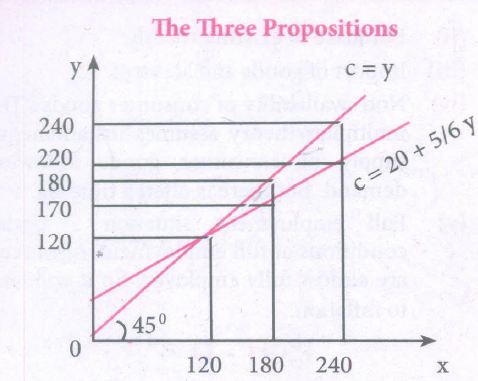
Explain Keynes psychological law of consumption function with diagram.
1.
(c)
MPS
2.
(c)
Value of multiplier
3.
(c)
\(\frac{ΔC}{ΔC}\)
4.
(a)
5.
(b)
Internet Banking
6.
(c)
7.
(a)
Central Bank
8.
(d)
RBI
9.
(c)
Bank loans and advances
10.
(c)
creeping
11.
(c)
medium of exchange
12.
(d)
Trade cycle
13.
(a)
Disinflation
14.
(c)
1911
15.
(d)
Rate of interest
16.
(a)
17.
(d)
increase
18.
(c)
Change in consumption / change in income
19.
(a)
₹ 0.8
20.
(a)
Lead to consumption function becoming steeper
21.
(i) The multiplier assumes that those who earn income are likely to spend a proportion of their additional income on consumption.
(ii) In practice, people tend to spend their additional income on other items
(iii) Such expenses are known as leakages.
22.
(i) The Central Bank purchases and sells Government securities and proper eligible securities like bills and securities of private concerns.
(ii) This is called Open Market operation.
23.
(i) Central bank is the monetary authority that manages a state's currency, money supply, and interest rate
(ii) It oversees the commercial banking system
24.
25.
Stagflation is a combination of stagnant economic growth, high unemployment and high inflation.
26.
(i) Plastic money refers to the hard plastic cards used everyday in place of actual bank notes.
(ii) They aim at removing the need for carrying cash to make transactions.
(iii) (E.g.) Cash cards, Credit cards, Debit cards, Pre-paid Cash cards, Store cards, Forex cards and Smart cards.
27.
(i) The value of the monetary unit is directly linked with a certain weight of gold.
(ii) The purchasing power of a unit of money is maintained equal to the value of a fixed weight of gold.
28.
Muliplier is the ratio of the change in national income to change in Investment.
K = \(\frac{ΔY}{ΔI}\)
29.
MPC is the ratio of change in the consumption to the change in income.
MPC = \(\frac{ΔC}{Δ Y}\)
30.
(i) The consumption function or propensity to consume refers to income consumption relationship.
(ii) It is a "functional relationship between two aggregates viz., total consumption and gross national, income".
31.
(i) Multiplier highlights the importance of investment in income and employment theory.
(ii) The process throws light on the different stages of trade cycle.
(iii) It also helps in bringing the equality between S and I.
(iv) It helps to reduce unemployment and achieve full employment.
32.
Objectives of Demonetisation :
(i) Removing Black Money from the country.
(ii) Stopping of corruption.
(iii) Stopping terror funds.
(iv) Curbing fake note
33.
| S. No. |
Money Market |
Capital Market |
|---|---|---|
| (1) | Short term funds are loaned and borrowed | Long term funds are loaned and borrowed |
| (2) | It deals with purchase, sale and transfer of short term credit instruments. | It raises capital by dealing in shares, bonds mortgages and other long term investments. |
| (3) | Commercial banks, acceptance houses, Non Banking Financial Institutions and the Central Bank deals with short term funds | Instruments traded in capital market comprise of equity shares, preference. shares, Debentures, bonds and other long term securities. |
34.
Quantitative methods
1) Bank Rate Policy:
(i) It is the rate at which the Central Bank rediscount the first class.
(ii) The bank advances loans on approved securities to its member banks.
(iii) If the Central Bank wants to control credit, it will raise the bank rate.
(iv) So deposit rate and other lending rates rise, borrowing is discouraged.
2) Open Marker Operation:
(i) The Central Bank purchases and sells Government securities in the money market.
(ii) When banks or public buy these securities they have to pay to the Central Bank.
3) Variable Cash Reserves Ratio:
(i) The Central Bank controls credit by changing the Cash Reserve Ratio.
(ii) If Commercial Banks have excessive cash reserves and create too much credit, the central bank will raise the CPR.
(iii) If CRR is high, commercial bank's capacity to create credit will be less.
Qualitative Methods
1) Rationing of Credit:
(i) It controls and regulates the purposes for which credit is granted by commercial banks.
(ii) It is of 2 types - variable portfolio ceiling and variable capital asset ratio
2) Direct Action:
(i) Direct action is taken against erring banks
3) Moral Suasion:
(i) Central Bank gives advice, then requests and persuades the Commercial Banks to co-operate with the Central Bank in implementing its credit policies.
4) Publicity:
(i) A policy can be effectively successful only when an effective public opinion is created in its favour.
5) Regulation of Consumer's Credit:
(i) The down payment is raised and the number of installments reduced for credit sale.
6) Changes in the Marginal Requirements on Security Loans:
(i) The margin requirements can be increased to prevent excessive use of credit for stock exchange speculation
35.
(i) It is the slowing down the rate of inflation by controlling the amount of credit (bank loan, hire purchase) available to consumers without causing more unemployment.
(ii) It is defined as the process of reversing inflation without creating unemployment or reducing output in the company.
36.
37.
(i) After the barter system and commodity money system, modern money systems evolved.
(ii) Metallic standard is the premier one.
(iii) Some kind of metal, gold or silver is used to determine the standard value of the money and currency.
(iv) Standard coins made out of the metal are the principal coins used under the metallic standard.
(v) These Standard coins are full bodied or full weighted legal tender.
(vi) Their face value is equal to their intrinsic metal value.
38.
(i) Hicks combined multiplier and accelerator to measure the total effect of initial investment on income.
(ii) Both induced consumption and induced investment are combined.
(iii) Also called leverage effect, it may lead the economy to a very high or low level of income propagation.
\(\mathrm{Y}=\mathrm{C}+\mathrm{I}_{\mathrm{A}}+\mathrm{I}_{\mathrm{P}}\)
Y = aggregate income
C = consumption expenditure
IA = autonomous investment
IB = induced private investment
39.
| S. No | Autonomous Investment | Induced Investment |
|---|---|---|
| 2. | Independent | Planned |
| 3. | Income inelastic | Income elastic |
| 4. | Welfare motive | Profit motive |
40.
(i) When income incrcases, consumption expenditure also incrcases but by a smaller amount.
(ii) The increased income will be divided in some proportion between consumption expenditure and saving.
(iii) Increase in income always leads to an increase in both consumption and saving.
41.
BARTER SYSTEM
(i) Exchange of goods for goods was known as “Barter Exchange” or “Barter System”.
(ii) In a barter system, the commodities and services were directly exchanged for other commodities and services.
(iii) Goods like furs, skins, salt, rice, wheat, utensils, weapons, etc. were commonly used as money.
METALLIC MONEY
(i) Under metallic standard, some kind of metal either gold or silver is used to determine the standard value of the money and currency.
(ii) Standard coins made out of the metal are the principal coins used under the metallic standard.
(iii) These standard coins are full bodied or full weighted legal tender. Their face value is equal to their intrinsic metal value.
GOLD STANDARD
(i) Gold Standard is a system in which the value of the monetary unit or the standard currency is directly linked with gold.
(ii) The monetary unit is defined in terms of a certain weight of gold.
SILVER STANDARD
(i) The silver standard is a monetary system in which the standard economic unit of account is a fixed weight of silver.
(ii) The silver standard is a monetary arrangement in which a country’s Government allows conversion of its currency into fixed amount of silver.
PAPER CURRENCY
The paper currency standard refers to the monetary system in which the paper currency notes issued by the Treasury or the Central Bank or both circulate as unlimited legal tender.
PLASTIC MONEY
(i) The latest type of money is plastic money.
(ii) Plastic money is a term that is used predominantly in reference to the hard plastic cards used every day in place of actual bank notes.
(iii) Plastic money can come in many different forms such as Cash cards, Credit cards, Debit cards, Pre-paid Cash cards, Store cards, Forex cards and Smart cards.
CRYPTO CURRENCIES
Decentralised crypto currencies such as Bitcoin now provide an outlet for Personal Wealth that is beyond restriction and confiscation.
42.
(i) Savings done in terms of commodities were not permanent.
(ii) With the invention of money, this difficulty has now disappeared and savings are now done in terms of money.
(iii) Money also serves as an excellent store of wealth.
(iv) Money can be easily converted into other assets such as land, machinery, plant etc.
(v) The modern money - economy has greatly facilitated the borrowing and lending processes.
(vi) In other words, money now acts as the standard of deferred payments.
(vii) The field of exchange also went on extended to distant lands.
(viii) It is therefore, felt necessary to transfer purchasing power from one place to another.
43.
Introduction
(i) Monetary Policy is the macroeconomic policy laid down by the Central Bank towards the management of money, supply and interest rate. It is associated with Milton Friedman
1) Neutrality of Money
(i) Wicksteed, Hayek and Robertson are the chief exponents of neutral money.
(ii) They say that the monetary authority should aim at neutrality of money in the economy.
(iii) Monetary changes cause distortion and disturbances in the proper functioning of the economic system of the leading to all economic fluctuations.
2) Exchange Rate Stability
(i) It is a traditional objective from the Gold Standard period
(ii) When there was disequilibrium in the balance of payment, it was automatically corrected by movements.
(iii) It was popularly known as "Expand Currency and Credit when gold is coming in; Contract currency and credit when gold is going out."
(iv) If there is instability in the exchange rates, it would result in outflow or inflow of gold resulting in unfavorable balance of payments.
3) Price Stability
(i) Crustave Cassel and Keynes suggested price stabilization as a main objective of monetary policy.
(ii) Stable Price creates public confidence, promotes business activity and ensures equitable distribution of income and wealth leading to prosperity and welfare
(iii) Price stability does not mean price rigidity or price stagnation.
(iv) A mild increase in the price level provides a tonic for economic growth.
4) Full Employment
(i) Unemployment was socially dangerous, economically wasteful and morally deplorable.
(ii) Both Keynes' General Theory of Employment, Interest and Money in 1936, the objective of full employment became very important
5) Economic Growth
(i) Economic growth is the process whereby the real per capita income of a country increases
(ii) There is increase in the total physical or real output
(iii) Monetary policy should promote sustained and continuous economic growth by maintaining equilibrium between the total demand for money and total production capacity for creating increase in saving and investment.
(iv) Flexible monetary policy is the best solution.
6) Equilibrium in the Balance of Payments (BoP)
(i) World trade was faster than world liquidity.
(ii) Increasing deficit in BoP reduces the ability of an economy to achieve other objectives.
(iii) Many less developed countries reduce their imports which adversely affects development activities, so monetary authority should make efforts to bring equilibrium in the BoP.
44.
Introduction
The functions of commercial banks are broadly classified into primary, and secondary functions
1) Primary Functions:
Accepting Deposits
Demand Deposits
1. It refers to deposits that can be withdrawn by individuals without any prior notice to the bank.
2. Depositors can withdraw money at any time by writing a withdrawal slip or a cheque or from ATM centres
Time Deposits
1. It refers to deposits that are made for certain committed period of time.
2. It has higher interest.
3. Deposits can be withdrawn only after a specific time period
Advancing Loans
1. Banks grant loans to individuals and businesses in the form of overdraft, cash credit and discounting bills of exchange.
2) Secondary Functions
Agency Functions
1. Commercial banks act as agents of customers by performing various functións.
Collecting Cheques
1. Banks collect cheques and bills of exchange on behalf of their customers through clearing house facilities provided by the central bank.
Collecting Income
1. Banks collect dividends, pension, salaries, rents and interests on investment on behalf of their customers.
2. A credit voucher is sent to customers for information when any income is collected by the bank.
Paying Expenses
1. Telephone bills, insurance premium, school fees and rents can be paid through banks.
2. A debit voucher is sent to customers for information when expenses are paid by the bank.
3) General Utility Functions
Providing Locker Facilities
1. Locker is provided for safe custody of jewellery, shares, debentures and other valuable items.
2. This minimizes the risk of loss due to theft at home.
Issuing Traveller's Cheques
1. Banks issue traveller's cheques to individuals for travelling outside the country.
2. These cheques are safe and easy way to protect money.
Dealing in Foreign Exchange
1. Banks provide foreign exchange to businessmen dealing in exports and imports.
2. But they need to take the permission of the Central Bank for dealing in foreign exchange.
4) Transferring Funds
1. Funds are transferred by means of draft, telephonic transfer and electronic transfer.
5) Letter of Credit
1. Commercial banks issue letters of credit to their customers to certify their credit worthiness.
Underwriting Securities
1. As public have full faith in the credit worthiness of banks, public do not hesitate in buying the securities underwritten by banks.
Electronic Banking
1. It includes services, such as debit cards, credit cards and Internet banking.
6) Other Functions
Money Supply
E.g: A bank lends Rs.5 lakh to an individual and opens a demand deposit in the name of that individual.
1. Bank makes a credit entry of 25 lakh in that account.
2. This leads to creation of demand deposits in that account.
3. Thus, without printing additional money, the supply of money is increased.
Credit Creation
1. It means the multiplication of loans and advances
2. Banks receive deposits from the public and use these deposits to give loans.
3. However, loans offered are many times more than the deposits received by banks.
Collection of Statistics
1. Banks collect and publish statistics relating to trade, commerce and industry and advice customers and public authorities on financial matters.
45.
Boom or Prosperity:
1. The employment and the movement of the economy beyond full employment is the characterized features of boom.
2. There is hectic activity, money wages rise, profits increase, interest rates go up, demand for bank credit increases.
3. There is all round optimism.
Recession:
1. The turning point from boom condition is recession.
2. Failure of a company or bank brings a phase of recession.
3. Investments are drastically reduced, production falls, income and profits decline.
4. There is panic in the stock market and business is dull.
5. Liquidity preference of the people rises and money market becomes tight.
Depression:
1. The level of economic activity becomes extremely low.
2. Firms incur loss and close down resulting in unemployment.
3. Interest rate, profits, wages are low.
4. Agricultural class and wage carners are badly affected.
5. Banks do not lend to businessmen.
6. The extreme point of depression is called as "trough".
7. Keynes said that autonomous investment of the government can help the economy to come out of depression.
Recovery:
1. After depression, recovery sets in the upswing.
2. It begins with the revival of demand for capital goods.
3. The demand slowly picks up and in due course there is more production, profit, income, wages and employment.
4. Recovery may be initiated by innovation or investment or by government.
46.
Causes:
Increase in Money Supply:
1. Increase in money supply leads to increase in aggregate demand.
2. The higher the growth rate of nominal money supply, the higher is the rate of inflation.
Increase in Disposable Income:
1. When disposable income increases, it raises their demand for goods and services.
2. Disposable income may increase with the rise in national income or reduction in taxes or saving of the people.
Increase in Public Expenditure:
1. Government activities have been expanding due to developmental activities and social welfare programmes.
2. This is also a cause for price rise.
Increase in Consumer Spending:
1. The demand for goods and services increases when they are given credit to buy goods on hire-purchase and instalment basis.
Cheap Monetary Policy:
1. Cheap monetary policy leads to increase in the money supply which raises demand for goods and services.
Deficit Financing:
1. To meet the expenses, government resorts to deficit financing by borrowing from the public and even by printing more notes.
2. This raises aggregate demand leading to inflation.
Black Assets, Activities and Money:
1. It leads to corruption, tax evasion.
2. People spend black money lavishly.
3. Black marketing and hoarding reduces the supply of goods and increases.
Repayment of Public Debt:
1. Whenever government repays its past internal debt to the public, money supply increases.
Increase in Exports:
1. When exports are encouraged, domestic supply of goods decline, prices rise.
Effects:
On Production:
1. When inflation is very moderate it is an incentive to traders and producers.
2. When profit increases the business men increase their investments in production leading to more employment and income.
3. Hyper inflation leads to depreciation of the value of money and discourages savings.
4. It may even drain out the foreign capital already invested in the country.
5. The reduced capital accumulation, discourage entrepreneurs and business men from taking business risk.
6. Inflation also leads to hoarding of essential goods by traders and consumers leading to still higher inflation rate.
7. Encourages investment in speculative activities rather than productive purposes.
On Distribution:
Debtors and Creditors:
1. During inflation debtors are the gainers.
2. Debtors had borrowed when the purchasing power of money was high and now repay the loans when the purchasing power of money is low due to rising prices.
Fixed-income Groups:
1. They are worst hit because their incomes being fixed has no relationship with the rising cost of living.
Entrepreneurs:
1. Inflation is a boon to manufacturers, traders, merchants, businessmen, because it serves as a tonic for business enterprise.
2. They get windfall gains as the prices of their stocks suddenly go up.
Investors:
1. Those who invest in fixed interest yielding bonds and securities lose during inflation.
2. Those who invest in shares stand to gain by rich dividends and appreciation in value of shares.
47.
(i) Primary Functions:
Medium of exchange:
(i) Money has general acceptability and all exchanges take place in terms of money.
(ii) First, money is got through sale of goods or services.
(iii) Later, money is used to buy goods and services.
(iv) Thus, in the modern exchange system money acts as the intermediary in sales and purchases.
Measure of value
(i) Money measures the value of goods and services.
(ii) Prices of all goods and services are expressed in terms of money.
(iii) Since all the values are expressed in terms of money, it is easier to determine the rate of exchange between various types of goods in the community.
(ii) Secondary Functions:
Store of value:
(i) Savings is done in terms of money.
(ii) Money is a store of wealth, as it can be easily converted into other marketable assets such as land, machinery, plant.
Standard of Deferred Payments:
(i) Borrowing and lending is done in money.
Means of Transferring Purchasing Power:
(i) The field of exchange went on extending with growing economic development.
(ii) The exchange of goods is now. extended to distant lands.
(iii) So it is necessary to transfer purchasing power from one place to another.
(iii) Contingent Functions:
Basis of the Credit System:
(i) Business transactions are either in cash or on credit.
(ii) A depositor uses cheques only when there are sufficient funds in his account.
(iii) The commercial banks create credit on the basis of adequate cash reserves.
(iv) Money is at the back of all credit.
Money facilitates distribution of National Income:
(i) Money is used in the distribution of income as rent, wage, interest and profit.
Equalize Marginal Utilities and Marginal Productivities:
(i) Consumer gets maximum utility only if he incurs expenditure on various commodities in such a manner as to equalize marginal utilities accruing from them.
(ii) Here, money plays an important role, because the prices of all commodities are expressed in money.
(iii) Money helps to equalize marginal productivities of various factors of production.
Increases Productivity of Capital:
(i) Money is the most liquid form of capital.
(ii) It can be put to any use.
(iii) So it can be transferred from the less productive to the more productive uses.
(iv) Other Functions:
Maintains Repayment Capacity:
(i) Money has general acceptability.
(ii) To maintain its repayment capacity, every firm has to keep assets in the form of money.
(iii) Firms, banks, insurance companies and governments have to keep some liquid money (i.e., cash) to maintain their repayment capacity.
Represents Generalized
Purchasing Power:
(i) Purchasing power kept in terms of money can be put to any use.
Gives liquidity to Capital:
(i) Money is the most liquid form of capital & so can be put to any use.
48.
| S. No | Marginal Efficiency of Captial (MEC) | Marginal Efficiency of Investment (MEI) |
|---|---|---|
| 1. | It is based on given supply price for capital. | It is based on the induced change in the price due to change in the demand for capital. |
| 2. | It represents the rate of return on all successive unit of capital without regard to existing capital. | It shows the rate of return on just those units of capital over and above the existing capital stock |
| 3. | The capital stock is taken on the X axis of diagram. | The amount of investment is taken on the X axis of diagram. |
| 4. | It is a 'Stock' concept. | It is a 'Flow' concept. |
| 5. | It determines the optimum capital stock in an economy at each level of interest rate. | It determines the net investment of the economy at each interest rate given the capital stock. |
49.
Introduction
A systematic development of the simple accelerator model was made by J.M.Clark, It was further developed by Hicks, Samuelson and Harrod.
Definition
Accelerator coefficient is the ratio between induced investment and an initial change in consumption \(\beta=\frac{\Delta \mathrm{I}}{\Delta \mathrm{C}}\)
Operation
Suppose that in order to produce 1000 consumer goods, 100 machines are needed. Working life of a machine is 10 yrs i.e, every year 10 machines have to be replaced. This is called replacement demand
(i) Suppose that demand for consumer goods rises by 10 % (i.e, from 1000 to 1100)
(ii) This results in increase in demand for 10 more machines
(iii) The total demand for machines is 20 i.e, 10 % increase in demand for consumer goods causes 100 % increase in demand for machine (from 10 to 20 )
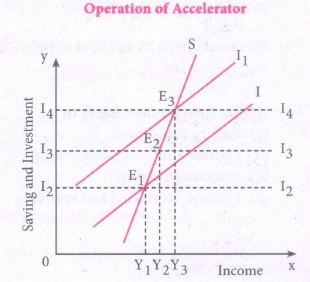
Explanation
(i) SS is the saving curve.
(ii) II is the investment curve.
(iii) At point E1 the economy is in equilibrium with OY1 income.
(iv) S and I are equal at O2.
(v) Now I increased from OI2 to OI4.
(vi) This increases income from OY1 to OY3 at E2 equilibrium.
(vii) If the increase in investment by I2I4 is purely exogenous, then the increase in income by Y1Y3 would be due to multiplier.
(viii) But in this diagram it is assumed that exogenous investment is only by I2I3 and induced investment is by I3I4.
(ix) Therefore, the increase in income by Y1Y2 is due to the multiplier effect and the increase in income by Y2Y3 is due to the accelerator effect.
50.
Law
According to Keynes, "men are disposed as a rule and on the average to increase their consumption as their income increases but not by as much as the increáse in their income".
Propositions
1. When income increases, consumption expenditure also increases, but by a smaller amount
(a) When income increases from 120 to 180; consumption also increases from 120 to 170 but the increase in consumption is less than the increase in income, 10 is saved.
2. The increased income will be divided in some proportion between consumption expenditure and saving
(a) When income increases to 180 and 240, it is divided between consumption (170 and 220) and saving (10 and 20)
3. Incrcascs in income always lead to in incrcase in both consumption and saving
(a) Increases in income to 180) and 240; lead to increased consumption 170 and 220; increased saving 10 and 20.
(b) It is clear from the widening area below the C curve and the saving gap between 45o line and C curve.
| Y | C | S |
|---|---|---|
| 120 | 120 | 0 |
| 180 | 170 | 10 |
| 240 | 220 | 20 |

12th Standard Syllabus & Materials
12th Standard
TN 12th Computer Applications களப்பெயர் முறைமை (DNS) Sample Question Papers Study Material - QB365 Set A
NEW12th Standard
TN 12th Computer Applications வலையமைப்பு எடுத்துக்காட்டுகள் மற்றும் நெறிமுறைகள் Sample Question Papers Study Material - QB365 Set A
NEW12th Standard
TN 12th Computer Applications கணினி வலையமைப்பு ஓர் அறிமுகம் Sample Question Papers Study Material - QB365 Set A
NEW12th Standard
TN 12th Computer Applications PHP-உடன் MySQL-ஐ இணைத்தல் Sample Question Papers Study Material - QB365 Set A



Tamilnadu Stateboard 12th Standard Subjects

Maths

Chemistry

Physics

Biology

Computer Science

Business Maths and Statistics
Economics

Commerce

Accountancy

History

Computer Applications
Biology
Computer Technology
Computer Applications
Computer Science
Business Maths and Statistics
Commerce
Economics
Maths
Chemistry
Physics
Computer Technology
History
Accountancy

Tamil

English

French
Tamilnadu Stateboard Standards


