
12th Standard Syllabus & Materials
12th Standard
TN 12th Computer Applications மின்னணு தரவு பரிமாற்றம் Sample Question Papers Study Material - QB365 Set A
NEW12th Standard
TN 12th Computer Applications மின் - வணிக பாதுகாப்பு அமைப்புகள் Sample Question Papers Study Material - QB365 Set A
NEW12th Standard
TN 12th Computer Applications மின்னணு செலுத்தல் முறைகள் Sample Question Papers Study Material - QB365 Set A
NEW12th Standard
TN 12th Computer Applications மின் - வணிகம் Sample Question Papers Study Material - QB365 Set A
NEW12th Standard
TN 12th Computer Applications திறந்த மூல கருத்துருக்கள் Sample Question Papers Study Material - QB365 Set A
NEW12th Standard
TN 12th Computer Applications வலையமைப்பு வடமிடல் Sample Question Papers Study Material - QB365 Set A

Published on: 22/08/2026
Download Tamil Nadu 12th Standard Economics question papers, model tests, one-mark questions, important questions, and public exam papers in PDF format. Free study materials and answer keys for TN State Board students.
Questions + Answers key
Take MCQ Economics Test
1.
Which is the most important green house gas?
Carbon dioxide
Chlorofluro carbon
Methane
Nitrous oxide
2.
Expand the term SAPTA
SAARC Preferential Trading Agency
SAARC Preferential Trading Arrangement
SAARC Preferential Trading Agreement
SAARC Pricing and Trading Agency
3.
Eutrophication is an increase____________ in water bodies.
level of minerals
level of vitamins
level of nutrients
level of balance
4.
Who are the "founding fathers" of both the world bank and the IMF?
John Maynard Keynes and Harry Dexter White
Adam smith and J.M. Keynes
Rudi Dorbush and Adam smith
Alfred Marshall and Adam smith
5.
J.B. Say is a __________ economist.
French
British
Dutch
Indian
6.
7.
Which of the following is main cause for deforestation?
Timber harvesting industry
Natural afforestation
Soil stabilization
Climate stabilization
8.
Global warming also refers to as
Ecological change
Climate Change
Atmosphere change
None of the above
9.
The common source of outdoor air pollution is caused by combustion processes from the following ______________
Heating and cooking
Traditional stoves
Motor vehicles
All the above
10.
Who developed Material Balance Models?
Thomas and Picardy
AlenKneese and R.Y. Ayres
Joan Robinson and J.M. Keynes
Joseph Stiglitz and Edward Chamberiin
11.
BENELUX is a form of
Free trade area
Economic Union
Common market
Customs union
12.
The Tenth BRICS Summit was held in July 2018 at
Beijing
Moscow
Johannesburg
Brasilia
13.
14.
_______ relates to patents, copyrights, trade secrets, etc.,
TRIPS
TRIMS
GATS
NAMA
15.
The other name for Special Drawing Rights is
Paper gold
Quotas
Voluntary Export Restrictions
None of these
16.
Say’s law stressed the operation of________ in the economy
Induced price mechanism
Automatic price mechanism
Induced demand
Induced investment
17.
Classical theory advocates_______
Balanced budget
Unbalanced budget
Surplus budget
Deficit budget
18.
The component of aggregate demand is__________
Personal demand
Government expenditure
Only export
Only import
19.
Keynes attributes unemployment to_______.
A lack of effective supply
A lock of effective demand
A lack of both
None of the above
20.
The main concern of the Classical Economic Theory is _______.
Under employment
Economy is always in the state of equilibrium
Demand creates its supply
Imperfect competition
21.
Write a brief note on “Compensatory Financing Facility”
22.
Specify the meaning of seed ball.
23.
What are environmental goods? Give examples
24.
State the meaning of environment.
25.
26.
Define Common Market.
27.
Write the meaning of Special Drawing rights.
28.
What are the components of aggregate supply ?
29.
What is effective demand?
30.
Define full employment.
31.
What is alkali farming?
32.
Write a note on
a) Climate change and
b) Acid rain
33.
What are the causes of water pollution?
34.
35.
List out the achievements of BRICS.
36.
What is Multilateral Agreement?
37.
What are trade blocks?
38.
Explain about aggregate supply with the help of diagram.
39.
What do you mean by aggregate demand ? Mention its components.
40.
Write short note on the implications of Say’s law
41.
Explain the importance of sustainable development and its goals.
42.
43.
44.
Explain the objectives of IMF.
45.
46.
Narrate the equilibrium between ADF and ASF with diagram
47.
Describe the types of unemployment.
1.
(a)
Carbon dioxide
2.
(d)
SAARC Pricing and Trading Agency
3.
(c)
level of nutrients
4.
(a)
John Maynard Keynes and Harry Dexter White
5.
(a)
French
6.
(d)
7.
(a)
Timber harvesting industry
8.
(d)
None of the above
9.
(b)
Traditional stoves
10.
(d)
Joseph Stiglitz and Edward Chamberiin
11.
(d)
Customs union
12.
(c)
Johannesburg
13.
(a)
14.
(a)
TRIPS
15.
(a)
Paper gold
16.
(b)
Automatic price mechanism
17.
(a)
Balanced budget
18.
(b)
Government expenditure
19.
(b)
A lock of effective demand
20.
(b)
Economy is always in the state of equilibrium
21.
In 1963, IMF established compensatory financing facility to provide additional financial assistance to the member countries, particularly primary producing countries facing shortfall in export earnings
22.
(i) A seed ball is a seed that has been wrapped in soil materials, usually a mixture of clay and compost and then dried.
(ii) The seed is pre-planted and can be sown by depositing the seed ball anywhere suitable for the species, keeping the seed safely until the proper germination window arises.
23.
Environmental goods are typically non-market goods, including clear air, clean water, landscape, green transport infrastructure, public parks, rivers, mountains, forest and beaches.
24.
(i) Environment means "all the conditions, circumstances, and influences surrounding and affecting the development of an organism or group of organisms".
(ii) It also means that the complex of physical, chemical and biotic factors that act upon an organism or an ecological community ultimately determine its form and survival.
25.
26.
(i) Common market is established through trade pacts.
(ii) A group formed by countries within a geographical area to promote duty free trade and free movement of labour and capital among its members.
27.
(i) Also called 'Paper Gold', SDR is a form of international reserves created by the IMF in 1969 to solve the problem of international liquidity.
(ii) They are allocated to IMF members in proportion to their quotas.
(iii) It is used as a means of payment to meet balance of payments deficits.
28.
(i) Aggregate (desired) consumption expenditure (C)
(ii) Aggregate (desired) private savings (S)
(iii) Net tax payments (T)
(iv) Personal (desired) transfer payments to the foreigners (Rf)
AS = C + S + T + Rf
29.
(i) Effective demand is the money spent on consumption of goods and services and on investment.
(ii) Employment and output depends on the level of effective demand
(iii) When effective demand increases, employment will increase.
(iv) Effective demand is determined by aggregate supply and aggregate demand.
30.
(i) "Full employment is the absence of involuntary unemployment." - Keynes
(ii) "Full employment is that level of employment at which any further increase in spending would result in an inflationary spiral of wages and prices" - Lerner
31.
1. Nearly 50% of the irrigated land in the arid and semi-arid regions has some degree of soil salinization problems.
2. The accumulation of excess salt or acid in the root zone results in a partial or complete loss of soil productivity.
3. Such soil is called problem (alkali, saline and acid) soil.
4. Alkali soils are located in the Indo- Gangetic plains - in Punjab, Hariyana, Uttar Pradesh, Bihar and in states like, Chattisgarh, Rajasthan, Andhra Pradesh, Gujarat, Maharastra, Karnataka and Tamil Nadu.
32.
a) Climate change
(i) Climate change refers to seasonal changes over a long period with respect to the growing accumulation of greenhouse gases in the atmosphere.
(ii) Industrial revolution has increased the concentration of carbon dioxide in the atmosphere by 40 %.
(iii) Several parts of the world have experienced warming of coastal waters, high temperatures, a marked change in rainfall patterns and an increased intensity and frequency of storms.
(iv) Sea levels and temperatures are expected to be rising.
b) Acid rain
(i) Acid rain is one of the results of air pollution.
33.
Discharge of sewage and waste water:
(i) Sewage, garbage and liquid waste of households, agricultural runoff and effluents from factories are discharged into lakes and rivers.
(ii) These wastes contain harmful chemicals and toxins which make the water poisonous for aquatic animals and plants.
Dumping of solid wastes:
(i) The dumping of solid wastes and litters in water bodies cause huge problems.
Discharge of industrial wastes:
(i) Industrial waste contains asbestos, lead, mercury, grease oil and petrochemicals.
Oil Spill:
(i) Sea water gets polluted due to oil spilled from ships and tankers.
Acid Rain:
(i) When the acidic particles caused by air pollution mix with water vapour, it results in acid rain.
Global warming:
(i) The increase in water temperature affects aquatic plants and animals.
Eutrophication:
(i) The increased level of nutrients in water depletes oxygen in water and this negatively affects fish and other aquatic animal population.
34.
35.
1. The establishment of the Contingent Reserve Arrangement (CRA) has further deepened and consolidated the partnership of its members in the economic-financial area.
2. In the sixth BRICS summit in Brazil, the member countries, signed an agreement to create a development bank (New Development Bank) with headquarters at Shangai, China in 2015 on the lines of Asian Development Bank and the World Bank.
3. The economic potential and demographic development are putting the BRICS countries, increasingly in a leading position in setting the global agenda and having a greater say in the global governance.
36.
(i) It is a multinational legal or trade agreements between countries.
(ii) It is an agreement between more than two countries but not many.
37.
(i) Trade blocks cover different kinds of arrangements between or among countries for mutual benefit.
(ii) Free Trade Area, Customs Union, Common Market and Economic Union.
38.
(i) Aggregate supply refers to the value of total output of goods and services produced in an economy in a year ie national product or income.
(ii) The components of aggregate supply are:
(iii) Aggregate (desired) consumption expenditure (C)
(iv) Aggregate (desired) private savings (S)
(v) Net tax payments (T)
(vi) Personal (desired) transfer payments to the foreigners (Rf)
AS = C + S + T + Rf
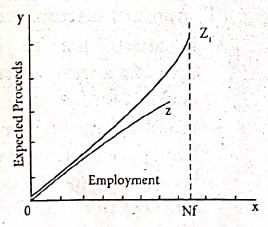
In this figure 2 aggregate supply curves are drawn for the assumption of fixed money wages and variable wages.
Explanation
(i) Z Curve is linear (fixed money wages)
(ii) Z1 curve is non-linear (wage rate increases with employment)
(iii) When full employment level of Nf is reached output cannot be increased by employing more men.
(iv) So aggregate supply curve becomes inelastic (Vertical straight line).
(v) In reality aggregate supply curve will be like Z1 .
(vi) If prices are high and wages low, the producers will employ more labourers.
(vii) 4YAggregate supply is an important factor in determining the level of economic activity.
39.
(i) In the Keynesian model, output is determined mainly by aggregate demand.
(ii) The aggregate demand is the amount of money which entrepreneurs expect to get by selling the output produced by the labourers employed.
(iii) Aggregate demand (spending) is the amount that households, firms, the governments and the foreign purchasers would like to spend on domestic output
Aggregate demand has four components:
1. Consumption demand (C)
2. Investment demand (I)
3. Government expenditure (G)
Net Export ( export - import) (X - M)
AD = C + I + G + (X - M)
40.
(i) There is no possibility for over production or unemployment.
(ii) If there exist unutilized resources, it is profitable to employ them up to full employment.
(iii) There is automatic price mechanism, so no need for government intervention
(iv) Interest flexibility brings about equality between saving and investment.
(v) Money acts as the medium of exchange.
41.
Introduction:
(i) Sustainable development is concerned with the welfare of the present and future generation.
(ii) It aims at satisfying the luxury wants of the rich and the basic necessities of the poor.
Definition:
(i) Sustainable development is development that meets the needs of the present without compromising the ability of future generations to meet their own needs.
Goals:
(i) It is crucial to harmonize three core elements such as economic growth, social inclusion and environmental protection.
(ii) A set of 17 goals for the world's future can be achieved before 2030 with three unanimous principles fixed by United Nations such as Universality, Integration and Transformation.
1) End poverty in all its forms everywhere.
2) End hunger, achieve food security and improved nutrition and promote sustainable agriculture.
3) Ensure healthy lives and promote wellbeing for all at all ages.
4) Ensure inclusive and quality education for all and promote lifelong learning.
5) Achieve gender equality and empower women and girls.
6) Ensure access to water and sanitation for all.
7) Ensure access to affordable, reliable, sustainable and modern energy for all.
8) Promote inclusive and sustainable economic growth, employment and decent work for all.
9) Build resilient infrastructure, promote, sustainable industrialization and foster innovation.
10) Reduce inequality within and among countries.
11) Make cities inclusive, safe, resilient and sustainable.
12) Ensure sustainable consumption and production pattern.
13) Take urgent action to combat climate change and its impacts
14) Conserve and sustainably use the oceans, seas and marine resources.
15) Sustainably manage forests, combat desertification, stop and reverse land degradation, stop biodiversity loss.
16) Promote just, peaceful and inclusive societies.
17) Revitalize the global partnership for sustainable development.
42.
43.
44.
(i) To promote international monetary cooperation among the member nations.
(ii) To facilitate faster and balanced growth of international trade.
(iii) To ensure exchange rate stability by curbing competitive exchange depreciations.
(iv) To reduce exchange controls imposed by member nations.
(v) To establish multilateral trade and payment system in respect of current transactions.
(vi) To promote the flow of capital from developed to developing nations.
(vii) To solve the problem of international liquidity.
45.
46.
Introduction
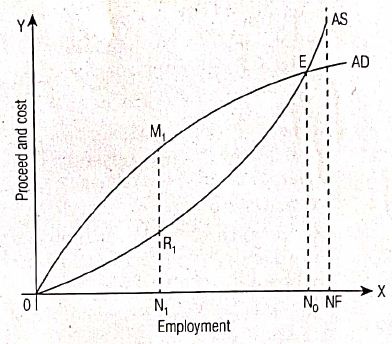
Under the Keynes theory of employment, a simple two sector economy consisting of the household sector and the business sector is taken to understand the equilibrium between ADF and ASF.
Explanation
1. AD and AS reach equilibrium at E. The employment level is No
2. At ON1employment, the aggregate supply is N1R1. But the aggregate demand is M1N1.
3. The expected level of profit is M1R1.
4. To attain this level of profit, entrepreneurs will employ more labourers, till they reach point E i.e. ONo.
5. Beyond ONo, the aggregate demand curve is below the aggregate supply curve showing loss.
6. So they will never employ more than ONo labour.
7. The equilibrium level of employment need not be the full employment level (No).
8. The difference between No - N1 is the level of unemployment.
Conclusion
Thus the concept of effective demand becomes significant in explaining the under employment equilibrium.
47.
Cyclical unemployment:
(i) During the downturn phase (recession and depression) of trade cycle, income and output fall leading to cyclical unemployment.
(ii) It is caused by deficiency of effective demand
Structural unemployment:
(i) Unemployment due to massive and deep rooted changes in economic structure leads to structural unemployment.
(ii) Lack of demand for the product or shift in demand to other products cause this type of unemployment.
(iii) (e.g.) rise in demand for mobile phones has adversely affected the demand for cameras, tape recorders
Disguised unemployment:
(i) It occurs in agriculture when more people are there than required. Even if some workers are withdrawn, production does not suffer.
Actual marginal productivity is zero, less or negative.
(i) Seasonal unemployment
1. In agriculture and agro based industries like sugar, production activities are carried out only in some seasons.
2. These industries offer employment only during that season in a year.
3. People remain unemployed during the off season.
4. Seasonal unemployment takes place from demand side also (eg) ice cream industry, holiday resorts
(ii) Frictional unemployment (Temporary unemployment)
1. It arises due to imbalance between supply of labour and demand for labour.
2. It is because of immobility of labour, lack of necessary skills, break down of machinery, shortage of raw materials.
3. The persons who lose jobs and in search of jobs also come under frictional unemployment
(iii) Educated unemployment
1. Educated people are underemployed or unemployed when qualification does not match the job.
2. Faulty education system, lack of employable skills, mass student turnout and preference for white collar jobs are highly responsible for educated unemployment.

12th Standard Syllabus & Materials
12th Standard
TN 12th Computer Applications களப்பெயர் முறைமை (DNS) Sample Question Papers Study Material - QB365 Set A
NEW12th Standard
TN 12th Computer Applications வலையமைப்பு எடுத்துக்காட்டுகள் மற்றும் நெறிமுறைகள் Sample Question Papers Study Material - QB365 Set A
NEW12th Standard
TN 12th Computer Applications கணினி வலையமைப்பு ஓர் அறிமுகம் Sample Question Papers Study Material - QB365 Set A
NEW12th Standard
TN 12th Computer Applications PHP-உடன் MySQL-ஐ இணைத்தல் Sample Question Papers Study Material - QB365 Set A



Tamilnadu Stateboard 12th Standard Subjects

Maths

Chemistry

Physics

Biology

Computer Science

Business Maths and Statistics
Economics

Commerce

Accountancy

History

Computer Applications
Biology
Computer Technology
Computer Applications
Computer Science
Business Maths and Statistics
Commerce
Economics
Maths
Chemistry
Physics
Computer Technology
History
Accountancy

Tamil

English

French
Tamilnadu Stateboard Standards


