
12th Standard Syllabus & Materials
12th Standard
TN 12th Computer Applications மின்னணு தரவு பரிமாற்றம் Sample Question Papers Study Material - QB365 Set A
NEW12th Standard
TN 12th Computer Applications மின் - வணிக பாதுகாப்பு அமைப்புகள் Sample Question Papers Study Material - QB365 Set A
NEW12th Standard
TN 12th Computer Applications மின்னணு செலுத்தல் முறைகள் Sample Question Papers Study Material - QB365 Set A
NEW12th Standard
TN 12th Computer Applications மின் - வணிகம் Sample Question Papers Study Material - QB365 Set A
NEW12th Standard
TN 12th Computer Applications திறந்த மூல கருத்துருக்கள் Sample Question Papers Study Material - QB365 Set A
NEW12th Standard
TN 12th Computer Applications வலையமைப்பு வடமிடல் Sample Question Papers Study Material - QB365 Set A

Published on: 22/08/2026
Download Tamil Nadu 12th Standard Economics question papers, model tests, one-mark questions, important questions, and public exam papers in PDF format. Free study materials and answer keys for TN State Board students.
Questions + Answers key
Take MCQ Economics Test
1.
The minimum amount for RTGS transfer is __________.
2 lakhs
2.5 lakhs
3 lakhs
4 lakhs
2.
The symbol of India rupee came into use on________
15th July, 2010
16th July, 2010
15th June, 2010
16th June, 2010
3.
Consider the following statements and identify the right ones.
(i) The finance commission is appointed by the President
(ii) The tenure of Finance commission is five years
i only
ii only
both
none
4.
The word budget has been derived from the French word "bougette" which means
A small bag
An empty box
A box with papers
None of the above
5.
Deficit Budget means
An excess of government's revenue over expenditure
An excess of government's current expenditure over its current revenue
An excess of government's total expenditure over its total revenue
None of above
6.
"Revenue Receipts" of the Government do not include
Interest
Profits and dividents
Recoveries and loans
Rent from property
7.
GST is equivalence of
Sales tax
Corporation tax
Income tax
Local tax
8.
One of the following is NOT a feature of private finance
Balancing of income and expenditure
Secrecy
Saving some part of income
Publicity
9.
The State Financial Corporation Act was passed by
Government of India
Government of Tamilnadu
Government of Union Territories
Local Government
10.
Moral suasion refers.
Optimization
Maximization
Persuasion
Minimization
11.
Bank Rate means.
Re-discounting the first class securities
Interest rate
Exchange rate
Growth rate
12.
Who will act as the banker to the Government of India?
SBI
NABARD
ICICI
RBI
13.
Credit creation means
Multiplication of loans and advances
Revenue
Expenditure
Debt
14.
A Bank is a
Financial institution
Corporate
An Industry
Service institutions
15.
“Money can be anything that is generally acceptable as a means of exchange and that thesame time acts as a measure and a store of value”, This definition was given by
Crowther
A.C.Pigou
F.A.Walker
Francis Bacon
16.
___________inflation occurs when general prices of commodities increases due to increase in production costs such as wages and raw materials.
Cost-push
demand pull
running
galloping
17.
Inflation means
Prices are rising
Prices are falling
Value of money is increasing
Prices are remaining the same
18.
Irving Fisher’s Quantity Theory of Money was popularized in
1908
1910
1911
1914
19.
Paper currency system is managed by the______.
Central Monetary authority
State Government
Central Government
Banks
20.
The RBI Headquarters is located at
Delhi
Chennai
Mumbai
Bengaluru
21.
What is Currency Deposit Ratio (CDR)?
22.
What are the components of GST?
23.
Differentiate tax and fee.
24.
Define public finance.
25.
What is rationing of credit?
26.
Define Central bank.
27.
Define Commercial banks.
28.
Define inflation.
29.
What is barter?
30.
Define Money.
31.
Write a short note on
(i) Debit card
(ii) Credit card
32.
Point out any three differences between direct tax and indirect tax.
33.
What are the functions of a modern state?
34.
Describe Canons of Taxation.
35.
Specify the functions of IFCI.
36.
What are the functions of NABARD?
37.
Give a brief note on NBFI.
38.
Explain disinflation.
39.
Write the types of inflation
40.
Write a note on metallic money.
41.
42.
Explain the principles of Federal Finance.
43.
State and explain instruments of fiscal policy.
44.
Explain the methods of debt redemption.
45.
Bring out the merits of indirect taxes over direct taxes.
46.
Explain the scope of public finance.
47.
What are the objectives of Monetary Policy? Explain.
48.
Describe the functions of Reserve Bank of India.
49.
Elucidate the functions of Commercial Banks
50.
Explain the role of Commercial Banks in economic development.
51.
Describe the phases of Trade cycle.
52.
What are the causes and effects of inflation on the economy?
53.
Explain the functions of money
54.
Illustrate Fisher’s Quantity theory of money.
1.
(a)
2 lakhs
2.
(a)
15th July, 2010
3.
(c)
both
4.
(a)
A small bag
5.
(c)
An excess of government's total expenditure over its total revenue
6.
(d)
Rent from property
7.
(a)
Sales tax
8.
(d)
Publicity
9.
(a)
Government of India
10.
(c)
Persuasion
11.
(a)
Re-discounting the first class securities
12.
(d)
RBI
13.
(a)
Multiplication of loans and advances
14.
(a)
Financial institution
15.
(a)
Crowther
16.
(a)
Cost-push
17.
(a)
Prices are rising
18.
(c)
1911
19.
(a)
Central Monetary authority
20.
(c)
Mumbai
21.
It is the ratio of money held by the public in currency to that they hold in bank deposits.
22.
(i) CGST - Central Goods and Services Tax
(ii) SGST - State Goods and Services Tax
(iii) IGST - Integrated Goods and Services Tax
23.
(i) Both are source of public revenue.
(ii) Tax is a compulsory payment but the tax payer cannot claim any specific benefit by paying a tax.
(iii) Fee does not involve compulsion.
(iv) Government provides certain services (e.g.) driving license and charges a fee for it.
24.
(i) "Public finance is one of those subjects that lie on the border linè between Economics and Politics. It is concerned with income and expenditure of public authorities and with the adjustment of one to the other". . - Huge Dalton
(ii) Public finance is an investigation into the nature and principles of the state revenue and expenditure - Adam Smith
25.
(i) It aims to control and regulate the purposes for which credit is granted by commercial banks.
(ii) It is of 2 types: variable portfolio ceiling and variable capital asset ratio
26.
(i) Central bank is the monetary authority that manages a state's currency, money supply, and interest rate
(ii) It oversees the commercial banking system
27.
A Commercial bank is a financial institution that accepts deposits and advances loans and are profit motivated.
28.
(i) "Too much of Money chasing too few goods" - Coulbourn
(ii) "A state of abnormal increase in the quantity of purchasing power" - Gregorye
29.
(i) Exchange of goods for goods.
(ii) Commodities and services were directly exchanged for other commodities and services.
30.
(i) Money is, what money does - Walker:
(ii) Money can be anything that is generally acceptable as a means of exchange and at the same time acts as a measure and a store of value. - Crowther.
31.
(i) Debit card:
Debit card is a. card allowing the holder to transfer money electronically from their bank account when making a purchase.
(ii) Credit card:
A credit card is a payment card issued to users to enable the cardholder to pay a merchant for goods and services based on the cardholder's promise to the card issuer to pay them for the amounts so paid plus the other agreed charges.
(i) The card issuer (a bank) creates a revolving account and grants a line of credit to the cardholder, from which the cardholder can borrow money for payment to a merchant or as a cash advance.
(ii) Credit cards combine payment services with extensions of credit.
(iii) But complex fee structures may limit customers 'ability to shopping.
32.
| SI.No | Direct Tax | Indirect Tax |
|---|---|---|
| 1. | Direct tax is levied on person's income and wealth and is paid directly to the government. | It is levied on a person who consumes the goods and services and is paid indirectly to government. |
| 2. | Progressive in nature | Regressive in nature |
| 3. | Falls on the same person. | Falls on different persons. |
| 4. | Burden cannot be shifted. | can be shifted |
| 5. | Tax evasion is possible. | Included in the price of the goods. |
33.
Defence
1. The Government protects the people from external aggression and internal disorder.
2. Through police and military forces it renders protective services.
Judiciary:
1. It provides adequate judicial structure to render justice to all citizens.
Enterprises
1. The regulation and control of private enterprise comes under the government.
Social Welfare:
1. The state provides education, social security, social insurance, health and sanitation for the people.
Infrastructure
1. Modern States build the base for the economic development of the country by creating social and economic infrastructure.
Macro-economic policy
1. The Government follows fiscal policy and monetary policy to achieve macro economic goals.
Social Justice
1. During the process of growth certain sections of the economy gain at the cost of others.
2. Government intervenes with fiscal measures to redistribute income.
Control of Monopoly
1. State intervenes through control of monopolies and restrictive trade practices to curb concentration of economic power.
34.
Canon of Ability
1. The Government should impose tax in such a way that the people have to pay taxes according to their ability.
2. Rich person should pay more tax.
Canon of Certainty
1. There is no uncertainty regarding the rate of tax or the time of payment.
Canon of Convenience
1. The method of tax collection and the timing of the tax payment should be convenient to the people.
Canon of Economy
1. The Government should impose only those taxes whose collection costs are very less and cheap.
35.
The IFCI does the following functions
(i) Providing long-term loans in rupees and foreign currencies.
(ii) Underwriting of equity, preference and debenture issues.
(iii) Subscribing to equity, preference and debenture issues.
(iv) Guaranteeing the deferred payments for machinery imported from abroad or purchased in India
(v) Guaranteeing of loans raised in foreign currency from foreign financial institutions.
36.
1) NABARD acts as a refinancing institution for all kinds of production and investment credit to agriculture, small-scale industries, cottage and village industries, handicrafts, rural crafts and real artisans to promote integrated rural development.
2) It provides short-term, medium term and long-term credit to state co-operative Banks, RRBs, LDBs and other financial institutions approved by RBI.
3) NABARD gives long-term loans (20 Years) to State Government to enable them to subscribe to the share capital of co-operative credit societies.
4). It gives long-term loans to any institution approved by the Central Government or contribute to the share capital or invests in securities of any institution concerned with agriculture and rural development.
5) NABARD co-ordinates the activities of Central and State Governments, Planning Commission and all India and State level institutions entrusted with the development of small scale industries, village and cottage industries, rural crafts, industries in the tiny and decentralized sectors
6) It has the responsibility to inspect RRBs and CO-operative banks, other than primary co-operative societies.
7) It maintains a Research and Development Fund to promote research in agriculture and rural development
37.
(i) A non-banking financial institution or company is a financial institution that does not have a full banking license or is not supervised by the central bank.
(ii) They receive deposits and give loans.
(iii) They mobilize people's savings and use the funds to finance expenditure on investment activities.
(iv) The undertake borrowing and lending in the money and capital markets.
(v) They are classified into Stock Exchange and Other Financial institutions.
(vi) Under other financial institutions come Finance Companies, Finance Corporations, Chit Funds, Building Societies, Issue Houses, Investment Trusts, Unit Trusts and Insurance Companies.
38.
(i) It is the slowing down the rate of inflation by controlling the amount of credit (bank loan, hire purchase) available to consumers without causing more unemployment.
(ii) It is defined as the process of reversing inflation without creating unemployment or reducing output in the company.
39.
(i) On the basis of speed there are four types of inflation - Creeping inflation, Walking Inflation, Running inflation, Galloping inflation.
(ii) Demand-Pull inflation, Cost-Push inflation.
(iii) On the basis of inducement - currency inflation, credit inflation, deficit induced inflation, profit induced inflation, scarcity induced inflation, tax induced inflation.
40.
(i) After the barter system and commodity money system, modern money systems evolved.
(ii) Metallic standard is the premier one.
(iii) Some kind of metal, gold or silver is used to determine the standard value of the money and currency.
(iv) Standard coins made out of the metal are the principal coins used under the metallic standard.
(v) These Standard coins are full bodied or full weighted legal tender.
(vi) Their face value is equal to their intrinsic metal value.
41.
42.
Principle of Independence
(i) A Government should be autonomous and free about the internal financial matters concerned.
(ii) Each Government should have separate sources of revenue, authority to levy taxes, to borrow money and to meet the expenditure.
Principle of Equity
(i) The resources should be distributed among the different states so that each state receives a fair share of revenue.
Principle of Uniformity
(i) Each state should contribute equal tax payments for federal finance.
Principle of Adequacy of Resources
(i) The resources of each Government should be adequate to carry out its functions effectively to meet current and future needs.
(ii) Resources should be elastic to meet the growing needs and unforeseen expenditure.
Principle of Fiscal Access
(i) The Central and State Governments must be able to develop new source of revenue.
Principle of Integration and coordination
(i) There should be perfect coordination among different layers of the financial system.
Principle of Efficiency
(i) The financial system should be well organized and efficiently administered.
(ii) There should be no scope for evasion and fraud.
(iii) Double taxation should be avoided.
Principle of Administrative
Economy
(i) The cost of collection should be at the minimum level and the major portion of revenue should be made available for the other expenditure outlays of the Governments.
Principle of Accountability
(i) Each Government should be accountable to its own legislature for its financial decisions.
43.
(i) Fiscal Policy is implemented through fiscal instruments also called 'fiscal tools' or fiscal levers - Government expenditure, taxation and borrowing are the instruments of fiscal policy.
Taxation:
(i) Taxes transfer income from the people to the Government.
(ii) Taxes are direct or indirect.
(iii) An increase in tax reduces disposable income.
(iv) So tax should be raised to control inflation.
(v) During depression, taxes are to be reduced.
Public Expenditure:
(i) Public expenditure raises wages and salaries of the employees and so aggregate demand for goods rises.
(ii) So, public expenditure is raised during recession and reduced during inflation.
Public debt:
(i) When Government borrows by floating a loan, there is transfer of funds from the public to the Government.
(ii) At the time of interest payment and repayment of public debt, funds are transferred from Government to public.
44.
Introduction:
(i) The process of repaying a public debt is called redemption.
Sinking Fund
(i) The Government establishes a separate fund into which every year a fixed amount of money is credited.
(ii) By the time the debt matures, the fund accumulates enough amount to pay off the principal along with interest.
Conversion
(i) An old loan is converted into a new loan.
(ii) A high interest public debt is converted into a low interest public debt.
Budgetary Surplus
(i) When the Government has a surplus budget, it can be used for repaying the debt.
Terminal Annuity
(i) Government pays off debt on the basis of terminal annuity in equal annual instalments.
Repudiation
(i) Government does not recognise its obligation to repay the loan.
(ii) But in normal case the Government does not do so; if done it will lose its credibility.
Reduction in Rate of Interest
(i) During financial crisis there is compulsory reduction in the rate of interest.
Capital Levy
(i) When Government imposes levy on the capital assets owned by an individual or any institution, it is called capital levy.
(ii) This levy is imposed on capital assets above a minimum limit on a progressive scale.
(iii) The fund so collected can be used by the Government for paying off war time debt.
45.
Wider Coverage
(i) All consumers have to pay indirect taxes, but only 2 % pay direct tax.
Equitable
(i) It satisfies the canon of equity when higher tax is imposed on luxuries used by the rich.
Economical
(i) Cost of collection is less as producers and retailers collect tax and pay to government.
(ii) The traders act as honorary tax collectors.
Checks harmful consumption
(i) Government imposes indirect taxes on goods which are harmful to health e.g. tobacco, liquor.
Convenient
(i) Indirect taxes are levied on goods and services.
(ii) When consumers buy, they pay tax along with the price.
(iii) So, they do not feel the pinch of paying tax.
46.
Public Finance
(i) Public finance is a study of the financial aspects of Government.
Public Revenue:
(i) Public revenue deals with the methods of raising revenue such as tax and non-tax, the principles of taxation, rates of taxation, impact, incidence and shifting of taxes and their effects.
Public Expenditure
(i) It studies the fundamental principles that govern the Government expenditure, effects of public expenditure and control of public expenditure.
Public Debt
(i) Public debt deals with the methods of raising loans from internal and external sources.
(ii) The burden, effects and redemption of public debt fall under this head.
Financial Administration
(i) This part deals with the Annual master financial plan of the Government, the budget, the various objectives, steps in preparing a public budget passing or sanctioning, allocation, evaluation and auditing.
Fiscal Policy
(i) Taxes, subsidies, public debt and public expenditure are the instruments of fiscal policy.
47.
Introduction
(i) Monetary Policy is the macroeconomic policy laid down by the Central Bank towards the management of money, supply and interest rate. It is associated with Milton Friedman
1) Neutrality of Money
(i) Wicksteed, Hayek and Robertson are the chief exponents of neutral money.
(ii) They say that the monetary authority should aim at neutrality of money in the economy.
(iii) Monetary changes cause distortion and disturbances in the proper functioning of the economic system of the leading to all economic fluctuations.
2) Exchange Rate Stability
(i) It is a traditional objective from the Gold Standard period
(ii) When there was disequilibrium in the balance of payment, it was automatically corrected by movements.
(iii) It was popularly known as "Expand Currency and Credit when gold is coming in; Contract currency and credit when gold is going out."
(iv) If there is instability in the exchange rates, it would result in outflow or inflow of gold resulting in unfavorable balance of payments.
3) Price Stability
(i) Crustave Cassel and Keynes suggested price stabilization as a main objective of monetary policy.
(ii) Stable Price creates public confidence, promotes business activity and ensures equitable distribution of income and wealth leading to prosperity and welfare
(iii) Price stability does not mean price rigidity or price stagnation.
(iv) A mild increase in the price level provides a tonic for economic growth.
4) Full Employment
(i) Unemployment was socially dangerous, economically wasteful and morally deplorable.
(ii) Both Keynes' General Theory of Employment, Interest and Money in 1936, the objective of full employment became very important
5) Economic Growth
(i) Economic growth is the process whereby the real per capita income of a country increases
(ii) There is increase in the total physical or real output
(iii) Monetary policy should promote sustained and continuous economic growth by maintaining equilibrium between the total demand for money and total production capacity for creating increase in saving and investment.
(iv) Flexible monetary policy is the best solution.
6) Equilibrium in the Balance of Payments (BoP)
(i) World trade was faster than world liquidity.
(ii) Increasing deficit in BoP reduces the ability of an economy to achieve other objectives.
(iii) Many less developed countries reduce their imports which adversely affects development activities, so monetary authority should make efforts to bring equilibrium in the BoP.
48.
Introduction
(i) The Reserve Bank of India is India's central banking institution
(ii) It commenced its operations on 1 April 1935 and it was nationalised on 1 Jan, $1949 .$
1) Monetary Authority
(i) It controls the supply of money in the economy to stabilize exchange rate, maintain healthy balance of payment, attain financial stability, control inflation, strengthen banking system.
2) Issuer of currency
(i) It is the sole authority to issue currency
(ii) It also takes action to control the circulation of fake currency.
3) Issuer of Banking License
(i) Every bank has to obtain a banking license from RBI to conduct banking business in India.
4) Banker to the Government
(i) It is the banker to the central and the state governments.
(ii) It provides short term credit, manages all need issues of government loans, services the government debt outstanding
(iii) It advises the government on banking and financial matters.
5) Banker's Bank
(i) It is the bank of all banks in India as it provides loan to banks, accepts the deposit of banks and rediscounts the bills of banks.
6) Lender of last resort
(i) The banks can borrow from RBI by keeping eligible securities as collateral at the time of need when there is no other source.
7) Act as clearing house
(i) For settlement of banking transactions, RBI manages 14 clearing houses.
(ii) It facilitates the exchange of instruments and processing of payment instructions.
8) Custodian of foreign exchange reserves
(i) It administers and enforces the provision of Foreign Exchange Management Acr, 1999.
(ii) RBI buys and sells foreign currency to maintain the exchange rate of Indian rupee vs foreign currencies.
9) Regulator of Economy
(i) It controls the money supply in the system, monitors GDP, Inflation
10) Managing Government securities
(i) RBI administers investments in institutions when they invest specified minimum proportions of their total assets/liabilities in government securities.
11) Regulator and Supervisor of Payment and Settlement Systems
(i) RBI oversees the payment and settlement systems in the country.
(ii) It focuses on the development and functioning of safe, secure and efficient payment and settlement mechanisms.
12) Developmental Role
(i) It develops the quality of banking system in India and ensures that credit is available to the productive sectors of the economy.
(ii) It provides a wide range of promotional functions to support national objectives.
(iii) It establishes institutions which build the financial infrastructure.
(iv) It also helps in expanding access to affordable financial services and promotes financial education and literacy.
13) Publisher of monetary data
(i) It maintains and provides all essential bánking and other economic "data, formulating and critically evaluating the economic policies in India.
(ii) RBI collects, collates and publishes data regularly.
14) Exchange manager and controller
(i) RBI represents India as a member of the International Monetary Fund.
(ii) Most of thé commercial banks are authorized dealers of RBI.
15) Banking Ombudsman Scheme
(i) RBI introduced this Scheme in 1995
(ii) Those who have complaints including online, can appeal to the Ombudsman against the awards and the other decisions of the Banks.
16) Banking Codes and Standards Board of India
(i) To measure the performance of banks against Codes and Standards based on established global practices, the RBI has set up the Banking Codes and Standards Board of India.
49.
Introduction
The functions of commercial banks are broadly classified into primary, and secondary functions
1) Primary Functions:
Accepting Deposits
Demand Deposits
1. It refers to deposits that can be withdrawn by individuals without any prior notice to the bank.
2. Depositors can withdraw money at any time by writing a withdrawal slip or a cheque or from ATM centres
Time Deposits
1. It refers to deposits that are made for certain committed period of time.
2. It has higher interest.
3. Deposits can be withdrawn only after a specific time period
Advancing Loans
1. Banks grant loans to individuals and businesses in the form of overdraft, cash credit and discounting bills of exchange.
2) Secondary Functions
Agency Functions
1. Commercial banks act as agents of customers by performing various functións.
Collecting Cheques
1. Banks collect cheques and bills of exchange on behalf of their customers through clearing house facilities provided by the central bank.
Collecting Income
1. Banks collect dividends, pension, salaries, rents and interests on investment on behalf of their customers.
2. A credit voucher is sent to customers for information when any income is collected by the bank.
Paying Expenses
1. Telephone bills, insurance premium, school fees and rents can be paid through banks.
2. A debit voucher is sent to customers for information when expenses are paid by the bank.
3) General Utility Functions
Providing Locker Facilities
1. Locker is provided for safe custody of jewellery, shares, debentures and other valuable items.
2. This minimizes the risk of loss due to theft at home.
Issuing Traveller's Cheques
1. Banks issue traveller's cheques to individuals for travelling outside the country.
2. These cheques are safe and easy way to protect money.
Dealing in Foreign Exchange
1. Banks provide foreign exchange to businessmen dealing in exports and imports.
2. But they need to take the permission of the Central Bank for dealing in foreign exchange.
4) Transferring Funds
1. Funds are transferred by means of draft, telephonic transfer and electronic transfer.
5) Letter of Credit
1. Commercial banks issue letters of credit to their customers to certify their credit worthiness.
Underwriting Securities
1. As public have full faith in the credit worthiness of banks, public do not hesitate in buying the securities underwritten by banks.
Electronic Banking
1. It includes services, such as debit cards, credit cards and Internet banking.
6) Other Functions
Money Supply
E.g: A bank lends Rs.5 lakh to an individual and opens a demand deposit in the name of that individual.
1. Bank makes a credit entry of 25 lakh in that account.
2. This leads to creation of demand deposits in that account.
3. Thus, without printing additional money, the supply of money is increased.
Credit Creation
1. It means the multiplication of loans and advances
2. Banks receive deposits from the public and use these deposits to give loans.
3. However, loans offered are many times more than the deposits received by banks.
Collection of Statistics
1. Banks collect and publish statistics relating to trade, commerce and industry and advice customers and public authorities on financial matters.
50.
Introduction
(i) Commercial banks are institutions that conduct business with profit motive by accepting public deposits and lending loans.
Capital Formation
(i) Bank mobilize the small savings of the people scattered over a wide area through their network of branches and make it available for productive purposes.
(ii) Attractive schemes of the banks induce the people to save their money
Creation of Credit
(i) Credit creation leads to increased production, employment, sales and prices and thereby there is faster economic development.
Channelizing Funds towards Productive Investment
(i) Pooled savings is allocated to various sectors and productivity increases.
Encouraging Right Industries
(i) Banks give loan to right type of persons.
(ii) Banks grant loans and advances to manufacturers whose products are in great demand.
(iii) Manufacturers introduce new methods of production and assist in raising the national income of the country.
Banks Monetize Debt
(i) Banks transform the loan to be repaid after a certain period into cash, which can be immediately used for business activity.
(ii) Manufacturers and wholesale traders cannot increase their sales without selling goods on credit basis.
(iii) But credit sales may lead to locking up of capital.
(iv) So production is reduced.
(v) As banks are lending money by discounting bills of exchange, business concerns are able to carry out economic activities without gap.
Finance to Government
(i) Government needs finance for promoting industries.
(ii) Banks provide long-term credit to Government by investing their funds in Government securities and short-term finance by purchasing Treasury Bills.
(iii) RBI has given Rs.68,000 crores to the government of India in the year 2018-19.
Employment Generation
(i) Bank's branches are opened frequently and so new employment opportunities are created.
Banks Promote Entrepreneurship
(i) Banks induce new entrepreneurs to take up the well-formulated projects and provision of counseling services like technical and managerial guidance.
(ii) Conclusions Banks provide 100 % credit for worthwhile projects, which is also technically feasible and economically viable.
(iii) Thus commercial banks help for the development of entrepreneurship in the country.
51.
Boom or Prosperity:
1. The employment and the movement of the economy beyond full employment is the characterized features of boom.
2. There is hectic activity, money wages rise, profits increase, interest rates go up, demand for bank credit increases.
3. There is all round optimism.
Recession:
1. The turning point from boom condition is recession.
2. Failure of a company or bank brings a phase of recession.
3. Investments are drastically reduced, production falls, income and profits decline.
4. There is panic in the stock market and business is dull.
5. Liquidity preference of the people rises and money market becomes tight.
Depression:
1. The level of economic activity becomes extremely low.
2. Firms incur loss and close down resulting in unemployment.
3. Interest rate, profits, wages are low.
4. Agricultural class and wage carners are badly affected.
5. Banks do not lend to businessmen.
6. The extreme point of depression is called as "trough".
7. Keynes said that autonomous investment of the government can help the economy to come out of depression.
Recovery:
1. After depression, recovery sets in the upswing.
2. It begins with the revival of demand for capital goods.
3. The demand slowly picks up and in due course there is more production, profit, income, wages and employment.
4. Recovery may be initiated by innovation or investment or by government.
52.
Causes:
Increase in Money Supply:
1. Increase in money supply leads to increase in aggregate demand.
2. The higher the growth rate of nominal money supply, the higher is the rate of inflation.
Increase in Disposable Income:
1. When disposable income increases, it raises their demand for goods and services.
2. Disposable income may increase with the rise in national income or reduction in taxes or saving of the people.
Increase in Public Expenditure:
1. Government activities have been expanding due to developmental activities and social welfare programmes.
2. This is also a cause for price rise.
Increase in Consumer Spending:
1. The demand for goods and services increases when they are given credit to buy goods on hire-purchase and instalment basis.
Cheap Monetary Policy:
1. Cheap monetary policy leads to increase in the money supply which raises demand for goods and services.
Deficit Financing:
1. To meet the expenses, government resorts to deficit financing by borrowing from the public and even by printing more notes.
2. This raises aggregate demand leading to inflation.
Black Assets, Activities and Money:
1. It leads to corruption, tax evasion.
2. People spend black money lavishly.
3. Black marketing and hoarding reduces the supply of goods and increases.
Repayment of Public Debt:
1. Whenever government repays its past internal debt to the public, money supply increases.
Increase in Exports:
1. When exports are encouraged, domestic supply of goods decline, prices rise.
Effects:
On Production:
1. When inflation is very moderate it is an incentive to traders and producers.
2. When profit increases the business men increase their investments in production leading to more employment and income.
3. Hyper inflation leads to depreciation of the value of money and discourages savings.
4. It may even drain out the foreign capital already invested in the country.
5. The reduced capital accumulation, discourage entrepreneurs and business men from taking business risk.
6. Inflation also leads to hoarding of essential goods by traders and consumers leading to still higher inflation rate.
7. Encourages investment in speculative activities rather than productive purposes.
On Distribution:
Debtors and Creditors:
1. During inflation debtors are the gainers.
2. Debtors had borrowed when the purchasing power of money was high and now repay the loans when the purchasing power of money is low due to rising prices.
Fixed-income Groups:
1. They are worst hit because their incomes being fixed has no relationship with the rising cost of living.
Entrepreneurs:
1. Inflation is a boon to manufacturers, traders, merchants, businessmen, because it serves as a tonic for business enterprise.
2. They get windfall gains as the prices of their stocks suddenly go up.
Investors:
1. Those who invest in fixed interest yielding bonds and securities lose during inflation.
2. Those who invest in shares stand to gain by rich dividends and appreciation in value of shares.
53.
(i) Primary Functions:
Medium of exchange:
(i) Money has general acceptability and all exchanges take place in terms of money.
(ii) First, money is got through sale of goods or services.
(iii) Later, money is used to buy goods and services.
(iv) Thus, in the modern exchange system money acts as the intermediary in sales and purchases.
Measure of value
(i) Money measures the value of goods and services.
(ii) Prices of all goods and services are expressed in terms of money.
(iii) Since all the values are expressed in terms of money, it is easier to determine the rate of exchange between various types of goods in the community.
(ii) Secondary Functions:
Store of value:
(i) Savings is done in terms of money.
(ii) Money is a store of wealth, as it can be easily converted into other marketable assets such as land, machinery, plant.
Standard of Deferred Payments:
(i) Borrowing and lending is done in money.
Means of Transferring Purchasing Power:
(i) The field of exchange went on extending with growing economic development.
(ii) The exchange of goods is now. extended to distant lands.
(iii) So it is necessary to transfer purchasing power from one place to another.
(iii) Contingent Functions:
Basis of the Credit System:
(i) Business transactions are either in cash or on credit.
(ii) A depositor uses cheques only when there are sufficient funds in his account.
(iii) The commercial banks create credit on the basis of adequate cash reserves.
(iv) Money is at the back of all credit.
Money facilitates distribution of National Income:
(i) Money is used in the distribution of income as rent, wage, interest and profit.
Equalize Marginal Utilities and Marginal Productivities:
(i) Consumer gets maximum utility only if he incurs expenditure on various commodities in such a manner as to equalize marginal utilities accruing from them.
(ii) Here, money plays an important role, because the prices of all commodities are expressed in money.
(iii) Money helps to equalize marginal productivities of various factors of production.
Increases Productivity of Capital:
(i) Money is the most liquid form of capital.
(ii) It can be put to any use.
(iii) So it can be transferred from the less productive to the more productive uses.
(iv) Other Functions:
Maintains Repayment Capacity:
(i) Money has general acceptability.
(ii) To maintain its repayment capacity, every firm has to keep assets in the form of money.
(iii) Firms, banks, insurance companies and governments have to keep some liquid money (i.e., cash) to maintain their repayment capacity.
Represents Generalized
Purchasing Power:
(i) Purchasing power kept in terms of money can be put to any use.
Gives liquidity to Capital:
(i) Money is the most liquid form of capital & so can be put to any use.
54.
Introduction:
(i) It was first propounded in 1588 by an Italian economist Davanzatti. It was popularised by an Americill economist, Irving Fisher is his book, "The Purchasing Power of Money" in 1911. He gave it a quantitative form in terms of "Equation of Exchange".
Equations:
MV = PT
(i) The Supply of Money = Demand for Money
M = Money Supply
V = Velocity of Money
P = Price level
T = Volume of Transaction.
(ii) The total quantity of money will be equal to the total value of all goods and services bought and sold.
\(P=\frac{M V}{T}\)
(iii) The quantity of money determines the price level and the price level varies directly with the quantity of money provided 'V' and 'T' remain constant.
(iv) Later Fisher extended his exchange to include bank deposits M1 and its velocity V1.
\(P T =M V+M^{\prime} V^{\prime} \)
\(P =\frac{M V+M^{\prime} V^{\prime}}{T}\)
- The price level is determined by
(a) quantity of money in circulation M
(b) velocity of circulation of money V
(c) volume of bank credit money M1
(d) velocity of circulation of credit money V1
(c) Volume of trade ('T')
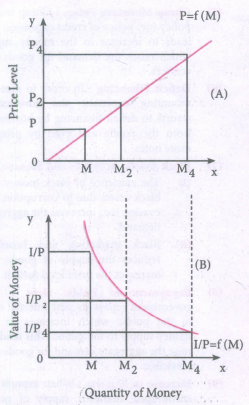
(i) It show's the effect of changes in the quantity of money on the price level.
(ii) When quantity of money is OM1, the price level is OP1.
(iii) When the quantity of money is doubled to OM2, the price level is also doubled to OP2.
(iv) When quantity of money is increased four-fold to OM4, the price level also increases by 4 times to OP4 his relationship is shown by the curve OP = f(M) from the origin at 45o.
Quantity of money
(i) Fig B shows the inverse relation between the quantity of money and the value of money.
(ii) Value of money is taken on the vertical axis.
(iii) When the quantity of money is OM1, the value of money is OI / P1.
(iv) When quantity of money is doubled to OM2, the value of money becomes one half of what it was before (OI / P2)
(v) When quantity of money increases by the four fold to OM4, the value of among is reduced by OI / P4
(vi) This inverse relationship between the quantity of money and the value of money is shown by downward sloping curve 1 / OP= f(M).

12th Standard Syllabus & Materials
12th Standard
TN 12th Computer Applications களப்பெயர் முறைமை (DNS) Sample Question Papers Study Material - QB365 Set A
NEW12th Standard
TN 12th Computer Applications வலையமைப்பு எடுத்துக்காட்டுகள் மற்றும் நெறிமுறைகள் Sample Question Papers Study Material - QB365 Set A
NEW12th Standard
TN 12th Computer Applications கணினி வலையமைப்பு ஓர் அறிமுகம் Sample Question Papers Study Material - QB365 Set A
NEW12th Standard
TN 12th Computer Applications PHP-உடன் MySQL-ஐ இணைத்தல் Sample Question Papers Study Material - QB365 Set A



Tamilnadu Stateboard 12th Standard Subjects

Maths

Chemistry

Physics

Biology

Computer Science

Business Maths and Statistics
Economics

Commerce

Accountancy

History

Computer Applications
Biology
Computer Technology
Computer Applications
Computer Science
Business Maths and Statistics
Commerce
Economics
Maths
Chemistry
Physics
Computer Technology
History
Accountancy

Tamil

English

French
Tamilnadu Stateboard Standards


