
 100% FREE ACCESS
12th Standard Syllabus & Materials
12th Standard
TN 12th Maths Applications of Matrices and Determinants Sample Question Papers Study Material - QB365 Set A
NEW12th Standard
TN 12th Computer Applications மின்னணு தரவு பரிமாற்றம் Sample Question Papers Study Material - QB365 Set A
NEW12th Standard
TN 12th Computer Applications மின் - வணிக பாதுகாப்பு அமைப்புகள் Sample Question Papers Study Material - QB365 Set A
NEW12th Standard
TN 12th Computer Applications மின்னணு செலுத்தல் முறைகள் Sample Question Papers Study Material - QB365 Set A
NEW12th Standard
TN 12th Computer Applications மின் - வணிகம் Sample Question Papers Study Material - QB365 Set A
NEW12th Standard
TN 12th Computer Applications திறந்த மூல கருத்துருக்கள் Sample Question Papers Study Material - QB365 Set A

Published on: 28/11/2025
Download Tamil Nadu 12th Standard Maths question papers, model tests, one-mark questions, important questions, and public exam papers in PDF format. Free study materials and answer keys for TN State Board students.
Questions + Answers key
Take MCQ Maths Test
1.
Prove that q ➝ p ≡ ¬p ➝ ¬q
2.
If u(x, y) = \(\frac { { x }^{ 2 }+{ y }^{ 2 } }{ \sqrt { x+y } } \), prove that \(x\frac { \partial u }{ \partial x } +y\frac { \partial u }{ \partial y } =\frac { 3 }{ 2 } u\)
3.
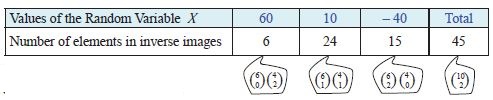
Two balls are chosen randomly from an urn containing 6 white and 4 black balls. Suppose that we win Rs. 30 for each black ball selected and we lose Rs. 20 for each white ball selected. If X denotes the winning amount, then find the values of X and number of points in its inverse images.
4.
Evaluate the following integrals using properties of integration:
\(\int _{ -\frac { \pi }{ 4 } }^{ \frac { \pi }{ 4 } }{ { sin }^{ 2 }xdx } \)
5.
Evaluate the following definite integrals:
\(\int _{ 0 }^{ \frac { \pi }{ 2 } }{ { e }^{ x }\left( \frac { 1+sinx }{ 1+cosx } \right) dx } \)
6.
Find a linear approximation for the following functions at the indicated points.
f(x) = x3 - 5x + 12, x0 = 2
7.
A six sided die is marked '2' on one face, '3' on two ofits faces, and '4' on remaining three faces. The die is thrown twice. If X denotes the total score in two throws, find the values of the random variable and number of points in its inverse images.
8.
Evaluate: : \(\underset{x\rightarrow 0^{+}}{lim}\) x log x.
9.
Using the Lagrange’s mean value theorem determine the values of x at which the tangent is parallel to the secant line at the end points of the given interval:
f (x) = (x − 2)(x − 7), x ∈ [3,11]
10.
Find the differential equation of the family of all nonhorizontal lines in a plane.
11.
Prove that p➝(¬q V r) ≡ ¬pV(¬qVr) using truth table.
12.
Let A be Q\{1}. Define ∗ on A by x*y = x + y − xy. Is ∗ binary on A? If so, examine the commutative and associative properties satisfied by ∗ on A.
13.
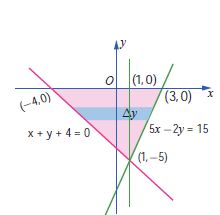
Find, by integration, the area of the region bounded by the lines 5x − 2y = 15, x + y + 4 = 0 and the x-axis
14.
If the probability mass function f(x) of a random variable X is
| x | 1 | 2 | 3 | 4 |
| f (x) | \(\cfrac { 1 }{ 12 } \) | \(\cfrac { 5 }{ 12 } \) | \(\cfrac { 5 }{ 12 } \) | \(\cfrac { 1 }{ 12 } \) |
find (i) its cumulative distribution function, hence find
(ii) P(X ≤ 3) and,
(iii) P(X ≥ 2)
15.
If the probability that a fluorescent light has a useful life of at least 600 hours is 0.9, find the probabilities that among 12 such lights
(i) exactly 10 will have a useful life of at least 600 hours
(ii) at least 11 will have a useful life of at least 600 hours
(iii) at least 2 will not have a useful life of at least 600 hours.
16.
Let g(x, y) = 2y + x2, x = 2r -s, y = r2+ 2s, r, s ∊ R. Find \(\frac { \partial g }{ \partial r } ,\frac { \partial g }{ \partial s } \)
17.
Let w(x, y, z) = \(\frac { 1 }{ \sqrt { { x }^{ 2 }+{ y }^{ 2 }+{ z }^{ 2 } } } ,(x,y,z)\neq (0,0,0)\). Show that \(\frac { { \partial }^{ 2 }w }{ \partial { x }^{ 2 } } +\frac { { \partial }^{ 2 }w }{ \partial { y }^{ 2 } } +\frac { { \partial }^{ 2 }w }{ \partial { z }^{ 2 } } =0\)
18.
Evaluate: \(\int _{ 0 }^{ \frac { \pi }{ 2 } }{ (\sqrt { tan\ x } +\sqrt { cot\ x } )dx } \)
19.
The cumulative distribution function of a discrete random variable is given by
\(F(x)=\left\{\begin{array}{lc}
0 & -\infty<x<-1 \\
0.15 & -1 \leq x<0 \\
0.35 & 0 \leq x<1 \\
0.60 & 1 \leq x<2 \\
0.85 & 2 \leq x<3 \\
1 & 3 \leq x<\infty
\end{array}\right.\)
Find
(i) the probability mass function
(ii) P(X < 1 ) and
(iii) P(X \(\geq\)2)
20.
Find the intervals of monotonicity and local extrema of the function \(f(x)=\frac{1}{1+x^{2}}\)
21.
22.
Solve the Linear differential equation:
\(\frac { dy }{ dx } +\frac { y }{ (1-x)\sqrt { x } } =1-\sqrt { x } \)
23.
Find the equation of the curve whose slope is \(\frac { y-1 }{ { x }^{ 2 }+x } \) and which passes through the point (1, 0).
24.
A ladder 17 metre long is leaning against the wall. The base of the ladder is pulled away from the wall at a rate of 5 m/s. When the base of the ladder is 8 metres from the wall.
(i) How fast is the top of the ladder moving down the wall?
(ii) At what rate, the area of the triangle formed by the ladder, wall and the floor is changing?
25.
Fill in the following table so that the binary operation ∗ on A = {a, b, c} is commutative.
| * | a | b | c |
| a | b | ||
| b | c | b | a |
| c | a | c |
26.
Examine the binary operation (closure property) of the following operations on the respective sets (if it is not, make it binary)
\(a*b=\left( \frac { a-1 }{ b-1 } \right) ,\forall a,b\in Q\)
27.
Compute P(X = k) for the binomial distribution, B(n, p) where
n = 6, \(p=\frac { 1 }{ 3 } \), k = 3
28.
The time to failure in thousands of hours of an electronic equipment used in a manufactured computer has the density function \(f(x)=\begin{cases} \begin{matrix} { 3e }^{ -3x } & x>0 \end{matrix} \\ \begin{matrix} 0 & elsewhere \end{matrix} \end{cases}\)
Find the expected life of this electronic equipment.
29.
Let \(f(x,y)=\frac { { y }^{ 2 }-xy }{ \sqrt { x } -\sqrt { y } } \) for (x, y) ≠ (0, 0). Show that \(\begin{matrix} lim \\ (x,y)\rightarrow (0,0) \end{matrix}\) f(x, y) = 0
30.
Evaluate: \(\int ^{log 2}_{-log 2} e ^{-|x|}\) dx.
31.
Find df for f(x) = x2 + 3x and evaluate it for
x = 2 and dx = 0.1
32.
Solve \(\frac { dy }{ dx } +2y={ e }^{ -x }\)
33.
Find the slope of the tangent to the following curves at the respective given points
y = x4 + 2x2 − x at x = 1
34.
Show that y = mx + \(\frac{7}{m}\), m ≠ 0 is a solution of the differential equation xy'+7\(\frac{1}{y'}\)-y = 0.
35.
\(\int _{ 0 }^{ \frac { \pi }{ 2 } }{ \frac { sin \ x-cos \ x }{ 1+sin \ x cos \ x } dx= } \) ............
\(\frac { \pi }{ 2 } \)
0
\(\frac { \pi }{ 4 } \)
\( \pi\)
36.
The value of \(\underset { x\rightarrow \infty }{ lim } { e }^{ -x }\) is __________
0
∞
e
\(\frac{1}{e}\)
37.
If a compound statement involves 3 simple statements, then the number of rows in the truth table is
9
8
6
3
38.
Which one of the following statements has truth value F?
Chennai is in India or \(\sqrt 2\) is an integer
Chennai is in India or \(\sqrt 2\) is an irrational number
Chennai is in China or \(\sqrt 2\) is an integer
Chennai is in China or \(\sqrt 2\) is an irrational number
39.
Which one of the following statements has the truth value T?
sin x is an even function
Every square matrix is non-singular
The product of complex number and its conjugate is purely imaginary
\(\sqrt 5\) is an irrational number
40.
41.
The value of \(\int _{ 0 }^{ 1 }{ x{ (1-x) }^{ 99 }dx } \) is
\(\frac{1}{11000}\)
\(\frac{1}{10100}\)
\(\frac{1}{10010}\)
\(\frac{1}{10001}\)
42.
The area between y2 = 4x and its latus rectum is
\(\frac{2}{3}\)
\(\frac{4}{3}\)
\(\frac{8}{3}\)
\(\frac{5}{3}\)
43.
If u(x, y) = x2+ 3xy + y - 2019, then \(\left.\frac{\partial u}{\partial x}\right|_{(4,-5)}\) is equal to
-4
-3
-7
13
44.
If v (x, y) = log (ex + ey), then \(\frac { { \partial }v }{ \partial x } +\frac { \partial v }{ \partial y } \) is equal to
ex + ey
\(\frac{1}{e^x + e^y}\)
2
1
45.
A circular template has a radius of 10 cm. The measurement of radius has an approximate error of 0.02 cm. Then the percentage error in calculating area of this template is
0.2%
0.4%
0.04%
0.08%
46.
47.
Four buses carrying 160 students from the same school arrive at a football stadium. The buses carry, respectively, 42, 36, 34, and 48 students. One of the students is randomly selected. Let X denote the number of students that were on the bus carrying the randomly selected student. One of the 4 bus drivers is also randomly selected. Let Y denote the number of students on that bus. Then E(X) and E(Y) respectively are
50,40
40,50
40.75,40
41,41
48.
Let X be random variable with probability density function
\(f(x)=\left\{\begin{array}{ll} \frac{2}{x^{3}} & x \geq 1 \\ 0 & x<1 \end{array}\right.\)
Which of the following statement is correct
both mean and variance exist
mean exists but variance does not exist
both mean and variance do not exist
variance exists but Mean does not exist
49.
50.
The population P in any year t is such that the rate of increase in the population is proportional to the population. Then
P=Cekt
P=Ce-kt
P=Ckt
P=C
51.
If sin x is the integrating factor of the linear differential equation \(\frac { dy }{ dx } +Py=Q,\) then P is
log sin x
cos x
tan x
cot x
52.
53.
One of the closest points on the curve x2 - y2 = 4 to the point (6, 0) is
(2,0)
\(\left( \sqrt { 5 } ,1 \right) \)
\(\left( 3,\sqrt { 5 } \right) \)
\(\left( \sqrt { 13 } ,-\sqrt { 3 } \right) \)
54.
What is the value of the limit \(\lim _{x \rightarrow 0}\left(\cot x-\frac{1}{x}\right) \text { is }\)
0
1
2
∞
1.
| p | q | q ➝ p | ~p | ~q | ~q ➝ ~p |
| T | T | T | F | F | T |
| T | F | T | F | T | T |
| F | T | F | T | F | F |
| F | F | T | T | T | T |
The entries in the columns corresponding q ➝ p and ~p ➝ ~q are identical and hence they are equivalent.
q ➝ p ≡ ~p ➝ ~q
Hence proved
2.
Given u (x, y) = \(\frac { { x }^{ 2 }+{ y }^{ 2 } }{ \sqrt { x+y } } \)
\(u({ \lambda }x,{ \lambda }y)=\frac { { \lambda }^{ 2 }{ x }^{ 2 }+{ { \lambda } }^{ 2 }{ y }^{ 2 } }{ \sqrt { { \lambda }x+{ \lambda }y } } \)
= \(\frac { { { \lambda } }^{ 2 }({ x }^{ 2 }+{ y }^{ 2 }) }{ \sqrt { { \lambda } } (\sqrt { x+y } ) } \)
= \({ { \lambda } }^{ 2-\frac { 1 }{ 2 } }u(x,y)\)
= \({ { \lambda } }^{ \frac { 3 }{ 2 } }u(x,y)\)
∴ u (x, y) is a homogeneous function of degree \(\frac32\)
∴ By Euler's theorem,
\(x\frac { \partial u }{ \partial x } +y\frac { \partial u }{ \partial y } \) = n.u ≍ \(x\frac { \partial u }{ \partial x } +y\frac { \partial u }{ \partial y } =\frac { 3 }{ 2 } u\)
Hence, proved.
3.
The possible events of selection are
(i) both balls may be black, or
(ii) one white and one black or
(iii) both are white.
Therefore X is a random variable that take the values,
X (both are black balls) = Rs. 2(30) = Rs. 60
X (one black and one white ball) = Rs. 30 − Rs. 20 = Rs. 10
X (both are white balls) = Rs. 2( − 20) = - Rs. 40
Therefore X takes on the values 60,10, and − 40.
4.
Let \(f(x)={ sin }^{ 2 }x\)
\(f(-x)={ (sin(-x)) }^{ 2 }={ sin }^{ 2 }x=f(x)\)
\(\therefore \int _{ -\frac { \pi }{ 4 } }^{ \frac { \pi }{ 4 } }{ { sin }^{ 2 }xdx } =2\int _{ 0 }^{ \frac { \pi }{ 4 } }{ { sin }^{ 2 }xdx } \)
\(cos\ 2x=1-2{ sin }^{ 2 }x\)
\(2{ sin }^{ 2 }x=1-cos2\)
\({ sin }^{ 2 }x=\frac { 1-cos\quad 2x }{ 2 } \)
\(=2\int _{ 0 }^{ \frac { \pi }{ 4 } }{ \left( \frac { 1-cos2x }{ 2 } \right) dx } \)
\(=\frac { 2 }{ 2 } { \left[ x-\frac { sin2x }{ 2 } \right] }_{ 0 }^{ \frac { \pi }{ 4 } }\)
\(=\frac { \pi }{ 4 } -\frac { sin\frac { \pi }{ 4 } }{ 2 } -0+\frac { sin0 }{ 2 } \)
\(\\ =\frac { \pi }{ 4 } -\frac { 1 }{ 2 } =\frac { \pi -2 }{ 4 } \)
5.
\(Let\int _{ 0 }^{ \frac { \pi }{ 2 } }{ { e }^{ x }\left( \frac { sinx }{ 1+cosx } \right) dx } \)
\(\int _{ 0 }^{ \frac { \pi }{ 2 } }{ { e }^{ x }\left( \frac { 1+sinx }{ { cos }^{ 2 }\frac { x }{ 2 } } \right) dx } \)
\(\left[ \because cosx=2{ cos }^{ 2 }x-1\Rightarrow 1+cos2x=2{ cos }^{ 2 }x \right] \)
\(=\frac { 1 }{ 2 } \int _{ 0 }^{ \frac { \pi }{ 2 } }{ { e }^{ x }\left( \frac { 1 }{ { cos }^{ 2 }\frac { x }{ 2 } } +\frac { sinx }{ { cos }^{ 2 }\frac { x }{ 2 } } \right) dx } \)
\(=\frac { 1 }{ 2 } \int _{ 0 }^{ \frac { \pi }{ 2 } }{ { e }^{ x }\left( { sec }^{ 2 }\frac { x }{ 2 } +\frac { 2sin\frac { x }{ 2 } cos\frac { x }{ 2 } }{ { cos }^{ 2 }\frac { x }{ 2 } } \right) dx } \)
\(\\ [\because sin2x=2sinx\quad cosx]\)
\(=\frac { 1 }{ 2 } \int _{ 0 }^{ \frac { \pi }{ 2 } }{ { e }^{ x }\left( { sec }^{ 2 }\frac { x }{ 2 } 2tan\frac { x }{ 2 } \right) dx } \)
\(=\frac { 1 }{ 2 } \int _{ 0 }^{ \frac { \pi }{ 2 } }{ { e }^{ x }(f'(x)+f(x)dx } \)
Where \(f(x)=2tan\frac { x }{ 2 } \)
\(=\frac { 1 }{ 2 } .{ e }^{ x }.f(x)={ \left[ \left( \frac { 1 }{ 2 } { e }^{ x }.2tan\frac { x }{ 2 } \right) \right] }_{ 0 }^{ \frac { \pi }{ 2 } }\)
\(={ \left[ { e }^{ x }tan\frac { x }{ 2 } \right] }_{ 0 }^{ \frac { \pi }{ 2 } }\)
\(={ e }^{ \frac { \pi }{ 2 } }tan\frac { \pi }{ 4 } -{ e }^{ 0 }tan0={ e }^{ \frac { \pi }{ 2 } }(1)\)
\(\therefore I={ e }^{ \frac { \pi }{ 2 } }\)
6.
f(x) = x3 - 5x + 12, x0 = 2
f(xo) = 23 - 5(2) + 12
= 8 - 10 + 12 = 10
f'(x) = 3x2 - 5
⇒ f'(xo) = 3 (22) - 5 = 7
∴ L(x) = f(xo) +f'(xo) (x - xo)
= 10 + 7(x - 2)
= 10 + 7x - 14
L(x) = 7x- 4
7.
Let X be the random variable denotes the total C score is two throws of a die.
Sample space S
| II | 2 | 3 | 3 | 4 | 4 | 4 |
| I | ||||||
| 2 | 4 | 5 | 5 | 6 | 6 | 6 |
| 3 | 5 | 6 | 6 | 7 | 7 | 7 |
| 3 | 5 | 6 | 6 | 7 | 7 | 7 |
| 4 | 6 | 7 | 7 | 8 | 8 | 8 |
| 4 | 6 | 7 | 7 | 8 | 8 | 8 |
| 4 | 6 | 7 | 7 | 8 | 8 | 8 |
n (S) = 36
X = {4,5,6,7,8}
From the sample space
| Values of random variable | 4 | 5 | 6 | 7 | 8 | Total |
| No of points in inverse image | 1 | 4 | 10 | 12 | 9 | 36 |
8.
This is an indeterminate of the form (0×∞). To evaluate this limit, we first simplify and bring it to the form \((\frac{\infty}{\infty})\) and apply L’Hôpital Rule.
\(\underset{x\rightarrow 0^{+}}{lim}xlog x= \underset{x\rightarrow 0^{+}}{(\frac{log x}{\frac{1}{x}})}\)
\(\underset{x\rightarrow 0^{+}}{lim}(\frac{\frac{1}{x}}{-\frac{1}{x^{2}}})=\underset{x\rightarrow 0^{+}}{lim}(-x)=0.\)
9.
Given f (x) = (x − 2)(x − 7), x ∈ [3,11]
a) f(x) is continuous in [3, 11]
b) f(x) is differentiable in (3, 11)
c) f(11) = (11-2)(11-7)
= (9) (4) = 36
f(3) = (3 - 2)(3 - 7)
= (1)(-4) = - 4
∴ By Lagrange's mean value theorem, there exists c ∈ [3,11] such that f'(c) = \(\frac { f(b)-f(a) }{ b-a } \)
\(\left[ \begin{matrix} f(x)\begin{matrix} = & (x \end{matrix}- & 2) & \begin{matrix} (x & - \end{matrix}7) \\ \begin{matrix} = & { x }^{ 2 } \end{matrix}- & 7x & -2x\begin{matrix} + & 14 \end{matrix} \\ \begin{matrix} = & { x }^{ 2 } \end{matrix}- & 9x & +\begin{matrix} 14 & \end{matrix} \end{matrix} \right] \)
⇒ 2c - 9 = \(\frac{36+4}{11-3}\)
⇒ 3c - 9 = \(\frac{40}{8}\) = 5
⇒ 2c = 14
⇒ c = 7 ∈ [3 , 11]
10.
General equation of a straight line in a plane is ax + by = 1 .....(1)
Since, the lines are non - horizontal, a ≠ 0
Hence, differentiating with respect to y, equation (1)
a \(\\ \frac { dx }{ dy }+b =0\)
Differentiating again with respect to 'y'; we get,
\((a) \ \frac { { d }^{ 2 }x }{ d{ y }^{ 2 } } =0\Rightarrow \frac { { d }^{ 2 }x }{ d{ y }^{ 2 } } =0\quad [\because a\neq 0]\)
This is the differential equation of all non-horizontal lines in a plane.
11.
| p | q | r | ~ q | ~q V r | p➝(¬qVr) | ~p | ~pV(~qVr) |
| T | T | T | F | T | T | F | T |
| T | T | F | F | F | F | F | F |
| T | F | T | T | T | T | F | T |
| T | F | F | T | T | T | F | T |
| F | T | T | F | T | T | T | T |
| F | T | F | F | F | T | T | T |
| F | F | T | T | T | T | T | T |
| F | F | F | T | T | T | T | T |
From the table, it is clear that the column of p➝(¬q V ~r) and ~pV(~q V r) are identical
∴ p➝(¬q V ~r) ≡ ~pV(~q V r)
Hence proved.
12.
given A = {Q\{1}}
A is defined on A by x*y = x+y-xy
Let x,y ≠ 1
∴ x*y = x + y - xy
Now to prove that x + y - xy ≠ 1
Let us assume that x + y - xy = 1
x+y-xy-1 = 0
(x-1)-y(x-1) = 0
(x-1)(1-y) = 0
x =1 or y = 1 which is a false [∵x, y ≠ 1]
∴ is a binary operation on A.
Commutative property:
Let x,y ∈A ⇒ x, y≠1
∴x*y = x+y-xy
and y*x = y+x-yx
⇒x+y = y*x∀x, y∈A
A has commutative property under *
Associative property:
Let x,y,z ∊A ⇒x,y,z≠1
Consider (x*y)*z = (x+y-xy)*z
= x +y~xy +z- (x +y-xy)z
= x +y-xy+ z-xz- yz + xyz
= x +y+z-xy-yz-zx +xyz ...(1)
= x +y+z - yz - x (y + z - yz)
= x +y +z-yz-zy-xz +xyz ..(2)
From (1) & (2), (x*y)*z = x*(y*z)
A has associative property under *.
13.
The lines 5x − 2y = 15, x + y + 4 = 0 intersect at (1, −5). The line 5x − 2y =15 meets the x-axis at (3, 0). The line x + y + 4 = 0 meets the x-axis at (−4, 0). The required area is shaded. It lies below the x-axis. It can be computed either by considering vertical strips or horizontal strips.
When we do by vertical strips, the region has to be divided into two sub-regions by the line x = 1. Then, we get
\(A=\left| \int _{ -4 }^{ 1 }{ ydx } \right| +\left| \int _{ 1 }^{ 3 }{ ydx } \right| \)
\(=\left| \int _{ -4 }^{ 1 }{ (-4-x)dx } \right| +\left| \int _{ 1 }^{ 3 }{ \left( \frac { 5x-15 }{ 2 } \right) dx } \right| \)
\(=\left| { \left( -4x-\frac { { x }^{ 2 } }{ 2 } \right) }_{ -4 }^{ 1 } \right| +\left| { \left( \frac { { 5x }^{ 2 } }{ 4 } -\frac { 15x }{ 2 } \right) }_{ 1 }^{ 3 } \right| \)
\(=\left| \left( -\frac { 9 }{ 2 } \right) -\left( 8 \right) \right| +\left| \left( -\frac { 45 }{ 4 } \right) -\left( -\frac { 25 }{ 4 } \right) \right| \)
\(=\frac { 25 }{ 2 } +5\)
\(=\frac { 35 }{ 2 } \)
When we do by horizontal strips, there is no need to subdivide the region. In this case, the area is bounded on the right by the line 5x − 2y = 15 and on the left by x + y + 4 = 0. So, we get
\(A=\int _{ -5 }^{ 0 }{ [{ x }_{ R }-{ x }_{ L }]dy } =\int _{ -5 }^{ 0 }{ \left[ \frac { 15+2y }{ 5 } -(-4-y) \right] dy } \)
\(=\int _{ -5 }^{ 0 }{ \left[ 7+\frac { 7y }{ 5 } \right] dy={ \left[ 7y+\frac { { 7y }^{ 2 } }{ 10 } \right] }_{ -5 }^{ 0 } } \)
\(\\ =0-\left[ -35+\frac { 35 }{ 2 } \right] =\frac { 35 }{ 2 } \)
14.
By definition the cumulative distribution function for discrete random variable is
\(F(x)P\left( X\le x \right) =\underset { { x }_{ 1 }\le x }{ \Sigma } P(X={ x }_{ 1 })\)
\(P(X<1)=0\) for -∞
\(F(1)=P\left( X\le 1 \right) =\underset { { x }_{ 1 }\le x }{ \Sigma } P(X={ x }_{ i })=\sum _{ -\infty }^{ 1 }{ P(X=x) } =P\left( X<1 \right) +P\left( X=1 \right) =0+\frac { 1 }{ 12 } =\frac { 1 }{ 12 }\)
\(F(2)=P\left( X\le 2 \right) =\sum _{ -\infty }^{ 2 }{ P\left( X=x \right) } =P\left( X\le 1 \right) +P\left( X=1 \right) +P\left( X=2 \right)\)
= \(0+\frac { 1 }{ 12 } +\frac { 5 }{ 12 } =\frac { 1 }{ 2 }\)
\(F(3)=P\left( X\le 3 \right) =\sum _{ -\infty }^{ 3 }{ P(X=x) } =P\left( X<1 \right) +P\left( X=1 \right) +P\left( X=2 \right) +P\left( X=3 \right)\)
= \(0+\frac { 1 }{ 2 } +\frac { 5 }{ 12 } +\frac { 5 }{ 12 } =\frac { 11 }{ 12 }\)
\(F(4)=P\left( X\le 4 \right) =\sum _{ -\infty }^{ 4 }{ P\left( X=x \right) } =P\left( X=1 \right) +P\left( X=2 \right) +P\left( X=3 \right) +P(X=4)\)
= \(0+\frac { 1 }{ 12 } +\frac { 5 }{ 12 } +\frac { 5 }{ 12 } +\frac { 1 }{ 12 } =1\)
\(F(x)=\{0, \quad-\infty \ldots\)

(ii) \(P(X\le 3)=F(3)\frac { 11 }{ 12 }\)
(iii) \(P(X\ge 2)=1-P\left( X<2 \right) =1-P(X\le 1)=1-F(1)=1-\frac { 1 }{ 12 } =\frac { 11 }{ 12 }\)
15.
Let p be the probability of the useful life hours of a fluorescent light.
n = 12
P = 0.9
q = 1-p = 0.1
P(X= x)= nCx px qn-x, x = 0, 1,2, .., n
(i) Exactly 10
P(X = 10) = 12C10(0.9)10(1 - 0.9)2
= 12C10(0.9)10 (0.1)2
(ii) Atleast 11
P(X≥11) = R(X = 11) + P(X = 12)
= 12C11(0.9)11 (0.1)1 + 12C12(0.9)12(0.1)6
= 12C1 (0.9)11 (0.1) + (0.9)12
= 12(0.9)11 (0.1) + (0.9)12
= (0.9)11 ((12)(0.1) + 0.9)
= (0.9)11 (1.2 + 0.9)
= (0.9)11 (2.1)
(ii) Atleast 2 will not have a useful
P(X,10) = 1 -P(X > 10)
= 1 - [P(X = 11) + P(X = 12)]
= 1-(2.1) (0.9)11
16.
Here again we shall use the tree diagram to calculate \(\frac { \partial g }{ \partial r } ,\frac { \partial g }{ \partial s } \)
Hence we find \(\frac { \partial g }{ \partial x } \) = 2x, \(\frac { \partial g }{ \partial y } \) = 2, \(\frac { \partial x }{ \partial y } \) = 2, \(\frac { \partial x }{ \partial s } \) = -1, \(\frac { \partial y }{ \partial r } \) =2r, and \(\frac { \partial y }{ \partial s } \) = 2.
Now, \(\frac { \partial g }{ \partial r } \) = \(\frac { \partial g }{ \partial x } \frac { \partial x }{ \partial r } +\frac { \partial g }{ \partial y } \frac { \partial y }{ \partial r } \) = 2x(2) + 2(2r) 12r - 4s.
also, \(\frac { \partial g }{ \partial s } \) = \(\frac { \partial g }{ \partial x } \frac { \partial x }{ \partial s } +\frac { \partial g }{ \partial y } \frac { \partial y }{ \partial s } \) = 2x(-1) +(2)2 = 2s - 4r + 4.
17.
Given w(x, y, z) = \(\frac { 1 }{ \sqrt { { x }^{ 2 }+{ y }^{ 2 }+{ z }^{ 2 } } }\)
= (x2 + y2 + z2) -\(\frac12\)
\(\frac { \partial w }{ \partial x } =\frac { -1 }{ 2 } ({ x^{ 2 }+{ y }^{ 2 }+{ z }^{ 2 }) }^{ -\frac { 3 }{ 2 } }(2x)\)
= (-x2 + y2 + z2) -\(\frac12\)
\(\frac { { \partial }^{ 2 }w }{ \partial { x }^{ 2 } } =\frac { \partial }{ \partial x } \left( \frac { \partial w }{ \partial x } \right) \)
= -[x\(\left( \frac { -3 }{ 2 } \right) \)( x2 + y2 +z2)\(-\frac32\)
\((\not 2 x)+\left(x^{2}+y^{2}+z^{2}\right)^{\frac{3}{2}}\)
= (x2 + y2 + z2)-\(\frac52\) [-3x2 + x2 +y + z2]
= - (x2 + y2 + z2)-\(\frac52\) [y2 + z2 - 2x2] ....(1)
\(\frac { \partial w }{ \partial y } =\frac { -1 }{ 2 } ({ x^{ 2 }+{ y }^{ 2 }+{ z }^{ 2 }) }^{ -\frac { 3 }{ 2 } }(2y)\)
= -y(x2 +y2 + z2)-\(\frac32\)
\(\frac { { \partial }^{ 2 }w }{ \partial { y }^{ 2 } } =\frac { \partial }{ \partial y } \left( \frac { \partial w }{ \partial y } \right) \)
\(=-\left[y\left(\frac{-3}{\not 2}\right)\left(x^{2}+y^{2}+z^{2}\right)^{\frac{5}{2}}(\not 2 y)+\left(x^{2}+y^{2}+z^{2}\right)^{\frac{3}{2}}(1)\right]\)
= -(x2 + y2 + z2)-\(\frac52 \)
= -(x2 + y2 + z2)-\(\frac52 \) [3y2 + x2 + y2 + z2]
= -(x2 + y2 + z2)-\(\frac52 \) [x2 + y2 + 2z2] ....(2)
Now \(\frac { \partial w }{ \partial z } =\frac { -1 }{ 2 } ({ x^{ 2 }+{ y }^{ 2 }+{ z }^{ 2 }) }^{ -\frac { 3 }{ 2 } }(2z)\)
= -z(x2 + y2 + z2)-\(\frac32 \)
∴ \(\frac { { \partial }^{ 2 }w }{ \partial { z }^{ 2 } } \) = -(x2 + y2 + z2)-\(\frac52 \) [x2 + y2 - 2z2] ...(3)
(1)+(2)+(3)⟶
∴ \(\frac { { \partial }^{ 2 }w }{ \partial { x }^{ 2 } } +\frac { { \partial }^{ 2 }w }{ \partial { y }^{ 2 } } +\frac { { \partial }^{ 2 }w }{ \partial { y }^{ 2 } } \) = -(x2 + y2 + z2)-\(\frac52 \) [y2 + z2 - 2x2 + x2 + z2 - 2y + x2+ y-2z2]
= -(x2 + y2 + z2)-\(\frac52 \)(0) = 0
Hence proved
18.
Let I = \(\int _{ 0 }^{ \frac { \pi }{ 2 } }{ (\sqrt { tan\ x } +\sqrt { cot\ x } )dx } \) Then we get
\(I=\int _{ 0 }^{ \frac { \pi }{ 2 } }{ \left( \sqrt { \frac { sinx }{ cosx } } +\sqrt { \frac { cosx }{ sinx } } \right) dx } =\int _{ 0 }^{ \frac { \pi }{ 2 } }{ \frac { sinx+cosx }{ \sqrt { sinxcosx } } dx } =\sqrt { 2 } \int _{ 0 }^{ \frac { \pi }{ 2 } }{ \frac { sinx+cosx }{ \sqrt { 2sinxcosx } } dx } \)
\(=\sqrt { 2 } \int _{ 0 }^{ \frac { \pi }{2 } }{ \frac { (sinx+cosx)dx }{ \sqrt { 1-sinx-cosx{ ) }^{ 2 } } } } \)
Put u = sin x − cos x
Then, du = (cos x + sin x)dx .
When x = 0, u = −1
When x =\(\frac{\pi}{2}\), u = 1
\(\therefore I=\sqrt { 2 } \int _{ -1 }^{ 1 }{ \frac { du }{ \sqrt { 1-{ u }^{ 2 } } } =\sqrt { 2 } { [{ sin }^{ -1 }u] }_{ -1 }^{ 1 }=\sqrt { 2 } \left[ { sin }^{ -1 }(1)-{ sin }^{ -1 }(-1)) \right] } =\pi \sqrt { 2 } \)
19.
(i) The equivalent table is
X | -1 | 0 | 1 | 2 | 3 |
|---|---|---|---|---|---|
F(x) | 0.15 | 0.35 | 0.60 | 0.85 | 1 |
f(x) = P[X= x] | 0.15 | 0.20 | 0.25 | 0.25 | 0.15 |
(ii) P(X <1) = P(X =-1)+P(X =0) =0.35
\(\text { (iii) } P(X \geq 2)=\) P(X =2)+P(X =3) = 0.40
20.
The given function is defined and is differentiable at all \(x\in (-\infty, \infty) \). As
\(f(x)=\frac{1}{1+x^{2}}\).
We have \(f'(x)=-\frac{2x}{(1+x^{2})^{2}}\)
The stationary points are given by \(-\frac{2x}{(1+x^{2})^{2}}=0\) that is x = 0
Hence the intervals of monotonicity are \((-\infty,0)\) and \((0,\infty)\)
On the interval \((-\infty,0)\) the function strictly increases because f'(x) > 0 in that interval.
The function f(x) strictly decreases in the interval \((0,\infty)\) because f'(x) < 0 in that interval.
Since f′(x) changes from positive to negative when passing through x = 0, the first derivative test tells us there is local maximum at x = 0 and the local maximum value is f (0) = 1.
21.
22.
The given linear differential euation is of the form
\(\frac{d y}{d x}+P y=Q \)
where \(\mathrm{P}=\frac{1}{(1-x) \sqrt{x}} ; \mathrm{Q}=1-\sqrt{x} \)
Take \(\sqrt{x}=\mathrm{t} \Rightarrow \mathrm{t}^2=x \)
\( x^{1 / 2}=\mathrm{t} \)
\( \frac{1}{2} x^{1 / 2-1} \mathrm{~d} x=\mathrm{dt} \Rightarrow \frac{1}{2} x^{-1 / 2} d x=\mathrm{dt} \)
\( \frac{1}{2 x^{1 / 2}} d x=\mathrm{dt} \Rightarrow \frac{1}{2 \sqrt{x}} d x=\mathrm{dt} \)
\( \frac{d x}{\sqrt{x}}=2 \mathrm{dt} \)
\( \text { I.F }=e^{\int P d x}=e^{\int \frac{1}{(1-x) \sqrt{x}} d x} \)
\( =e^{\int \frac{1}{1-t^{t^2} 2 d t}}=e^{\int \frac{2 d t}{1-1^2}} \)
\(\because \int \frac{d x}{a^2-x^2}=\frac{1}{2 x} \log \left|\frac{a+x}{a-x}\right| \)
\(\text { Here } a=1 ; x=t\)
\(=e^{\log \left(\frac{1+1}{1-t}\right)} \)
\(\mathrm{I} . \mathrm{F}=\frac{1+t}{1-t} \)
\({ I.F }=\frac{1+\sqrt{x}}{1-\sqrt{x}} \)
The solution is y\(\times \mathrm{I} . \mathrm{F}=\int \mathrm{Q} \times \mathrm{I}.Fd x+c\)
\( y\left(\frac{1+\sqrt{x}}{1-\sqrt{x}}\right)=\int(1-\sqrt{x}) \frac{1+\sqrt{x}}{1-\sqrt{x}} d x+c \)
\( =\int(1+\sqrt{x}) d x+c \)
\( y\left(\frac{1+\sqrt{x}}{1-\sqrt{x}}\right)=x+\frac{x^{3 / 2}}{3 / 2}+c \)
\( y\left(\frac{1+\sqrt{x}}{1-\sqrt{x}}\right)=x+\frac{2}{3} x^{3 / 2}+c \)
\( y\left(\frac{1+\sqrt{x}}{1-\sqrt{x}}\right)=x+\frac{2}{3} x \sqrt{x}+c \quad \because x^{3 / 2}=x \sqrt{x} \)
Which is the required solution
23.
Given slope curve
\(\Rightarrow \frac { dy }{ dx } =\frac { y-1 }{ { x }^{ 2 }+x } \) ..... (1)
\(\Rightarrow \frac { dy }{ y-1 } =\frac { dx }{ { x }^{ 2 }+x } \)
\(
\Rightarrow \frac{d y}{y-1}=\frac{d x}{x^2+x}=\frac{d x}{x^2+2\left(\frac{x}{2}\right)+\left(\frac{1}{2}\right)^2-\left(\frac{1}{2}\right)^2}
\)
\(ie) \frac{d y}{y-1}=\frac{d x}{\left(x+\frac{1}{2}\right)^2-\left(\frac{1}{2}\right)^2} \)
Integrating on both sides, we get
\( \int \frac{d y}{\log (y-1)}=\int \frac{d x}{\left(x+\frac{1}{2}\right)^2-\left(\frac{1}{2}\right)^2} \\
\text { ie) } \log (y-1)=\left(\frac{1}{2\left(\frac{1}{2}\right)}\right) \log \left[\frac{\left(x+\frac{1}{2}\right)-\left(\frac{1}{2}\right)}{\left(x+\frac{1}{2}\right)+\left(\frac{1}{2}\right)}\right]+\log C \\
\log (y-1)=\log \left(\frac{x}{x+1}\right)+\log C\\
ie) (y-1)=\frac{C x}{x+1}
\)
\(\Rightarrow log(y-1)=log\left( \frac { cx }{ x+1 } \right) \)
\(\Rightarrow y-1=\frac { cx }{ x+1 } \)
Since the curve passes through (1, 0) we get,
\(0-1=\frac { c }{ 2 } \Rightarrow c=-2\)
\(\Rightarrow y-1=\frac { -2x }{ x+1 } \)
\(\Rightarrow y=1-\frac { -2x }{ x+1 } \)
\(\Rightarrow y=\frac { x+1-2x }{ x+1 } =\frac { 1-x }{ x+1 } \)
\(\therefore y=\frac { 1-x }{ 1+x } \)
24.
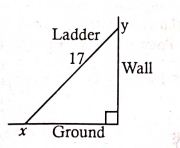
Let AB be the position of the ladder at any time t such that OA = x and OB = y
Then OA2 + OB2 = AB2
⇒ x2 + y2 = 172
Given \(\frac { dx }{ dt } \) = 5 and x = 8
When x = 8, 82 + y2 = 172
⇒ y2 = 289 - 64 = 225
⇒ y = 15
Differentiating (1) with respect to 't' we get,
\(2x\frac { dx }{ dt } +2y\frac { dy }{ dt } =0\)
⇒ 8(5) + 15 \(\frac { dy }{ dt } \) = 0 [∵ x = 8, \(\frac { dx }{ dt } \) = 15, y = 15]
⇒ 40 + 15\(\frac { dy }{ dt } \) = 0
⇒ \(\frac { dy }{ dt } =\frac { -40 }{ 15 } =\frac { -8 }{ 3 } \) m/sec
∴ The rate of top of the ladder moving down the wall is \(\frac{-8}{3}\) m/sec
(ii) The ladder, the wall and the floor forms a right angled triangle.
Area = \(\frac12\)xy
Differentiating with respect to 't' we get,
\(\frac { dA }{ dt } =\frac { 1 }{ 2 } \left[ x\frac { dy }{ dx } +y\frac { dx }{ dt } \right] \)
\(=\frac { 1 }{ 2 } \left[ 8\left( -\frac { 8 }{ 3 } \right) +15(5) \right] \)
= \(\frac { 1 }{ 2 } \left[ \frac { -64 }{ 3 } +75 \right] =\frac { 1 }{ 2 } \)
= \(\frac { 1 }{ 2 } \left[ \frac { -64+225 }{ 3 } \right] =\frac { 1 }{ 2 } \left( \frac { 161 }{ 3 } \right) \)
= \(\frac { dA }{ dt } \) = 26.83 sq.m/sec
25.
Given * on A is commutative
Given b * a = c ⇒ a * b = c
Given c * a = a ⇒ a * c = a
Given b * c = a ⇒ c * b = a
Hence
| * | a | b | c |
| a | b | c | a |
| b | c | b | a |
| c | a | a | c |
26.
In this problem a ∗ b is in the quotient form. Since the division by 0 is undefined, the denominator b -1 must be nonzero.
It is clear that b −1 = 0 if b = 1. As 1∈Q, ∗ is not a binary operation on the whole of Q. However it can be found that by omitting 1 from Q, the output a ∗b exists in Q\{1}. Hence ∗ is a binary operation on Q\{1}.
27.
Given n = 6, \(p=\frac { 1 }{ 3 }\), k = 3
\(P(X=k)=\left( \begin{matrix} n \\ k \end{matrix} \right) { p }^{ k }\left( 1-p \right) ^{ n-k },\)
n = 0,1,2, ... n
\(\therefore P(X=k)=\left( \begin{matrix} n \\ k \end{matrix} \right) { p }^{ k }(1-p)^{ n-k }\)
n = 0,1,2, ... n
\(P(X=3)=\left( \begin{matrix} 6 \\ 3 \end{matrix} \right) \left( \cfrac { 1 }{ 3 } \right) ^{ 3 }\left( 1-p \right) ^{ 6-3 }\)
= \(\left( \begin{matrix} 6 \\ 3 \end{matrix} \right) \left( \cfrac { 1 }{ 3 } \right) ^{ 3 }\left( \cfrac { 2 }{ 3 } \right) ^{ 2 }\)
\(=\frac{6 \times 5 \times 4}{8 \times 2 \times 1} \times \frac{1}{27} \times \frac{8}{27}\)
\(P(X=3)=\frac { 160 }{ 729 }\)
28.
Given \(f(x)=\begin{cases} \begin{matrix} { 3e }^{ -3x } & x>0 \end{matrix} \\ \begin{matrix} 0 & elsewhere \end{matrix} \end{cases}\)
\(E(X)=\int _{ 0 }^{ \infty }{ x.f(x)dx } =\int _{ 0 }^{ \infty }{ x.3.{ e }^{ -3x }dx } \)
= \(3\int _{ 0 }^{ \infty }{ x.{ e }^{ -3x }dx } \left[ \therefore \int _{ 0 }^{ \infty }{ { x }^{ n }{ e }^{ -ax }dx=\cfrac { n! }{ { a }^{ n+1 } } } \right] \)
= \(3\times \frac { 1! }{ { 3 }^{ 2 } } =\frac { 3 }{ 9 } =\frac { 1 }{ 3 } \)
ஃ Expected life of the electronic equipment is = \(\frac { 1 }{ 3 } \)
29.
\(\begin{matrix} lim \\ (x,y)\rightarrow (0,0) \end{matrix}=\left| \frac { { y }^{ 2 }-xy }{ \sqrt { x } -\sqrt { y } } -0 \right| \)
= \(\left| \frac { { y }^{ 2 }-xy }{ \sqrt { x } -\sqrt { y } } \right| =\frac { \left| y \right| \left| y-x \right| }{ \left| \sqrt { x } -\sqrt { y } \right| } \)
= \(\frac { \left| y \right| \left| \sqrt { x } +\sqrt { y } \right| |\sqrt { y } -\sqrt { x } | }{ \left| -\sqrt { y } -\sqrt { x } \right| } \)
\(=\frac{|y||\sqrt{x}+\sqrt{y}| \sqrt{y}-\sqrt{\not x} \mid}{|\sqrt{y}-\sqrt{\not x}|}\)
= \(|y||\sqrt { x } +\sqrt { y } |\)
\(\therefore \begin{matrix} lim \\ (x,y)\rightarrow (0,0) \end{matrix}=\begin{matrix} lim \\ (x,y)\rightarrow (0,0) \end{matrix}|y||\sqrt { x } +\sqrt { y } |=0\)
30.
Let f(x) = e-|-x| = e-|x| = f(x)
So f (x) is an even function.
Hence, \(\int ^{log 2}_{-log 2} e ^{-|x|}\)dx = 2\(\int ^{log 2}_{0} e ^{-|x|}\)dx = 2\(\int ^{log 2}_{0} e ^{-x}\) dx
= 2(-e-x)\(^{log2}_{0}\) = 2 (-e-log2 + e0) = 2 \((-e ^{log \frac{1}{2}} + 1)\)
= 2\((-\frac {1}{2}+1)=1\).
31.
x = 2 and dx = 0.1
Taking differentials,
df = (2x + 3) dx
Whenx = 2, dx = 0.1
df = (2(2) + 3)(0.1) = 7(0.1) = 0.7
32.
Given that \(\frac{dy}{dx}+2y\) = e-x
This is a linear differential equation
Here P = 2 ; Q = e−x.
\(\int { pdx } =\int { 2dx } =2x\)
Thus, I.F.\(={ e }^{ \int { pdx } }={ e }^{ 2x }\)
Hence the solution of (1) is \({ ye }^{ \int { pdx } }=\int { { Qe }^{ \int { Pdx } }dx+C } \)
That is, \({ ye }^{ 2x }=\int { { e }^{ -x }{ e }^{ 2x }dx+C } or\quad { ye }^{ 2x }={ e }^{ x }+C\quad or\quad y={ e }^{ -x }+{ Xe }^{ -2x }\) required solution
33.
Given y = x4 + 2x2 - x
\(\frac { dy }{ dx } \) = 4x3 + 4x - 1
Slope of the tangent at x = 1 is
m = \(\left( \frac { dy }{ dx } \right) \)(x = 1)
= 4(1)3+ 4 (1) - 1
= 4+4-1 = 7
∴ m = 7
34.
The given function is y mx +\(\frac{7}{m}\), where m is an arbitrary constant ....(1)
Differentiating both sides of equation (1) with respect to x, we get y' = m.
Substituting the values of y' and y in the given differential equation
we get xy'\(\frac{1}{y'}\)-y = xm +\(\frac{7}{m}\)- mx -\(\frac{7}{m}\) = 0
Therefore, the given function is a solution of the differential equation xy' + 7\(\frac{1}{y'}\) - y = 0
35.
(b)
0
36.
(a)
0
37.
(b)
8
38.
(c)
Chennai is in China or \(\sqrt 2\) is an integer
39.
(d)
\(\sqrt 5\) is an irrational number
40.
(d)
41.
(b)
\(\frac{1}{10100}\)
42.
(c)
\(\frac{8}{3}\)
43.
(c)
-7
44.
(d)
1
45.
(b)
0.4%
46.
(d)
47.
(c)
40.75,40
48.
(b)
mean exists but variance does not exist
49.
(b)
50.
(a)
P=Cekt
51.
(d)
cot x
52.
(c)
53.
(c)
\(\left( 3,\sqrt { 5 } \right) \)
54.
(a)
0

12th Standard Syllabus & Materials
12th Standard
TN 12th Computer Applications வலையமைப்பு வடமிடல் Sample Question Papers Study Material - QB365 Set A
NEW12th Standard
TN 12th Computer Applications களப்பெயர் முறைமை (DNS) Sample Question Papers Study Material - QB365 Set A
NEW12th Standard
TN 12th Computer Applications வலையமைப்பு எடுத்துக்காட்டுகள் மற்றும் நெறிமுறைகள் Sample Question Papers Study Material - QB365 Set A
NEW12th Standard
TN 12th Computer Applications கணினி வலையமைப்பு ஓர் அறிமுகம் Sample Question Papers Study Material - QB365 Set A



Tamilnadu Stateboard 12th Standard Subjects
Maths

Chemistry

Physics

Biology

Computer Science

Business Maths and Statistics

Economics

Commerce

Accountancy

History

Computer Applications
Biology
Computer Technology
Computer Applications
Computer Science
Business Maths and Statistics
Commerce
Economics
Maths
Chemistry
Physics
Computer Technology
History
Accountancy

Tamil

English

French
Tamilnadu Stateboard Standards


