
 100% FREE ACCESS
12th Standard Syllabus & Materials
12th Standard
TN 12th Computer Applications மின்னணு தரவு பரிமாற்றம் Sample Question Papers Study Material - QB365 Set A
NEW12th Standard
TN 12th Computer Applications மின் - வணிக பாதுகாப்பு அமைப்புகள் Sample Question Papers Study Material - QB365 Set A
NEW12th Standard
TN 12th Computer Applications மின்னணு செலுத்தல் முறைகள் Sample Question Papers Study Material - QB365 Set A
NEW12th Standard
TN 12th Computer Applications மின் - வணிகம் Sample Question Papers Study Material - QB365 Set A
NEW12th Standard
TN 12th Computer Applications திறந்த மூல கருத்துருக்கள் Sample Question Papers Study Material - QB365 Set A
NEW12th Standard
TN 12th Computer Applications வலையமைப்பு வடமிடல் Sample Question Papers Study Material - QB365 Set A

Published on: 28/11/2025
Download Tamil Nadu 12th Standard Maths question papers, model tests, one-mark questions, important questions, and public exam papers in PDF format. Free study materials and answer keys for TN State Board students.
Questions + Answers key
Take MCQ Maths Test
1.
Solve :\(\frac { dy }{ dx } =\frac { 2x }{ { x }^{ 2 }+1 } \)
2.
Evaluate the following \(\int _{ 0 }^{ \pi /2 }{ { cos}^{ 7}x\quad dx } \)
3.
Evaluate the following definite integrals:
\(\int _{ 3 }^{ 4 }{ \frac { dx }{ { x }^{ 2 }-4 } } \)
4.
An egg of a particular bird is very nearly spherical. If the radius to the inside of the shell is 5 mm and radius to the outside of the shell is 5.3 mm, find the volume of the shell approximately.
5.
Evaluate: \(\int ^{\frac{\pi}{2}}_{\frac{\pi}{2}}\)x cos x dx.
6.
Find df for f(x) = x2 + 3x and evaluate it for
x = 3 and dx = 0.02
7.
Find the asymptotes of the following curve \(f(x)=\frac { { x }^{ 2 }-6x-1 }{ x+3 } \)
8.
Explain why Rolle’s theorem is not applicable to the following functions in the respective intervals.
\(f(x)=x-2logx, x\in [2,7]\)
9.
Find value of m so that the function y = emx is a solution of the given differential equation.
y '+ 2y = 0
10.
For each of the following differential equations, determine its order, degree (if exists)
\(\frac { { d }^{ 2 }y }{ d{ x }^{ 2 } } +5\frac { dy }{ dx } +\int { ydx } ={ x }^{ 3 }\)
11.
Evaluate: \(\lim _{x \rightarrow 0}(\cos x)^{\frac{1}{x}}\)
12.
If u \(=\sin 3 x\ \cos 4 y \) verify \( \frac{\partial^{2} u}{\partial x \partial y}=\frac{\partial^{2} u}{\partial y \partial x}\)
13.
If w(x, y, z) = x2 y + y2z + z2x, x, y, z∈R, find the differential dw .
14.
Evaluate the following definite integrals:
\(\int _{ -1 }^{ 1 }{ \frac { dx }{ { x }^{ 2 }+2x+5 } } \)
15.
Evaluate :\(\int _{ 0 }^{ \frac { \pi }{ 3 } }{ \frac { sec\ x\ tan\ x }{ 1+{ sec }^{ 2 }x } dx } \)
16.
Use the linear approximation to find approximate values of \({ (123) }^{ \frac { 2 }{ 3 } }\)
17.
Write the Maclaurin series expansion of the following function
log(1 - x); -1 ≤ x < 1
18.
Solve \((1+{ x }^{ 2 })\frac { dy }{ dx } =1+{ y }^{ 2 }\)
19.
Find the point on the curve y = x2 − 5x + 4 at which the tangent is parallel to the line 3x + y = 7.
20.
Find the differential equations of the family of all the ellipses having foci on the y-axis and centre at the origin.
21.
If u = sin-1 \(\left( \frac { x+y }{ \sqrt { x } +\sqrt { y } } \right) \), Show that \(x\frac { \partial u }{ \partial x } +y\frac { \partial u }{ \partial y } =\frac { 1 }{ 2 } tanu\)
22.
Find the volume of the solid formed by revolving the region bounded by the ellipse \(\frac { { x }^{ 2 } }{ { a }^{ 2 } } +\frac { { y }^{ 2 } }{ { b }^{ 2 } } =1\), a>b about the major axis.
23.
Let U(x, y) = ex sin y, where x = st2, y = s2 t, s, t ∈ R. Find \(\frac { \partial U }{ \partial s } ,\frac { \partial U }{ \partial t } \) and evaluate them at s = t = 1.
24.
Find the area of the region bounded by y = cos x, y = sin x, the lines x = \(\frac{\pi}{4}\) and x = \(\frac{5\pi}{4}\).
25.
Find the area of the region bounded between the parabolas y2 = 4x and x2 = 4y.
26.
Show that \(\int ^\frac{\pi}{2}_0\) \(\frac {dx}{4+5 sin x}\) = \(\frac {1}{3}\) loge 2.
27.
Find the population of a city at any time t, given that the rate of increase of population is proportional to the population at that instant and that in a period of 40 years the population increased from 3,00,000 to 4,00,000.
28.
Solve the Linear differential equation:
\((x+a)\frac { dy }{ dx } -2y={ (x+a) }^{ 4 }\)
29.
30.
Solve: \(\frac{dv}{dx}+2y\ cot\ x=3x^2 cosec^2x\)
31.
Find intervals of concavity and points of inflexion for the following function:
f(x) = sin x + cos x, 0 < x < 2
32.
Solve the following differential equations
\(\left( 1+3{ e }^{ \frac { y }{ x } } \right) dy+3{ e }^{ \frac { y }{ x } }\left( 1-\frac { y }{ x } \right) dx=0,\) given that y = 0 when x = 1
33.
34.
35.
The order and degree of the differential equation \(e^{\frac{d^{3}y}{d x^{2}}}+\cos (x) \frac{d y}{d x}=4 \text { is }\)__________
3, not defined
not defined 1
3, 1
none of these
36.
\(\int_{-1}^{1} \log \left(\frac{3-x}{3+x}\right) d x=\) __________
3
\(\frac{3}{2}\)
0
6
37.
The linear approximation of \(f(x)=x^{3}+2 x+1 \text { at } x_{0}=1 \text { is }\) _____________
x3 + 2x + 1
3x2 + 2
5x - 1
4
38.
The curve 9y2 = x2 (4- x2) is symmetrical about ____________
y-axis
x-axis
y = x
both the axes
39.
40.
The value of \(\int _{ 0 }^{ \infty }{ { e }^{ -3x }{ x }^{ 2 }dx } \) is
\(\frac{7}{27}\)
\(\frac{5}{27}\)
\(\frac{4}{27}\)
\(\frac{2}{27}\)
41.
The value of \(\int _{ 0 }^{ 1 }{ x{ (1-x) }^{ 99 }dx } \) is
\(\frac{1}{11000}\)
\(\frac{1}{10100}\)
\(\frac{1}{10010}\)
\(\frac{1}{10001}\)
42.
The area between y2 = 4x and its latus rectum is
\(\frac{2}{3}\)
\(\frac{4}{3}\)
\(\frac{8}{3}\)
\(\frac{5}{3}\)
43.
If \(f(x)=\frac{x}{x+1}\), then its differential is given by
\(\frac { -1 }{ ({ x+1) }^{ 2 } } dx\)
\(\frac { 1 }{ ({ x+1) }^{ 2 } } dx\)
\(\frac { 1 }{ x+1 } dx\)
\(\frac {- 1 }{ x+1 } dx\)
44.
If we measure the side of a cube to be 4 cm with an error of 0.1 cm, then the error in our calculation of the volume is
0.4 cu.cm
0.45 cu.cm
2 cu.cm
4.8 cu.cm
45.
If w (x, y) = xy, x > 0, then \(\frac { \partial w }{ \partial x } \) is equal to
xy log x
y log x
yxy-1
x log y
46.
The percentage error of fifth root of 31 is approximately how many times the percentage error in 31?
\(\frac{1}{31}\)
\(\frac15\)
5
31
47.
48.
If sin x is the integrating factor of the linear differential equation \(\frac { dy }{ dx } +Py=Q,\) then P is
log sin x
cos x
tan x
cot x
49.
The differential equation of the family of curves y = Aex + Be−x, where A and B are arbitrary constants is
\(\frac { { d }^{ 2 }y }{ { dx }^{ 2 } } +y=0\)
\(\frac { { d }^{ 2 }y }{ { dx }^{ 2 } } -y=0\)
\(\frac { { d }y }{ { dx } } +y=0\)
\(\frac { { d }y }{ { dx } } -y=0\)
50.
The order and degree of the differential equation \(\frac { { d }^{ 2 }y }{ { dx }^{ 2 } } +{ \left( \frac { dy }{ dx } \right) }^{ 1/3 }+{ x }^{ 1/4 }=0\) are respectively
2, 3
3, 3
2, 6
2, 4
51.
52.
The number given by the Rolle's theorem for the functlon x3 - 3x2, x ∈ [0, 3] is
1
\(\sqrt { 2 } \)
\(\frac { 3 }{ 2 } \)
2
53.
The abscissa of the point on the curve \(f\left( x \right) =\sqrt { 8-2x } \) at which the slope of the tangent is -0.25 ?
-8
-4
-2
0
54.
1.
y = log(x2+1)+c
2.
\({ I }_{ n }=\int _{ 0 }^{ \pi /2 }{ { cos }^{ 7 }xdx=\frac { n-1 }{ n } { I }_{ n-2 },n\ge 2 } \)
\(\therefore { I }_{ 7 }=\int _{ 0 }^{ \pi /2 }{ { cos }^{ 7 }xdx=\frac { 6 }{ 7 } \times \frac { 4 }{ 5 } \times \frac { 2 }{ 3 } \times 1 } =\frac { 16 }{ 35 } \)
3.
\(\int _{ 3 }^{ 4 }{ \frac { dx }{ { x }^{ 2 }-4 } } \)
\(\int _{ 3 }^{ 4 }{ \frac { dx }{ { x }^{ 2 }-4 } } =\int _{ 3 }^{ 4 }{ \frac { dx }{ { x }^{ 2 }-{ 2 }^{ 2 } } } \)
\(\left[ \because \int { \frac { dx }{ { x }^{ 2 }-{ a }^{ 2 } } } =\frac { 1 }{ 2a } log\left| \frac { x-a }{ x+a } \right| +c\right] \)
\(=\frac { 1 }{ 4 } \left[ log\left( \frac { 4-2 }{ 4+2 } \right) -log\left( \frac { 3-2 }{ 3+2 } \right) \right] \)
\(=\frac { 1 }{ 4 } log\left[ \left( \frac { 2 }{ 6 } \right) - log \ \frac { 1 }{ 5 } \right] \\ =\frac { 1 }{ 4 } log\left( \frac { 1 }{ 3 } \times 5 \right) \)
\(=\frac { 1 }{ 4 } log\left( \frac { 5 }{ 3 } \right) \)
4.
Volume of sphere = \(\frac43\) πr3
Given r = 5 mm
⇒ dr = (5.3 - 5) = 0.3 mm
\(\text { Approximate volume }=\frac{4}{\not 3} \pi \cdot \not 3 r^{2} d r\)
= 4π (52) (0.3)
= 100 π (0.3)
= 30π mm3
5.
Let f (x) = x cos x
Then f (−x) = (−x) cos(−x) = −x cos x = − f (x).
So f (x) = x cos x is an odd function.
Hence, applying the property, for odd function f(x), \(\int _{ -a }^{ a }{ f(x)dx=0 } \)
\(\therefore\) we get \(\int _{ -\frac { \pi }{ 2 } }^{ \frac { \pi }{ 2 } }{ xcosx } dx=0\)
6.
x = 3 and dx = 0.02
When x = 3 and dx = 0.02,
df = (6 + 3) (0.02)
= 9(0.02) = 0.18
7.
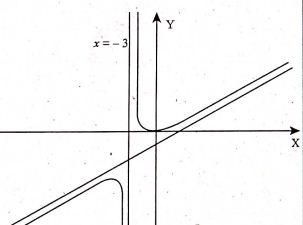
Given \(f(x)=\frac { { x }^{ 2 }-6x-1 }{ x+3 } \)
\(\underset { x\rightarrow -3^{ + } }{ lim } \frac { { x }^{ 2 }-6x-1 }{ x+3 } =\underset { h\rightarrow { 0 }^{ + } }{ lim } \frac { \left( -3+h \right) ^{ 2 }-6(-3+h)-1 }{ -3+h+3 } \)
= \(\underset { h\rightarrow 0^{ + } }{ lim } \frac { 9+{ h }^{ 2 }-6h+18-6h-1 }{ h } \)
= \(\underset { h\rightarrow 0^{ + } }{ lim } \frac { { h }^{ 2 }-12h+26 }{ h } =\infty \)
and \(\underset { x\rightarrow 3^{ - } }{ lim } \frac { { x }^{ 2 }-6x-1 }{ x+3 } =\underset { h\rightarrow { o }^{ + } }{ lim } \frac { \left( -3-h \right) ^{ 2 }-6(-3-h)-1 }{ -3-h+3 } \)
= -∞
ஃx = -3 is the vertical asymptote,
Also
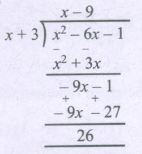
ஃ y = x - 9 is the slanting asymptote,
8.
Given \(f(x)=x-2logx, x\in [2,7]\)
(i) f(x) is continuous in [2, 7]
(ii) f(x) is differentiable in (2, 7)
f(2) = 2 - 2 log 2
= 2 - log 22 = 2 - log 4
f (7) = 7 - 2 log 7
= 7 - log 72 = 7 - log 49
Since f(2) ≠ f (7), Rolle's theorem is not applicable.
9.
Given = emx is the solution of
y' + 2y = 0 ...(1)
y = emx ...... (2)
\(\frac{dy}{dx} = e^{mx}. m\)
\(\frac{dy}{dx} = ym\)
\(\frac{dy}{dx} - my=0\)
⇒ y' - my = 0 ...(3)
Comparing equation (1) & (3),
we get m = -2
10.
\(\frac { { d }^{ 2 }y }{ d{ x }^{ 2 } } +5\frac { dy }{ dx } +\int { ydx } ={ x }^{ 3 }\)
The given differential equation is
\(\frac { { d }^{ 2 }y }{ d{ x }^{ 2 } } +5\frac { dy }{ dx } +\int { ydx } ={ x }^{ 3 }.\)
Differentiating again with respect to 'x' we get.
\(\frac { { d }^{ 2 }y }{ d{ x }^{ 2 } } +5\frac { { d }^{ 2 }y }{ d{ x }^{ 2 } } +y=3{ x }^{ 2 }\)
The highest derivative is 3 and its power is 1.
∴ Order is 3 and degree is 1.
11.
\( \lim _{x \rightarrow 0}(\cos x)^{\frac{1}{x}} \) \(\left[1^{\infty}\right. \) form
\(\text {Let } y =(\cos x)^{\frac{1}{x}} \)
\(\log y =\frac{1}{x} \log \cos x \)
\(\lim _{x \rightarrow 0} \log y =\lim _{x \rightarrow 0} \frac{\log \cos x}{x}\) \(\left[\frac{0}{0}\right. \) form
Applying L' Hopital's rule
\( =\lim _{x \rightarrow 0}-\frac{\sin x}{\frac{\cos x}{1}} \)
\( =\lim _{x \rightarrow 0}-\tan x=0 \)
\(\therefore \log \left(\lim _{x \rightarrow 0} y\right) =0 \)
\(\lim _{x \rightarrow 0} y =e^{0}=1 \)
\(ie., \lim _{x \rightarrow 0}(\cos x)^{\frac{1}{x}}=1\)
12.
u = sin 3x cos 4y
\( \frac{\partial u}{\partial x} =3 \cos 3 \mathrm{x}\ \cos 4 \mathrm{y} \)
\(\frac{\partial^{2} u}{\partial y \partial x} =-12 \cos 3 \mathrm{x} \ \sin 4 \mathrm{y} \)..........(1)
\(\frac{\partial u}{\partial y} =-4 \sin 3 \mathrm{x} \sin 4 \mathrm{y} \)
\(\frac{\partial^{2} u}{\partial x \partial y} =-12 \cos 3 \mathrm{x} \sin 4 \mathrm{y}\) ......(2)
From (1) and (2),
\(\frac{\partial^{2} u}{\partial x \partial y}=\frac{\partial^{2} u}{\partial y \partial x}\)
13.
First let us find wx, wy, and wz
Now wx = 2xy + z2, wy = 2yz +x2 and wz = 2zx + y2.
Thus,by (15), the differential is
dw = (2xy + z2 )dx + (2yz + x2 )dy+ (2zx + y2 )dz.
14.
\(\int _{ -1 }^{ 1 }{ \frac { dx }{ { x }^{ 2 }+2x+5 } } \)
\(=\int _{ -1 }^{ 1 }{ \frac { dx }{ { x }^{ 2 }+2x+1+4 } } =\int _{ -1 }^{ 1 }{ \frac { dx }{ { (x+1) }^{ 2 }{ 2 }^{ 2 } } } \)
\(\left[ \because \int { \frac { dx }{ { x }^{ 2 }-{ a }^{ 2 } } } =\frac { 1 }{ 2a } log\left| \frac { x-a }{ x+a } \right| \right] \)
\(={ \left[ \frac { 1 }{ 2 } { tan }^{ -1 }\left( \frac { x+1 }{ 2 } \right) \right] }_{ -1 }^{ 1 }\)
\(=\frac { 1 }{ 2 } \left[ { tan }^{ -1 }(1)-{ tan }^{ -1 }(0) \right] \)
\(\\ =\frac { 1 }{ 2 } \left[ \frac { \pi }{ 4 } \right] =\frac { \pi }{ 8 } \)
15.
Let I = \(\int _{ 0 }^{ \frac { \pi }{ 3 } }{ \frac { sec\ x\ tan\ x }{ 1+{ sec }^{ 2 }x } dx } \)
Put sec x = u. Then, sec x tan x dx = du.
When x = 0, u = sec0 = 1. When x = \(\frac{\pi}{3}, u=sec\frac{\pi}{2}=2\)
\(\therefore I=\int _{ 1 }^{ 2 }{ \frac { du }{ 1+{ u }^{ 2 } } ={ [{ tan }^{ -1 }u] }_{ 1 }^{ 2 }={ tan }^{ -1 }1={ tan }^{ -1 } } (2)-\frac { \pi }{ 4 } \)
16.
Let f(x) = \(f(x)={ x }^{ \frac { 2 }{ 3 } },{ x }_{ 0 }=125,\triangle x=-2\)
∴ (123)\(\frac23\) = f(125) +1'(125) (-2) ... (1)
\(f(125)={ (125) }^{ \frac { 2 }{ 3 } }={ { (5 }^{ 3 }) }^{ \frac { 2 }{ 3 } }\) = 52 = 25
\({ f }^{ ' }(x)={ \frac { 2 }{ 3 } x }^{ \frac { 2 }{ 3 } -1 }={ \frac { 2 }{ 3 } x }^{ \frac { 1 }{ 3 } }=\frac { 2 }{ { 3x }^{ \frac { 1 }{ 3 } } } \)
\({ f }^{ ' }(125)=\frac { 2 }{ { 3(125)x }^{ \frac { 1 }{ 3 } } } =\frac { 2 }{ { 3{ (5 }^{ 3 } })^{ \frac { 1 }{ 3 } } } =\frac { 2 }{ 3(5) } =\frac { 2 }{ 15 } \)
∴ \({ (123) }^{ \frac { 2 }{ 3 } }=25+\frac { 2 }{ 15 } (-2)\)
\(=25-\frac { 4 }{ 15 } =25-0.27\)
\({ (123) }^{ \frac { 2 }{ 3 } }=24.73\)
17.
| Function and its derivatives | log (1-x) cos x and its derivatives | Value at x = 0 |
| f(x) | log (1-x) | log 1 = 0 |
| fI(x) | \(\frac{-1}{1-x}\) = -1(1 - x)-1 | \(\frac{-1}{1}\) = -1 |
| fIl(x) | -1(1-x)-2 | -1 |
| fIIl(x) | -2(1-x)-3 | -2 |
| fIV(x) | -6 (1 - x)-4 | -6 |
| fV(x) | -24 (1 - x)-5 | -24 |
Meclaurin's expansion
\(f(x)=f(0)+\frac { { f }^{ 1 }(0) }{ 1! } x+\frac { { f }^{ II }(0) }{ 2! } { x }^{ 2 }+\frac { { f }^{ III }(0) }{ 3! } { x }^{ 3 }+\).................
log(1-x) = \(0-\frac { 1 }{ 1! } x-\frac { { x }^{ 2 } }{ 2! }- \frac { 2 }{ 3! } { x }^{ 3 }-\frac { { 6x }^{ 4 } }{ 4! } +.....\)
= \(-x-\frac { { x }^{ 2 } }{ 2 } +\frac { { x }^{ 3 } }{ 3 } +\frac { { x }^{ 4 } }{ 4 } \)+ .....
log(1 - x) = \(-\left( x+\frac { { x }^{ 2 } }{ 2 } +\frac { { x }^{ 3 } }{ 3 } +\frac { { x }^{ 4 } }{ 4 } +.... \right) \)
18.
Given that \((1+{ x }^{ 2 })\frac { dy }{ dx } =1+{ y }^{ 2 }\) ..(1)
The given equation is written in the variables separable form
\(\frac { dy }{ { 1+y }^{ 2 } } =\frac { dx }{ { 1+x }^{ x } } \) ...(2)
Integrating both sides of (2), we get tan−1 tan−1x +C.
But tan-1 y - tan-1 x = tan-1 \(\left( \frac { y-x }{ 1+xy } \right) .\) ...(4)
Using (4) in (3) leads to tan-1 \(\left( \frac { y-x }{ 1+xy } \right)\) = C, which implies \(\frac { y-x }{ 1+xy } \) = tan C = a (say).
Thus, y − x = a(1+ xy) gives the required solution
19.
Given curve is y = x2 − 5x + 4 and the line is 3x + y = 7
Slope of the tangent to the curve
\({ m }_{ 1 }=\frac { dx }{ dt } \) = 2x - 5
Slope of the line = \({ m }_{ 2}=\frac { dx }{ dt } \) = -3
\(\left[ \because m=\frac { co-efficient \ of \ x }{ co-efficient \ of \ y } \right] \)
Since the tangent of the curve and the lines are parallel, their slopes are equal.
∴ m1 = m2
⇒ 2x - 5 = -3
⇒ 2x = 2
⇒ x = 1
Substituting x = 1 in y = x2 - 5x + 4 we get
y = 12-5(1)+4 = 0
∴ The required point is (1, 0).
20.
The equation of the family of ellipses having centre at the origin & foci on the y-axis, is given
\(\frac { { x }^{ 2 } }{ { b }^{ 2 } } +\frac { { y }^{ 2 } }{ { a }^{ 2 } } =1\) ...(1)
where b >a & a, b are the parameters or a,b are arbitrary constant.
Differentiating equation (1) twice successively, because we have two arbitrary constant) we get
\( \frac{2 x}{a^{2}}+\frac{2 y}{b^{2}} \frac{d y}{d x} =0 \)
\(2\left(\frac{x}{a^{2}}+\frac{y}{b^{2}} \frac{d y}{d x}\right) =0 \)
\(\frac{x}{a^{2}}+\frac{y}{b^{2}} \frac{d y}{d x} =0\) ............(2)
Again differentiating equation (2)
\(\frac{1}{a^{2}}+\frac{y}{b^{2}} \frac{d^{2} y}{d x^{2}}+\frac{d y}{d x} \frac{d y}{d x b^{2}}=0\)
\(\frac{1}{a^{2}}+\frac{y}{b^{2}} \frac{d^{2} y}{d x^{2}}+\left(\frac{d y}{d x}\right)^{2} \frac{1}{b^{2}}=0\)
multiply by x
\(\frac{x}{a^{2}}+\frac{x y}{b^{2}}\left(\frac{d^{2} y}{d x^{2}}\right)+\left(\frac{d y}{d x}\right)^{2} \frac{x}{b^{2}}=0\) .........(3)
Equation (3)-(2)
\( \frac{x}{a^{2}}+\frac{x y}{b^{2}}\left(\frac{d^{2} y}{d x^{2}}\right)+\left(\frac{d y}{d x}\right)^{2}\left(\frac{x}{b^{2}}\right) -\left(\frac{x}{a^{2}}+\frac{y}{b^{2}} \frac{d y}{d x}\right) =0 \)
\(\frac{x y}{b^{2}}\left(\frac{d^{2} y}{d x^{2}}\right)+\left(\frac{d y}{d x}\right)^{2} \frac{x}{b^{2}}-\frac{y}{b^{2}} \frac{d y}{d x} =0 \)
Taking \(\frac{1}{b^{2}}\) outside, we get
\( \frac{1}{b^{2}}\left[x y \frac{d^{2} y}{d x^{2}}+x\left(\frac{d y}{d x}\right)^{2}-y \frac{d y}{d x}\right]=0 \\ x y \frac{d^{2} y}{d x^{2}}+x\left(\frac{d y}{d x}\right)^{2}-y \frac{d y}{d x}=0 \)
is the required differential equation.
21.
Note that the function u is not homogeneous. So we cannot apply Euler’s Theorem for u.
However, note that f(x,y) = \(\frac { x+y }{ \sqrt { x } +\sqrt { y } }\) = sin u is homogeneous; because
f(tx,ty) = \(\frac { tx+ty }{ \sqrt { tx } +\sqrt { ty } } \) = t1/2 f(x, y), \(\forall \) x, y, t\(\ge \)0
Thus f is homogeneous with degree \(\frac { 1 }{ 2 } \) and so by Euler’s Theorem we have
\(x\frac { \partial f }{ \partial x } +y\frac { \partial f }{ \partial y } =\frac { 1 }{ 2 } f(x,y)\).
Now substituting f = sin u in the above equation, we obtain
\(x\frac { \partial (sinu) }{ \partial x } +y\frac { \partial (sinu) }{ \partial y } =\frac { 1 }{ 2 } sin \ u\)
\(x\quad cosu\frac { \partial u }{ \partial x } +y\quad cosu\frac { \partial u }{ \partial x } =\frac { 1 }{ 2 } sin \ u\) ...(19)
Dividing both sides by cosu we obtain
\(x\frac { \partial u }{ \partial x } +y\frac { \partial u }{ \partial y } =\frac { 1 }{ 2 } tan \ u\)
Note:
Solving this problem by direct calculation will be possible; but will involve lengthy calculations.
22.
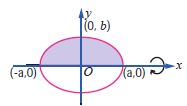
The ellipse is symmetric about both the axes. The major axis lies along x-axis. The region to be revolved is sketched
Hence, the required volume is given by
\(V=\pi \int _{ -a }^{ a }{ { y }^{ 2 }dx } =\pi \int _{ -a }^{ a }{ \frac { { b }^{ 2 } }{ { a }^{ 2 } } \left( { a }^{ 2 }-{ x }^{ 2 } \right) dx } \)
\(=\frac { 2\pi { b }^{ 2 } }{ { a }^{ 2 } } \int _{ 0 }^{ a }{ ({ a }^{ 2 }-{ x }^{ 2 })dx } \) since the integrand is an even function
\(=\frac { { 2\pi b }^{ 2 } }{ { a }^{ 2 } } { \left( { a }^{ 2 }x-\frac { { x }^{ 3 } }{ 3 } \right) }_{ 0 }^{ a }=\frac { 2\pi { b }^{ 2 } }{ 3 } ={ \left( { a }^{ 2 }-\frac { { a }^{ 3 } }{ 3 } \right) }_{ 0 }^{ a }=\frac { 2\pi { b }^{ 2 } }{ 3 } \left( \frac { { 2a }^{ 3 } }{ 3 } \right) =\frac { 4\pi { ab }^{ 2 } }{ 3 } \)
23.
Given U (x, y) = ex sin y ; x = st2 ; y = s2t
\(\frac { \partial U }{ \partial x } \) = ex sin y ; \(\frac { \partial U }{ \partial y } \) = ex cos y
\(\frac { \partial U }{ \partial x } \) = \({ e }^{ { st }^{ 2 } }\) sin (s2t)
\(\frac { \partial U }{ \partial y } \) = \({ e }^{ { st }^{ 2 } }\) cos (s2t)
\(\frac{dx}{dt}\) = 2st; \(\frac{dy}{dt}\) = s2
\(\frac{dx}{ds}\) = t2; \(\frac{dy}{ds}\) = 2 st
By chain rule
\(\frac { dU }{ ds } =\frac { \partial U }{ \partial x } .\frac { dx }{ ds } +\frac { \partial U }{ \partial y } .\frac { dy }{ ds } \)
= \({ e }^{ { st }^{ 2 } }\). sin (s2t) (t2) + \({ e }^{ { st }^{ 2 } }\) cos(s2t).(2st)
∴ \({ \left( \frac { \partial U }{ \partial s } \right) }_{ (s=t=1) }\) = e1 sin (1) + 2e1 cos (1)
= e [sin (1) + 2 cos (1)] and
\(\frac { dU }{ dt } =\frac { \partial u }{ \partial x } .\frac { dx }{ dt } +\frac { \partial u }{ \partial y } .\frac { dy }{ dt } \)
= \({ e }^{ { st }^{ 2 } }\) . sin (s2t)(2st) + \({ e }^{ { st }^{ 2 } }\) cos (s2t). (s2)
∴ \({ \left( \frac { \partial U }{ \partial t } \right) }_{ (s=t=1) }\) = 2e1 sin (1) + e1 cos (1)
= e [2 sin (1) + cos (1)]
24.
The region is sketched. The upper boundary of the region is y = sin x for \(\\ \\ \frac { \pi }{ 4 } \le x\le \frac { 5\pi }{ 4 } \) and the lower boundary of the region is y = cos x for \(\frac { \pi }{ 4 } \le x\le \frac { 5\pi }{ 4 } \). So the required area A is given by
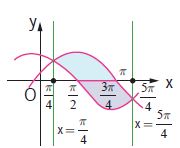
\(A=\int _{ \frac { \pi }{ 4 } }^{ \frac { 5\pi }{ 4 } }{ ({ y }_{ U }-{ y }_{ L })dx= } \int _{ \frac { \pi }{ 4 } }^{ \frac { 5\pi }{ 4 } }{ (sinx-cosx)dx={ [-cosx=sinx] }_{ \frac { \pi }{ 4 } }^{ \frac { 5\pi }{ 4 } } } \)
\(=\left( -sin\frac { 5\pi }{ 4 } -cos\frac { 5\pi }{ 4 } \right) -\left( -sin\frac { \pi }{ 4 } -cos\frac { \pi }{ 4 } \right) \)
\(=\left( -\left( -\frac { 1 }{ \sqrt { 2 } } \right) -\left( -\frac { 1 }{ \sqrt { 2 } } \right) -\left( -\left( \frac { 1 }{ \sqrt { 2 } } \right) -\left( \frac { 1 }{ \sqrt { 2 } } \right) \right) \right) \)
\(=\frac { 2 }{ \sqrt { 2 } } +\frac { 2 }{ \sqrt { 2 } } =2\sqrt { 2 } \)
25.
First, we get the points of intersection of the parabolas. For this, we solve y2 x = 4 and x2 y = 4 simultaneously Eliminating y between them, we get x4 = 64x and so x = 0 and x = 4. Then the points of intersection are (0, 0) and (4, 4). The required region is sketched.
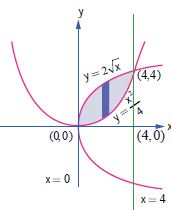
Viewing in the direction of y -axis, the equation of the upper boundary is y = 2\(\sqrt x\) for 0\(\le x \le\) 4 and the equation of the lower boundary is \(y =\frac {x^2}{4}\)for \(0 \leq x \leq 4\). So, the required area \(\Delta\) is
\(A=\int_{0}^{4}\left(y_{U}-Y_{L}\right) d x=\int_{0}^{4}\left(2 \sqrt{x}-\frac{x^{2}}{4}\right) d x=\left[2\left(\frac{2 x^{3 / 2}}{3}\right)-\frac{x^{3}}{12}\right]_{0}^{4}=\left[2\left(\frac{2 \times 8}{3}\right)-\frac{64}{12}\right]-0=\frac{16}{3}\)
26.
Put u = tan \(\frac{x}{2}\)
Then, sin x = \(\frac{2 tan \frac {x}{2}}{1 + tan^2 \frac{x}{2}}\) = \(\frac{2u}{1+u^2}\), du = \(\frac{1}{2}\) sec2 \(\frac{x}{2}\) dx \(\Rightarrow \) dx = \(\frac {2du}{1+u^2}\)
When x = 0,u = tan 0 = 0
When x = \(\frac{\pi}{2},u=tan\frac{\pi}{4}=1\)
∴ I =\(\int ^\frac{\pi}{2}_0\) \(\frac{dx}{4+5 sin x}\) =\(\int ^{1}_0\) \(\frac{\frac {2du}{1+u^2}}{4+5 (\frac{2u}{1+u^2})}\) =\(\int ^{1}_0\) \(\frac {du}{2u^2+5u +2}\)=\(\frac{1}{2}\)\(\int ^{1}_{0}\) \(\frac {du}{u^2+\frac{5}{2}u +1}\)
\(\frac { 1 }{ 2 } \int _{ 0 }^{ 1 } \frac { du }{ (u+\frac { 5 }{ 4 } )^2-(\frac { 3 }{ 4 } )^{ 2 } } { \left[ \frac { 1 }{ 2 } \times \frac { 1 }{ 2\times \left( \frac { 3 }{ 4 } \right) } log\left( \frac { (u+\frac { 5 }{ 4 } )-\frac { 3 }{ 4 } }{ (u+\frac { 5 }{ 4 } )+\frac { 3 }{ 4 } } \right) \right] }_{ 0 }^{ 1 }
= \frac{1}{3} [log (\frac{u+\frac{1}{2}}{u+2})]
=\frac { 1 }{ 3 } log2\)
27.
Let P be denote the population of a city
Given that \(\frac{dP}{dt}\infty\)
\(\Rightarrow P=\frac{dP}{dt}kP\)
\(\Rightarrow \frac{dP}{P}=kdt\)
\(\Rightarrow \int { \frac { dP }{ P } = } k\int { dt } \)
\(\Rightarrow logP=kt+logc\)
\(\Rightarrow log\left( \frac { P }{ c } \right) =kt\)
\(\Rightarrow \frac { P }{ c } ={ e }^{ kt }\)
\(_{ }^{ c }{ P }={ c.e }^{ kt } ..(1)\)
Given when t = 0, P = 3,00,000
\(\therefore(1)\rightarrow\) = ce0 \(\Rightarrow\) c = 3,00,000
\(\therefore\) P = 3,00,000 ekt ...(2)
Again when t = 40, P = 4,00,000
\(\therefore\) (2) \(\Rightarrow\) 4,00,000 = 3,00,000e40k
\(\Rightarrow \frac { 4 }{ 3 } ={ e }^{ 40k }\)
\(\Rightarrow log\left( \frac { 4 }{ 3 } \right) =40K\)
\(\Rightarrow K=\frac { 1 }{ 40 } log\left( \frac { 4 }{ 3 } \right) \)
\(\Rightarrow k=log{ \left( \frac { 4 }{ 3 } \right) }^{ \frac { 1 }{ 40 } }...(3)\)
\(\therefore\) (2) becomes, P = 3,00,000\({ e }^{ log{ \left( \frac { 4 }{ 3 } \right) }^{ \frac { 1 }{ 40 } t } }\)
\(\Rightarrow\) P = 3,00,000 \(^{ { \left( \frac { 4 }{ 3 } \right) }^{ \frac { 1 }{ 40 } } }\)
28.
\((x+a)\frac { dy }{ dx } -2y={ (x+a) }^{ 4 }\)
\(\div (x+a)\)we get,
\(\frac { dy }{ dx } -\frac { 2 }{ x+a } y={ (x+a) }^{ 3 }\)
This is a linear differential equation
\(\therefore P=\frac { -2 }{ x+a } ;Q={ (x+a) }^{ 3 }\)
\(\int { pdx } =\int { \frac { -2 }{ x+a } } dx=-2log(x+a)\)
\(=log{ \left( \frac { 1 }{ x+a } \right) }^{ 2 }\)
\(\therefore I.F.={ e }^{ \int { pdx } }={ e }^{ log{ \left( \frac { 1 }{ x+a } \right) }^{ 2 } }=\frac { 1 }{ { (x+a) }^{ 2 } } \)
The solution is \(\Rightarrow { ye }^{ \int { pdx } }=\int { Q{ e }^{ \int { pdx } }dx+c } \)
\(\Rightarrow y\left( \frac { 1 }{ { (x+a) }^{ 2 } } \right) =\int { { (x+a) }^{ 3 }\frac { 1 }{ (x+a{ ) }^{ 2 } } dx+c } \)
\(\Rightarrow \frac { y }{ { (x+a) }^{ 2 } } =\int { (x+a)dx+c } \)
\(\Rightarrow \frac { y }{ { (x+a) }^{ 2 } } =\int { (x+a)dx+c } \)
\(\Rightarrow \frac { y }{ { (x+a) }^{ 2 } } =\frac { { (x+a) }^{ 2 } }{ 2 } +c\)
\(\Rightarrow \frac { y }{ { (x+a) }^{ 2 } } =\frac { { (x+a) }^{ 2 }+2c }{ 2 } \)
\(2y={ (x+a) }^{ 4 }{ +2c(x+a) }^{ 2 }\)
29.
30.
Given that the equation is \(\frac{dv}{dx}+2y\ cot\ x=3x^2 cosec^2x\)
This is a linear differential equation. Here, P = 2 cot x ; Q = 3x2cosec2x.
\(\int { Pdx=\int { 2cot\quad xdx=2log|sin\quad x|=log|sin\quad x{ | }^{ 2 } } =log{ sin }^{ 2 }x } \)
Thus, \(I.F={ e }^{ \int { Pdx } }={ e }^{ log{ sin }^{ 2 } }x={ sin }^{ 2 }x\)
Hence, the solution is \({ ye }^{ \int { Pdx } }={ \int { Qe } }^{ \int { Pdx } }dx+C\)
That is, \(y{ sin }^{ 2 }x=\int { { 3x }^{ 2 }cose{ c }^{ 2 }x.{ sin }^{ 2 }xdx+C=\int { { 3x }^{ 2 }dx+C={ x }^{ 3 }+C } } \)
Hence, \(y{ sin }^{ 2 }x={ x }^{ 3 }+C\) is the required solution
31.
Givenf(x) = sin x + cos x, 0
f"(x) = sin x - cos x
\(\therefore\) f"(x) = 0
\(\Rightarrow\) sin x - cos X = 0
\(\Rightarrow\) -sin x = cosx
\(\Rightarrow\) sin (-x) = cos x
\(\Rightarrow\) \(x=\frac { 3\pi }{ 4 } ,\frac { 7\pi }{ 4 } ,2\pi \)
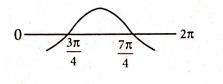
ஃ The possible intervals are \(\left( 0,\frac { 3\pi }{ 4 } \right) \left( \frac { 3\pi }{ 4 } ,\frac { 7\pi }{ 4 } \right) \left( \frac { 7\pi }{ 4 } ,2\pi \right) \)
| Interval | \(\left( 0,\frac { 3\pi }{ 4 } \right) \) | \(\left( \frac { 3\pi }{ 4 } ,\frac { 7\pi }{ 4 } \right) \) | \(\left( \frac { 7\pi }{ 4 } ,2\pi \right) \) |
| Say x = -1 \(f''\left( x \right) =-\frac { 1 }{ \sqrt { 2 } } -\frac { 1 }{ \sqrt { 2 } } =-\frac { 2 }{ \sqrt { 2 } } \) |
Say x = π f''(x) = -sinπ-cosπ = 0-(1) = 1 +ve |
Say x = 320° f" (x) = - sin 320 - cos 320 = -sin (270 + 60) - cos (270 + 60) = cos 60 - sin 60 = \(\frac { 1 }{ 2 } -\frac { \sqrt { 3 } }{ 2 } \) -ve |
|
| Concavity | Concave down | Concave up | Concave down |
ஃf (x) is concave upward in \(\left( \frac { 3\pi }{ 4 } ,\frac { 7\pi }{ 4 } \right) \) and concave downward in \(\left( 0,\frac { 3\pi }{ 4 } \right) \left( \frac { 7\pi }{ 4 } ,2\pi \right) \)
Since f" (x) changes its sign from negative to positive at \(\frac { 3\pi }{ 4 } \) and positive at \(\frac { 7\pi }{ 4 } \) f(x) has point of inflection at \(\left( \frac { 3\pi }{ 4 } ,f\left( \frac { 3\pi }{ 4 } \right) \right) \) and
\(\left( \frac { 7\pi }{ 4 } ,f\left( \frac { 7\pi }{ 4 } \right) \right) \)
\(\therefore f\left( \frac { 3\pi }{ 4 } \right) =sin\frac { 3\pi }{ 4 } -cos\frac { \pi }{ 4 } \)
= \(sin\left( \pi -\frac { \pi }{ 4 } \right) +cos\left( \frac { \pi }{ 4 } \right) \)
= \(\frac { 1 }{ \sqrt { 2 } } -\frac { 1 }{ \sqrt { 2 } } =0\)
ஃ The points of inflection are \(\left( \frac { 3\pi }{ 4 } ,0 \right) \) and \(\left( \frac { 7\pi }{ 4 } ,0 \right) \)
32.
The given differential equation may be written
\(\Rightarrow \frac { dy }{ dx } =\frac { -3{ e }^{ \frac { y }{ x } }\left( 1-\frac { y }{ x } \right) }{ 1+3{ e }^{ \frac { y }{ x } } } ...(1)\)
This is a homogeneous differential equation
\(\therefore put\quad y=vx\Rightarrow \frac { dy }{ dx } =v+x\frac { dv }{ dx }\)
\(v+x\frac { dv }{ dx } =\frac { -3{ e }^{ v }(1-v) }{ 1+3{ e }^{ v } }\)
\(\Rightarrow x\frac { dv }{ dx } =\frac { -3{ e }^{ v }(1-v) }{ 1+3{ e }^{ v } } -v\)
\(\Rightarrow \quad x \frac{d v}{d x}=\frac{-3 e^v+3 x e^v-v-3 v e^v}{1+3 e^v}\)
\(=\frac { -3{ e }^{ v }-v }{ 1+3{ e }^{ v } } =-\left( \frac { -3{ e }^{ v }+v }{ 1+3{ e }^{ v } } \right)\)
Separating the variables we get,
\(\frac { 1+3{ e }^{ v } }{ 3{ e }^{ v }+v } dv=-\frac { dx }{ x }\)
\(\Rightarrow log(3{ e }^{ v }+v)=-log\quad x+log\quad c\)
\(\Rightarrow log(3{ e }^{ v }+v)=log\left( \frac { c }{ x } \right) \Rightarrow { 3e }^{ v }+v=\frac { c }{ x }\)
\({ 3e }^{ \frac { y }{ x } }+\frac { y }{ x } =\frac { c }{ x }\)
\(\Rightarrow \frac { 3x{ e }^{ \frac { y }{ x } }+y }{ x } =\frac { c }{ x }\)
\(\Rightarrow y+3x{ e }^{ \frac { y }{ x } }=c\)
Given that y = 0 when x = 1
3(1)e0+ 0 = c \(\Rightarrow\) c = 3
\(\therefore\) (2) becomes, 3x\({ e }^{ \frac { y }{ x } }\)+ y = 3
33.
34.
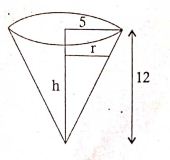
35.
(a)
3, not defined
36.
(c)
0
37.
(c)
5x - 1
38.
(d)
both the axes
39.
(d)
40.
(d)
\(\frac{2}{27}\)
41.
(b)
\(\frac{1}{10100}\)
42.
(c)
\(\frac{8}{3}\)
43.
(b)
\(\frac { 1 }{ ({ x+1) }^{ 2 } } dx\)
44.
(d)
4.8 cu.cm
45.
(c)
yxy-1
46.
(b)
\(\frac15\)
47.
(a)
48.
(d)
cot x
49.
(b)
\(\frac { { d }^{ 2 }y }{ { dx }^{ 2 } } -y=0\)
50.
(a)
2, 3
51.
(c)
52.
(d)
2
53.
(b)
-4
54.
(b)

12th Standard Syllabus & Materials
12th Standard
TN 12th Computer Applications களப்பெயர் முறைமை (DNS) Sample Question Papers Study Material - QB365 Set A
NEW12th Standard
TN 12th Computer Applications வலையமைப்பு எடுத்துக்காட்டுகள் மற்றும் நெறிமுறைகள் Sample Question Papers Study Material - QB365 Set A
NEW12th Standard
TN 12th Computer Applications கணினி வலையமைப்பு ஓர் அறிமுகம் Sample Question Papers Study Material - QB365 Set A
NEW12th Standard
TN 12th Computer Applications PHP-உடன் MySQL-ஐ இணைத்தல் Sample Question Papers Study Material - QB365 Set A



Tamilnadu Stateboard 12th Standard Subjects
Maths

Chemistry

Physics

Biology

Computer Science

Business Maths and Statistics

Economics

Commerce

Accountancy

History

Computer Applications
Biology
Computer Technology
Computer Applications
Computer Science
Business Maths and Statistics
Commerce
Economics
Maths
Chemistry
Physics
Computer Technology
History
Accountancy

Tamil

English

French
Tamilnadu Stateboard Standards


