
 100% FREE ACCESS
12th Standard Syllabus & Materials
12th Standard
TN 12th Computer Applications மின்னணு தரவு பரிமாற்றம் Sample Question Papers Study Material - QB365 Set A
NEW12th Standard
TN 12th Computer Applications மின் - வணிக பாதுகாப்பு அமைப்புகள் Sample Question Papers Study Material - QB365 Set A
NEW12th Standard
TN 12th Computer Applications மின்னணு செலுத்தல் முறைகள் Sample Question Papers Study Material - QB365 Set A
NEW12th Standard
TN 12th Computer Applications மின் - வணிகம் Sample Question Papers Study Material - QB365 Set A
NEW12th Standard
TN 12th Computer Applications திறந்த மூல கருத்துருக்கள் Sample Question Papers Study Material - QB365 Set A
NEW12th Standard
TN 12th Computer Applications வலையமைப்பு வடமிடல் Sample Question Papers Study Material - QB365 Set A

Published on: 28/11/2025
Download Tamil Nadu 12th Standard Maths question papers, model tests, one-mark questions, important questions, and public exam papers in PDF format. Free study materials and answer keys for TN State Board students.
Questions + Answers key
Take MCQ Maths Test
1.
Test the curve y = x4 for points of inflection.
2.
Let A =\(\begin{bmatrix} 0 & 1 \\ 1 & 1 \end{bmatrix},B=\begin{bmatrix} 1 & 1 \\ 0 & 1 \end{bmatrix}\)be any two boolean matrices of the same type. Find AvB and A\(\wedge\)B.
3.
A pair of fair dice is rolled once. Find the probability mass function to get the number of fours.
4.
Evaluate the following:
\(\int _{ 0 }^{ \infty }{ { x }^{ 5 }{ e }^{ -3x }dx } \)
5.
Find df for f(x) = x2 + 3x and evaluate it for
x = 3 and dx = 0.02
6.
Evaluate :\(\int _{ 0 }^{ 1 }{ [2x] } dx\) where [⋅] is the greatest integer function
7.
Prove that the function f (x) = x2 − 2x − 3 is strictly increasing in \((2, \infty)\)
8.
Show that y = mx + \(\frac{7}{m}\), m ≠ 0 is a solution of the differential equation xy'+7\(\frac{1}{y'}\)-y = 0.
9.
If the volume of a cube of side length x is v = x3. Find the rate of change of the volume with respect to x when x = 5 units.
10.
Find value of m so that the function y = emx is a solution of the given differential equation.
y '+ 2y = 0
11.
Show that \(\neg(p \rightarrow q) \equiv p \wedge \neg q\)
12.
If u = sin-1 \(\left( \frac { x+y }{ \sqrt { x } +\sqrt { y } } \right) \), Show that \(x\frac { \partial u }{ \partial x } +y\frac { \partial u }{ \partial y } =\frac { 1 }{ 2 } tanu\)
13.
Two balls are chosen randomly from an urn containing 8 white and 4 black balls. Suppose that we win Rs. 20 for each black ball selected and we lose Rs. 10 for each white ball selected. Find the expected winning amount and variance
14.
Find the area of the region bounded between the parabolas y2 = 4x and x2 = 4y.
15.
Let w(x, y, z) = \(\frac { 1 }{ \sqrt { { x }^{ 2 }+{ y }^{ 2 }+{ z }^{ 2 } } } ,(x,y,z)\neq (0,0,0)\). Show that \(\frac { { \partial }^{ 2 }w }{ \partial { x }^{ 2 } } +\frac { { \partial }^{ 2 }w }{ \partial { y }^{ 2 } } +\frac { { \partial }^{ 2 }w }{ \partial { z }^{ 2 } } =0\)
16.
Evaluate \(\int ^{\pi}_{-\pi} \frac{cos ^2 x}{1+ a^x}\) dx
17.
The cumulative distribution function of a discrete random variable is given by
\(F(x)=\left\{\begin{array}{lc}
0 & -\infty<x<-1 \\
0.15 & -1 \leq x<0 \\
0.35 & 0 \leq x<1 \\
0.60 & 1 \leq x<2 \\
0.85 & 2 \leq x<3 \\
1 & 3 \leq x<\infty
\end{array}\right.\)
Find
(i) the probability mass function
(ii) P(X < 1 ) and
(iii) P(X \(\geq\)2)
18.
Evaluate: \( (\underset{x\rightarrow \infty}{lim}(1+2x)^{\frac{1}{2log\ x}}\)
19.
In a murder investigation, a corpse was found by a detective at exactly 8 p.m. Being alert, the detective also measured the body temperature and found it to be 70oF. Two hours later, the detective measured the body temperature again and found it to be 60oF. If the room temperature is 50oF, and assuming that the body temperature of the person before death was 98.6oF, at what time did the murder occur? [log(2.43) = 0.88789; log(0.5)=-0.69315]
20.
A manufacturer wants to design an open box having a square base and a surface area of 108 sq. cm. Determine the dimensions of the box for the maximum volume.
21.
Expand tan x in ascending powers of x upto 5th power for \(-\frac{\pi}{2} <x<\frac{\pi}{2}\)
22.
Find intervals of concavity and points of inflexion for the following functions
f(x) = x(x - 4)3
23.
If F is the constant force generated by the motor of an automobile of mass M, its velocity is given by M \(\frac{dV}{dt}\)= F-kV, where k is a constant. Express V in terms of t given that V = 0 when t = 0.
24.
Salt is poured from a conveyer belt at a rate of 30 cubic metre per minute forming a conical pile with a circular base whose height and diameter of base are always equal. How fast is the height of the pile increasing when the pile is 10 metre high?
25.
In an algebraic structure the inverse of an element (if exists) must be unique.
26.
Suppose that f (x) given below represents a probability mass function
| x | 1 | 2 | 3 | 4 | 5 | 6 |
| f(x) | c2 | 2c2 | 3c2 | 4c2 | c | 2c |
Find
(i) the value of c
(ii) Mean and variance.
27.
Let g(x, y) = \(\frac { { e }^{ y }sinx }{ x } \), for x ≠ 0 and g(0, 0) = 1. Show that g is continuous at (0, 0).
28.
The time T, taken for a complete oscillation of a single pendulum with length l, is given by the equation T = 2ㅠ\(\sqrt { \frac { 1 }{ g } } \), where g is a constant. Find the approximate percentage error in the calculated value of T corresponding to an error of 2 percent in the value of l.
29.
Evaluate :\(\int _{ 0 }^{ 9 }{ \frac { 1 }{ x+\sqrt { x } } dx } \)
30.
A six sided die is marked '2' on one face, '3' on two ofits faces, and '4' on remaining three faces. The die is thrown twice. If X denotes the total score in two throws, find the values of the random variable and number of points in its inverse images.
31.
Compute the value of 'c' satisfied by the Rolle’s theorem for the function f (x) = x2 (1 - x)2, x ∈ [0,1]
32.
Solve the following differential equations or show that the solution of
\(\\ \\ \\ \frac { dy }{ dx } =\sqrt { \frac { 1-{ y }^{ 2 } }{ 1-{ x }^{ 2 } } } \)
33.
Find the points of x the curve y = x3 − 3x2 + x − 2 at which the tangent is parallel to the line y = x
34.
A point moves along a straight line in such a way that after t seconds its distance from the origin is s = 2t2 + 3t metres.
(i) Find the average velocity of the points between t = 3 and t = 6 seconds.
(ii) Find the instantaneous velocities at t = 3 and t = 6 seconds.
35.
Which one of the following is incorrect? For any two propositions p and q, we have
¬ (p∨q) ≡ ¬ p ∧ ¬q
¬ ( p∧ q)≡¬p ∨ ¬q
¬ (p ∨ q)≡¬p∨¬q
¬(¬p)≡ p
36.
37.
The operation * defined by \(a * b =\frac{ab}{7}\) is not a binary operation on
Q+
Z
R
C
38.
39.
A binary operation on a set S is a function from
S ⟶ S
(SxS) ⟶ S
S⟶ (SxS)
(SxS) ⟶ (SxS)
40.
For any value of \(n \in \mathbb{Z}, \int_{0}^{\pi} e^{\cos ^{2} x} \cos ^{3}[(2 n+1) x] d x\) is
\(\frac{\pi}{2}\)
\(\pi\)
0
2
41.
The value of \(\int _{ 0 }^{ \pi }{ { sin }^{ 4 }xdx } \) is
\(\frac{3\pi}{10}\)
\(\frac{3\pi}{8}\)
\(\frac{3\pi}{4}\)
\(\frac{3\pi}{2}\)
42.
43.
The value of \(\int _{ 0 }^{ \pi }{ \frac { dx }{ 1+{ 5 }^{ cos\ x } } } \) is
\(\frac{\pi}{2}\)
\(\pi\)
\(\frac{3\pi}{2}\)
\(2\pi\)
44.
Linear approximation for g(x) = cos x at \(x=\frac{\pi}{2}\) is
\(x+\frac{\pi}{2}\)
\(-x +\frac{\pi}{2}\)
\(x - \frac{\pi}{2}\)
\(-x - \frac{\pi}{2}\)
45.
If u(x, y) = x2+ 3xy + y - 2019, then \(\left.\frac{\partial u}{\partial x}\right|_{(4,-5)}\) is equal to
-4
-3
-7
13
46.
The change in the surface area S = 6x2 of a cube when the edge length varies from xo to xo+ dx is
12 xo+dx
12xo dx
6xo dx
6xo+ dx
47.
The probability mass function of a random variable is defined as:
| x | -2 | -1 | 0 | 1 | 2 |
| f(x) | k | 2k | 3k | 4k | 5k |
Then E(X ) is equal to:
\(\frac { 1 }{ 15 } \)
\(\frac { 1 }{ 10 } \)
\(\frac { 1 }{ 3 } \)
\(\frac { 2 }{ 3 } \)
48.
If X is a binomial random variable with expected value 6 and variance 2.4, then P(X = 5) is
\(\left( \frac { 10 }{ 5 } \right) \left( \frac { 3 }{ 5 } \right) ^{ 6 }\left( \frac { 2 }{ 5 } \right) ^{ 4 }\)
\(\left( \frac { 10 }{ 5 } \right) \left( \frac { 3 }{ 5 } \right) ^{ 10 }\)
\(\left( \frac { 10 }{ 5 } \right) { \left( \frac { 3 }{ 5 } \right) }^{ 4 }\left( \frac { 2 }{ 5 } \right) ^{ 6 }\)
\(\left( \frac { 10 }{ 5 } \right) \left( \frac { 3 }{ 5 } \right) ^{ 5 }\left( \frac { 2 }{ 5 } \right) ^{ 5 }\)
49.
Four buses carrying 160 students from the same school arrive at a football stadium. The buses carry, respectively, 42, 36, 34, and 48 students. One of the students is randomly selected. Let X denote the number of students that were on the bus carrying the randomly selected student. One of the 4 bus drivers is also randomly selected. Let Y denote the number of students on that bus. Then E(X) and E(Y) respectively are
50,40
40,50
40.75,40
41,41
50.
Let X be random variable with probability density function
\(f(x)=\left\{\begin{array}{ll} \frac{2}{x^{3}} & x \geq 1 \\ 0 & x<1 \end{array}\right.\)
Which of the following statement is correct
both mean and variance exist
mean exists but variance does not exist
both mean and variance do not exist
variance exists but Mean does not exist
51.
The solution of the differential equation \(\frac { dy }{ dx } =2xy\) is
y = Cex2
y = 2x2 + C
y = Ce−x2 + C
y = x2 + C
52.
The integrating factor of the differential equation \(\frac{d y}{d x}+P(x) y=Q(x)\) is x, then P(x)
x
\(\frac { { x }^{ 2 } }{ 2 } \)
\(\frac{1}{x}\)
\(\frac{1}{x^2}\)
53.
What is the value of the limit \(\lim _{x \rightarrow 0}\left(\cot x-\frac{1}{x}\right) \text { is }\)
0
1
2
∞
54.
The point on the curve 6y = x3 + 2 at which y-coordinate changes 8 times as fast as x-coordinate is
(4, 11)
(4, -11)
(-4, 11)
(-4,-11)
1.
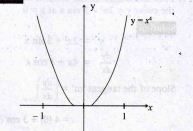
\(
y =x^{4}
\)
\(y^{\prime} =4 x^{3}
\)
\(y^{\prime \prime} =12 x^{2}
\)
\(y^{\prime \prime}=0 \Rightarrow 12 x^{2}=0
\)
x =0
Also y" >0 for x < 0 and x > 0
Hence the curve is concave upward. y'' does not change sign as the curve passes through x = 0. Thus the curve does not admit any point of inflection. The curve is concave in (\(-\infty\),0) and (0, \(\infty\)) .
2.
Then A∨ B =\(\begin{bmatrix} 0 & 1 \\ 1 & 1 \end{bmatrix}\vee \begin{bmatrix} 1 & 1 \\ 0 & 1 \end{bmatrix}=\begin{bmatrix} 0\vee 1 & 1\vee 1 \\ 1\vee 0 & 1\vee 1 \end{bmatrix}=\begin{bmatrix} 1 & 1 \\ 1 & 1 \end{bmatrix}\)
\(A\wedge B=\begin{bmatrix} 0 & 1 \\ 1 & 1 \end{bmatrix}\wedge \begin{bmatrix} 1 & 1 \\ 0 & 1 \end{bmatrix}=\begin{bmatrix} 0\wedge 1 & 1\wedge 1 \\ 1\wedge 0 & 1\wedge 1 \end{bmatrix}=\begin{bmatrix} 0 & 1 \\ 0 & 1 \end{bmatrix}\)
3.
\(S=\left|\begin{array}{l} (1,1),(1,2),(1,3),(1,4),(1,5),(1,6) \\ (2,1),(2,2),(2,3),(2,4),(2,5),(2,6) \\ (3,1),(3,2),(3,3),(3,4),(3,5),(3,6) \\ (4,1),(4,2),(4,3),(4,4),(4,5),(4,6) \\ (5,1),(5,2),(5,3),(5,4),(5,5),(5,6) \\ (6,1),(6,2),(6,3),(6,4),(6,5),(6,6) \end{array}\right|\)
Let X be a random variable whose values x are the number of fours.
The sample space S is given in the table.
It can also be written as
S = {(i, j)} , where i = 1, 2, 3, 6 and j = 1, 2, 3, 6
Therefore X takes on the values of 0, 1 and 2.
We observe that
(i) X = 0, if (i, j) for i ≠ 4, j≠ 4,
(ii) X = 1, if (1, 4), (2, 4), (3, 4), (5, 4), (6, 4), (4, 1), (4, 2), (4, 3), (4, 5), (4, 6)
(iii) X = 2, if (4, 4) ,
Therefore,
| Values of the Random Variable X | 0 | 1 | 2 | Toatal |
| Number of elements in inverse images | 25 | 10 | 1 | 36 |
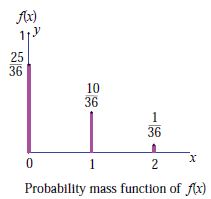
The probabilities are
\(f(0)=P(X=0)\cfrac { 25 }{ 36 } \)
\(f(1)=P(X=1)=\cfrac { 10 }{ 36 } \)
and \(f(20=P(X=2)=\cfrac { 1 }{ 36 } \)
Clearly the function f(x) satisfies the conditions
(i) f (x) ≥ 0, for x = 0, 1, 2 and
(ii) \(\underset { x }{ \Sigma } f(x)=\sum _{ x=0 }^{ x=-2 }{ f(x) } =f(0)+f(1)+f(2)=1\)
\(=\frac{25}{36}+\frac{10}{36}+\frac{1}{36}=1\)
The probability mass function is presented as
| x | 0 | 1 | 2 |
| f(x) | \(\frac { 25 }{ 36 } \) | \(\frac { 10 }{ 36 } \) | \(\frac { 1 }{ 36 } \) |
(or)
\(f(x)=\begin{cases} \begin{matrix} \frac { 25 }{ 36 } & for \ x=0 \end{matrix} \\ \begin{matrix} \frac { 10 }{ 36 } & for \ x=1 \end{matrix} \\ \begin{matrix} \frac { 1 }{ 36 } & for \ x=2 \end{matrix} \end{cases}\)
4.
\( \because \int _{ 0 }^{ \infty }{ { x }^{ n }{ e }^{ -ax }dx}=\frac { n! }{ { a }^{ n+1 } } \)
\(n=5,\quad a=3 \)
\(=\frac { 5! }{ { 3 }^{ 6 } } \)
5.
x = 3 and dx = 0.02
When x = 3 and dx = 0.02,
df = (6 + 3) (0.02)
= 9(0.02) = 0.18
6.
\(\int _{ 0 }^{ 1 }{ [2x]dx } =\int _{ 0 }^{ \frac { 1 }{ 2 } }{ [2x] } dx+\int _{ \frac { 1 }{ 2 } }^{ 1 }{ [2x]dx } =\int _{ 0 }^{ \frac { 1 }{ 2 } }{ 0dx+ } \int _{ \frac { 1 }{ 2 } }^{ 1 }{ 1 dx} = 0+[x]^1_{\frac{1}{2}} = 1 -\frac { 1 }{ 2 } =\frac { 1 }{ 2 } \)
7.
Since f(x) = x2 - 2x - 3 , \(f'(x)=2x-2>0 \forall x\in (2, \infty)\). Hence f (x) is strictly increasing in \((2, \infty)\)
8.
The given function is y mx +\(\frac{7}{m}\), where m is an arbitrary constant ....(1)
Differentiating both sides of equation (1) with respect to x, we get y' = m.
Substituting the values of y' and y in the given differential equation
we get xy'\(\frac{1}{y'}\)-y = xm +\(\frac{7}{m}\)- mx -\(\frac{7}{m}\) = 0
Therefore, the given function is a solution of the differential equation xy' + 7\(\frac{1}{y'}\) - y = 0
9.
Given v = x3
Differentiating with respect to x we get,
\(\frac { dv }{ dt } \) = 3x2
When x = 5, \(\frac { dv }{ dt } \) = 3(52) = 75
∴ \(\frac { dv }{ dt } \) when x = 5 is 75 units.
10.
Given = emx is the solution of
y' + 2y = 0 ...(1)
y = emx ...... (2)
\(\frac{dy}{dx} = e^{mx}. m\)
\(\frac{dy}{dx} = ym\)
\(\frac{dy}{dx} - my=0\)
⇒ y' - my = 0 ...(3)
Comparing equation (1) & (3),
we get m = -2
11.
To prove \(\neg(p \rightarrow q) \equiv p \wedge \neg q\)
Truth table for \(\neg(p \rightarrow q)\)
| p | q | \(p \rightarrow q \) | \(\neg(p \rightarrow q)\) |
| T | T | T | F |
| T | F | F | T |
| F | T | T | F |
| F | F | T | F |
Truth table for \(p \wedge \neg q\)
| p | q | \(\neg q\) | \(p \wedge \neg q\) |
| T | T | F | F |
| T | F | T | T |
| F | T | F | F |
| F | F | T | T |
The entries in the column \(\neg(p \rightarrow q) \text { and } p \wedge \neg q\) are identical and they are equivalent.
12.
Note that the function u is not homogeneous. So we cannot apply Euler’s Theorem for u.
However, note that f(x,y) = \(\frac { x+y }{ \sqrt { x } +\sqrt { y } }\) = sin u is homogeneous; because
f(tx,ty) = \(\frac { tx+ty }{ \sqrt { tx } +\sqrt { ty } } \) = t1/2 f(x, y), \(\forall \) x, y, t\(\ge \)0
Thus f is homogeneous with degree \(\frac { 1 }{ 2 } \) and so by Euler’s Theorem we have
\(x\frac { \partial f }{ \partial x } +y\frac { \partial f }{ \partial y } =\frac { 1 }{ 2 } f(x,y)\).
Now substituting f = sin u in the above equation, we obtain
\(x\frac { \partial (sinu) }{ \partial x } +y\frac { \partial (sinu) }{ \partial y } =\frac { 1 }{ 2 } sin \ u\)
\(x\quad cosu\frac { \partial u }{ \partial x } +y\quad cosu\frac { \partial u }{ \partial x } =\frac { 1 }{ 2 } sin \ u\) ...(19)
Dividing both sides by cosu we obtain
\(x\frac { \partial u }{ \partial x } +y\frac { \partial u }{ \partial y } =\frac { 1 }{ 2 } tan \ u\)
Note:
Solving this problem by direct calculation will be possible; but will involve lengthy calculations.
13.
Let X denote the winning amount. The possible events of selection are
(i) both balls are black, or
(ii) one white and one black or
(iii) both are white
Therefore X is a random variable that can be defined as
X (both are black balls) = Rs. 2(20) = Rs. 40
X (one black and one white ball) = Rs. 20 − Rs. 10 = Rs. 10
X (both are white balls) = (Rs. 20) = - Rs. 20
Therefore X takes on the values 40,10 and −20
Total number of balls n = 12
Total number of ways of selecting 2 balls = \(\left( \begin{matrix} 12 \\ 2 \end{matrix} \right) =\frac { 12\times 11 }{ 1\times 2 } =66\)
Number of ways of selecting 2 black balls = \(\left( \begin{matrix} 4 \\ 2 \end{matrix} \right) =6\)
Number of ways of selecting one black ball and one white ball = \(\left( \begin{matrix} 8 \\ 1 \end{matrix} \right) \left( \begin{matrix} 4 \\ 1 \end{matrix} \right) =32\)
Number of ways of selecting 2 white balls = \(\left( \begin{matrix} 8 \\ 2 \end{matrix} \right) =28\)
| Values of Random Variable X | 40 | 10 | -20 | Total |
| Number of elements in inverse images | 6 | 32 | 28 | 66 |
Probability mass function is
| X | 40 | 10 | -20 | Total |
| f (x) | \(\cfrac { 6 }{ 66 } \) | \(\cfrac { 32 }{ 66 } \) | \(\cfrac { 28 }{ 66 } \) | 1 |
Mean :
\(E(X)\Sigma xf(x)=40.\left( \frac { 6 }{ 66 } \right) +10.\left( \frac { 32 }{ 66 } \right) +\left( -20 \right) .\left( \frac { 28 }{ 66 } \right) =\frac { 4000 }{ 11 } \)
That is expected winning amount is 0
Variance :
\(\Sigma x^{ 2 }=\Sigma { x }^{ 2 }f(x)=40^{ 2 }.\left( \frac { 6 }{ 66 } \right) +10^{ 2 }.\left( \frac { 32 }{ 66 } \right) +\left( -20 \right) ^{ 2 }.\left( \frac { 28 }{ 66 } \right) =\frac { 4000 }{ 11 } \)
(E(X )2 = 02 = 0
This gives \(V(X)=E({ X }^{ 2 })-\left( E(X))^{ 2 } \right) =\frac { 4000 }{ 11 } -0=\frac { 4000 }{ 11 } \)
Therefore E(X ) = 0 and \(V(x)=\frac { 4000 }{ 11 } \)
14.
First, we get the points of intersection of the parabolas. For this, we solve y2 x = 4 and x2 y = 4 simultaneously Eliminating y between them, we get x4 = 64x and so x = 0 and x = 4. Then the points of intersection are (0, 0) and (4, 4). The required region is sketched.
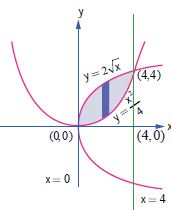
Viewing in the direction of y -axis, the equation of the upper boundary is y = 2\(\sqrt x\) for 0\(\le x \le\) 4 and the equation of the lower boundary is \(y =\frac {x^2}{4}\)for \(0 \leq x \leq 4\). So, the required area \(\Delta\) is
\(A=\int_{0}^{4}\left(y_{U}-Y_{L}\right) d x=\int_{0}^{4}\left(2 \sqrt{x}-\frac{x^{2}}{4}\right) d x=\left[2\left(\frac{2 x^{3 / 2}}{3}\right)-\frac{x^{3}}{12}\right]_{0}^{4}=\left[2\left(\frac{2 \times 8}{3}\right)-\frac{64}{12}\right]-0=\frac{16}{3}\)
15.
Given w(x, y, z) = \(\frac { 1 }{ \sqrt { { x }^{ 2 }+{ y }^{ 2 }+{ z }^{ 2 } } }\)
= (x2 + y2 + z2) -\(\frac12\)
\(\frac { \partial w }{ \partial x } =\frac { -1 }{ 2 } ({ x^{ 2 }+{ y }^{ 2 }+{ z }^{ 2 }) }^{ -\frac { 3 }{ 2 } }(2x)\)
= (-x2 + y2 + z2) -\(\frac12\)
\(\frac { { \partial }^{ 2 }w }{ \partial { x }^{ 2 } } =\frac { \partial }{ \partial x } \left( \frac { \partial w }{ \partial x } \right) \)
= -[x\(\left( \frac { -3 }{ 2 } \right) \)( x2 + y2 +z2)\(-\frac32\)
\((\not 2 x)+\left(x^{2}+y^{2}+z^{2}\right)^{\frac{3}{2}}\)
= (x2 + y2 + z2)-\(\frac52\) [-3x2 + x2 +y + z2]
= - (x2 + y2 + z2)-\(\frac52\) [y2 + z2 - 2x2] ....(1)
\(\frac { \partial w }{ \partial y } =\frac { -1 }{ 2 } ({ x^{ 2 }+{ y }^{ 2 }+{ z }^{ 2 }) }^{ -\frac { 3 }{ 2 } }(2y)\)
= -y(x2 +y2 + z2)-\(\frac32\)
\(\frac { { \partial }^{ 2 }w }{ \partial { y }^{ 2 } } =\frac { \partial }{ \partial y } \left( \frac { \partial w }{ \partial y } \right) \)
\(=-\left[y\left(\frac{-3}{\not 2}\right)\left(x^{2}+y^{2}+z^{2}\right)^{\frac{5}{2}}(\not 2 y)+\left(x^{2}+y^{2}+z^{2}\right)^{\frac{3}{2}}(1)\right]\)
= -(x2 + y2 + z2)-\(\frac52 \)
= -(x2 + y2 + z2)-\(\frac52 \) [3y2 + x2 + y2 + z2]
= -(x2 + y2 + z2)-\(\frac52 \) [x2 + y2 + 2z2] ....(2)
Now \(\frac { \partial w }{ \partial z } =\frac { -1 }{ 2 } ({ x^{ 2 }+{ y }^{ 2 }+{ z }^{ 2 }) }^{ -\frac { 3 }{ 2 } }(2z)\)
= -z(x2 + y2 + z2)-\(\frac32 \)
∴ \(\frac { { \partial }^{ 2 }w }{ \partial { z }^{ 2 } } \) = -(x2 + y2 + z2)-\(\frac52 \) [x2 + y2 - 2z2] ...(3)
(1)+(2)+(3)⟶
∴ \(\frac { { \partial }^{ 2 }w }{ \partial { x }^{ 2 } } +\frac { { \partial }^{ 2 }w }{ \partial { y }^{ 2 } } +\frac { { \partial }^{ 2 }w }{ \partial { y }^{ 2 } } \) = -(x2 + y2 + z2)-\(\frac52 \) [y2 + z2 - 2x2 + x2 + z2 - 2y + x2+ y-2z2]
= -(x2 + y2 + z2)-\(\frac52 \)(0) = 0
Hence proved
16.
Let I = \(\int ^{\pi}_{-\pi} \frac{cos ^2 x}{1+ a^x} dx\)-- (1)
Using \(\int ^{b}_{a}\) f(x) dx =\(\int ^{b}_{a}\) f(a+b -x)dx we get,
I = \(\int ^{\pi}_{-\pi} \frac{cos ^2 (\pi -\pi - x)}{1+ a^{\pi -\pi - x}} dx\)
= \(\int ^{\pi}_{-\pi} \frac{cos ^2 (-x)}{1+ a^{-x}} dx\)
= \(\int ^{\pi}_{-\pi} a^x (\frac{cos ^2 x }{a^x+ 1} )dx\) --- (2)
Adding (1) and (2) we get
2I = \(\int ^{\pi}_{-\pi} \frac{cos ^2 x }{a^x+ 1}(a^x+ 1) dx\) = \(\int ^{\pi}_{-\pi} cos ^2 x dx\)
= 2 \(x =\int ^{\pi}_{-\pi} cos ^2 x dx\) (since cos2 x is an even function)
Hence, I = \(\int ^{\pi}_{0} (\frac{1 + cos2x }{2} )dx\)
= \(\frac {1}{2} [ x + \frac {sin 2x}{2}]^{x}_{0}\)
= \(\frac {1}{2} [\pi]\)
= \(\frac {\pi}{2}\)
17.
(i) The equivalent table is
X | -1 | 0 | 1 | 2 | 3 |
|---|---|---|---|---|---|
F(x) | 0.15 | 0.35 | 0.60 | 0.85 | 1 |
f(x) = P[X= x] | 0.15 | 0.20 | 0.25 | 0.25 | 0.15 |
(ii) P(X <1) = P(X =-1)+P(X =0) =0.35
\(\text { (iii) } P(X \geq 2)=\) P(X =2)+P(X =3) = 0.40
18.
This is an indeterminate of the form \(\infty^{0}\).
Let \(g(x)=(1+2x)^{\frac{1}{2log \ x}}\)
Taking the logarithm, we get
log g(x) = \(\frac{log(1+2x)}{2log \ x}\)
\(\underset{x\rightarrow \infty}{lim}log \ g(x)=\underset{x\rightarrow \infty}{lim}(\frac{log(1+2x)}{2log \ x})\) \((\frac{\infty}{\infty})\)
\(=\underset{x\rightarrow \infty}{lim}(\frac{\frac{2}{1+2x}}{\frac{2}{x}})\) (by l’Hôpital Rule)
= \(\underset{x\rightarrow \infty}{lim}(\frac{x}{1+2x})\) \((\frac{\infty}{\infty})\)
= \(\underset{x\rightarrow \infty}{lim}(\frac{1}{2})=\frac{1}{2}\) but,
\(\underset{x\rightarrow \infty}{lim}log \ g(x)=log (\underset{x\rightarrow \infty}{lim}g(x))\).
Hence by exponentiating, we get the required limit as \(\sqrt{e}\)
19.
Let T be the temperature of the body at any time t and with time 0 taken to be 8 p.m. By Newton’s law of cooling \(\frac { dT }{ dt } =k(T-50)or\frac { dT }{ T-50 } =dt\).
Integrating on both sides, we get log |50 −T| = kt + logC or 50 −T = Cekt.
When t = 0, T = 70, and so C = −20
When t = 2,T = 60, we have −10 = −20 ek2.
Thus, \(k=\frac { 1 }{ 2 } log\left( \frac { 1 }{ 2 } \right) \)
Hence, the solution is 50-T = -20e\(\frac{1}{2}\)tlog\((\frac{1}{2})\) or T = 50 + 20\((\frac{1}{2})^\frac{t}{2}\)
Now, we would like to find the value of t, for which T(t) = 98.6 , and t = 2\(\left( \frac { log\left( \frac { 48.6 }{ 20 } \right) }{ log\left( \frac { 1 }{ 2 } \right) } \right) \approx -2.56\)
It appears that the person was murdered at about 5.30 p.m.
20.
Since the open box has square area, let the length, breadth and height of the box be I, l and b cm respectively.
ஃ Surface area = l2 + 41b = 108
\(\Rightarrow l+4b=\frac { 108 }{ l } \)
\(\Rightarrow 4b=\frac { 108 }{ l } -1\)
\(\Rightarrow b=\frac { 108 }{ 4l } -\frac { l }{ 4 } \)
\(\Rightarrow b=\frac { 27 }{ l } -\frac { l }{ 4 } \)
Let f(1) = Volume of the box = 1 \(\times\) 1\(\times\) b = l2 b
= \({ l }^{ 2 }\left( \frac { 27 }{ l } -\frac { l }{ 4 } \right) \)
\(f(1)=27l-\frac { { l }^{ 3 } }{ 4 } \)
\(f'(l)=27-\frac { { 3l }^{ 2 } }{ 4 } \)
f'(1) = 0
\(\Rightarrow 27-\frac { 3{ l }^{ 2 } }{ 4 } =0\)
\(\Rightarrow \frac { 3l^{ 2 } }{ 4 } =27\)
\(\Rightarrow l^{2}=\not 27 \times \frac{4}{\not 3}=36\)
\(\Rightarrow 1=\pm 6\)
\(\Rightarrow 1=6\)
ஃThe critical number is 6
\(f''(l)=\frac { 6l }{ 4 } =\frac { 3l }{ 2 } \)
\(\therefore f''(6)=-\frac { 3(6) }{ 2 } <0\)
ஃ f"(1) is maximum when l = 6
When l = 6,\(b=\frac { 27 }{ 6 } -\frac { 6 }{ 4 } \)
= \(\frac { 9 }{ 2 } -\frac { 3 }{ 2 } =\frac { 6 }{ 2 } =3cm\)
Hence the dimensions of the required box are 6 cm, 6 cm and 3 cm respectively.
21.
Let f (x) = tan x, then the Mclaurin series of f (x) is
\(f(x)=\sum^{n=\infty}_{n=0} a_{n}x^{n}\), where , \(a_{n}=\frac{f^{(n)}(0)}{n!}\).
Various derivative’s of the function f (x) evaluated at x = 0 is given below :
Now,
\(f'(x)=\frac{d}{dx}(tanx)=sec^{2}(x)\)
\(f''(x)=\frac{d}{dx}sec^{2}(x))=2sec x.sec x.tan x= 2sec^{2}x.tanx\)
\(f'''(x)=\frac{d}{dx}(2sec^{2}(x).tan x)= 2sec^{2}(x).sec^{2}x+tan x.4secx.secx.tanx\)
=\(2sec^{4}x+4sec^{2}x.tan^{2}x\)
\(f^{(iv)}(x)=8sec^{3}(x).secx+tan x+4sec^{2}x.2tanx sec^{2}x+8secx.secx.tanx.tan^{2}x\)
=\(16sec^{4}xtanx+8sec^{2}x.tan^{3}x\)
\(f^{(v)}(x)=16sec^{4}x.sec^{2}x+64sec^{3}x.sec x.tan x.tan x+8 sec^{2}x.3tan^{2}x.sec^{2}x+16secx.secx.tanx.tan^{3}x\)
=\(16sec^{6}x+88sec^{4}x.tan^{2}x+16sec^{2}x.tan^{4}x\).
| Function and its derivatives | tan x and its derivatives | value at x = 0 |
| f(x) | tan x | 0 |
| f'(x) | sec2x | 1 |
| f''(x) | 2sec2x tanx | 0 |
| f'''(x) | 2sec4x+4sec2x.tan2x | 2 |
| f(iv)(x) | 16sec4x.tanx+8sec2x.tan3x | 0 |
| f(v)(x) | 16sec6x+88sec4x.tan2x+16sec2x.tan4x | 16 |
Substituting the values and on simplification we get the required expansion of the function as
\(tan x=x+\frac{1}{3}x^{3}+\frac{2}{15}x^{5}+...; -\frac{\pi}{2}
22.
Given f(x) = x (x - 4)3
f'(x) = x .3(x - 4)2 + (x - 4)3(1)
= 3x (x - 4)2 + (x - 4)3
= (x - 4)2 + (3x +x- 4)3
= (x - 4)2 + (4x - 4)
= 4 (x-1) (x-4)2
f"(x) = 4 [(x - 1)2 (x - 4) +(x - 4)2 (1)]
= 4[2(x-4)(x-1)+(x - 4)2]
= 4(x- 4)[2x - 2 +x - 4)]
= 4(x - 4)(3x - 6)
= 12 (x - 4)(x- 2)
f"(x) = 0
⇒ 12 (x - 4)(x- 2) = 0
⇒ x = 2, 4
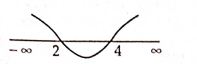
The possible intervals are (-∞, 2) (2, 4) and (4, ∞)
| Interval | (-∞, 2) | (2, 4) | (4, ∞) |
| Sign of f"(x) | Say x= 0 12(-4)(-2) = +ve |
Say x = 3 12(-1 )(1) = -ve |
Say x = 5 12(1)(3) = +ve |
| Concavity | Concave up | Concave down | Concave up |
ஃThe curve is concave upward on (-∞, 2) (4, ∞) and concave downward on (2, 4).
As f"(x) changes its sign when it passes through x = 2 and x = 4, the points of inflection are (2, f(2)) and (4,f(4)).
f(2) = 2(2 - 4)3
= 2(-2)3 = 2(-8) = -16
f(4) = 4 (4 - 4)3 = 0
\(\therefore\) (2, -16) and (4, 0) are the points of inflection
23.
Given equation is m \(\frac{dV}{dt}\) = F- kv
The given equation can be written as
\(\frac { dv }{ F-kv } =\frac { dt }{ m } \)
Now Integrating, we get
\(\int { \frac { dv }{ F-kv } } =\int { \frac { dt }{ m } } \)
\(\int \frac{d V}{F-k V}=\int \frac{d t}{M}
\frac{\log (F-k V)}{-k}=\frac{t}{M}+C_1 \\
\log [\mathrm{F}-\mathrm{kV}]=-\frac{k t}{M}-k C_1 \\
\log [\mathrm{F}-\mathrm{kV}]=-\frac{k t}{M}+\log \mathrm{C} \\
\log [\mathrm{F}-\mathrm{kV}]-\log \mathrm{C}=-\frac{k t}{M} \\
\log \left(\frac{F-k V}{C}\right)=-\frac{k t}{M} \\
\frac{F-k V}{C}=e^{\frac{-k t}{M}} \\
\frac{F-k V}{e^{\frac{-t}{M}}}=\mathrm{C} \Rightarrow \mathrm{C}=e^{\frac{k t}{M}}(F-k V) \\\)
Initial condition:
Given V = 0 when t = 0
\(\mathrm{C}=e^{\frac{k(0)}{M}}[\mathrm{~F}-\mathrm{k}(0)] \\
=\mathrm{e}^0[\mathrm{~F}-0] \\
\mathrm{C}=\mathrm{F} \\
\therefore \mathrm{F}=(F-k V) e^{\frac{k t}{M}}\)
24.
Let h and r be the height and the base radius. Therefore h = 2r. Let V be the volume of the salt cone.
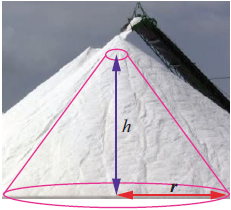
\(V=\frac{1}{3}\pi r^{2}h=\frac{1}{12}\pi h^{3}; \frac{dV}{dt}=30\) mtr3 / min.
Hence, \(\frac{dV}{dt}=\frac{1}{4}\pi h^{2}\frac{dh}{dt}\)
Therefore, \(\frac{dh}{dt}=4 \frac{dV}{dt}.\frac{1}{\pi h^{2}}\)
That is, \(\frac{dh}{dt}=4\times30\times \frac{1}{100 \pi}\)
=\(\frac{6}{5\pi}\) mtr / min.
25.
Let (S, *) be an algebraic structure and a ∈ S. Assume that the inverse of a exists in S. It is to be proved that the inverse of a is unique. The existence of inverse in S ensures the existence of the identity element e in S.
Let a ∈ S. It is to be proved that the inverse a (if exists) is unique.
Suppose that a has two inverses, say a1, a2
Treating a1 as an inverse of a gives \(a * a_{1}=a_{1} * a=e\) ........(1)
Next treating a2 as the inverse of a gives \(a * a_{2}=a_{2} * a=e\) ........(2)
\(a_{1}=a_{1} * e=a_{1} *\left(a * a_{2}\right)=\left(a_{1} * a\right) * a_{2}=e * a_{2}=a_{2}(\text { by }(1) \text { and }(2))\)
So, a1= a2. Hence the inverse of a is unique which completes the proof.
26.
(i) Since f (x) is a probability mass function, f (x) ≥ 0 for all x , and d \(\sum_{x} f(x)=1\)
Thus, \(\sum_{x} f(x)=1\)
\(c^{2}+2 c^{2}+3 c^{2}+4 c^{2}+c+2 c=0\)
\(c=\frac{1}{5} \text { or }-\frac{1}{2}\)
Since f x( ) ≥ 0 for all x , the possible value of c is \(\frac{1}{5}\)
Hence, the probability mass function is
| x | 1 | 2 | 3 | 4 | 5 | 6 |
| f(x) | \( \frac{1}{25} \) | \( \frac{2}{25} \) | \( \frac{3}{25} \) | \(\frac{4}{25} \) | \(\frac{1}{5}\) | \( \frac{2}{5}\) |
(ii) To find mean and variance, let us use the following table
| x | f(x) | xf(x) | x2f(x) |
| 1 | \(\cfrac { 1 }{ 25 } \) | \(\cfrac { 2 }{ 25 } \) | \(\cfrac { 1 }{ 25 } \) |
| 2 | \(\cfrac { 2 }{ 25 } \) | \(\cfrac { 4 }{ 25 } \) | \(\cfrac { 8 }{ 25 } \) |
| 3. | \(\cfrac { 3 }{ 25 } \) | \(\cfrac { 9 }{ 25 } \) | \(\cfrac { 27 }{ 25 } \) |
| 4. | \(\cfrac { 4 }{ 25 } \) | \(\cfrac { 16 }{ 25 } \) | \(\cfrac { 64 }{ 25 } \) |
| 5. | \(\cfrac { 1 }{ 5 } \) | \(\cfrac { 5 }{ 5 } \) | \(\cfrac { 25 }{ 5 } \) |
| 6. | \(\cfrac { 2 }{ 25 } \) | \(\cfrac { 12 }{ 5 } \) | \(\cfrac { 72 }{ 5 } \) |
| \(\Sigma f(x)=1\) | \(\Sigma xf(x)=\cfrac { 115 }{ 25 } \) | \({ \Sigma x }^{ 2 }f(x)=\cfrac { 585 }{ 25 } \) |
Mean : \(E(X)=\Sigma xf(x)=\frac { 115 }{ 25 } =4.6\)
Variance : \(V(x)=E\left( x \right) ^{ 2 }=\Sigma { x }^{ 2 }f(x)-\left( \Sigma xf(x) \right) ^{ 2 }\)
= \(\frac { 585 }{ 25 } -\left( \frac { 115 }{ 25 } \right) ^{ 2 }=23.40-21.16=2.24\)
Therefore the mean and variance are 4.6 and 2.24 respectively.
27.
Given g(x, y) = \(\frac { { e }^{ y }sinx }{ x } \) for x ≠ 0 and g(0, 0) = 1
g(0, 0) = 1
The function g is defined for all (x, y) ∈ R2
To check if g has a limit L at (0,0) and if L= g(0,0) = 1
Consider \(\left| g(x,y)-g(0,y) \right| =\left| \frac { { e }^{ y }sinx }{ x } -0 \right| \)
= \(\left| \frac { { e }^{ y }sinx }{ x } \right| =\left| \frac { \left| { e }^{ y } \right| \left| sinx \right| }{ x } \right| =\left| { e }^{ x } \right| \left| \frac { sinx }{ x } \right| =1\)
\(\left[ \because (x,y)\longrightarrow (0,0)\Rightarrow \left| { e }^{ y } \right| =1and\left| \frac { sinx }{ x } \right| =1 \right] \)
\(\because \begin{matrix} lim \\ (x,y)\rightarrow (0,0) \end{matrix}\frac { { e }^{ y }sinx }{ x } =1=g(0,0)\) Which proves that is continuous at (0, 0)
∴ g(x, y) is continuous at (0, 0)
28.
Given absolute error = 2%
⇒ \(\frac { dl }{ l } =2 \% =\frac { 2 }{ 100 } =0.02\)
Given T = 2ㅠ\(\sqrt { \frac { 1 }{ g } } \)
Taking logarithm on both sides,
log T = log 2ㅠ + \(\frac12\) log l - \(\frac12\) log g
Taking differential on both sides we get,
\(\frac{1}{T}dT=0+\frac{1}{2}.\frac{1}{l}.dl\)
\(\frac { \Delta T }{ T } =\frac { 1 }{ 2 } (.02)\)
\(\frac { \Delta T }{ T } =0\)
ஃ Percentage error = \(\frac { \Delta T }{ T } \times100=.01\times100=1 \%\)
29.
Let \(\sqrt{x}\) = u
Then x = u2, and so dx = 2u du
When x = 0, u = 0
When x = 9, u = 3
\(\therefore \int _{ 0 }^{ 9 }{ \frac { 1 }{ x+\sqrt { x } } dx=\int _{ 0 }^{ 3 }{ \frac { 1 }{ { u }^{ 2 }+u } (2u)du=2\int _{ 0 }^{ 3 }{ \frac { 1 }{ 1+u } du=2{ \left[ log|1+u \right] }_{ 0 }^{ 3 }=2[log4-0]=log16 } } } \)
30.
Let X be the random variable denotes the total C score is two throws of a die.
Sample space S
| II | 2 | 3 | 3 | 4 | 4 | 4 |
| I | ||||||
| 2 | 4 | 5 | 5 | 6 | 6 | 6 |
| 3 | 5 | 6 | 6 | 7 | 7 | 7 |
| 3 | 5 | 6 | 6 | 7 | 7 | 7 |
| 4 | 6 | 7 | 7 | 8 | 8 | 8 |
| 4 | 6 | 7 | 7 | 8 | 8 | 8 |
| 4 | 6 | 7 | 7 | 8 | 8 | 8 |
n (S) = 36
X = {4,5,6,7,8}
From the sample space
| Values of random variable | 4 | 5 | 6 | 7 | 8 | Total |
| No of points in inverse image | 1 | 4 | 10 | 12 | 9 | 36 |
31.
Observe that, f(0) = 0 = f (1), is continuous in the interval [0,1] and is differentiable in (0,1). Now,
\(f'{x}=2x(1-x)(1-2x)\).
Therefore, \(f'(c)=0 \) gives c = 0, 1 and \(\frac{1}{2}\)
which \(\Rightarrow c= \frac{1}{2}\in (0,1)\).
32.
Separating the variables we get,
\(\frac { dy }{ \sqrt { 1-{ y }^{ 2 } } } \frac { dx }{ \sqrt { 1-{ x }^{ 2 } } } \)
Taking Integration on both sides, we get
\(\int \frac{d y}{\sqrt{1-y^{2}}}=\int \frac{d x}{\sqrt{1-x^{2}}}\)
sin-1y = sin-1 x + c
33.
The slope of the line y = x is 1. The tangent to the given curve will be parallel to the line, if the slope of the tangent to the curve at a point is also 1. Hence,
\(\frac{dy}{dx}=3x^{2}-6x+1=1\)
which gives \( 3x^{2}-6x=0\)
Hence, x = 0 and x = 2.
Therefore, at (0, –2) and (2, –4) the tangent is parallel to the line y = x.
34.
Given s = 2t2 + 3t
s(3) = 2 \(\times\) 32 + 3 (3)
= 2\(\times\)9+9
= 27 m ....(1)
s(6) = 2\(\times\) 62 + 3 (6)
= 72 + 18 = 90m ... (2)
Average velocity = \(\frac { s(6)-s(3) }{ 6-3 } \)
= \(\frac { 90-27 }{ 3 } \) = 21 m/s
(ii) Instantaneous Velocity V(t) = \(\frac { ds }{ dt } \)
Instantaneous Velocity at t = 3
= V(3) = 15 m/sec
Instantaneous Velocity at t = 6
= V(6) = 27m/sec
35.
(c)
¬ (p ∨ q)≡¬p∨¬q
36.
(b)
37.
(b)
Z
38.
(c)
39.
(b)
(SxS) ⟶ S
40.
(c)
0
41.
(b)
\(\frac{3\pi}{8}\)
42.
(b)
43.
(a)
\(\frac{\pi}{2}\)
44.
(b)
\(-x +\frac{\pi}{2}\)
45.
(c)
-7
46.
(b)
12xo dx
47.
(d)
\(\frac { 2 }{ 3 } \)
48.
(d)
\(\left( \frac { 10 }{ 5 } \right) \left( \frac { 3 }{ 5 } \right) ^{ 5 }\left( \frac { 2 }{ 5 } \right) ^{ 5 }\)
49.
(c)
40.75,40
50.
(b)
mean exists but variance does not exist
51.
(a)
y = Cex2
52.
(c)
\(\frac{1}{x}\)
53.
(a)
0
54.
(a)
(4, 11)

12th Standard Syllabus & Materials
12th Standard
TN 12th Computer Applications களப்பெயர் முறைமை (DNS) Sample Question Papers Study Material - QB365 Set A
NEW12th Standard
TN 12th Computer Applications வலையமைப்பு எடுத்துக்காட்டுகள் மற்றும் நெறிமுறைகள் Sample Question Papers Study Material - QB365 Set A
NEW12th Standard
TN 12th Computer Applications கணினி வலையமைப்பு ஓர் அறிமுகம் Sample Question Papers Study Material - QB365 Set A
NEW12th Standard
TN 12th Computer Applications PHP-உடன் MySQL-ஐ இணைத்தல் Sample Question Papers Study Material - QB365 Set A



Tamilnadu Stateboard 12th Standard Subjects
Maths

Chemistry

Physics

Biology

Computer Science

Business Maths and Statistics

Economics

Commerce

Accountancy

History

Computer Applications
Biology
Computer Technology
Computer Applications
Computer Science
Business Maths and Statistics
Commerce
Economics
Maths
Chemistry
Physics
Computer Technology
History
Accountancy

Tamil

English

French
Tamilnadu Stateboard Standards


