
 100% FREE ACCESS
12th Standard Syllabus & Materials
12th Standard
TN 12th Computer Applications மின்னணு தரவு பரிமாற்றம் Sample Question Papers Study Material - QB365 Set A
NEW12th Standard
TN 12th Computer Applications மின் - வணிக பாதுகாப்பு அமைப்புகள் Sample Question Papers Study Material - QB365 Set A
NEW12th Standard
TN 12th Computer Applications மின்னணு செலுத்தல் முறைகள் Sample Question Papers Study Material - QB365 Set A
NEW12th Standard
TN 12th Computer Applications மின் - வணிகம் Sample Question Papers Study Material - QB365 Set A
NEW12th Standard
TN 12th Computer Applications திறந்த மூல கருத்துருக்கள் Sample Question Papers Study Material - QB365 Set A
NEW12th Standard
TN 12th Computer Applications வலையமைப்பு வடமிடல் Sample Question Papers Study Material - QB365 Set A

Published on: 28/11/2025
Download Tamil Nadu 12th Standard Maths question papers, model tests, one-mark questions, important questions, and public exam papers in PDF format. Free study materials and answer keys for TN State Board students.
Questions + Answers key
Take MCQ Maths Test
1.
Evaluate \(\int _{ b }^{ \infty }{ \frac { 1 }{ { a }^{ 2 }+{ x }^{ 2 } } dx,a>0,b\in R } \)
2.
Evaluate the following definite integrals:
\(\int _{ 0 }^{ 1 }{ \sqrt { \frac { 1-x }{ 1+x } } } dx\)
3.
Evaluate: \(\int_{0}^{a} \frac{f(x)}{f(x)+f(a-x)} d x\)
4.
Evaluate :\(\int _{ 0 }^{ \frac { \pi }{ 3 } }{ \frac { sec\ x\ tan\ x }{ 1+{ sec }^{ 2 }x } dx } \)
5.
Evaluate: \(\int _{ 0 }^{ 3 }{ (3{ x }^{ 2 }-4x+5) } dx\)
6.
Evaluate the following:
\(\int _{ 0 }^{ \infty }{ { x }^{ 5 }{ e }^{ -3x }dx } \)
7.
Evaluate the following
\(\int _{ 0 }^{ \pi /2 }{ { sin }^{ 10 }x\quad dx } \)
8.
Evaluate \(\int ^\frac {\pi}{2}_{0} \)( sin2 x + cos4 x ) dx
9.
Evaluate: \(\int ^{log 2}_{-log 2} e ^{-|x|}\) dx.
10.
Evaluate: \(\int ^{\frac{\pi}{2}}_{\frac{\pi}{2}}\)x cos x dx.
11.
Find the area of the region bounded between the parabolas y2 = 4x and x2 = 4y.
12.
13.
Evaluate \(\int ^{\pi}_{-\pi} \frac{cos ^2 x}{1+ a^x}\) dx
14.
Show that \(\int ^{1}_{0} (tan ^{-1} x + tan ^{-1}(1-x))\) dx = \(\frac {\pi}{2}\) - loge2
15.
Prove that \(\int ^\frac{\pi}{4}_{0}\) log(1+tan x)dx = \(\frac{\pi}{8}\) log2.
1.
\(\int _{ b }^{ \infty }{ \frac { 1 }{ { a }^{ 2 }+{ x }^{ 2 } } dx } ={ \left[ \frac { 1 }{ a } { tan }^{ -1 }\frac { x }{ a } \right] }_{ b }^{ \infty }=\frac { 1 }{ a } { tan }^{ -1 }\infty -\frac { 1 }{ a } { tan }^{ -1 }\frac { b }{ a } =\frac { 1 }{ a } \left[ \frac { \pi }{ 2 } -{ tan }^{ -1 }\frac { b }{ a } \right] \)
2.
I \(=\int _{ 0 }^{ 1 }{ \sqrt { \frac { (1-x)(1-x) }{ (1+x)(1-x) } } } dx\)
\(=\int _{ 0 }^{ 1 }{ \sqrt { \frac { (1-x) 2}{ (1-x)^2 } } } dx\)
\(=\int _{ 0 }^{ 1 }{ \frac { 1-x }{ \sqrt { 1-{ x }^{ 2 } } } } dx\)
Put x = sin u, dx = cosu.du, 0u = sin-1(x)
For x = 0, u = 0 and x = 1, u = \(\frac{\pi}{2}\)
\(=\int _{ 0 }^{ 1 }{ \frac { 1-sin\ u }{ \sqrt { 1-{ sin }^{ 2 }u } } } \times cos u.du\)
\(=\int _{ 0 }^{ 1 } \frac { 1-sin\ u }{cos u} \times cos u.du\)
= \( [u+cos u]^\frac{\pi }{2}_0\)= (\(\frac{\pi}{2}\)+0)-(0+1) = \(\frac{\pi}{2}\) -1
\(=\frac { \pi }{ 2 } -0-1=\frac { \pi }{ 2 } -1\)
3.
Let I = \(\int ^{a}_{0} \frac{f(x)}{f(x)+f(a-x)}\) ------- (1)
Applying the formula \(\int ^{a}_{0}\) f(x) dx = \(\int ^{a}_{0}\)f(a-x)dx in equation (1), we get
I = \(\int ^{a}_{0} \frac{f{(a-x)}}{f{(a-x)}+f(a-(a-x))}\) dx
= \(\int ^{a}_{0} \frac{f{(a-x)}}{f{(x)}+f(a-x)}\) dx----- (2)
Adding equations (1) and (2), we get
2I = \(\int ^{a}_{0} \frac{f{(x)}}{f{(x)}+f(a-x)}\) dx + \(\int ^{a}_{0} \frac{f{(a-x)}}{f{(x)}+f(a-x)}\) dx
= \(\int ^{a}_{0} \frac{f(x) +f{(a-x)}}{f{(x)}+f(a-x)}\) dx
= \(\int ^{a}_{0} dx = a\)
Hence, we get I = \(\frac{a}{2}\)
4.
Let I = \(\int _{ 0 }^{ \frac { \pi }{ 3 } }{ \frac { sec\ x\ tan\ x }{ 1+{ sec }^{ 2 }x } dx } \)
Put sec x = u. Then, sec x tan x dx = du.
When x = 0, u = sec0 = 1. When x = \(\frac{\pi}{3}, u=sec\frac{\pi}{2}=2\)
\(\therefore I=\int _{ 1 }^{ 2 }{ \frac { du }{ 1+{ u }^{ 2 } } ={ [{ tan }^{ -1 }u] }_{ 1 }^{ 2 }={ tan }^{ -1 }1={ tan }^{ -1 } } (2)-\frac { \pi }{ 4 } \)
5.
\(\int _{ 0 }^{ 3 }{ (3{ x }^{ 2 }-4x+5) } dx=\int _{ 0 }^{ 3 }{ 3{ x }^{ 2 } } dx-\int _{ 0 }^{ 3 }{ 4x } dx+\int _{ 0 }^{ 3 }{ 5 } dx\)
\(=3\int _{ 0 }^{ 3 }{ { x }^{ 2 } } dx-4\int _{ 0 }^{ 3 }{ c } dx+5\int _{ 0 }^{ 3 }{ dx } \)
\(=3{ \left[ \frac { { x }^{ 3 } }{ 3 } \right] }_{ 0 }^{ 3 }-4{ \left[ \frac { { x }^{ 2 } }{ 2 } \right] }_{ 0 }^{ 3 }+5{ \left[ x \right] }_{ 0 }^{ 3 }\)
= (27 − 0) − 2(9 − 0) + 5(3− 0)
= 27 −18 +15 = 24.
6.
\( \because \int _{ 0 }^{ \infty }{ { x }^{ n }{ e }^{ -ax }dx}=\frac { n! }{ { a }^{ n+1 } } \)
\(n=5,\quad a=3 \)
\(=\frac { 5! }{ { 3 }^{ 6 } } \)
7.
\({ I }_{ n }=\int _{ 0 }^{ \pi /2 }{ { sin }^{ n }x } =\frac { n-1 }{ n } { I }_{ n-2 },n\ge 2\)
\(Let\quad { I }_{ 10 }=\int _{ 0 }^{ \pi /2 }{ { sin }^{ 10 }xdx=\frac { 9 }{ 10 } { I }_{ 8 } } \)
\(=\frac { 9 }{ 10 } \times \frac { 7 }{ 8 } \times { I }_{ 6 }=\frac { 9 }{ 10 } \times \frac { 7 }{ 8 } \times \frac { 5 }{ 6 } \times { I }_{ 4 }\)
\(\\ =\frac { 9 }{ 10 } \times \frac { 7 }{ 8 } \times \frac { 5 }{ 6 } \times \frac { 3 }{ 4 } { I }_{ 2 }\)
\(=\frac { 9 }{ 10 } \times \frac { 7 }{ 8 } \times \frac { 5 }{ 6 } \times \frac { 3 }{ 4 } \times \frac { 1 }{ 2 } \times \frac { \pi }{ 2 } \)
\(=\frac { 315 }{ 1280 } \times \frac { \pi }{ 2 } =\frac { 63\pi }{ 256(2) } =\frac { 63\pi }{ 512 } \)
8.
Given that I =\(\int ^\frac {\pi}{2}_{0} \)( sin2x + cos4x)dx =\(\int ^\frac {\pi}{2}_{0} \) sin2x dx+\(\int ^\frac {\pi}{2}_{0} \)cos4x dx\(\frac {1}{2} \times \frac {\pi}{2} + \frac {3}{4} \times \frac {1}{2} \times \frac {\pi}{2} = \frac {7\pi}{16} \)
9.
Let f(x) = e-|-x| = e-|x| = f(x)
So f (x) is an even function.
Hence, \(\int ^{log 2}_{-log 2} e ^{-|x|}\)dx = 2\(\int ^{log 2}_{0} e ^{-|x|}\)dx = 2\(\int ^{log 2}_{0} e ^{-x}\) dx
= 2(-e-x)\(^{log2}_{0}\) = 2 (-e-log2 + e0) = 2 \((-e ^{log \frac{1}{2}} + 1)\)
= 2\((-\frac {1}{2}+1)=1\).
10.
Let f (x) = x cos x
Then f (−x) = (−x) cos(−x) = −x cos x = − f (x).
So f (x) = x cos x is an odd function.
Hence, applying the property, for odd function f(x), \(\int _{ -a }^{ a }{ f(x)dx=0 } \)
\(\therefore\) we get \(\int _{ -\frac { \pi }{ 2 } }^{ \frac { \pi }{ 2 } }{ xcosx } dx=0\)
11.
First, we get the points of intersection of the parabolas. For this, we solve y2 x = 4 and x2 y = 4 simultaneously Eliminating y between them, we get x4 = 64x and so x = 0 and x = 4. Then the points of intersection are (0, 0) and (4, 4). The required region is sketched.
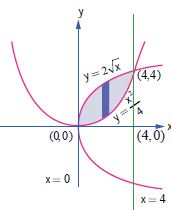
Viewing in the direction of y -axis, the equation of the upper boundary is y = 2\(\sqrt x\) for 0\(\le x \le\) 4 and the equation of the lower boundary is \(y =\frac {x^2}{4}\)for \(0 \leq x \leq 4\). So, the required area \(\Delta\) is
\(A=\int_{0}^{4}\left(y_{U}-Y_{L}\right) d x=\int_{0}^{4}\left(2 \sqrt{x}-\frac{x^{2}}{4}\right) d x=\left[2\left(\frac{2 x^{3 / 2}}{3}\right)-\frac{x^{3}}{12}\right]_{0}^{4}=\left[2\left(\frac{2 \times 8}{3}\right)-\frac{64}{12}\right]-0=\frac{16}{3}\)
12.
13.
Let I = \(\int ^{\pi}_{-\pi} \frac{cos ^2 x}{1+ a^x} dx\)-- (1)
Using \(\int ^{b}_{a}\) f(x) dx =\(\int ^{b}_{a}\) f(a+b -x)dx we get,
I = \(\int ^{\pi}_{-\pi} \frac{cos ^2 (\pi -\pi - x)}{1+ a^{\pi -\pi - x}} dx\)
= \(\int ^{\pi}_{-\pi} \frac{cos ^2 (-x)}{1+ a^{-x}} dx\)
= \(\int ^{\pi}_{-\pi} a^x (\frac{cos ^2 x }{a^x+ 1} )dx\) --- (2)
Adding (1) and (2) we get
2I = \(\int ^{\pi}_{-\pi} \frac{cos ^2 x }{a^x+ 1}(a^x+ 1) dx\) = \(\int ^{\pi}_{-\pi} cos ^2 x dx\)
= 2 \(x =\int ^{\pi}_{-\pi} cos ^2 x dx\) (since cos2 x is an even function)
Hence, I = \(\int ^{\pi}_{0} (\frac{1 + cos2x }{2} )dx\)
= \(\frac {1}{2} [ x + \frac {sin 2x}{2}]^{x}_{0}\)
= \(\frac {1}{2} [\pi]\)
= \(\frac {\pi}{2}\)
14.
I =\(\int ^{1}_{0} (tan ^{-1} x + tan ^{-1}(1-x))\) dx
=\(\int ^{1}_{0} (tan ^{-1} x dx + \int ^{1}_{0} tan ^{-1}(1-x)) dx\)
= \(\int ^{1}_{0} (tan ^{-1} x dx + \int ^{1}_{0} tan ^{-1}(1-(1-x)) dx\), Since\(\int ^{a}_{0} f (x) dx = \int ^{a}_{0} f(a-x) dx \)
=\(\int ^{1}_{0} tan ^{-1} x dx + \int ^{1}_{0} tan ^{-1} x dx\)
= 2\(\int ^{1}_{0} tan^{-1} x dx\)
= \([2 \int udv]^1_0\) , Where u = tan-1 x and dν = dx
= 2\([uν - \int udv]^1_0,\) applying integration by parts
= 2\((x tan^{-1} x - \int x \frac{dx}{1+x^2})^{1}_{0}\)
= 2\((x tan^{-1} x - \frac {1}{2} log (1+x^2))^{1}_{0}\)
= \(\frac{\pi}{2} \)- log 2
15.
Let us put I = \(\int ^\frac{\pi}{4}_{0}\) log(1 + tan x) dx
Applying the property \(\int ^{a}_{0}\) f(x) dx =\(\int ^{a}_{0}\)f(a-x) dx in equation (1), we get
I = \(\int ^\frac{\pi}{4}_{0}\) log \([1+tan (\frac{\pi}{4}-x)]\)dx = \(\int ^\frac{\pi}{4}_{0}\) log\([1 + \frac{tan \frac {\pi}{4}- tan x}{1 + tan {\frac {\pi}{4} tan x}}]\) dx
=\(\int ^\frac{\pi}{4}_{0}\) log \([1 + \frac {1 - tan x}{1 + tan x}]\)dx = \(\int ^\frac{\pi}{4}_{0}\) log\([\frac {1+tan x +1 - tan x}{1 + tan x}]\) dx
=\(\int ^\frac{\pi}{4}_{0}\) log \([\frac{2}{1+tanx}]\) dx = \(\int ^\frac{\pi}{4}_{0}\) [log 2 - log (1+tan x)] dx
= log 2 \(\int ^\frac{\pi}{4}_{0}\) dx - \(\int ^\frac{\pi}{4}_{0}\)log (1+tan x)] dx
= \(\frac{\pi}{4}\)log 2 - I
So, we get 2I = \(\frac{\pi}{4}\)log 2.
Hence, we get I = \(\frac{\pi}{8}\)log 2.

12th Standard Syllabus & Materials
12th Standard
TN 12th Computer Applications களப்பெயர் முறைமை (DNS) Sample Question Papers Study Material - QB365 Set A
NEW12th Standard
TN 12th Computer Applications வலையமைப்பு எடுத்துக்காட்டுகள் மற்றும் நெறிமுறைகள் Sample Question Papers Study Material - QB365 Set A
NEW12th Standard
TN 12th Computer Applications கணினி வலையமைப்பு ஓர் அறிமுகம் Sample Question Papers Study Material - QB365 Set A
NEW12th Standard
TN 12th Computer Applications PHP-உடன் MySQL-ஐ இணைத்தல் Sample Question Papers Study Material - QB365 Set A



Tamilnadu Stateboard 12th Standard Subjects
Maths

Chemistry

Physics

Biology

Computer Science

Business Maths and Statistics

Economics

Commerce

Accountancy

History

Computer Applications
Biology
Computer Technology
Computer Applications
Computer Science
Business Maths and Statistics
Commerce
Economics
Maths
Chemistry
Physics
Computer Technology
History
Accountancy

Tamil

English

French
Tamilnadu Stateboard Standards


