
 100% FREE ACCESS
12th Standard Syllabus & Materials
12th Standard
TN 12th Maths Applications of Matrices and Determinants Sample Question Papers Study Material - QB365 Set A
NEW12th Standard
TN 12th Computer Applications மின்னணு தரவு பரிமாற்றம் Sample Question Papers Study Material - QB365 Set A
NEW12th Standard
TN 12th Computer Applications மின் - வணிக பாதுகாப்பு அமைப்புகள் Sample Question Papers Study Material - QB365 Set A
NEW12th Standard
TN 12th Computer Applications மின்னணு செலுத்தல் முறைகள் Sample Question Papers Study Material - QB365 Set A
NEW12th Standard
TN 12th Computer Applications மின் - வணிகம் Sample Question Papers Study Material - QB365 Set A
NEW12th Standard
TN 12th Computer Applications திறந்த மூல கருத்துருக்கள் Sample Question Papers Study Material - QB365 Set A

Published on: 28/11/2025
Download Tamil Nadu 12th Standard Maths question papers, model tests, one-mark questions, important questions, and public exam papers in PDF format. Free study materials and answer keys for TN State Board students.
Questions + Answers key
Take MCQ Maths Test
1.
Compute P(X = k) for the binomial distribution, B(n, p) where
n = 6, \(p=\frac { 1 }{ 3 } \), k = 3
2.
Evaluate the following \(\int _{ 0 }^{ \pi /2 }{ { cos}^{ 7}x\quad dx } \)
3.
Find df for f(x) = x2 + 3x and evaluate it for
x = 3 and dx = 0.02
4.
For each of the following differential equations, determine its order, degree (if exists)
\({ \left( \frac { d^2y }{ dx^2 } \right) }^{ 3 }=\sqrt { 1+\left( \frac { dy }{ dx } \right) } \)
5.
Find centre and radius of the following circles.
x2+y2−x+2y−3 = 0
6.
If \(\hat { 2i } -\hat { j } +\hat { 3k } ,\hat { 3i } +\hat { 2j } +\hat { k } ,\hat { i } +\hat { mj } +\hat { 4k } \) are coplanar, find the value of m.
7.
Find the square root of 6−8i .
8.
If adj(A) = \(\left[ \begin{matrix} 0 & -2 & 0 \\ 6 & 2 & -6 \\ -3 & 0 & 6 \end{matrix} \right] \), find A−1.
9.
If x2+2(k+2)x+9k = 0 has equal roots, find k.
10.
Find the value of
\(cos\left( { cos }^{ -1 }\left( \frac { 4 }{ 5 } \right) +{ sin }^{ -1 }\left( \frac { 4 }{ 5 } \right) \right) \)
11.
If u(x, y) = \(\frac { { x }^{ 2 }+{ y }^{ 2 } }{ \sqrt { x+y } } \), prove that \(x\frac { \partial u }{ \partial x } +y\frac { \partial u }{ \partial y } =\frac { 3 }{ 2 } u\)
12.
Evaluate: \(\int _{ 0 }^{ 3 }{ (3{ x }^{ 2 }-4x+5) } dx\)
13.
An urn contains 5 mangoes and 4 apples. Three fruits are taken at randaom. If the number of apples taken is a random variable, then find the values of the random variable and number of points in its inverse images.
14.
Write the Maclaurin series expansion of the following function
sin x
15.
Find the angle between the straight line \(\frac { x+3 }{ 2 } =\frac { y-1 }{ 2 } =-z\) with coordinate axes.
16.
Prove that
\({ tan }^{ -1 }(\frac { 2 }{ 11 }) +{ tan }^{ -1 }(\frac { 7 }{ 24 }) ={ tan }^{ -1 }(\frac { 1 }{ 2 } )\)
17.
Solve the following system of linear equations by matrix inversion method:
2x + 5y = −2, x + 2y = −3
18.
Show that the equation \({ z }^{ 3 }+2\bar { z } =0\) has five solutions
19.
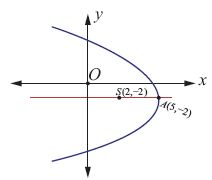
Find the equation of the parabola whose vertex is (5, -2) and focus (2, -2)
20.
Find a polynomial equation of minimum degree with rational coefficients, having 2i+3 as a root.
21.
Let A be Q\{1}. Define ∗ on A by x*y = x + y − xy. Is ∗ binary on A? If so, examine the commutative and associative properties satisfied by ∗ on A.
22.
Let z(x, y) = x3 - 3x2y3, where x = set, y = se-t, s, t ∈ R. Find \(\frac { \partial z }{ \partial s } \) and \(\frac { \partial z }{ \partial t } \)
23.
Find the area of the region bounded by the curve 2+x−x2+y = 0 , x-axis, x = −3 and x = 3.
24.
The probability density function of X is given
\(f(x)=\begin{cases} \begin{matrix} { Ke }^{ \frac { -x }{ 3 } } & \begin{matrix} for & x>0 \end{matrix} \end{matrix} \\ \begin{matrix} 0 & \begin{matrix} for & x\le 0 \end{matrix} \end{matrix} \end{cases}\)
Find
(i) the value of k
(ii) the distribution function.
(iii) P(X <3)
(iv) P(5 ≤X)
(v) P(X ≤ 4)
25.
Assume that the rate at which radioactive nuclei decay is proportional to the number of such nuclei that are present in a given sample. In a certain sample 10% of the original number of radioactive nuclei have undergone disintegration in a period of 100 years. What percentage of the original radioactive nuclei will remain after 1000 years?
26.
27.
The velocity v , of a parachute falling vertically satisfies the equation \(\\ \\ \\ \\ \\ \\ \\ v\frac { dv }{ dx } =g\left( 1-\frac { { v }^{ 2 } }{ { k }^{ 2 } } \right) \\ \\ \), where g and k are constants. If v and x are both initially zero, find v in terms of x.
28.
Solve \({ cot }^{ -1 }x-{ cot }^{ -1 }\left( x+2 \right) =\frac { \pi }{ 12 } ,x>0\)
29.
Solve the system: x + y − 2z = 0, 2x − 3y + z = 0, 3x − 7y + 10z = 0, 6x − 9y + 10z = 0.
30.
Find the non-parametric form of vector equation, and Cartesian equations of the plane passing through the points (2, 2, 1), (9, 3, 6) and perpendicular to the plane 2x + 6y + 6z = 9
31.
On lighting a rocket cracker it gets projected in a parabolic path and reaches a maximum height of 4 m when it is 6 m away from the point of projection. Finally it reaches the ground 12 m away from the starting point. Find the angle of projection.
32.
If z = x + iy and arg \(\left( \frac { z-i }{ z+2 } \right) =\frac { \pi }{ 4 } \), then show that x2 + y2 + 3x - 3y + 2 = 0
33.
Solve : (x - 5) (x - 7) (x + 6) (x + 4) = 504
34.
35.
In the set R of real numbers ‘*’ is defined as follows. Which one of the following is not a binary operation on R?
a*b = min (a.b)
a*b = max (a, b)
a*b = a
a*b = ab
36.
37.
If \(\frac{\Gamma(n+2)}{\Gamma(n)}=90\) then n is
10
5
8
9
38.
The change in the surface area S = 6x2 of a cube when the edge length varies from xo to xo+ dx is
12 xo+dx
12xo dx
6xo dx
6xo+ dx
39.
If v (x, y) = log (ex + ey), then \(\frac { { \partial }v }{ \partial x } +\frac { \partial v }{ \partial y } \) is equal to
ex + ey
\(\frac{1}{e^x + e^y}\)
2
1
40.
41.
A pair of dice numbered 1, 2, 3, 4, 5, 6 of a six-sided die and 1, 2, 3, 4 of a four-sided die is rolled and the sum is determined. Let the random variable X denote this sum. Then the number of elements in the inverse image of 7 is
1
2
3
4
42.
The order and degree of the differential equation \(\sqrt { sinx } (dx+dy)=\sqrt { cos x } (dx-dy)\) is
1, 2
2, 2
1, 1
2, 1
43.
The number given by the Rolle's theorem for the functlon x3 - 3x2, x ∈ [0, 3] is
1
\(\sqrt { 2 } \)
\(\frac { 3 }{ 2 } \)
2
44.
45.
46.
If A, B and C are invertible matrices of some order, then which one of the following is not true?
adj A = |A|A-1
adj(AB) = (adj A)(adj B)
det A-1 = (det A)-1
(ABC)-1 = C-1B-1A-1
47.
If \(\vec { a } =2\hat { i } +3\hat { j } -\hat { k } ,\vec { b } =\hat { i } +2\hat { j } -5\hat { k } ,\vec { c } =3\hat { i } +5\hat { j } -\hat { k } ,\) then a vector perpendicular to \(\vec { a } \) and lies in the plane containing \(\vec { b } \) and \(\vec { c } \) is
\(-17\hat { i } +21\hat { j } -97\hat { k } \)
\(17\hat { i } +21\hat { j } -123\hat { k } \)
\(-17\hat { i } -21\hat { j } +97\hat { k } \)
\(-17\hat { i } -21\hat { j } -97\hat { k } \)
48.
If \(\vec { a } ,\vec { b } ,\vec { c } \) are three non-coplanar vectors such that \(\vec { a } \times (\vec { b } \times \vec { c } )=\frac { \vec { b } +\vec { c } }{ \sqrt { 2 } } \), then the angle between \(\vec { a } \ and \ \vec { b } \) is
\(\frac { \pi }{ 2 } \)
\(\frac { 3\pi }{ 4 } \)
\(\frac { \pi }{ 4 } \)
\( { \pi }\)
49.
The area of quadrilateral formed with foci of the hyperbolas \(\frac{x^{2}}{a^{2}}-\frac{y^{2}}{b^{2}}=1 \text { and } \frac{x^{2}}{a^{2}}-\frac{y^{2}}{b^{2}}=-1\)
4(a2+b2)
2(a2+b2)
a2 +b2
\(\frac { 1 }{ 2 } \)(a2+b2)
50.
The centre of the circle inscribed in a square formed by the lines x2 − 8x − 12 = 0 and y2 − 14y + 45 = 0 is
(4, 7)
(7, 4)
(9, 4)
(4, 9)
51.
If sin-1 x+sin-1 y+sin-1 \(z = \frac{3\pi}{2}\), the value of x2017+y2018+z2019\(-\frac { 9 }{ { x }^{ 101 }+{ y }^{ 101 }+{ z }^{ 101 } } \)is
0
1
2
3
52.
The polynomial x3 - kx2 + 9x has three real zeros if and only if, k satisfies
|k| ≤ 6
k = 0
|k| > 6
|k| ≥ 6
53.
If |z1| = 1, |z2| = 2, |z3| = 3 and |9z1z2 + 4z1z3 + z2z3| = 12, then the value of |z1+z2+z3| is
1
2
3
4
54.
The area of the triangle formed by the complex numbers z, iz and z+iz in the Argand’s diagram is
\(\cfrac { 1 }{ 2 } \left| z \right| ^{ 2 }\)
|z|2
\(\cfrac { 3 }{ 2 } \left| z \right| ^{ 2 }\)
2|z|2
1.
Given n = 6, \(p=\frac { 1 }{ 3 }\), k = 3
\(P(X=k)=\left( \begin{matrix} n \\ k \end{matrix} \right) { p }^{ k }\left( 1-p \right) ^{ n-k },\)
n = 0,1,2, ... n
\(\therefore P(X=k)=\left( \begin{matrix} n \\ k \end{matrix} \right) { p }^{ k }(1-p)^{ n-k }\)
n = 0,1,2, ... n
\(P(X=3)=\left( \begin{matrix} 6 \\ 3 \end{matrix} \right) \left( \cfrac { 1 }{ 3 } \right) ^{ 3 }\left( 1-p \right) ^{ 6-3 }\)
= \(\left( \begin{matrix} 6 \\ 3 \end{matrix} \right) \left( \cfrac { 1 }{ 3 } \right) ^{ 3 }\left( \cfrac { 2 }{ 3 } \right) ^{ 2 }\)
\(=\frac{6 \times 5 \times 4}{8 \times 2 \times 1} \times \frac{1}{27} \times \frac{8}{27}\)
\(P(X=3)=\frac { 160 }{ 729 }\)
2.
\({ I }_{ n }=\int _{ 0 }^{ \pi /2 }{ { cos }^{ 7 }xdx=\frac { n-1 }{ n } { I }_{ n-2 },n\ge 2 } \)
\(\therefore { I }_{ 7 }=\int _{ 0 }^{ \pi /2 }{ { cos }^{ 7 }xdx=\frac { 6 }{ 7 } \times \frac { 4 }{ 5 } \times \frac { 2 }{ 3 } \times 1 } =\frac { 16 }{ 35 } \)
3.
x = 3 and dx = 0.02
When x = 3 and dx = 0.02,
df = (6 + 3) (0.02)
= 9(0.02) = 0.18
4.
The given differential equation is
\({ \left( \frac { d^2y }{ dx^2 } \right) }^{ 3\times2 }= { 1+\left( \frac { dy }{ dx } \right) } \)
squaring both sides, we get
\({ \left( \frac { dy }{ dx } \right) }^{ 6 }=1+\left( \frac { dy }{ dx } \right) \)
In this equation, the highest order derivative is 2 and its power is 6.
∴ Order 2, degree 6.
5.
Equation of the circle is x2 + y2 - x + 2y - 3 = 0
Here 2g = -1 ⇒ g = \(\frac { -1 }{ 2 } \)
2f = 2 ⇒ f = 1 and c = -3
Centre is (-g, -f) = \(\left( \frac { 1 }{ 2 } ,-1 \right) \)
and r = \(\sqrt { { g }^{ 2 }+{ f }^{ 2 }-c } \)
= \(\sqrt { \frac { 1 }{ 4 } +1+3 } \)
= \(\sqrt { \frac { 1 }{ 4 } +4 } =\sqrt { \frac { 1+16 }{ 2 } } \)
r = \(\sqrt { \frac { 17 }{ 2 } } \) units.
6.
Since the given three vectors are coplanar, we have \(\left| \begin{matrix} 2 & -1 & 3 \\ 3 & 2 & 1 \\ 1 & m & 4 \end{matrix} \right| \) = 0 ⇒ m = -3
7.
We compute \(\left| 6-8i \right| =\sqrt { { 6 }^{ 2 }+\left( -8 \right) ^{ 2 } } =10\)
and applying the formula for square root, we get
\(\sqrt { 6-8i } =\pm \left( \sqrt { \frac { 10+6 }{ 2 } } -i\sqrt { \frac { 10-6 }{ 2 } } \right) \) (\(\therefore\) b is negative\( \frac{b}{|b|}=-1 \))
= \(\pm \left( \sqrt { 8 } +i\sqrt { 2 } \right) \)
= \(\pm \left( 2\sqrt { 2 } -i\sqrt { 2 } \right) \)
8.
Given adj (A) =\(\left[ \begin{matrix} 0 & -2 & 0 \\ 6 & 2 & -6 \\ -3 & 0 & 6 \end{matrix} \right] \)
We know that A-1 = ±\(\frac { 1 }{ \sqrt { |adjA| } } \) (adj A) ...............(1)
|adj A| = 0 + 2\(\left| \begin{matrix} 6 & -6 \\ -3 & 6 \end{matrix} \right| \) + 0
[Expanded along R1]
= 2(36-18) = 2(18) = 36
∴ A-1 = \(\pm \frac { 1 }{ \sqrt { 36 } } \left[ \begin{matrix} 0 & -2 & 0 \\ 6 & 2 & -6 \\ -3 & 0 & 6 \end{matrix} \right] \)
= \(\pm \frac { 1 }{ 6 } \left[ \begin{matrix} 0 & -2 & 0 \\ 6 & 2 & -6 \\ -3 & 0 & 6 \end{matrix} \right] \).
9.
Here Δ = b2−4ac = 0 for equal roots. This implies 4(k + 2)2 = 4(9)k. This implies k = 4 or 1.
10.
\(cos\left( { cos }^{ -1 }\left( \frac { 4 }{ 5 } \right) +{ sin }^{ -1 }\left( \frac { 4 }{ 5 } \right) \right) \)
\({ cos }^{ -1 }\left( \frac { 4 }{ 5 } \right) =\theta \Rightarrow \frac { 4 }{ 5 } =cos\theta \)
Also \({ sin }^{ -1 }\left( \frac { 4 }{ 5 } \right) ={ sin }^{ -1 }\left( cos\theta \right) \) [using (1)]
= \({ sim }^{ -1 }\left( sin\left( \frac { \pi }{ 2 } -\theta \right) \right) \) \(\left[ \because cos\theta =sin\left( \frac { \pi }{ 2 } -\theta \right) \right] \)
= \(\frac { \pi }{ 2 } -\theta \)
\(\therefore cos\left( cos^{ i1 }\left( \frac { 4 }{ 5 } \right) +sin^{ -1 }\left( \frac { 4 }{ 5 } \right) \right) \)
= \(cos\left( \theta +\frac { \pi }{ 2 } -\theta \right) \)[using (1) & (2)]
= \(cos\frac { \pi }{ 2 } \)
= 0
11.
Given u (x, y) = \(\frac { { x }^{ 2 }+{ y }^{ 2 } }{ \sqrt { x+y } } \)
\(u({ \lambda }x,{ \lambda }y)=\frac { { \lambda }^{ 2 }{ x }^{ 2 }+{ { \lambda } }^{ 2 }{ y }^{ 2 } }{ \sqrt { { \lambda }x+{ \lambda }y } } \)
= \(\frac { { { \lambda } }^{ 2 }({ x }^{ 2 }+{ y }^{ 2 }) }{ \sqrt { { \lambda } } (\sqrt { x+y } ) } \)
= \({ { \lambda } }^{ 2-\frac { 1 }{ 2 } }u(x,y)\)
= \({ { \lambda } }^{ \frac { 3 }{ 2 } }u(x,y)\)
∴ u (x, y) is a homogeneous function of degree \(\frac32\)
∴ By Euler's theorem,
\(x\frac { \partial u }{ \partial x } +y\frac { \partial u }{ \partial y } \) = n.u ≍ \(x\frac { \partial u }{ \partial x } +y\frac { \partial u }{ \partial y } =\frac { 3 }{ 2 } u\)
Hence, proved.
12.
\(\int _{ 0 }^{ 3 }{ (3{ x }^{ 2 }-4x+5) } dx=\int _{ 0 }^{ 3 }{ 3{ x }^{ 2 } } dx-\int _{ 0 }^{ 3 }{ 4x } dx+\int _{ 0 }^{ 3 }{ 5 } dx\)
\(=3\int _{ 0 }^{ 3 }{ { x }^{ 2 } } dx-4\int _{ 0 }^{ 3 }{ c } dx+5\int _{ 0 }^{ 3 }{ dx } \)
\(=3{ \left[ \frac { { x }^{ 3 } }{ 3 } \right] }_{ 0 }^{ 3 }-4{ \left[ \frac { { x }^{ 2 } }{ 2 } \right] }_{ 0 }^{ 3 }+5{ \left[ x \right] }_{ 0 }^{ 3 }\)
= (27 − 0) − 2(9 − 0) + 5(3− 0)
= 27 −18 +15 = 24.
13.
Let X be the random variable of getting apples Given 5 mangoes and 4 apples are in an urn
= {0, 1,2,3}
The sample space consists of 9C3 = 84
X = 0, X (3 mangoes) = 5C3 = 10
X = 1, X (2 mangoes and 1 apples) = 5C2 x 4C1 = 40
X = 2, X (1 mangoes and 2 apples) = 5C1 x 4C2 = 30
X = 3, X (apples) = 4C3 = 4
| Values of random variable | 0 | 1 | 2 | 3 | Total |
| No of points in inverse image | 10 | 40 | 30 | 4 | 84 |
14.
Let f(x) = sin x ⇒ f(0) = sin 0 = 0
fI(x) = cos x ⇒ fI(0) = cos 0 = 1
fIl(x) = - sin x ⇒ fII(0) = -sin 0 = 0
fIlI(x) = - cos x ⇒ fIII(0) = -cos 0 = 0
fIV(x) = + sin x ⇒ fIV(0) = sin 0 = 0
fV(x) = cos x ⇒ fv(0) = cos 0 = 0
fVI(x) = - sin x ⇒ fvI(0) = - sin 0 = 0
fVII(x) = - cos x ⇒ fvII(0) = - cos 0 = 0
∴ Maclaurins' series expansion
\(f(x)=f(0)+\frac { { f }^{ 1 }(0) }{ 1! } x+\frac { { f }^{ II }(0) }{ 2! } { x }^{ 2 }+\frac { { f }^{ III }(0) }{ 3! } { x }^{ 3 }+\frac { { f }^{ IV }(0) }{ 4! } { x }^{ 4 }+.....\)
\(\therefore sinx=0+\frac { 1 }{ 1! } x+0-\frac { 1 }{ 3! } { x }^{ 3 }+0-\frac { 1 }{ 5! } { x }^{ 5 }+0-\frac { 1 }{ 7! } { x }^{ 7 }+........\)
\(x-\frac { { x }^{ 3 } }{ 3! } -\frac { { x }^{ 5 } }{ 5! } -\frac { { x }^{ 7 } }{ 7! } +...\)
15.
If \(\hat { b } =\frac { 2\hat { i } +2\hat { j } -\hat { k } }{ \left| \hat { 2i } +2\hat { j } -\hat { k } \right| } =\frac { 1 }{ 3 } (2\hat { i } +2\hat { j } -\hat { k } )\). Therefore from the definition of direction cosines of \(\hat { b } \), we have
\(cos\alpha =\frac { 2 }{ 3 } ,cos\beta =\frac { 2 }{ 3 } ,cos\gamma =-\frac { 1 }{ 3 } \)
where α, β, \(\gamma \) are the angles made by \(\hat { b } \) with the positive x -axis, positive y -axis, and positive
z -axis, respectively. As the angle between the given straight line with the coordinate axes are same as the angles made by \(\hat { b } \) with the coordinate axes, we have \(\alpha ={ cos }^{ -1 }\left( \frac { 2 }{ 3 } \right) ,\beta ={ cos }^{ -1 }\left( \frac { 2 }{ 3 } \right) ,\gamma ={ cos }^{ -1 }\left( \frac { -1 }{ 3 } \right) \) respectively.
16.
\({ tan }^{ -1 }(\frac { 2 }{ 11 }) +{ tan }^{ -1 }(\frac { 7 }{ 24 }) ={ tan }^{ -1 }(\frac { 1 }{ 2 } )\)
\(LHS={ tan }^{ -1 }\left( \frac { 2 }{ 11 } \right) +{ tan }^{ -1 }\left( \frac { 7 }{ 24 } \right)\)
= \({ tan }^{ -1 }\left( \frac { \frac { 2 }{ 11 } +\frac { 7 }{ 24 } }{ 1-\left( \frac { 2 }{ 11 } \right) \left( \frac { 7 }{ 24 } \right) } \right)\) \(\left[ \because { tan }^{ -1 }(x)+{ tan }^{ -1 }y={ tan }^{ -1 }\left( \frac { x+y }{ 1-xy } \right) \right]\)
= \({ tan }^{ -1 }\left( \frac { \frac { 48+77 }{ 11\times 24 } }{ \frac { 264-14 }{ 264 } } \right) ={ tan }^{ -1 }\left( \frac { \frac { 125 }{ 264 } }{ \frac { 250 }{ 264 } } \right)\)
\(=\tan ^{-1}\left(\frac{125}{264} \times \frac{264}{250}\right)=\tan ^{-1}\left(\frac{1}{2}\right)\)
= RHS
Hence proved.
17.
2x+5y = -2, x+2y = -3
The matrix form of the system is
\(\left( \begin{matrix} 2 & 5 \\ 1 & 2 \end{matrix} \right) \left( \begin{matrix} x \\ y \end{matrix} \right) =\left( \begin{matrix} -2 \\ -3 \end{matrix} \right) \)
⇒ AX = B where
A =\(\left( \begin{matrix} 2 & 5 \\ 1 & 2 \end{matrix} \right) ,B=\left( \begin{matrix} -2 \\ -3 \end{matrix} \right) \)
X =\(\left( \begin{matrix} x \\ y \end{matrix} \right) \)
⇒ = A-1B
|A| = \(\left| \begin{matrix} 2 & 5 \\ 1 & 2 \end{matrix} \right| \)= 4 - 5 = -1 ≠ 0
∴ A-1 =\(\frac { 1 }{ |A| } adjA=\frac { 1 }{ -1 } \left[ \begin{matrix} 2 & -5 \\ -1 & 2 \end{matrix} \right] \)
=\(\left[ \begin{matrix} -2 & 5 \\ 1 & -2 \end{matrix} \right] \)
∴ X = A-1B =\(\left[ \begin{matrix} -2 & 5 \\ 1 & -2 \end{matrix} \right] \left[ \begin{matrix} -2 \\ -3 \end{matrix} \right] \)
= \(\left[ \begin{matrix} 4-15 \\ -2+6 \end{matrix} \right] =\left[ \begin{matrix} -11 \\ 4 \end{matrix} \right] \)
∴ Solution set is x = -11, y = 4
18.
Given z3+2\(\overline { z } \) = 0
⇒ z3 = -2\(\overline { z } \)
Taking modulus, |z3| = |-2\(\overline { z } \)|
⇒ |z|3 = 2|z|
⇒ |z| [|z|2-2] = 0
|z| = 0 or |z|2-2 = 0
⇒ |z| = 0
⇒ z = 0 is a solution ....(1)
|z2| = 2
⇒ |z2| = 2 ⇒ (z\(\overline { z } \))2 = 2
⇒ z\(\overline { z } \) = \(\sqrt { 2 } \Rightarrow \overline { z } \frac { \sqrt { 2 } }{ z } \)
Given z + 2\(\overline { z } \) = 0
⇒ z3+2\(\frac { \sqrt { 2 } }{ z } \) = 0
⇒ z4+2\(\sqrt { 2 } \) = 0
If has 4 non-zero solutions
Hence from (1) and (2), z3+2\(\overline { z } \) has 5 solutions.
19.
Given vertex A(5, -2) and focus S(2, -2) and the focal distance
AS = a = 3
Parabola is open left and symmetric about the line parallel to x -axis.
Then, the equation of the required parabola is
(y + 2)2 = −4(3)(x − 5)
y2 + 4y + 4 = −12x + 60
y2 + 4y +12x − 56 = 0
20.
Given 2i + 3 is a root
∴ Its conjugate 3 - 2i is also a root of the polynomial equation.
∴ Sum of the roots 3 + 2i + 3 - 2i = 6
Product of the roots = (3 + 2i) (3 - 2i)
= 32 + 22 = 9+ 4 = 13
∴ The polynomial equation of minimum degree with rational co-efficients is
x2 - x (sum of the roots) + product of the roots = 0
⇒x2 -x (6) + 13 = 0
⇒ x2- 6x + 13 = 0
21.
given A = {Q\{1}}
A is defined on A by x*y = x+y-xy
Let x,y ≠ 1
∴ x*y = x + y - xy
Now to prove that x + y - xy ≠ 1
Let us assume that x + y - xy = 1
x+y-xy-1 = 0
(x-1)-y(x-1) = 0
(x-1)(1-y) = 0
x =1 or y = 1 which is a false [∵x, y ≠ 1]
∴ is a binary operation on A.
Commutative property:
Let x,y ∈A ⇒ x, y≠1
∴x*y = x+y-xy
and y*x = y+x-yx
⇒x+y = y*x∀x, y∈A
A has commutative property under *
Associative property:
Let x,y,z ∊A ⇒x,y,z≠1
Consider (x*y)*z = (x+y-xy)*z
= x +y~xy +z- (x +y-xy)z
= x +y-xy+ z-xz- yz + xyz
= x +y+z-xy-yz-zx +xyz ...(1)
= x +y+z - yz - x (y + z - yz)
= x +y +z-yz-zy-xz +xyz ..(2)
From (1) & (2), (x*y)*z = x*(y*z)
A has associative property under *.
22.
Given z(x, y) = x3 - 3x2y3 ; x = set; y = se-t
\(\frac { \partial z }{ \partial s } \) = 3x2 - 6xy3; \(\frac { \partial z }{ \partial y } \) = -9x2y2
∴ \(\frac { \partial z }{ \partial s } \) 3s2e2t - 6 set s3 e-3t
\(\frac { \partial z }{ \partial y } \) = 9s2e2t.s2e-2t
\(\frac { \partial z }{ \partial y } \) = -9s4
\(\frac { \partial z }{ \partial s} \) = et; \(\frac { \partial y }{ \partial s} \) = e-t
\(\frac { \partial x }{ \partial t} \) = set; \(\frac { \partial y }{ \partial s} \) = -se-t
By chain rule;
\(\therefore \frac { \partial z }{ \partial s } =\frac { \partial z }{ \partial x } .\frac { dx }{ ds } +\frac { \partial u }{ \partial y } .\frac { dy }{ dx } \)
= (3s2e2t - 6 s4 e-2t) (et) + (-9s4) (e-t)
= 3s2e3t - 6 s4 e-t -9s4 e-t
\(\frac { \partial z }{ \partial s } \) = 3s2e3t - 15 s4 e-t
By chain rule;
\(\frac { \partial z }{ \partial t } =\frac { \partial z }{ \partial x } .\frac { dx }{ dt } +\frac { \partial z }{ \partial y } .\frac { dy }{ dt } \)
= (3s2e2t - 6 s4e-2t) (set) + (-9 s4) (-se-t)
= 3s3e3t - 6 s5e-t + 9 s5 e-t
= 3s3 e3t + 3 s5e-t
= 3s3(e3t + s2e-t)
23.
Equation of the given curve is 2+x-x2+y = 0
| x | 0 | 2 | -1 |
| y | -2 | 0 | 0 |
\(\Rightarrow\)y = x2-x-2
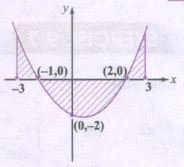
\(\therefore\) Required area= \(\int _{ -3 }^{ -1 }{ ydx } +\int _{ -1 }^{ 2 }{ -y } dx+\int _{ 2 }^{ 3 }{ ydx } \)
\(\\ =\int _{ -3 }^{ -1 }{ \left( { x }^{ 2 }-x-2 \right) } dx\int _{ -1 }^{ 2 }{ (2+x-{ x }^{ 2 })dx } +\int _{ 2 }^{ 3 }{ ({ x }^{ 2 }-x-2) } dx\)
\(={ \left( \frac { { x }^{ 3 } }{ 3 } -\frac { { x }^{ 2 } }{ 2 } -2x \right) }_{ -3 }^{ -1 }+{ \left( 2x+\frac { { x }^{ 2 } }{ 2 } -\frac { { x }^{ 3 } }{ 3 } \right) }_{ -1 }^{ 2 }+{ \left( \frac { { x }^{ 3 } }{ 3 } -\frac { { x }^{ 2 } }{ 2 } -2x \right) }_{ 2 }^{ 3 }\)
\(=\left( -\frac { 1 }{ 3 } -\frac { 1 }{ 2 } +2 \right) -\left( -9-\frac { 9 }{ 2 } +6 \right) +\left( 4+2-\frac { 8 }{ 3 } \right) -\left( -2+\frac { 1 }{ 2 } +\frac { 1 }{ 3 } \right) +\left( 9-\frac { 9 }{ 2 } -6 \right) -\left( \frac { 8 }{ 3 } -2-4 \right) \)
\(\\ =\left( \frac { -2-3+6 }{ 6 } \right) -\left( \frac { -6-9 }{ 2 } \right) +\left( \frac { 18-8 }{ 3 } \right) -\left( \frac { -12+3+2 }{ 6 } \right) +\left( \frac { 6-9 }{ 2 } \right) -\left( \frac { 8-24 }{ 3 } \right) \)
\(=\frac { 1 }{ 6 } +\frac { 15 }{ 2 } +\frac { 10 }{ 3 } +\frac { 7 }{ 6 } -\frac { 3 }{ 2 } +\frac { 16 }{ 3 } \)
\(=\frac { 1+45+20+7-9+32 }{ 6 } =\frac { 90 }{ 6 } =15
\)
24.
Given
\(f(x)=\begin{cases} \begin{matrix} { Ke }^{ \frac { -x }{ 3 } } & \begin{matrix} for & x>0 \end{matrix} \end{matrix} \\ \begin{matrix} 0 & \begin{matrix} for & x\le 0 \end{matrix} \end{matrix} \end{cases}\)
(i) Since f(x) is a probability density function
\(\int _{ -\infty }^{ \infty }{ f(x) } dx=1\)
\(\Rightarrow \int _{ 0 }^{ \infty }{ K.{ e }^{ \frac { -x }{ 3 } } } dx=1\Rightarrow k\frac { \left[ { e }^{ \frac { -x }{ 3 } } \right] ^{ \infty } }{ -\frac { 1 }{ 3 } } \)
\(\Rightarrow -3k\left[ { e }^{ -\infty }-{ e }^{ 0 } \right] =1\) [∵ e∞ = 0, e0 = 1]
\(\Rightarrow 3k=1\Rightarrow k=\frac { 1 }{ 3 } \)
\(\therefore k=\cfrac { 1 }{ 3 } \)
(ii) The distribution function F(x) = \(\int _{ -\infty }^{ x }{ f(u)du } \)
Case 1: x < 0,
\(F(x)=\int _{ -\infty }^{ x }{ f(x)dx=0 } \)
Case 2: x > 0,
\(f(x)=\int _{ -\infty }^{ x }{ f(x)dx } \)
= \(\int _{ -\infty }^{ 0 }{ f(x)dx+\int _{ 0 }^{ x }{ f(x) } dx } \)
= \(0+k\int _{ 0 }^{ x }{ { e }^{ \frac { -x }{ 3 } } } dx\)
= \(\frac { 1 }{ 3 } \left[ \cfrac { { e }^{ \frac { -x }{ 3 } } }{ -\frac { 1 }{ 3 } } \right] =-\left[ { e }^{ -\frac { x }{ 3 } }-{ e }^{ o } \right] \)
= \(-[{ e }^{ -\frac { x }{ 3 } }-1]\)
= \(1-{ e }^{ -\frac { x }{ 3 } }\)
\(\therefore F(x)=\begin{cases} \begin{matrix} 0 & x\le 0 \end{matrix} \\ \begin{matrix} 1-{ e }^{ \frac { -x }{ 3 } } & x>0 \end{matrix} \end{cases}\)
(iii) p(X < 3)
= \(\int _{ 0 }^{ 3 }{ ke^{ -\frac { x }{ 3 } } } dx=\cfrac { 1 }{ 3 } \int _{ 0 }^{ 3 }{ { e }^{ -\frac { x }{ 3 } }dx } \)
= \(\cfrac { 1 }{ 3 } \left[ \frac { { e }^{ -\frac { x }{ 3 } } }{ \frac { -1 }{ 3 } } \right] \)
= -[e-1-e0] = -[e-1-1]
(iv) \(p(5\le X)=p(X\ge 5)=\int _{ 5 }^{ \infty }{ f(x)dx } \)
= \(\int _{ 5 }^{ \infty }{ ke^{ -\frac { x }{ 3 } } } dx=\cfrac { 1 }{ 3 } \cfrac { \left[ { e }^{ -\frac { x }{ 3 } } \right] _{ 5 }^{ \infty } }{ \frac { -1 }{ 3 } } \)
= \(-\left[ { e }^{ -\infty }-e^{ \frac { -3 }{ 5 } } \right] =\left[ 0-{ e }^{ \frac { -5 }{ 3 } } \right] \)
= \({ e }^{ \frac { -5 }{ 3 } }\)
(v) \(p(X\le 4)=\int _{ -\infty }^{ 4 }{ f(x)dx } \)
= \(\int _{ -\infty }^{ 0 }{ f(x)dx+\int _{ 0 }^{ 4 }{ f(x)dx } } \)
= \(0+\int _{ 0 }^{ 4 }{ { ke }^{ -\frac { x }{ 3 } }dx } =k\left[ \frac { { e }^{ -\frac { x }{ 3 } } }{ -\frac { 1 }{ 3 } } \right] _{ 0 }^{ 4 }\)
= \(\cfrac { 1 }{ 3 } \cfrac { \left[ { e }^{ -\frac { x }{ 3 } } \right] _{ 0 }^{ 4 } }{ -\frac { 1 }{ 3 } } =-\left[ { e }^{ \frac { -4 }{ 3 } }-{ e }^{ o } \right] \)
= \(-\left[ { e }^{ \frac { -4 }{ 3 } }-1 \right] =1-{ e }^{ \frac { -4 }{ 3 } }\)
25.
Let there be N radioactive nuclei in a sample at any time t and let No be the initial number of radioactive nuclei.
Then \(\frac{dN}{dt}\infty N\)
\(\Rightarrow \frac { dN }{ dt } =-\lambda N\)
Where \(\lambda>0\) is a constant
\(\Rightarrow \frac { dN }{ N } =-\lambda dt\)
\(\int { \frac { dN }{ N } } =-\lambda dt\)
\(\int { \frac { dN }{ N } =-\lambda \int { dt } } \)
\(\Rightarrow log\ N=-\lambda t+C\ ...(1)\)
\(T\quad t=0,\ we\ have\ N={ N }_{ 0 }\)
\(\therefore log{ N }_{ 0 }=0+C\)
\(\Rightarrow C=log{ N }_{ 0 }\)
\(\therefore\)(1) becomes, log N = -\(\lambda t+log{ N }_{ 0 }\)
\(\Rightarrow log\frac { N }{ { N }_{ 0 } } =-\lambda t\quad ...(2)\)
It is given that 10% of the original number of nuclei have undergone disintegration in a period of 100 years.
Whent= 100 \(N={ N }_{ 0 }-\frac { 10 }{ 100 } \times { N }_{ 0 }=\frac { { 9N }_{ 0 } }{ 10 } \)
Substituting in (2) we get
\(log\quad \frac { 9 }{ 10 } =-100\lambda \)
\(\Rightarrow \lambda =-\frac { 1 }{ 100 } log\frac { 9 }{ 10 } \)
Substituting in (2) we get,
\(log\frac { N }{ { N }_{ 0 } } =\left( \frac { 1 }{ 100 } log\frac { 9 }{ 10 } \right) t\)
when t = 1000,
\(log\frac { N }{ { N }_{ 0 } } =\frac { 1 }{ 100 } log\left( \frac { 9 }{ 10 } \right) \times 1000\)
\(=10log\left( \frac { 9 }{ 10 } \right) \)
\(\Rightarrow log\frac { N }{ { N }_{ 0 } } ={ \left( \frac { 9 }{ 10 } \right) }^{ 10 }\)
\(\Rightarrow \frac { N }{ { N }_{ 0 } } ={ \left( \frac { 9 }{ 10 } \right) }^{ 10 }\)
\(\Rightarrow \frac { N }{ { N }_{ 0 } } \times 100={ \left( \frac { 9 }{ 10 } \right) }^{ 10 }\times 100=\frac { { 9 }^{ 10 } }{ { 10 }^{ 8 } } \)
Hence, \(\frac { { 9 }^{ 10 } }{ { 10 }^{ 8 } } \%\) of radioactive nuclei will remain after 1000 years,
26.
27.
Given \(v\frac { dv }{ dx } =g\left( 1-\frac { { v }^{ 2 } }{ { k }^{ 2 } } \right) =g\left( \frac { { k }^{ 2 }-{ v }^{ 2 } }{ { k }^{ 2 } } \right) \)
On separating the variables we get,
\(\frac { vdv }{ { k }^{ 2 }-{ v }^{ 2 } } =\frac { g }{ { k }^{ 2 } } .dx\)
Multiplying by -2 both sides we get,
\(v\frac { dv }{ dx } =g\left( 1-\frac { { v }^{ 2 } }{ { k }^{ 2 } } \right) =g\left( \frac { { k }^{ 2 }-{ v }^{ 2 } }{ { k }^{ 2 } } \right) \)
\(\frac { -2vdv }{ { k }^{ 2 }-{ v }^{ 2 } } =\frac { -2g }{ { k }^{ 2 } } dx\)
Taking integrating on both sides, we get
\(\int { \frac { -2v }{ { k }^{ 2 }-{ v }^{ 2 } } } =\frac { -2g }{ { k }^{ 2 } } .x+log\quad c\)
\(\Rightarrow log({ k }^{ 2 }-{ v }^{ 2 })=\frac { -2g }{ { k }^{ 2 } } .x+log\quad c\)
\(\Rightarrow log({ k }^{ 2 }-{ v }^{ 2 })-log\quad c=\frac { -2g }{ { k }^{ 2 } } .x\)
\(\Rightarrow log\left( \frac { { k }^{ 2 }-{ v }^{ 2 } }{ c } \right) -\frac { -2gx }{ { k }^{ 2 } } \)
\(\Rightarrow \frac { { k }^{ 2 }-{ v }^{ 2 } }{ e } ={ e }^{ -\frac { -2gx }{ { k }^{ 2 } } }\)
\(\Rightarrow { k }^{ 2 }-{ v }^{ 2 }{ ce }^{ \frac { -2gx }{ { k }^{ 2 } } }...(1)\)
Initial condition:
when v = 0, x = 0 we get
\(
k^2-(0)^2 =C e^{\frac{-2g(0)}{k^2}}
\)
\(k^2 =C e^0 \Rightarrow k^2=C
\)
\((1) \Rightarrow k^2-v^2 =k^2 e^{\frac{-2 x^2}{k^2}}
\)
\(k^2-k^2 e^{\frac{-2 s x}{k^1}} =\mathrm{v}^2
\)
\(k^2\left[1-e^{\frac{-2 s x}{k^2}}\right] =\mathrm{v}^2\)
28.
\({ cot }^{ -1 }x-{ xot }^{ -1 }\left( x+2 \right) =\frac { \pi }{ 12 } ,x>0\)
\({ tan }^{ -1 }\left( \frac { 1 }{ x } \right) -{ tan }^{ -1 }\left( \frac { 1 }{ x+2 } \right) =\frac { \pi }{ 2 } \)
\(\left[ \because { cot }^{ 1 }\left( x \right) ={ tan }^{ -1 }\left( \frac { 1 }{ x } \right) ifx>0 \right] \)
\(\Rightarrow { tan }^{ -1 }\left( \frac { \frac { 1 }{ x } +\frac { 1 }{ x+2 } }{ 1+\frac { 1 }{ x } .\frac { 1 }{ x+2 } } \right) =\frac { \pi }{ 2 } \)
\(\Rightarrow \left( \frac { \frac { x+2-x }{ x(x+2) } }{ \frac { x(x+2)+1 }{ x(x+2) } } \right) ={ tan15 }^{ 0 }\)
\(\left[ \because { tan15 }^{ 0 }=tan\left( { 45 }^{ 0 }-30^{ 0 } \right) \right] \)
\(\frac { { tan45 }^{ 0 }-{ tan30 }^{ 0 } }{ 1+tan{ 45 }^{ 0 }tan{ 30 }^{ 0 } } \)
\(\frac { 1-\frac { 1 }{ \sqrt { 3 } } }{ 1+\frac { 1 }{ \sqrt { 3 } } } =\frac { \sqrt { 3 } -1 }{ \sqrt { 3 } +1 } \times \frac { \sqrt { 3 } -1 }{ \sqrt { 3 } -1 } \)
\(\frac { \left( \sqrt { 3 } -1 \right) ^{ 2 } }{ 3-1 } =\frac { \left( \sqrt { 3 } -1 \right) ^{ 2 } }{ 2 } \)
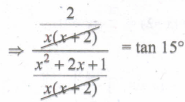
\(\Rightarrow \frac { 2 }{ { x }^{ 2 }+2x+1 } =\frac { \left( \sqrt { 3 } -1 \right) ^{ 2 } }{ 2 } \)
\(\Rightarrow \frac { 7 }{ (x+1)^{ 2 } } =\frac { \left( \sqrt { 3 } -1 \right) ^{ 2 } }{ 2 } \)
\(\Rightarrow 4=(x+1)^{ 2 }\left( \sqrt { 3 } -1 \right) ^{ 2 }\)
Taking square root both sides
\(2=(x+1)(\sqrt { 3 } -1)\)
\(\Rightarrow x+1=\frac { 2 }{ \sqrt { 3- } 1 } \times \frac { \sqrt { 3 } +1 }{ \sqrt { 3 } +1 } =\frac { 2\left( \sqrt { 3 } +1 \right) }{ 3-1 } =\sqrt { 3 } +1\)
\(x+1=\sqrt { 3 }+ 1\)
\(x=\sqrt { 3 } \)
29.
Here the number of equations is 4 and the number of unknowns is 3. Reducing the augmented matrix to echelon-form, we get
[A | O] = \(\left[ \begin{matrix} 1 \\ \begin{matrix} 2 \\ \begin{matrix} 3 \\ 6 \end{matrix} \end{matrix} \end{matrix}\begin{matrix} 1 \\ \begin{matrix} -3 \\ \begin{matrix} -7 \\ -9 \end{matrix} \end{matrix} \end{matrix}\begin{matrix} -2 \\ \begin{matrix} 1 \\ \begin{matrix} 10 \\ 10 \end{matrix} \end{matrix} \end{matrix}|\begin{matrix} 0 \\ \begin{matrix} 0 \\ \begin{matrix} 0 \\ 0 \end{matrix} \end{matrix} \end{matrix} \right] \overset { \begin{matrix} { R }_{ 2 }\rightarrow { R }_{ 2 }-2{ R }_{ 1 } \\ { R }_{ 3 }\rightarrow { R }_{ 3 }-3{ R }_{ 1 }, \\ { R }_{ 4 }\rightarrow { R }_{ 4 }-6{ R }_{ 1 } \end{matrix} }{ \longrightarrow } \left[ \begin{matrix} 1 \\ \begin{matrix} 0 \\ \begin{matrix} 0 \\ 0 \end{matrix} \end{matrix} \end{matrix}\begin{matrix} 1 \\ \begin{matrix} -5 \\ \begin{matrix} -10 \\ -15 \end{matrix} \end{matrix} \end{matrix}\begin{matrix} -2 \\ \begin{matrix} 5 \\ \begin{matrix} 16 \\ 22 \end{matrix} \end{matrix} \end{matrix}|\begin{matrix} 0 \\ \begin{matrix} 0 \\ \begin{matrix} 0 \\ 0 \end{matrix} \end{matrix} \end{matrix} \right] \overset { \begin{matrix} { R }_{ 2 }\rightarrow { R }_{ 2 }\div \left( -5 \right) \\ { R }_{ 3 }\rightarrow { R }_{ 3 }\div \left( -2 \right) \end{matrix} }{ \longrightarrow } \left[ \begin{matrix} 1 \\ \begin{matrix} 0 \\ \begin{matrix} 0 \\ 0 \end{matrix} \end{matrix} \end{matrix}\begin{matrix} 1 \\ \begin{matrix} 1 \\ \begin{matrix} 5 \\ -15 \end{matrix} \end{matrix} \end{matrix}\begin{matrix} -2 \\ \begin{matrix} -1 \\ \begin{matrix} -8 \\ 22 \end{matrix} \end{matrix} \end{matrix}|\begin{matrix} 0 \\ \begin{matrix} 0 \\ \begin{matrix} 0 \\ 0 \end{matrix} \end{matrix} \end{matrix} \right] \)
\(\overset { \begin{matrix} { R }_{ 3 }\rightarrow { R }_{ 3 }-5{ R }_{ 2 }, \\ { R }_{ 4 }\rightarrow { R }_{ 4 }+15{ R }_{ 2 } \end{matrix} }{ \longrightarrow } \left[ \begin{matrix} 1 \\ \begin{matrix} 0 \\ \begin{matrix} 0 \\ 0 \end{matrix} \end{matrix} \end{matrix}\begin{matrix} 1 \\ \begin{matrix} 1 \\ \begin{matrix} 0 \\ 0 \end{matrix} \end{matrix} \end{matrix}\begin{matrix} -2 \\ \begin{matrix} -1 \\ \begin{matrix} -3 \\ 7 \end{matrix} \end{matrix} \end{matrix}|\begin{matrix} 0 \\ \begin{matrix} 0 \\ \begin{matrix} 0 \\ 0 \end{matrix} \end{matrix} \end{matrix} \right] \overset { \begin{matrix} { R }_{ 3 }\rightarrow { R }_{ 3 }\div \left( -3 \right) \\ { R }_{ 4 }\rightarrow { R }_{ 4 }\div 7 \end{matrix} }{ \longrightarrow } \left[ \begin{matrix} 1 \\ \begin{matrix} 0 \\ \begin{matrix} 0 \\ 0 \end{matrix} \end{matrix} \end{matrix}\begin{matrix} 1 \\ \begin{matrix} 1 \\ \begin{matrix} 0 \\ 0 \end{matrix} \end{matrix} \end{matrix}\begin{matrix} -2 \\ \begin{matrix} -1 \\ \begin{matrix} 1 \\ 1 \end{matrix} \end{matrix} \end{matrix}|\begin{matrix} 0 \\ \begin{matrix} 0 \\ \begin{matrix} 0 \\ 0 \end{matrix} \end{matrix} \end{matrix} \right] \overset { { R }_{ 4 }\rightarrow { R }_{ 4 }-{ R }_{ 3 } }{ \longrightarrow } \left[ \begin{matrix} 1 \\ \begin{matrix} 0 \\ \begin{matrix} 0 \\ 0 \end{matrix} \end{matrix} \end{matrix}\begin{matrix} 1 \\ \begin{matrix} 1 \\ \begin{matrix} 0 \\ 0 \end{matrix} \end{matrix} \end{matrix}\begin{matrix} -2 \\ \begin{matrix} -1 \\ \begin{matrix} 1 \\ 0 \end{matrix} \end{matrix} \end{matrix}|\begin{matrix} 0 \\ \begin{matrix} 0 \\ \begin{matrix} 0 \\ 0 \end{matrix} \end{matrix} \end{matrix} \right] \)
So, ρ(A) = ρ([A | O]) = 3 = number of unknowns
Hence the system has trivial solution only.
30.
Given plane is passing through the points
\(\vec { a } =2\hat { i } +2\hat { j } +2\hat { k }, \vec { b } =9\hat { i } +3\hat { j } +6\hat { k } \)
Equation of the given plane is 2x + 6y + 6z = 9. It can be written as \(\vec { r } .(2\hat { i } +6\hat { j } +6\hat { k } )=9\)
Since the given plane is perpendicular to \(2\hat { i } +6\hat { j } +6\hat { k } \), the required plane is parallel to \(\vec { c } =2\hat { i } +6\hat { j } +6\hat { k } \). Hence, parametric form of vector equation of plane passing through two points and parallel to a vector is
\(\vec { r } =\vec { a } +s(\vec { b } -\vec { a } )+t\vec { c } ,s,t\in R\)
\(\vec { r } =2\hat { i } +2\hat { j } +\hat { k } +s(7\hat { i } +\hat { j } +5\hat { k } )+t(2\hat { i } +6\hat { j } +6\hat { k } ),s,t\in R\)
Cartesian equation of the plane is
\(\left| \begin{matrix} x-{ x }_{ 1 } & y-{ y }_{ 1 } & z-{ z }_{ 1 } \\ { x }_{ 2 }-{ x }_{ 1 } & { y }_{ 2 }-{ y }_{ 1 } & { z }_{ 2 }-{ z }_{ 1 } \\ { c }_{ 1 } & { c }_{ 2 } & { c }_{ 3 } \end{matrix} \right| =0\)
\(\Rightarrow \left| \begin{matrix} x-2 & y-2 & z-1 \\ 7 & 1 & 5 \\ 2 & 6 & 6 \end{matrix} \right| =0\)
⇒ (x-2)(6-30) - (y-2)(42-10) + (z-1)(42-2) = 0
⇒ (x - 2)(-24) - (y - 2)(32) + (z - 1)(40) = 0
⇒ 24x + 48 - 32y + 64 + 40z - 40 = 0
⇒ -24x - 32y + 40z + 72 = 0
\(\div\) - 8 we get
3x+ 4y - 5z - 9 = 0 is the Cartesian form.
∴ The parametric form of vector equation is
\(\vec { r } =\vec { r } (3\vec { i } +4\vec { j } -5\vec { k } )=9\)
31.
By taking the vertex; at the origin, the parabola is open downward.
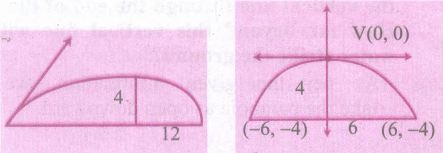
Its equation is x2 = -4ay
It passes through (6, -4)
∴ 36 = -4a(-4) ⇒ 4a = - \(\frac { 36 }{ 4 } \) = 9
∴ (1) becomes, x2 = -9y
To find the slope at (-6, -4)
Differentiating (1) with respect to 'x' we get,
2x = -9\(\frac { dy }{ dx } \)
⇒ \(\frac { dy }{ dx } =\frac { -2x }{ 9 } \)
At (-6, -4), \(\frac { dy }{ dx } =-2\frac { (-6) }{ 9 } =\frac { 12 }{ 9 } =\frac { 4 }{ 3 } \)
∴ \(tan\theta =\frac { 4 }{ 3 } \Rightarrow \theta ={ tan }^{ -1 }\left( \frac { 4 }{ 3 } \right) \)
∴ The angle of projection is tan-1 \(\left( \frac { 4 }{ 3 } \right) \)
32.
Given z = x + iy and arg\(\left( \frac { z-i }{ z+2 } \right) =\frac { \pi }{ 4 } \)
⇒ arg(z-i) - arg(z+2) = \(\frac { \pi }{ 4 } \)
⇒ arg(x + iy-i) - arg(x+iy+2) = \(\frac { \pi }{ 4 } \)
⇒ arg(x+i(y-1)-arg((x+2)+iy) = \(\frac { \pi }{ 4 } \)
⇒ \(tan^{ -1 }\left( \frac { y-1 }{ x } \right) -tan^{ -1 }\left( \frac { y }{ x+2 } \right) \) = \(\frac { \pi }{ 4 } \)
⇒ \(tan^{ -1 }\left( \frac { \frac { y-1 }{ x } -\frac { y }{ x+2 } }{ 1+\frac { y-1 }{ x } .\frac { y }{ x+2 } } \right) \)
= \(\frac { \pi }{ 4 } \)\(\left[ \because tan^{ -1 }x-tan^{ -1 }y=tan^{ -1 }\left( \frac { x-y }{ 1+xy } \right) \right] \)
\(\Rightarrow \frac{\left(\frac{(x+2)(y-1)- x y}{\not {x (\not x+\not2)}}\right)}{\left(\frac{x(x+2)+y(y-1)}{\not x(\not x+\not 2)}\right)}=\tan \frac{\pi}{4}=1\)
⇒ \(\frac { (x+2)(y-1)-xy }{ x(x+2)+y(y-1) } \) = 1
⇒ -x + 2y-2 = x2+ 2x + y2-y
⇒ x2 + 2x + y2-y + x-2y + 2 = 0
⇒ x2 + y2+3x-3y + 2 = 0
Hence proved.
33.
(i) 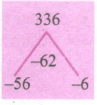
Rearrange the terms as,
(x-5) (x+4) (x-7) (x+6) = 504
{-2, 3, -7, 8}
⇒ (x2 -x - 20) (x2 -x - 42) = 504
Put x2- x = y
⇒ (y-20)(y-42) = 504
⇒ y2-62y+840-504 = 0
⇒ y2-62y+336 = 0
⇒ (y - 56) (y - 6) = 0
⇒ y = 56, 6
Case (i)
When y = 56, x2 - x = 56
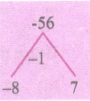
⇒ x2 - x - 56 = 0
⇒ (x - 8)(x + 7) = 0
⇒ x = 8, -7
Case (ii)
When y = 6,
x2- x = 6
x2- x - 6 = 0
⇒ (x - 3)(x + 2) = 0
⇒ x = 3, - 2

Hence the roots are -2, 3, 8, -7
34.
35.
(d)
a*b = ab
36.
(d)
37.
(d)
9
38.
(b)
12xo dx
39.
(d)
1
40.
(d)
41.
(d)
4
42.
\({ I }_{ n }=\int _{ 0 }^{ \pi /2 }{ { cos }^{ 7 }xdx=\frac { n-1 }{ n } { I }_{ n-2 },n\ge 2 } \)
\(\therefore { I }_{ 7 }=\int _{ 0 }^{ \pi /2 }{ { cos }^{ 7 }xdx=\frac { 6 }{ 7 } \times \frac { 4 }{ 5 } \times \frac { 2 }{ 3 } \times 1 } =\frac { 16 }{ 35 } \)
43.
(d)
2
44.
(b)
45.
(a)
46.
(b)
adj(AB) = (adj A)(adj B)
47.
(d)
\(-17\hat { i } -21\hat { j } -97\hat { k } \)
48.
(b)
\(\frac { 3\pi }{ 4 } \)
49.
(b)
2(a2+b2)
50.
(a)
(4, 7)
51.
(a)
0
52.
(d)
|k| ≥ 6
53.
(b)
2
54.
(a)
\(\cfrac { 1 }{ 2 } \left| z \right| ^{ 2 }\)

12th Standard Syllabus & Materials
12th Standard
TN 12th Computer Applications வலையமைப்பு வடமிடல் Sample Question Papers Study Material - QB365 Set A
NEW12th Standard
TN 12th Computer Applications களப்பெயர் முறைமை (DNS) Sample Question Papers Study Material - QB365 Set A
NEW12th Standard
TN 12th Computer Applications வலையமைப்பு எடுத்துக்காட்டுகள் மற்றும் நெறிமுறைகள் Sample Question Papers Study Material - QB365 Set A
NEW12th Standard
TN 12th Computer Applications கணினி வலையமைப்பு ஓர் அறிமுகம் Sample Question Papers Study Material - QB365 Set A



Tamilnadu Stateboard 12th Standard Subjects
Maths

Chemistry

Physics

Biology

Computer Science

Business Maths and Statistics

Economics

Commerce

Accountancy

History

Computer Applications
Biology
Computer Technology
Computer Applications
Computer Science
Business Maths and Statistics
Commerce
Economics
Maths
Chemistry
Physics
Computer Technology
History
Accountancy

Tamil

English

French
Tamilnadu Stateboard Standards


