
 100% FREE ACCESS
12th Standard Syllabus & Materials
12th Standard
TN 12th Computer Applications மின்னணு தரவு பரிமாற்றம் Sample Question Papers Study Material - QB365 Set A
NEW12th Standard
TN 12th Computer Applications மின் - வணிக பாதுகாப்பு அமைப்புகள் Sample Question Papers Study Material - QB365 Set A
NEW12th Standard
TN 12th Computer Applications மின்னணு செலுத்தல் முறைகள் Sample Question Papers Study Material - QB365 Set A
NEW12th Standard
TN 12th Computer Applications மின் - வணிகம் Sample Question Papers Study Material - QB365 Set A
NEW12th Standard
TN 12th Computer Applications திறந்த மூல கருத்துருக்கள் Sample Question Papers Study Material - QB365 Set A
NEW12th Standard
TN 12th Computer Applications வலையமைப்பு வடமிடல் Sample Question Papers Study Material - QB365 Set A

Published on: 28/11/2025
Download Tamil Nadu 12th Standard Maths question papers, model tests, one-mark questions, important questions, and public exam papers in PDF format. Free study materials and answer keys for TN State Board students.
Questions + Answers key
Take MCQ Maths Test
1.
If y = 3x + c is a tangent to the circle \(x^{2}+y^{2}=9\), find the value of c.
2.
Determine whether ∗ is a binary operation on the sets given below.
a*b = min (a, b) on A = {1, 2, 3, 4, 5}
3.
Compute P(X = k) for the binomial distribution, B(n, p) where
n = 6, \(p=\frac { 1 }{ 3 } \), k = 3
4.
Evaluate the following \(\int _{ 0 }^{ \pi /2 }{ { cos}^{ 7}x\quad dx } \)
5.
Explain why Rolle’s theorem is not applicable to the following functions in the respective intervals.
\(f(x)=|\frac{1}{x}|, x\in [-1,1]\)
6.
Form the differential equation by eliminating the arbitrary constants A and B from y = A cos x + B sin x.
7.
Find centre and radius of the following circles.
x2 + y2+ 6x − 4y + 4 = 0
8.
The volume of the parallelepiped whose coterminus edges are \(7\hat { i } +\lambda \hat { j } -3\hat { k } ,\hat { i } +2\hat { j } -\hat { k } \), \(-3\hat { i } +7\hat { j } +5\hat { k } \) is 90 cubic units. Find the value of λ.
9.
Find the principal value of tan−1(\(\sqrt3\))
10.
If α, β, and γ are the roots of the equation x3 + px2 + qx + r = 0, find the value of \(\Sigma \frac { 1 }{ \beta \gamma } \) in terms of the coefficients.
11.
Prove that p➝(¬q V r) ≡ ¬pV(¬qVr) using truth table.
12.
A watermelon has an ellipsoid shape which can be obtained by revolving an ellipse with major-axis 20 cm and minor-axis 10 cm about its major-axis. Find its volume using integration.
13.
A random variable X has the following probability mass function
| x | 1 | 2 | 3 | 4 | 5 | 6 |
| f(x) | k | 2k | 6k | 5k | 6k | 10k |
Find
(i) P(2 < X < 6)
(ii) P(2 ≤ X < 5)
(iii) P(X ≤4)
(iv) P(3 < X )
14.
The engine of a motor boat moving at 10 m/s is shut off. Given that the retardation at any subsequent time (after shutting off the engine) equal to the velocity at that time. Find the velocity after 2 seconds of switching off the engine.
15.
16.
A ladder 17 metre long is leaning against the wall. The base of the ladder is pulled away from the wall at a rate of 5 m/s. When the base of the ladder is 8 metres from the wall.
(i) How fast is the top of the ladder moving down the wall?
(ii) At what rate, the area of the triangle formed by the ladder, wall and the floor is changing?
17.
Solve the following systems of linear equations by Cramer’s rule:
\(\frac { 3 }{ x } -\frac { 4 }{ y } -\frac { 2 }{ z } \) -1 = 0, \(\frac { 1 }{ x } +\frac { 2 }{ y } +\frac { 1 }{ z } \) - 2 = 0, \(\frac { 2 }{ x } -\frac { 5 }{ y } -\frac { 4 }{ z } \) + 1 = 0
18.
Find the parametric vector, non-parametric vector and Cartesian form of the equations of the plane passing through the points (3, 6, −2), (−1,−2, 6) , and (6, 4, −2).
19.
On lighting a rocket cracker it gets projected in a parabolic path and reaches a maximum height of 4 m when it is 6 m away from the point of projection. Finally it reaches the ground 12 m away from the starting point. Find the angle of projection.
20.
Prove that the point of intersection of the tangents at ‘t1’ and ‘t2’ on the parabola y2 = 4ax is \(\left[ at_{ 1 }t_{ 2 },a({ t }_{ 1 }+{ t }_{ 2 }) \right] .\)
21.
If cos−1 x + cos−1 y + cos−1 z = \(\pi \) and 0 < x, y, z < 1, show that x2
22.
If z = x + iy is a complex number such that Im \(\left( \frac { 2z+1 }{ iz+1 } \right) =0\) show that the locus of z is 2x2+ 2y2+ x - 2y = 0
23.
Find all zeros of the polynomial x6- 3x5- 5x4 + 22x3- 39x2- 39x + 135, if it is known that 1+2i and \(\sqrt{3}\) are two of its zeros.
24.
By vector method, prove that cos(α + β) = cos α cos β - sin α sin β
25.
Evaluate \(\int _{ 3 }^{ 6 }{ \frac { \sqrt { x } }{ \sqrt { 9 } -x+\sqrt { x } } dx } \)
26.
Prove that q ➝ p ≡ ¬p ➝ ¬q
27.
The time T, taken for a complete oscillation of a single pendulum with length l, is given by the equation T = 2ㅠ\(\sqrt { \frac { 1 }{ g } } \), where g is a constant. Find the approximate percentage error in the calculated value of T corresponding to an error of 2 percent in the value of l.
28.
Solve the Linear differential equation:
cos x\(\frac{dy}{dx}\)+y sin x = 1
29.
Using the Lagrange’s mean value theorem determine the values of x at which the tangent is parallel to the secant line at the end points of the given interval:
f(x) = x3 − 3x + 2, x ∈ [-2, 2]
30.
Find the value of \({ cos }^{ -1 }\left( cos\frac { \pi }{ 7 } cos\frac { \pi }{ 17 } -sin\frac { \pi }{ 7 } sin\frac { \pi }{ 17 } \right) .\)
31.
Find the angle between the planes \(\vec { r } .(\hat { i } +\hat { j } -2\hat { k } )\) = 3 and 2x - 2y + z =2
32.
If \(2cos\alpha=x+\frac { 1 }{ x } \) and \(2cos\ \beta =y+\frac { 1 }{ y } \), show that \({ x }^{ m }{ y }^{ n }+\frac { 1 }{ { x }^{ m }{ y }^{ n } } =2cos(m\alpha +n\beta )\)
33.
Show that the absolute value of difference of the focal distances of any point P on the hyperbola is the length of its transverse axis.
34.
Solve the following system of linear equations, using matrix inversion method:
5x + 2y = 3, 3x + 2y = 5.
35.
If |adj (adj A)| = |A|9 then the order of the square matrix A is ______
3
4
2
5
36.
The Cumulative distribution function F(x) of a discrete random variable is _______
A decreasing function
An increasing function
A non - decreasing function
A non - increasing function
37.
38.
39.
The area between y2 = 4x and its latus rectum is
\(\frac{2}{3}\)
\(\frac{4}{3}\)
\(\frac{8}{3}\)
\(\frac{5}{3}\)
40.
If v (x, y) = log (ex + ey), then \(\frac { { \partial }v }{ \partial x } +\frac { \partial v }{ \partial y } \) is equal to
ex + ey
\(\frac{1}{e^x + e^y}\)
2
1
41.
42.
The solution of the differential equation \(\frac { dy }{ dx } =2xy\) is
y = Cex2
y = 2x2 + C
y = Ce−x2 + C
y = x2 + C
43.
The differential equation of the family of curves y = Aex + Be−x, where A and B are arbitrary constants is
\(\frac { { d }^{ 2 }y }{ { dx }^{ 2 } } +y=0\)
\(\frac { { d }^{ 2 }y }{ { dx }^{ 2 } } -y=0\)
\(\frac { { d }y }{ { dx } } +y=0\)
\(\frac { { d }y }{ { dx } } -y=0\)
44.
The curve y= ax4 + bx2 with ab > 0
has, no horizontal tangent
is concave up
is concave down
has no points of inflection
45.
46.
47.
If A = \(\left[ \begin{matrix} 2 & 0 \\ 1 & 5 \end{matrix} \right] \) and B = \(\left[ \begin{matrix} 1 & 4 \\ 2 & 0 \end{matrix} \right] \) then |adj (AB)| =
-40
-80
-60
-20
48.
If the direction cosines of a line are \(\frac { 1 }{ c } ,\frac { 1 }{ c } ,\frac { 1 }{ c } \), then
\(c=\pm 3\)
\(c=\pm \sqrt { 3 } \)
c > 0
0 < c < 1
49.
If \(\vec { a } .\vec { b } =\vec { b } .\vec { c } =\vec { c } .\vec { a } =0\) , then the value of \([\vec { a } ,\vec { b } ,\vec { c } ]\) is
\(\left| \vec { a } \right| \left| \vec { b } \right| \left| \vec { c } \right| \)
\(\frac{1}{3}\)\(\left| \vec { a } \right| \left| \vec { b } \right| \left| \vec { c } \right| \)
1
-1
50.
The radius of the circle 3x2 + by2 + 4bx − 6by + b2 = 0 is
1
3
\( \sqrt {10}\)
\( \sqrt {11}\)
51.
If sin−1x = 2sin−1 \(\alpha\) has a solution, then
\(|\alpha |\le \frac { 1 }{ \sqrt { 2 } } \)
\(|\alpha |\ge \frac { 1 }{ \sqrt { 2 } } \)
\(|\alpha |<\frac { 1 }{ \sqrt { 2 } } \)
\(|\alpha |>\frac { 1 }{ \sqrt { 2 } } \)
52.
If (1+i)(1+2i)(1+3i)...(1+ni) = x + iy, then \(2\cdot 5\cdot 10...\left( 1+{ n }^{ 2 } \right) \) is
1
i
x2+y2
1+n2
53.
A zero of x3 + 64 is
0
4
4i
-4
54.
If |z| = 1, then the value of \(\frac { 1+z }{ 1+\overline { z } }\) is
z
\(\bar { z } \)
\(\cfrac { 1 }{ z } \)
1
1.
The condition for the line y = mx+c to be a tangent to
\(x^{2}+y^{2}=a^{2} \text { is } \mathrm{c}=\pm a \sqrt{1+m^{2}}\)
Here a = 3, m = 3
\(\therefore c=\pm 3 \sqrt{10}\)
2.
a *b = min (a, b) on A = {1,2,3,4, 5} Let a,b ∈A
A = {1,2, 3, 4, 5}
a*b = min {(a, b)}
Now, 1,2 ∈ A \(\Rightarrow\)1 * 2 = 1 ∈ A
3, 5 ∈ A \(\Rightarrow\) 3 * 5 = 3 ∈ A
Hence * is a binary operation on A
3.
Given n = 6, \(p=\frac { 1 }{ 3 }\), k = 3
\(P(X=k)=\left( \begin{matrix} n \\ k \end{matrix} \right) { p }^{ k }\left( 1-p \right) ^{ n-k },\)
n = 0,1,2, ... n
\(\therefore P(X=k)=\left( \begin{matrix} n \\ k \end{matrix} \right) { p }^{ k }(1-p)^{ n-k }\)
n = 0,1,2, ... n
\(P(X=3)=\left( \begin{matrix} 6 \\ 3 \end{matrix} \right) \left( \cfrac { 1 }{ 3 } \right) ^{ 3 }\left( 1-p \right) ^{ 6-3 }\)
= \(\left( \begin{matrix} 6 \\ 3 \end{matrix} \right) \left( \cfrac { 1 }{ 3 } \right) ^{ 3 }\left( \cfrac { 2 }{ 3 } \right) ^{ 2 }\)
\(=\frac{6 \times 5 \times 4}{8 \times 2 \times 1} \times \frac{1}{27} \times \frac{8}{27}\)
\(P(X=3)=\frac { 160 }{ 729 }\)
4.
\({ I }_{ n }=\int _{ 0 }^{ \pi /2 }{ { cos }^{ 7 }xdx=\frac { n-1 }{ n } { I }_{ n-2 },n\ge 2 } \)
\(\therefore { I }_{ 7 }=\int _{ 0 }^{ \pi /2 }{ { cos }^{ 7 }xdx=\frac { 6 }{ 7 } \times \frac { 4 }{ 5 } \times \frac { 2 }{ 3 } \times 1 } =\frac { 16 }{ 35 } \)
5.
Given \(f(x)=|\frac{1}{x}|, x\in [-1,1]\)
Rolle's theorem is not applicable since \(f(x)=(\frac{1}{x})\) is not continuous at x = 0 in [-1, 1] and not differentiable in (-1, 1)
6.
y = Acos x + Bsin x ... (1)
Differentiating (1) twice successively, we get
\(\frac{dy}{dx}\)= −Asin x + Bcos x. ...(2)
\(\frac{d^2y}{dx^2}\) = -Acos x − Bsin x = −(A cos x + B sin x). ...(3)
Substituting (1) in (3), we get \(\frac{d^2y}{dx^2}\) + = 0 as the required differential equation
7.
Equation of the circle is
x2 + y2 + 6x - 4y + 4 = 0.
Here 2g = 6 ⇒ g = 3
2f = -4 ⇒ f = -2 and c = 4
Centre is (-g, -f) ⇒ (-3, 2)
r = \(\sqrt { { g }^{ 2 }+{ f }^{ 2 }-c } \) = \(\sqrt { { 3 }^{ 2 }+(-2){ }^{ 2 }-{ 4 } } \)
= \(\sqrt { 9+4-4 } \)
= \(\sqrt { 9 } \)
= 3 unit
8.
Let \(\vec { a } =7\hat { i } +\lambda \hat { j } -3\hat { k } ,\vec { b } =\hat { i } +2\hat { j } -\hat { k } \) and \(\vec { c } =-3\hat { i } +7\hat { j } -5\hat { k } \)
∴ volume of the parallelepiped
= \(\vec { a } .(\vec { b } \times \vec { c } )\)
Given \(\vec { a } .(\vec { b } \times \vec { c } )\) = 90
⇒ \(\left| \begin{matrix} 7 & \lambda & -3 \\ 1 & 2 & -1 \\ -3 & 7 & 5 \end{matrix} \right| \) = 90
⇒ \(-6\left| \begin{matrix} 2 & -1 \\ 7 & 5 \end{matrix} \right| -\lambda \left| \begin{matrix} 1 & -1 \\ -3 & 5 \end{matrix} \right| -3\left| \begin{matrix} 1 & 2 \\ -3 & 7 \end{matrix} \right| \) = 90
⇒ 7(10+7)-λ(5-3)-3(7+6) = 90
⇒ 7(17)-λ(2)-3(13) = 90
⇒ 119-2λ-39 = 90
⇒ 119-39-90 = 2λ
⇒ -10 = 2λ
⇒ λ = -5
9.
Let tan−1(\(\sqrt3\)) = y
Then, tan y =\(\sqrt3\)
Thus, y = \(\frac{\pi}{3}\)
Since \(\in(-\frac{\pi}{2},\frac{\pi}{2})\)
Thus the principal value of tan−1(\(\sqrt3\)) = \(\frac{\pi}{3}\)
10.
Since α, β, and γ are the roots of the equation x3+ px2+ qx + r = 0, we have
Σ1 α + β + γ = -p and Σ3 αβγ = -r
\(\Sigma \frac { 1 }{ \beta \gamma } =\frac { 1 }{ \beta \gamma } +\frac { 1 }{ \gamma \alpha } +\frac { 1 }{ \alpha \beta } =\frac { \alpha +\beta +\gamma }{ \alpha \beta \gamma } =\frac { -p }{ -r } =\frac { p }{ r } \).
11.
| p | q | r | ~ q | ~q V r | p➝(¬qVr) | ~p | ~pV(~qVr) |
| T | T | T | F | T | T | F | T |
| T | T | F | F | F | F | F | F |
| T | F | T | T | T | T | F | T |
| T | F | F | T | T | T | F | T |
| F | T | T | F | T | T | T | T |
| F | T | F | F | F | T | T | T |
| F | F | T | T | T | T | T | T |
| F | F | F | T | T | T | T | T |
From the table, it is clear that the column of p➝(¬q V ~r) and ~pV(~q V r) are identical
∴ p➝(¬q V ~r) ≡ ~pV(~q V r)
Hence proved.
12.
Given 2a = 20 cm \(\Rightarrow\) a = 10 cm;
2b = 10 cm \(\Rightarrow\)a = 5 cm
\(\therefore\) Equation of the ellipse is \(\frac { { x }^{ 2 } }{ { a }^{ 2 } } +\frac { { y }^{ 2 } }{ { b }^{ 2 } } =1\)
\(\Rightarrow \frac { { x }^{ 2 } }{ 100 } +\frac { { y }^{ 2 } }{ 25 } =1\Rightarrow \frac { { y }^{ 2 } }{ 25 } =1-\frac { { x }^{ 2 } }{ 100 } =\frac { 100-{ x }^{ 2 } }{ 100 } \)
\(\Rightarrow { y }^{ 2 }=\frac { 25 }{ 100 } (100-{ x }^{ 2 })\)
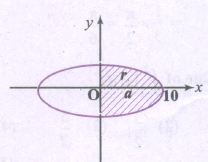
\(\therefore\) Required volume \(=2\pi \int _{ 0 }^{ 10 }{ { y }^{ 2 }dx } \)
\(=2\pi \int _{ 0 }^{ 10 }{ \frac { 25 }{ 100 } (100-{ x }^{ 2 })dx=\frac { 50\pi }{ 100 } \int _{ 0 }^{ 10 }{ (100-{ x }^{ 2 })dx } } \)
\(=\frac { \pi }{ 2 } { \left[ 100x-\frac { { x }^{ 3 } }{ 3 } \right] }_{ 0 }^{ 10 }=\frac { \pi }{ 2 } \left[ 100-\frac { 1000 }{ 3 } \right] \)
\(V=\frac { \pi }{ 2 } \left( \frac { 3000-1000 }{ 3 } \right) =\frac { \pi }{ 2 } \left( \frac { 2000 }{ 3 } \right) \)
\(=\frac { 1000\pi }{ 3 } \)
13.
Since the given function is a probability mass function, the total probability is one. That is \(\underset { x }{ \Sigma } f(x)=1\)
From the given data k + 2k + 6k + 5k + 6k +10k+1
\(30k=1\Rightarrow k=\frac { 1 }{ 30 } \)
Therefore the probability mass function is
| x | 1 | 2 | 3 | 4 | 5 | 6 |
| f(x) | \(\cfrac { 1 }{ 30 } \) | \(\cfrac { 2 }{ 30 } \) | \(\cfrac { 6 }{ 30 } \) | \(\cfrac { 5 }{ 30 } \) | \(\cfrac { 6 }{ 30 } \) | \(\cfrac { 10 }{ 30 } \) |
(i) P(2 < X < 6) = f(3)+ f(4)+ f(5) = \(\frac { 6 }{ 30 } +\frac { 5 }{ 30 } +\frac { 6 }{ 30 } =\frac { 17 }{ 30 } \)
(ii) P(2≤X≤5) = f(2)+f(3)+f(4) = \(\frac { 2 }{ 30 } +\frac { 6 }{ 30 } +\frac { 5 }{ 30 } =\frac { 13 }{ 30 } \)
(iii) P(2≤4) = f(1)+f(2)+f(3)+f(4) = \(\frac { 1 }{ 30 } +\frac { 2 }{ 30 } +\frac { 6 }{ 30 } +\frac { 5 }{ 30 } =\frac { 14 }{ 30 } \)
(iv) P(3>X) = f(4)+f(5)+f(6) = \(\frac { 5 }{ 30 } +\frac { 6 }{ 30 } +\frac { 10 }{ 30 } =\frac { 21 }{ 30 } \)
14.
Let V be the velocity and the retardation (negative acceleration) be -\(\frac{dv}{dt}\)
Given \(\frac{dv}{dt}\) = -V
Separating the variables,
\(\frac{dv}{v}=-dt\)
\(\Rightarrow \int { \frac { dv }{ v } } =-\int { dt } \)
\(\Rightarrow log\quad v=-t+logC\)
\(\Rightarrow logv-logC=-t\)
\(\Rightarrow log\left( \frac { v }{ { C }_{ v } } \right) =-t\)
\(\Rightarrow ={ e }^{ -t }\)
\(\Rightarrow \frac { v }{ { C }_{ v } } ={ Ce }^{ -t }...(1)\)
Given when t = 0, v = m/sec
\(\therefore\) (1) become 10 = Ce0 \(\Rightarrow\) C = 10
\(\therefore\) (1) v = 10e-t
When t = 2, v = 10e-2
\(\Rightarrow v=\frac { 10 }{ { e }^{ 2 } } \)
15.
16.
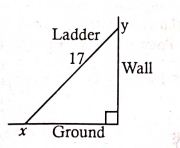
Let AB be the position of the ladder at any time t such that OA = x and OB = y
Then OA2 + OB2 = AB2
⇒ x2 + y2 = 172
Given \(\frac { dx }{ dt } \) = 5 and x = 8
When x = 8, 82 + y2 = 172
⇒ y2 = 289 - 64 = 225
⇒ y = 15
Differentiating (1) with respect to 't' we get,
\(2x\frac { dx }{ dt } +2y\frac { dy }{ dt } =0\)
⇒ 8(5) + 15 \(\frac { dy }{ dt } \) = 0 [∵ x = 8, \(\frac { dx }{ dt } \) = 15, y = 15]
⇒ 40 + 15\(\frac { dy }{ dt } \) = 0
⇒ \(\frac { dy }{ dt } =\frac { -40 }{ 15 } =\frac { -8 }{ 3 } \) m/sec
∴ The rate of top of the ladder moving down the wall is \(\frac{-8}{3}\) m/sec
(ii) The ladder, the wall and the floor forms a right angled triangle.
Area = \(\frac12\)xy
Differentiating with respect to 't' we get,
\(\frac { dA }{ dt } =\frac { 1 }{ 2 } \left[ x\frac { dy }{ dx } +y\frac { dx }{ dt } \right] \)
\(=\frac { 1 }{ 2 } \left[ 8\left( -\frac { 8 }{ 3 } \right) +15(5) \right] \)
= \(\frac { 1 }{ 2 } \left[ \frac { -64 }{ 3 } +75 \right] =\frac { 1 }{ 2 } \)
= \(\frac { 1 }{ 2 } \left[ \frac { -64+225 }{ 3 } \right] =\frac { 1 }{ 2 } \left( \frac { 161 }{ 3 } \right) \)
= \(\frac { dA }{ dt } \) = 26.83 sq.m/sec
17.
\(\frac { 3 }{ x } -\frac { 4 }{ y } -\frac { 2 }{ z } \) - 0, \(\frac { 1 }{ x } +\frac { 2 }{ y } +\frac { 1 }{ z } \) - 2 = 0, \(\frac { 2 }{ x } -\frac { 5 }{ y } -\frac { 4 }{ z } \) + 1 = 0
Put \(\frac { 1 }{ x } =u,\frac { 1 }{ y } =v,\frac { 1 }{ z } =w\)
We get 3u - 4v - 2w = 1, u + 2v + w = 2, 2u - 5v - 4w = -1
∴ \(\left| \begin{matrix} 3 & -4 & -2 \\ 1 & 2 & 1 \\ 2 & -5 & -4 \end{matrix} \right| =3\left| \begin{matrix} 2 & 1 \\ -5 & -4 \end{matrix} \right| +4\left| \begin{matrix} 1 & 1 \\ 2 & -4 \end{matrix} \right| -2\left| \begin{matrix} 1 & 2 \\ 2 & -5 \end{matrix} \right| \)
= 3(- 8 + 5) + 4'(- 4 - 2) - 2(- 5 - 4)
= 3(- 3) + 4(- 6) - 2(- 9)
= - 9 - 24 + 18 = -15
Δ1 = \(\left| \begin{matrix} 1 & -4 & -2 \\ 2 & 2 & 1 \\ -1 & -5 & -4 \end{matrix} \right| \)
= \(1\left| \begin{matrix} 2 & 1 \\ -5 & -4 \end{matrix} \right| +4\left| \begin{matrix} 2 & 1 \\ -1 & -4 \end{matrix} \right| -2\left| \begin{matrix} 2 & 2 \\ -1 & -5 \end{matrix} \right| \)
= 1(- 8 + 5) + 4(- 8 + 11 -2(-10 + 2)
= 1(- 3) + 4(-7) - 2(- 8)
= - 3 - 28 + 16= -15
Δ2 = \(\left| \begin{matrix} 3 & 1 & -2 \\ 1 & 2 & 1 \\ 2 & -1 & -4 \end{matrix} \right| \)
\(3\left| \begin{matrix} 2 & 1 \\ -1 & -4 \end{matrix} \right| -1\left| \begin{matrix} 1 & 1 \\ 2 & -4 \end{matrix} \right| -2\left| \begin{matrix} 1 & 2 \\ 2 & -1 \end{matrix} \right| \)
= 3(- 8 + 1) - 1(- 4 - 2) - 2(- 1 - 4)
= 3(-7) - 1(- 6) - 2(- 5)
= -21 + 6 + 10 = -5
Δ3 = \(\left| \begin{matrix} 3 & -4 & 1 \\ 1 & 2 & 2 \\ 2 & -5 & -1 \end{matrix} \right| \)
\(3\left| \begin{matrix} 2 & 2 \\ -5 & -1 \end{matrix} \right| +4\left| \begin{matrix} 1 & 2 \\ 2 & -1 \end{matrix} \right| -2\left| \begin{matrix} 1 & 2 \\ 2 & -5 \end{matrix} \right| \)
= 3(-2 + 10) + 4(-1 - 4)+ 1(-5 - 4)
= 3(8) + 4(- 5) + 1(- 9)
= 24 - 20 - 9 = - 5
∴ \(\frac { { \triangle }_{ 1 } }{ \triangle } =\frac { -15 }{ -15 } =1\Rightarrow \frac { 1 }{ x } =1\Rightarrow \)x = 1
v = \(\frac { { \triangle }_{ 2 } }{ \triangle } =\frac { -5 }{ -15 } =\frac { 1 }{ 3 } \Rightarrow \frac { 1 }{ y } =\frac { 1 }{ 3 } \Rightarrow \)y = 3
w = \(\frac { { \triangle }_{ 3 } }{ \triangle } =\frac { 5 }{ -15 } =\frac { 1 }{ 3 } \Rightarrow \frac { 1 }{ z } =\frac { 1 }{ 3 } \Rightarrow \)z = 3
∴ Solution set is {1, 3, 3}
18.
The plane passing through three points namely
\(\vec { a } =3\hat { i } +6\hat { k } -2\hat { k } \),
\(\vec { b } =-\hat { i } -2\hat { j } +6\hat { k } \) and
\(\vec { c } =6\hat { i } +4\hat { j } -2\hat { k } \)
Now, \(\vec { b } -\vec { a } =(-1-3)\hat { i } +(-2-6)\hat { j } +(6+2)\hat { k } \)
\(=-4\hat { i } -8\hat { j } +8\hat { k } \)
\(\vec { c } -\vec { a } =(6-3)\hat { i } +(-4-6)\hat { j } +(-2+2)\hat { k } \)
\(=3\hat { i } -10\hat { j } \)
The parametric form of vector equation of the plane passing through three points is
\(\vec { r } =\vec { a } +s(\vec { b } -\vec { a } )+t(\vec { c } -\vec { a } ),s,t\in R\)
\(\Rightarrow \vec { r } =(3i+6i-2k)+s(4\hat { i } -8\hat { j } +8\hat { k } )+(3\hat { i } -10\hat { j } )s,t\in R\)
The parametric form of vector equation of the plane passing through three points is
\([\vec { r } -\vec { a } ,\vec { b } -\vec { a } ,\vec { c } -\vec { a } ]\) = 0
\(\Rightarrow \vec { r } -(3i+6i-2k).[(4\hat { i } -8\hat { j } 8\hat { k } )+(3\hat { i } -10\hat { j } )]=0\)
Cartesian equation is
\( \Rightarrow \vec{r}(2 \hat{i}+3 \hat{j}+4 \hat{k})=16 \)
\( \Rightarrow 2 x+3 y+4 z-16=0 \)
19.
By taking the vertex; at the origin, the parabola is open downward.
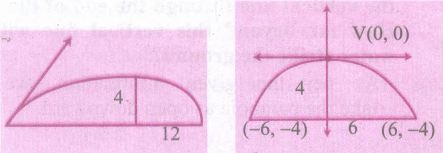
Its equation is x2 = -4ay
It passes through (6, -4)
∴ 36 = -4a(-4) ⇒ 4a = - \(\frac { 36 }{ 4 } \) = 9
∴ (1) becomes, x2 = -9y
To find the slope at (-6, -4)
Differentiating (1) with respect to 'x' we get,
2x = -9\(\frac { dy }{ dx } \)
⇒ \(\frac { dy }{ dx } =\frac { -2x }{ 9 } \)
At (-6, -4), \(\frac { dy }{ dx } =-2\frac { (-6) }{ 9 } =\frac { 12 }{ 9 } =\frac { 4 }{ 3 } \)
∴ \(tan\theta =\frac { 4 }{ 3 } \Rightarrow \theta ={ tan }^{ -1 }\left( \frac { 4 }{ 3 } \right) \)
∴ The angle of projection is tan-1 \(\left( \frac { 4 }{ 3 } \right) \)
20.
The parametric equation of tangent at 't1' to the parabola y2 = 4ax is yt1 = x + at12 ...(1)
Also, the parametric equation of tangent at 't2' to the parabola y = 4ax is yt2 = x+ at22 ...(2)
(1) ➝ yt1 = x + at12
(2) ➝ yt2 = x + at22
(1) - (2) y(t1 -t2) = a(t12 - t22)
.JPG)
⇒ y = a(t1 + t2)
Substitutingy = a(t1 + t2) in (1) we get,
a(t1 + t2)t1 = x + at12
.JPG)
⇒ x = at1t2
Hence, the point of intersection of two lengths is
[at1t2, a(t1 + t2)]
21.
Let cos−1x = \(\alpha\) and cos-1 y = \(\beta\).
Then, x = cos\(\alpha\) and y cos =\(\beta\)
cos-1x + x + cos-1 y + cos-1x = \(\pi\) gives \(\alpha\)+\(\beta\) = \(\pi\) -cos-1z.
Now, cos(\(\alpha\)+\(\beta\)) = cos\(\alpha\)cos\(\beta\)-sin\(\alpha\)sin\(\beta\) = xy-\(\sqrt { 1-{ x }^{ 2 } } \sqrt { 1-{ y }^{ 2 } } \)
-cos(cos-1 z) = xy\(\sqrt { 1-{ x }^{ 2 } } \sqrt { 1-{ y }^{ 2 } } \)
so, \(-z=xy-\sqrt { 1-{ x }^{ 2 } } \sqrt { 1-{ y }^{ 2 } } \), Which gives -xy - z = -\(\sqrt { 1-{ x }^{ 2 } } \sqrt { 1-{ y }^{ 2 } } \)
Squaring on both sides and simplifying, we get x2 + y2 + z2 + 2xyz = 1.
22.
Given z = x + iy
Im \(\left( \frac { 2z+1 }{ iz+1 } \right) \)= 0
⇒ Im\(\left( \frac { 2(x+iy)+1 }{ i(x+iy)+1 } \right) \)= 0
⇒ Im\(\left( \frac { (2x+1)+2iy }{ ix+i^{ 2 }y+1 } \right) \)
⇒ Im\(\left( \frac { (2x+1)+2iy }{ ix-y+1 } \right) \)
\(\left( \frac { (2x+1)+iy }{ (1-y)+ix } \right) \)
Multiply and divide by the conjugate of the denominator
We get Im\(\left( \frac { (2x+1)+2iy }{ (1-y)+ix } \times \frac { (1-y)-ix }{ (1-y)-ix } \right) \)=0
⇒ Im\(\left( \frac { (2x+1)+2iy\times (1-y)-ix }{ (1-y)^{ 2 }+{ x }^{ 2 } } \right) \)
Choosing the imaginably part we get,
\(\frac { (2x+1)(-x)+2y(1-y) }{ (1-y)^{ 2 }+{ x }^{ 2 } } \)
⇒ (2x+1)-x+2y(1-y) = 0
⇒ -2x2-x+2y-2y2 = 0
⇒ 2x2+2y2+x-2y = 0
Hence, locus of z is 2x2+2y2+x-2y = 0
23.
Let f(x) x6-3x5-5x4+22x3-39x2-39x+135
Given (1+2i) is a root \(\Rightarrow\)(-2i) is also a root
Also \(\sqrt3\) is a root \(\Rightarrow\)-\(\sqrt3\) is also a root.
Hence, the factors of f(x) are [x - (1 + 2i)]
[x-(1-2i)] [x\(\sqrt3\)] [x+\(\sqrt3\)]
[(x-1)-2i] [(x-1)+2i] [x-\(\sqrt3\)][x+\(\sqrt3\)]
((x-1)2+22)(x2-3) = (x2-2x+1+4)(x2-3)
\(\Rightarrow\) factor of f(x) is (x2-2x+5)(x2-3)
\(\Rightarrow\)x4-3x2-2x3+6x+5x2-15
\(\Rightarrow\)(x4-3x2-2x3+6x-15) is a factor of f(x)
To find the other factor, let us divide f(x) by
x4 - 2x3 + 2x2 + 6x - 15
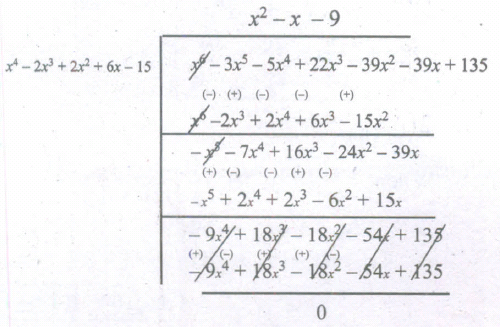
The other factor is x2 - x - 9
\(\Rightarrow x=\frac { 1\pm \sqrt { { (-1) }^{ 2 }-4(1)(-9) } }{ 2 } \left[ \because x=\frac { -b\pm \sqrt { { b }^{ 2 }-4ac } }{ 2a } \right] \)
\(\Rightarrow x=\frac { 1\pm \sqrt { 37 } }{ 2 } \)
Hence the roots are
1 - 2i, 1 + 2i, \(\sqrt { 3 }, -\sqrt { 3 }, \frac { 1+\sqrt { 37 } }{ 2 } ,\frac { 1-\sqrt { 37 } }{ 2 } \).
24.
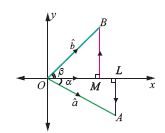
Let \(\hat { a } =\vec { OA } \) and \(\hat { b } =\vec { OB } \) be the unit vectors and which make angles α and β, respectively, with positive x-axis, where A and B are as in the diagram.
Draw AL and BM perpendicular to the x-axis. Then \(\left| \vec { OL } \right| =\left| \vec { OA } \right| \) cos α = cos α, \(\left| \vec { LA } \right| =\left| \vec { OA } \right| \) sin α = sin α
So, \(\vec { OL } =\left| \vec { OL } \right| \)\(\hat { i } \) = cos,α \(\hat { i } \), \(\overrightarrow { LA } \) = sin α (-\(\hat { j } \))
Therefore, \(\hat { a } =\overrightarrow { OA} = \overrightarrow { OL } +\overrightarrow { LA } \) = cos α \(\hat { i } \) - sin α \(\hat { j } \) ..(1)
Similarly \(\hat { b } \) = cos β \(\hat { i } \)+ sin β \(\hat { j } \) ....(2)
The angle between \(\hat { a } \) and \(\hat{b}\) is α + β and so,
\(\hat { a } .\hat { b } =\left| \hat { a } \right| \left| \hat { b } \right| \) cos (α + β) = cos (α + β) ... (3)
On the other hand, from (1) and (2)
\(\hat { a } .\hat { b } =(cos\alpha \hat { i } -sina\hat { j } )(cos\beta \hat { i } -sin\beta \hat { j } )\) = cos α cos β - sin α sin β....(4)
From (3) and (4), we get cos(α + β) = cos α cos β - sin α sin β
25.
\(\frac { 3 }{ 2 } \)
26.
| p | q | q ➝ p | ~p | ~q | ~q ➝ ~p |
| T | T | T | F | F | T |
| T | F | T | F | T | T |
| F | T | F | T | F | F |
| F | F | T | T | T | T |
The entries in the columns corresponding q ➝ p and ~p ➝ ~q are identical and hence they are equivalent.
q ➝ p ≡ ~p ➝ ~q
Hence proved
27.
Given absolute error = 2%
⇒ \(\frac { dl }{ l } =2 \% =\frac { 2 }{ 100 } =0.02\)
Given T = 2ㅠ\(\sqrt { \frac { 1 }{ g } } \)
Taking logarithm on both sides,
log T = log 2ㅠ + \(\frac12\) log l - \(\frac12\) log g
Taking differential on both sides we get,
\(\frac{1}{T}dT=0+\frac{1}{2}.\frac{1}{l}.dl\)
\(\frac { \Delta T }{ T } =\frac { 1 }{ 2 } (.02)\)
\(\frac { \Delta T }{ T } =0\)
ஃ Percentage error = \(\frac { \Delta T }{ T } \times100=.01\times100=1 \%\)
28.
The given differential equation can be written as
\(\frac{\cos x}{\cos x} \frac{d y}{d x}+y \frac{\sin x}{\cos x} =\frac{1}{\cos x} \)
\(\frac{d y}{d x}+\left(\frac{\sin x}{\cos x}\right) y =\sec x \)
\(\frac{d y}{d x}+(\tan x) y =\sec x\)
This is of the form \(\frac{d y}{d x}+P y=Q \)
where
\(\mathrm{P} =\tan x \)
\(\mathrm{Q} =\sec x\)
Thus, the given differential equation is linear.
\(I.F=e^{\int \operatorname{Pdx}}=e^{\int \operatorname{Lin} x d x}=e^{\log (\sec x)}=\sec x\)
So, the required solution is given by
\({[\mathrm{y} \times \mathrm{I} . \mathrm{F}] } =\int[Q \times I F] d x+c \)
\(\mathrm{y} \times \sec x =\int \sec x \times \sec x d x+c \)
\(\mathrm{y} \sec x =\int \sec ^2 x d x+c \\ \mathrm{y} \sec x =\tan x+\mathrm{c} \)
\(\div \sec x, \frac{y \sec x}{\sec x} =\frac{\tan x}{\sec x}+\frac{c}{\sec x} \)
\(\mathrm{y} =\frac{\sin x}{\cos x} \times \frac{1}{\sec x}+\frac{c}{\sec x} \)
\(\mathrm{y} =\frac{\sin x}{\cos x} \times \cos x+c \cos x \)
\(=\sin x+c \cos x\)
29.
f(x) = x3 − 3x + 2, x ∈ [-2, 2]
a) f(x) is continuous in [-2, 2]
b) f(x) is differentiable in (-2, 2)
f(-2) = (-2)3 - 3 (-2) + 2
= -8 + 6 + 2 = 0
f(2) = 23 - 3(2) +2
= 8 - 6 + 2 = 4
By Lagrange's mean value theorem, there exists c ∈ [-2,2] such that f'(c) = \(\frac { f(b)-f(a) }{ b-a } \)
⇒ 3c3 - 3 = \(\frac { 4-0 }{ 2-(-2) } =\frac { 4 }{ 4 } =1\)
⇒ 32-3 = 1
⇒ 32 =4 ⇒ c2 = \(\frac43\)
⇒ c = 土 \(\frac { 2 }{ \sqrt { 3 } } \) ∈ [-2, 2]
30.
\({ cos }^{ -1 }\left( cos\frac { \pi }{ 7 } cos\frac { \pi }{ 17 } -sin\frac { \pi }{ 17 } sin\frac { \pi }{ 17 } \right) .\)
\({ cos }^{ -1 }\left( cos\left( \frac { \pi }{ 7 } +\frac { \pi }{ 17 } \right) \right) \)
\(\left[ \therefore cosA\ cosB-sinA\ sinB=cos(A+B) \right] \)
= \({ cos }^{ -1 }\left( cos\left( \frac { 24\pi }{ 119 } \right) \right) \) \(\left[ \therefore \frac { 24\pi }{ 119 } \varepsilon \left[ 0,\pi \right] \right] \)
= \(\frac { 24\pi }{ 119 } \)
31.
Given planes are \(\vec { r } .(\hat { i } +\hat { j } -2\hat { k } )\) and
\(2x-2y+z=2\Rightarrow \vec { r } .\left( 2\hat { i } -2\hat { j } +\hat { k } \right) =3\)
\(\therefore { \vec { n } }_{ 1 }=\hat { i } +\hat { j } -2\hat { k } \) and \({ \vec { n } }_{ 2 }=2\hat { i } -2\hat { j } +\hat { k } \)
Angle between the plane is'
\(cos\theta =\frac { { \vec { n } }_{ 1 }.{ \vec { n } }_{ 2 } }{ \left| { \vec { n } }_{ 1 } \right| \left| { { \vec { n } }_{ 2 } } \right| } =\frac { \left| 1(2)+1(-2)-2(1) \right| }{ \sqrt { { 1 }^{ 2 }+{ 1 }^{ 2 }+\left( -2 \right) ^{ 2 }.\sqrt { { 2 }^{ 2 }+\left( -2 \right) ^{ 2 }+{ 1 }^{ 2 } } } } \)
= \(\frac { \left| -2 \right| }{ \sqrt { 6 } .\sqrt { 9 } } =\frac { 2 }{ \sqrt { 6 } (3) } =\frac { 2 }{ 3\sqrt { 6 } } \)
\(\theta ={ { cos }^{ -1 }\left( \frac { 2 }{ 3\sqrt { 6 } } \right) }\)
32.
Given 2cos α = x+\(\frac { 1 }{ x } \)
⇒ 2cos α = \(\frac { { x }^{ 2 }+1 }{ x } \)
⇒ x2+1 = 2xcos α
⇒ x2-2x cos α+1 = 0
⇒ \(\frac { 2cos\alpha \pm \sqrt { (-2cos\alpha )^{ 2 }-4(1)(1) } }{ 2 } \)
= \(\frac { 2cos\alpha \pm \sqrt { 4cos^{ 2 }\alpha -4 } }{ 2 } \) \(\left[ \because \frac { b\pm \sqrt { { b }^{ 2 }-4ac } }{ 2a } \right] \)
= \(\frac { 2cos\alpha \pm \sqrt { -sin^{ 2 }\alpha } }{ 2 } \)
= \(\frac { 2cos\alpha \pm isin\alpha }{ 2 } \) [∵ sin2α+cos2α = 1]
⇒ x2 = cos α ± sin α
Also, 2cos β = y+\(\frac { 1 }{ y } \)
⇒ 2cos β = \(\frac { { y }^{ 2 }+1 }{ y } \)
⇒ y2-2y cos β+1 = 0
⇒ \(\frac { 2cos\beta \pm \sqrt { (-2cos^{ 2 }\beta ^{ 2 }-4(1)(1) } }{ 2 } \)
=\(\frac { 2cos\beta \pm \sqrt { 4cos^{ 2 }\beta } -4 }{ 2 } =\frac { 2cos\beta \pm 2isin\beta }{ 2 } \)
⇒ y = cosβ ± i sinβ
\({ x }^{ m }{ y }^{ n }+\cfrac { 1 }{ { x }^{ m }{ y }^{ n } } =2cos(m\alpha +n\beta )\)
xmyn = (cos α + i sin mα) (cos nβ + i sin nβ)
cos(mα+nβ)+i sin(mα+nβ)
\(\frac { 1 }{ { x }^{ m }{ y }^{ n } } \) = cos(mα+nβ)-i sin(mα+nβ)
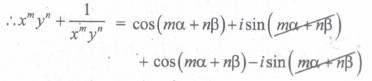
= 2cos(mα+nβ)
33.
Let P(x, y) be any point on the hyperbola
\(\frac { { x }^{ 2 } }{ { a }^{ 2 } } -\frac { { y }^{ 2 } }{ { b }^{ 2 } } =1\)
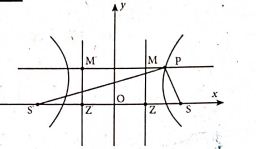
Then by definition, SP = ePM and S'P = ePM'
SP = ePM ⇒ SP = e(NK)
= e(CN - CK)
= \(e\left( x-\frac { a }{ e } \right) \) = ex - a
= and S'P = ePM' ⇒ S'P = e(NK')
⇒ e(CN + CK') = \(e\left( x+\frac { a }{ e } \right) \) = ex + a
∴ S'P -SP = (ex + a) - (ex - a)
ex + a - ex + a = 2a (constant)
= length of the transverse axis.
34.
The matrix form of the system is AX = B , where A = \(\left[ \begin{matrix} 5 & 2 \\ 3 & 2 \end{matrix} \right] \), X = \(\left[ \begin{matrix} x \\ y \end{matrix} \right] \), B = \(\left[ \begin{matrix} 3 \\ 5 \end{matrix} \right] \)
We find |A| = \(\left| \begin{matrix} 5 & 2 \\ 3 & 2 \end{matrix} \right| \) = 10 - 6 = 4 ≠ 0. So, A−1 exists and A−1 = \(\frac { 1 }{ 4 } \left[ \begin{matrix} 2 & -2 \\ -3 & 5 \end{matrix} \right] \)
Then, applying the formula X = A−1B, we get
\(\left[ \begin{matrix} x \\ y \end{matrix} \right] =\frac { 1 }{ 4 } \left[ \begin{matrix} 2 & -2 \\ -3 & 5 \end{matrix} \right] \left[ \begin{matrix} 3 \\ 5 \end{matrix} \right] =\frac { 1 }{ 4 } \left[ \begin{matrix} -4 \\ 16 \end{matrix} \right] =\left[ \begin{matrix} \frac { -4 }{ 4 } \\ \frac { 16 }{ 4 } \end{matrix} \right] =\left[ \begin{matrix} -1 \\ 4 \end{matrix} \right] \).
So the solution is (x = −1, y = 4).
35.
(d)
5
36.
(c)
A non - decreasing function
37.
(c)
38.
(a)
39.
(c)
\(\frac{8}{3}\)
40.
(d)
1
41.
(a)
42.
(a)
y = Cex2
43.
(b)
\(\frac { { d }^{ 2 }y }{ { dx }^{ 2 } } -y=0\)
44.
(d)
has no points of inflection
45.
(b)
46.
(a)
47.
(b)
-80
48.
(b)
\(c=\pm \sqrt { 3 } \)
49.
(a)
\(\left| \vec { a } \right| \left| \vec { b } \right| \left| \vec { c } \right| \)
50.
(c)
\( \sqrt {10}\)
51.
(a)
\(|\alpha |\le \frac { 1 }{ \sqrt { 2 } } \)
52.
(c)
x2+y2
53.
(d)
-4
54.
(a)
z

12th Standard Syllabus & Materials
12th Standard
TN 12th Computer Applications களப்பெயர் முறைமை (DNS) Sample Question Papers Study Material - QB365 Set A
NEW12th Standard
TN 12th Computer Applications வலையமைப்பு எடுத்துக்காட்டுகள் மற்றும் நெறிமுறைகள் Sample Question Papers Study Material - QB365 Set A
NEW12th Standard
TN 12th Computer Applications கணினி வலையமைப்பு ஓர் அறிமுகம் Sample Question Papers Study Material - QB365 Set A
NEW12th Standard
TN 12th Computer Applications PHP-உடன் MySQL-ஐ இணைத்தல் Sample Question Papers Study Material - QB365 Set A



Tamilnadu Stateboard 12th Standard Subjects
Maths

Chemistry

Physics

Biology

Computer Science

Business Maths and Statistics

Economics

Commerce

Accountancy

History

Computer Applications
Biology
Computer Technology
Computer Applications
Computer Science
Business Maths and Statistics
Commerce
Economics
Maths
Chemistry
Physics
Computer Technology
History
Accountancy

Tamil

English

French
Tamilnadu Stateboard Standards


