
 100% FREE ACCESS
12th Standard Syllabus & Materials
12th Standard
TN 12th Computer Applications மின்னணு தரவு பரிமாற்றம் Sample Question Papers Study Material - QB365 Set A
NEW12th Standard
TN 12th Computer Applications மின் - வணிக பாதுகாப்பு அமைப்புகள் Sample Question Papers Study Material - QB365 Set A
NEW12th Standard
TN 12th Computer Applications மின்னணு செலுத்தல் முறைகள் Sample Question Papers Study Material - QB365 Set A
NEW12th Standard
TN 12th Computer Applications மின் - வணிகம் Sample Question Papers Study Material - QB365 Set A
NEW12th Standard
TN 12th Computer Applications திறந்த மூல கருத்துருக்கள் Sample Question Papers Study Material - QB365 Set A
NEW12th Standard
TN 12th Computer Applications வலையமைப்பு வடமிடல் Sample Question Papers Study Material - QB365 Set A

Published on: 28/11/2025
Download Tamil Nadu 12th Standard Maths question papers, model tests, one-mark questions, important questions, and public exam papers in PDF format. Free study materials and answer keys for TN State Board students.
Questions + Answers key
Take MCQ Maths Test
1.
Find the value of \({ cot }^{ -1 }(1)+{ sin }^{ -1 }\left( -\frac { \sqrt { 3 } }{ 2 } \right) -{ sec }^{ -1 }(-\sqrt { 2 } )\)
2.
Solve the following systems of linear equations by Cramer’s rule:
\(\frac { 3 }{ x } \) + 2y = 12, \(\frac { 2 }{ x } \) + 3y = 13
3.
Solve the following system of linear equations by matrix inversion method:
2x + 5y = −2, x + 2y = −3
4.
Solve the following equations,
sin2x - 5 sinx + 4 = 0
5.
Show that the points 1, \(\frac { -1 }{ 2 } +i\frac { \sqrt { 3 } }{ 2 } ,\) and \(\frac { -1 }{ 2 } -i\frac { \sqrt { 3 } }{ 2 } \) are the vertices of an equilateral triangle.
6.
If α, β, and γ are the roots of the polynomial equation ax3+ bx2+ cx + d = 0, find the value of \(\Sigma \frac { \alpha }{ \beta \gamma } \) in terms of the coefficients.
7.
Construct a cubic equation with roots \(2, \frac{1}{2} \text { and } 1\)
8.
Find the period and amplitude of
y = -sin\((\frac{1}{3}x)\)
9.
Find the principal argument Arg z, when z = \(\frac { -2 }{ 1+i\sqrt { 3 } } \)
10.
Find the square root of 6−8i .
11.
Find the domain of the following functions :
\(tan^{-1}(\sqrt{9-x^{2}})\)
12.
Prove that \(\left[ \begin{matrix} \cos { \theta } & -\sin { \theta } \\ \sin { \theta } & \cos { \theta } \end{matrix} \right] \) is orthogonal.
13.
Assume that the rate at which radioactive nuclei decay is proportional to the number of such nuclei that are present in a given sample. In a certain sample 10% of the original number of radioactive nuclei have undergone disintegration in a period of 100 years. What percentage of the original radioactive nuclei will remain after 1000 years?
14.
15.
Solve the following differential equations
(x2+y2)dy = xy dx. It is given that y(1) = 1 and y(x0) = e. Find the value of x0.
16.
17.
Solve the equation z3+ 8i = 0, where \(z \in \mathbb{C}\)
18.
If cos−1 x + cos−1 y + cos−1 z = \(\pi \) and 0 < x, y, z < 1, show that x2
19.
(a) If A = \(\left[ \begin{matrix} -5 & 1 & 3 \\ 7 & 1 & -5 \\ 1 & -1 & 1 \end{matrix} \right] \) and B = \(\left[ \begin{matrix} 1 & 1 & 2 \\ 3 & 2 & 1 \\ 2 & 1 & 3 \end{matrix} \right] \), find the products AB and BA and hence solve the system of equations x + y + 2z = 1, 3x + 2y + z = 7, 2x + y + 3z = 2.
20.
Find all zeros of the polynomial x6- 3x5- 5x4 + 22x3- 39x2- 39x + 135, if it is known that 1+2i and \(\sqrt{3}\) are two of its zeros.
1.
\({ cot }^{ -1 }(1)+{ sin }^{ -1 }\left( -\frac { \sqrt { 3 } }{ 2 } \right) -{ sec }^{ -1 }(-\sqrt { 2 } )\)
Let \(\Rightarrow cot\ x=1\Rightarrow tan\ x=1\Rightarrow tan\ x=tan\frac { \pi }{ 4 }\)
\(\Rightarrow x=\frac { \pi }{ 4 }\)
\({ sin }^{ -1 }\left( \frac { -\sqrt { 3 } }{ 2 } \right) =y\Rightarrow sin\ y=\frac { -\sqrt { 3 } }{ 2 } =-sin\frac { \pi }{ 3 }\)
\(\Rightarrow sin\ y=sin\left( { \frac { -\pi }{ 3 } } \right)\)
\(\Rightarrow y=\frac { -\pi }{ 3 }\)
\({ sec }^{ -1 }\left( -\sqrt { 2 } \right) =z\)
\(\Rightarrow sec\ z=-\sqrt { 2 } \Rightarrow cosz=\frac { -1 }{ \sqrt { 2 } }\)
\(\Rightarrow cos\ z=-cos\frac { \pi }{ 4 }\)
\(\Rightarrow cos\ z=cos\left( \pi -\frac { \pi }{ 4 } \right)\)
\(\Rightarrow cos\ z=cos\left( \frac { 3\pi }{ 4 } \right)\)
\(\Rightarrow z=\frac { 3\pi }{ 4 }\)
\(\therefore { cot }^{ -1 }(1)+{ sin }^{ -1 }\left( \frac { -\sqrt { 3 } }{ 2 } \right) -{ sec }^{ -1 }\left( \frac { \sqrt { 3 } }{ 2 } \right) -{ sec }^{ -1 }\left( -\sqrt { 2 } \right)\)
= \(\frac { \pi }{ 4 } -\frac { \pi }{ 3 } -\frac { 3\pi }{ 4 }\)
\(=\frac{3 \pi-4 \pi-9 \pi}{12}=\frac{-10^5 \pi}{12_6}\)
= \(-\frac { 5\pi }{ 6 }\)
\(\therefore\) \({ cot }^{ -1 }(1)+{ sin }^{ -1 }\left( -\frac { \sqrt { 3 } }{ 2 } \right) -{ sec }^{ -1 }(-\sqrt { 2 } )\) =\(-\frac { 5\pi }{ 6 }\)
2.
\(\frac { 3 }{ x } \) + 2y = 12, \(\frac { 2 }{ x } \) + 3y = 13
Let \(\frac { 1 }{ x } \)
∴ z+2y = 12, 2z+3z = 13
∴ Δ = \(\left| \begin{matrix} 3 & 2 \\ 2 & 3 \end{matrix} \right| \)= 9 - 4 = 5
Δ1 = \(\left| \begin{matrix} 12 & 2 \\ 13 & 3 \end{matrix} \right| \)= 36 - 26 = 10
Δ2 = \(\left| \begin{matrix} 3 & 12 \\ 2 & 13 \end{matrix} \right| \)= 39 - 26 = 10
∴ z = \(\frac { { \triangle }_{ 1 } }{ \triangle } =\frac { 10 }{ 5 } =2\Rightarrow \frac { 1 }{ x } =2\Rightarrow x=\frac { 1 }{ 2 } \)
y = \(\frac { { \triangle }_{ 2 } }{ \triangle } =\frac { 15 }{ 5 } \) = 3
∴ Solution set {\(\frac{1}{2}\), 3}
3.
2x+5y = -2, x+2y = -3
The matrix form of the system is
\(\left( \begin{matrix} 2 & 5 \\ 1 & 2 \end{matrix} \right) \left( \begin{matrix} x \\ y \end{matrix} \right) =\left( \begin{matrix} -2 \\ -3 \end{matrix} \right) \)
⇒ AX = B where
A =\(\left( \begin{matrix} 2 & 5 \\ 1 & 2 \end{matrix} \right) ,B=\left( \begin{matrix} -2 \\ -3 \end{matrix} \right) \)
X =\(\left( \begin{matrix} x \\ y \end{matrix} \right) \)
⇒ = A-1B
|A| = \(\left| \begin{matrix} 2 & 5 \\ 1 & 2 \end{matrix} \right| \)= 4 - 5 = -1 ≠ 0
∴ A-1 =\(\frac { 1 }{ |A| } adjA=\frac { 1 }{ -1 } \left[ \begin{matrix} 2 & -5 \\ -1 & 2 \end{matrix} \right] \)
=\(\left[ \begin{matrix} -2 & 5 \\ 1 & -2 \end{matrix} \right] \)
∴ X = A-1B =\(\left[ \begin{matrix} -2 & 5 \\ 1 & -2 \end{matrix} \right] \left[ \begin{matrix} -2 \\ -3 \end{matrix} \right] \)
= \(\left[ \begin{matrix} 4-15 \\ -2+6 \end{matrix} \right] =\left[ \begin{matrix} -11 \\ 4 \end{matrix} \right] \)
∴ Solution set is x = -11, y = 4
4.
sin2x - 5 sinx + 4 = 0
put y = sin x
⇒ y2-5y+4 = 0
⇒ (y-4)(y-1) = 0
⇒ y = 4, 1
Case (i)
When y = 4, sin x = 4 and no solution for sin x = 4 since the range the sin function is [-1, 1]
Case (ii)
When y = 1, sin x = 1
⇒ sin x = sin \(\frac{\pi}{2}\) [\(\because sin \frac {\pi}{2}=1\)]
\(x=n \pi+(-1)^{n} \frac{\pi}{2} \forall n \in z\).
5.
It is enough to prove that the sides of the triangle are equal.
Let z1 = 1, \({ z }_{ 2 }=\frac { -1 }{ 2 } +i\frac { \sqrt { 3 } }{ 2 }\) and \({ z }_{ 3 }=\frac { -1 }{ 2 } -i\frac { \sqrt { 3 } }{ 2 }\)
The length of the sides of the triangles are
\(\left| { z }_{ 1 }-{ z }_{ 2 } \right| =\left| 1-\left( \frac { -1 }{ 2 } +i\frac { \sqrt { 3 } }{ 2 } \right) \right| =\left| \cfrac { 3 }{ 2 } -\cfrac { \sqrt { 3 } }{ 2 } i \right| =\sqrt { \frac { 9 }{ 4 } +\frac { 3 }{ 4 } } =\frac { 2\sqrt { 3 } }{ 2 } =\sqrt { 3 }\)
\(\left\lfloor { z }_{ 2 }-{ z }_{ 3 } \right\rfloor =\left| \left( \frac { -1 }{ 2 } +i\frac { \sqrt { 3 } }{ 2 } \right) -\left( \frac { -1 }{ 2 } -i\frac { \sqrt { 3 } }{ 2 } \right) \right| =\sqrt { \left( \sqrt { 3 } \right) ^{ 2 } } =\sqrt { 3 }\)
\(\left| { z }_{ 3 }-{ z }_{ 1 } \right| =\left| \left( \frac { -1 }{ 2 } +i\frac { \sqrt { 3 } }{ 2 } \right) -1 \right| =\left| \frac { -3 }{ 2 } -\frac { \sqrt { 3 } }{ 2 } i \right| =\sqrt { \frac { 9 }{ 4 } +\frac { 3 }{ 4 } } =\sqrt { 3 }\)
Since the sides are equal, the given points form an equilateral triangle
6.
Given ∝, β and ૪ are the roots of ax3 + bx2 + cx + d = 0
\(\therefore \alpha +\beta +\gamma =\frac { -b }{ a } \)
\(\alpha \beta +\beta \gamma +\gamma \alpha =\frac { c }{ a } \)
\(\alpha \beta \gamma =\frac { -d }{ a } \)
Now, \(\sum { \frac { \alpha }{ \beta \gamma } } =\frac { \alpha }{ \beta \gamma } +\frac { \beta }{ \gamma \alpha } +\frac { \gamma }{ \alpha \beta } \)
\(=\frac { { \alpha }^{ 2 }+{ \beta }^{ 2 }+{ \gamma }^{ 2 } }{ \alpha \beta \gamma } \)
\(=\frac { { (\alpha +\beta +\gamma ) }^{ 2 }-2(\alpha \beta +\beta \gamma +\gamma \alpha ) }{ \alpha \beta \gamma } \)
\(=\frac { { \left( -\frac { b }{ a } \right) }^{ 2 }-2\left( \frac { c }{ a } \right) }{ -\frac { d }{ a } } \)
\(=\frac { \frac { { b }^{ 2 } }{ { a }^{ 2 } } -\frac { 2c }{ a } }{ -\frac { d }{ a } } \Rightarrow \frac { { b }^{ 2 }-2ac }{ { a }^{ 2 } } \times \frac { -a }{ d } \)
\(\therefore \frac { \sum { \alpha } }{ \beta \gamma } =-\frac { \left( { b }^{ 2 }-2ac \right) }{- ad } =\frac { 2ac-{ b }^{ 2 } }{ ad } \)
7.
The cubic equation is
x3 – x2 (α + β + γ) + x (αβ + βγ + γα) – αβγ = 0
\( x^{3}-x^{2}\left(2+\frac{1}{2}+1\right)+x\left(1+\frac{1}{2}+2\right)-(2)\left(\frac{1}{2}\right)(1)=0\)
\(x^{3}-x^{2}\left(\frac{4+1+2}{2}\right)+x\left(\frac{2+1+4}{2}\right)-1=0 \)
\(x^{3}-x^{2}\left(\frac{7}{2}\right)+x\left(\frac{7}{2}\right)-1=0\)
2x3 – 7x2 + 7x – 2 = 0
8.
\(y=-sin\left( { \frac { 1 }{ 3 } x } \right) \)
The amplitude sin x is 1
\(\Rightarrow \) amplitude of \(-sin\left( \frac { 1 }{ 3 } x \right) \) is also 1.
The period of \(-sin\left( \frac { 1 }{ 3 } x \right) \) is \(\frac { 1 }{ 3 } x=2\pi \Rightarrow x=6\pi \)
9.
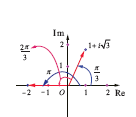
ang \(z=\frac { -2 }{ 1+i\sqrt { 3 } } \)
= arg(-2)-arg \(\left( 1+i\sqrt { 3 } \right) \) \(\left( \because arg\left( \frac { { z }_{ 1 } }{ { z }_{ 2 } } \right) =arg{ z }_{ 1 }=g_{ 2 } \right) \)
= \(\left( \pi -{ tan }^{ -1 }\left( \frac { 0 }{ 2 } \right) \right) -tan^{ -1 }\left( \frac { \sqrt { 3 } }{ 1 } \right) \)
= \(\pi -\frac { \pi }{ 3 } =\frac { 2\pi }{ 3 } \)
This implies that one of the values of arg z is \(\frac { 2\pi }{ 3 } \)
Since \(\frac { 2\pi }{ 3 } \) lies between \(-\pi \), the principal argument Argz is \(\frac { 2\pi }{ 3 } \)
10.
We compute \(\left| 6-8i \right| =\sqrt { { 6 }^{ 2 }+\left( -8 \right) ^{ 2 } } =10\)
and applying the formula for square root, we get
\(\sqrt { 6-8i } =\pm \left( \sqrt { \frac { 10+6 }{ 2 } } -i\sqrt { \frac { 10-6 }{ 2 } } \right) \) (\(\therefore\) b is negative\( \frac{b}{|b|}=-1 \))
= \(\pm \left( \sqrt { 8 } +i\sqrt { 2 } \right) \)
= \(\pm \left( 2\sqrt { 2 } -i\sqrt { 2 } \right) \)
11.
Let \(f(x)={ tan }^{ -1 }\sqrt { 9-{ x }^{ 2 } } \)
\(\sqrt { 9-{ x }^{ 2 } } \varepsilon R\) but \(\sqrt { 9-{ x }^{ 2 } } \varepsilon R\)
\(\therefore \ 9-{ x }^{ 2 }\ge 0\)
\(\Rightarrow { x }^{ 2 }-9\ge 0\)
\(\Rightarrow (x+3)(x-3)\le 0\)
\(\Rightarrow \) Domain is [-3, 3]
12.
Let A = \(\left[ \begin{matrix} \cos { \theta } & -\sin { \theta } \\ \sin { \theta } & \cos { \theta } \end{matrix} \right] \). Then, AT = \({ \left[ \begin{matrix} \cos { \theta } & -\sin { \theta } \\ \sin { \theta } & \cos { \theta } \end{matrix} \right] }^{ T }=\left[ \begin{matrix} \cos { \theta } & \sin { \theta } \\ -\sin { \theta } & \cos { \theta } \end{matrix} \right] \)
So, we get
AAT = \({ \left[ \begin{matrix} \cos { \theta } & -\sin { \theta } \\ \sin { \theta } & \cos { \theta } \end{matrix} \right] }\left[ \begin{matrix} \cos { \theta } & \sin { \theta } \\ -\sin { \theta } & \cos { \theta } \end{matrix} \right] \)
= \(\left[ \begin{matrix} \cos ^{ 2 }{ \theta +\sin ^{ 2 }{ \theta } } & \cos { \theta \sin { \theta } } -\sin { \theta \cos { \theta } } \\ \sin { \theta \cos { \theta -\cos { \theta \sin { \theta } } } } & \sin ^{ 2 }{ \theta } +\cos ^{ 2 }{ \theta } \end{matrix} \right] =\left[ \begin{matrix} 1 & 0 \\ 0 & 1 \end{matrix} \right] \) = I2
Similarly, we get ATA = I2. Hence AAT = ATA = I2 ⇒ A is orthogonal.
13.
Let there be N radioactive nuclei in a sample at any time t and let No be the initial number of radioactive nuclei.
Then \(\frac{dN}{dt}\infty N\)
\(\Rightarrow \frac { dN }{ dt } =-\lambda N\)
Where \(\lambda>0\) is a constant
\(\Rightarrow \frac { dN }{ N } =-\lambda dt\)
\(\int { \frac { dN }{ N } } =-\lambda dt\)
\(\int { \frac { dN }{ N } =-\lambda \int { dt } } \)
\(\Rightarrow log\ N=-\lambda t+C\ ...(1)\)
\(T\quad t=0,\ we\ have\ N={ N }_{ 0 }\)
\(\therefore log{ N }_{ 0 }=0+C\)
\(\Rightarrow C=log{ N }_{ 0 }\)
\(\therefore\)(1) becomes, log N = -\(\lambda t+log{ N }_{ 0 }\)
\(\Rightarrow log\frac { N }{ { N }_{ 0 } } =-\lambda t\quad ...(2)\)
It is given that 10% of the original number of nuclei have undergone disintegration in a period of 100 years.
Whent= 100 \(N={ N }_{ 0 }-\frac { 10 }{ 100 } \times { N }_{ 0 }=\frac { { 9N }_{ 0 } }{ 10 } \)
Substituting in (2) we get
\(log\quad \frac { 9 }{ 10 } =-100\lambda \)
\(\Rightarrow \lambda =-\frac { 1 }{ 100 } log\frac { 9 }{ 10 } \)
Substituting in (2) we get,
\(log\frac { N }{ { N }_{ 0 } } =\left( \frac { 1 }{ 100 } log\frac { 9 }{ 10 } \right) t\)
when t = 1000,
\(log\frac { N }{ { N }_{ 0 } } =\frac { 1 }{ 100 } log\left( \frac { 9 }{ 10 } \right) \times 1000\)
\(=10log\left( \frac { 9 }{ 10 } \right) \)
\(\Rightarrow log\frac { N }{ { N }_{ 0 } } ={ \left( \frac { 9 }{ 10 } \right) }^{ 10 }\)
\(\Rightarrow \frac { N }{ { N }_{ 0 } } ={ \left( \frac { 9 }{ 10 } \right) }^{ 10 }\)
\(\Rightarrow \frac { N }{ { N }_{ 0 } } \times 100={ \left( \frac { 9 }{ 10 } \right) }^{ 10 }\times 100=\frac { { 9 }^{ 10 } }{ { 10 }^{ 8 } } \)
Hence, \(\frac { { 9 }^{ 10 } }{ { 10 }^{ 8 } } \%\) of radioactive nuclei will remain after 1000 years,
14.
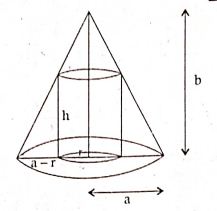
15.
(x2+y2)dy = xy dx
\(\frac { dy }{ dx } =\frac { xy }{ { x }^{ 2 }+{ y }^{ 2 } } ...(1)\)
\(\therefore put=vx\Rightarrow \frac { dy }{ dx } =v+x\frac { dv }{ dx } \)
\(\therefore\)(1) becomes,
\(v+x\frac { dv }{ dx } =\frac { xvx }{ { x }^{ 2 }+{ v }^{ 2 }{ x }^{ 2 } } \)
\(=\frac { { x }^{ 2 }v }{ { x }^{ 2 }(1+{ v }^{ 2 }) } =\frac { v }{ 1+{ v }^{ 2 } } \)
\(x\frac { dv }{ dx } =\frac { v }{ 1+{ v }^{ 2 } } v=\frac { v-v-{ v }^{ 3 } }{ 1+{ v }^{ 2 } } =\frac { -{ v }^{ 3 } }{ 1+{ v }^{ 2 } } \)
Separating the variables we get,
\(\frac { 1+{ v }^{ 2 } }{ { v }^{ 3 } } dv=\frac { -dx }{ x } \)
\(\Rightarrow \frac { 1 }{ { v }^{ 3 } } +\frac { { v }^{ 2 } }{ { v }^{ 3 } } dv=\frac { -dx }{ x } \)
\(\Rightarrow \int { { v }^{ -3 }dv } +\int { \frac { dv }{ v } =-\int { \frac { dx }{ x } } } \)
\(\Rightarrow \frac { { v }^{ -2 } }{ -2 } +log\ v=-logx+logc\)
\(\Rightarrow -\frac { 1 }{ 2{ v }^{ 2 } } +log\ v=-log\ x+log\quad c\)
\(\Rightarrow \frac { 1 }{ 2{ v }^{ 2 } } -log\ v=logx-logc\)
\(\Rightarrow \frac { 1 }{ 2{ v }^{ 2 } } =logv+logx-logc\)
\(\Rightarrow \frac { 1 }{ 2{ v }^{ 2 } } =logv+logx-logc\)
\(\Rightarrow \frac { 1 }{ 2{ v }^{ 2 } } =log\left( \frac { vx }{ c } \right) \)
\(\Rightarrow \frac { { x }^{ 2 } }{ 2{ y }^{ 2 } } =log\left( \frac { y }{ c } \right) \Rightarrow { e }^{ \frac { { x }^{ 2 } }{ { e }^{ 2{ y }^{ 2 } } } }=\frac { y }{ c } \)
\(\Rightarrow y={ ce }^{ \frac { { x }^{ 2 } }{ 2{ y }^{ 2 } } } ...(2)\)
Given y(1) = 1
\(1={ ce }^{ \frac { 1 }{ 2 } }\Rightarrow 1=c\sqrt { e } \)
\(\Rightarrow c=\frac { 1 }{ \sqrt { e } } \)
\(\therefore\)(2) becomes,
\(y=\frac { 1 }{ \sqrt { e } } { e }^{ \frac { { x }^{ 2 } }{ 2{ y }^{ 2 } } }\)
\(Also\ y({ x }_{ 0 })=e\Rightarrow e=\frac { 1 }{ \sqrt { e } } { e }^{ \frac { { x }_{ 0 }^{ 2 } }{ 2{ e }^{ 2 } } }\)
\(\Rightarrow e\sqrt { e } ={ e }^{ \frac { { x }_{ 0 }^{ 2 } }{ 2{ e }^{ 2 } } }\)
\(\Rightarrow \frac { { x }_{ 0 }^{ 2 } }{ 2{ e }^{ 2 } } =log\quad e\sqrt { e } =log{ e }^{ \frac { 3 }{ 2 } }\)
\(\Rightarrow \frac { { x }_{ 0 }^{ 2 } }{ 2{ e }^{ 2 } } =\frac { 3 }{ 2 } { log }_{ e }^{ e }=\frac { 3 }{ 2 } (1)\)
\(\left[ \because { log }_{ e }^{ e }=1 \right] \)
\(\Rightarrow { x }_{ 0 }^{ 2 }=\frac { 3 }{ 2 } (2{ e }^{ 2 })={ 3e }^{ 2 }\)
\(\Rightarrow { x }_{ 0 }=\pm \sqrt { 3{ e }^{ 2 } } =\pm \sqrt { 3 } .e\)
\(\therefore { x }_{ 0 }=\pm \sqrt { 3 } .e\)
16.
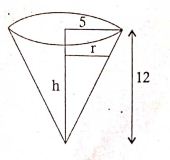
17.
Let \({ z }^{ 3 }+8i=0\)
\(\Rightarrow\) z3 = -8i
= \(8(-i)=8\left( cos\left( -\frac { \pi }{ 2 } +2k\pi \right) isin\left( -\frac { \pi }{ 2 } +2k\pi \right) \right) \),k\(\in Z\)
\(z=\sqrt [ 3 ]{ 8 } \left( cos\left( \frac { -\pi +4k\pi }{ 6 } \right) +isin\left( \frac { -\pi +4k\pi }{ 6 } \right) \right) \)
Taking k = 0, 1, 2 we get,
k = 0, \(z=2\left( cos\left( -\frac { \pi }{ 6 } \right) +isin\left( -\frac { \pi }{ 6 } \right) \right) =2\left( -\frac { 1 }{ 2 } -i\frac { \sqrt { 3 } }{ 2 } \right) =2\left( \frac { \sqrt { 3 } }{ 2 } -i\frac { 1 }{ 2 } \right) \)
k = 1, \(z=2\left( cos\left( \frac { \pi }{ 2 } \right) +isin\left( \frac { \pi }{ 2 } \right) \right) =2=\left( 0+i \right) =0+2i=2i\)
k = 2,\(z=2\left( xcos\left( \frac { 7\pi }{ 6 } \right) +isim\left( \frac { 7\pi }{ 6 } \right) \right) =2\left( cos\left( \pi +\frac { \pi }{ 6 } \right) \right) +isin\left( \pi +\frac { \pi }{ 6 } \right) \)
= \(2\left( -cos\left( \frac { \pi }{ 6 } \right) -isin\left( \frac { \pi }{ 6 } \right) \right) =2\left( -\frac { \sqrt { 3 } }{ 2 } -i\frac { 1 }{ 2 } \right) =-\sqrt { 3 } -i\)
The values of z are \(\sqrt { 3 } -i,2i\) and \(-\sqrt { 3 } -i\)
18.
Let cos−1x = \(\alpha\) and cos-1 y = \(\beta\).
Then, x = cos\(\alpha\) and y cos =\(\beta\)
cos-1x + x + cos-1 y + cos-1x = \(\pi\) gives \(\alpha\)+\(\beta\) = \(\pi\) -cos-1z.
Now, cos(\(\alpha\)+\(\beta\)) = cos\(\alpha\)cos\(\beta\)-sin\(\alpha\)sin\(\beta\) = xy-\(\sqrt { 1-{ x }^{ 2 } } \sqrt { 1-{ y }^{ 2 } } \)
-cos(cos-1 z) = xy\(\sqrt { 1-{ x }^{ 2 } } \sqrt { 1-{ y }^{ 2 } } \)
so, \(-z=xy-\sqrt { 1-{ x }^{ 2 } } \sqrt { 1-{ y }^{ 2 } } \), Which gives -xy - z = -\(\sqrt { 1-{ x }^{ 2 } } \sqrt { 1-{ y }^{ 2 } } \)
Squaring on both sides and simplifying, we get x2 + y2 + z2 + 2xyz = 1.
19.
Given A =\(\left[ \begin{matrix} -5 & 1 & 3 \\ 7 & 1 & -5 \\ 1 & -1 & 1 \end{matrix} \right] \), B=\(\left[ \begin{matrix} 1 & 1 & 2 \\ 3 & 2 & 1 \\ 2 & 1 & 3 \end{matrix} \right] \)
AB =\(\left[ \begin{matrix} -5 & 1 & 3 \\ 7 & 1 & -5 \\ 1 & -1 & 1 \end{matrix} \right] \left[ \begin{matrix} 1 & 1 & 2 \\ 3 & 2 & 1 \\ 2 & 1 & 3 \end{matrix} \right] \)
=\(\left[ \begin{matrix} -5+3+6 & -5+2+3 & -10+1+9 \\ 7+3-10 & 7+2-3 & 14+1-15 \\ 1-3+2 & 1-2+1 & 2-1+3 \end{matrix} \right] \)
=\(\left[ \begin{matrix} 4 & 0 & 0 \\ 0 & 4 & 0 \\ 0 & 0 & 4 \end{matrix} \right] \)= 4. I3
BA =\(\left[ \begin{matrix} 1 & 1 & 2 \\ 3 & 2 & 1 \\ 2 & 1 & 3 \end{matrix} \right] \left[ \begin{matrix} -5 & 1 & 3 \\ 7 & 1 & -5 \\ 1 & -1 & 1 \end{matrix} \right] \)
=\(\left[ \begin{matrix} -5+7+2 & 1+1-2 & 3-5+2 \\ -15+14+1 & 3+2-1 & 9-10+1 \\ -10+7+3 & 2+1-3 & 6-5+3 \end{matrix} \right] \)
=\(\left[ \begin{matrix} 4 & 0 & 0 \\ 0 & 4 & 0 \\ 0 & 0 & 4 \end{matrix} \right] \)= 4. I3.
So, we get AB = BA = 4. I3
⇒ \(\left( \frac { 1 }{ 4 } A \right) B=B\left( \frac { 1 }{ 4 } A \right) =1\)
⇒ B-1 = \(\frac { 1 }{ 4 } \) = 1
Writing the given set of equations in matrix form we get,
\(\left[ \begin{matrix} 1 & 1 & 2 \\ 3 & 2 & 1 \\ 2 & 1 & 3 \end{matrix} \right] \left[ \begin{matrix} x \\ y \\ z \end{matrix} \right] =\left[ \begin{matrix} 1 \\ 7 \\ 2 \end{matrix} \right] \)
⇒ \(B=\left[ \begin{matrix} x \\ y \\ z \end{matrix} \right] =\left[ \begin{matrix} 1 \\ 7 \\ 2 \end{matrix} \right] \)
⇒ \(\left[ \begin{matrix} x \\ y \\ z \end{matrix} \right] ={ B }^{ -1 }\left[ \begin{matrix} 1 \\ 7 \\ 2 \end{matrix} \right] =\left[ \frac { 1 }{ 4 } A \right] \left[ \begin{matrix} 1 \\ 7 \\ 2 \end{matrix} \right] \)
= \(\frac { 1 }{ 4 } \left[ \begin{matrix} -5 & 1 & 3 \\ 7 & 1 & -5 \\ 1 & -1 & 1 \end{matrix} \right] \left[ \begin{matrix} 1 \\ 7 \\ 2 \end{matrix} \right] \)
= \(\frac { 1 }{ 4 } \left[ \begin{matrix} -5+7+6 \\ 7+7-10 \\ 1-7+2 \end{matrix} \right] =\frac { 1 }{ 4 } \left[ \begin{matrix} 8 \\ 4 \\ -4 \end{matrix} \right] =\left[ \begin{matrix} 2 \\ 1 \\ -1 \end{matrix} \right] \)
∴ x = 2, y = 1, z = -1
Hence, the solution set is {2, 1, - 1}.
20.
Let f(x) x6-3x5-5x4+22x3-39x2-39x+135
Given (1+2i) is a root \(\Rightarrow\)(-2i) is also a root
Also \(\sqrt3\) is a root \(\Rightarrow\)-\(\sqrt3\) is also a root.
Hence, the factors of f(x) are [x - (1 + 2i)]
[x-(1-2i)] [x\(\sqrt3\)] [x+\(\sqrt3\)]
[(x-1)-2i] [(x-1)+2i] [x-\(\sqrt3\)][x+\(\sqrt3\)]
((x-1)2+22)(x2-3) = (x2-2x+1+4)(x2-3)
\(\Rightarrow\) factor of f(x) is (x2-2x+5)(x2-3)
\(\Rightarrow\)x4-3x2-2x3+6x+5x2-15
\(\Rightarrow\)(x4-3x2-2x3+6x-15) is a factor of f(x)
To find the other factor, let us divide f(x) by
x4 - 2x3 + 2x2 + 6x - 15
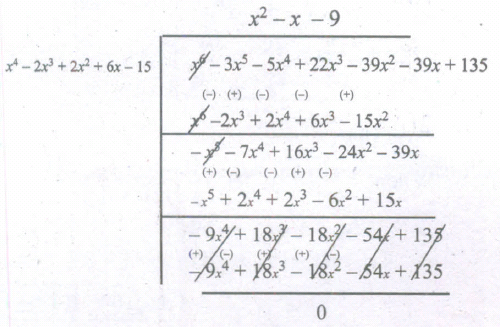
The other factor is x2 - x - 9
\(\Rightarrow x=\frac { 1\pm \sqrt { { (-1) }^{ 2 }-4(1)(-9) } }{ 2 } \left[ \because x=\frac { -b\pm \sqrt { { b }^{ 2 }-4ac } }{ 2a } \right] \)
\(\Rightarrow x=\frac { 1\pm \sqrt { 37 } }{ 2 } \)
Hence the roots are
1 - 2i, 1 + 2i, \(\sqrt { 3 }, -\sqrt { 3 }, \frac { 1+\sqrt { 37 } }{ 2 } ,\frac { 1-\sqrt { 37 } }{ 2 } \).

12th Standard Syllabus & Materials
12th Standard
TN 12th Computer Applications களப்பெயர் முறைமை (DNS) Sample Question Papers Study Material - QB365 Set A
NEW12th Standard
TN 12th Computer Applications வலையமைப்பு எடுத்துக்காட்டுகள் மற்றும் நெறிமுறைகள் Sample Question Papers Study Material - QB365 Set A
NEW12th Standard
TN 12th Computer Applications கணினி வலையமைப்பு ஓர் அறிமுகம் Sample Question Papers Study Material - QB365 Set A
NEW12th Standard
TN 12th Computer Applications PHP-உடன் MySQL-ஐ இணைத்தல் Sample Question Papers Study Material - QB365 Set A



Tamilnadu Stateboard 12th Standard Subjects
Maths

Chemistry

Physics

Biology

Computer Science

Business Maths and Statistics

Economics

Commerce

Accountancy

History

Computer Applications
Biology
Computer Technology
Computer Applications
Computer Science
Business Maths and Statistics
Commerce
Economics
Maths
Chemistry
Physics
Computer Technology
History
Accountancy

Tamil

English

French
Tamilnadu Stateboard Standards


