
 100% FREE ACCESS
12th Standard Syllabus & Materials
12th Standard
TN 12th Computer Applications மின்னணு தரவு பரிமாற்றம் Sample Question Papers Study Material - QB365 Set A
NEW12th Standard
TN 12th Computer Applications மின் - வணிக பாதுகாப்பு அமைப்புகள் Sample Question Papers Study Material - QB365 Set A
NEW12th Standard
TN 12th Computer Applications மின்னணு செலுத்தல் முறைகள் Sample Question Papers Study Material - QB365 Set A
NEW12th Standard
TN 12th Computer Applications மின் - வணிகம் Sample Question Papers Study Material - QB365 Set A
NEW12th Standard
TN 12th Computer Applications திறந்த மூல கருத்துருக்கள் Sample Question Papers Study Material - QB365 Set A
NEW12th Standard
TN 12th Computer Applications வலையமைப்பு வடமிடல் Sample Question Papers Study Material - QB365 Set A

Published on: 28/11/2025
Download Tamil Nadu 12th Standard Maths question papers, model tests, one-mark questions, important questions, and public exam papers in PDF format. Free study materials and answer keys for TN State Board students.
Questions + Answers key
Take MCQ Maths Test
1.
If the two lines \(\frac { x-1 }{ 2 } =\frac { y+1 }{ 3 } =\frac { z-1 }{ 4 } \) and \(\frac { x-3 }{ 1 } =\frac { y-m }{ 2 } =z\) intersect at a point, find the value of m
2.
If the straight lines \(\frac { x-5 }{ 5m+2 } =\frac { 2-y }{ 5 } =\frac { 1-z }{ -1 } \) and \(x=\frac { 2y+1 }{ 4m } =\frac { 1-z }{ -3 } \) are perpendicular to each other, find the value of m.
3.
Show that \(\left( \frac { \sqrt { 3 } }{ 2 } +\frac { i }{ 2 } \right) ^{ 5 }+\left( \frac { \sqrt { 3 } }{ 2 } -\frac { i }{ 2 } \right) ^{ 5 }=-\sqrt { 3 } \)
4.
Prove by vector method that an angle in a semi-circle is a right angle.
5.
If |z| = 2 show that \(3\le \left| z+3+4i \right| \le 7\)
6.
If y = 4x + c is a tangent to the circle x2 + y2 = 9, find c
7.
A circle of radius 3 units touches both the axes. Find the equations of all possible circles formed in the general form.
8.
Find the distance between the parallel planes x + 2y - 2z + 1 = 0 and 2x + 4y - 4z + 5 = 0
9.
For any vector \(\vec { a } \), prove that \(\hat { i } \times (\vec { a } \times \hat { i } )+\hat { j } \times (\vec { a } \times \hat { j } )+\hat { k } \times \vec { a } \times \hat { k } =2\vec { a } \).
10.
If \(\hat { 2i } -\hat { j } +\hat { 3k } ,\hat { 3i } +\hat { 2j } +\hat { k } ,\hat { i } +\hat { mj } +\hat { 4k } \) are coplanar, find the value of m.
11.
Find the square root of 6−8i .
12.
The orbit of Halley’s Comet is an ellipse 36.18 astronomical units long and by 9.12 astronomical units wide. Find its eccentricity.
13.
Obtain the equation of the circle for which (3, 4) and (2, -7) are the ends of a diameter.
14.
Show that \(\left( 2+i\sqrt { 3 } \right) ^{ 10 }-\left( 2-i\sqrt { 3 } \right) ^{ 10 }\) is purely imaginary
15.
Show that the lines \(\vec { r } =(\hat {- i } -3\hat { j } -5\hat { k } )+s(3\hat { i } +5\hat { j } +7\hat { k } )\) and \(\vec { r } =(2\hat { i } +4\hat { j } +6\hat { k } )+t(\hat { i } +4\hat { j } +7\hat { k } )\) are coplanar. Also, find the non-parametric form of vector equation of the plane containing these lines
16.
17.
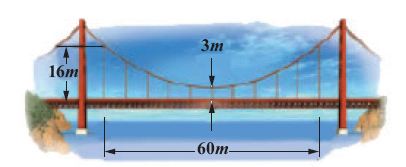
Parabolic cable of a 60m portion of the roadbed of a suspension bridge are positioned as shown below. Vertical Cables are to be spaced every 6m along this portion of the roadbed. Calculate the lengths of first two of these vertical cables from the vertex.
18.
Prove by vector method that sin(α + β ) = sin α cos β + cos α sin β
19.
If z = x + iy is a complex number such that Im \(\left( \frac { 2z+1 }{ iz+1 } \right) =0\) show that the locus of z is 2x2+ 2y2+ x - 2y = 0
20.
If z1, z2 and z3 are complex numbers such that |z1| = |z2| = |z3| = |z1+z2+z3| = 1 find the value of \(\left| \frac { 1 }{ { z }_{ 1 } } +\frac { 1 }{ z_{ 2 } } +\frac { 1 }{ { z }_{ 3 } } \right| \)
21.
Find the foci, vertices and length of major and minor axis of the conic 4x2 + 36y2 + 40x − 288y + 532 = 0
22.
Distance from the origin to the plane 3x − 6y + 2z + 7 = 0 is
0
1
2
3
23.
Consider the vectors \(\vec { a } ,\vec { b } ,\vec { c } ,\vec { d} \) such that \((\vec { a } \times \vec { b } )\times (\vec { c } \times \vec { d } )\) = \(\vec { 0 } \) Let \({ P }_{ 1 }\) and \({ P }_{ 2 }\) be the planes determined by the pairs of vectors \(\vec { a } ,\vec { b } \) and \(\vec { c } ,\vec { d } \) respectively. Then the angle between \({ P }_{ 1 }\) and \({ P }_{ 2 }\) is
0°
45°
60°
90°
24.
25.
If the coordinates at one end of a diameter of the circle x2 + y2 − 8x − 4y + c = 0 are (11, 2), the coordinates of the other end are
(-5, 2)
(-3, 2)
(5, -2)
(-2, 5)
26.
The radius of the circle passing through the point(6, 2) two of whose diameter are x + y = 6 and x + 2y = 4 is
10
\( {2} \sqrt {5}\)
6
4
27.
The eccentricity of the hyperbola whose latus rectum is 8 and conjugate axis is equal to half the distance between the foci is
\(\frac { 4 }{ 3 } \)
\(\frac { 4 }{ \sqrt { 3 } } \)
\(\frac { 2 }{ \sqrt { 3 } } \)
\(\frac { 3 }{ 2 } \)
28.
29.
30.
31.
If z is a non zero complex number, such that 2iz2 = \(\bar { z } \) then |z| is
\(\cfrac { 1 }{ 2 } \)
1
2
3
1.
Given lines are
\(\frac { x-1 }{ 2 } =\frac { y+1 }{ 3 } =\frac { z-1 }{ 4 } \)
\(\vec { a } =\hat { i } -\hat { j } +\hat { k } \vec { b } \quad and\quad \vec { b } =2\hat { i } +3\hat { j } +4\hat { k } \)
\(\frac { x-3 }{ 1 } =\frac { y-m }{ 2 } =\frac{z-0}{1}\)\(\Rightarrow \vec { c } =3\hat { i } +m\hat { j } \)
\(\vec { d } =\hat { i } +2\hat { j } +\hat { k } \quad \)
\(\vec { c } -\vec { a } =(3\hat { i } +m\hat { j } )-(\hat { i } -\hat { j } +\hat { k } )\)
\(=2\hat { i } +(m,+1)\hat { j } -\hat { k } \)
\(\vec { b } \times \vec { d } =\left| \begin{matrix} \hat { i } & \hat { j } & \hat { k } \\ 2 & 3 & 4 \\ 1 & 2 & 1 \end{matrix} \right| =\hat { i } (3-8)-\hat { j } (2-4)+\hat { k } (4-3)\)
\(=-5\hat { i } +2\hat { j } +\hat { k } \)
Since the lines intersect at a point, \((\vec { c } -\vec { a } ).(\vec { b } \times \vec { d } )=0,\)
\(\Rightarrow (2\hat { i } +(m+1)\hat { j } -\hat { k } ).(-5\hat { i } +2\hat { j } +\hat { k } )=0\)
\(\Rightarrow -10+2(m+1)-1=0\Rightarrow -10+2m+2-1=0\)
\(\Rightarrow 2m-9=0\Rightarrow 2m=9\Rightarrow m=\frac { 9 }{ 2 } \)
\(\therefore m=\frac { 9 }{ 2 } \)
2.
Given lines are \(\frac { x-5 }{ 5m+2 } =\frac { 2-y }{ 5 } =\frac { 1-z }{ -1 } \)
⇒ \(\frac { x-5 }{ 5m+2 } =\frac { y-2 }{ -5 } =\frac { z-1 }{ 1 } \)
∴ \(\vec { b } =(5m+2)\hat { i } -5\hat { j } +\hat { k } \) ...(1)
and x = \(\frac { 2y+1 }{ 4m } =\frac { 1-z }{ -3 } \)
⇒ \(\frac { x }{ 1 } =\frac { y+\frac { 1 }{ z } }{ 2m } =\frac { z-1 }{ 3 } \)
∴ \(\vec { d } =\hat { i } +2m\hat { j } +3\hat { k } \) ...(2)
since \(\vec { b } \bot \vec { d } \Rightarrow \vec { b } .\vec { d } \)= 0
⇒ \((\hat { i } +2m\hat { j } +3\hat { k } ).((5m+2)\hat { i } -5\hat { j } +\hat { k } )=0\)
⇒ (5m+2)1+2m(-5)+3(1) = 0
⇒ 5m+2-10m+3 = 0
⇒ 5-5m = 0
⇒ 5 = 5m
∴ m = 1
3.
Let \(\frac { \sqrt { 3 } }{ 2 } +\frac { i }{ 2 } \) = r(cos θ + i sin θ)
r = \(\sqrt { \left( \frac { \sqrt { 3 } }{ 2 } \right) ^{ 2 }+\left( \frac { 1 }{ 2 } \right) ^{ 2 } } =\sqrt { \frac { 3 }{ 4 } +\frac { 1 }{ 4 } } =\sqrt { \frac { 4 }{ 4 } } \)=1
α = \(tan^{ -1 }\left| \frac { y }{ x } \right| =tan^{ -1 }\left| \frac { \frac { 1 }{ 2 } }{ \frac { \sqrt { 3 } }{ 2 } } \right| =tan^{ -1 }\left( \frac { 1 }{ \sqrt { 3 } } \right) =\frac { \pi }{ 6 } \)
Since \(\frac { \sqrt { 3 } }{ 2 } +\frac { i }{ 2 } \) lies is the I quadrant, θ = α
∴ \(\frac { \sqrt { 3 } }{ 2 } +\frac { i }{ 2 } =1\left( cos\frac { \pi }{ 6 } +isin\frac { \pi }{ 6 } \right) \)
∴ \(\left( \frac { \sqrt { 3 } }{ 2 } +\frac { i }{ 2 } \right) ^{ 5 }=1^{ 5 }\left( cos\frac { \pi }{ 6 } +isin\frac { \pi }{ 6 } \right) ^{ 5 }\)
= \(cos\frac { 5\pi }{ 6 } +isin\frac { 5\pi }{ 6 } \) ....(1) [De moivres theorem]
Similarly \(\frac { \sqrt { 3 } }{ 2 } +\frac { i }{ 2 } =1\left( cos\frac { \pi }{ 6 } -isin\frac { \pi }{ 6 } \right) \)
∴ \(\left( \frac { \sqrt { 3 } }{ 2 } -\frac { i }{ 2 } \right) ^{ 5 }=1^{ 5 }\left[ cos\frac { \pi }{ 6 } +isin\frac { \pi }{ 6 } \right] ^{ 5 }\)
= \(cos\frac { 5\pi }{ 6 } -isin\frac { 5\pi }{ 6 } \) ....(2)
Adding (1) and (2) we get,
\(\left( \frac { \sqrt { 3 } }{ 2 } +\frac { i }{ 2 } \right) ^{ 5 }+\left( \frac { \sqrt { 3 } }{ 2 } -\frac { i }{ 2 } \right) ^{ 5 }\)

= \(2cos\frac { 5\pi }{ 6 } =2cos\left( \pi -\frac { \pi }{ 6 } \right) \)
= \(-2cos\ \frac { \pi }{ 6 } \) [∵ \(\frac { 5\pi }{ 6 } \) lies in the II quard]
= \(-2\left( \frac { \sqrt { 3 } }{ 2 } \right) =-\sqrt { 3 } \).
4.
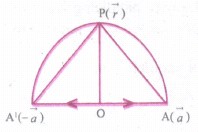
Let O be the centre of the semi-circle and AA1 be the diameter.
Let P be any point on the circumference of the semi circle.
Taking O as the origin, let the position vectors of A and P be a and \(\vec { r } \) respectively.
Let us prove that \(\angle A P B=90^{\circ}\)
W.K.T OA = OB = OP ( because of radius)
\(
\overrightarrow{P A} =\overrightarrow{P O}+\overrightarrow{O A}
\)
\(\overrightarrow{P B} =\overrightarrow{P O}+\overrightarrow{O B}
\)
\( =\overrightarrow{P O}-\overrightarrow{O A}
\)
\(\overrightarrow{P A} \cdot \overrightarrow{P B} =(\overrightarrow{P O}+\overrightarrow{O A})(\overrightarrow{P O}-\overrightarrow{O A})
\)
\( =\overrightarrow{P O}^{2}-\overrightarrow{O A}^{2}=0
\)
\(
\overrightarrow{P A} \perp \overrightarrow{P B}
\)
\( \Rightarrow \ \angle A P B=90^{\circ}
\). Hence proved.
5.

\(\left| z+3+4i \right| \le \left| z \right| +\left| 3+4i \right| =2+5=7\)
\(\left| z+3+4i \right| \le 7\) .............. (1)
\(\left| z+3+4i \right| \ge \left| \left| z \right| -\left| 3+4i \right| \right| =\left| 2-5 \right| =3\)
\(\left| z+3+4i \right| \ge 3\) ............ (2)
From (1) and (2) we get, \(3\le \left| z+3+4i \right| \le 7\)
6.
The condition for the line y = mx + c to be a tangent to the circle x2 + y2 = a2 is c2 = a2(1 + m2) from
Then \(c=\pm \sqrt { 9\left( 1+16 \right) } \)
\(c=\pm 3\sqrt { 17 } \)
7.
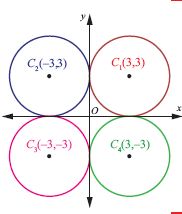
As the circle touches both the axes, the distance of the centre from both the axes is 3 units, centre can be (±3, ±3) and hence there are four circles with radius 3, and the required equations of the four circles are
x2 + y2 ± 6x ± 6y + 9 = 0.
8.
We know that the formula for the distance between two parallel ax + by + cz + d1 = 0 and ax + by + cz + d2 = 0 is \(\delta =\frac { |{ d }_{ 1 }-{ d }_{ 2 }| }{ \sqrt { { a }^{ 2 }+{ b }^{ 2 }+{ c }^{ 2 } } } \). Rewrite the second equation as x + 2y - 2z + \(\frac { 5 }{ 2 } \) = 0.
Comparing the given equations with the general equations, we get a = 1, b = 2, c = -2, d1 = 1, d2 = \(\frac { 5 }{ 2 } \). Substituting these values in the formula, we get the distance
\(\delta =\frac { |{ d }_{ 1 }-{ d }_{ 2 }| }{ \sqrt { { a }^{ 2 }+{ b }^{ 2 }+{ c }^{ 2 } } } =\frac { |1-\frac { 5 }{ 2 } | }{ \sqrt { { 1 }^{ 2 }+{ 2 }^{ 2 }+(-2^{ 2 }) } } =\frac { 1 }{ 2 } \) units.
9.
Let \(\vec { a } ={ a }_{ 1 }\hat { i } +{ a }_{ 2 }\hat { j } +{ a }_{ 3 }\hat { k } \)
∴ LHS = \(\hat { i } \times (\vec { a } \times \hat { i } )+\hat { j } \times (\vec { a } \times \hat { j } )+\hat { k } \times \vec { a } \times \hat { k }\)
\((\hat { i }. \hat { i } )\vec { a } -(\hat { i } .\hat { a } )\hat { i } +(\hat { j } .\hat { j } )\vec { a } -(\hat { j } .\vec { a } )\hat { j } +(\hat { k } .\hat { k } )\vec { a } -(\hat { k } .\vec { a } )\hat { k } \)
\([\because \vec { a } \times (\vec { b } \times \vec { c } )=(\vec { a } .\vec { c } )\vec { b } -(\vec { a } .\vec { b } )\vec { c } ]\)
\(1.\vec { a } -{ a }_{ 1 }\hat { i } +1.\vec { a } -{ a }_{ 2 }\hat { j } +1.\vec { a } -{ a }_{ 3 }\hat { k } ]\)
\([\because \hat { i } .\hat { i } =\hat { j } .\hat { j } =\hat { k } .\hat { k } =1\)and
\(\hat { i } \vec { a } =\hat { i } ({ a }_{ 1 }\hat { i } +{ a }_{ 2 }\hat { j } +{ a }_{ 3 }\hat { k } )={ a }_{ 1 }\hat { j } .\vec { a } ={ a }_{ 2 }\quad \hat { k } .\vec { a } ={ a }_{ 3 }\)
\(3\vec { a } -({ a }_{ 1 }\hat { i } +{ a }_{ 2 }\hat { j } +{ a }_{ 3 }\hat { k } )\)
= \(3\vec { a } -\vec { a } =2\vec { a } \)
= RHS .
∴ LHS = RHS. Hence proved
10.
Since the given three vectors are coplanar, we have \(\left| \begin{matrix} 2 & -1 & 3 \\ 3 & 2 & 1 \\ 1 & m & 4 \end{matrix} \right| \) = 0 ⇒ m = -3
11.
We compute \(\left| 6-8i \right| =\sqrt { { 6 }^{ 2 }+\left( -8 \right) ^{ 2 } } =10\)
and applying the formula for square root, we get
\(\sqrt { 6-8i } =\pm \left( \sqrt { \frac { 10+6 }{ 2 } } -i\sqrt { \frac { 10-6 }{ 2 } } \right) \) (\(\therefore\) b is negative\( \frac{b}{|b|}=-1 \))
= \(\pm \left( \sqrt { 8 } +i\sqrt { 2 } \right) \)
= \(\pm \left( 2\sqrt { 2 } -i\sqrt { 2 } \right) \)
12.
Given that 2a = 36.18, 2b = 9.12 , we get
e = \(\sqrt { 1-\frac { { b }^{ 2 } }{ { a }^{ 2 } } } =\frac { \sqrt { { a }^{ 2 }-{ b }^{ 2 } } }{ a } \) = \(\frac { \sqrt { { \left( \frac { 36.18 }{ 2 } \right) }^{ 2 }{ \left( \frac { 9.12 }{ 2 } \right) }^{ 2 } } }{ \frac { 36.18 }{ 2 } } \)
\(\frac { \sqrt { { \left( 18.09 \right) }^{ 2 }-{ \left( 4.56 \right) }^{ 2 } } }{ \left( 8.09 \right) } \approx0.97\)
13.
Given ends of diameter are (3, 4)(2, -7)
∴ Equation of the circle is
(x - x1)(x - x2) + (y - y1)(y - y2) = 0
⇒ (x - 3)(x - 2) + (y - 4)(y + 7) = 0
⇒ x2 - 2x - 3x + 6 + y2 + 7y - 4y - 28 = 0
⇒ x2 + y2 − 5x + 3y − 22 = 0
14.
\(\overline { (2-i)^{ 12 }+(2+i)^{ 12 } } =\overline { (2-i)^{ 12 } } +\overline { (2+i)^{ 12 } } \)
\(\left( 2+i\sqrt { 3 } \right) ^{ 10 }-\left( 2-i\sqrt { 3 } \right) ^{ 10 }\)
Now \(\overline { z } \) = \(\overline { (2+\sqrt { 3 } )^{ 10 }-(2-i\sqrt { 3 } )^{ 10 } } \)
\(\overline { z } \) = \(\overline { (2+i\sqrt { 3 } )^{ 10 } } -(2-i\sqrt { 3 } )^{ 10 }\)
[∵ \(\overline { { z }_{ 1 }-{ z }_{ 2 } } =\overline { { z }_{ 1 } } -\overline { { z }_{ 2 } } \)]
= \((2-i\sqrt { 3 } )^{ 10 }-(2+i\sqrt { 3 } )^{ 10 }\)
= -\(\left[ (2-i\sqrt { 3 } )^{ 10 }-(2+i\sqrt { 3 } )^{ 10 } \right] \)
∴ \(\overline { z } \) = -\(\ { z } \) ⇒ z is purely imaginary
Hence \((2-i\sqrt { 3 } )^{ 10 }-(2+i\sqrt { 3 } )^{ 10 }\)is purely imaginary
15.
Comparing the two given lines with
\(\vec { r } =\vec { a } +t\vec { b } ,\vec { r } =\vec { c } +s\vec { d } \)
we have, \(\vec { a } =-\hat { i } -3\hat { j } -5\hat { k } ,\vec { b } =3\hat { i } +5\hat { j } +7\hat { k } ,\vec { c } =2\hat { i } +4\hat { j } +6\hat { k } \) and \(\vec { d } =\hat { i } +4\hat { j } +7\hat { k } \)
We know that the two given lines are coplar, if \((\vec { c } -\vec { a } ).(\vec { b } \times \vec { d } )\) = 0
Here, \(\vec { b } \times \vec { d } \left| \begin{matrix} \hat { i } & \hat { j } & \hat { k } \\ 3 & 5 & 7 \\ 1 & 4 & 7 \end{matrix} \right| =7\hat { i } -14\hat { j } +7\hat { k } \) and \(\vec { c } -\vec { a } =3\hat { i } +7\hat { j } +11\hat { k } \)
Then, \((\vec { c } -\vec { a } ).(\vec { b } \times \vec { d } )=(3\hat { i } +7\hat { j } +11\hat { k } )(7\hat { i } -14\hat { j } +7\hat { k } )=0\)
Therefore the two given lines are coplanar. Then we find the non parametric form of vector equation of the plane containing the two given coplanar lines. We know that the plane containing the two given coplanar lines is
\((\vec { r } -\vec { a } ).(\vec { b } \times \vec { d } )\)= 0
which implies that \((\vec { r } -(-\hat { i } -3\hat { j } -5\hat { k } )).(7\hat { i } -14\hat { j } +7\hat { k } )\) = 0.
Thus, the required non-parametric vector equation of the plane containing the two given coplanar lines is
\(\vec { r } .(\hat { i } -2\hat { j } +\hat { k } )\) = 0.
16.
.JPG)
17.
Let the of the parbola be x2 = 4ay (1)
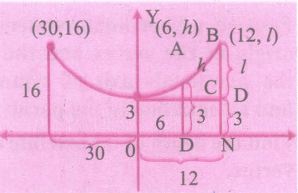
Since (30, 16) is a point on (1),
we get 302 = 4 \(\times\) a \(\times\) 16
⇒ a = \(\frac { 30\times 30 }{ 4\times 16 } =\frac { 225 }{ 16 } \)
∴ becomes, x2 = \({ x }^{ 2 }=\frac { 4\times 225 }{ 16 } y=\frac { 225 }{ 4 } y\)
Let AC = h m and BD = lm
∴ A(6, h) is a point on the parabola [∵ OD = 6]
∴ \({ 6 }^{ 2 }=\frac { 225 }{ 4 } \times h\)
⇒ \(h=\frac { 36\times 4 }{ 225 } \Rightarrow h=0.52\)
∴ AD = 3 + h = 3 + 0.52 = 3.52 m
Also (12, 1) is a point on the parabola
[∵ ON = 6 + 6 = 12]
∴ \({ 12 }^{ 2 }=\frac { 225 }{ 4 } \times l\)
⇒ l = \(\frac { 12\times 12\times 4 }{ 225 } =\frac { 576 }{ 225 } =2.08\) = 5.08 m
Hence the length of first two vertical cables are 3.52 m and 5.08 m.
18.
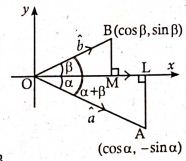
Let \(\hat { a } =\vec { OA } \) and \(\hat { b } =\vec { OB } \) be the unit vectors and which make angles α,β respectively with positive x-axis
Draw AL and BM 丄 to x-axis
Then \(|\vec { OL } |=|\vec { OA } |cos\alpha \Rightarrow \vec { OL } =\vec { |OL| } \hat { i } =cos\alpha \hat { i } \)
\(|\vec { LA } |=|\vec { OB } |\) sin α
⇒ \(\vec { LA } =|\vec { OB } |\hat { j } =sin\alpha (-\hat { j } )=-sin\alpha \hat { j } \)
[\(\vec { LA } \) is in the opp direction of y axis]
\(\hat { a } =\vec { OA } =\vec { OL } +\vec { LA } =cos\alpha \hat { i } -sin\alpha \check { j } \) ..(1)
Similarly \(\hat { b } =\vec { OB } =\vec { OM } +\vec { MB } =cos\beta \hat { i } +sin\beta \hat { j } \) ...(2)
Now \(\hat { a } \times \hat { b } =|\hat { a } ||\hat { b } |sin(\alpha +\beta )\hat { k } =sin(\alpha +\beta )\hat { k } \) ....(3)
[\(|\hat { a } |=|\hat { b } |\) = 1]
Also \(\hat { a } \times \hat { b } =\left| \begin{matrix} \hat { i } & \hat { j } & \hat { k } \\ cos\alpha & -sin\alpha & 0 \\ cos\beta & cos\beta & 0 \end{matrix} \right| \)
= \(\hat { i } (0)-\hat { j } (0)+\hat { k } \)(cosα sinβ + sinα cosβ)
= (sin α cos β + cos α sin β)\(\hat { k } \) .(4)
using (3) and (4), sin(α+β) = sin α cos β + cos α sin β
19.
Given z = x + iy
Im \(\left( \frac { 2z+1 }{ iz+1 } \right) \)= 0
⇒ Im\(\left( \frac { 2(x+iy)+1 }{ i(x+iy)+1 } \right) \)= 0
⇒ Im\(\left( \frac { (2x+1)+2iy }{ ix+i^{ 2 }y+1 } \right) \)
⇒ Im\(\left( \frac { (2x+1)+2iy }{ ix-y+1 } \right) \)
\(\left( \frac { (2x+1)+iy }{ (1-y)+ix } \right) \)
Multiply and divide by the conjugate of the denominator
We get Im\(\left( \frac { (2x+1)+2iy }{ (1-y)+ix } \times \frac { (1-y)-ix }{ (1-y)-ix } \right) \)=0
⇒ Im\(\left( \frac { (2x+1)+2iy\times (1-y)-ix }{ (1-y)^{ 2 }+{ x }^{ 2 } } \right) \)
Choosing the imaginably part we get,
\(\frac { (2x+1)(-x)+2y(1-y) }{ (1-y)^{ 2 }+{ x }^{ 2 } } \)
⇒ (2x+1)-x+2y(1-y) = 0
⇒ -2x2-x+2y-2y2 = 0
⇒ 2x2+2y2+x-2y = 0
Hence, locus of z is 2x2+2y2+x-2y = 0
20.
Since,\(\left| { z }_{ 1 } \right| =\left| { z }_{ 2 } \right| =\left| { z }_{ 3 } \right| =1\)
\(\left| { z }_{ 1 } \right| ^{ 2 }=1\Rightarrow { z }\bar { { z }_{ 1 } } =1,\left| { z }_{ 2 } \right| ^{ 2 }=1\Rightarrow { z }_{ 2 }\bar { { z }_{ 2 } } =1\ \)
Therefore, \(\bar { { z }_{ 1 } } =\frac { 1 }{ { z }_{ 1 } } ,\bar { { z }_{ 2 } } =\frac { 1 }{ { z }_{ 3 } } \) and hence
\(\left| \frac { 1 }{ { z }_{ 1 } } +\frac { 1 }{ { z }_{ 2 } } +\frac { 1 }{ { z }_{ 3 } } \right| =\left| \bar { { z }_{ 1 } } +\bar { { z }_{ 2 } } +{ \bar { z } }_{ 3 } \right| \)
= \(\left| \overline { { z }_{ 1 }+\left| { z }_{ 2 }+{ z }_{ 3 } \right| } \right| ={ { z }_{ 1 }+{ z }_{ 2 }+{ z }_{ 3 } }=1\)
21.
Completing the square on x and y of 4x2+36y2+40x−288y+532 = 0,
4(x2 + 10x + 25 − 25) + 36(y2 − 8y + 16 − 16) + 532 = 0 , gives
4(x2 + 10x + 25) + 36(y2 − 8y + 16) = −532 + 100 + 576
4(x + 5)2 + 36(y − 4)2 = 144.
Dividing both sides by 144, the equation reduces to \(\frac { { \left( x+5 \right) }^{ 2 } }{ 36 } \frac { { \left( y-4 \right) }^{ 2 } }{ 4 } =1\)
This is an ellipse with centre (-5, 4), major axis is parallel to x-axis, length of major axis is 12 and length of minor axis is 4. Vertices are (1, 4) and (-11, 4).
Now, c2 = a2−b2 = 36 − 4 = 32
and c = ±4 \(\sqrt { 2 } \)
Then the foci are (−5 − 4\(\sqrt { 2 } \), 4) and (−5 + 4\(\sqrt { 2 } \) , 4).
Length of the major axis = 2a = 12 units and
the length of the minor axis = 2b = 4 units.
22.
(b)
1
23.
(a)
0°
24.
(d)
25.
(b)
(-3, 2)
26.
(b)
\( {2} \sqrt {5}\)
27.
(c)
\(\frac { 2 }{ \sqrt { 3 } } \)
28.
(b)
29.
(b)
30.
(b)
31.
(a)
\(\cfrac { 1 }{ 2 } \)

12th Standard Syllabus & Materials
12th Standard
TN 12th Computer Applications களப்பெயர் முறைமை (DNS) Sample Question Papers Study Material - QB365 Set A
NEW12th Standard
TN 12th Computer Applications வலையமைப்பு எடுத்துக்காட்டுகள் மற்றும் நெறிமுறைகள் Sample Question Papers Study Material - QB365 Set A
NEW12th Standard
TN 12th Computer Applications கணினி வலையமைப்பு ஓர் அறிமுகம் Sample Question Papers Study Material - QB365 Set A
NEW12th Standard
TN 12th Computer Applications PHP-உடன் MySQL-ஐ இணைத்தல் Sample Question Papers Study Material - QB365 Set A



Tamilnadu Stateboard 12th Standard Subjects
Maths

Chemistry

Physics

Biology

Computer Science

Business Maths and Statistics

Economics

Commerce

Accountancy

History

Computer Applications
Biology
Computer Technology
Computer Applications
Computer Science
Business Maths and Statistics
Commerce
Economics
Maths
Chemistry
Physics
Computer Technology
History
Accountancy

Tamil

English

French
Tamilnadu Stateboard Standards


