
 100% FREE ACCESS
12th Standard Syllabus & Materials
12th Standard
TN 12th Computer Applications மின்னணு தரவு பரிமாற்றம் Sample Question Papers Study Material - QB365 Set A
NEW12th Standard
TN 12th Computer Applications மின் - வணிக பாதுகாப்பு அமைப்புகள் Sample Question Papers Study Material - QB365 Set A
NEW12th Standard
TN 12th Computer Applications மின்னணு செலுத்தல் முறைகள் Sample Question Papers Study Material - QB365 Set A
NEW12th Standard
TN 12th Computer Applications மின் - வணிகம் Sample Question Papers Study Material - QB365 Set A
NEW12th Standard
TN 12th Computer Applications திறந்த மூல கருத்துருக்கள் Sample Question Papers Study Material - QB365 Set A
NEW12th Standard
TN 12th Computer Applications வலையமைப்பு வடமிடல் Sample Question Papers Study Material - QB365 Set A

Published on: 28/11/2025
Download Tamil Nadu 12th Standard Maths question papers, model tests, one-mark questions, important questions, and public exam papers in PDF format. Free study materials and answer keys for TN State Board students.
Questions + Answers key
Take MCQ Maths Test
1.
If V(x,y) = ex(x cos y - y siny), then prove that \(\frac { { \partial }^{ 2 }V }{ \partial { x }^{ 2 } } =\frac { { \partial }^{ 2 }V }{ \partial { y }^{ 2 } } \) = 0
2.
For each of the following functions find the fx, fy, and show that fxy = fyx
f(x, y) = tan -1 (x/y)
3.
Let w(x, y) = xy+\(\frac { { e }^{ y } }{ { y }^{ 2 }+1 } \) for all (x, y) ∈ R2. Calculate \(\frac { { \partial }^{ 2 }w }{ { \partial y\partial x } } \) and \(\frac { { \partial }^{ 2 }w }{ { \partial x\partial y } } \)
4.
Let F(x, y) = x3 y + y2x + 7 for all (x, y)∈ R2. Calculate \(\frac { \partial F }{ \partial x } \)(-1, 3) and \(\frac { \partial F }{ \partial y } \)(-2, 1).
5.
The trunk of a tree has diameter 30 cm. During the following year, the circumference grew 6cm.
(i) Approximately, how much did the tree's diameter grow?
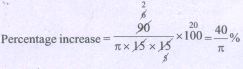
(ii) What is the percentage increase in area of the tree's cross-section?
6.
A right circular cylinder has radius r =10 cm. and height h = 20 cm. Suppose that the radius of the cylinder is increased from 10 cm to 10. 1 cm and the height does not change. Estimate the change in the volume of the cylinder. Also, calculate the relative error and percentage error.
7.
If U(x, y, z) = log (x3 + y3 + z3), find \(\frac { \partial U }{ \partial x } +\frac { \partial U }{ \partial y } +\frac { \partial U }{ \partial z } \)
8.
Find the partial derivatives of the following functions at the indicated point
h (x, y, z) = x sin (xy) + z2x, \(\left( 2,\frac { \pi }{ 4 }, 1\right) \)
9.
Show that f(x, y) = \(\frac { { x }^{ 2 }-{ y }^{ 2 } }{ { y }^{ 2 }+1 } \) is continuous at every (x, y) ∈ R2
10.
The time T, taken for a complete oscillation of a single pendulum with length l, is given by the equation T = 2ㅠ\(\sqrt { \frac { 1 }{ g } } \), where g is a constant. Find the approximate percentage error in the calculated value of T corresponding to an error of 2 percent in the value of l.
11.
Use the linear approximation to find approximate values of \({ (123) }^{ \frac { 2 }{ 3 } }\)
12.
A firm produces two types of calculators each week, x number of type A and y number of type B. The weekly revenue and cost functions (in rupees) are R(x, y) = 80x + 90y + 0.04xy − 0.05x2 − 0.05y2 and C(x, y) = 8x + 6y + 2000 respectively
(i) Find the profit function P(x, y)
(ii) Find \(\frac { { \partial P } }{ \partial { x } } \) (1200, 1800) and \(\frac { \partial v }{ \partial y} \) (1200, 1800)
13.
Evaluate \(\begin{matrix} lim \\ (x,y)\rightarrow (0,0) \end{matrix}cos=\left( \frac { { e }^{ x }siny }{ y } \right) \), if the limit exists.
14.
An egg of a particular bird is very nearly spherical. If the radius to the inside of the shell is 5 mm and radius to the outside of the shell is 5.3 mm, find the volume of the shell approximately.
15.
Find df for f(x) = x2 + 3x and evaluate it for
x = 2 and dx = 0.1
16.
Let g(x) = x2 + sin x. Calculate the differential dg.
17.
If we measure the side of a cube to be 4 cm with an error of 0.1 cm, then the error in our calculation of the volume is
0.4 cu.cm
0.45 cu.cm
2 cu.cm
4.8 cu.cm
18.
If w (x, y) = xy, x > 0, then \(\frac { \partial w }{ \partial x } \) is equal to
xy log x
y log x
yxy-1
x log y
19.
If v (x, y) = log (ex + ey), then \(\frac { { \partial }v }{ \partial x } +\frac { \partial v }{ \partial y } \) is equal to
ex + ey
\(\frac{1}{e^x + e^y}\)
2
1
20.
If \(u(x, y)=e^{x^{2}+y^{2}}\),then \(\frac { \partial u }{ \partial x } \) is equal to
\(e^{x^{2}+y^{2}}\)
2xu
x2u
y2u
21.
A circular template has a radius of 10 cm. The measurement of radius has an approximate error of 0.02 cm. Then the percentage error in calculating area of this template is
0.2%
0.4%
0.04%
0.08%
1.
Given V(x, y) = ex(x cos y - y sin y)
\(\frac { \partial V }{ \partial x } \) = ex (cos y) +(x cos y - y sin y)ex
= ex (cos y + x cos y - y sin y)
\(\frac { { \partial }^{ 2 }V }{ \partial { x }^{ 2 } } \) = ex(0 + cos y - 0) + (cos y +x cos y.- y sin y)ex
= ex(2 cos y + x cos y - y sin y) ... (1)
\(\frac { \partial V }{ \partial y } \) = ex(-x sin y- y cos y- sin y)
\(\frac { { \partial }^{ 2 }V }{ \partial { y }^{ 2 } } \) = ex (-x cos y - (-y sin y + cos y) - cos y)
= ex(- x cos y + y sin y - cos y - cos y)
= ex (- x cos y + y sin y - 2 cos y) ... (2)
(1)+(2)➝
\(\frac { { \partial }^{ 2 }V }{ \partial { x }^{ 2 } } \) + \(\frac { { \partial }^{ 2 }V }{ \partial { y }^{ 2 } } \) = ex(2 cos y + x cos y - y sin y - x cos y + y sin y - 2 cos y]
= ex (0) = 0
Hence proved
2.
\({ f }_{ y }=\frac { 1 }{ 1+\frac { { x }^{ 2 } }{ { y }^{ 2 } } } \left( \frac { -x }{ { y }^{ 2 } } \right) =\frac { -\frac { x }{ { y }^{ 2 } } }{ \frac { { x }^{ 2 }+{ y }^{ 2 } }{ { { x }{ x }^{ 2 } } } } \)
= \(\frac { -x }{ { x }^{ 2 }+{ y }^{ 2 } } \)
\({ f }_{ x }=\frac { 1 }{ 1+\frac { { x }^{ 2 } }{ { { y }^{ 2 } } } } \left( \frac { 1 }{ y } \right) =\frac { \frac { 1 }{ y } }{ \frac { { x }^{ 2 }+{ y }^{ 2 } }{ { { y }^{ 2 } } } } \)
\(=\frac { y }{ { { x }^{ 2 }+{ y }^{ 2 } } } \)
\({ f }_{ xy }=\frac { \partial }{ \partial x } ({ f }_{ y })\)
\({ f }_{ xy }=-\left[ \frac { { (x }^{ 2 }+{ y }^{ 2 })(1)-x{ (2x) } }{ { ({ x }^{ 2 }+{ y }^{ 2 }) }^{ 2 } } \right] \)
\(=-\left[ \frac { { x }^{ 2 }+{ y }^{ 2 }-2{ x }^{ 2 } }{ { ({ x }^{ 2 }+{ y }^{ 2 }) }^{ 2 } } \right] \)
\(=-\left[ \frac { { y }^{ 2 }-{ x }^{ 2 } }{ { ({ x }^{ 2 }+{ y }^{ 2 }) }^{ 2 } } \right] \)
\(=\frac { x^{ 2 }-{ y }^{ 2 } }{ { ({ x }^{ 2 }+{ y }^{ 2 }) }^{ 2 } } \) ...(1)
\({ f }_{ xy }=\frac { \partial }{ \partial y } ({ f }_{ x })\)
\({ f }_{ xy }=\frac { ({ x }^{ 2 }+{ y }^{ 2 })(1)-y(2y) }{ ({ x }^{ 2 }+{ { y }^{ 2 }) }^{ 2 } } \)
\(=\frac { { x }^{ 2 }+{ y }^{ 2 }-2{ y }^{ 2 } }{ ({ x }^{ 2 }+{ { y }^{ 2 }) }^{ 2 } } \)
\(=\frac { { x }^{ 2 }-{ y }^{ 2 } }{ ({ x }^{ 2 }+{ { y }^{ 2 }) }^{ 2 } } \) ...(2)
∴ From (1) and (2), fxy = fyz
3.
First we calculate \(\frac { { \partial }w }{ { \partial x } } (x,y)=\frac { { \partial }(xy) }{ { \partial x } } +\frac { \partial \left( \frac { { e }^{ y } }{ { y }^{ 2 }+1 } \right) }{ \partial x } \)
This gives \(\frac { { \partial }^{ }w }{ { \partial x } } \) (x, y) = y + 0 and hence \(\frac { { \partial }^{ 2 }w }{ \partial y\partial x } \) (x, y) = 1 On the other hand,
\(\frac { { \partial }w }{ { \partial y } } (x,y)=\frac { { \partial }(xy) }{ { \partial y } } +\frac { \partial \left( \frac { { e }^{ y } }{ { y }^{ 2 }+1 } \right) }{ \partial y } \)
\(=x+\frac { \left( { y }^{ 2 }+1 \right) { e }^{ y }-{ e }^{ y }2y }{ \left( { y }^{ 2 }+1 \right) } \)
Hence, \(\frac { { \partial }^{ 2 }w }{ { \partial x\partial y } } \) (x, y) = 1
4.
First we shall calculate \(\frac { \partial F }{ \partial x } \)(x, y) then we evaluate it at (−1, 3) As we have already observed we find the derivative with respect to x holding y as a constant. That is,
\(\frac { \partial f }{ \partial x } (x,y)=\frac { \partial \left( { x }^{ 3 }y+{ y }^{ 2 }x+7 \right) }{ \partial x } =\frac { \partial \left( { x }^{ 3 }y \right) }{ \partial x } +\frac { \partial \left( { y }^{ 2 }x \right) }{ \partial x } +\frac { \partial (7) }{ \partial x } \)
= 3x2 y + y2 +0
= 3x2 y + y2 .
so, \(\frac { \partial F }{ \partial x } \) ( -1, 3) = 3( -1)2 3 + 32 = 18.
Next similarly we find partial derivative with respect to y.
\(\frac { \partial F }{ \partial y } \) (x, y) = \(\frac { \partial \left( { x }^{ 3 }y+{ y }^{ 2 }x+7 \right) }{ \partial y } =\frac { \partial \left( { x }^{ 3 }y \right) }{ \partial y } +\frac { \partial \left( { y }^{ 2 }x \right) }{ \partial y } +\frac { \partial (7) }{ \partial y } \)
= x3 + 2yx + 0
= x3 + 2yx.
Hence we have \(\frac { \partial F }{ \partial y } \) (-2, 1) = (-2)3 + 2(1)( -2) = -12.
Note that in the above example \(\frac { \partial F }{ \partial x } \) (x, y) = 3x2 y + y2 which is again a function of two variables.
So, we can take the partial derivative of this function with respect to x or y.
For instance, if we take G(x, y) = 3x2 y+y2 then we find \(\frac { \partial F }{ \partial x } \) = 6xy. Since G(x, y) = \(\frac { \partial F }{ \partial x } \), we have \(\frac { \partial G }{ \partial x } \)=\(\frac { \partial }{ \partial x } \)\(\left( \frac { \partial f }{ \partial x } \right) \) = 6xy.
We denote this as \(\frac { { \partial }^{ 2 }F }{ { \partial x }^{ 2 } } \) which is called the second order partial derivative of F with respect to x.
Also, \(\frac { \partial F }{ \partial y } \) = 3x2 + 2y. Since G (x, y) = \(\frac { \partial F }{ \partial x } \) we have \(\frac { \partial G }{ \partial y } =\frac { \partial }{ \partial y } \left( \frac { \partial F }{ \partial x } \right) \) = 3x2 + 2y.
We denote this as \(\frac { { \partial }^{ 2 }F }{ \partial y\partial x } \) which is called the mixed partial derivative of F with respect to x, y.
Similarly we can also calculate \(\frac { \partial }{ \partial x } \left( \frac { \partial F }{ \partial y } \right) \) = 3x2+2y.
Also, if we differentiate \(\frac { \partial F }{ \partial y } \) partially with respect to y we obtain \(\frac { { \partial }^{ 2 }F }{ { \partial y }^{ 2 } } \) which is called the second order partial derivatives of F with respect to y.
So for any function F defined on any subset {(x, y) | a < x < b, c < y < d} ⊂ R2 we have the following notation
\(\frac { { \partial }^{ 2 }F }{ { \partial x }^{ 2 } } =\frac { \partial }{ \partial x } \left( \frac { \partial F }{ \partial x } \right) ={ F }_{ xx' }\frac { { \partial }^{ 2 }F }{ { \partial x\partial y } } =\frac { \partial }{ \partial y } \left( \frac { \partial F }{ \partial y } \right) ={ F }_{ xy }\)
\(\frac { { \partial }^{ 2 }F }{ { \partial y\partial x } } =\frac { \partial }{ \partial y } \left( \frac { \partial F }{ \partial x } \right) ={ F }_{ yx' }\frac { { \partial }^{ 2 }F }{ { { \partial y }^{ 2 } } } =\frac { \partial }{ \partial y } \left( \frac { \partial F }{ \partial y } \right) ={ F }_{ yy }\)
All the above are called second order partial derivatives of F.
Similarly we can define higher order partial derivatives.
For example, \(\frac { { \partial }^{ 2 }F }{ { \partial y\partial x } } =\frac { \partial }{ \partial y } \left( \frac { \partial }{ \partial y } \left( \frac { \partial F }{ \partial x } \right) \right) \) and \(\frac { { \partial }^{ 2 }F }{ { \partial x\partial y\partial x } } =\frac { \partial }{ \partial x } \left( \frac { \partial F }{ \partial y } \left( \frac { \partial F }{ \partial x } \right) \right) \)
Next we shall see more examples on partial differentiation.
5.
Diameter = 30 cm
Radius = 15 cm
Circumference (c) = 2πr
\(\frac{dc}{dr}\) = 2π(3) = 6πcm
dc = 2πdr
\(\frac{6}{2π}\) cm = dr
\(\frac{3}{π}\) cm = dr
Approximate growth of the diameter
= 2dr = 2 \(\times\) \(\frac{3}{π}\) cm = \(\frac{6}{2π}\)cm
(ii) A = πr2
dA = π 2r dr
\(d \mathrm{~A}=\not \pi 2(15) \frac{3}{\not \pi} \mathrm{cm}^{2}\)
dA = 90 cm2
Area = πr2 = π \(\times\)15 \(\times\) 15 cm2
6.
Recall that volume of a right circular cylinder is given by V = \(\pi \)r2h where r is the radius and h is the height. So we have V (r) = \(\pi \)r2h = 20\(\pi \)r2
V (10.1) −V (10)≈ \(\frac { dV }{ dr } { { | }_{ r=10 } }\) (10.1 10) = 20\(\pi \)2(10(0.1))
Thus the estimate for the change in the volume is 40 \(\pi \) cm3
Exact calculation of the volume change gives
V (10.1) −V (10) = 2040.2\(\pi \) -2000\(\pi \) = 40.2\(\pi \) cm3.
So relative error = \(\frac { 40.2\pi -40\pi }{ 40.2\pi } \) = \(\frac { 1 }{ 201 } \) = 0.00497 and hence
the percentage error = relative error x 100 = \(\frac { 1 }{ 201 } \)x100 = 0.497%
7.
Given (x, y, z) = log (x3 + y3 + z3)
\(\frac { \partial U }{ \partial x } =\frac { 1 }{ { x }^{ 3 }+{ y }^{ 3 }+{ z }^{ 3 } } { (3x }^{ 2 });\)
\(\frac { \partial U }{ \partial y } =\frac { { 3y }^{ 2 } }{ { x }^{ 3 }+{ y }^{ 3 }+{ z }^{ 3 } } \) and
\(\frac { \partial U }{ \partial z } =\frac { { 3z }^{ 2 } }{ { x }^{ 3 }+{ y }^{ 3 }+{ z }^{ 3 } } \)
\(\therefore \frac { \partial U }{ \partial x } +\frac { \partial U }{ \partial y } +\frac { \partial U }{ \partial z } =\frac { { 3x }^{ 2 } }{ { x }^{ 3 }+{ y }^{ 3 }+{ z }^{ 3 } } +\frac { { 3y }^{ 2 } }{ { x }^{ 3 }+{ y }^{ 3 }+{ z }^{ 3 } } +\frac { { 3z }^{ 2 } }{ { x }^{ 3 }+{ y }^{ 3 }+{ z }^{ 3 } } \)
\(=\frac { { 3({ x }^{ 2 }+y }^{ 2 }+{ z }^{ 2 }) }{ { x }^{ 3 }+{ y }^{ 3 }+{ z }^{ 3 } } \)
8.
Given h (x, y, z) = x sin (xy) + z2x
\(\frac { \partial h }{ \partial x } =x.cos(x,y).\frac { \partial }{ \partial x } (xy)+sin(xy)(1)+{ z }^{ 2 }(1)\)
= x cos (xy) (y)(1) + sin (xy) + z2
= xy cos (xy) + sin (xy) + z2
\(\therefore { \left( \frac { \partial h }{ \partial x } \right) }_{ \left( 2,\frac { \pi }{ 4 } ,1 \right) }=2\left( \frac { \pi }{ 4 } \right) cos\left( 2\frac { \pi }{ 4 } \right) +sin\left( 2\frac { \pi }{ 4 } (1) \right) +{ 1 }^{ 2 }\)
\(=\frac { \pi }{ 2 } cos\left( \frac { \pi }{ 2 } \right) +sin\left( \frac { \pi }{ 2 } \right) +1\)
\(=\frac { \pi }{ 2 } (0)+1+1=2\)
\(\frac { \partial h }{ \partial y } =x.cos(xy).\frac { \partial h }{ \partial y } (xy)+0\)
= x cos (xy) x(1)
= x2 cos (xy)
\(\therefore { \left( \frac { \partial h }{ \partial x } \right) }_{ \left( 2,\frac { \pi }{ 4 } ,1 \right) }={ 2 }^{ 2 }cos\left( 2\frac { \pi }{ 4 } \right) \)
= \(4cos\left( \frac { \pi }{ 2 } \right) \)
= 4(0) = (0)
\(\left( \frac { \partial h }{ \partial z } \right) =0+x(2z)=2xz\)
\(\therefore { \left( \frac { \partial h }{ \partial x } \right) }_{ \left( 2,\frac { \pi }{ 4 } ,1 \right) }=2(2)(1)=4\)
9.
Let (a, b) ∈ R2 an arbitrary point we shall investigate continuity of f at (a,b).
That is, we shall check if all the three conditions for continuity hold for f at (a, b).
(i) f(a, b) = \(\frac { { a }^{ 2 }-{ b }^{ 2 } }{ b^{ 2 }+1 } \) is defined
(ii) \(\begin{matrix} lim \\ (x,y)\rightarrow (a,b) \end{matrix}=\frac { \begin{matrix} lim \\ (x,y)\rightarrow (a,b) \end{matrix}{ x }^{ 2 }-{ y }^{ 2 } }{ \begin{matrix} lim \\ (x,y)\rightarrow (a,b) \end{matrix}{ y }^{ 2 }+1 } \) = L exists
= \(\frac { { a }^{ 2 }-{ b }^{ 2 } }{ b^{ 2 }+1 } \) = L exists
(iii) Also, f(a, b) = \(\frac { { a }^{ 2 }-{ b }^{ 2 } }{ b^{ 2 }+1 } \)
∴ \(\begin{matrix} lim \\ (x,y)\rightarrow (a,b) \end{matrix}\)= L = f(a, b)
Hence f satisfies all the three conditions since (a, b) is an arbitrary point on R2, we conclude that f is continuous at every point of R2.
10.
Given absolute error = 2%
⇒ \(\frac { dl }{ l } =2 \% =\frac { 2 }{ 100 } =0.02\)
Given T = 2ㅠ\(\sqrt { \frac { 1 }{ g } } \)
Taking logarithm on both sides,
log T = log 2ㅠ + \(\frac12\) log l - \(\frac12\) log g
Taking differential on both sides we get,
\(\frac{1}{T}dT=0+\frac{1}{2}.\frac{1}{l}.dl\)
\(\frac { \Delta T }{ T } =\frac { 1 }{ 2 } (.02)\)
\(\frac { \Delta T }{ T } =0\)
ஃ Percentage error = \(\frac { \Delta T }{ T } \times100=.01\times100=1 \%\)
11.
Let f(x) = \(f(x)={ x }^{ \frac { 2 }{ 3 } },{ x }_{ 0 }=125,\triangle x=-2\)
∴ (123)\(\frac23\) = f(125) +1'(125) (-2) ... (1)
\(f(125)={ (125) }^{ \frac { 2 }{ 3 } }={ { (5 }^{ 3 }) }^{ \frac { 2 }{ 3 } }\) = 52 = 25
\({ f }^{ ' }(x)={ \frac { 2 }{ 3 } x }^{ \frac { 2 }{ 3 } -1 }={ \frac { 2 }{ 3 } x }^{ \frac { 1 }{ 3 } }=\frac { 2 }{ { 3x }^{ \frac { 1 }{ 3 } } } \)
\({ f }^{ ' }(125)=\frac { 2 }{ { 3(125)x }^{ \frac { 1 }{ 3 } } } =\frac { 2 }{ { 3{ (5 }^{ 3 } })^{ \frac { 1 }{ 3 } } } =\frac { 2 }{ 3(5) } =\frac { 2 }{ 15 } \)
∴ \({ (123) }^{ \frac { 2 }{ 3 } }=25+\frac { 2 }{ 15 } (-2)\)
\(=25-\frac { 4 }{ 15 } =25-0.27\)
\({ (123) }^{ \frac { 2 }{ 3 } }=24.73\)
12.
Given R (x, y) = 80 x + 90 y + 0.04xy - 0.05 x2 + 0.05 y2 and
(x,y) = 8x + 6y + 2000
Profit function P (x,y) = Revenue - cost
P (x,y) = R (x,y) - C (x,y)
= -80 x + 90 y + 0.04xy - 0.05 x2 - 0.05y2 - 8x - 6y - 2000
P (x, y) = 72x + 84y + 0.04 xy - 0.05 x2 - 0.05y2 - 2000
(ii) \(\frac { { \partial P } }{ \partial { x } } \) = 72 + 0 + 0.04y - 0.05(2x) - 0 - 0
= 72 + 0.04y- 0.1x
∴ \(\frac { { \partial P } }{ \partial { x } } \) (1200, (1800)
= 72+ 0.04 (1800) - 0.1(1200)
= 72 + 72 - 120 = 24 .......(1)
\(\frac { \partial v }{ \partial y} \) = 0 + 84+ 0.4x-0-0.5(2y) - 0
= 84 + 0.04x - 0.1y
= 84 + 0.04 (1200) - 0.1(1800)
∴ \(\frac { \partial v }{ \partial y} \)(1200,1800) = 84 + 48 - 180 = - 48 .......(2)
From (1) and (2), keeping y constant and 4 increasing x then increases profit.
13.
\(\begin{matrix} lim \\ (x,y)\rightarrow (0,0) \end{matrix}cos=\left( \frac { { e }^{ x }siny }{ y } \right) \) = \(cos\left( { e }^{ 0 }\frac { siny }{ y } \right) \)
= cos[(1)(1)] = cos (1) \(\left[ \because \begin{matrix} lim \\ y\rightarrow 0 \end{matrix}\frac { siny }{ y } =1 \right] \)
14.
Volume of sphere = \(\frac43\) πr3
Given r = 5 mm
⇒ dr = (5.3 - 5) = 0.3 mm
\(\text { Approximate volume }=\frac{4}{\not 3} \pi \cdot \not 3 r^{2} d r\)
= 4π (52) (0.3)
= 100 π (0.3)
= 30π mm3
15.
x = 2 and dx = 0.1
Taking differentials,
df = (2x + 3) dx
Whenx = 2, dx = 0.1
df = (2(2) + 3)(0.1) = 7(0.1) = 0.7
16.
Note that g is differentiable and g'(x) = 2x + cos x
Thus dg = (2x + cos x)dx.
17.
(d)
4.8 cu.cm
18.
(c)
yxy-1
19.
(d)
1
20.
(b)
2xu
21.
(b)
0.4%

12th Standard Syllabus & Materials
12th Standard
TN 12th Computer Applications களப்பெயர் முறைமை (DNS) Sample Question Papers Study Material - QB365 Set A
NEW12th Standard
TN 12th Computer Applications வலையமைப்பு எடுத்துக்காட்டுகள் மற்றும் நெறிமுறைகள் Sample Question Papers Study Material - QB365 Set A
NEW12th Standard
TN 12th Computer Applications கணினி வலையமைப்பு ஓர் அறிமுகம் Sample Question Papers Study Material - QB365 Set A
NEW12th Standard
TN 12th Computer Applications PHP-உடன் MySQL-ஐ இணைத்தல் Sample Question Papers Study Material - QB365 Set A



Tamilnadu Stateboard 12th Standard Subjects
Maths

Chemistry

Physics

Biology

Computer Science

Business Maths and Statistics

Economics

Commerce

Accountancy

History

Computer Applications
Biology
Computer Technology
Computer Applications
Computer Science
Business Maths and Statistics
Commerce
Economics
Maths
Chemistry
Physics
Computer Technology
History
Accountancy

Tamil

English

French
Tamilnadu Stateboard Standards


